WELCOME
SEMINAR TOPIC:
DEFINITIONS AND
FACETS OF LIMNOLOGY, LIMNOLOGY
AS AN APPLIED SCIENCE.
DEFINITIONS OF LIMNOLOGY
 "What is Limnology?" With time an acceptable answer emerges that
sounds something like, "It can be described as inland oceanography."
 F.A.Forel (1892), a Swiss professor, who has been called the Father of
limnology. Translated, Forel's definition was "the oceanography of lakes."
 Sometimes limnology is described as hydrobiology or aquatic ecology.
 The former word was more in vogue a few decades ago than now; its
meaning is too narrow unless we emphasize that general ecology and the
study of habitats are understood to be part of Biology.
Ø Aquatic ecologists can be found at oceanographic institutes and inland
biologic stations; they share methods and goals.
Therefore, although other people have put forth definitions, a workable definition of limnology is
that it is a segment of aquatic ecology.
In this respect limnology resembles geography, and indeed you will find some
valuable references catalogued in your library as a segment of geography rather than biology.
The late Edgardo Baldi, a prominent Italian limnologist, set limnology apart from other
disciplines by defining it as the science dealing with interrelations of processes and
methods where by matter and energy are transformed within a lake.
He stated further that it should not be confused with zoology, botany, or ecology of aquatic
organisms.
Similarly, the Russian Winberg (1963), who delivered the Baldi Memorial Lecture at
the 18th CONGRESS of the International Society of Limnology held in the USSR in 1971,
implied that the most important goal of limnology is to study the circulation of materials -
especially organic substances - in a body of water.
One cannot deny that Baldi and Winberg put forth a commendable goal and format for
aquatic study, but their criteria should not preclude other research.
Moreover, research scientists are inclined to follow paths they find engaging and to pursue work
that is fun; this is any it should be.
The term "LIMNOLOGY" is derived from Greek word limne meaning pool, marsh, or
lake.
The science arose from lake investigation, however.
It was born on the shores of Lake Geneva, its original description in
French(Forel,1892); or according to Deevey (1942a), it was described earlier, when
Henry David Thoreau recorded mid-nineteenth-century observations from Walden
Pond, a respectable lake despite its name.
As time passed, limnology became the science of Inland waters, concerned with all
the factors that influence living populations within those waters.
It now includes study of running water(lentic habitats), although the study
of lotic habitats has been set off specifically by some as POTAMOLOGY.
It is incorrect to designate it the study of fresh waters; for
in arid regions extremely saline pools and lakes are found, and these fall within the
realm of limnology.
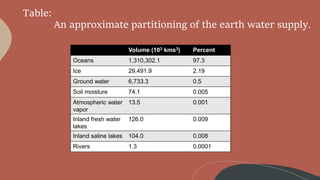
It is somewhat humiliating, however, to consider how tiny a part of the planet's
water is within that realm.
Table:
An approximate partitioning of the earth water supply.
Volume (103 kms3) Percent
Oceans 1,310,302.1 97.3
Ice 29,491.9 2.19
Ground water 6,733.3 0.5
Soil moisture 74.1 0.005
Atmospheric water
vapor
13.5 0.001
Inland fresh water
lakes
126.0 0.009
Inland saline lakes 104.0 0.008
Rivers 1.3 0.0001
BRANCHES OF LIMNOLOGY
There are three branches of limnology
1. Physical limnology
2. Biological limnology
3. Chemical limnology
Physical Limnology
Unique properties of water – important role in penetration,
distribution of light, heat.
Water movements (waves, currents).
Geology of basin (origin, morphology, leaching, minerals).
Biological Limnology
Base is photosynthesis-primary productivity.
Regulated by and may regulate, physical and chemical factors.
Chemical Limnology
Inorganic, organic compounds.
Closely allied to geology (leaching).
Distribution often related to water movements.
FACETS OF LIMNOLOGY
1. Geology
2. Physics and Mathematics
3. Chemistry
4. Biology
5. Historic and Personal Facets
Geology
The origin of lake basins, their resultant morphology, and subsequent
modification of shape are the results of geologic processes.
Because erosion and sedimentation are within the scope of geology, it is
apparent that the birth, life, and death of a lake, as its basin fills,
are geologic functions.
The substratum on which a water-filled depression lies or from which it
receives its soluble salts and other nutrients is dependent on its geologic
legacy.
There is a range of climates from severe to favourable for growth and
productivity, with many meteorologic ramifications.
These are fairly obvious, including extreme temperature differences,
duration of growth season, solar radiation, precipitation, evaporation rates,
and wind.
Physics and Mathematics
The first concern of physical limnology is the very nature of the water
molecule.
Water is a mixture of hydrogen, deuterium, and tritium isotopes
combined with isotopes of oxygen, rather than a single type of molecule.
Water's high specific heat and the nonlinear relation of density and viscosity
to temperature are unique properties.
They play important roles in the penetration, absorption, and distribution of
light and heat in the resultant density stratification in lakes.
In addition, the various movements of water-eddies, currents, and waves-
come under the heading of physical limnology; we are indebted to those
limnologists well-grounded in mathematics for our knowledge of these
topics.
Chemistry
Analysis and study of the chemical constituents in natural waters is a
big part of limnology.
Much of chemical limnology has been inorganic, but more is being
learned continuously about the importance of complex organic
compounds in the dynamics of fresh water.
It is apparent that water chemistry is closely allied to geology and
biology of aquatic habitats.
The relationship of physical limnology to the distribution of chemical
compounds within Inland waters is discussed subsequently.
Biology
The organisms of inland waters range from bacteria to mammals.
Bacteriologists, botanists, and zoologists, are therefore members of
the limnologic fraternity.
Their discipline is aquatic biology, the study of aquatic species and
populations.
This definition rests on shaky grounds for when biologists
concern themselves with environmental factors that affect the
species or community, they have ventured into limnology.
Investigations of population dynamics and life histories of
aquatic plants and animals are still needed, despite the research that
has been carried out in biologic limnology.
Historic and Personal Facets
Forel's first volume on Lake Geneva(1892) dealt with environmental factors rather
than with the lacustrine biota.
Since then geographic-physical-chemical studies have been termed forelian
limnology.
The work performed during first 40 years of this century by E. A. Birge, C.
Juday, and their students at the University of Wisconsin marked the onset
of modern American limnology and made conditions in Wisconsin lakes
a touchstone for later studies in work regions.
Birge, one of the first Americans to work seriously with microcrustaceans known
as Cladocera, was led for a biologic study of their spatial and seasonal distribution
in Lake Mendota in a study of the physical and chemical reasons accounting for
puzzling fluctuations of cladoceran populations- in other words to forelian
limnology.
ØWisconsin shores are washed by enormous bodies of water, Lake Superior and
Lake Michigan, but Birge and Juday were more concerned with small lakes.
ØSimilarly, in the first three volumes of A Treatise on
Limnology, Hutchinson (1957, 1967, 1975) revealed a preference for standing
water .
ØIn these extremely valuable books the reader's at-tension is directed
almost entirely towards lakes, with few references to lotic environments.
ØOn the other hand, Hynes (1970) showed his long-term interest in running waters
by publishing a comprehensive book on rivers and streams.
ØAlthough the Wisconsin workers touched on many elements
of limnology, their interests were focused on the smaller bodies of water, the so-
called inland lakes of Wisconsin.
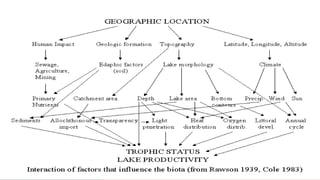
AN OVERVIEW: RAWSON'S DIAGRAM
The late D.S. Rawson, a Canadian limnologist whose
contributions were numerous, varied, and important constructed
a diagram that displays the multitude of factors that interact to
give a lake a certain character and to determine its inhabitants
and its productivity.
Although the diagram was published more than 50 years
ago(1939), it retains its usefulness.
Much of any limnology course could be developed from this diagram, but the
converging arrows do not stop; they leads to Forbe's microcosm and the
communities therein.
Rawson showed just part of the ecosystem in detail.
His arrows point especially to the primary producers of the biotic
communities within the aquatic ecosystem.
Next there should be a complex diagram showing the interactions of these
communities, connected principally to Rawson's scheme at Insolation
and Allochthonous import, with various arrows returning to Rawson's complex
web, because atmospheric exchanges occur and humans and even climatic
factors are influenced; the aquatic ecosystem includes more than just the
watery medium.
LIMNOLOGY AS AN APPLIED SCIENCE
Like other sciences, the study of limnology is essentially a search of
principles.
Principles that involve several processes and management strategies that
are used to make decisions and compare.
Particularly, emphasis should be placed on the comparative aspect of
limnology.
For example, comparing the hydrology of rivers, lakes, and reservoirs on
the fundamental aspects shows that there are some fundamental
practical aspects that influence the life cycle of aquatic organisms an their
extent and biomass.
Limnology is considered a science because of its ability to make
predictions, and it is vital in applied limnology.
In recent years, deforestation and air pollution around various types
of waste reservoirs have resulted in acid rain, leading to a
gradual deterioration of inland water bodies.
All these processes which are damaging the inland water bodies can
be brought back to normal by changing and correcting them.
On the other hand, human intervention in aquatic organisms(over-
exploitation of aquatic plants and animals, the introduction of
exotic species) has brought about many structural changes in the
aquatic ecosystem.
In addition to pollution problems, inland water bodies are affected
by eutrophication.
IMPORTANT GOALS OF LIMNOLOGY
One of the more important goals of limnology is providing guidelines
for water management and water pollution control.
Limnologists also study ways to protect the wildlife that lives in lakes
and rivers as well as the lakes and rivers themselves.
Some limnologists are working on construction of artificial wetlands,
which could serve as habitats for a variety of animal and
plant species and aid in decreasing water pollution.
THANK YOU
B. Vaishnavi,
Roll:no:02,
M.Sc. Aquaculture 1st year,
Department of Zoology and Aquaculture,
Acharya Nagarjuna University,
Guntur.

LIMNOLOGY.pptx

  • 1.
  • 2.
    SEMINAR TOPIC: DEFINITIONS AND FACETSOF LIMNOLOGY, LIMNOLOGY AS AN APPLIED SCIENCE.
  • 3.
    DEFINITIONS OF LIMNOLOGY "What is Limnology?" With time an acceptable answer emerges that sounds something like, "It can be described as inland oceanography."  F.A.Forel (1892), a Swiss professor, who has been called the Father of limnology. Translated, Forel's definition was "the oceanography of lakes."  Sometimes limnology is described as hydrobiology or aquatic ecology.  The former word was more in vogue a few decades ago than now; its meaning is too narrow unless we emphasize that general ecology and the study of habitats are understood to be part of Biology. Ø Aquatic ecologists can be found at oceanographic institutes and inland biologic stations; they share methods and goals.
  • 4.
    Therefore, although otherpeople have put forth definitions, a workable definition of limnology is that it is a segment of aquatic ecology. In this respect limnology resembles geography, and indeed you will find some valuable references catalogued in your library as a segment of geography rather than biology. The late Edgardo Baldi, a prominent Italian limnologist, set limnology apart from other disciplines by defining it as the science dealing with interrelations of processes and methods where by matter and energy are transformed within a lake. He stated further that it should not be confused with zoology, botany, or ecology of aquatic organisms. Similarly, the Russian Winberg (1963), who delivered the Baldi Memorial Lecture at the 18th CONGRESS of the International Society of Limnology held in the USSR in 1971, implied that the most important goal of limnology is to study the circulation of materials - especially organic substances - in a body of water. One cannot deny that Baldi and Winberg put forth a commendable goal and format for aquatic study, but their criteria should not preclude other research. Moreover, research scientists are inclined to follow paths they find engaging and to pursue work that is fun; this is any it should be.
  • 5.
    The term "LIMNOLOGY"is derived from Greek word limne meaning pool, marsh, or lake. The science arose from lake investigation, however. It was born on the shores of Lake Geneva, its original description in French(Forel,1892); or according to Deevey (1942a), it was described earlier, when Henry David Thoreau recorded mid-nineteenth-century observations from Walden Pond, a respectable lake despite its name. As time passed, limnology became the science of Inland waters, concerned with all the factors that influence living populations within those waters. It now includes study of running water(lentic habitats), although the study of lotic habitats has been set off specifically by some as POTAMOLOGY. It is incorrect to designate it the study of fresh waters; for in arid regions extremely saline pools and lakes are found, and these fall within the realm of limnology. It is somewhat humiliating, however, to consider how tiny a part of the planet's water is within that realm.
  • 6.
    Table: An approximate partitioningof the earth water supply. Volume (103 kms3) Percent Oceans 1,310,302.1 97.3 Ice 29,491.9 2.19 Ground water 6,733.3 0.5 Soil moisture 74.1 0.005 Atmospheric water vapor 13.5 0.001 Inland fresh water lakes 126.0 0.009 Inland saline lakes 104.0 0.008 Rivers 1.3 0.0001
  • 7.
    BRANCHES OF LIMNOLOGY Thereare three branches of limnology 1. Physical limnology 2. Biological limnology 3. Chemical limnology
  • 8.
    Physical Limnology Unique propertiesof water – important role in penetration, distribution of light, heat. Water movements (waves, currents). Geology of basin (origin, morphology, leaching, minerals).
  • 9.
    Biological Limnology Base isphotosynthesis-primary productivity. Regulated by and may regulate, physical and chemical factors.
  • 10.
    Chemical Limnology Inorganic, organiccompounds. Closely allied to geology (leaching). Distribution often related to water movements.
  • 11.
    FACETS OF LIMNOLOGY 1.Geology 2. Physics and Mathematics 3. Chemistry 4. Biology 5. Historic and Personal Facets
  • 12.
    Geology The origin oflake basins, their resultant morphology, and subsequent modification of shape are the results of geologic processes. Because erosion and sedimentation are within the scope of geology, it is apparent that the birth, life, and death of a lake, as its basin fills, are geologic functions. The substratum on which a water-filled depression lies or from which it receives its soluble salts and other nutrients is dependent on its geologic legacy. There is a range of climates from severe to favourable for growth and productivity, with many meteorologic ramifications. These are fairly obvious, including extreme temperature differences, duration of growth season, solar radiation, precipitation, evaporation rates, and wind.
  • 13.
    Physics and Mathematics Thefirst concern of physical limnology is the very nature of the water molecule. Water is a mixture of hydrogen, deuterium, and tritium isotopes combined with isotopes of oxygen, rather than a single type of molecule. Water's high specific heat and the nonlinear relation of density and viscosity to temperature are unique properties. They play important roles in the penetration, absorption, and distribution of light and heat in the resultant density stratification in lakes. In addition, the various movements of water-eddies, currents, and waves- come under the heading of physical limnology; we are indebted to those limnologists well-grounded in mathematics for our knowledge of these topics.
  • 14.
    Chemistry Analysis and studyof the chemical constituents in natural waters is a big part of limnology. Much of chemical limnology has been inorganic, but more is being learned continuously about the importance of complex organic compounds in the dynamics of fresh water. It is apparent that water chemistry is closely allied to geology and biology of aquatic habitats. The relationship of physical limnology to the distribution of chemical compounds within Inland waters is discussed subsequently.
  • 15.
    Biology The organisms ofinland waters range from bacteria to mammals. Bacteriologists, botanists, and zoologists, are therefore members of the limnologic fraternity. Their discipline is aquatic biology, the study of aquatic species and populations. This definition rests on shaky grounds for when biologists concern themselves with environmental factors that affect the species or community, they have ventured into limnology. Investigations of population dynamics and life histories of aquatic plants and animals are still needed, despite the research that has been carried out in biologic limnology.
  • 16.
    Historic and PersonalFacets Forel's first volume on Lake Geneva(1892) dealt with environmental factors rather than with the lacustrine biota. Since then geographic-physical-chemical studies have been termed forelian limnology. The work performed during first 40 years of this century by E. A. Birge, C. Juday, and their students at the University of Wisconsin marked the onset of modern American limnology and made conditions in Wisconsin lakes a touchstone for later studies in work regions. Birge, one of the first Americans to work seriously with microcrustaceans known as Cladocera, was led for a biologic study of their spatial and seasonal distribution in Lake Mendota in a study of the physical and chemical reasons accounting for puzzling fluctuations of cladoceran populations- in other words to forelian limnology.
  • 17.
    ØWisconsin shores arewashed by enormous bodies of water, Lake Superior and Lake Michigan, but Birge and Juday were more concerned with small lakes. ØSimilarly, in the first three volumes of A Treatise on Limnology, Hutchinson (1957, 1967, 1975) revealed a preference for standing water . ØIn these extremely valuable books the reader's at-tension is directed almost entirely towards lakes, with few references to lotic environments. ØOn the other hand, Hynes (1970) showed his long-term interest in running waters by publishing a comprehensive book on rivers and streams. ØAlthough the Wisconsin workers touched on many elements of limnology, their interests were focused on the smaller bodies of water, the so- called inland lakes of Wisconsin.
  • 18.
    AN OVERVIEW: RAWSON'SDIAGRAM The late D.S. Rawson, a Canadian limnologist whose contributions were numerous, varied, and important constructed a diagram that displays the multitude of factors that interact to give a lake a certain character and to determine its inhabitants and its productivity. Although the diagram was published more than 50 years ago(1939), it retains its usefulness.
  • 20.
    Much of anylimnology course could be developed from this diagram, but the converging arrows do not stop; they leads to Forbe's microcosm and the communities therein. Rawson showed just part of the ecosystem in detail. His arrows point especially to the primary producers of the biotic communities within the aquatic ecosystem. Next there should be a complex diagram showing the interactions of these communities, connected principally to Rawson's scheme at Insolation and Allochthonous import, with various arrows returning to Rawson's complex web, because atmospheric exchanges occur and humans and even climatic factors are influenced; the aquatic ecosystem includes more than just the watery medium.
  • 21.
    LIMNOLOGY AS ANAPPLIED SCIENCE Like other sciences, the study of limnology is essentially a search of principles. Principles that involve several processes and management strategies that are used to make decisions and compare. Particularly, emphasis should be placed on the comparative aspect of limnology. For example, comparing the hydrology of rivers, lakes, and reservoirs on the fundamental aspects shows that there are some fundamental practical aspects that influence the life cycle of aquatic organisms an their extent and biomass.
  • 22.
    Limnology is considereda science because of its ability to make predictions, and it is vital in applied limnology. In recent years, deforestation and air pollution around various types of waste reservoirs have resulted in acid rain, leading to a gradual deterioration of inland water bodies. All these processes which are damaging the inland water bodies can be brought back to normal by changing and correcting them. On the other hand, human intervention in aquatic organisms(over- exploitation of aquatic plants and animals, the introduction of exotic species) has brought about many structural changes in the aquatic ecosystem. In addition to pollution problems, inland water bodies are affected by eutrophication.
  • 23.
    IMPORTANT GOALS OFLIMNOLOGY One of the more important goals of limnology is providing guidelines for water management and water pollution control. Limnologists also study ways to protect the wildlife that lives in lakes and rivers as well as the lakes and rivers themselves. Some limnologists are working on construction of artificial wetlands, which could serve as habitats for a variety of animal and plant species and aid in decreasing water pollution.
  • 24.
    THANK YOU B. Vaishnavi, Roll:no:02, M.Sc.Aquaculture 1st year, Department of Zoology and Aquaculture, Acharya Nagarjuna University, Guntur.