MANGROVES
ALBA GARCERÁN TORRES 2ºA
MANGROVES
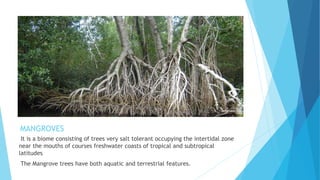
It is a biome consisting of trees very salt tolerant occupying the intertidal zone
near the mouths of courses freshwater coasts of tropical and subtropical
latitudes
The Mangrove trees have both aquatic and terrestrial features.
WEATHER
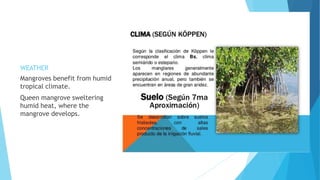
Mangroves benefit from humid
tropical climate.
Queen mangrove sweltering
humid heat, where the
mangrove develops.
THE IMPORTANCE OF MANGROVES
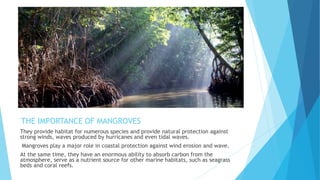
They provide habitat for numerous species and provide natural protection against
strong winds, waves produced by hurricanes and even tidal waves.
Mangroves play a major role in coastal protection against wind erosion and wave.
At the same time, they have an enormous ability to absorb carbon from the
atmosphere, serve as a nutrient source for other marine habitats, such as seagrass
beds and coral reefs.
TYPES OF MANGLE
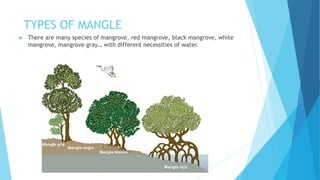
 There are many species of mangrove, red mangrove, black mangrove, white
mangrove, mangrove gray… with different necessities of water.
RED MANGROVE
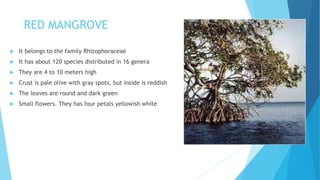
 It belongs to the family Rhizophoraceae
 It has about 120 species distributed in 16 genera
 They are 4 to 10 meters high
 Crust is pale olive with gray spots, but inside is reddish
 The leaves are round and dark green
 Small flowers. They has four petals yellowish white
BLACK MANGROVE
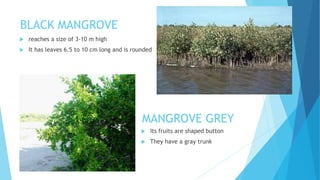
 reaches a size of 3-10 m high
 It has leaves 6.5 to 10 cm long and is rounded
MANGROVE GREY
 Its fruits are shaped button
 They have a gray trunk
WHITE MANGROVE
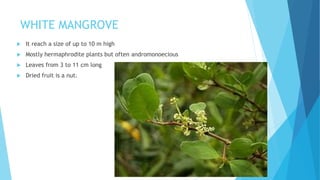
 It reach a size of up to 10 m high
 Mostly hermaphrodite plants but often andromonoecious
 Leaves from 3 to 11 cm long
 Dried fruit is a nut.
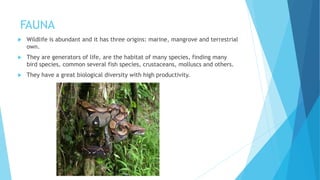
FAUNA
 Wildlife is abundant and it has three origins: marine, mangrove and terrestrial
own.
 They are generators of life, are the habitat of many species, finding many
bird species, common several fish species, crustaceans, molluscs and others.
 They have a great biological diversity with high productivity.
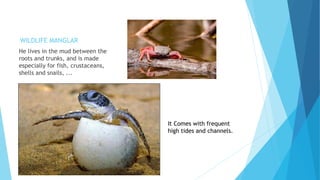
WILDLIFE MANGLAR
He lives in the mud between the
roots and trunks, and is made
especially for fish, crustaceans,
shells and snails, ...
It Comes with frequent
high tides and channels.
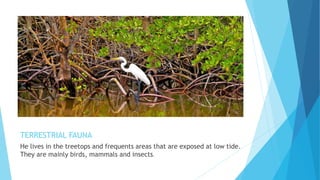
TERRESTRIAL FAUNA
He lives in the treetops and frequents areas that are exposed at low tide.
They are mainly birds, mammals and insects.
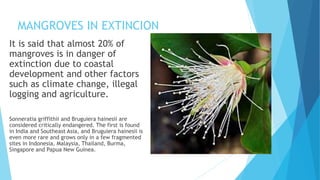
MANGROVES IN EXTINCION
It is said that almost 20% of
mangroves is in danger of
extinction due to coastal
development and other factors
such as climate change, illegal
logging and agriculture.
Sonneratia griffithii and Bruguiera hainesii are
considered critically endangered. The first is found
in India and Southeast Asia, and Bruguiera hainesii is
even more rare and grows only in a few fragmented
sites in Indonesia, Malaysia, Thailand, Burma,
Singapore and Papua New Guinea.

MANGROVES

  • 1.
  • 2.
    MANGROVES It is abiome consisting of trees very salt tolerant occupying the intertidal zone near the mouths of courses freshwater coasts of tropical and subtropical latitudes The Mangrove trees have both aquatic and terrestrial features.
  • 3.
    WEATHER Mangroves benefit fromhumid tropical climate. Queen mangrove sweltering humid heat, where the mangrove develops.
  • 4.
    THE IMPORTANCE OFMANGROVES They provide habitat for numerous species and provide natural protection against strong winds, waves produced by hurricanes and even tidal waves. Mangroves play a major role in coastal protection against wind erosion and wave. At the same time, they have an enormous ability to absorb carbon from the atmosphere, serve as a nutrient source for other marine habitats, such as seagrass beds and coral reefs.
  • 5.
    TYPES OF MANGLE There are many species of mangrove, red mangrove, black mangrove, white mangrove, mangrove gray… with different necessities of water.
  • 6.
    RED MANGROVE  Itbelongs to the family Rhizophoraceae  It has about 120 species distributed in 16 genera  They are 4 to 10 meters high  Crust is pale olive with gray spots, but inside is reddish  The leaves are round and dark green  Small flowers. They has four petals yellowish white
  • 7.
    BLACK MANGROVE  reachesa size of 3-10 m high  It has leaves 6.5 to 10 cm long and is rounded MANGROVE GREY  Its fruits are shaped button  They have a gray trunk
  • 8.
    WHITE MANGROVE  Itreach a size of up to 10 m high  Mostly hermaphrodite plants but often andromonoecious  Leaves from 3 to 11 cm long  Dried fruit is a nut.
  • 9.
    FAUNA  Wildlife isabundant and it has three origins: marine, mangrove and terrestrial own.  They are generators of life, are the habitat of many species, finding many bird species, common several fish species, crustaceans, molluscs and others.  They have a great biological diversity with high productivity.
  • 10.
    WILDLIFE MANGLAR He livesin the mud between the roots and trunks, and is made especially for fish, crustaceans, shells and snails, ... It Comes with frequent high tides and channels.
  • 11.
    TERRESTRIAL FAUNA He livesin the treetops and frequents areas that are exposed at low tide. They are mainly birds, mammals and insects.
  • 12.
    MANGROVES IN EXTINCION Itis said that almost 20% of mangroves is in danger of extinction due to coastal development and other factors such as climate change, illegal logging and agriculture. Sonneratia griffithii and Bruguiera hainesii are considered critically endangered. The first is found in India and Southeast Asia, and Bruguiera hainesii is even more rare and grows only in a few fragmented sites in Indonesia, Malaysia, Thailand, Burma, Singapore and Papua New Guinea.