Mangroves
An Introduction
Syllabus Link
• Management of coral reefs and mangrove
swamps, including different stakeholder
perspectives on their use and value
What are mangroves?
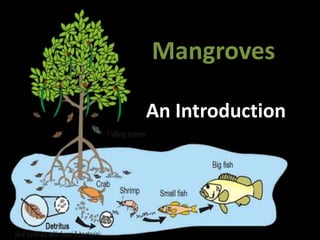
Mangroves are defined as assemblages of salt
tolerant trees and shrubs that grow in the
intertidal regions of the tropical and subtropical
coastlines.
They grow in the places where freshwater mixes
with seawater and where sediment is composed
of accumulated deposits of mud.
Types of Mangroves
Types of Mangroves
Types of Mangroves
Global Distribution
Thai Distribution
Natural capital- What is the true value
of Mangroves?
Natural capital is another term for the stock of
renewable and non-renewable resources (e.g.
plants, animals, air, water, soils, minerals) that
combine to yield a flow of benefits to people.
Natural capital- What is the true value
of Mangroves?
.Natural capital is a stock, and from it flows ecosystem
services or benefits. These services can provide economic,
social, environmental, cultural or spiritual benefits
Natural capital- What is the true value
of Mangroves?
.
Natural capital- What is the true value
of Mangroves?
.
Thailand, which has moved towards more
environmentally sustainable growth by attempting to
place a value on its mangrove swamps.
Chopping down mangrove for wood gives a return of
less than $1,000 per hectare; removing the
mangroves to make room for a shrimp farm might
generate nearly $10,000 per hectare; but if the
mangrove swamps were retained and their
importance in providing a barrier against floods was
taken into account, they could be valued at more than
$16,000 per hectare.
Natural Environment Benefits of
Mangroves
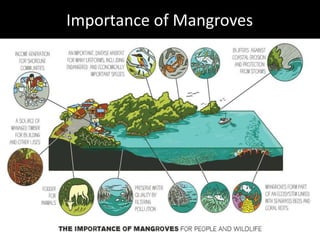
Importance of Mangroves

Mangroves introduction