Dental Anatomy
Dr. Ibtisam Briek SENUSSI, BDS, Msc Orthodontist,
Msr & PhD Physiology and Physiopathology
Department of Oral Biology
Faculty of dentistry - MisurataDr. Ibtisam Briek Senussi
 The Permanent Mandibular Incisors
The mandibular incisors are the simplest and least
variable teeth in the mouth. They are also the smallest
permanent teeth. The central is slightly smaller than
the lateral, whereas in the maxillary incisors the
central is considerably larger. The mandibular
incisors resemble each other to an even greater
extent than do the maxillary incisors. Compared to
the maxillary incisors, they reveal crowns which are
relatively longer inciso-cervically, and markedly
narrower mesiodistally.
Dr. Ibtisam Briek Senussi
Permanent Mandibular Central Incisor
 Arch position - The mandibular central incisors
occupy the position adjacent to the midline in each
mandibular quadrant. They share a mesial contact
area with each other, while the distal contact is with
the permanent lateral incisor.
 TOOTH NUMBERING
 UNIVERSAL SYSTEM – 25 24
 ZSIGMONDY PALMER – 1 1
 FDI SYSTEM – 41 31
41 31
FDI
Dr. Ibtisam Briek Senussi
Permanent Mandibular Central Incisor
 Development Table - (Mandibular central incisor)
o Initiation of calcification .................... 3 to 4 months
o Completion of enamel ....................... 4 to 5 years
o Eruption ................................. ........... 6 to 7 years
o Completion of root ............................. 9 years
 General form and function - The mandibular central
incisor normally has the narrowest mesio-distal dimension
and the smallest crown size of any permanent tooth. The
crown is also quite symmetrical, with mesial and distal
halves nearly identical. These teeth function in biting,
cutting. incising, and shearing, just as do their maxillary
counterparts.
Dr. Ibtisam Briek Senussi
Permanent Mandibular central Incisor
 Labial aspect of the crown
 Mesial outline (margin)- The mesial margin normally
tapers evenly toward the gingival in a nearly straight line.
The mesio-incisal angle is quite sharp, normally more so
than any of the incisal angles of maxillary incisors. The
height of contour is associated with the contact area in the
incisal third, very close to the incisal margin.
 Distal outline - Distally, the outline is straight and almost
exactly like the mesial outline, with a similarly sharp disto-
incisal angle. The height of contour is also in the incisal
third.
 Incisal outline - When present, mamelons most always
number three. After incisal wear has obliterated the
mamelons, the incisal outline is straight, and at right angles
to the long axis of the tooth.
 Cervical outline ( CEJ) - The cervical line is
symmetrically curved toward the root. Dr. Ibtisam Briek Senussi
Margin straightMargin rounded
MD
Permanent Mandibular central Incisor
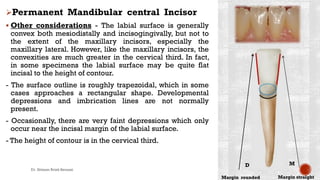
 Other considerations - The labial surface is generally
convex both mesiodistally and incisogingivally, but not to
the extent of the maxillary incisors, especially the
maxillary lateral. However, like the maxillary incisors, the
convexities are much greater in the cervical third. In fact,
in some specimens the labial surface may be quite flat
incisal to the height of contour.
- The surface outline is roughly trapezoidal, which in some
cases approaches a rectangular shape. Developmental
depressions and imbrication lines are not normally
present.
- Occasionally, there are very faint depressions which only
occur near the incisal margin of the labial surface.
- The height of contour is in the cervical third.
Dr. Ibtisam Briek Senussi
Margin straightMargin rounded
MD
Permanent Mandibular central Incisor
 Lingual aspect of the crown
 Mesial, distal and incisal outline - All three of these
margins closely resemble those of the labial aspect.
 Cervical outline - The CEJ curves evenly toward the root,
but is located farther from the incisal edge than it is on the
labial surface.
 Other considerations: The lingual surface is relatively
smooth, and its structures are generally less prominent
than those of the maxillary incisors. There is usually a
slight concavity, or lingual fossa, bordered by indistinct
marginal ridges on the mesial and distal. There are
normally no grooves, fissures, or pits on the lingual surface.
A cingulum is normally present, although it is not so
prominent as in the
Dr. Ibtisam Briek Senussi
Margin straightMargin rounded
DM
Lingual fossa
Cingulum
Permanent Mandibular central Incisor
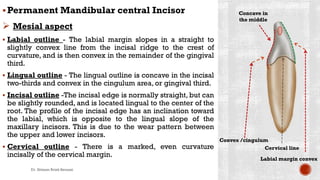
 Mesial aspect
 Labial outline - The labial margin slopes in a straight to
slightly convex line from the incisal ridge to the crest of
curvature, and is then convex in the remainder of the gingival
third.
 Lingual outline - The lingual outline is concave in the incisal
two-thirds and convex in the cingulum area, or gingival third.
 Incisal outline -The incisal edge is normally straight, but can
be slightly rounded, and is located lingual to the center of the
root. The profile of the incisal edge has an inclination toward
the labial, which is opposite to the lingual slope of the
maxillary incisors. This is due to the wear pattern between
the upper and lower incisors.
 Cervical outline - There is a marked, even curvature
incisally of the cervical margin.
Labial margin convex
Convex /cingulum
Concave in
the middle
Cervical line
Dr. Ibtisam Briek Senussi
Permanent Mandibular central Incisor
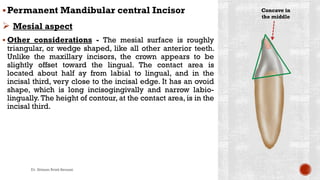
 Mesial aspect
 Other considerations - The mesial surface is roughly
triangular, or wedge shaped, like all other anterior teeth.
Unlike the maxillary incisors, the crown appears to be
slightly offset toward the lingual. The contact area is
located about half ay from labial to lingual, and in the
incisal third, very close to the incisal edge. It has an ovoid
shape, which is long incisogingivally and narrow labio-
lingually. The height of contour, at the contact area, is in the
incisal third.
Concave in
the middle
Dr. Ibtisam Briek Senussi
Permanent Mandibular central Incisor
Distal aspect: The distal surface is similar in all respects to
the mesial, except that the cervical margin curves slightly
less toward the incisal. Even the contact area has a similar
location, a fact which is unique among incisors.
Incisal aspect: The most notable features from the incisal
aspect are the symmetry of the mesial and distal portions,
and the straight incisal edge. Unlike the maxillary central, this
tooth is roughly four sided, or diamond-shaped, from this
aspect, and the tooth is normally wider labiolingually than
mesiodistally.
 Because the crown is offset toward the lingual, more of the
labial surface than the lingual surface is visible from this
aspect.
 Even though the central incisor is described as symmetrical
from the incisal aspect, careful inspection will reveal that the
cingulum is very slightly offset toward the distal, an important
feature when attempting to distinguish right from left
mandibular central incisors
Dr. Ibtisam Briek Senussi
cingulum
Concave in
the middle
Cervical line
 Permanent Mandibular central Incisor
 Root : The root is normally single and straight.
 From the labial or lingual aspects, the root is generally
symmetrical, and tapers gradually to a relatively sharp
apex.
 From the mesial or distal aspects, the root is much wider,
and it is slightly convex cervico-apically on both labial and
lingual margins. The central portion of the mesial and distal
surfaces is usually flattened, or concave. When concave, the
surface is said to have a root concavity which is also known
as a longitudinal groove. Root concavities are found on the
roots of other teeth, and usually extend the majority of the
root length
 In cross section at the neck, the outline is roughly a
rectangle with rounded comers, but it is slightly wider at the
labial than at the lingual. When there are root concavities
present, they are reflected as concavities in the mesial and
distal outlines. The mid root cross section is similar to the
cervical section, only more ovoid.
Dr. Ibtisam Briek Senussi
B
L
Dr. Ibtisam Briek Senussi
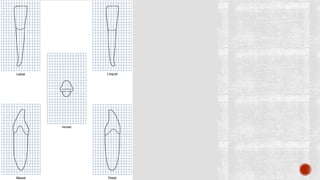
Incisal
LingualLabial
Mesial
Distal
Permanent Mandibular Lateral Incisor
 Arch position - The mandibular lateral incisor is
the second tooth from the midline in each lower
quadrant, and it shares a mesial contact area with the
central incisor.
- The distal contact is with the deciduous mandibular
canine until that tooth's exfoliation and then contact is
shared with the permanent canine.
 TOOTH NUMBERING  UNIVERSAL SYSTEM – 26 23
 ZSIGMONDY PALMER – 2 2
 FDI SYSTEM – 42 32
42 32
FDI
Dr. Ibtisam Briek Senussi
Permanent Mandibular Lateral Incisor
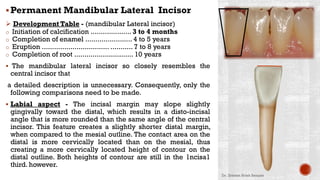
 Development Table - (mandibular Lateral incisor)
o Initiation of calcification .................... 3 to 4 months
o Completion of enamel ....................... 4 to 5 years
o Eruption ................................. ........... 7 to 8 years
o Completion of root ............................. 10 years
 The mandibular lateral incisor so closely resembles the
central incisor that
a detailed description is unnecessary. Consequently, only the
following comparisons need to be made.
 Labial aspect - The incisal margin may slope slightly
gingivally toward the distal, which results in a disto-incisal
angle that is more rounded than the same angle of the central
incisor. This feature creates a slightly shorter distal margin,
when compared to the mesial outline. The contact area on the
distal is more cervically located than on the mesial, thus
creating a more cervically located height of contour on the
distal outline. Both heights of contour are still in the 1ncisa1
third. however.
Dr. Ibtisam Briek Senussi
Permanent Mandibular Lateral Incisor
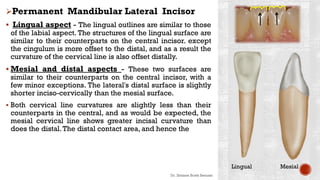
 Lingual aspect - The lingual outlines are similar to those
of the labial aspect. The structures of the lingual surface are
similar to their counterparts on the central incisor. except
the cingulum is more offset to the distal, and as a result the
curvature of the cervical line is also offset distally.
 Mesial and distal aspects - These two surfaces are
similar to their counterparts on the central incisor, with a
few minor exceptions. The lateral's distal surface is slightly
shorter inciso-cervically than the mesial surface.
 Both cervical line curvatures are slightly less than their
counterparts in the central, and as would be expected, the
mesial cervical line shows greater incisal curvature than
does the distal.The distal contact area, and hence the
Dr. Ibtisam Briek Senussi
Lingual Mesial
Permanent Mandibular Lateral Incisor
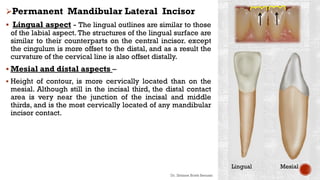
 Lingual aspect - The lingual outlines are similar to those
of the labial aspect. The structures of the lingual surface are
similar to their counterparts on the central incisor. except
the cingulum is more offset to the distal, and as a result the
curvature of the cervical line is also offset distally.
 Mesial and distal aspects –
 Height of contour, is more cervically located than on the
mesial. Although still in the incisal third, the distal contact
area is very near the junction of the incisal and middle
thirds, and is the most cervically located of any mandibular
incisor contact.
Dr. Ibtisam Briek Senussi
Lingual Mesial
Permanent Mandibular Lateral Incisor
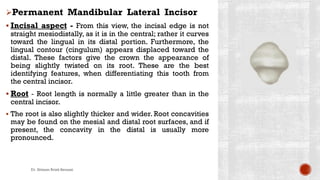
 Incisal aspect - From this view, the incisal edge is not
straight mesiodistally, as it is in the central; rather it curves
toward the lingual in its distal portion. Furthermore, the
lingual contour (cingulum) appears displaced toward the
distal. These factors give the crown the appearance of
being slightly twisted on its root. These are the best
identifying features, when differentiating this tooth from
the central incisor.
 Root - Root length is normally a little greater than in the
central incisor.
 The root is also slightly thicker and wider. Root concavities
may be found on the mesial and distal root surfaces, and if
present, the concavity in the distal is usually more
pronounced.
Dr. Ibtisam Briek Senussi
The mandibular incisors

The mandibular incisors

  • 1.
    Dental Anatomy Dr. IbtisamBriek SENUSSI, BDS, Msc Orthodontist, Msr & PhD Physiology and Physiopathology Department of Oral Biology Faculty of dentistry - MisurataDr. Ibtisam Briek Senussi
  • 2.
     The PermanentMandibular Incisors The mandibular incisors are the simplest and least variable teeth in the mouth. They are also the smallest permanent teeth. The central is slightly smaller than the lateral, whereas in the maxillary incisors the central is considerably larger. The mandibular incisors resemble each other to an even greater extent than do the maxillary incisors. Compared to the maxillary incisors, they reveal crowns which are relatively longer inciso-cervically, and markedly narrower mesiodistally. Dr. Ibtisam Briek Senussi
  • 3.
    Permanent Mandibular CentralIncisor  Arch position - The mandibular central incisors occupy the position adjacent to the midline in each mandibular quadrant. They share a mesial contact area with each other, while the distal contact is with the permanent lateral incisor.  TOOTH NUMBERING  UNIVERSAL SYSTEM – 25 24  ZSIGMONDY PALMER – 1 1  FDI SYSTEM – 41 31 41 31 FDI Dr. Ibtisam Briek Senussi
  • 4.
    Permanent Mandibular CentralIncisor  Development Table - (Mandibular central incisor) o Initiation of calcification .................... 3 to 4 months o Completion of enamel ....................... 4 to 5 years o Eruption ................................. ........... 6 to 7 years o Completion of root ............................. 9 years  General form and function - The mandibular central incisor normally has the narrowest mesio-distal dimension and the smallest crown size of any permanent tooth. The crown is also quite symmetrical, with mesial and distal halves nearly identical. These teeth function in biting, cutting. incising, and shearing, just as do their maxillary counterparts. Dr. Ibtisam Briek Senussi
  • 5.
    Permanent Mandibular centralIncisor  Labial aspect of the crown  Mesial outline (margin)- The mesial margin normally tapers evenly toward the gingival in a nearly straight line. The mesio-incisal angle is quite sharp, normally more so than any of the incisal angles of maxillary incisors. The height of contour is associated with the contact area in the incisal third, very close to the incisal margin.  Distal outline - Distally, the outline is straight and almost exactly like the mesial outline, with a similarly sharp disto- incisal angle. The height of contour is also in the incisal third.  Incisal outline - When present, mamelons most always number three. After incisal wear has obliterated the mamelons, the incisal outline is straight, and at right angles to the long axis of the tooth.  Cervical outline ( CEJ) - The cervical line is symmetrically curved toward the root. Dr. Ibtisam Briek Senussi Margin straightMargin rounded MD
  • 6.
    Permanent Mandibular centralIncisor  Other considerations - The labial surface is generally convex both mesiodistally and incisogingivally, but not to the extent of the maxillary incisors, especially the maxillary lateral. However, like the maxillary incisors, the convexities are much greater in the cervical third. In fact, in some specimens the labial surface may be quite flat incisal to the height of contour. - The surface outline is roughly trapezoidal, which in some cases approaches a rectangular shape. Developmental depressions and imbrication lines are not normally present. - Occasionally, there are very faint depressions which only occur near the incisal margin of the labial surface. - The height of contour is in the cervical third. Dr. Ibtisam Briek Senussi Margin straightMargin rounded MD
  • 7.
    Permanent Mandibular centralIncisor  Lingual aspect of the crown  Mesial, distal and incisal outline - All three of these margins closely resemble those of the labial aspect.  Cervical outline - The CEJ curves evenly toward the root, but is located farther from the incisal edge than it is on the labial surface.  Other considerations: The lingual surface is relatively smooth, and its structures are generally less prominent than those of the maxillary incisors. There is usually a slight concavity, or lingual fossa, bordered by indistinct marginal ridges on the mesial and distal. There are normally no grooves, fissures, or pits on the lingual surface. A cingulum is normally present, although it is not so prominent as in the Dr. Ibtisam Briek Senussi Margin straightMargin rounded DM Lingual fossa Cingulum
  • 8.
    Permanent Mandibular centralIncisor  Mesial aspect  Labial outline - The labial margin slopes in a straight to slightly convex line from the incisal ridge to the crest of curvature, and is then convex in the remainder of the gingival third.  Lingual outline - The lingual outline is concave in the incisal two-thirds and convex in the cingulum area, or gingival third.  Incisal outline -The incisal edge is normally straight, but can be slightly rounded, and is located lingual to the center of the root. The profile of the incisal edge has an inclination toward the labial, which is opposite to the lingual slope of the maxillary incisors. This is due to the wear pattern between the upper and lower incisors.  Cervical outline - There is a marked, even curvature incisally of the cervical margin. Labial margin convex Convex /cingulum Concave in the middle Cervical line Dr. Ibtisam Briek Senussi
  • 9.
    Permanent Mandibular centralIncisor  Mesial aspect  Other considerations - The mesial surface is roughly triangular, or wedge shaped, like all other anterior teeth. Unlike the maxillary incisors, the crown appears to be slightly offset toward the lingual. The contact area is located about half ay from labial to lingual, and in the incisal third, very close to the incisal edge. It has an ovoid shape, which is long incisogingivally and narrow labio- lingually. The height of contour, at the contact area, is in the incisal third. Concave in the middle Dr. Ibtisam Briek Senussi
  • 10.
    Permanent Mandibular centralIncisor Distal aspect: The distal surface is similar in all respects to the mesial, except that the cervical margin curves slightly less toward the incisal. Even the contact area has a similar location, a fact which is unique among incisors. Incisal aspect: The most notable features from the incisal aspect are the symmetry of the mesial and distal portions, and the straight incisal edge. Unlike the maxillary central, this tooth is roughly four sided, or diamond-shaped, from this aspect, and the tooth is normally wider labiolingually than mesiodistally.  Because the crown is offset toward the lingual, more of the labial surface than the lingual surface is visible from this aspect.  Even though the central incisor is described as symmetrical from the incisal aspect, careful inspection will reveal that the cingulum is very slightly offset toward the distal, an important feature when attempting to distinguish right from left mandibular central incisors Dr. Ibtisam Briek Senussi cingulum Concave in the middle Cervical line
  • 11.
     Permanent Mandibularcentral Incisor  Root : The root is normally single and straight.  From the labial or lingual aspects, the root is generally symmetrical, and tapers gradually to a relatively sharp apex.  From the mesial or distal aspects, the root is much wider, and it is slightly convex cervico-apically on both labial and lingual margins. The central portion of the mesial and distal surfaces is usually flattened, or concave. When concave, the surface is said to have a root concavity which is also known as a longitudinal groove. Root concavities are found on the roots of other teeth, and usually extend the majority of the root length  In cross section at the neck, the outline is roughly a rectangle with rounded comers, but it is slightly wider at the labial than at the lingual. When there are root concavities present, they are reflected as concavities in the mesial and distal outlines. The mid root cross section is similar to the cervical section, only more ovoid. Dr. Ibtisam Briek Senussi B L
  • 12.
    Dr. Ibtisam BriekSenussi Incisal LingualLabial Mesial Distal
  • 13.
    Permanent Mandibular LateralIncisor  Arch position - The mandibular lateral incisor is the second tooth from the midline in each lower quadrant, and it shares a mesial contact area with the central incisor. - The distal contact is with the deciduous mandibular canine until that tooth's exfoliation and then contact is shared with the permanent canine.  TOOTH NUMBERING  UNIVERSAL SYSTEM – 26 23  ZSIGMONDY PALMER – 2 2  FDI SYSTEM – 42 32 42 32 FDI Dr. Ibtisam Briek Senussi
  • 14.
    Permanent Mandibular LateralIncisor  Development Table - (mandibular Lateral incisor) o Initiation of calcification .................... 3 to 4 months o Completion of enamel ....................... 4 to 5 years o Eruption ................................. ........... 7 to 8 years o Completion of root ............................. 10 years  The mandibular lateral incisor so closely resembles the central incisor that a detailed description is unnecessary. Consequently, only the following comparisons need to be made.  Labial aspect - The incisal margin may slope slightly gingivally toward the distal, which results in a disto-incisal angle that is more rounded than the same angle of the central incisor. This feature creates a slightly shorter distal margin, when compared to the mesial outline. The contact area on the distal is more cervically located than on the mesial, thus creating a more cervically located height of contour on the distal outline. Both heights of contour are still in the 1ncisa1 third. however. Dr. Ibtisam Briek Senussi
  • 15.
    Permanent Mandibular LateralIncisor  Lingual aspect - The lingual outlines are similar to those of the labial aspect. The structures of the lingual surface are similar to their counterparts on the central incisor. except the cingulum is more offset to the distal, and as a result the curvature of the cervical line is also offset distally.  Mesial and distal aspects - These two surfaces are similar to their counterparts on the central incisor, with a few minor exceptions. The lateral's distal surface is slightly shorter inciso-cervically than the mesial surface.  Both cervical line curvatures are slightly less than their counterparts in the central, and as would be expected, the mesial cervical line shows greater incisal curvature than does the distal.The distal contact area, and hence the Dr. Ibtisam Briek Senussi Lingual Mesial
  • 16.
    Permanent Mandibular LateralIncisor  Lingual aspect - The lingual outlines are similar to those of the labial aspect. The structures of the lingual surface are similar to their counterparts on the central incisor. except the cingulum is more offset to the distal, and as a result the curvature of the cervical line is also offset distally.  Mesial and distal aspects –  Height of contour, is more cervically located than on the mesial. Although still in the incisal third, the distal contact area is very near the junction of the incisal and middle thirds, and is the most cervically located of any mandibular incisor contact. Dr. Ibtisam Briek Senussi Lingual Mesial
  • 17.
    Permanent Mandibular LateralIncisor  Incisal aspect - From this view, the incisal edge is not straight mesiodistally, as it is in the central; rather it curves toward the lingual in its distal portion. Furthermore, the lingual contour (cingulum) appears displaced toward the distal. These factors give the crown the appearance of being slightly twisted on its root. These are the best identifying features, when differentiating this tooth from the central incisor.  Root - Root length is normally a little greater than in the central incisor.  The root is also slightly thicker and wider. Root concavities may be found on the mesial and distal root surfaces, and if present, the concavity in the distal is usually more pronounced. Dr. Ibtisam Briek Senussi