College of DentistryCollege of Dentistry
Human Dentition IHuman Dentition I
Mandibular Incisors & CanineMandibular Incisors & Canine
Dr. Hazem Al AjramiDr. Hazem Al Ajrami
Mandibular IncisorsMandibular Incisors
The mandibular incisors are four in number.The mandibular incisors are four in number.
The mandibular central incisors are centered inThe mandibular central incisors are centered in
the mandible, one on either side of the medianthe mandible, one on either side of the median
line, with the mesial surface of each one inline, with the mesial surface of each one in
contact with the mesial surface of the other.contact with the mesial surface of the other.
The right and left mandibular lateral or secondThe right and left mandibular lateral or second
incisors are distal to the central incisors. Theyincisors are distal to the central incisors. They
are in contact with the central incisors mesiallyare in contact with the central incisors mesially
and with the canines distally. The crowns areand with the canines distally. The crowns are
relatively longer with constricted neck give therelatively longer with constricted neck give the
crown fan shape appearance.crown fan shape appearance.
The mandibular incisors have smallerThe mandibular incisors have smaller
mesiodistal dimensions than any of the othermesiodistal dimensions than any of the other
teeth. The central incisor is somewhat smallerteeth. The central incisor is somewhat smaller
than the lateral incisor, which is the reverse ofthan the lateral incisor, which is the reverse of
the situation in the maxilla.the situation in the maxilla.
These teeth are similar in form and have smoothThese teeth are similar in form and have smooth
crown surfaces that show few traces ofcrown surfaces that show few traces of
developmental lines. Mamelons on the incisaldevelopmental lines. Mamelons on the incisal
ridges are worn off soon after eruption, if theridges are worn off soon after eruption, if the
occlusion is normal, leaving the incisal edgesocclusion is normal, leaving the incisal edges
smooth and straight.smooth and straight.
The contact areas are near the incisal edgesThe contact areas are near the incisal edges
mesially and distally, and lines drawn throughmesially and distally, and lines drawn through
the contact areas are near the same level onthe contact areas are near the same level on
both central and lateral incisors; here also theboth central and lateral incisors; here also the
situation is unlike the maxillary incisors. Thesituation is unlike the maxillary incisors. The
mandibular incisors show uniformmandibular incisors show uniform
development, with few instances ofdevelopment, with few instances of
malformations or anomalies.malformations or anomalies.
The anatomic form of these teeth differsThe anatomic form of these teeth differs
entirely from that of the maxillary incisors.entirely from that of the maxillary incisors.
The inclination of the crowns differs from theThe inclination of the crowns differs from the
mesial and distal aspects; the labial faces aremesial and distal aspects; the labial faces are
inclined lingually so that the incisal edges areinclined lingually so that the incisal edges are
lingual to a line bisecting the root.lingual to a line bisecting the root.
Mandibular Central IncisorMandibular Central Incisor
Normally, the mandibular central incisor is theNormally, the mandibular central incisor is the
smallest tooth in the dental arches. The crownsmallest tooth in the dental arches. The crown
has little more than half the mesiodistalhas little more than half the mesiodistal
diameter of the maxillary central incisor;diameter of the maxillary central incisor;
however, the labiolingual diameter is only abouthowever, the labiolingual diameter is only about
1 mm. less. The lines of greatest masticatory1 mm. less. The lines of greatest masticatory
stress are brought to bear on the mandibularstress are brought to bear on the mandibular
incisors in a labiolingual direction, making thisincisors in a labiolingual direction, making this
reinforcement necessary.reinforcement necessary.
The single root is very narrow mesiodistallyThe single root is very narrow mesiodistally
and corresponds to the narrowness of theand corresponds to the narrowness of the
crown, although the root and crown are widecrown, although the root and crown are wide
labiolingually. The length of the root is aslabiolingually. The length of the root is as
great, if not greater, than that of the maxillarygreat, if not greater, than that of the maxillary
central incisor.central incisor.
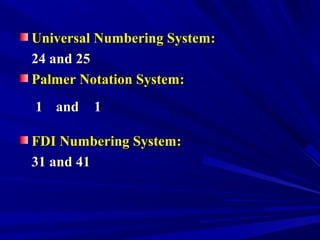
Universal Numbering System:Universal Numbering System:
24 and 2524 and 25
Palmer Notation System:Palmer Notation System:
FDI Numbering System:FDI Numbering System:
31 and 4131 and 41
11 andand 11
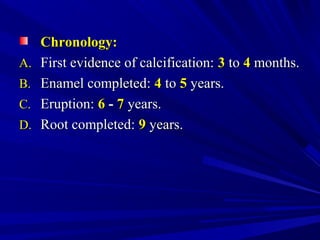
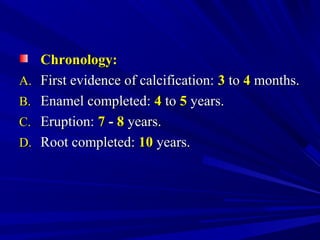
Chronology:Chronology:
A.A. First evidence of calcification:First evidence of calcification: 33 toto 44 months.months.
B.B. Enamel completed:Enamel completed: 44 toto 55 years.years.
C.C. Eruption:Eruption: 66 -- 77 years.years.
D.D. Root completed:Root completed: 99 years.years.
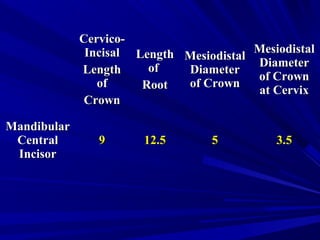
Cervico-Cervico-
IncisalIncisal
LengthLength
ofof
CrownCrown
LengthLength
ofof
RootRoot
MesiodistalMesiodistal
DiameterDiameter
of Crownof Crown
MesiodistalMesiodistal
DiameterDiameter
of Crownof Crown
at Cervixat Cervix
MandibularMandibular
CentralCentral
IncisorIncisor
99 12.512.5 55 3.53.5
Labio-Labio-
linguallingual
DiameteDiamete
r ofr of
CrownCrown
Labio-Labio-
linguallingual
DiameterDiameter
of Crownof Crown
at Cervixat Cervix
CurvatureCurvature
ofof
CervicalCervical
LineLine
(Mesial)(Mesial)
CurvatureCurvature
ofof
CervicalCervical
LineLine
(Distal)(Distal)
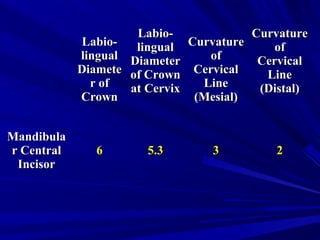
MandibulaMandibula
r Centralr Central
IncisorIncisor
66 5.35.3 33 22
Labial AspectLabial Aspect
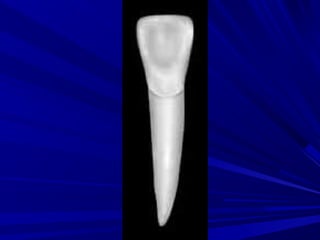
The labial aspect of the mandibular centralThe labial aspect of the mandibular central
incisor is regular, tapering evenly from theincisor is regular, tapering evenly from the
relatively sharp mesial and distal incisal anglesrelatively sharp mesial and distal incisal angles
to the apical portion of the root. The incisalto the apical portion of the root. The incisal
edge of the crown is straight and is atedge of the crown is straight and is at
approximately a right angle to the long axis ofapproximately a right angle to the long axis of
the tooth. Usually, the mesial and distalthe tooth. Usually, the mesial and distal
outlines of the crown make a straight dropoutlines of the crown make a straight drop
downward from the incisal angles to thedownward from the incisal angles to the
contact areas, which are incisal to the junctioncontact areas, which are incisal to the junction
of incisal and middle thirds of the crown.of incisal and middle thirds of the crown.
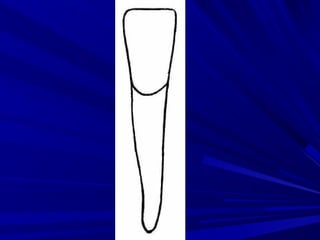
The labial aspect is trapezoid in outline withThe labial aspect is trapezoid in outline with
the smallest at cervix.the smallest at cervix.
The mesial and distal sides of the crown taperThe mesial and distal sides of the crown taper
evenly from the contact areas to the narrowevenly from the contact areas to the narrow
cervix having fan shape. The mesial and distalcervix having fan shape. The mesial and distal
root outlines are straight with the mesial androot outlines are straight with the mesial and
distal outlines of the crown down to the apicaldistal outlines of the crown down to the apical
portion. The apical third of the root terminatesportion. The apical third of the root terminates
in a small pointed taper, in most cases curvingin a small pointed taper, in most cases curving
distally. Sometimes the roots are straightdistally. Sometimes the roots are straight..
The labial face of the mandibular centralThe labial face of the mandibular central
incisor crown is ordinarily smooth, with aincisor crown is ordinarily smooth, with a
flattened surface at the incisal third: the middleflattened surface at the incisal third: the middle
third is more convex, narrowing down to thethird is more convex, narrowing down to the
convexity of the root at the cervical portion.convexity of the root at the cervical portion.
Except in newly erupted teeth, central incisorsExcept in newly erupted teeth, central incisors
show few traces of developmental lines. Theshow few traces of developmental lines. The
labial surface of the root of the mandibularlabial surface of the root of the mandibular
central incisor is regular and convex.central incisor is regular and convex.
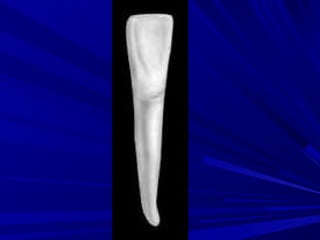
Lingual AspectLingual Aspect
The lingual surface of the crown is smooth,The lingual surface of the crown is smooth,
with very slight concavity at the incisal thirdwith very slight concavity at the incisal third
between the inconspicuous marginal ridges.between the inconspicuous marginal ridges.
The incisal edge and marginal ridges are notThe incisal edge and marginal ridges are not
well developed. The lingual fossa is shallow.well developed. The lingual fossa is shallow.
The lingual surface becomes flat and thenThe lingual surface becomes flat and then
convex as progression is made from the incisalconvex as progression is made from the incisal
third to the cervical third.third to the cervical third.
The outline of the crown is the reverse of thatThe outline of the crown is the reverse of that
from the labial aspect but narrower as the toothfrom the labial aspect but narrower as the tooth
tapers labiolingually.tapers labiolingually.
No developmental lines mark the cingulumNo developmental lines mark the cingulum
development on this tooth at the cervical third.development on this tooth at the cervical third.
No other tooth in the mouth, except theNo other tooth in the mouth, except the
mandibular lateral incisor, shows so fewmandibular lateral incisor, shows so few
developmental lines and grooves. The outlinesdevelopmental lines and grooves. The outlines
and surfaces of the mandibular incisors areand surfaces of the mandibular incisors are
regular and symmetrical.regular and symmetrical.
Mesial AspectMesial Aspect
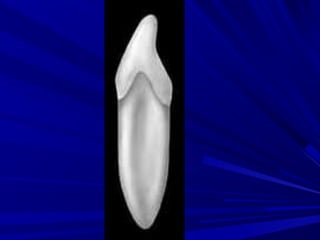
The curvature labially and lingually above theThe curvature labially and lingually above the
cervical line is less than that found on maxillarycervical line is less than that found on maxillary
incisors. The outline of the labial face of theincisors. The outline of the labial face of the
crown is straight above the cervical curvature,crown is straight above the cervical curvature,
sloping rapidly from the crest of curvature to thesloping rapidly from the crest of curvature to the
incisal ridge. The lingual outline of the crown is aincisal ridge. The lingual outline of the crown is a
straight line inclined labially for a short distancestraight line inclined labially for a short distance
above the smooth convexity of the cingulum; theabove the smooth convexity of the cingulum; the
straight outline joins a concave line at the middlestraight outline joins a concave line at the middle
third of the crown, which extends upward to jointhird of the crown, which extends upward to join
the rounded outline of a narrow incisal edge.the rounded outline of a narrow incisal edge.
The incisal edge is rounded or worn flat, and itsThe incisal edge is rounded or worn flat, and its
center is usually lingual to the center of the root.center is usually lingual to the center of the root.
The curvature of the cervical line representing theThe curvature of the cervical line representing the
cementoenamel junction on the mesial surface iscementoenamel junction on the mesial surface is
marked, curving incisally approximately one-marked, curving incisally approximately one-
third the length of the crown.third the length of the crown.
The root outlines from the mesial aspect areThe root outlines from the mesial aspect are
straight with the crown outline from the cervicalstraight with the crown outline from the cervical
line, keeping the root diameter uniform throughline, keeping the root diameter uniform through
the cervical third and part of the middle third; thethe cervical third and part of the middle third; the
outline of the root begins to taper in the middleoutline of the root begins to taper in the middle
third area, tapering rapidly in the apical third tothird area, tapering rapidly in the apical third to
either a bluntly rounded or a pointed root end.either a bluntly rounded or a pointed root end.
The mesial surface of the root is flat just belowThe mesial surface of the root is flat just below
the cervical line. Most of these roots have athe cervical line. Most of these roots have a
broad developmental depression for most ofbroad developmental depression for most of
the root length. The depressions usually arethe root length. The depressions usually are
deeper at the junction of the middle and apicaldeeper at the junction of the middle and apical
thirds.thirds.
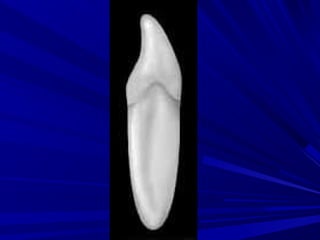
Distal AspectDistal Aspect
The cervical line representing theThe cervical line representing the
cementoenamel junction curves incisally aboutcementoenamel junction curves incisally about
1 mm. less than on the mesial. The distal1 mm. less than on the mesial. The distal
surface of the crown and root of thesurface of the crown and root of the
mandibular central incisor is similar to that ofmandibular central incisor is similar to that of
the mesial surface. The developmentalthe mesial surface. The developmental
depression on the distal surface of the rootdepression on the distal surface of the root
may be more marked, with a deeper and moremay be more marked, with a deeper and more
well-defined developmental groove at itswell-defined developmental groove at its
center.center.
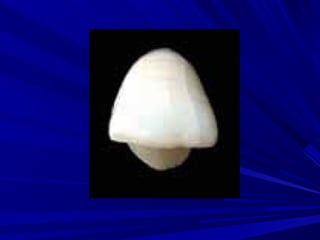
Incisal AspectIncisal Aspect
This aspect illustrates the bilateral symmetryThis aspect illustrates the bilateral symmetry
of the mandibular central incisor. The mesialof the mandibular central incisor. The mesial
half of the crown is almost identical with thehalf of the crown is almost identical with the
distal half. It is diamond in shape with fourdistal half. It is diamond in shape with four
sides.sides.
The incisal edge is almost at right angles to aThe incisal edge is almost at right angles to a
line bisecting the crown labiolingually. Thisline bisecting the crown labiolingually. This
feature is characteristic of the tooth and servesfeature is characteristic of the tooth and serves
as a mark of identification in differentiationas a mark of identification in differentiation
between mandibular central and lateralbetween mandibular central and lateral
incisors.incisors.
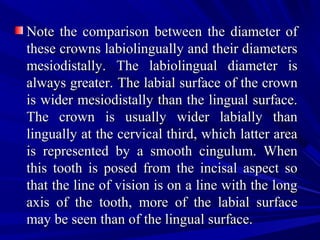
Note the comparison between the diameter ofNote the comparison between the diameter of
these crowns labiolingually and their diametersthese crowns labiolingually and their diameters
mesiodistally. The labiolingual diameter ismesiodistally. The labiolingual diameter is
always greater.always greater. The labial surface of the crownThe labial surface of the crown
is wider mesiodistally than the lingual surface.is wider mesiodistally than the lingual surface.
The crown is usually wider labially thanThe crown is usually wider labially than
lingually at the cervical third, which latter arealingually at the cervical third, which latter area
is represented by a smooth cingulum. Whenis represented by a smooth cingulum. When
this tooth is posed from the incisal aspect sothis tooth is posed from the incisal aspect so
that the line of vision is on a line with the longthat the line of vision is on a line with the long
axis of the tooth, more of the labial surfaceaxis of the tooth, more of the labial surface
may be seen than of the lingual surface.may be seen than of the lingual surface.
Mandibular Lateral IncisorMandibular Lateral Incisor
The mandibular lateral incisor is the secondThe mandibular lateral incisor is the second
mandibular tooth from the median line, rightmandibular tooth from the median line, right
or left. It resembles the mandibular centralor left. It resembles the mandibular central
incisor so closely that only a brief descriptionincisor so closely that only a brief description
of each aspect of the lateral incisor will beof each aspect of the lateral incisor will be
necessary. Direct comparison will be madenecessary. Direct comparison will be made
with the mandibular central incisor, and thewith the mandibular central incisor, and the
variations will be mentioned.variations will be mentioned.
The two incisors operate in the dental arch as aThe two incisors operate in the dental arch as a
team; therefore, their functional form isteam; therefore, their functional form is
related. The mandibular lateral incisor isrelated. The mandibular lateral incisor is
somewhat larger (compare measurements), butsomewhat larger (compare measurements), but
generally speaking, its form closely resemblesgenerally speaking, its form closely resembles
the mandibular central incisor.the mandibular central incisor.
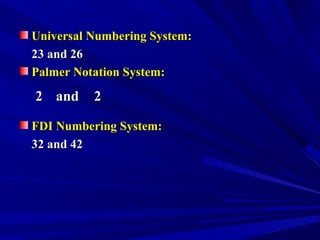
Universal Numbering System:Universal Numbering System:
23 and 2623 and 26
Palmer Notation System:Palmer Notation System:
FDI Numbering System:FDI Numbering System:
32 and 4232 and 42
22 andand 22
Chronology:Chronology:
A.A. First evidence of calcification:First evidence of calcification: 33 toto 44 months.months.
B.B. Enamel completed:Enamel completed: 44 toto 55 years.years.
C.C. Eruption:Eruption: 77 -- 88 years.years.
D.D. Root completed:Root completed: 1010 years.years.
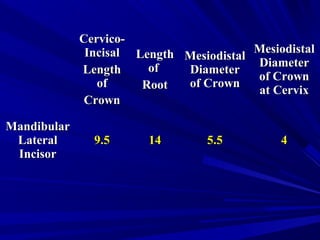
Cervico-Cervico-
IncisalIncisal
LengthLength
ofof
CrownCrown
LengthLength
ofof
RootRoot
MesiodistalMesiodistal
DiameterDiameter
of Crownof Crown
MesiodistalMesiodistal
DiameterDiameter
of Crownof Crown
at Cervixat Cervix
MandibularMandibular
LateralLateral
IncisorIncisor
9.59.5 1414 5.55.5 44
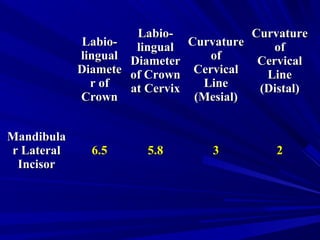
Labio-Labio-
linguallingual
DiameteDiamete
r ofr of
CrownCrown
Labio-Labio-
linguallingual
DiameterDiameter
of Crownof Crown
at Cervixat Cervix
CurvatureCurvature
ofof
CervicalCervical
LineLine
(Mesial)(Mesial)
CurvatureCurvature
ofof
CervicalCervical
LineLine
(Distal)(Distal)
MandibulaMandibula
r Lateralr Lateral
IncisorIncisor
6.56.5 5.85.8 33 22
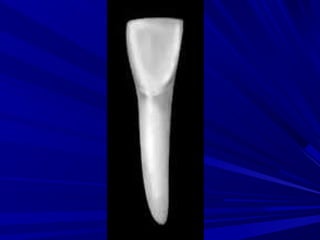
Labial AspectLabial Aspect
The labial aspect show the added fraction ofThe labial aspect show the added fraction of
approximately 1 mm. of crown diameterapproximately 1 mm. of crown diameter
mesiodistally added to the distal half.mesiodistally added to the distal half.
The mesial side of the crown is often longerThe mesial side of the crown is often longer
than the distal side, causing the incisal edge,than the distal side, causing the incisal edge,
which is straight, to slope downward in a distalwhich is straight, to slope downward in a distal
direction.direction.
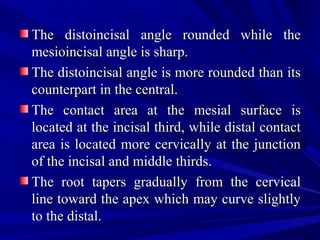
The distoincisal angle rounded while theThe distoincisal angle rounded while the
mesioincisal angle is sharp.mesioincisal angle is sharp.
The distoincisal angle is more rounded than itsThe distoincisal angle is more rounded than its
counterpart in the central.counterpart in the central.
The contact area at the mesial surface isThe contact area at the mesial surface is
located at the incisal third, while distal contactlocated at the incisal third, while distal contact
area is located more cervically at the junctionarea is located more cervically at the junction
of the incisal and middle thirds.of the incisal and middle thirds.
The root tapers gradually from the cervicalThe root tapers gradually from the cervical
line toward the apex which may curve slightlyline toward the apex which may curve slightly
to the distal.to the distal.
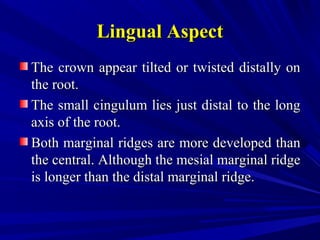
Lingual AspectLingual Aspect
The crown appear tilted or twisted distally onThe crown appear tilted or twisted distally on
the root.the root.
The small cingulum lies just distal to the longThe small cingulum lies just distal to the long
axis of the root.axis of the root.
Both marginal ridges are more developed thanBoth marginal ridges are more developed than
the central. Although the mesial marginal ridgethe central. Although the mesial marginal ridge
is longer than the distal marginal ridge.is longer than the distal marginal ridge.
Mesial and Distal AspectsMesial and Distal Aspects
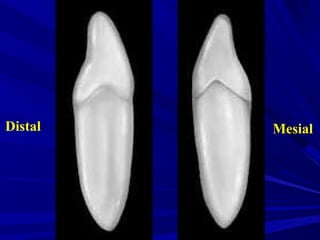
The mesial side of the crown is often longerThe mesial side of the crown is often longer
incisocervically than the distal side, causingincisocervically than the distal side, causing
the incisal edge, which is straight, to slopethe incisal edge, which is straight, to slope
downward in a distal direction. The distaldownward in a distal direction. The distal
contact area is more toward the cervical thancontact area is more toward the cervical than
the mesial contact area to contact properly thethe mesial contact area to contact properly the
mesial contact area of the mandibular canine.mesial contact area of the mandibular canine.
MesialDistal
Except for size, there is no marked differenceExcept for size, there is no marked difference
between the mesial and distal surfaces of centralbetween the mesial and distal surfaces of central
and lateral incisors. Even the curvatures of theand lateral incisors. Even the curvatures of the
cervical line mesially and distally are similar incervical line mesially and distally are similar in
extent.extent.
Although the crown of the mandibular lateralAlthough the crown of the mandibular lateral
incisor is somewhat longer than that of theincisor is somewhat longer than that of the
central incisor (usually a fraction of acentral incisor (usually a fraction of a
millimeter), the root may be considerablymillimeter), the root may be considerably
longer.longer.
The tooth is, therefore, in most instances, aThe tooth is, therefore, in most instances, a
little larger in all dimensions. The root form islittle larger in all dimensions. The root form is
similar to that of the central incisor, includingsimilar to that of the central incisor, including
the developmental depressions mesially andthe developmental depressions mesially and
distally.distally.
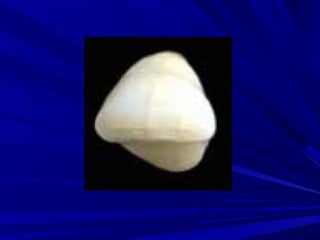
Incisal AspectIncisal Aspect
The incisal aspect of the mandibular lateralThe incisal aspect of the mandibular lateral
incisor provides a feature that can usuallyincisor provides a feature that can usually
serve to identify this tooth. The incisal edge isserve to identify this tooth. The incisal edge is
not at approximate right angles to a linenot at approximate right angles to a line
bisecting the crown and root labiolingually, asbisecting the crown and root labiolingually, as
was found when observing the central incisor:was found when observing the central incisor:
The edge follows the curvature of theThe edge follows the curvature of the
mandibular dental arch, giving the crown ofmandibular dental arch, giving the crown of
the mandibular lateral incisor the appearancethe mandibular lateral incisor the appearance
of being twisted slightly on its root base.of being twisted slightly on its root base.
The lateral incisors appear to be rotated onThe lateral incisors appear to be rotated on
their root axis because the distaltheir root axis because the distal
developmental lobe of the mandibular lateraldevelopmental lobe of the mandibular lateral
incisors is larger and located more distallyincisors is larger and located more distally
than the mesial lobe. The reason for this is thatthan the mesial lobe. The reason for this is that
the laterals have to curve distally to fit into thethe laterals have to curve distally to fit into the
mandibular arch (the mandibular arch curvemandibular arch (the mandibular arch curve
more than the maxillary because it has to fitmore than the maxillary because it has to fit
inside the maxillary arch). The incisal edgeinside the maxillary arch). The incisal edge
follows the curvature of the mandibular dentalfollows the curvature of the mandibular dental
arch.arch.
It is interesting to note that the labiolingualIt is interesting to note that the labiolingual
root axes of mandibular central and lateralroot axes of mandibular central and lateral
incisors remain almost parallel in the alveolarincisors remain almost parallel in the alveolar
process, even though the incisal ridges are notprocess, even though the incisal ridges are not
directly in line.directly in line.
The Mandibular CanineThe Mandibular Canine
Because maxillary and mandibular caninesBecause maxillary and mandibular canines
bear a close resemblance to each other, directbear a close resemblance to each other, direct
comparisons will be made with the maxillarycomparisons will be made with the maxillary
canine in describing the mandibular canine.canine in describing the mandibular canine.
The mandibular canine resembles theThe mandibular canine resembles the
maxillary canine in that they have the samemaxillary canine in that they have the same
wedge-shaped outline and long crown.wedge-shaped outline and long crown.
Universal Numbering System:Universal Numbering System:
22 and 2722 and 27
Palmer Notation System:Palmer Notation System:
FDI Numbering System:FDI Numbering System:
33 and 4333 and 43
33 andand 33
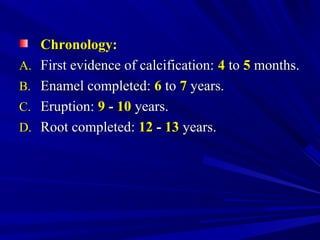
Chronology:Chronology:
A.A. First evidence of calcification:First evidence of calcification: 44 toto 55 months.months.
B.B. Enamel completed:Enamel completed: 66 toto 77 years.years.
C.C. Eruption:Eruption: 99 -- 1010 years.years.
D.D. Root completed:Root completed: 1212 -- 1313 years.years.
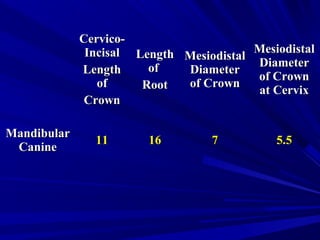
Cervico-Cervico-
IncisalIncisal
LengthLength
ofof
CrownCrown
LengthLength
ofof
RootRoot
MesiodistalMesiodistal
DiameterDiameter
of Crownof Crown
MesiodistalMesiodistal
DiameterDiameter
of Crownof Crown
at Cervixat Cervix
MandibularMandibular
CanineCanine
1111 1616 77 5.55.5
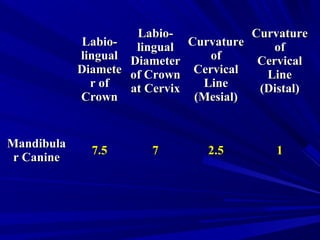
Labio-Labio-
linguallingual
DiameteDiamete
r ofr of
CrownCrown
Labio-Labio-
linguallingual
DiameterDiameter
of Crownof Crown
at Cervixat Cervix
CurvatureCurvature
ofof
CervicalCervical
LineLine
(Mesial)(Mesial)
CurvatureCurvature
ofof
CervicalCervical
LineLine
(Distal)(Distal)
MandibulaMandibula
r Caniner Canine
7.57.5 77 2.52.5 11
Labial AspectLabial Aspect
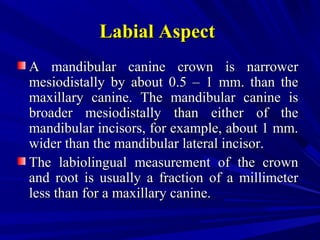
A mandibular canine crown is narrowerA mandibular canine crown is narrower
mesiodistally by about 0.5 – 1 mm. than themesiodistally by about 0.5 – 1 mm. than the
maxillary canine. The mandibular canine ismaxillary canine. The mandibular canine is
broader mesiodistally than either of thebroader mesiodistally than either of the
mandibular incisors, for example, about 1 mm.mandibular incisors, for example, about 1 mm.
wider than the mandibular lateral incisor.wider than the mandibular lateral incisor.
The labiolingual measurement of the crownThe labiolingual measurement of the crown
and root is usually a fraction of a millimeterand root is usually a fraction of a millimeter
less than for a maxillary canine.less than for a maxillary canine.
A mandibular canine crown length is as long asA mandibular canine crown length is as long as
that of a maxillary canine, but sometimes longerthat of a maxillary canine, but sometimes longer
by 0.5 to 1 mm. The effect of greater length isby 0.5 to 1 mm. The effect of greater length is
emphasized by the narrowness of the crownemphasized by the narrowness of the crown
mesio-distally and the hight of the contact areasmesio-distally and the hight of the contact areas
above the cervix.above the cervix.
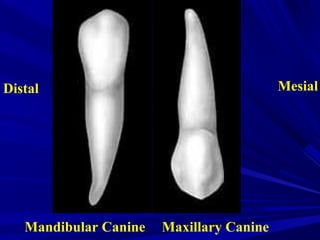
The mesial outline of the crown of theThe mesial outline of the crown of the
mandibular canine is nearly straight (slightlymandibular canine is nearly straight (slightly
convex) with the mesial outline of the root. Soconvex) with the mesial outline of the root. So
the mesial side of the crown doesn’t bulge orthe mesial side of the crown doesn’t bulge or
project beyond the root outline. The mesialproject beyond the root outline. The mesial
contact area is near the mesio-incisal angle thancontact area is near the mesio-incisal angle than
the maxillary counterpart.the maxillary counterpart.
MesialDistal
Mandibular Canine Maxillary Canine
The distal outline is convex incisocervically withThe distal outline is convex incisocervically with
a more rounded and obtuse distoincisal angle. Ita more rounded and obtuse distoincisal angle. It
is shorter than the mesial outline and the hight ofis shorter than the mesial outline and the hight of
contour (contact area) is located more cervicallycontour (contact area) is located more cervically
than the mesial one, but it is more incisal thanthan the mesial one, but it is more incisal than
that of the maxillary canine (The distal contactthat of the maxillary canine (The distal contact
area of the mandibular canine is more toward thearea of the mandibular canine is more toward the
incisal than that of the maxillary canine, but notincisal than that of the maxillary canine, but not
up to the level of the mesial area). It usually doesup to the level of the mesial area). It usually does
project beyond the distal root outline.project beyond the distal root outline.
The crown is not divided into equal halvesThe crown is not divided into equal halves
mesiodistally but there is noticeably more of themesiodistally but there is noticeably more of the
crown distal to the root center. This often makescrown distal to the root center. This often makes
the crown appears to be tilted or bent distally.the crown appears to be tilted or bent distally.
The incisal outline: the cusp doesn’t appear toThe incisal outline: the cusp doesn’t appear to
be so long and sharp as maxillary canine cusp.be so long and sharp as maxillary canine cusp.
The cusp tip and ridges of the mandibularThe cusp tip and ridges of the mandibular
canine are not as well developed as those ofcanine are not as well developed as those of
the maxillary canine.the maxillary canine.
The distal slope is normally much longer andThe distal slope is normally much longer and
its slope is much greater cervically than theits slope is much greater cervically than the
mesial slope.mesial slope.
Labially, the cervical line of the mandibularLabially, the cervical line of the mandibular
canine is more symmetrically contoured thancanine is more symmetrically contoured than
the cervical line of a maxillary canine (thethe cervical line of a maxillary canine (the
cervical line of a maxillary canine is lesscervical line of a maxillary canine is less
uniform, cresting slightly mesial to the midlineuniform, cresting slightly mesial to the midline
of the tooth). The labial ridge is often presentof the tooth). The labial ridge is often present
but not as prominent as on the maxillarybut not as prominent as on the maxillary
canine.canine.
Many mandibular canines give the impressionMany mandibular canines give the impression
from this aspect of being bent distally on thefrom this aspect of being bent distally on the
root base. The maxillary canine crowns areroot base. The maxillary canine crowns are
more likely to be in line with the root.more likely to be in line with the root.
The mandibular canine root is more oftenThe mandibular canine root is more often
shorter by 1-2 mm. than the maxillary canine;shorter by 1-2 mm. than the maxillary canine;
the total crown root ratio is approximately thethe total crown root ratio is approximately the
same. So it is shorter than maxillary canine.same. So it is shorter than maxillary canine.
Its apex is more sharply pointed.Its apex is more sharply pointed.
Lingual aspectLingual aspect
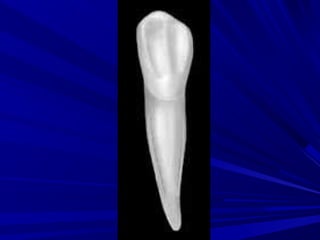
The lingual surface of the crown is flatter,The lingual surface of the crown is flatter,
smooth and regular simulating the mandibularsmooth and regular simulating the mandibular
incisors.incisors.
The cingulum, the marginal and the lingualThe cingulum, the marginal and the lingual
ridges are less distinct. The lingual fossae areridges are less distinct. The lingual fossae are
less pronounced.less pronounced.
The lingual portion of the root is narrower thanThe lingual portion of the root is narrower than
that of the maxillary canine. It is about onethat of the maxillary canine. It is about one
half or little more in width than the labialhalf or little more in width than the labial
portion.portion.
Mesial AspectMesial Aspect
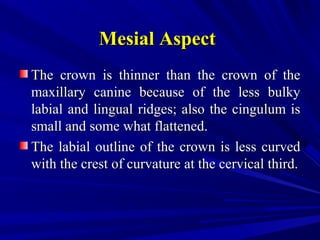
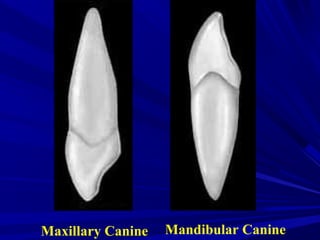
The crown is thinner than the crown of theThe crown is thinner than the crown of the
maxillary canine because of the less bulkymaxillary canine because of the less bulky
labial and lingual ridges; also the cingulum islabial and lingual ridges; also the cingulum is
small and some what flattened.small and some what flattened.
The labial outline of the crown is less curvedThe labial outline of the crown is less curved
with the crest of curvature at the cervical third.with the crest of curvature at the cervical third.
Mandibular CanineMaxillary Canine
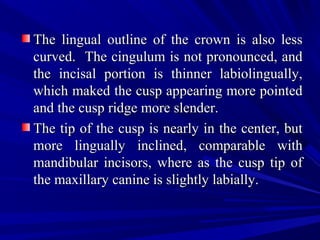
The lingual outline of the crown is also lessThe lingual outline of the crown is also less
curved. The cingulum is not pronounced, andcurved. The cingulum is not pronounced, and
the incisal portion is thinner labiolingually,the incisal portion is thinner labiolingually,
which maked the cusp appearing more pointedwhich maked the cusp appearing more pointed
and the cusp ridge more slender.and the cusp ridge more slender.
The tip of the cusp is nearly in the center, butThe tip of the cusp is nearly in the center, but
more lingually inclined, comparable withmore lingually inclined, comparable with
mandibular incisors, where as the cusp tip ofmandibular incisors, where as the cusp tip of
the maxillary canine is slightly labially.the maxillary canine is slightly labially.
The cervical line curves more toward theThe cervical line curves more toward the
incisal portion than does the cervical line onincisal portion than does the cervical line on
the maxilly canine.the maxilly canine.
The roots of the maxillary and the mandibularThe roots of the maxillary and the mandibular
canines are similar, but the mesialcanines are similar, but the mesial
developmental depression on the root of thedevelopmental depression on the root of the
mandibular canine is more pronounced. Somemandibular canine is more pronounced. Some
times the root of the mandibuar is bifurcatedtimes the root of the mandibuar is bifurcated
specially at the apical third.specially at the apical third.
Distal AspectDistal Aspect
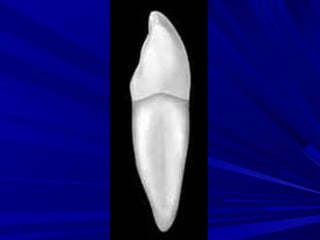
There is little difference from the distal aspectThere is little difference from the distal aspect
between mandibular and maxillary caninesbetween mandibular and maxillary canines
except those features mentioned underexcept those features mentioned under mesialmesial
aspect,aspect, which are common to both.which are common to both.
Incisal AspectIncisal Aspect
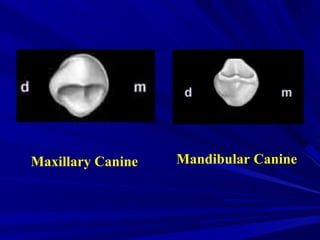
The outlines of the crowns of mandibularThe outlines of the crowns of mandibular
and maxillary canines from the incisal aspectand maxillary canines from the incisal aspect
are often similar. The main differences to beare often similar. The main differences to be
noted are these:noted are these:
The mesiodistal dimension of the mandibularThe mesiodistal dimension of the mandibular
canine is less than the labiolingual dimension.canine is less than the labiolingual dimension.
In this there is a similarity, but the outlines ofIn this there is a similarity, but the outlines of
the mesial surface are less curved.the mesial surface are less curved.
Mandibular CanineMaxillary Canine
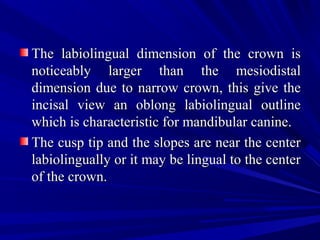
The labiolingual dimension of the crown isThe labiolingual dimension of the crown is
noticeably larger than the mesiodistalnoticeably larger than the mesiodistal
dimension due to narrow crown, this give thedimension due to narrow crown, this give the
incisal view an oblong labiolingual outlineincisal view an oblong labiolingual outline
which is characteristic for mandibular canine.which is characteristic for mandibular canine.
The cusp tip and the slopes are near the centerThe cusp tip and the slopes are near the center
labiolingually or it may be lingual to the centerlabiolingually or it may be lingual to the center
of the crown.of the crown.
Thank YouThank You

تشريح أسنان محاضرة 8

  • 2.
    College of DentistryCollegeof Dentistry Human Dentition IHuman Dentition I Mandibular Incisors & CanineMandibular Incisors & Canine Dr. Hazem Al AjramiDr. Hazem Al Ajrami
  • 3.
  • 4.
    The mandibular incisorsare four in number.The mandibular incisors are four in number. The mandibular central incisors are centered inThe mandibular central incisors are centered in the mandible, one on either side of the medianthe mandible, one on either side of the median line, with the mesial surface of each one inline, with the mesial surface of each one in contact with the mesial surface of the other.contact with the mesial surface of the other. The right and left mandibular lateral or secondThe right and left mandibular lateral or second incisors are distal to the central incisors. Theyincisors are distal to the central incisors. They are in contact with the central incisors mesiallyare in contact with the central incisors mesially and with the canines distally. The crowns areand with the canines distally. The crowns are relatively longer with constricted neck give therelatively longer with constricted neck give the crown fan shape appearance.crown fan shape appearance.
  • 5.
    The mandibular incisorshave smallerThe mandibular incisors have smaller mesiodistal dimensions than any of the othermesiodistal dimensions than any of the other teeth. The central incisor is somewhat smallerteeth. The central incisor is somewhat smaller than the lateral incisor, which is the reverse ofthan the lateral incisor, which is the reverse of the situation in the maxilla.the situation in the maxilla. These teeth are similar in form and have smoothThese teeth are similar in form and have smooth crown surfaces that show few traces ofcrown surfaces that show few traces of developmental lines. Mamelons on the incisaldevelopmental lines. Mamelons on the incisal ridges are worn off soon after eruption, if theridges are worn off soon after eruption, if the occlusion is normal, leaving the incisal edgesocclusion is normal, leaving the incisal edges smooth and straight.smooth and straight.
  • 6.
    The contact areasare near the incisal edgesThe contact areas are near the incisal edges mesially and distally, and lines drawn throughmesially and distally, and lines drawn through the contact areas are near the same level onthe contact areas are near the same level on both central and lateral incisors; here also theboth central and lateral incisors; here also the situation is unlike the maxillary incisors. Thesituation is unlike the maxillary incisors. The mandibular incisors show uniformmandibular incisors show uniform development, with few instances ofdevelopment, with few instances of malformations or anomalies.malformations or anomalies.
  • 7.
    The anatomic formof these teeth differsThe anatomic form of these teeth differs entirely from that of the maxillary incisors.entirely from that of the maxillary incisors. The inclination of the crowns differs from theThe inclination of the crowns differs from the mesial and distal aspects; the labial faces aremesial and distal aspects; the labial faces are inclined lingually so that the incisal edges areinclined lingually so that the incisal edges are lingual to a line bisecting the root.lingual to a line bisecting the root.
  • 8.
  • 9.
    Normally, the mandibularcentral incisor is theNormally, the mandibular central incisor is the smallest tooth in the dental arches. The crownsmallest tooth in the dental arches. The crown has little more than half the mesiodistalhas little more than half the mesiodistal diameter of the maxillary central incisor;diameter of the maxillary central incisor; however, the labiolingual diameter is only abouthowever, the labiolingual diameter is only about 1 mm. less. The lines of greatest masticatory1 mm. less. The lines of greatest masticatory stress are brought to bear on the mandibularstress are brought to bear on the mandibular incisors in a labiolingual direction, making thisincisors in a labiolingual direction, making this reinforcement necessary.reinforcement necessary.
  • 10.
    The single rootis very narrow mesiodistallyThe single root is very narrow mesiodistally and corresponds to the narrowness of theand corresponds to the narrowness of the crown, although the root and crown are widecrown, although the root and crown are wide labiolingually. The length of the root is aslabiolingually. The length of the root is as great, if not greater, than that of the maxillarygreat, if not greater, than that of the maxillary central incisor.central incisor.
  • 11.
    Universal Numbering System:UniversalNumbering System: 24 and 2524 and 25 Palmer Notation System:Palmer Notation System: FDI Numbering System:FDI Numbering System: 31 and 4131 and 41 11 andand 11
  • 12.
    Chronology:Chronology: A.A. First evidenceof calcification:First evidence of calcification: 33 toto 44 months.months. B.B. Enamel completed:Enamel completed: 44 toto 55 years.years. C.C. Eruption:Eruption: 66 -- 77 years.years. D.D. Root completed:Root completed: 99 years.years.
  • 13.
  • 14.
    Labio-Labio- linguallingual DiameteDiamete r ofr of CrownCrown Labio-Labio- linguallingual DiameterDiameter ofCrownof Crown at Cervixat Cervix CurvatureCurvature ofof CervicalCervical LineLine (Mesial)(Mesial) CurvatureCurvature ofof CervicalCervical LineLine (Distal)(Distal) MandibulaMandibula r Centralr Central IncisorIncisor 66 5.35.3 33 22
  • 15.
    Labial AspectLabial Aspect Thelabial aspect of the mandibular centralThe labial aspect of the mandibular central incisor is regular, tapering evenly from theincisor is regular, tapering evenly from the relatively sharp mesial and distal incisal anglesrelatively sharp mesial and distal incisal angles to the apical portion of the root. The incisalto the apical portion of the root. The incisal edge of the crown is straight and is atedge of the crown is straight and is at approximately a right angle to the long axis ofapproximately a right angle to the long axis of the tooth. Usually, the mesial and distalthe tooth. Usually, the mesial and distal outlines of the crown make a straight dropoutlines of the crown make a straight drop downward from the incisal angles to thedownward from the incisal angles to the contact areas, which are incisal to the junctioncontact areas, which are incisal to the junction of incisal and middle thirds of the crown.of incisal and middle thirds of the crown.
  • 17.
    The labial aspectis trapezoid in outline withThe labial aspect is trapezoid in outline with the smallest at cervix.the smallest at cervix. The mesial and distal sides of the crown taperThe mesial and distal sides of the crown taper evenly from the contact areas to the narrowevenly from the contact areas to the narrow cervix having fan shape. The mesial and distalcervix having fan shape. The mesial and distal root outlines are straight with the mesial androot outlines are straight with the mesial and distal outlines of the crown down to the apicaldistal outlines of the crown down to the apical portion. The apical third of the root terminatesportion. The apical third of the root terminates in a small pointed taper, in most cases curvingin a small pointed taper, in most cases curving distally. Sometimes the roots are straightdistally. Sometimes the roots are straight..
  • 18.
    The labial faceof the mandibular centralThe labial face of the mandibular central incisor crown is ordinarily smooth, with aincisor crown is ordinarily smooth, with a flattened surface at the incisal third: the middleflattened surface at the incisal third: the middle third is more convex, narrowing down to thethird is more convex, narrowing down to the convexity of the root at the cervical portion.convexity of the root at the cervical portion. Except in newly erupted teeth, central incisorsExcept in newly erupted teeth, central incisors show few traces of developmental lines. Theshow few traces of developmental lines. The labial surface of the root of the mandibularlabial surface of the root of the mandibular central incisor is regular and convex.central incisor is regular and convex.
  • 19.
    Lingual AspectLingual Aspect Thelingual surface of the crown is smooth,The lingual surface of the crown is smooth, with very slight concavity at the incisal thirdwith very slight concavity at the incisal third between the inconspicuous marginal ridges.between the inconspicuous marginal ridges. The incisal edge and marginal ridges are notThe incisal edge and marginal ridges are not well developed. The lingual fossa is shallow.well developed. The lingual fossa is shallow. The lingual surface becomes flat and thenThe lingual surface becomes flat and then convex as progression is made from the incisalconvex as progression is made from the incisal third to the cervical third.third to the cervical third.
  • 21.
    The outline ofthe crown is the reverse of thatThe outline of the crown is the reverse of that from the labial aspect but narrower as the toothfrom the labial aspect but narrower as the tooth tapers labiolingually.tapers labiolingually. No developmental lines mark the cingulumNo developmental lines mark the cingulum development on this tooth at the cervical third.development on this tooth at the cervical third. No other tooth in the mouth, except theNo other tooth in the mouth, except the mandibular lateral incisor, shows so fewmandibular lateral incisor, shows so few developmental lines and grooves. The outlinesdevelopmental lines and grooves. The outlines and surfaces of the mandibular incisors areand surfaces of the mandibular incisors are regular and symmetrical.regular and symmetrical.
  • 22.
    Mesial AspectMesial Aspect Thecurvature labially and lingually above theThe curvature labially and lingually above the cervical line is less than that found on maxillarycervical line is less than that found on maxillary incisors. The outline of the labial face of theincisors. The outline of the labial face of the crown is straight above the cervical curvature,crown is straight above the cervical curvature, sloping rapidly from the crest of curvature to thesloping rapidly from the crest of curvature to the incisal ridge. The lingual outline of the crown is aincisal ridge. The lingual outline of the crown is a straight line inclined labially for a short distancestraight line inclined labially for a short distance above the smooth convexity of the cingulum; theabove the smooth convexity of the cingulum; the straight outline joins a concave line at the middlestraight outline joins a concave line at the middle third of the crown, which extends upward to jointhird of the crown, which extends upward to join the rounded outline of a narrow incisal edge.the rounded outline of a narrow incisal edge.
  • 24.
    The incisal edgeis rounded or worn flat, and itsThe incisal edge is rounded or worn flat, and its center is usually lingual to the center of the root.center is usually lingual to the center of the root. The curvature of the cervical line representing theThe curvature of the cervical line representing the cementoenamel junction on the mesial surface iscementoenamel junction on the mesial surface is marked, curving incisally approximately one-marked, curving incisally approximately one- third the length of the crown.third the length of the crown. The root outlines from the mesial aspect areThe root outlines from the mesial aspect are straight with the crown outline from the cervicalstraight with the crown outline from the cervical line, keeping the root diameter uniform throughline, keeping the root diameter uniform through the cervical third and part of the middle third; thethe cervical third and part of the middle third; the outline of the root begins to taper in the middleoutline of the root begins to taper in the middle third area, tapering rapidly in the apical third tothird area, tapering rapidly in the apical third to either a bluntly rounded or a pointed root end.either a bluntly rounded or a pointed root end.
  • 25.
    The mesial surfaceof the root is flat just belowThe mesial surface of the root is flat just below the cervical line. Most of these roots have athe cervical line. Most of these roots have a broad developmental depression for most ofbroad developmental depression for most of the root length. The depressions usually arethe root length. The depressions usually are deeper at the junction of the middle and apicaldeeper at the junction of the middle and apical thirds.thirds.
  • 26.
    Distal AspectDistal Aspect Thecervical line representing theThe cervical line representing the cementoenamel junction curves incisally aboutcementoenamel junction curves incisally about 1 mm. less than on the mesial. The distal1 mm. less than on the mesial. The distal surface of the crown and root of thesurface of the crown and root of the mandibular central incisor is similar to that ofmandibular central incisor is similar to that of the mesial surface. The developmentalthe mesial surface. The developmental depression on the distal surface of the rootdepression on the distal surface of the root may be more marked, with a deeper and moremay be more marked, with a deeper and more well-defined developmental groove at itswell-defined developmental groove at its center.center.
  • 28.
    Incisal AspectIncisal Aspect Thisaspect illustrates the bilateral symmetryThis aspect illustrates the bilateral symmetry of the mandibular central incisor. The mesialof the mandibular central incisor. The mesial half of the crown is almost identical with thehalf of the crown is almost identical with the distal half. It is diamond in shape with fourdistal half. It is diamond in shape with four sides.sides. The incisal edge is almost at right angles to aThe incisal edge is almost at right angles to a line bisecting the crown labiolingually. Thisline bisecting the crown labiolingually. This feature is characteristic of the tooth and servesfeature is characteristic of the tooth and serves as a mark of identification in differentiationas a mark of identification in differentiation between mandibular central and lateralbetween mandibular central and lateral incisors.incisors.
  • 30.
    Note the comparisonbetween the diameter ofNote the comparison between the diameter of these crowns labiolingually and their diametersthese crowns labiolingually and their diameters mesiodistally. The labiolingual diameter ismesiodistally. The labiolingual diameter is always greater.always greater. The labial surface of the crownThe labial surface of the crown is wider mesiodistally than the lingual surface.is wider mesiodistally than the lingual surface. The crown is usually wider labially thanThe crown is usually wider labially than lingually at the cervical third, which latter arealingually at the cervical third, which latter area is represented by a smooth cingulum. Whenis represented by a smooth cingulum. When this tooth is posed from the incisal aspect sothis tooth is posed from the incisal aspect so that the line of vision is on a line with the longthat the line of vision is on a line with the long axis of the tooth, more of the labial surfaceaxis of the tooth, more of the labial surface may be seen than of the lingual surface.may be seen than of the lingual surface.
  • 31.
  • 32.
    The mandibular lateralincisor is the secondThe mandibular lateral incisor is the second mandibular tooth from the median line, rightmandibular tooth from the median line, right or left. It resembles the mandibular centralor left. It resembles the mandibular central incisor so closely that only a brief descriptionincisor so closely that only a brief description of each aspect of the lateral incisor will beof each aspect of the lateral incisor will be necessary. Direct comparison will be madenecessary. Direct comparison will be made with the mandibular central incisor, and thewith the mandibular central incisor, and the variations will be mentioned.variations will be mentioned.
  • 33.
    The two incisorsoperate in the dental arch as aThe two incisors operate in the dental arch as a team; therefore, their functional form isteam; therefore, their functional form is related. The mandibular lateral incisor isrelated. The mandibular lateral incisor is somewhat larger (compare measurements), butsomewhat larger (compare measurements), but generally speaking, its form closely resemblesgenerally speaking, its form closely resembles the mandibular central incisor.the mandibular central incisor.
  • 34.
    Universal Numbering System:UniversalNumbering System: 23 and 2623 and 26 Palmer Notation System:Palmer Notation System: FDI Numbering System:FDI Numbering System: 32 and 4232 and 42 22 andand 22
  • 35.
    Chronology:Chronology: A.A. First evidenceof calcification:First evidence of calcification: 33 toto 44 months.months. B.B. Enamel completed:Enamel completed: 44 toto 55 years.years. C.C. Eruption:Eruption: 77 -- 88 years.years. D.D. Root completed:Root completed: 1010 years.years.
  • 36.
  • 37.
    Labio-Labio- linguallingual DiameteDiamete r ofr of CrownCrown Labio-Labio- linguallingual DiameterDiameter ofCrownof Crown at Cervixat Cervix CurvatureCurvature ofof CervicalCervical LineLine (Mesial)(Mesial) CurvatureCurvature ofof CervicalCervical LineLine (Distal)(Distal) MandibulaMandibula r Lateralr Lateral IncisorIncisor 6.56.5 5.85.8 33 22
  • 38.
    Labial AspectLabial Aspect Thelabial aspect show the added fraction ofThe labial aspect show the added fraction of approximately 1 mm. of crown diameterapproximately 1 mm. of crown diameter mesiodistally added to the distal half.mesiodistally added to the distal half. The mesial side of the crown is often longerThe mesial side of the crown is often longer than the distal side, causing the incisal edge,than the distal side, causing the incisal edge, which is straight, to slope downward in a distalwhich is straight, to slope downward in a distal direction.direction.
  • 40.
    The distoincisal anglerounded while theThe distoincisal angle rounded while the mesioincisal angle is sharp.mesioincisal angle is sharp. The distoincisal angle is more rounded than itsThe distoincisal angle is more rounded than its counterpart in the central.counterpart in the central. The contact area at the mesial surface isThe contact area at the mesial surface is located at the incisal third, while distal contactlocated at the incisal third, while distal contact area is located more cervically at the junctionarea is located more cervically at the junction of the incisal and middle thirds.of the incisal and middle thirds. The root tapers gradually from the cervicalThe root tapers gradually from the cervical line toward the apex which may curve slightlyline toward the apex which may curve slightly to the distal.to the distal.
  • 41.
    Lingual AspectLingual Aspect Thecrown appear tilted or twisted distally onThe crown appear tilted or twisted distally on the root.the root. The small cingulum lies just distal to the longThe small cingulum lies just distal to the long axis of the root.axis of the root. Both marginal ridges are more developed thanBoth marginal ridges are more developed than the central. Although the mesial marginal ridgethe central. Although the mesial marginal ridge is longer than the distal marginal ridge.is longer than the distal marginal ridge.
  • 43.
    Mesial and DistalAspectsMesial and Distal Aspects The mesial side of the crown is often longerThe mesial side of the crown is often longer incisocervically than the distal side, causingincisocervically than the distal side, causing the incisal edge, which is straight, to slopethe incisal edge, which is straight, to slope downward in a distal direction. The distaldownward in a distal direction. The distal contact area is more toward the cervical thancontact area is more toward the cervical than the mesial contact area to contact properly thethe mesial contact area to contact properly the mesial contact area of the mandibular canine.mesial contact area of the mandibular canine.
  • 44.
  • 45.
    Except for size,there is no marked differenceExcept for size, there is no marked difference between the mesial and distal surfaces of centralbetween the mesial and distal surfaces of central and lateral incisors. Even the curvatures of theand lateral incisors. Even the curvatures of the cervical line mesially and distally are similar incervical line mesially and distally are similar in extent.extent.
  • 46.
    Although the crownof the mandibular lateralAlthough the crown of the mandibular lateral incisor is somewhat longer than that of theincisor is somewhat longer than that of the central incisor (usually a fraction of acentral incisor (usually a fraction of a millimeter), the root may be considerablymillimeter), the root may be considerably longer.longer. The tooth is, therefore, in most instances, aThe tooth is, therefore, in most instances, a little larger in all dimensions. The root form islittle larger in all dimensions. The root form is similar to that of the central incisor, includingsimilar to that of the central incisor, including the developmental depressions mesially andthe developmental depressions mesially and distally.distally.
  • 47.
    Incisal AspectIncisal Aspect Theincisal aspect of the mandibular lateralThe incisal aspect of the mandibular lateral incisor provides a feature that can usuallyincisor provides a feature that can usually serve to identify this tooth. The incisal edge isserve to identify this tooth. The incisal edge is not at approximate right angles to a linenot at approximate right angles to a line bisecting the crown and root labiolingually, asbisecting the crown and root labiolingually, as was found when observing the central incisor:was found when observing the central incisor: The edge follows the curvature of theThe edge follows the curvature of the mandibular dental arch, giving the crown ofmandibular dental arch, giving the crown of the mandibular lateral incisor the appearancethe mandibular lateral incisor the appearance of being twisted slightly on its root base.of being twisted slightly on its root base.
  • 49.
    The lateral incisorsappear to be rotated onThe lateral incisors appear to be rotated on their root axis because the distaltheir root axis because the distal developmental lobe of the mandibular lateraldevelopmental lobe of the mandibular lateral incisors is larger and located more distallyincisors is larger and located more distally than the mesial lobe. The reason for this is thatthan the mesial lobe. The reason for this is that the laterals have to curve distally to fit into thethe laterals have to curve distally to fit into the mandibular arch (the mandibular arch curvemandibular arch (the mandibular arch curve more than the maxillary because it has to fitmore than the maxillary because it has to fit inside the maxillary arch). The incisal edgeinside the maxillary arch). The incisal edge follows the curvature of the mandibular dentalfollows the curvature of the mandibular dental arch.arch.
  • 50.
    It is interestingto note that the labiolingualIt is interesting to note that the labiolingual root axes of mandibular central and lateralroot axes of mandibular central and lateral incisors remain almost parallel in the alveolarincisors remain almost parallel in the alveolar process, even though the incisal ridges are notprocess, even though the incisal ridges are not directly in line.directly in line.
  • 51.
    The Mandibular CanineTheMandibular Canine
  • 52.
    Because maxillary andmandibular caninesBecause maxillary and mandibular canines bear a close resemblance to each other, directbear a close resemblance to each other, direct comparisons will be made with the maxillarycomparisons will be made with the maxillary canine in describing the mandibular canine.canine in describing the mandibular canine. The mandibular canine resembles theThe mandibular canine resembles the maxillary canine in that they have the samemaxillary canine in that they have the same wedge-shaped outline and long crown.wedge-shaped outline and long crown.
  • 53.
    Universal Numbering System:UniversalNumbering System: 22 and 2722 and 27 Palmer Notation System:Palmer Notation System: FDI Numbering System:FDI Numbering System: 33 and 4333 and 43 33 andand 33
  • 54.
    Chronology:Chronology: A.A. First evidenceof calcification:First evidence of calcification: 44 toto 55 months.months. B.B. Enamel completed:Enamel completed: 66 toto 77 years.years. C.C. Eruption:Eruption: 99 -- 1010 years.years. D.D. Root completed:Root completed: 1212 -- 1313 years.years.
  • 55.
  • 56.
    Labio-Labio- linguallingual DiameteDiamete r ofr of CrownCrown Labio-Labio- linguallingual DiameterDiameter ofCrownof Crown at Cervixat Cervix CurvatureCurvature ofof CervicalCervical LineLine (Mesial)(Mesial) CurvatureCurvature ofof CervicalCervical LineLine (Distal)(Distal) MandibulaMandibula r Caniner Canine 7.57.5 77 2.52.5 11
  • 57.
    Labial AspectLabial Aspect Amandibular canine crown is narrowerA mandibular canine crown is narrower mesiodistally by about 0.5 – 1 mm. than themesiodistally by about 0.5 – 1 mm. than the maxillary canine. The mandibular canine ismaxillary canine. The mandibular canine is broader mesiodistally than either of thebroader mesiodistally than either of the mandibular incisors, for example, about 1 mm.mandibular incisors, for example, about 1 mm. wider than the mandibular lateral incisor.wider than the mandibular lateral incisor. The labiolingual measurement of the crownThe labiolingual measurement of the crown and root is usually a fraction of a millimeterand root is usually a fraction of a millimeter less than for a maxillary canine.less than for a maxillary canine.
  • 58.
    A mandibular caninecrown length is as long asA mandibular canine crown length is as long as that of a maxillary canine, but sometimes longerthat of a maxillary canine, but sometimes longer by 0.5 to 1 mm. The effect of greater length isby 0.5 to 1 mm. The effect of greater length is emphasized by the narrowness of the crownemphasized by the narrowness of the crown mesio-distally and the hight of the contact areasmesio-distally and the hight of the contact areas above the cervix.above the cervix. The mesial outline of the crown of theThe mesial outline of the crown of the mandibular canine is nearly straight (slightlymandibular canine is nearly straight (slightly convex) with the mesial outline of the root. Soconvex) with the mesial outline of the root. So the mesial side of the crown doesn’t bulge orthe mesial side of the crown doesn’t bulge or project beyond the root outline. The mesialproject beyond the root outline. The mesial contact area is near the mesio-incisal angle thancontact area is near the mesio-incisal angle than the maxillary counterpart.the maxillary counterpart.
  • 59.
  • 60.
    The distal outlineis convex incisocervically withThe distal outline is convex incisocervically with a more rounded and obtuse distoincisal angle. Ita more rounded and obtuse distoincisal angle. It is shorter than the mesial outline and the hight ofis shorter than the mesial outline and the hight of contour (contact area) is located more cervicallycontour (contact area) is located more cervically than the mesial one, but it is more incisal thanthan the mesial one, but it is more incisal than that of the maxillary canine (The distal contactthat of the maxillary canine (The distal contact area of the mandibular canine is more toward thearea of the mandibular canine is more toward the incisal than that of the maxillary canine, but notincisal than that of the maxillary canine, but not up to the level of the mesial area). It usually doesup to the level of the mesial area). It usually does project beyond the distal root outline.project beyond the distal root outline. The crown is not divided into equal halvesThe crown is not divided into equal halves mesiodistally but there is noticeably more of themesiodistally but there is noticeably more of the crown distal to the root center. This often makescrown distal to the root center. This often makes the crown appears to be tilted or bent distally.the crown appears to be tilted or bent distally.
  • 61.
    The incisal outline:the cusp doesn’t appear toThe incisal outline: the cusp doesn’t appear to be so long and sharp as maxillary canine cusp.be so long and sharp as maxillary canine cusp. The cusp tip and ridges of the mandibularThe cusp tip and ridges of the mandibular canine are not as well developed as those ofcanine are not as well developed as those of the maxillary canine.the maxillary canine. The distal slope is normally much longer andThe distal slope is normally much longer and its slope is much greater cervically than theits slope is much greater cervically than the mesial slope.mesial slope.
  • 62.
    Labially, the cervicalline of the mandibularLabially, the cervical line of the mandibular canine is more symmetrically contoured thancanine is more symmetrically contoured than the cervical line of a maxillary canine (thethe cervical line of a maxillary canine (the cervical line of a maxillary canine is lesscervical line of a maxillary canine is less uniform, cresting slightly mesial to the midlineuniform, cresting slightly mesial to the midline of the tooth). The labial ridge is often presentof the tooth). The labial ridge is often present but not as prominent as on the maxillarybut not as prominent as on the maxillary canine.canine. Many mandibular canines give the impressionMany mandibular canines give the impression from this aspect of being bent distally on thefrom this aspect of being bent distally on the root base. The maxillary canine crowns areroot base. The maxillary canine crowns are more likely to be in line with the root.more likely to be in line with the root.
  • 63.
    The mandibular canineroot is more oftenThe mandibular canine root is more often shorter by 1-2 mm. than the maxillary canine;shorter by 1-2 mm. than the maxillary canine; the total crown root ratio is approximately thethe total crown root ratio is approximately the same. So it is shorter than maxillary canine.same. So it is shorter than maxillary canine. Its apex is more sharply pointed.Its apex is more sharply pointed.
  • 64.
    Lingual aspectLingual aspect Thelingual surface of the crown is flatter,The lingual surface of the crown is flatter, smooth and regular simulating the mandibularsmooth and regular simulating the mandibular incisors.incisors. The cingulum, the marginal and the lingualThe cingulum, the marginal and the lingual ridges are less distinct. The lingual fossae areridges are less distinct. The lingual fossae are less pronounced.less pronounced. The lingual portion of the root is narrower thanThe lingual portion of the root is narrower than that of the maxillary canine. It is about onethat of the maxillary canine. It is about one half or little more in width than the labialhalf or little more in width than the labial portion.portion.
  • 66.
    Mesial AspectMesial Aspect Thecrown is thinner than the crown of theThe crown is thinner than the crown of the maxillary canine because of the less bulkymaxillary canine because of the less bulky labial and lingual ridges; also the cingulum islabial and lingual ridges; also the cingulum is small and some what flattened.small and some what flattened. The labial outline of the crown is less curvedThe labial outline of the crown is less curved with the crest of curvature at the cervical third.with the crest of curvature at the cervical third.
  • 67.
  • 68.
    The lingual outlineof the crown is also lessThe lingual outline of the crown is also less curved. The cingulum is not pronounced, andcurved. The cingulum is not pronounced, and the incisal portion is thinner labiolingually,the incisal portion is thinner labiolingually, which maked the cusp appearing more pointedwhich maked the cusp appearing more pointed and the cusp ridge more slender.and the cusp ridge more slender. The tip of the cusp is nearly in the center, butThe tip of the cusp is nearly in the center, but more lingually inclined, comparable withmore lingually inclined, comparable with mandibular incisors, where as the cusp tip ofmandibular incisors, where as the cusp tip of the maxillary canine is slightly labially.the maxillary canine is slightly labially.
  • 69.
    The cervical linecurves more toward theThe cervical line curves more toward the incisal portion than does the cervical line onincisal portion than does the cervical line on the maxilly canine.the maxilly canine. The roots of the maxillary and the mandibularThe roots of the maxillary and the mandibular canines are similar, but the mesialcanines are similar, but the mesial developmental depression on the root of thedevelopmental depression on the root of the mandibular canine is more pronounced. Somemandibular canine is more pronounced. Some times the root of the mandibuar is bifurcatedtimes the root of the mandibuar is bifurcated specially at the apical third.specially at the apical third.
  • 70.
    Distal AspectDistal Aspect Thereis little difference from the distal aspectThere is little difference from the distal aspect between mandibular and maxillary caninesbetween mandibular and maxillary canines except those features mentioned underexcept those features mentioned under mesialmesial aspect,aspect, which are common to both.which are common to both.
  • 72.
    Incisal AspectIncisal Aspect Theoutlines of the crowns of mandibularThe outlines of the crowns of mandibular and maxillary canines from the incisal aspectand maxillary canines from the incisal aspect are often similar. The main differences to beare often similar. The main differences to be noted are these:noted are these: The mesiodistal dimension of the mandibularThe mesiodistal dimension of the mandibular canine is less than the labiolingual dimension.canine is less than the labiolingual dimension. In this there is a similarity, but the outlines ofIn this there is a similarity, but the outlines of the mesial surface are less curved.the mesial surface are less curved.
  • 73.
  • 74.
    The labiolingual dimensionof the crown isThe labiolingual dimension of the crown is noticeably larger than the mesiodistalnoticeably larger than the mesiodistal dimension due to narrow crown, this give thedimension due to narrow crown, this give the incisal view an oblong labiolingual outlineincisal view an oblong labiolingual outline which is characteristic for mandibular canine.which is characteristic for mandibular canine. The cusp tip and the slopes are near the centerThe cusp tip and the slopes are near the center labiolingually or it may be lingual to the centerlabiolingually or it may be lingual to the center of the crown.of the crown.
  • 75.