G
O
O
D
M
O
R
N
I
N
G
Forensic odontology
•Introduction
•History
•Need
•Identification
1. Comparative- Disaster site
2. Dental Profiling-
Ethnicity
Tooth Morphology &
Sexing
Dental age estimation
methods
•Crime inv- bite mark & lip
print analysis
•Conclusion
•References
Latin word forum = public
square
 FDI -'that branch of dentistry which, in the interest of justice, deals
with the proper handling and examination of dental evidence, and with
the proper evaluation and presentation of dental findings'.
 It primarily deals with identification, based on recognition of unique
features present in an individual's dental structures.
 It relies on sound knowledge of the teeth and jaws, possessed by
dentists and incorporates dental anatomy, histology, radiography,
pathology, dental materials, and developmental anomalies.
 Bible- bite mark by Adam
 The earliest identification by dental means -66 AD, Roman
queen
 1193 Maharaja of Conouj –Jai Chandra Rathore was id in the
warfield by enemy troop by his golden crown
 1775 Battle of Bunkers hill - Paul Revere id Joseph’s body by
his amalgam bridge.
HISTORY…
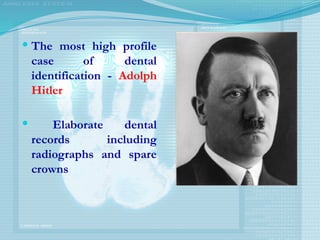
 The most high profile
case of dental
identification - Adolph
Hitler
 Elaborate dental
records including
radiographs and spare
crowns
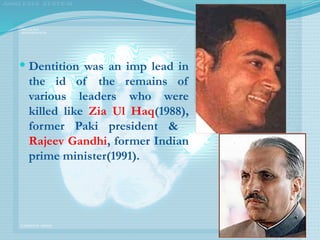
 Dentition was an imp lead in
the id of the remains of
various leaders who were
killed like Zia Ul Haq(1988),
former Paki president &
Rajeev Gandhi, former Indian
prime minister(1991).
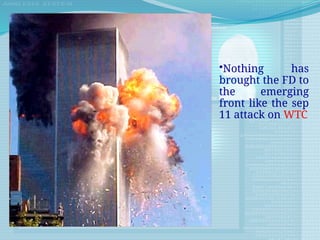
•Nothing has
brought the FD to
the emerging
front like the sep
11 attack on WTC
FORENSIC ODONTOLOGISTS DELVE INTO:
 Identifying unknown human remains through dental records, and
assisting at the location of a mass disaster.
 Eliciting the ethnicity and assisting in building up a picture of
lifestyle and diet of skeletal remains at archaeological sites.
 Determining the gender of unidentified individuals.
 Age estimation of both the living and the deceased.
 Recognition and analysis of bite marks found on victims of attacks
and in other substances such as foodstuffs.
 Presenting evidence in court as an expert witness.
Identification
 Establishment of a person's individuality.
 He who has gone, so we but cherish his memory, abides with
us, more potent, nay, more present than the living man.
~Antoine de saint
 Proper identification of the dead - legal and humanitarian
reasons.
• Most parts of the body undergo changes as the individual ages &
are replaced/recycled depending on tissue involved.
• The teeth are unique in that once physiological/growth
information is built into them they may remain stable for
thousands of years even after death.
• Teeth - strongest structures+ most materials used by the dentist
for restoring teeth are resistant to post-mortem decomposition.
• Traditional methods of identification have included visually
recognizing the body, fingerprints and personal property such as
clothing, jewellery, etc.
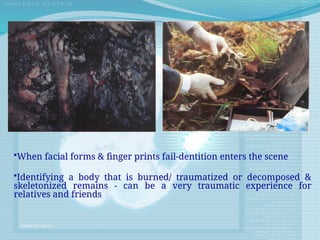
•When facial forms & finger prints fail-dentition enters the scene
•Identifying a body that is burned/ traumatized or decomposed &
skeletonized remains - can be a very traumatic experience for
relatives and friends
Basis for Dental Identification
 Theory that human dentition is never the same in any two
individuals.
 The morphology and arrangement of teeth vary from
person to person.
 Although teeth are relatively resistant to environmental
insults after death, during life they are susceptible to
physiological and pathological changes.
 Restorations, teeth that cannot be restored may have been
extracted .
 combinations 16 missing teeth -600 million.
 Sixteen filled teeth produce a similar combination.
 Four missing and four filled teeth in a mouth combined
can produce more than 700 million combinations.
 Now, every tooth has five surfaces. If, instead of
considering the whole tooth, the surfaces were taken
individually, the variations produced would be
astronomic.
 In fact, there are 1.8 X 10¹⁹
possible combinations of 32
teeth being intact, decayed, missing or filled.
DENTAL IDENTIFICATION PROCEDURES
1.Comparative identification: attempts conclusive
identification by comparing the dead individual's teeth with
presumed dental records of the individual.
2.Reconstructive identification or Dental Profiling: attempts to
elicit the ethnicity or 'race‘, gender, age, and occupation of
the dead individual. This is undertaken when virtually no
clue exists about the identity of the deceased.
Comparative dental identification
 Conventional method of post-mortem dental
identification
Four steps:
1. Oral autopsy
2. Obtaining dental records
3. Comparing post and ante-mortem dental data
4. Writing a report and drawing conclusions.
I. Oral autopsy
 Autopsy (necropsy or post-mortem) involves examination of
the deceased, usually with dissection to expose the organs, to
determine the cause of death.
 FD is invited to assist in a particular case investigated by the
police/forensic pathologist.
 Dentist is rarely the first expert to be called…
CDI
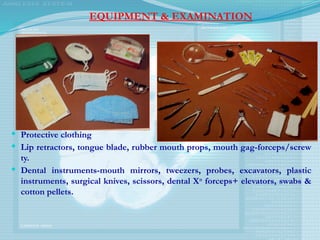
 Protective clothing
 Lip retractors, tongue blade, rubber mouth props, mouth gag-forceps/screw
ty.
 Dental instruments-mouth mirrors, tweezers, probes, excavators, plastic
instruments, surgical knives, scissors, dental Xn
forceps+ elevators, swabs &
cotton pellets.
EQUIPMENT & EXAMINATION
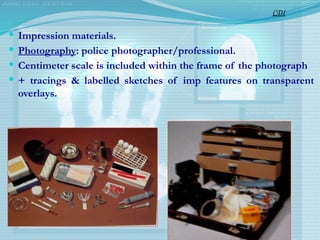
 Impression materials.
 Photography: police photographer/professional.
 Centimeter scale is included within the frame of the photograph
 + tracings & labelled sketches of imp features on transparent
overlays.
CDI
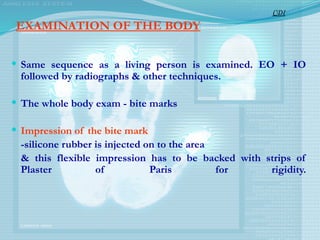
EXAMINATION OF THE BODY
 Same sequence as a living person is examined. EO + IO
followed by radiographs & other techniques.
 The whole body exam - bite marks
 Impression of the bite mark
-silicone rubber is injected on to the area
& this flexible impression has to be backed with strips of
Plaster of Paris for rigidity.
CDI
IO Examination
 Essential part of the post-mortem procedure.
 The forensic dentist should have adequate knowledge about
common post-mortem findings such as rigor mortis, livor
mortis, decomposition, & post-mortem artifacts.
CDI
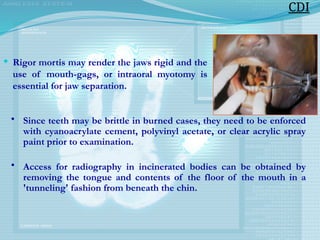
 Rigor mortis may render the jaws rigid and the
use of mouth-gags, or intraoral myotomy is
essential for jaw separation.
CDI
• Since teeth may be brittle in burned cases, they need to be enforced
with cyanoacrylate cement, polyvinyl acetate, or clear acrylic spray
paint prior to examination.
• Access for radiography in incinerated bodies can be obtained by
removing the tongue and contents of the floor of the mouth in a
'tunneling' fashion from beneath the chin.
 Every surface should be cleansed before examination
 Debris, blood, soil- toothbrush + soapy water
 Distribution, color & type of stains on teeth-tobacco,
beverages, medicaments
 Periodontal condition, gingival attachment - Oral hygiene
CDI
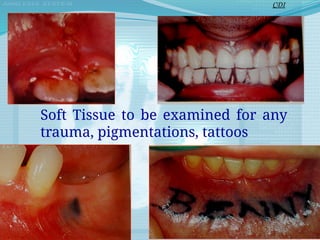
Soft Tissue to be examined for any
trauma, pigmentations, tattoos
CDI
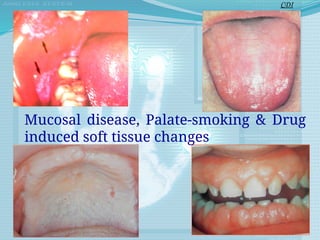
Mucosal disease, Palate-smoking & Drug
induced soft tissue changes
CDI
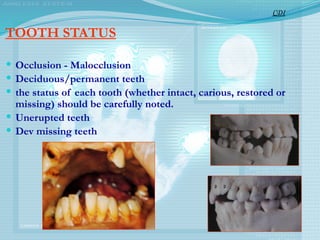
TOOTH STATUS
 Occlusion - Malocclusion
 Deciduous/permanent teeth
 the status of each tooth (whether intact, carious, restored or
missing) should be carefully noted.
 Unerupted teeth
 Dev missing teeth
CDI
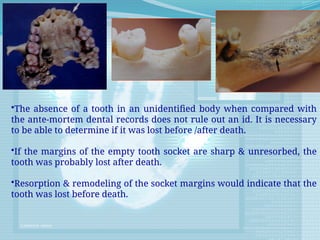
•The absence of a tooth in an unidentified body when compared with
the ante-mortem dental records does not rule out an id. It is necessary
to be able to determine if it was lost before /after death.
•If the margins of the empty tooth socket are sharp & unresorbed, the
tooth was probably lost after death.
•Resorption & remodeling of the socket margins would indicate that the
tooth was lost before death.
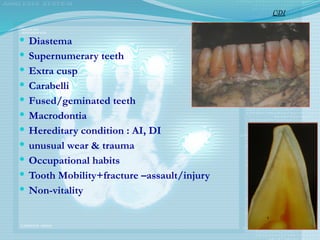
 Diastema
 Supernumerary teeth
 Extra cusp
 Carabelli
 Fused/geminated teeth
 Macrodontia
 Hereditary condition : AI, DI
 unusual wear & trauma
 Occupational habits
 Tooth Mobility+fracture –assault/injury
 Non-vitality
CDI
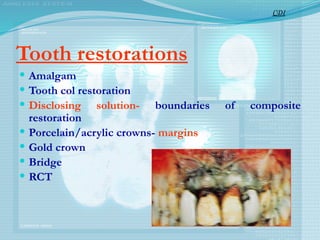
Tooth restorations
 Amalgam
 Tooth col restoration
 Disclosing solution- boundaries of composite
restoration
 Porcelain/acrylic crowns- margins
 Gold crown
 Bridge
 RCT
CDI
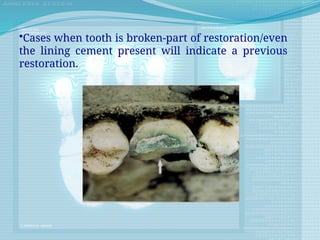
•Cases when tooth is broken-part of restoration/even
the lining cement present will indicate a previous
restoration.
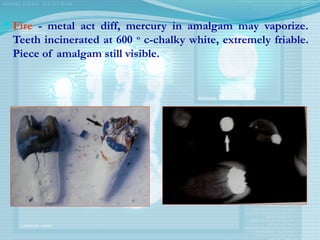
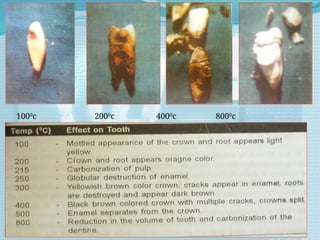
 Fire - metal act diff, mercury in amalgam may vaporize.
Teeth incinerated at 600 o
c-chalky white, extremely friable.
Piece of amalgam still visible.
1000
c 2000
c 4000
c 8000
c
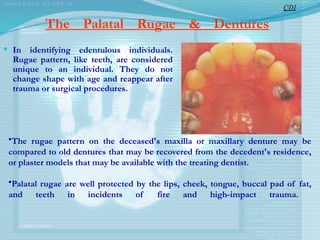
The Palatal Rugae & Dentures
 In identifying edentulous individuals.
Rugae pattern, like teeth, are considered
unique to an individual. They do not
change shape with age and reappear after
trauma or surgical procedures.
CDI
•The rugae pattern on the deceased's maxilla or maxillary denture may be
compared to old dentures that may be recovered from the decedent's residence,
or plaster models that may be available with the treating dentist.
•Palatal rugae are well protected by the lips, cheek, tongue, buccal pad of fat,
and teeth in incidents of fire and high-impact trauma.
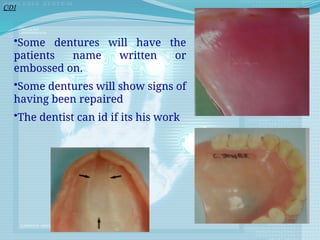
•Some dentures will have the
patients name written or
embossed on.
•Some dentures will show signs of
having been repaired
•The dentist can id if its his work
CDI
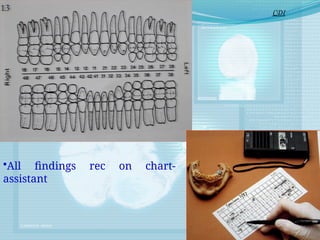
•All findings rec on chart-
assistant
CDI
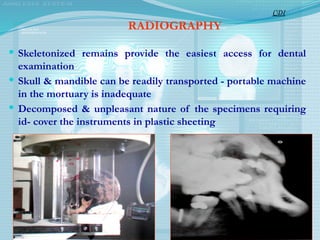
RADIOGRAPHY
 Skeletonized remains provide the easiest access for dental
examination
 Skull & mandible can be readily transported - portable machine
in the mortuary is inadequate
 Decomposed & unpleasant nature of the specimens requiring
id- cover the instruments in plastic sheeting
CDI
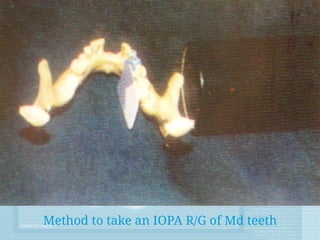
Method to take an IOPA R/G of Md teeth
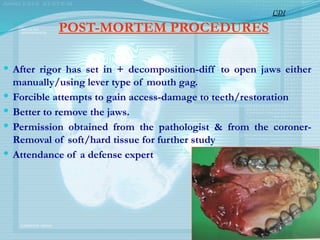
POST-MORTEM PROCEDURES
 After rigor has set in + decomposition-diff to open jaws either
manually/using lever type of mouth gag.
 Forcible attempts to gain access-damage to teeth/restoration
 Better to remove the jaws.
 Permission obtained from the pathologist & from the coroner-
Removal of soft/hard tissue for further study
 Attendance of a defense expert
CDI
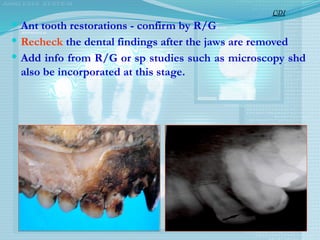
 Ant tooth restorations - confirm by R/G
 Recheck the dental findings after the jaws are removed
 Add info from R/G or sp studies such as microscopy shd
also be incorporated at this stage.
CDI
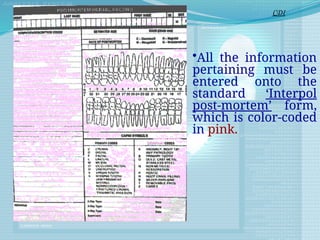
•All the information
pertaining must be
entered onto the
standard ‘Interpol
post-mortem’ form,
which is color-coded
in pink.
CDI
II. Obtaining Dental Records
 Dental records may be obtained from the treating dentist,
specialist or hospital records.
 Whenever possible, the original record should be
examined. Such records may be in the form of dental
charts, radiographs, casts or photographs.
 It is likely that multiple dentists might have treated an
individual.
CDI
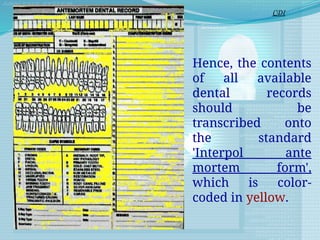
Hence, the contents
of all available
dental records
should be
transcribed onto
the standard
'Interpol ante
mortem form',
which is color-
coded in yellow.
CDI
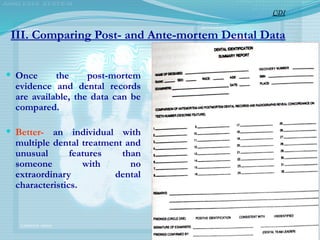
III. Comparing Post- and Ante-mortem Dental Data
 Once the post-mortem
evidence and dental records
are available, the data can be
compared.
 Better- an individual with
multiple dental treatment and
unusual features than
someone with no
extraordinary dental
characteristics.
CDI
IV. Writing a Report and Drawing Conclusions
 One needs to remember that any attempt at establishing identity is
addressed to the legal authorities. Therefore, a detailed report and
factual conclusion, based on the comparison, must be clearly stated.
 The quality and quantity of information required for establishing
dental identification may not have been established.
CDI
 For example, the post-mortem data may reveal a 'filling' on
the right upper first molar, but the dental records show the
same tooth as 'intact’.
 This difference, however, may be explained on the basis
that the filling might have been done on a date after the
available dental records, but for which no records are
available.
CDI
CONFIRMS IDENTIFICATION
 This indicates that the ante- and post-mortem data match each other.
The identity is proven 'beyond reasonable doubt'. It usually includes
radiographic support.
PROBABLE IDENTIFICATION
 The data is consistent but a lack of quality ante­
and/or post-mortem
information- means one cannot confirm identity. There is a high level of
agreement between the two sets of data but, usually, with no
radiographic support.
POSSIBLE IDENTIFICATION
 Explainable differences exist between the ante­
and post-mortem data.
CDI
 The data contains unexplainable differences that
comprehensively indicate a mismatch.
 The available ante- or post-mortem information is minimal
or insufficient.
 For e.g. if the post-mortem data shows an 'intact' right
upper first molar, whereas the same tooth is 'filled' in the
dental records, this would probably mean a mismatch.
CDI
EXCLUDES IDENTIFICATION
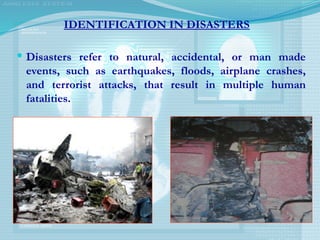
IDENTIFICATION IN DISASTERS
 Disasters refer to natural, accidental, or man made
events, such as earthquakes, floods, airplane crashes,
and terrorist attacks, that result in multiple human
fatalities.
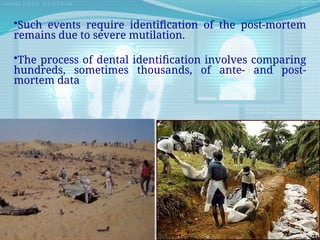
•Such events require identification of the post-mortem
remains due to severe mutilation.
•The process of dental identification involves comparing
hundreds, sometimes thousands, of ante- and post-
mortem data
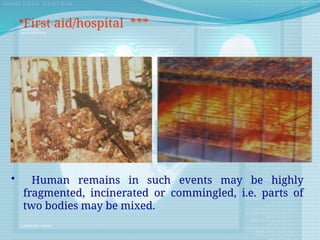
• Human remains in such events may be highly
fragmented, incinerated or commingled, i.e. parts of
two bodies may be mixed.
•First aid/hospital ***
 50 % of id in disasters are by dental means. Representation on the
dental section should be as broad as possible, and inclusion of
different specialists and dental auxiliaries can be useful.
 Each team member - familiar with procedures to be followed in a
disaster situation. Information about team activation, the tasks to be
performed, standardized charting methods, etc. should be known in
advance. Tasks may range from taking radiographs to performing
clerical duties.
 Forensic dentists are usually part of a team of identification
specialists that include anthropologists, and fingerprint experts,
radiologists, pathologist etc.,
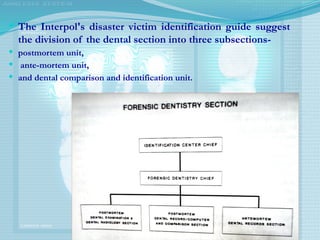
 The Interpol's disaster victim identification guide suggest
the division of the dental section into three subsections-
 post­
mortem unit,
 ante-mortem unit,
 and dental comparison and identification unit.
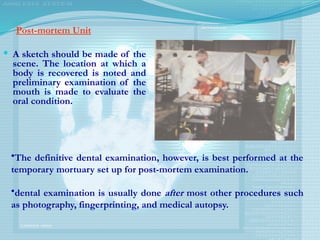
Post-mortem Unit
 A sketch should be made of the
scene. The location at which a
body is recovered is noted and
preliminary examination of the
mouth is made to evaluate the
oral condition.
•The definitive dental examination, however, is best performed at the
temporary mortuary set up for post-mortem examination.
•dental examination is usually done after most other procedures such
as photography, fingerprinting, and medical autopsy.
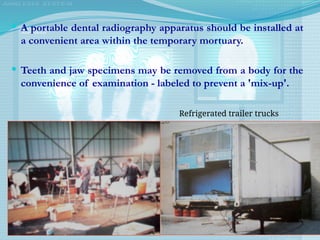
 A portable dental radiography apparatus should be installed at
a convenient area within the temporary mortuary.
 Teeth and jaw specimens may be removed from a body for the
convenience of examination - labeled to prevent a 'mix-up'.
Refrigerated trailer trucks
Ante-mortem Unit
 difficult.
 The members need to collect as much information as
possible in the shortest period of time.
 This begins with locating the dental records of the
victims, which requires an extensive network of
communication with the police, dentists, and relatives of
the victim.
 The dentist is requested to provide the written dental
records, radiographs, and study models to the ante-
mortem unit.
 Information - transferred onto the standard Interpol
ante-mortem form.
DRAWBACKS:
 The use of different types of tooth numbering system and
nonstandardized abbreviations
 While the FDI system is preferred, other numbering systems such
as Zsigmondy Palmer, ADA, are still employed in different
countries.
 The use of abbreviations for recording dental treatment is common
worldwide and varies from one dentist to another.
 This results in delayed identification or, worse,
nonidentification.
 A better solution is for the regional dental associations to
implement standardized codes for various surfaces of the
teeth as well as treatments performed.
DENTAL COMPARISON AND IDENTIFICATION UNIT
 Elimination of identification / confirmation.
 Done once all the post-mortem information is available. All ante-
mortem data may or may not be available.
 Manually or by computer aid.
 When there is a match, one must ensure that all sets of documents
relating to dental features are attached to the relevant sets of
documents for the rest of the body.
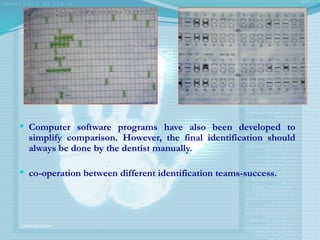
 Computer software programs have also been developed to
simplify comparison. However, the final identification should
always be done by the dentist manually.
 co-operation between different identification teams-success.
 Ante-mortem dental records are not traceable.
 Dental profiling includes extracting a triad of
information
1. The decedent's Ethnic origin
2. Gender
3. Age.
DENTAL PROFILING
I. Identifying Ethnic Origin from Teeth.
 Physically, humans are a diverse species. This diversity
is a result of genetic influences, as well as
environmental factors .
 The people of the world look different.
 Traditionally, the human species has been categorized
into three 'races'­Caucasoid, Mongoloid, and Negroid.
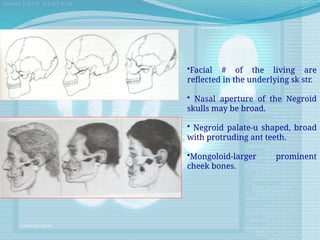
•Facial # of the living are
reflected in the underlying sk str.
• Nasal aperture of the Negroid
skulls may be broad.
• Negroid palate-u shaped, broad
with protruding ant teeth.
•Mongoloid-larger prominent
cheek bones.
GENETIC AND ENVIRONMENTAL INFLUENCES ON
TEETH
 Different populations show considerable diversity in their
dentition and several features have been grouped accordingly.
 Dental features used to describe population differences are
broadly categorized as metric and non metric.
DP
 Metric features are based on measurements, and non­
metric in
terms of presence or absence of a particular feature, e.g. whether
Carabelli's cusp is present or not.
 Metric features are considerably influenced by 'local'
environmental factors
 On the other hand, Non Metric features are more heritable,
therefore, dependable
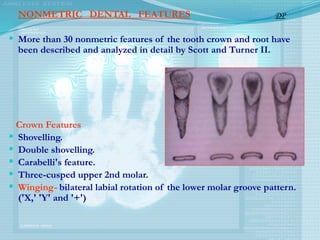
NONMETRIC DENTAL FEATURES
 More than 30 nonmetric features of the tooth crown and root have
been described and analyzed in detail by Scott and Turner II.
Crown Features
 Shovelling.
 Double shovelling.
 Carabelli's feature.
 Three-cusped upper 2nd molar.
 Winging- bilateral labial rotation of the lower molar groove pattern.
('X,' 'Y' and '+')
DP
 Lateral incisor variants: Include peg shaped, diminutive and
T-forms
 Parastyle: Tubercle on the buccal surface of the upper
molars.
 Protostylid: The presence of a tubercle on the mesiobuccal
cusp of the lower molars -lower first molar
ROOT FEATURES
 Two-rooted upper premolar.
 Two-rooted upper molar.
 Two-rooted lower canine.
 Tomes root: Presence of an extra root on the lower first
premolar.
 Three-rooted lower molar..
 Single-rooted lower molar.
DP
EUROPEAN, WEST- AND
SOUTH-ASIAN ORIGIN
 four-cusped lower second
molar
 two­
rooted lower canine
 Carabelli's feature
 three­
cusped upper second
molar
EAST-ASIANS
 Winging
 Shovelling
 double-shovelling
 interruption grooves
 enamel extensions
 three-rooted lower first
molar
 three-cusped upper 2nd
molar
 single-rooted lower second
molar
DP
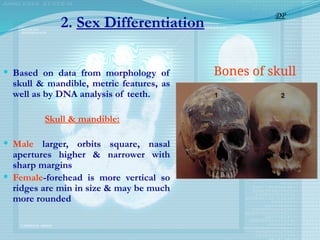
2. Sex Differentiation
 Based on data from morphology of
skull & mandible, metric features, as
well as by DNA analysis of teeth.
Skull & mandible:
 Male larger, orbits square, nasal
apertures higher & narrower with
sharp margins
 Female-forehead is more vertical so
ridges are min in size & may be much
more rounded
Bones of skull
DP
CRANIOFACIAL DIMENSIONS
 Are not reliable until well after puberty.
 Affected by old age changes.
 Lateral cephalometric tracings-99 per cent success
 Max length of the skull- In general, the male skull is larger, with
an endocranial volume about 200cc more than that of females.
DP
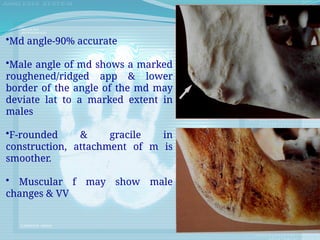
•Md angle-90% accurate
•Male angle of md shows a marked
roughened/ridged app & lower
border of the angle of the md may
deviate lat to a marked extent in
males
•F-rounded & gracile in
construction, attachment of m is
smoother.
• Muscular f may show male
changes & VV
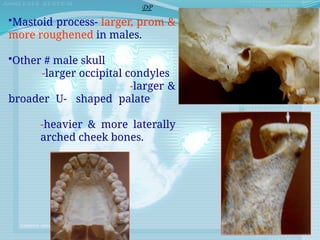
•Mastoid process- larger, prom &
more roughened in males.
•Other # male skull
-larger occipital condyles
-larger &
broader U- shaped palate
-heavier & more laterally
arched cheek bones.
DP
SEX DIFFERENCES IN TOOTH SIZE
 Studies show significant differences between male and female
permanent and deciduous tooth crown dimension
 Tooth size, or odontometrics , is under considerable influence of the
environment.
 The canines consistently show the maximum sex difference.
 Premolars, first and second molars as well as maxillary incisors are
also known to have significant differences.
DP
TOOTH MORPHOLOGY AND SEXING
 'Distal Accessory ridge', a nonmetric feature on the canine "is the most
sexually dimorphic crown trait in the human dentition, with males
showing significantly higher frequencies and more pronounced
expression than females".
 Greater absence of the distobuccal cusp or distal cusp on the
mandibular first molar in females (40.6 per cent) compared to males
(16.2 per cent) in a south Indian population.
 The reduction in the number of cusps is a reflection of an evolutionary
trend towards overall reduction in the size of the lower face, with males
apparently resisting this trend.
DP
DENTAL INDEX
 In addition to absolute tooth size, tooth proportions have
been suggested for differentiating the sexes.
AITCHISON - 'INCISOR INDEX'
 Ii = [MDI2
/ MDI1
] X 100
 Higher in males
DP
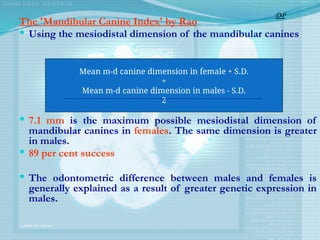
The 'Mandibular Canine Index' by Rao
 Using the mesiodistal dimension of the mandibular canines
 7.1 mm is the maximum possible mesiodistal dimension of
mandibular canines in females. The same dimension is greater
in males.
 89 per cent success
 The odontometric difference between males and females is
generally explained as a result of greater genetic expression in
males.
DP
Mean m-d canine dimension in female + S.D.
+
Mean m-d canine dimension in males - S.D.
2
SEX DETERMINATION BY DNA ANALYSIS
CDI
•DNA is a robust mol which can tolerate a remarkable range of temp,
pH, salt & other factors that destroy classical serological markers.
•Validation testing has shown that DNA mixed with detergents, oil,
gasoline & other adulterants did not alter its typing cha.
• Indeed it is this ruggedness which allows DNA longevity & has
permitted DNA typing of Egyptian mummies & 30 million year old
insects preserved in amber.
•Decedent’s ante-mortem sample is unavailable, the DNA pattern may
be compared to a parent or to a sibling
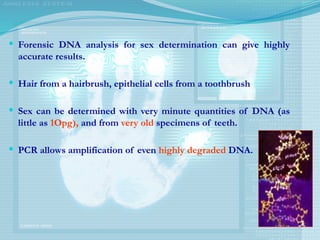
 Forensic DNA analysis for sex determination can give highly
accurate results.
 Hair from a hairbrush, epithelial cells from a toothbrush
 Sex can be determined with very minute quantities of DNA (as
little as 1Opg), and from very old specimens of teeth.
 PCR allows amplification of even highly degraded DNA.
Types of DNA:
 Genomic or Nuclear DNA: Commonly used in forensic cases.
 Mitochondrial DNA (mtDNA), While any given cell has a single
nucleus, each cell has a high copy number of mtDNA, e.g.
epithelial cells contain 5000 mtDNA molecules.
 substitute
CDI
 Sivagami and coworkers state, "amelogenin (AMEL) is one of the
major matrix proteins secreted by the ameloblasts of the enamel.
 The AMEL gene, coding for a highly conserved protein, is located on
the X- and the Y-chromosomes in humans.
 The two alleles are similar for the exonic sequences but differ in the
intronic sequences. Thus the females (XX) have two identical AMEL
genes but the males (XY) have two nonidentical genes.
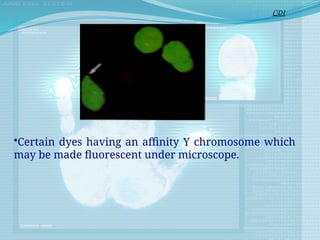
•Certain dyes having an affinity Y chromosome which
may be made fluorescent under microscope.
CDI
 RFLP (restriction fragment length polymorphism)/southern blotting:
-limited value in cadaveric tissue unless the remains are fresh since
DNA rapidly breaks down after death.
 Dot/blots: sequence info can be obtained by DNA probes (small piece
of single stranded DNA which will bind to another with the
complementary sequence)
- rapid, reasonably well - on degraded samples.
 STRs/short tandem repeat: significant degradation, quite amenable to
automation
CDI
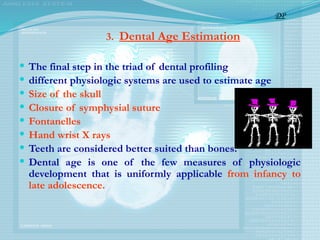
3. Dental Age Estimation
 The final step in the triad of dental profiling
 different physiologic systems are used to estimate age
 Size of the skull
 Closure of symphysial suture
 Fontanelles
 Hand wrist X rays
 Teeth are considered better suited than bones.
 Dental age is one of the few measures of physiologic
development that is uniformly applicable from infancy to
late adolescence.
DP
APPLICATION OF AGE ESTIMATION:
 Treatment planning
 Legal applications-
-crime investigation
-school admission
-marriage
-employment
Living
DP
 Dental age estimation makes use of morphologic,
radiographic, histological, and biochemical methods to
examine age dependant changes in teeth
Age estimation using the dentition may be grouped into three
phases:
1. Ageing in prenatal, neonatal and early postnatal
2. Age estimation in children and adolescents
-first 2 decades (teenage)
-3rd
molars in age estimation
3. Age estimation in adults.
2 imp events
 Calcification & Emergence of dec & perm teeth
 Calcification is preferred & is reliable compared to emergence
DP
 Emergence is a convenient clinical method-It involves visual
assessment of teeth present in the mouth and requires little
expertise or equipment.
 The use of tooth emergence for age estimation should,
however, be limited to deciduous teeth. Their emergence is
under genetic control and is relatively regular
 On the other hand, emergence patterns of permanent teeth are
under the influence of the intraoral environment, being
affected by infection, arch space, and premature tooth loss.
DP
 Therefore, evaluation of radiographs to assess tooth
calcification is a much better alternative since calcification
of teeth can be observed from radiographs for a period of
Several years
 It is not altered by local factors such as lack of space,
infection, etc.,
 And the study of tooth calcification also lets us assess age
at periods when no emergence takes place (2.5-6 years and
> 12 years).
DP
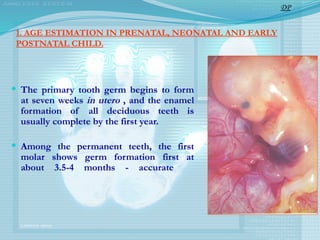
1. AGE ESTIMATION IN PRENATAL, NEONATAL AND EARLY
POSTNATAL CHILD.
 The primary tooth germ begins to form
at seven weeks in utero , and the enamel
formation of all deciduous teeth is
usually complete by the first year.
 Among the permanent teeth, the first
molar shows germ formation first at
about 3.5-4 months - accurate
DP
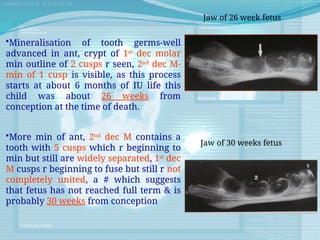
Jaw of 26 week fetus
Jaw of 30 weeks fetus
•Mineralisation of tooth germs-well
advanced in ant, crypt of 1st
dec molar
min outline of 2 cusps r seen, 2nd
dec M-
min of 1 cusp is visible, as this process
starts at about 6 months of IU life this
child was about 26 weeks from
conception at the time of death.
•More min of ant, 2nd
dec M contains a
tooth with 5 cusps which r beginning to
min but still are widely separated, 1st
dec
M cusps r beginning to fuse but still r not
completely united, a # which suggests
that fetus has not reached full term & is
probably 30 weeks from conception
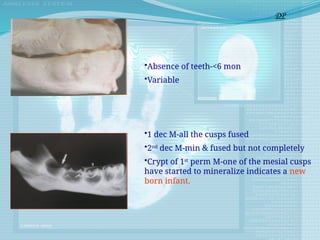
•Absence of teeth-<6 mon
•Variable
•1 dec M-all the cusps fused
•2nd
dec M-min & fused but not completely
•Crypt of 1st
perm M-one of the mesial cusps
have started to mineralize indicates a new
born infant.
DP
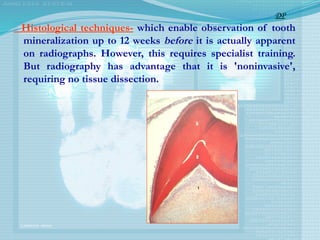
Histological techniques- which enable observation of tooth
mineralization up to 12 weeks before it is actually apparent
on radiographs. However, this requires specialist training.
But radiography has advantage that it is 'noninvasive',
requiring no tissue dissection.
DP
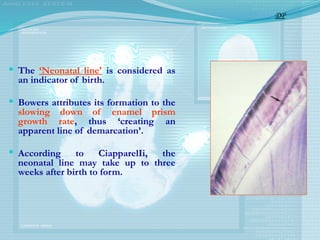
 The ‘Neonatal line' is considered as
an indicator of birth.
 Bowers attributes its formation to the
slowing down of enamel prism
growth rate, thus ‘creating an
apparent line of demarcation’.
 According to CiapparelIi, the
neonatal line may take up to three
weeks after birth to form.
DP
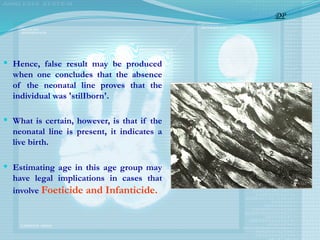
 Hence, false result may be produced
when one concludes that the absence
of the neonatal line proves that the
individual was 'stilIborn'.
 What is certain, however, is that if the
neonatal line is present, it indicates a
live birth.
 Estimating age in this age group may
have legal implications in cases that
involve Foeticide and Infanticide.
DP
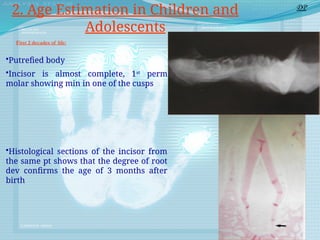
First 2 decades of life:
•Putrefied body
•Incisor is almost complete, 1st
perm
molar showing min in one of the cusps
•Histological sections of the incisor from
the same pt shows that the degree of root
dev confirms the age of 3 months after
birth
DP
2. Age Estimation in Children and
Adolescents
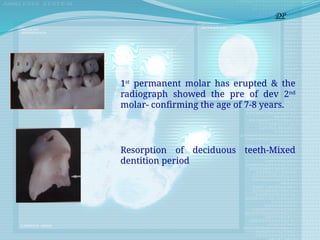
1st
permanent molar has erupted & the
radiograph showed the pre of dev 2nd
molar- confirming the age of 7-8 years.
Resorption of deciduous teeth-Mixed
dentition period
DP
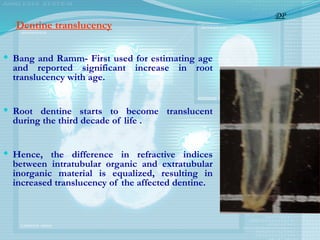
Dentine translucency
 Bang and Ramm- First used for estimating age
and reported significant increase in root
translucency with age.
 Root dentine starts to become translucent
during the third decade of life .
 Hence, the difference in refractive indices
between intratubular organic and extratubular
inorganic material is equalized, resulting in
increased translucency of the affected dentine.
DP
 For age estimation, Solheim suggested translucency length (in
mm) or area (in mm2) may be measured on intact or sectioned
teeth. These variables may be measured either manually or by
computer image analysis. Length of translucency had a greater
correlation to age, for which two equations were given:
 for zones of translucency ≤ 9 mm,
 and for zones > 9 mm,
 where Bo is a regression constant, B1 and B2 are regression
coefficients, and X is the translucency length.
Age = Bo + B1X+B2X2
Age = Bo + B1X
DP
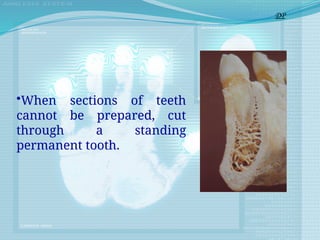
•When sections of teeth
cannot be prepared, cut
through a standing
permanent tooth.
DP
DISADVANTAGES:
 Irregular junction of translucent and non­
translucent zones,
thereby making it difficult to measure the length.
 Underestimation of age in older age groups. This could be due to
slowing down of dentinal sclerosis, since most of the root would
already be sclerosed by old age, thus restricting further increase
in translucency.
DP
Incremental lines of cementum.
 Use of mineralized, unstained cross-sections of teeth, preferably
mandibular central incisors and third molars.
 An accuracy of within two to three years of the actual chronologic
age.
 However, the pathologic state of the periodontium and/or
desmodontium may compromise the precision of ageing.
DP
 In addition to age, hypo mineralized bands in these incremental lines
gave an indication of events such as pregnancies, skeletal trauma, and
renal disorders, which could be accurately dated to an individual's life-
history, thus facilitating identification.
 A major disadvantage of the above methods of estimating age in adults
is the necessity to extract and/or section the teeth.
 While this is possible in the dead, it is not practical among living adults
DP
RADIOGRAPHIC METHOD OF KVAAL AND
ASSOCIATES.
 Nondestructive technique, used pulp size measurement of six teeth
Maxillary central and lateral incisor,
Second premolar;
Mandibular incisor,
Lateral incisor,
Canine, and First premolar observed on periapical
radiographs.
 The measurements included several length and width ratios used in
order to compensate for magnification and angulation errors of teeth
on the radiograph.
DP
 pulp-root length (P)
 pulp-tooth length (R)
 tooth-root length (T)
 pulp-root width at CE] (A)
 pulp-root width at mid-root level (C)
 pulp­
root width at mid-point between level C and A (B)
 Mean value of all ratios excluding T (M)
 Mean value of width ratios Band C (W)
 Mean value of length ratios P and R (L).
When six teeth (right or left side) from both jaws are available, the
following regression formula can be used:
Age = 129.8-316.4(M)-66.8(W-L).
DP
AMINO ACID RACEMISATION
 Relationship between dentinal age and the extent of aspartic acid
racemisation in dentine.
 All humans use amino acids exclusively in protein synthesis.
 Aspartic acid is an amino acid that has a rapid rate of racemisation,
i.e. it gets spontaneously converted from one type (L­
aspartic acid)
to another (D-aspartic acid) with increasing age.
DP
 Therefore, there is a constant change in the ratio of L- and D-
aspartic acid at different ages and this D-L ratio may be used for
age estimation.
 D-L ratio can be measured in those proteins that are synthesized
early in life and are not replaced. Such proteins are found in brain
cells, bone and teeth. Racemization rate of aspartic acid is high
in root dentine.
 Estimates age within plus/minus three years of the actual age.
OTHER METHODS
 Spectroradiometry- objective method for dentine color
measurements.
 Dentinal colors white, cream, and yellow - associated with age 12-37
years
 while dark yellow and brown were associated with the age-group 55-
64 years.
 Color changes in the dentine and cementum may be caused by
infusion of decomposition products from erythrocytes such as
PORPHYRINS, which fluoresce.
 There is a strong correlation between deepening of the tooth color
(i.e. increased yellowing of the roots) and increase in fluorescence
intensity with age.
DP
The keys to optimal dental age estimation suggested by Williams and
associates:
1. The investigator should be sufficiently experienced.
2. Multiple investigators or a second opinion is important.
3. Use of multiple age estimation methods.
4. Careful adherence to suggested protocol, including use of specific
equipment and proper storage of tooth specimens.
5. Use of multiple teeth.
DP
CRIME INVESTIGATION
 A vital role the forensic dentist plays is in Criminal
investigation Includes:
 the investigation of LIP PRINTS
 BITE MARKS
 CHILD ABUSE
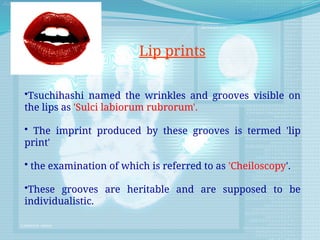
•Tsuchihashi named the wrinkles and grooves visible on
the lips as 'Sulci labiorum rubrorum'.
• The imprint produced by these grooves is termed 'lip
print'
• the examination of which is referred to as 'Cheiloscopy'.
•These grooves are heritable and are supposed to be
individualistic.
Lip prints
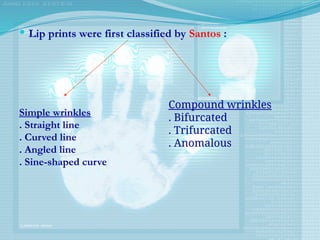
 Lip prints were first classified by Santos :
Simple wrinkles
. Straight line
. Curved line
. Angled line
. Sine-shaped curve
Compound wrinkles
. Bifurcated
. Trifurcated
. Anomalous
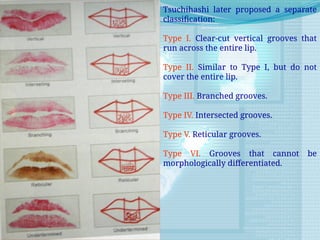
Tsuchihashi later proposed a separate
classification:
Type I. Clear-cut vertical grooves that
run across the entire lip.
Type II. Similar to Type I, but do not
cover the entire lip.
Type III. Branched grooves.
Type IV. Intersected grooves.
Type V. Reticular grooves.
Type VI. Grooves that cannot be
morphologically differentiated.
 A combination of these grooves may be found in any given set of
lips.
 Lips are divided into quadrants similar to the dentition-a
horizontal line dividing the upper and lower lip and a vertical line
dividing right and left sides.
 By noting the type of groove in each quadrant, the individual's lip
print pattern may be recorded.
 lipsticks have been developed that do not leave any visible
trace after contact with surfaces such as glass, clothing,
cutlery, or cigarette butts
 Alvarez and associates - 'persistent' lip prints.
 Can be 'lifted' by aluminium powder and magnetic powder.
 Use of lipsticks is not indispensable for leaving lip prints-
Ball states that the vermilion border has minor salivary
glands, and the edges of the lips have sebaceous glands,
with sweat glands in between.
 One may, therefore, assume that secretions of oil and
moisture from these enable development of 'latent' lip
prints, analogous to latent fingerprints, in most crime
scenes where close contact between the victim and culprit
has occurred.
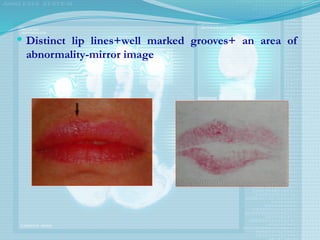
 Distinct lip lines+well marked grooves+ an area of
abnormality-mirror image
 However, a major disadvantage pertains to uncertainty about the
permanence of Lip patterns.
 Major trauma, pathosis and the surgical treatment rendered to
correct the pathosis, affect the size and shape of the lip, thereby may
alter the pattern and morphology of the grooves.
 The prints produced may differ in appearance depending on the
pressure applied and its direction. Hence, lip prints caused by one
individual may be mistakenly identified as those from another.
 Therefore, this sub-specialty of forensic odontology required further
study-first, to comprehensively establish the uniqueness of lip
grooves.
BITE MARKS
 Defined by MacDonald “a mark caused by the teeth either alone
or in combination with other mouth parts".
 Biting is considered to be a primitive type of assault and result
when teeth are employed as a weapon in an act of dominance or
desperation.
 Can be caused by humans or animals; they may be on tissue, food
items, or other objects.
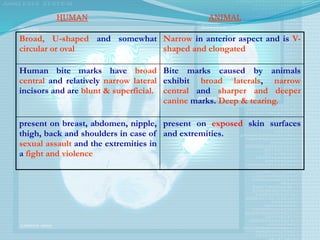
Broad, U-shaped and some­
what
circular or oval
Narrow in anterior aspect and is V-
shaped and elongated
Human bite marks have broad
central and relatively narrow lateral
incisors and are blunt & superficial.
Bite marks caused by animals
exhibit broad laterals, narrow
central and sharper and deeper
canine marks. Deep & tearing.
present on breast, abdomen, nipple,
thigh, back and shoulders in case of
sexual assault and the extremities in
a fight and violence
present on exposed skin surfaces
and extremities.
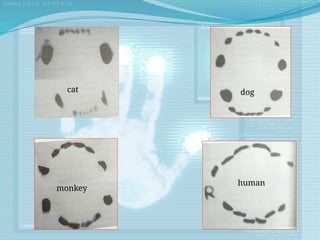
HUMAN ANIMAL
cat dog
monkey
human
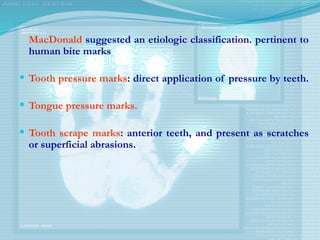
MacDonald suggested an etiologic classification. pertinent to
human bite marks
 Tooth pressure marks: direct application of pressure by teeth.
 Tongue pressure marks.
 Tooth scrape marks: anterior teeth, and present as scratches
or superficial abrasions.
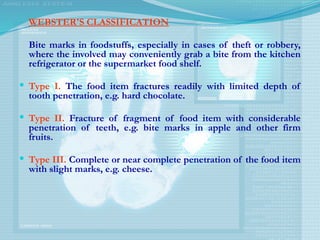
WEBSTER'S CLASSIFICATION
Bite marks in foodstuffs, especially in cases of theft or robbery,
where the involved may conveniently grab a bite from the kitchen
refrigerator or the supermarket food shelf.
 Type I. The food item fractures readily with limited depth of
tooth penetration, e.g. hard chocolate.
 Type II. Fracture of fragment of food item with considerable
penetration of teeth, e.g. bite marks in apple and other firm
fruits.
 Type III. Complete or near complete penetration of the food item
with slight marks, e.g. cheese.
Compression of skin-Tooth pressure -causes indentations
edema
contusions or bruises (SC bleeding-
bluish/purplish)
 When the intensity of the bite is great, there may be a break in
the integrity of skin surface, resulting in lacerations.
 The most extreme form of bite mark injury is avulsion, where
part of the tissue is bitten off.
Few min Elastic nature
Brief period obscures
FEATURES OF HUMAN BITE MARK:
 Class features. The pattern present in the bite mark may vary in size
and shape. This enables one to differentiate between different types of
teeth.
Incisors produce rectangular marks
Canines are triangular or rectangular, depending on the
amount of attrition
Premolars and Molars are spherical or point- shaped.
 Individual features. Class features may, in turn, have characteristics
such as fractures, rotations, etc. Such features are known as individual
features and they make the bite mark distinct.
Bites and Child Abuse
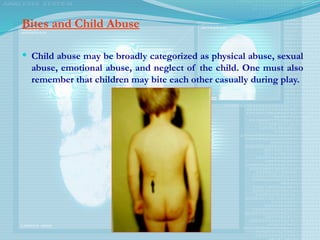
 Child abuse may be broadly categorized as physical abuse, sexual
abuse, emotional abuse, and neglect of the child. One must also
remember that children may bite each other casually during play.
 Visual Examination.
 Type of injury-petechiae, contusion, abrasion, laceration, incision,
avulsion
 Contour, texture, and elasticity of the bite site
 Physical appearance (color and size), orientation, and location
 Differences between upper and lower arches, and between individual
teeth.
 Photography : provide a permanent record of the appearance of bite
marks. No time should be lost in obtaining photographs, as the injury
rapidly changes appearance due to healing.
Examining a bite mark:
 Saliva deposited on skin may have WBCs and sloughed epithelial cells.
These are a potential source of DNA, thus enabling a direct link to the
suspect.
 Care should be taken not to wash the bite area before saliva swabbing.
 A cotton swab moistened with distilled water should be used for
swabbing. This rehydrates the dry cells in the bite area.
 The swab is then labeled and stored in a refrigerator. The latter prevents
degradation of salivary DNA and bacterial growth.
 If the bite has occurred through clothing, the clothes must also be
swabbed for saliva.
 The use of high intensity alternative light source (such as UV light) to
locate stains from body fluids enable saliva traces to be recovered even in
the absence of visible bite marks.
Saliva Swab.
Impressions.
 Impression of the bite area should be made when tooth
indentations exist.
 The material of choice is Vinyl Polysiloxane.
 The impression material should be reinforced with dental stone,
self-cure acrylic, or impression compound to prevent against
dimensional change.
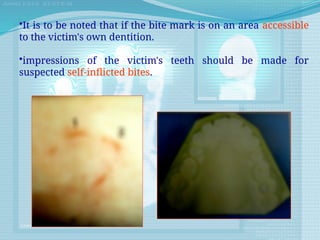
•It is to be noted that if the bite mark is on an area accessible
to the victim's own dentition.
•impressions of the victim's teeth should be made for
suspected self-inflicted bites.
EVIDENCE COLLECTION FROM THE SUSPECT.
 Informed consent or a court order (warrant).
The items of evidence recovered should include:
 Photographs of the suspect's teeth, in occlusion and in open bite.
 Maxillary and mandibular impressions made with rubber-based
material, and models poured in dental stone. It is advisable to pour at
least two casts of the suspect as a back-up.
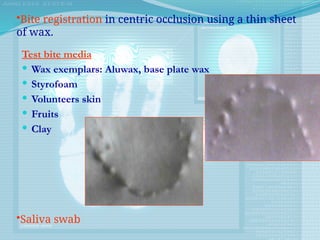
Test bite media
 Wax exemplars: Aluwax, base plate wax
 Styrofoam
 Volunteers skin
 Fruits
 Clay
•Bite registration in centric occlusion using a thin sheet
of wax.
•Saliva swab
BITE MARK ANALYSIS AND COMPARISON
 The dynamics of biting make analysis of the bite mark and its
comparison to the suspect's teeth challenging.
 In addition to jaw movements, one needs to consider movement on
part of the victim, the flexibility of the bitten tissue, as well as
distortion introduced during photography.
 Bearing this in mind, one may proceed with the analysis.
Tech aids employed for analysis:
-Transillumination of tissue
-Computer enhancement &/or digitization of mark &/or teeth
-Stereomicroscopy &/or macroscopy
-SEM
-Videotape
-Caliper for measurement
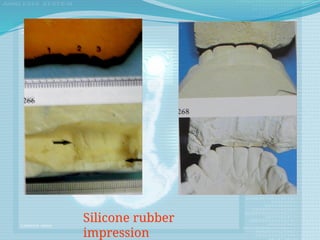
Silicone rubber
impression
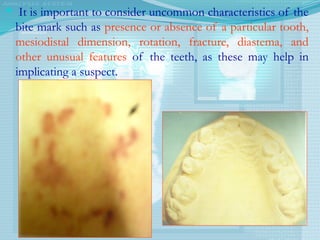
 It is important to consider uncommon characteristics of the
bite mark such as presence or absence of a particular tooth,
mesiodistal dimension, rotation, fracture, diastema, and
other unusual features of the teeth, as these may help in
implicating a suspect.
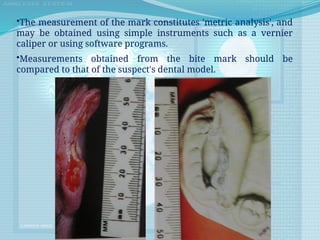
•The measurement of the mark constitutes 'metric analysis', and
may be obtained using simple instruments such as a vernier
caliper or using software programs.
•Measurements obtained from the bite mark should be
compared to that of the suspect's dental model.
 Metric analysis, ideally, should not be used alone, but in conjunction with
'pattern association', which involves matching the pattern of bite injury to
the arrangement of teeth in the suspect's dentition.
 Ciapparelli and Hughes have described 'direct methods' of comparison,
where the suspect's models were placed directly over the bite mark
photograph or on the bite mark itself, i.e. in situ.
 the incisal and occlusal edges of the suspect's teeth were traced onto clear
acetate and superimposed on life-sized bite mark photographs. This
constitutes the indirect method.
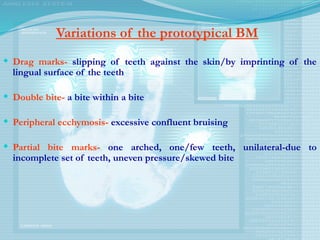
Variations of the prototypical BM
 Drag marks- slipping of teeth against the skin/by imprinting of the
lingual surface of the teeth
 Double bite- a bite within a bite
 Peripheral ecchymosis- excessive confluent bruising
 Partial bite marks- one arched, one/few teeth, unilateral-due to
incomplete set of teeth, uneven pressure/skewed bite
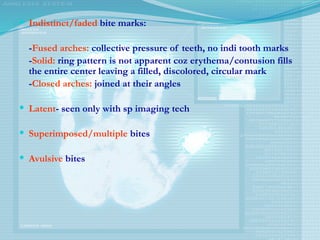
 Indistinct/faded bite marks:
-Fused arches: collective pressure of teeth, no indi tooth marks
-Solid: ring pattern is not apparent coz erythema/contusion fills
the entire center leaving a filled, discolored, circular mark
-Closed arches: joined at their angles
 Latent- seen only with sp imaging tech
 Superimposed/multiple bites
 Avulsive bites
 Terms indicate degree of confidence that an injury is a bite
mark:
 Possible BM: an injury showing a pattern that may/may not be
caused by teeth
 Criteria:
-gen shape & size are pre but distinctive # such as tooth marks
are missing
-incomplete, distorted/a few marks resembling tooth marks
are pre but arch configuration is missing
 Probable BM: the pattern suggests/supports origin from teeth but
could conceivably be caused by something else
 Cri: pattern shows some, basic, gen cha of teeth arranged around
arches
 Definite BM: there is no reasonable doubt that teeth created the
pattern, other possibilities were considered & excluded
 Cri: pattern conclusively illustrates (classic #, all the cha, typical class
cha) of dental arches & human teeth in proper arrangement so that it
is recognizable as an impression of the human dentition
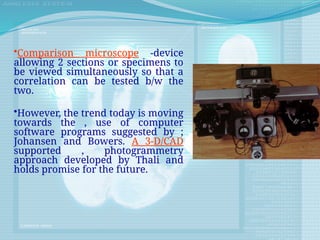
•Comparison microscope -device
allowing 2 sections or specimens to
be viewed simultaneously so that a
correlation can be tested b/w the
two.
•However, the trend today is moving
towards the , use of computer
software programs suggested by ;
Johansen and Bowers. A 3-D/CAD
supported , photogrammetry
approach developed by Thali and
holds promise for the future.
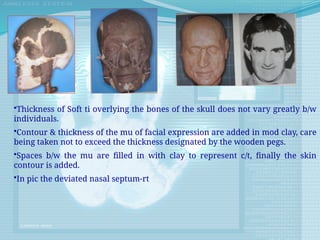
•Thickness of Soft ti overlying the bones of the skull does not vary greatly b/w
individuals.
•Contour & thickness of the mu of facial expression are added in mod clay, care
being taken not to exceed the thickness designated by the wooden pegs.
•Spaces b/w the mu are filled in with clay to represent c/t, finally the skin
contour is added.
•In pic the deviated nasal septum-rt
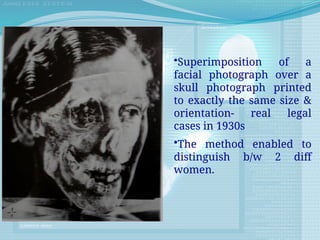
•Superimposition of a
facial photograph over a
skull photograph printed
to exactly the same size &
orientation- real legal
cases in 1930s
•The method enabled to
distinguish b/w 2 diff
women.
THE DENTIST AS AN EXPERT WITNESS
 Forensic dentists, who are associated with identification and crime
investigation, are usually required to provide testimony in the court
of law in the capacity of an 'expert witness'.
 i.e. an expert witness is one who gives an opinion on facts that fall
within the realm of his/her particular profession or specialization.
 the expert witness may appear for the prosecution or for the defense.
 questioning by the lawyers of the opposing side
cross-examination
 The opposition counsel may indulge in character assassination,
trying to weaken the expert witness and the evidence that is
presented.
 It is advisable to control one's temper, keep calm, and be
dispassionate.
 and should never try to guess answers, or answer questions that are
beyond one's expertise. To do so could be disastrous, with the
opposing lawyer taking full advantage to undermine the expert's
credibility.
 Opinion should be presented in such a way that it is accurate and yet
simple enough for the layman to understand.
 never to discuss matters pertaining to a case with anybody
 To summarize, the expert witness in particular and the forensic dentist
in general, must be professional, unbiased, ethical, and truthful
“In nature’s infinite
book of secrecy a little I
can read”
References
 Forensic Dentistry: Paul G Stimson, Curtis A
Mertz, NY 1997
 Forensic Medicine- A Guide to Principles-Gordon
& Shapiro, 2 ed, 1982
 A color atlas of Forensic Dentistry-D K Whittaker,
D G Mac Donald 1989
 Shafer’s Text book of Oral Pathology, 5th
ed,
Rajendran & Sivapathasundaram
 Forensic art & illustration- Karen T. Taylor, 2000
 Textbook of Forensic Odontology- Pramod K
Dayal,1st
ed, 1998
 The Human Skeleton in Forensic Medicine- Wilton
Marion Krogman
 Simpson’s Forensic Medicine-Richard Shepherd
 Google search
Thank you…

Forensic Odontology.pptx for BDS students

  • 1.
  • 2.
  • 3.
    •Introduction •History •Need •Identification 1. Comparative- Disastersite 2. Dental Profiling- Ethnicity Tooth Morphology & Sexing Dental age estimation methods •Crime inv- bite mark & lip print analysis •Conclusion •References
  • 4.
    Latin word forum= public square
  • 5.
     FDI -'thatbranch of dentistry which, in the interest of justice, deals with the proper handling and examination of dental evidence, and with the proper evaluation and presentation of dental findings'.  It primarily deals with identification, based on recognition of unique features present in an individual's dental structures.  It relies on sound knowledge of the teeth and jaws, possessed by dentists and incorporates dental anatomy, histology, radiography, pathology, dental materials, and developmental anomalies.
  • 6.
     Bible- bitemark by Adam  The earliest identification by dental means -66 AD, Roman queen  1193 Maharaja of Conouj –Jai Chandra Rathore was id in the warfield by enemy troop by his golden crown  1775 Battle of Bunkers hill - Paul Revere id Joseph’s body by his amalgam bridge. HISTORY…
  • 7.
     The mosthigh profile case of dental identification - Adolph Hitler  Elaborate dental records including radiographs and spare crowns
  • 8.
     Dentition wasan imp lead in the id of the remains of various leaders who were killed like Zia Ul Haq(1988), former Paki president & Rajeev Gandhi, former Indian prime minister(1991).
  • 9.
    •Nothing has brought theFD to the emerging front like the sep 11 attack on WTC
  • 10.
    FORENSIC ODONTOLOGISTS DELVEINTO:  Identifying unknown human remains through dental records, and assisting at the location of a mass disaster.  Eliciting the ethnicity and assisting in building up a picture of lifestyle and diet of skeletal remains at archaeological sites.  Determining the gender of unidentified individuals.  Age estimation of both the living and the deceased.  Recognition and analysis of bite marks found on victims of attacks and in other substances such as foodstuffs.  Presenting evidence in court as an expert witness.
  • 11.
    Identification  Establishment ofa person's individuality.  He who has gone, so we but cherish his memory, abides with us, more potent, nay, more present than the living man. ~Antoine de saint  Proper identification of the dead - legal and humanitarian reasons.
  • 12.
    • Most partsof the body undergo changes as the individual ages & are replaced/recycled depending on tissue involved. • The teeth are unique in that once physiological/growth information is built into them they may remain stable for thousands of years even after death. • Teeth - strongest structures+ most materials used by the dentist for restoring teeth are resistant to post-mortem decomposition. • Traditional methods of identification have included visually recognizing the body, fingerprints and personal property such as clothing, jewellery, etc.
  • 13.
    •When facial forms& finger prints fail-dentition enters the scene •Identifying a body that is burned/ traumatized or decomposed & skeletonized remains - can be a very traumatic experience for relatives and friends
  • 14.
    Basis for DentalIdentification  Theory that human dentition is never the same in any two individuals.  The morphology and arrangement of teeth vary from person to person.  Although teeth are relatively resistant to environmental insults after death, during life they are susceptible to physiological and pathological changes.  Restorations, teeth that cannot be restored may have been extracted .
  • 15.
     combinations 16missing teeth -600 million.  Sixteen filled teeth produce a similar combination.  Four missing and four filled teeth in a mouth combined can produce more than 700 million combinations.
  • 16.
     Now, everytooth has five surfaces. If, instead of considering the whole tooth, the surfaces were taken individually, the variations produced would be astronomic.  In fact, there are 1.8 X 10¹⁹ possible combinations of 32 teeth being intact, decayed, missing or filled.
  • 17.
    DENTAL IDENTIFICATION PROCEDURES 1.Comparativeidentification: attempts conclusive identification by comparing the dead individual's teeth with presumed dental records of the individual. 2.Reconstructive identification or Dental Profiling: attempts to elicit the ethnicity or 'race‘, gender, age, and occupation of the dead individual. This is undertaken when virtually no clue exists about the identity of the deceased.
  • 18.
    Comparative dental identification Conventional method of post-mortem dental identification Four steps: 1. Oral autopsy 2. Obtaining dental records 3. Comparing post and ante-mortem dental data 4. Writing a report and drawing conclusions.
  • 19.
    I. Oral autopsy Autopsy (necropsy or post-mortem) involves examination of the deceased, usually with dissection to expose the organs, to determine the cause of death.  FD is invited to assist in a particular case investigated by the police/forensic pathologist.  Dentist is rarely the first expert to be called… CDI
  • 20.
     Protective clothing Lip retractors, tongue blade, rubber mouth props, mouth gag-forceps/screw ty.  Dental instruments-mouth mirrors, tweezers, probes, excavators, plastic instruments, surgical knives, scissors, dental Xn forceps+ elevators, swabs & cotton pellets. EQUIPMENT & EXAMINATION
  • 21.
     Impression materials. Photography: police photographer/professional.  Centimeter scale is included within the frame of the photograph  + tracings & labelled sketches of imp features on transparent overlays. CDI
  • 22.
    EXAMINATION OF THEBODY  Same sequence as a living person is examined. EO + IO followed by radiographs & other techniques.  The whole body exam - bite marks  Impression of the bite mark -silicone rubber is injected on to the area & this flexible impression has to be backed with strips of Plaster of Paris for rigidity. CDI
  • 23.
    IO Examination  Essentialpart of the post-mortem procedure.  The forensic dentist should have adequate knowledge about common post-mortem findings such as rigor mortis, livor mortis, decomposition, & post-mortem artifacts. CDI
  • 24.
     Rigor mortismay render the jaws rigid and the use of mouth-gags, or intraoral myotomy is essential for jaw separation. CDI • Since teeth may be brittle in burned cases, they need to be enforced with cyanoacrylate cement, polyvinyl acetate, or clear acrylic spray paint prior to examination. • Access for radiography in incinerated bodies can be obtained by removing the tongue and contents of the floor of the mouth in a 'tunneling' fashion from beneath the chin.
  • 25.
     Every surfaceshould be cleansed before examination  Debris, blood, soil- toothbrush + soapy water  Distribution, color & type of stains on teeth-tobacco, beverages, medicaments  Periodontal condition, gingival attachment - Oral hygiene CDI
  • 26.
    Soft Tissue tobe examined for any trauma, pigmentations, tattoos CDI
  • 27.
    Mucosal disease, Palate-smoking& Drug induced soft tissue changes CDI
  • 28.
    TOOTH STATUS  Occlusion- Malocclusion  Deciduous/permanent teeth  the status of each tooth (whether intact, carious, restored or missing) should be carefully noted.  Unerupted teeth  Dev missing teeth CDI
  • 29.
    •The absence ofa tooth in an unidentified body when compared with the ante-mortem dental records does not rule out an id. It is necessary to be able to determine if it was lost before /after death. •If the margins of the empty tooth socket are sharp & unresorbed, the tooth was probably lost after death. •Resorption & remodeling of the socket margins would indicate that the tooth was lost before death.
  • 30.
     Diastema  Supernumeraryteeth  Extra cusp  Carabelli  Fused/geminated teeth  Macrodontia  Hereditary condition : AI, DI  unusual wear & trauma  Occupational habits  Tooth Mobility+fracture –assault/injury  Non-vitality CDI
  • 31.
    Tooth restorations  Amalgam Tooth col restoration  Disclosing solution- boundaries of composite restoration  Porcelain/acrylic crowns- margins  Gold crown  Bridge  RCT CDI
  • 32.
    •Cases when toothis broken-part of restoration/even the lining cement present will indicate a previous restoration.
  • 33.
     Fire -metal act diff, mercury in amalgam may vaporize. Teeth incinerated at 600 o c-chalky white, extremely friable. Piece of amalgam still visible.
  • 34.
  • 35.
    The Palatal Rugae& Dentures  In identifying edentulous individuals. Rugae pattern, like teeth, are considered unique to an individual. They do not change shape with age and reappear after trauma or surgical procedures. CDI •The rugae pattern on the deceased's maxilla or maxillary denture may be compared to old dentures that may be recovered from the decedent's residence, or plaster models that may be available with the treating dentist. •Palatal rugae are well protected by the lips, cheek, tongue, buccal pad of fat, and teeth in incidents of fire and high-impact trauma.
  • 36.
    •Some dentures willhave the patients name written or embossed on. •Some dentures will show signs of having been repaired •The dentist can id if its his work CDI
  • 37.
    •All findings recon chart- assistant CDI
  • 38.
    RADIOGRAPHY  Skeletonized remainsprovide the easiest access for dental examination  Skull & mandible can be readily transported - portable machine in the mortuary is inadequate  Decomposed & unpleasant nature of the specimens requiring id- cover the instruments in plastic sheeting CDI
  • 39.
    Method to takean IOPA R/G of Md teeth
  • 40.
    POST-MORTEM PROCEDURES  Afterrigor has set in + decomposition-diff to open jaws either manually/using lever type of mouth gag.  Forcible attempts to gain access-damage to teeth/restoration  Better to remove the jaws.  Permission obtained from the pathologist & from the coroner- Removal of soft/hard tissue for further study  Attendance of a defense expert CDI
  • 41.
     Ant toothrestorations - confirm by R/G  Recheck the dental findings after the jaws are removed  Add info from R/G or sp studies such as microscopy shd also be incorporated at this stage. CDI
  • 42.
    •All the information pertainingmust be entered onto the standard ‘Interpol post-mortem’ form, which is color-coded in pink. CDI
  • 43.
    II. Obtaining DentalRecords  Dental records may be obtained from the treating dentist, specialist or hospital records.  Whenever possible, the original record should be examined. Such records may be in the form of dental charts, radiographs, casts or photographs.  It is likely that multiple dentists might have treated an individual. CDI
  • 44.
    Hence, the contents ofall available dental records should be transcribed onto the standard 'Interpol ante mortem form', which is color- coded in yellow. CDI
  • 45.
    III. Comparing Post-and Ante-mortem Dental Data  Once the post-mortem evidence and dental records are available, the data can be compared.  Better- an individual with multiple dental treatment and unusual features than someone with no extraordinary dental characteristics. CDI
  • 46.
    IV. Writing aReport and Drawing Conclusions  One needs to remember that any attempt at establishing identity is addressed to the legal authorities. Therefore, a detailed report and factual conclusion, based on the comparison, must be clearly stated.  The quality and quantity of information required for establishing dental identification may not have been established. CDI
  • 47.
     For example,the post-mortem data may reveal a 'filling' on the right upper first molar, but the dental records show the same tooth as 'intact’.  This difference, however, may be explained on the basis that the filling might have been done on a date after the available dental records, but for which no records are available. CDI
  • 48.
    CONFIRMS IDENTIFICATION  Thisindicates that the ante- and post-mortem data match each other. The identity is proven 'beyond reasonable doubt'. It usually includes radiographic support. PROBABLE IDENTIFICATION  The data is consistent but a lack of quality ante­ and/or post-mortem information- means one cannot confirm identity. There is a high level of agreement between the two sets of data but, usually, with no radiographic support. POSSIBLE IDENTIFICATION  Explainable differences exist between the ante­ and post-mortem data. CDI
  • 49.
     The datacontains unexplainable differences that comprehensively indicate a mismatch.  The available ante- or post-mortem information is minimal or insufficient.  For e.g. if the post-mortem data shows an 'intact' right upper first molar, whereas the same tooth is 'filled' in the dental records, this would probably mean a mismatch. CDI EXCLUDES IDENTIFICATION
  • 50.
    IDENTIFICATION IN DISASTERS Disasters refer to natural, accidental, or man made events, such as earthquakes, floods, airplane crashes, and terrorist attacks, that result in multiple human fatalities.
  • 51.
    •Such events requireidentification of the post-mortem remains due to severe mutilation. •The process of dental identification involves comparing hundreds, sometimes thousands, of ante- and post- mortem data
  • 52.
    • Human remainsin such events may be highly fragmented, incinerated or commingled, i.e. parts of two bodies may be mixed. •First aid/hospital ***
  • 53.
     50 %of id in disasters are by dental means. Representation on the dental section should be as broad as possible, and inclusion of different specialists and dental auxiliaries can be useful.  Each team member - familiar with procedures to be followed in a disaster situation. Information about team activation, the tasks to be performed, standardized charting methods, etc. should be known in advance. Tasks may range from taking radiographs to performing clerical duties.  Forensic dentists are usually part of a team of identification specialists that include anthropologists, and fingerprint experts, radiologists, pathologist etc.,
  • 54.
     The Interpol'sdisaster victim identification guide suggest the division of the dental section into three subsections-  post­ mortem unit,  ante-mortem unit,  and dental comparison and identification unit.
  • 55.
    Post-mortem Unit  Asketch should be made of the scene. The location at which a body is recovered is noted and preliminary examination of the mouth is made to evaluate the oral condition. •The definitive dental examination, however, is best performed at the temporary mortuary set up for post-mortem examination. •dental examination is usually done after most other procedures such as photography, fingerprinting, and medical autopsy.
  • 56.
     A portabledental radiography apparatus should be installed at a convenient area within the temporary mortuary.  Teeth and jaw specimens may be removed from a body for the convenience of examination - labeled to prevent a 'mix-up'. Refrigerated trailer trucks
  • 57.
    Ante-mortem Unit  difficult. The members need to collect as much information as possible in the shortest period of time.  This begins with locating the dental records of the victims, which requires an extensive network of communication with the police, dentists, and relatives of the victim.
  • 58.
     The dentistis requested to provide the written dental records, radiographs, and study models to the ante- mortem unit.  Information - transferred onto the standard Interpol ante-mortem form.
  • 59.
    DRAWBACKS:  The useof different types of tooth numbering system and nonstandardized abbreviations  While the FDI system is preferred, other numbering systems such as Zsigmondy Palmer, ADA, are still employed in different countries.  The use of abbreviations for recording dental treatment is common worldwide and varies from one dentist to another.
  • 60.
     This resultsin delayed identification or, worse, nonidentification.  A better solution is for the regional dental associations to implement standardized codes for various surfaces of the teeth as well as treatments performed.
  • 61.
    DENTAL COMPARISON ANDIDENTIFICATION UNIT  Elimination of identification / confirmation.  Done once all the post-mortem information is available. All ante- mortem data may or may not be available.  Manually or by computer aid.  When there is a match, one must ensure that all sets of documents relating to dental features are attached to the relevant sets of documents for the rest of the body.
  • 62.
     Computer softwareprograms have also been developed to simplify comparison. However, the final identification should always be done by the dentist manually.  co-operation between different identification teams-success.
  • 63.
     Ante-mortem dentalrecords are not traceable.  Dental profiling includes extracting a triad of information 1. The decedent's Ethnic origin 2. Gender 3. Age. DENTAL PROFILING
  • 64.
    I. Identifying EthnicOrigin from Teeth.  Physically, humans are a diverse species. This diversity is a result of genetic influences, as well as environmental factors .  The people of the world look different.  Traditionally, the human species has been categorized into three 'races'­Caucasoid, Mongoloid, and Negroid.
  • 65.
    •Facial # ofthe living are reflected in the underlying sk str. • Nasal aperture of the Negroid skulls may be broad. • Negroid palate-u shaped, broad with protruding ant teeth. •Mongoloid-larger prominent cheek bones.
  • 66.
    GENETIC AND ENVIRONMENTALINFLUENCES ON TEETH  Different populations show considerable diversity in their dentition and several features have been grouped accordingly.  Dental features used to describe population differences are broadly categorized as metric and non metric. DP
  • 67.
     Metric featuresare based on measurements, and non­ metric in terms of presence or absence of a particular feature, e.g. whether Carabelli's cusp is present or not.  Metric features are considerably influenced by 'local' environmental factors  On the other hand, Non Metric features are more heritable, therefore, dependable
  • 68.
    NONMETRIC DENTAL FEATURES More than 30 nonmetric features of the tooth crown and root have been described and analyzed in detail by Scott and Turner II. Crown Features  Shovelling.  Double shovelling.  Carabelli's feature.  Three-cusped upper 2nd molar.  Winging- bilateral labial rotation of the lower molar groove pattern. ('X,' 'Y' and '+') DP
  • 69.
     Lateral incisorvariants: Include peg shaped, diminutive and T-forms  Parastyle: Tubercle on the buccal surface of the upper molars.  Protostylid: The presence of a tubercle on the mesiobuccal cusp of the lower molars -lower first molar
  • 70.
    ROOT FEATURES  Two-rootedupper premolar.  Two-rooted upper molar.  Two-rooted lower canine.  Tomes root: Presence of an extra root on the lower first premolar.  Three-rooted lower molar..  Single-rooted lower molar. DP
  • 71.
    EUROPEAN, WEST- AND SOUTH-ASIANORIGIN  four-cusped lower second molar  two­ rooted lower canine  Carabelli's feature  three­ cusped upper second molar EAST-ASIANS  Winging  Shovelling  double-shovelling  interruption grooves  enamel extensions  three-rooted lower first molar  three-cusped upper 2nd molar  single-rooted lower second molar DP
  • 72.
    2. Sex Differentiation Based on data from morphology of skull & mandible, metric features, as well as by DNA analysis of teeth. Skull & mandible:  Male larger, orbits square, nasal apertures higher & narrower with sharp margins  Female-forehead is more vertical so ridges are min in size & may be much more rounded Bones of skull DP
  • 73.
    CRANIOFACIAL DIMENSIONS  Arenot reliable until well after puberty.  Affected by old age changes.  Lateral cephalometric tracings-99 per cent success  Max length of the skull- In general, the male skull is larger, with an endocranial volume about 200cc more than that of females. DP
  • 74.
    •Md angle-90% accurate •Maleangle of md shows a marked roughened/ridged app & lower border of the angle of the md may deviate lat to a marked extent in males •F-rounded & gracile in construction, attachment of m is smoother. • Muscular f may show male changes & VV
  • 75.
    •Mastoid process- larger,prom & more roughened in males. •Other # male skull -larger occipital condyles -larger & broader U- shaped palate -heavier & more laterally arched cheek bones. DP
  • 76.
    SEX DIFFERENCES INTOOTH SIZE  Studies show significant differences between male and female permanent and deciduous tooth crown dimension  Tooth size, or odontometrics , is under considerable influence of the environment.  The canines consistently show the maximum sex difference.  Premolars, first and second molars as well as maxillary incisors are also known to have significant differences. DP
  • 77.
    TOOTH MORPHOLOGY ANDSEXING  'Distal Accessory ridge', a nonmetric feature on the canine "is the most sexually dimorphic crown trait in the human dentition, with males showing significantly higher frequencies and more pronounced expression than females".  Greater absence of the distobuccal cusp or distal cusp on the mandibular first molar in females (40.6 per cent) compared to males (16.2 per cent) in a south Indian population.  The reduction in the number of cusps is a reflection of an evolutionary trend towards overall reduction in the size of the lower face, with males apparently resisting this trend. DP
  • 78.
    DENTAL INDEX  Inaddition to absolute tooth size, tooth proportions have been suggested for differentiating the sexes. AITCHISON - 'INCISOR INDEX'  Ii = [MDI2 / MDI1 ] X 100  Higher in males DP
  • 79.
    The 'Mandibular CanineIndex' by Rao  Using the mesiodistal dimension of the mandibular canines  7.1 mm is the maximum possible mesiodistal dimension of mandibular canines in females. The same dimension is greater in males.  89 per cent success  The odontometric difference between males and females is generally explained as a result of greater genetic expression in males. DP Mean m-d canine dimension in female + S.D. + Mean m-d canine dimension in males - S.D. 2
  • 80.
    SEX DETERMINATION BYDNA ANALYSIS CDI •DNA is a robust mol which can tolerate a remarkable range of temp, pH, salt & other factors that destroy classical serological markers. •Validation testing has shown that DNA mixed with detergents, oil, gasoline & other adulterants did not alter its typing cha. • Indeed it is this ruggedness which allows DNA longevity & has permitted DNA typing of Egyptian mummies & 30 million year old insects preserved in amber. •Decedent’s ante-mortem sample is unavailable, the DNA pattern may be compared to a parent or to a sibling
  • 81.
     Forensic DNAanalysis for sex determination can give highly accurate results.  Hair from a hairbrush, epithelial cells from a toothbrush  Sex can be determined with very minute quantities of DNA (as little as 1Opg), and from very old specimens of teeth.  PCR allows amplification of even highly degraded DNA.
  • 82.
    Types of DNA: Genomic or Nuclear DNA: Commonly used in forensic cases.  Mitochondrial DNA (mtDNA), While any given cell has a single nucleus, each cell has a high copy number of mtDNA, e.g. epithelial cells contain 5000 mtDNA molecules.  substitute CDI
  • 83.
     Sivagami andcoworkers state, "amelogenin (AMEL) is one of the major matrix proteins secreted by the ameloblasts of the enamel.  The AMEL gene, coding for a highly conserved protein, is located on the X- and the Y-chromosomes in humans.  The two alleles are similar for the exonic sequences but differ in the intronic sequences. Thus the females (XX) have two identical AMEL genes but the males (XY) have two nonidentical genes.
  • 84.
    •Certain dyes havingan affinity Y chromosome which may be made fluorescent under microscope. CDI
  • 85.
     RFLP (restrictionfragment length polymorphism)/southern blotting: -limited value in cadaveric tissue unless the remains are fresh since DNA rapidly breaks down after death.  Dot/blots: sequence info can be obtained by DNA probes (small piece of single stranded DNA which will bind to another with the complementary sequence) - rapid, reasonably well - on degraded samples.  STRs/short tandem repeat: significant degradation, quite amenable to automation CDI
  • 86.
    3. Dental AgeEstimation  The final step in the triad of dental profiling  different physiologic systems are used to estimate age  Size of the skull  Closure of symphysial suture  Fontanelles  Hand wrist X rays  Teeth are considered better suited than bones.  Dental age is one of the few measures of physiologic development that is uniformly applicable from infancy to late adolescence. DP
  • 87.
    APPLICATION OF AGEESTIMATION:  Treatment planning  Legal applications- -crime investigation -school admission -marriage -employment Living DP
  • 88.
     Dental ageestimation makes use of morphologic, radiographic, histological, and biochemical methods to examine age dependant changes in teeth Age estimation using the dentition may be grouped into three phases: 1. Ageing in prenatal, neonatal and early postnatal 2. Age estimation in children and adolescents -first 2 decades (teenage) -3rd molars in age estimation 3. Age estimation in adults. 2 imp events  Calcification & Emergence of dec & perm teeth  Calcification is preferred & is reliable compared to emergence DP
  • 89.
     Emergence isa convenient clinical method-It involves visual assessment of teeth present in the mouth and requires little expertise or equipment.  The use of tooth emergence for age estimation should, however, be limited to deciduous teeth. Their emergence is under genetic control and is relatively regular  On the other hand, emergence patterns of permanent teeth are under the influence of the intraoral environment, being affected by infection, arch space, and premature tooth loss. DP
  • 90.
     Therefore, evaluationof radiographs to assess tooth calcification is a much better alternative since calcification of teeth can be observed from radiographs for a period of Several years  It is not altered by local factors such as lack of space, infection, etc.,  And the study of tooth calcification also lets us assess age at periods when no emergence takes place (2.5-6 years and > 12 years). DP
  • 91.
    1. AGE ESTIMATIONIN PRENATAL, NEONATAL AND EARLY POSTNATAL CHILD.  The primary tooth germ begins to form at seven weeks in utero , and the enamel formation of all deciduous teeth is usually complete by the first year.  Among the permanent teeth, the first molar shows germ formation first at about 3.5-4 months - accurate DP
  • 92.
    Jaw of 26week fetus Jaw of 30 weeks fetus •Mineralisation of tooth germs-well advanced in ant, crypt of 1st dec molar min outline of 2 cusps r seen, 2nd dec M- min of 1 cusp is visible, as this process starts at about 6 months of IU life this child was about 26 weeks from conception at the time of death. •More min of ant, 2nd dec M contains a tooth with 5 cusps which r beginning to min but still are widely separated, 1st dec M cusps r beginning to fuse but still r not completely united, a # which suggests that fetus has not reached full term & is probably 30 weeks from conception
  • 93.
    •Absence of teeth-<6mon •Variable •1 dec M-all the cusps fused •2nd dec M-min & fused but not completely •Crypt of 1st perm M-one of the mesial cusps have started to mineralize indicates a new born infant. DP
  • 94.
    Histological techniques- whichenable observation of tooth mineralization up to 12 weeks before it is actually apparent on radiographs. However, this requires specialist training. But radiography has advantage that it is 'noninvasive', requiring no tissue dissection. DP
  • 95.
     The ‘Neonatalline' is considered as an indicator of birth.  Bowers attributes its formation to the slowing down of enamel prism growth rate, thus ‘creating an apparent line of demarcation’.  According to CiapparelIi, the neonatal line may take up to three weeks after birth to form. DP
  • 96.
     Hence, falseresult may be produced when one concludes that the absence of the neonatal line proves that the individual was 'stilIborn'.  What is certain, however, is that if the neonatal line is present, it indicates a live birth.  Estimating age in this age group may have legal implications in cases that involve Foeticide and Infanticide. DP
  • 97.
    First 2 decadesof life: •Putrefied body •Incisor is almost complete, 1st perm molar showing min in one of the cusps •Histological sections of the incisor from the same pt shows that the degree of root dev confirms the age of 3 months after birth DP 2. Age Estimation in Children and Adolescents
  • 98.
    1st permanent molar haserupted & the radiograph showed the pre of dev 2nd molar- confirming the age of 7-8 years. Resorption of deciduous teeth-Mixed dentition period DP
  • 99.
    Dentine translucency  Bangand Ramm- First used for estimating age and reported significant increase in root translucency with age.  Root dentine starts to become translucent during the third decade of life .  Hence, the difference in refractive indices between intratubular organic and extratubular inorganic material is equalized, resulting in increased translucency of the affected dentine. DP
  • 100.
     For ageestimation, Solheim suggested translucency length (in mm) or area (in mm2) may be measured on intact or sectioned teeth. These variables may be measured either manually or by computer image analysis. Length of translucency had a greater correlation to age, for which two equations were given:  for zones of translucency ≤ 9 mm,  and for zones > 9 mm,  where Bo is a regression constant, B1 and B2 are regression coefficients, and X is the translucency length. Age = Bo + B1X+B2X2 Age = Bo + B1X DP
  • 101.
    •When sections ofteeth cannot be prepared, cut through a standing permanent tooth. DP
  • 102.
    DISADVANTAGES:  Irregular junctionof translucent and non­ translucent zones, thereby making it difficult to measure the length.  Underestimation of age in older age groups. This could be due to slowing down of dentinal sclerosis, since most of the root would already be sclerosed by old age, thus restricting further increase in translucency. DP
  • 103.
    Incremental lines ofcementum.  Use of mineralized, unstained cross-sections of teeth, preferably mandibular central incisors and third molars.  An accuracy of within two to three years of the actual chronologic age.  However, the pathologic state of the periodontium and/or desmodontium may compromise the precision of ageing. DP
  • 104.
     In additionto age, hypo mineralized bands in these incremental lines gave an indication of events such as pregnancies, skeletal trauma, and renal disorders, which could be accurately dated to an individual's life- history, thus facilitating identification.  A major disadvantage of the above methods of estimating age in adults is the necessity to extract and/or section the teeth.  While this is possible in the dead, it is not practical among living adults DP
  • 105.
    RADIOGRAPHIC METHOD OFKVAAL AND ASSOCIATES.  Nondestructive technique, used pulp size measurement of six teeth Maxillary central and lateral incisor, Second premolar; Mandibular incisor, Lateral incisor, Canine, and First premolar observed on periapical radiographs.  The measurements included several length and width ratios used in order to compensate for magnification and angulation errors of teeth on the radiograph. DP
  • 106.
     pulp-root length(P)  pulp-tooth length (R)  tooth-root length (T)  pulp-root width at CE] (A)  pulp-root width at mid-root level (C)  pulp­ root width at mid-point between level C and A (B)  Mean value of all ratios excluding T (M)  Mean value of width ratios Band C (W)  Mean value of length ratios P and R (L). When six teeth (right or left side) from both jaws are available, the following regression formula can be used: Age = 129.8-316.4(M)-66.8(W-L). DP
  • 107.
    AMINO ACID RACEMISATION Relationship between dentinal age and the extent of aspartic acid racemisation in dentine.  All humans use amino acids exclusively in protein synthesis.  Aspartic acid is an amino acid that has a rapid rate of racemisation, i.e. it gets spontaneously converted from one type (L­ aspartic acid) to another (D-aspartic acid) with increasing age. DP
  • 108.
     Therefore, thereis a constant change in the ratio of L- and D- aspartic acid at different ages and this D-L ratio may be used for age estimation.  D-L ratio can be measured in those proteins that are synthesized early in life and are not replaced. Such proteins are found in brain cells, bone and teeth. Racemization rate of aspartic acid is high in root dentine.  Estimates age within plus/minus three years of the actual age.
  • 109.
    OTHER METHODS  Spectroradiometry-objective method for dentine color measurements.  Dentinal colors white, cream, and yellow - associated with age 12-37 years  while dark yellow and brown were associated with the age-group 55- 64 years.  Color changes in the dentine and cementum may be caused by infusion of decomposition products from erythrocytes such as PORPHYRINS, which fluoresce.  There is a strong correlation between deepening of the tooth color (i.e. increased yellowing of the roots) and increase in fluorescence intensity with age. DP
  • 110.
    The keys tooptimal dental age estimation suggested by Williams and associates: 1. The investigator should be sufficiently experienced. 2. Multiple investigators or a second opinion is important. 3. Use of multiple age estimation methods. 4. Careful adherence to suggested protocol, including use of specific equipment and proper storage of tooth specimens. 5. Use of multiple teeth. DP
  • 111.
    CRIME INVESTIGATION  Avital role the forensic dentist plays is in Criminal investigation Includes:  the investigation of LIP PRINTS  BITE MARKS  CHILD ABUSE
  • 112.
    •Tsuchihashi named thewrinkles and grooves visible on the lips as 'Sulci labiorum rubrorum'. • The imprint produced by these grooves is termed 'lip print' • the examination of which is referred to as 'Cheiloscopy'. •These grooves are heritable and are supposed to be individualistic. Lip prints
  • 113.
     Lip printswere first classified by Santos : Simple wrinkles . Straight line . Curved line . Angled line . Sine-shaped curve Compound wrinkles . Bifurcated . Trifurcated . Anomalous
  • 114.
    Tsuchihashi later proposeda separate classification: Type I. Clear-cut vertical grooves that run across the entire lip. Type II. Similar to Type I, but do not cover the entire lip. Type III. Branched grooves. Type IV. Intersected grooves. Type V. Reticular grooves. Type VI. Grooves that cannot be morphologically differentiated.
  • 115.
     A combinationof these grooves may be found in any given set of lips.  Lips are divided into quadrants similar to the dentition-a horizontal line dividing the upper and lower lip and a vertical line dividing right and left sides.  By noting the type of groove in each quadrant, the individual's lip print pattern may be recorded.
  • 116.
     lipsticks havebeen developed that do not leave any visible trace after contact with surfaces such as glass, clothing, cutlery, or cigarette butts  Alvarez and associates - 'persistent' lip prints.  Can be 'lifted' by aluminium powder and magnetic powder.  Use of lipsticks is not indispensable for leaving lip prints- Ball states that the vermilion border has minor salivary glands, and the edges of the lips have sebaceous glands, with sweat glands in between.  One may, therefore, assume that secretions of oil and moisture from these enable development of 'latent' lip prints, analogous to latent fingerprints, in most crime scenes where close contact between the victim and culprit has occurred.
  • 117.
     Distinct liplines+well marked grooves+ an area of abnormality-mirror image
  • 118.
     However, amajor disadvantage pertains to uncertainty about the permanence of Lip patterns.  Major trauma, pathosis and the surgical treatment rendered to correct the pathosis, affect the size and shape of the lip, thereby may alter the pattern and morphology of the grooves.  The prints produced may differ in appearance depending on the pressure applied and its direction. Hence, lip prints caused by one individual may be mistakenly identified as those from another.  Therefore, this sub-specialty of forensic odontology required further study-first, to comprehensively establish the uniqueness of lip grooves.
  • 119.
    BITE MARKS  Definedby MacDonald “a mark caused by the teeth either alone or in combination with other mouth parts".  Biting is considered to be a primitive type of assault and result when teeth are employed as a weapon in an act of dominance or desperation.  Can be caused by humans or animals; they may be on tissue, food items, or other objects.
  • 120.
    Broad, U-shaped andsome­ what circular or oval Narrow in anterior aspect and is V- shaped and elongated Human bite marks have broad central and relatively narrow lateral incisors and are blunt & superficial. Bite marks caused by animals exhibit broad laterals, narrow central and sharper and deeper canine marks. Deep & tearing. present on breast, abdomen, nipple, thigh, back and shoulders in case of sexual assault and the extremities in a fight and violence present on exposed skin surfaces and extremities. HUMAN ANIMAL
  • 121.
  • 122.
    MacDonald suggested anetiologic classification. pertinent to human bite marks  Tooth pressure marks: direct application of pressure by teeth.  Tongue pressure marks.  Tooth scrape marks: anterior teeth, and present as scratches or superficial abrasions.
  • 123.
    WEBSTER'S CLASSIFICATION Bite marksin foodstuffs, especially in cases of theft or robbery, where the involved may conveniently grab a bite from the kitchen refrigerator or the supermarket food shelf.  Type I. The food item fractures readily with limited depth of tooth penetration, e.g. hard chocolate.  Type II. Fracture of fragment of food item with considerable penetration of teeth, e.g. bite marks in apple and other firm fruits.  Type III. Complete or near complete penetration of the food item with slight marks, e.g. cheese.
  • 124.
    Compression of skin-Toothpressure -causes indentations edema contusions or bruises (SC bleeding- bluish/purplish)  When the intensity of the bite is great, there may be a break in the integrity of skin surface, resulting in lacerations.  The most extreme form of bite mark injury is avulsion, where part of the tissue is bitten off. Few min Elastic nature Brief period obscures
  • 125.
    FEATURES OF HUMANBITE MARK:  Class features. The pattern present in the bite mark may vary in size and shape. This enables one to differentiate between different types of teeth. Incisors produce rectangular marks Canines are triangular or rectangular, depending on the amount of attrition Premolars and Molars are spherical or point- shaped.  Individual features. Class features may, in turn, have characteristics such as fractures, rotations, etc. Such features are known as individual features and they make the bite mark distinct.
  • 126.
    Bites and ChildAbuse  Child abuse may be broadly categorized as physical abuse, sexual abuse, emotional abuse, and neglect of the child. One must also remember that children may bite each other casually during play.
  • 127.
     Visual Examination. Type of injury-petechiae, contusion, abrasion, laceration, incision, avulsion  Contour, texture, and elasticity of the bite site  Physical appearance (color and size), orientation, and location  Differences between upper and lower arches, and between individual teeth.  Photography : provide a permanent record of the appearance of bite marks. No time should be lost in obtaining photographs, as the injury rapidly changes appearance due to healing. Examining a bite mark:
  • 128.
     Saliva depositedon skin may have WBCs and sloughed epithelial cells. These are a potential source of DNA, thus enabling a direct link to the suspect.  Care should be taken not to wash the bite area before saliva swabbing.  A cotton swab moistened with distilled water should be used for swabbing. This rehydrates the dry cells in the bite area.  The swab is then labeled and stored in a refrigerator. The latter prevents degradation of salivary DNA and bacterial growth.  If the bite has occurred through clothing, the clothes must also be swabbed for saliva.  The use of high intensity alternative light source (such as UV light) to locate stains from body fluids enable saliva traces to be recovered even in the absence of visible bite marks. Saliva Swab.
  • 129.
    Impressions.  Impression ofthe bite area should be made when tooth indentations exist.  The material of choice is Vinyl Polysiloxane.  The impression material should be reinforced with dental stone, self-cure acrylic, or impression compound to prevent against dimensional change.
  • 130.
    •It is tobe noted that if the bite mark is on an area accessible to the victim's own dentition. •impressions of the victim's teeth should be made for suspected self-inflicted bites.
  • 131.
    EVIDENCE COLLECTION FROMTHE SUSPECT.  Informed consent or a court order (warrant). The items of evidence recovered should include:  Photographs of the suspect's teeth, in occlusion and in open bite.  Maxillary and mandibular impressions made with rubber-based material, and models poured in dental stone. It is advisable to pour at least two casts of the suspect as a back-up.
  • 132.
    Test bite media Wax exemplars: Aluwax, base plate wax  Styrofoam  Volunteers skin  Fruits  Clay •Bite registration in centric occlusion using a thin sheet of wax. •Saliva swab
  • 133.
    BITE MARK ANALYSISAND COMPARISON  The dynamics of biting make analysis of the bite mark and its comparison to the suspect's teeth challenging.  In addition to jaw movements, one needs to consider movement on part of the victim, the flexibility of the bitten tissue, as well as distortion introduced during photography.  Bearing this in mind, one may proceed with the analysis.
  • 134.
    Tech aids employedfor analysis: -Transillumination of tissue -Computer enhancement &/or digitization of mark &/or teeth -Stereomicroscopy &/or macroscopy -SEM -Videotape -Caliper for measurement
  • 135.
  • 136.
     It isimportant to consider uncommon characteristics of the bite mark such as presence or absence of a particular tooth, mesiodistal dimension, rotation, fracture, diastema, and other unusual features of the teeth, as these may help in implicating a suspect.
  • 137.
    •The measurement ofthe mark constitutes 'metric analysis', and may be obtained using simple instruments such as a vernier caliper or using software programs. •Measurements obtained from the bite mark should be compared to that of the suspect's dental model.
  • 138.
     Metric analysis,ideally, should not be used alone, but in conjunction with 'pattern association', which involves matching the pattern of bite injury to the arrangement of teeth in the suspect's dentition.  Ciapparelli and Hughes have described 'direct methods' of comparison, where the suspect's models were placed directly over the bite mark photograph or on the bite mark itself, i.e. in situ.  the incisal and occlusal edges of the suspect's teeth were traced onto clear acetate and superimposed on life-sized bite mark photographs. This constitutes the indirect method.
  • 139.
    Variations of theprototypical BM  Drag marks- slipping of teeth against the skin/by imprinting of the lingual surface of the teeth  Double bite- a bite within a bite  Peripheral ecchymosis- excessive confluent bruising  Partial bite marks- one arched, one/few teeth, unilateral-due to incomplete set of teeth, uneven pressure/skewed bite
  • 140.
     Indistinct/faded bitemarks: -Fused arches: collective pressure of teeth, no indi tooth marks -Solid: ring pattern is not apparent coz erythema/contusion fills the entire center leaving a filled, discolored, circular mark -Closed arches: joined at their angles  Latent- seen only with sp imaging tech  Superimposed/multiple bites  Avulsive bites
  • 141.
     Terms indicatedegree of confidence that an injury is a bite mark:  Possible BM: an injury showing a pattern that may/may not be caused by teeth  Criteria: -gen shape & size are pre but distinctive # such as tooth marks are missing -incomplete, distorted/a few marks resembling tooth marks are pre but arch configuration is missing
  • 142.
     Probable BM:the pattern suggests/supports origin from teeth but could conceivably be caused by something else  Cri: pattern shows some, basic, gen cha of teeth arranged around arches  Definite BM: there is no reasonable doubt that teeth created the pattern, other possibilities were considered & excluded  Cri: pattern conclusively illustrates (classic #, all the cha, typical class cha) of dental arches & human teeth in proper arrangement so that it is recognizable as an impression of the human dentition
  • 143.
    •Comparison microscope -device allowing2 sections or specimens to be viewed simultaneously so that a correlation can be tested b/w the two. •However, the trend today is moving towards the , use of computer software programs suggested by ; Johansen and Bowers. A 3-D/CAD supported , photogrammetry approach developed by Thali and holds promise for the future.
  • 144.
    •Thickness of Softti overlying the bones of the skull does not vary greatly b/w individuals. •Contour & thickness of the mu of facial expression are added in mod clay, care being taken not to exceed the thickness designated by the wooden pegs. •Spaces b/w the mu are filled in with clay to represent c/t, finally the skin contour is added. •In pic the deviated nasal septum-rt
  • 145.
    •Superimposition of a facialphotograph over a skull photograph printed to exactly the same size & orientation- real legal cases in 1930s •The method enabled to distinguish b/w 2 diff women.
  • 146.
    THE DENTIST ASAN EXPERT WITNESS  Forensic dentists, who are associated with identification and crime investigation, are usually required to provide testimony in the court of law in the capacity of an 'expert witness'.  i.e. an expert witness is one who gives an opinion on facts that fall within the realm of his/her particular profession or specialization.
  • 147.
     the expertwitness may appear for the prosecution or for the defense.  questioning by the lawyers of the opposing side cross-examination  The opposition counsel may indulge in character assassination, trying to weaken the expert witness and the evidence that is presented.  It is advisable to control one's temper, keep calm, and be dispassionate.
  • 148.
     and shouldnever try to guess answers, or answer questions that are beyond one's expertise. To do so could be disastrous, with the opposing lawyer taking full advantage to undermine the expert's credibility.  Opinion should be presented in such a way that it is accurate and yet simple enough for the layman to understand.  never to discuss matters pertaining to a case with anybody  To summarize, the expert witness in particular and the forensic dentist in general, must be professional, unbiased, ethical, and truthful
  • 149.
    “In nature’s infinite bookof secrecy a little I can read”
  • 150.
    References  Forensic Dentistry:Paul G Stimson, Curtis A Mertz, NY 1997  Forensic Medicine- A Guide to Principles-Gordon & Shapiro, 2 ed, 1982  A color atlas of Forensic Dentistry-D K Whittaker, D G Mac Donald 1989  Shafer’s Text book of Oral Pathology, 5th ed, Rajendran & Sivapathasundaram
  • 151.
     Forensic art& illustration- Karen T. Taylor, 2000  Textbook of Forensic Odontology- Pramod K Dayal,1st ed, 1998  The Human Skeleton in Forensic Medicine- Wilton Marion Krogman  Simpson’s Forensic Medicine-Richard Shepherd  Google search
  • 152.