-Dr.Smitha Rao
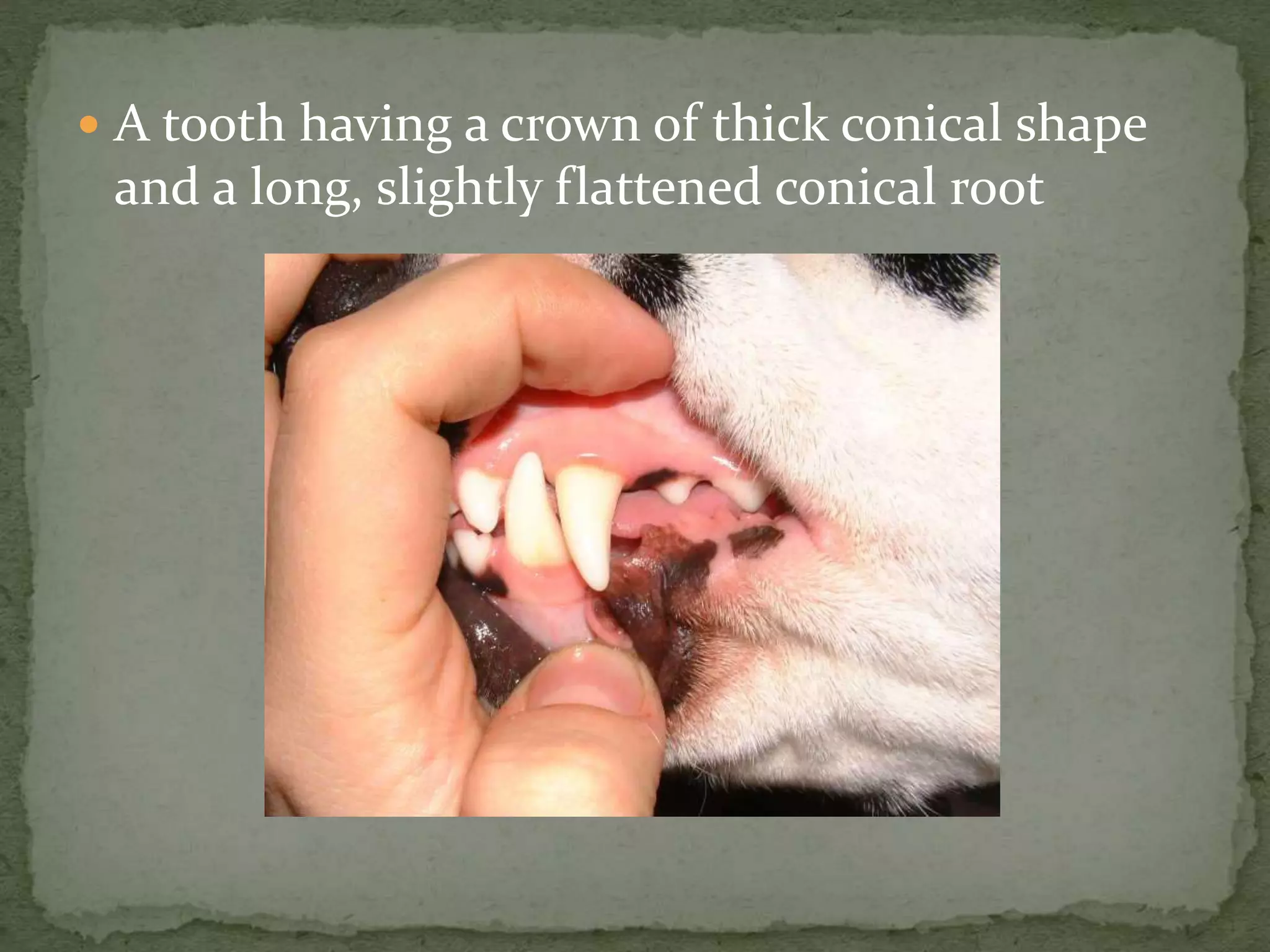
 A tooth having a crown of thick conical shape
and a long, slightly flattened conical root
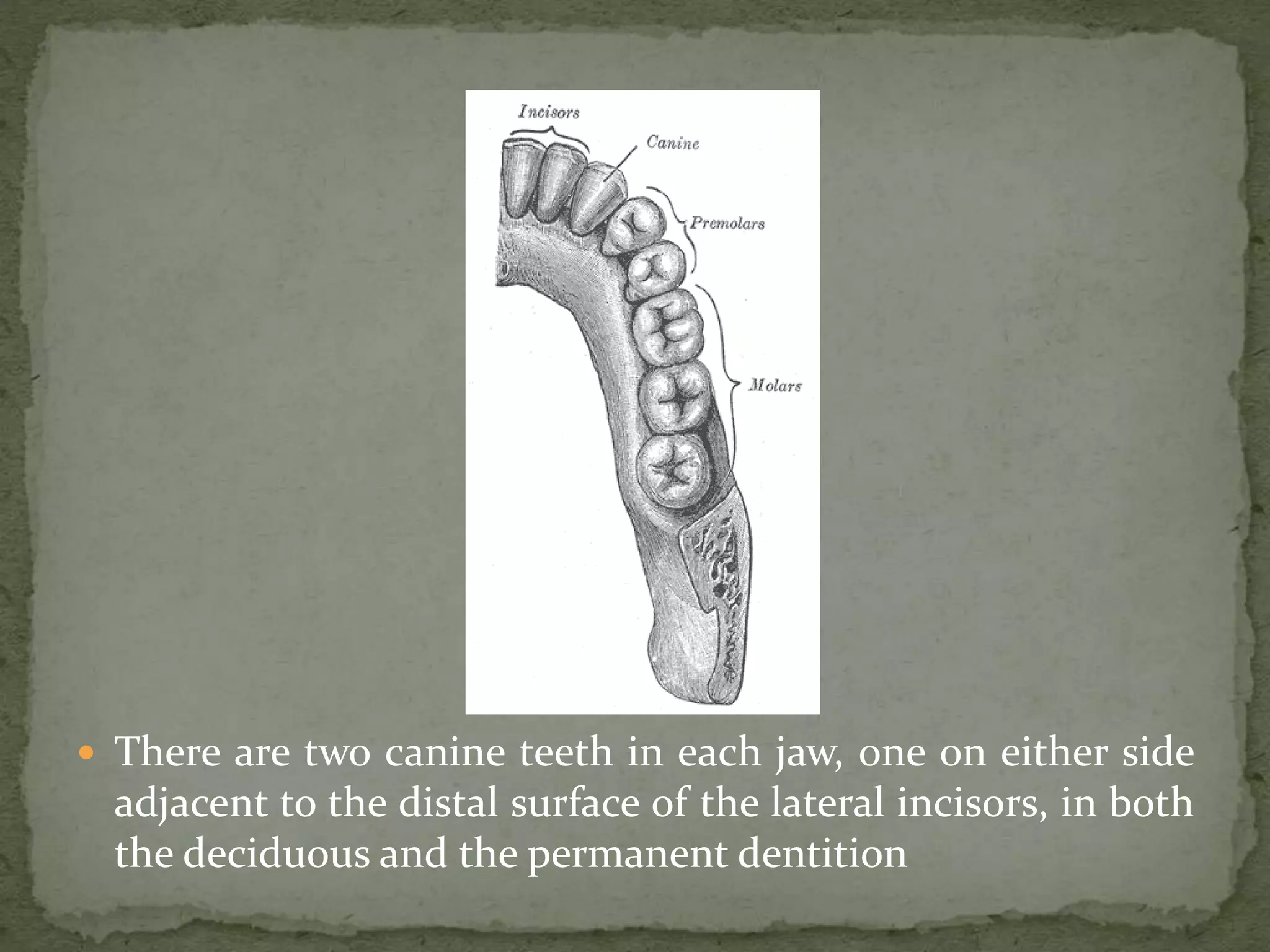
 There are two canine teeth in each jaw, one on either side
adjacent to the distal surface of the lateral incisors, in both
the deciduous and the permanent dentition
 Human canines are the longest and most
stable of teeth in the dental arch
 Only one tooth of this class is present in each
quadrant
 Called cuspids, dogteeth, fangs, or eye
teeth
 Considered as the cornerstones of the dental
arch
 Only teeth in the dentition with a single cusp
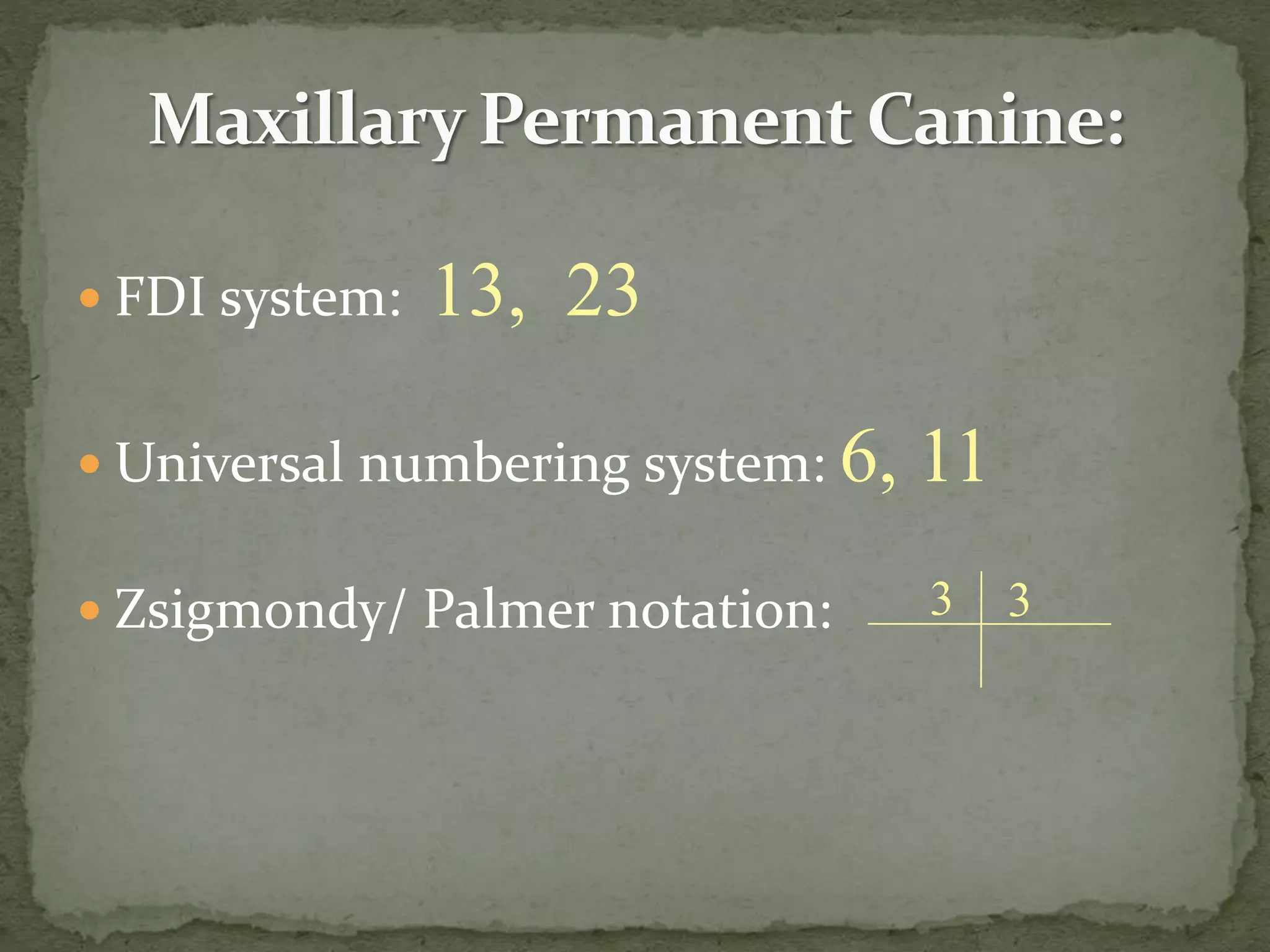
 FDI system: 13, 23
 Universal numbering system: 6, 11
 Zsigmondy/ Palmer notation: 3 3
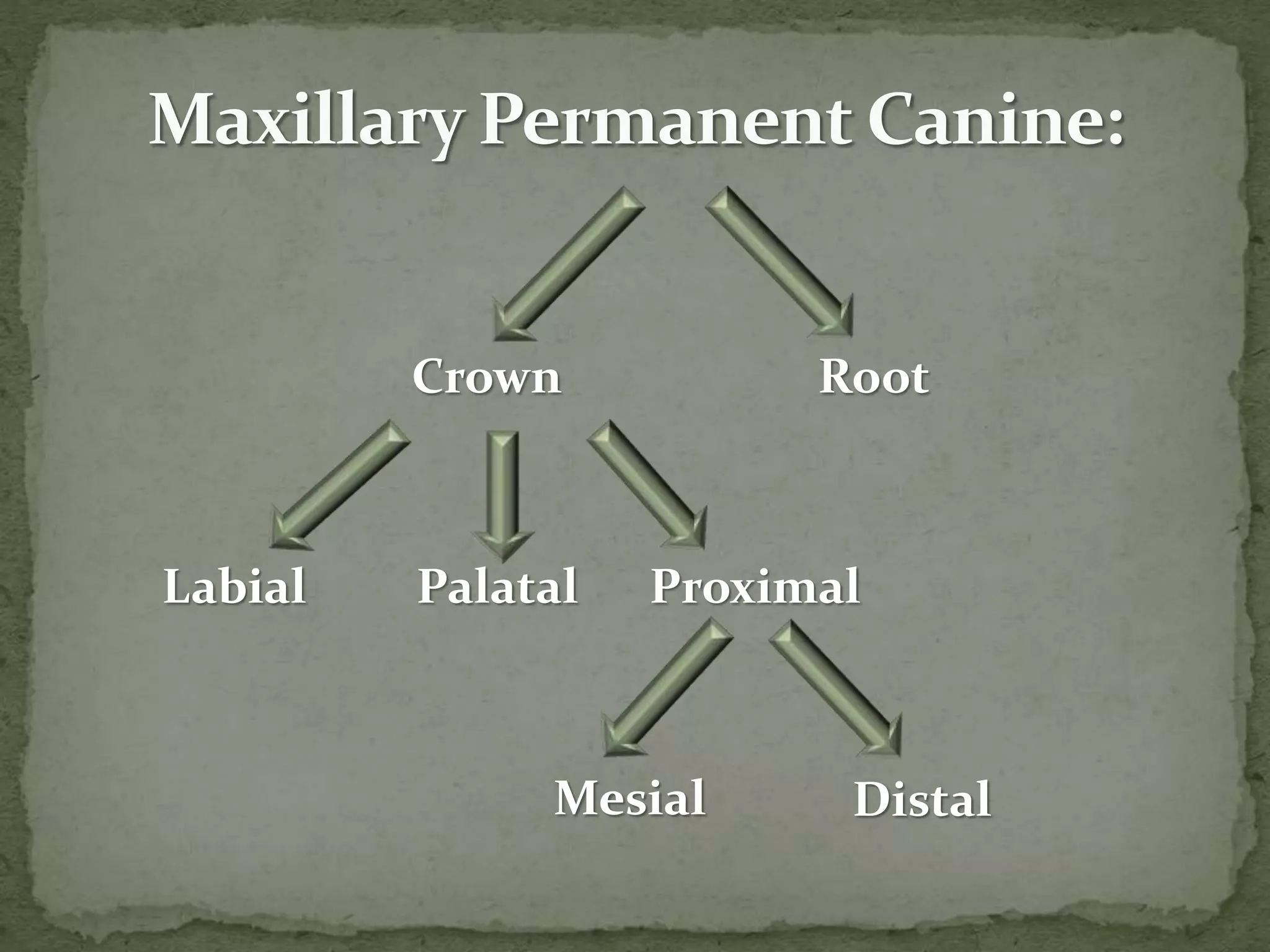
Crown Root
Labial Palatal Proximal
Mesial Distal
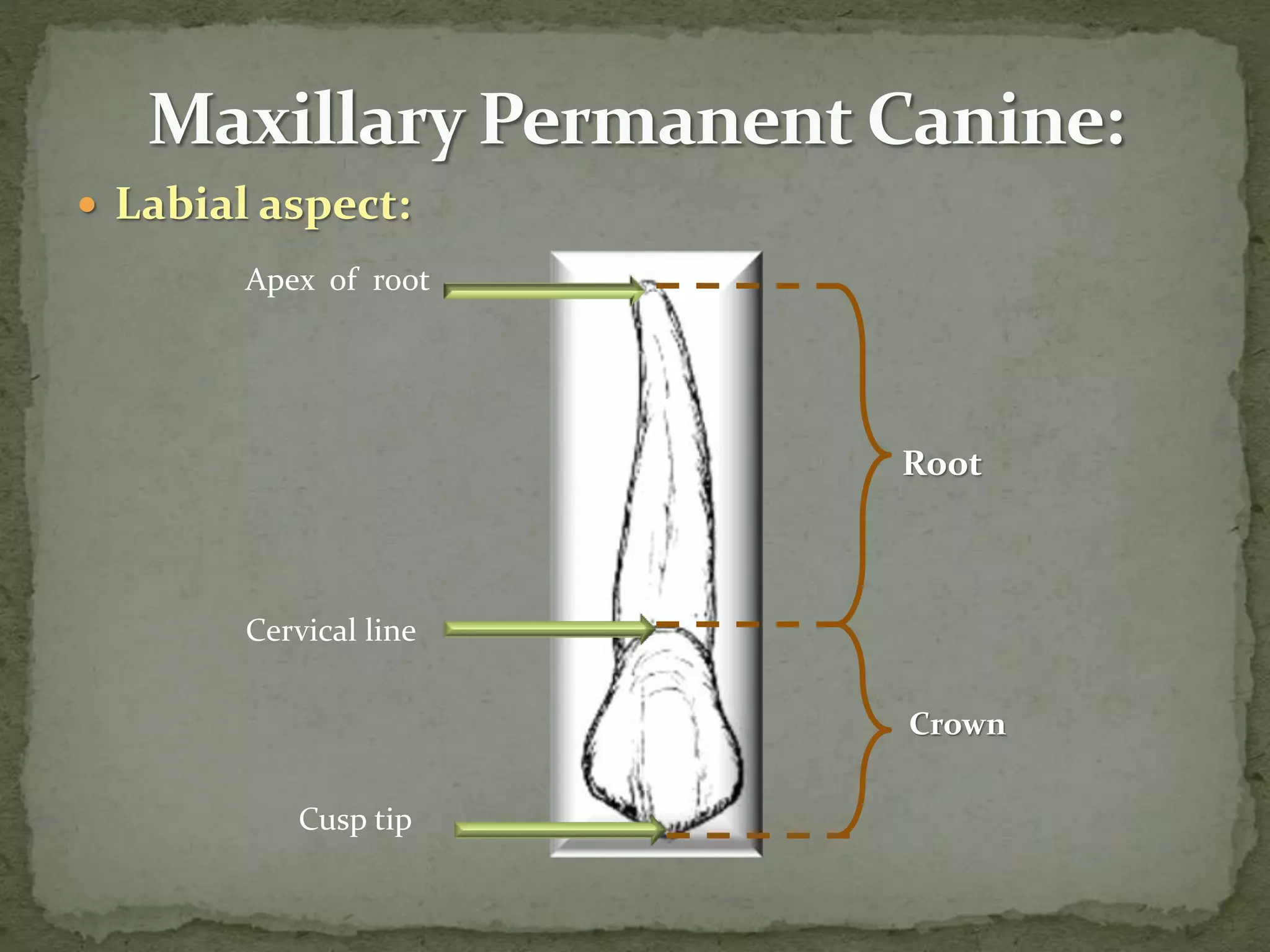
 Labial aspect:
Cervical line
Apex of root
Root
Crown
Cusp tip
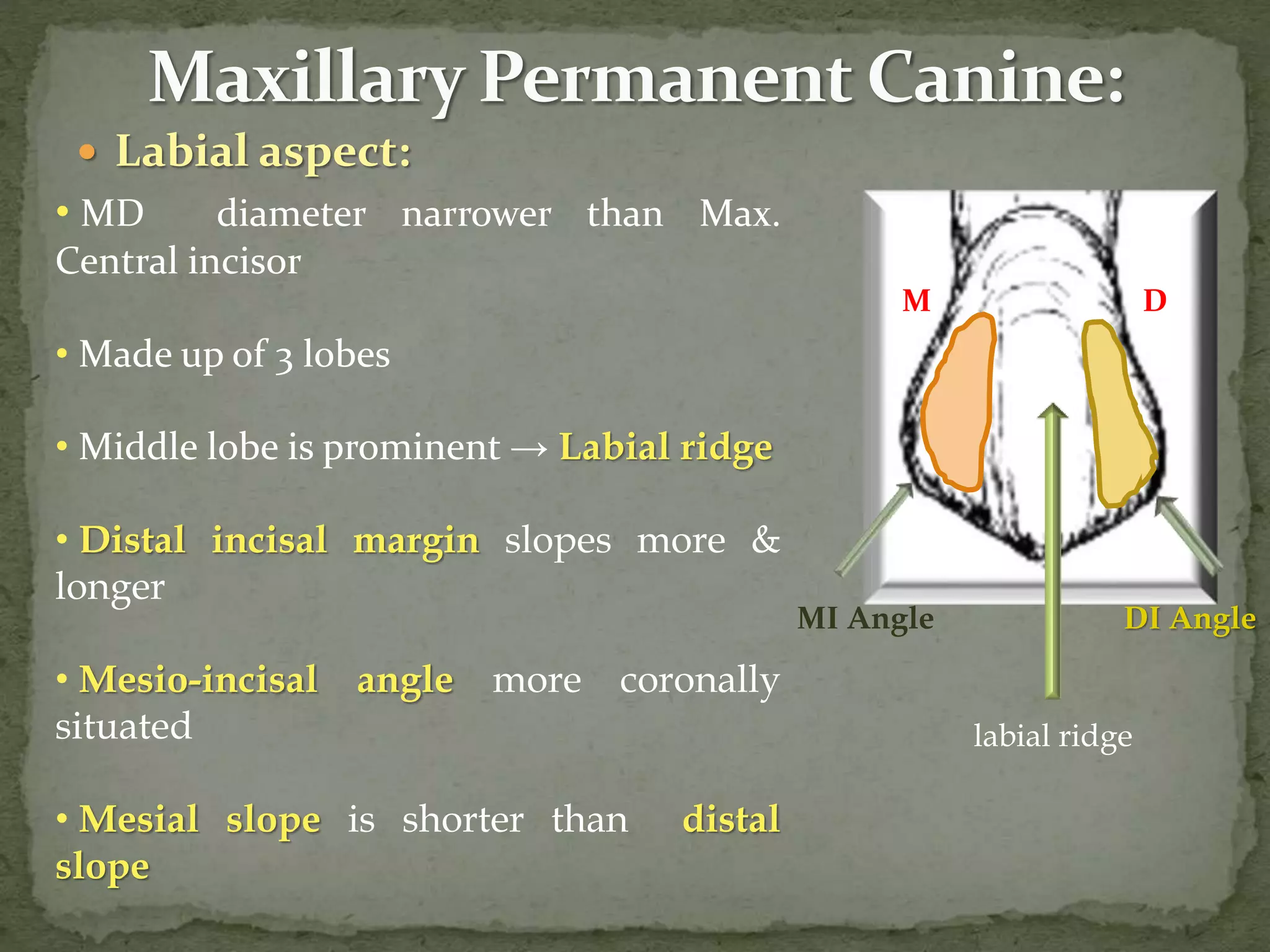
 Labial aspect:
• MD diameter narrower than Max.
Central incisor
• Made up of 3 lobes
• Middle lobe is prominent → Labial ridge
• Distal incisal margin slopes more &
longer
• Mesio-incisal angle more coronally
situated
• Mesial slope is shorter than distal
slope
labial ridge
M D
MI Angle DI Angle
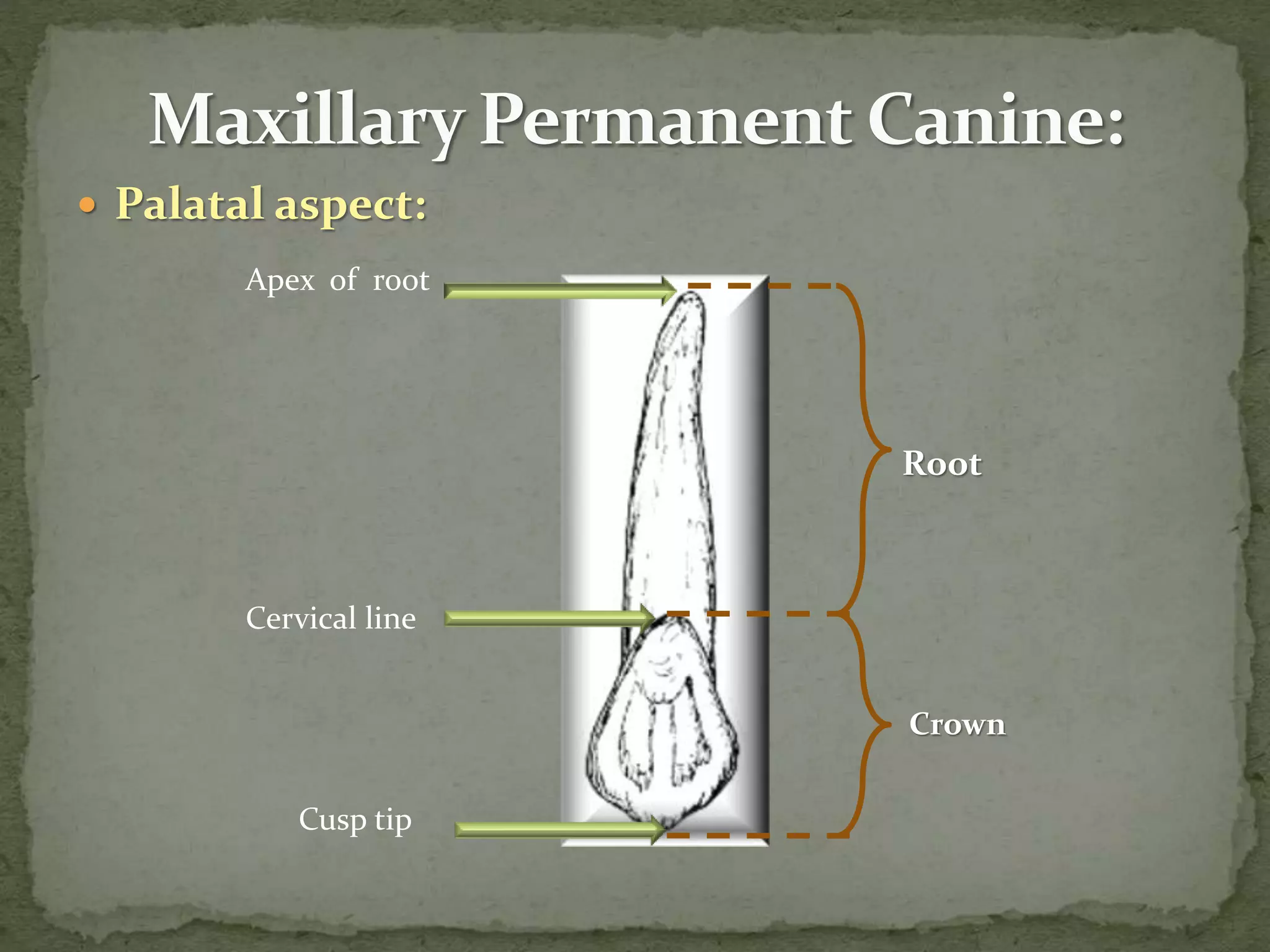
 Palatal aspect:
Cervical line
Apex of root
Root
Crown
Cusp tip
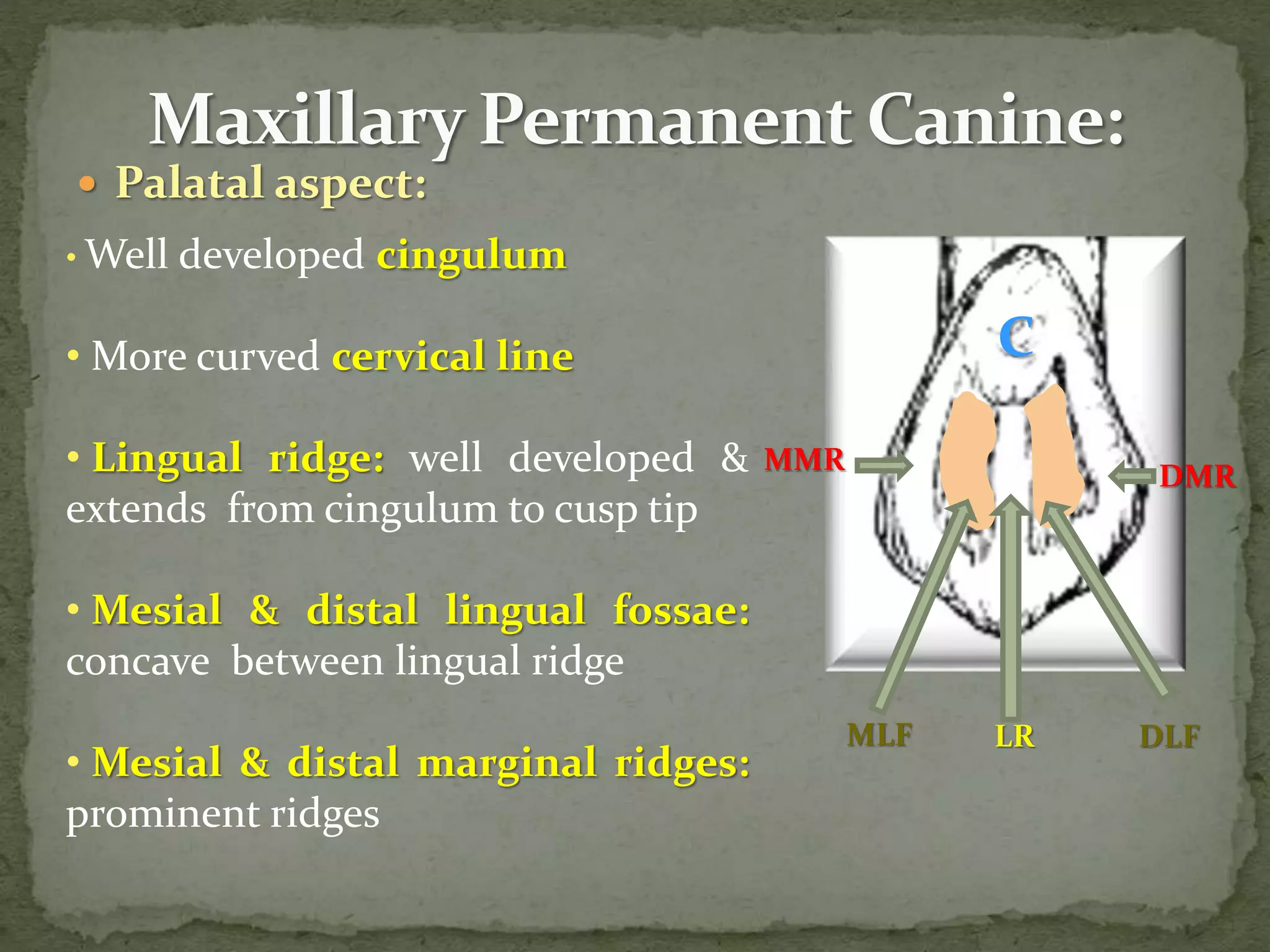
 Palatal aspect:
C
MMR
DMR
LR
MLF DLF
• Well developed cingulum
• More curved cervical line
• Lingual ridge: well developed &
extends from cingulum to cusp tip
• Mesial & distal lingual fossae:
concave between lingual ridge
• Mesial & distal marginal ridges:
prominent ridges
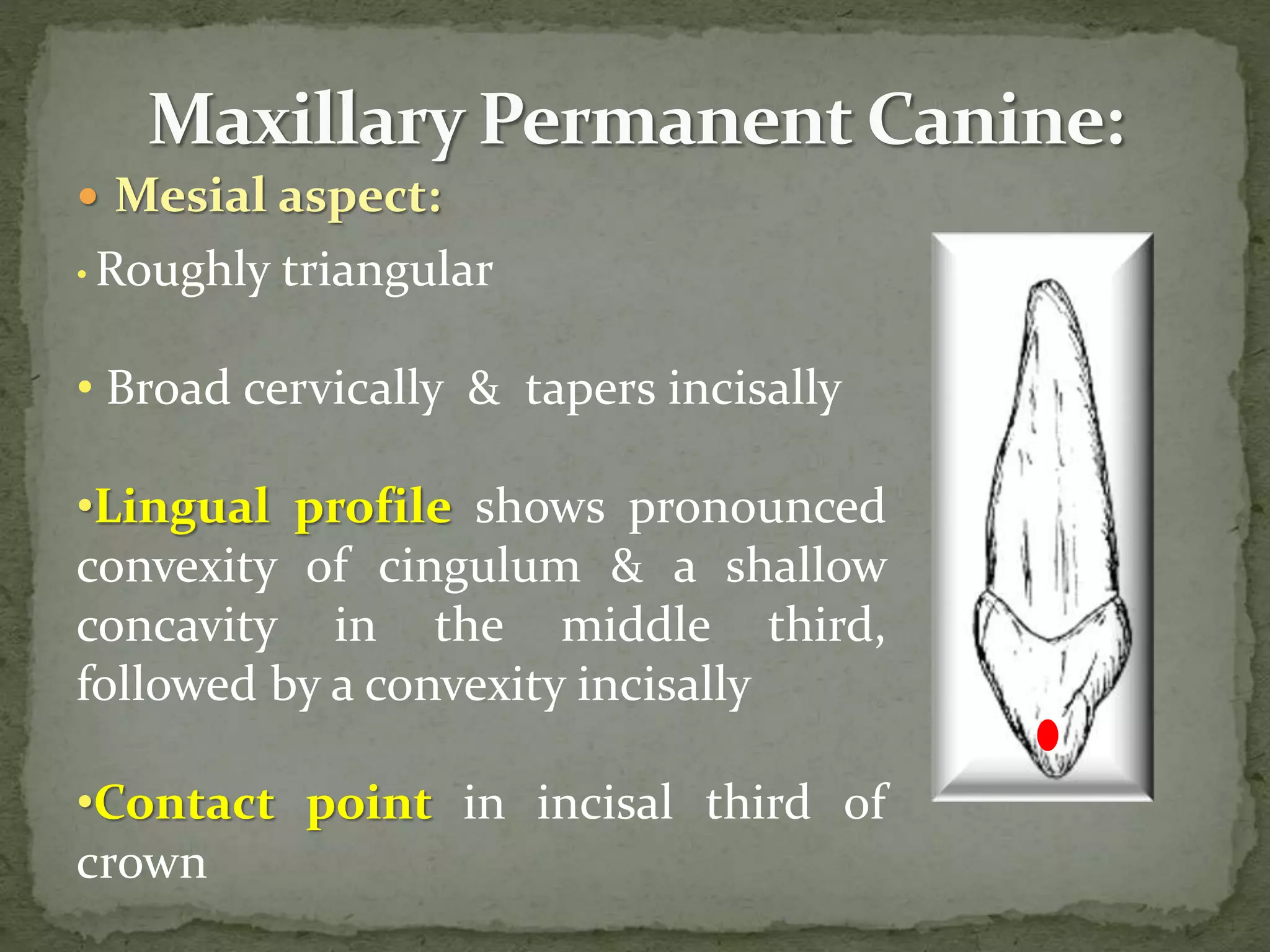
 Mesial aspect:
• Roughly triangular
• Broad cervically & tapers incisally
•Lingual profile shows pronounced
convexity of cingulum & a shallow
concavity in the middle third,
followed by a convexity incisally
•Contact point in incisal third of
crown
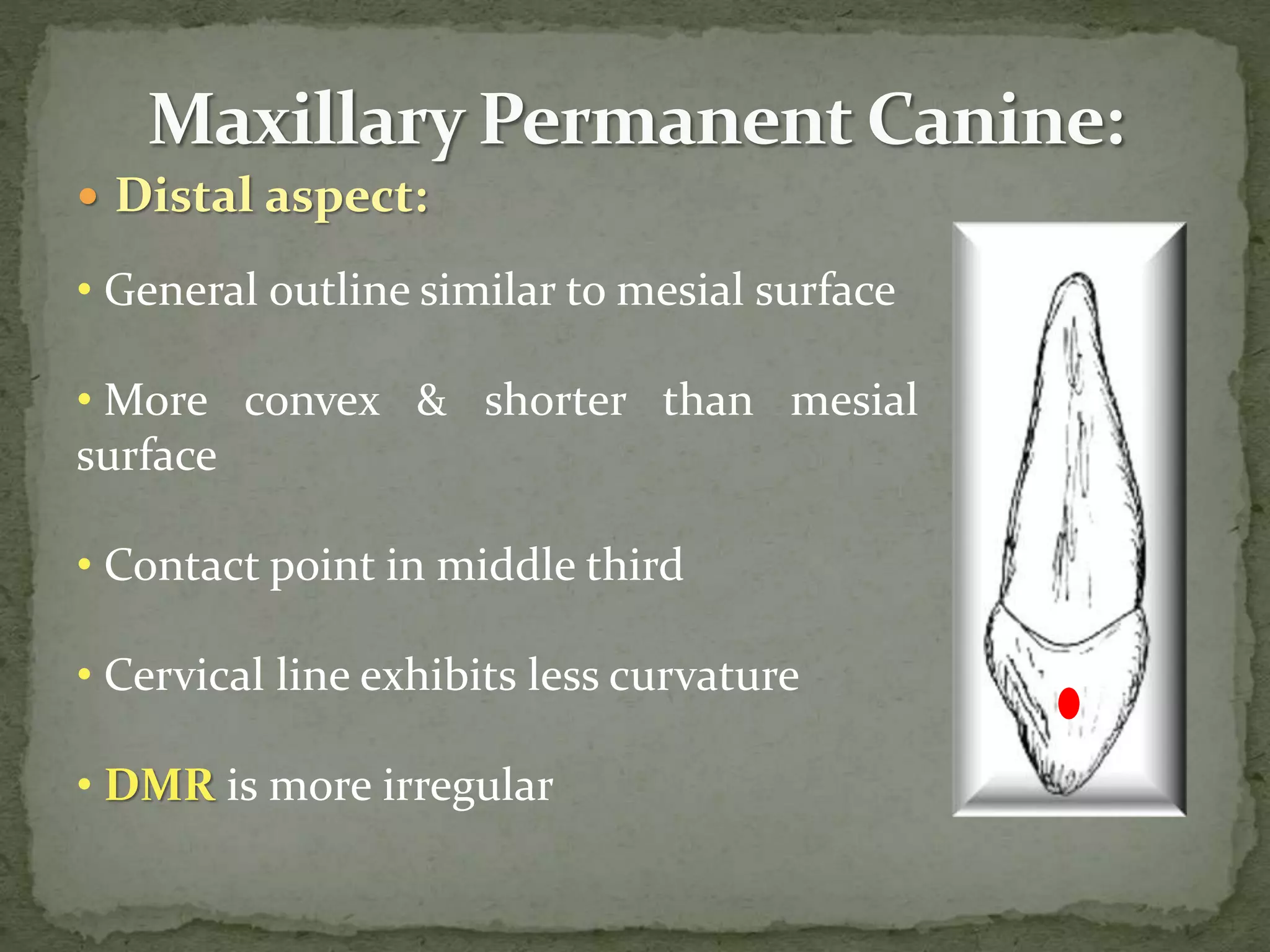
 Distal aspect:
• General outline similar to mesial surface
• More convex & shorter than mesial
surface
• Contact point in middle third
• Cervical line exhibits less curvature
• DMR is more irregular
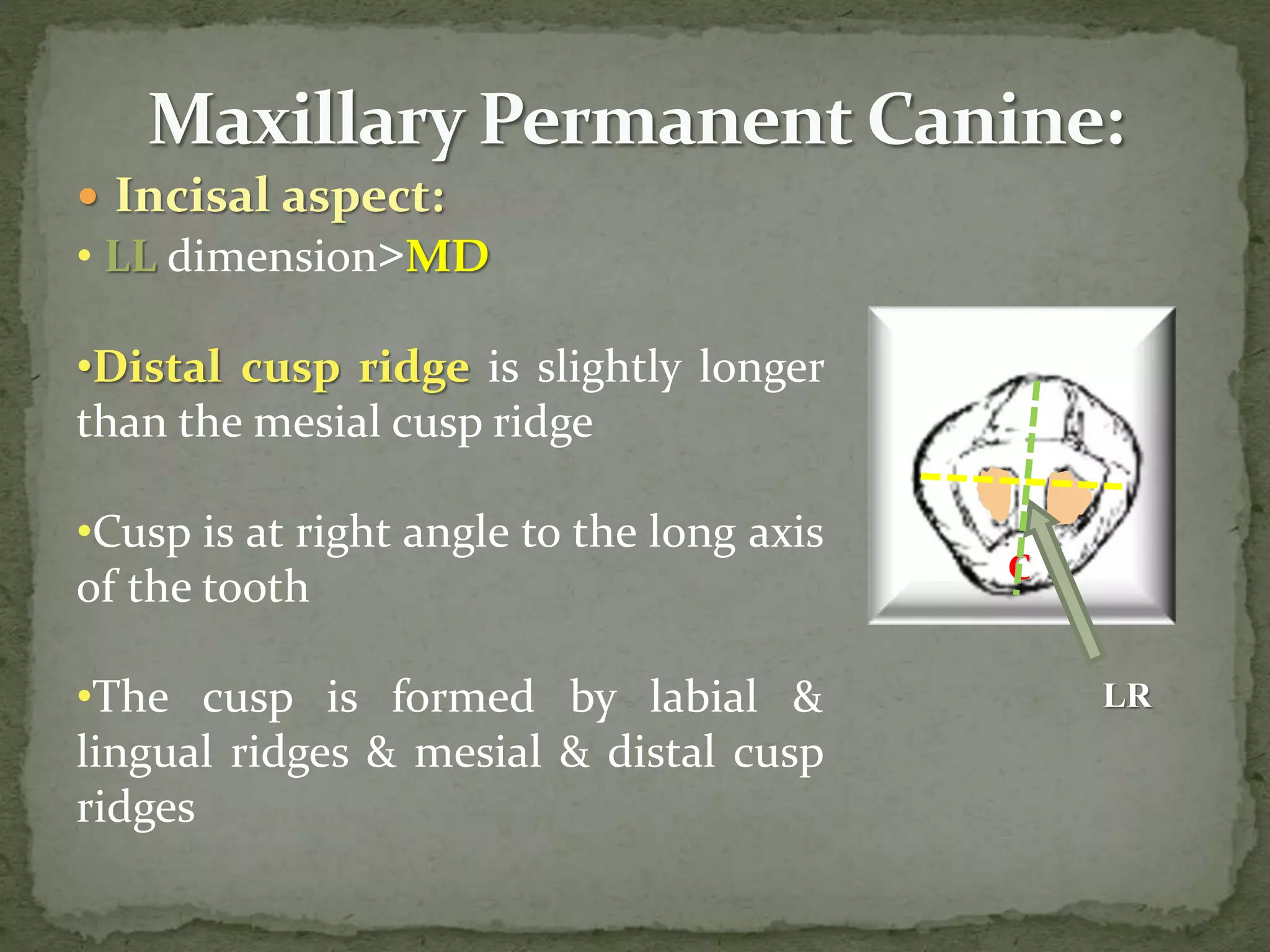
 Incisal aspect:
• LL dimension>MD
•Distal cusp ridge is slightly longer
than the mesial cusp ridge
•Cusp is at right angle to the long axis
of the tooth
•The cusp is formed by labial &
lingual ridges & mesial & distal cusp
ridges
C
LR
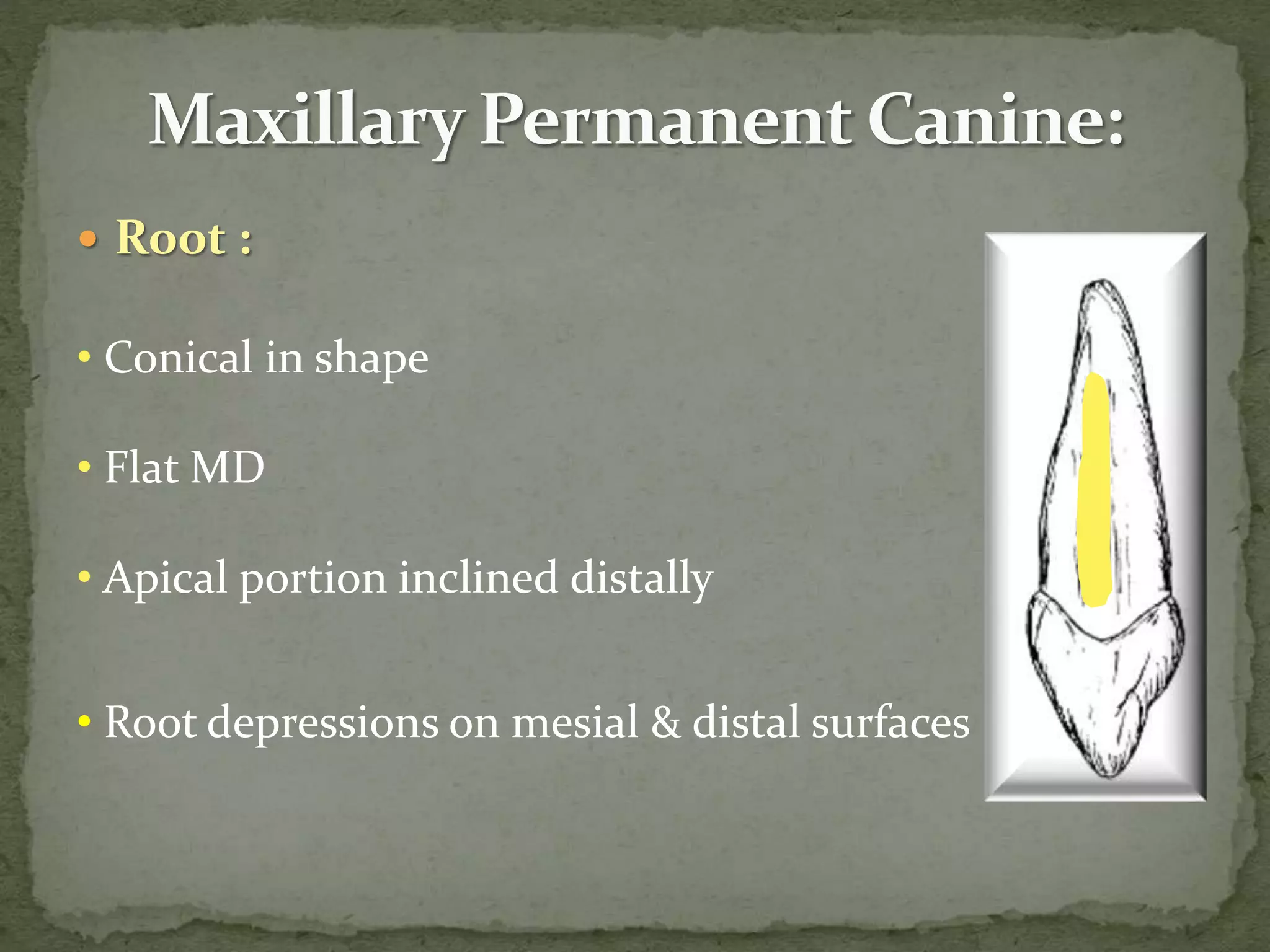
 Root :
• Conical in shape
• Flat MD
• Apical portion inclined distally
• Root depressions on mesial & distal surfaces
 FDI system: 33, 43
 Universal numbering system: 22,27
 Zsigmondy/ Palmer notation:
3 3
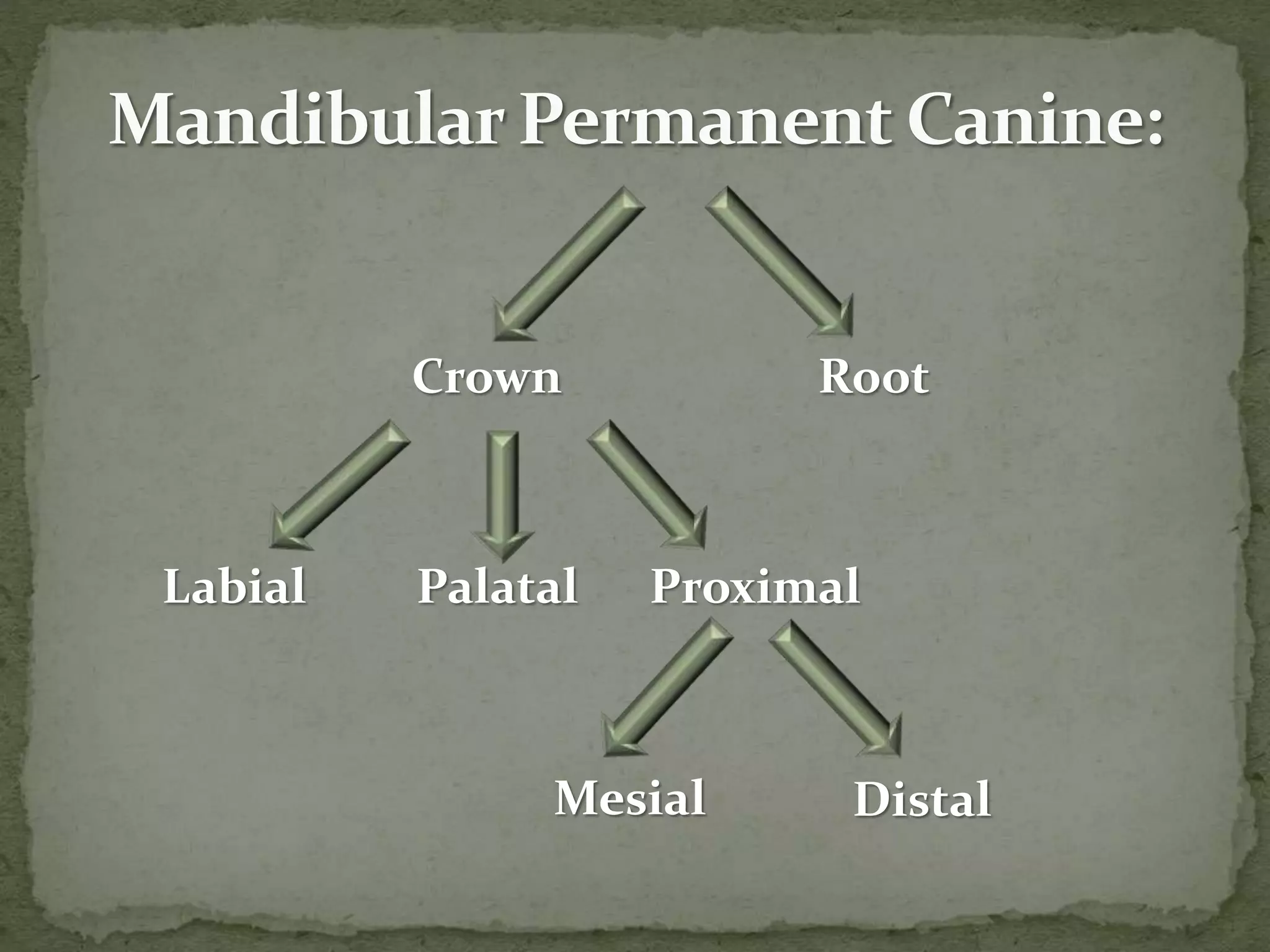
Crown Root
Labial Palatal Proximal
Mesial Distal
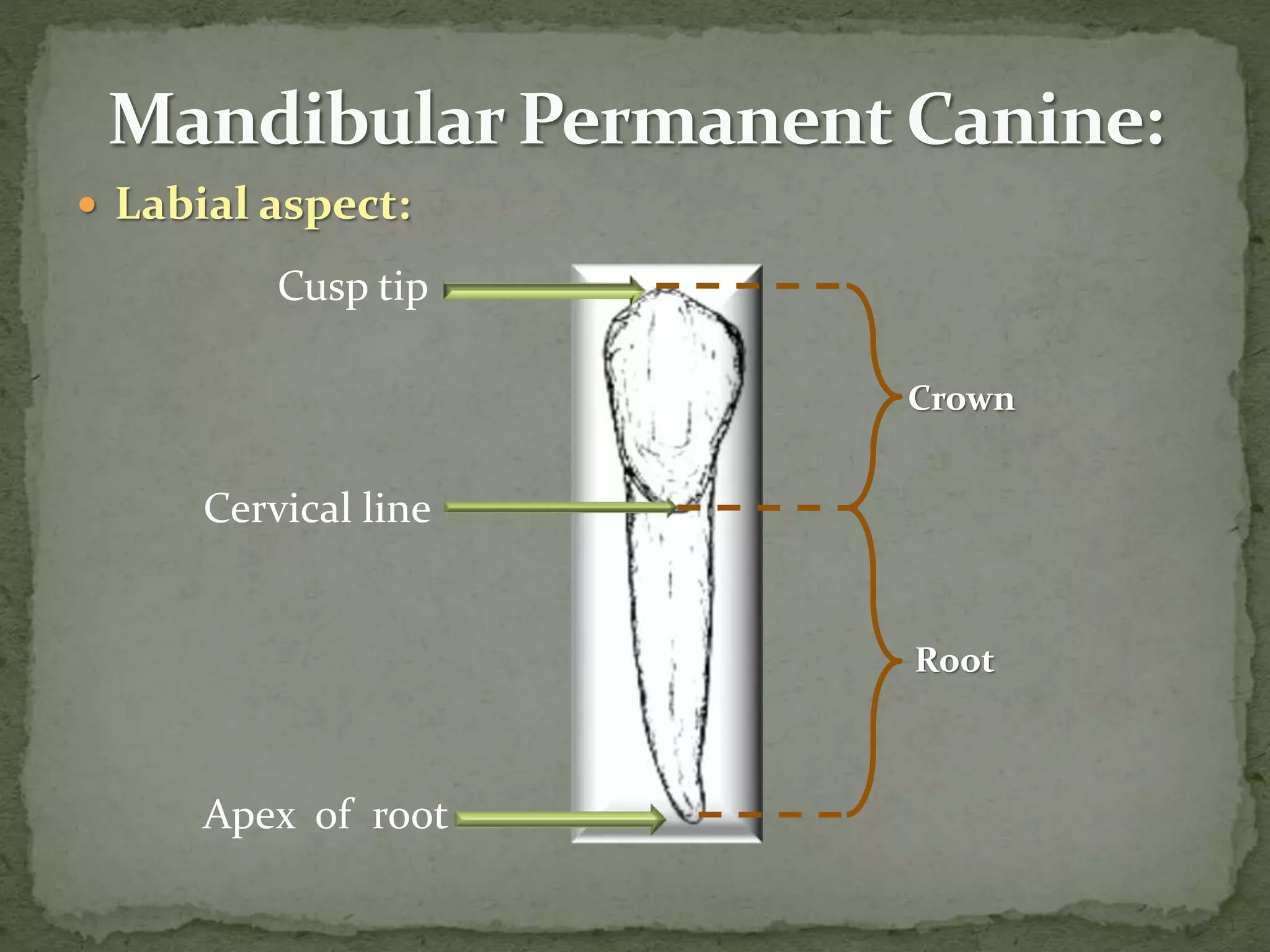
 Labial aspect:
Cervical line
Apex of root
Root
Crown
Cusp tip
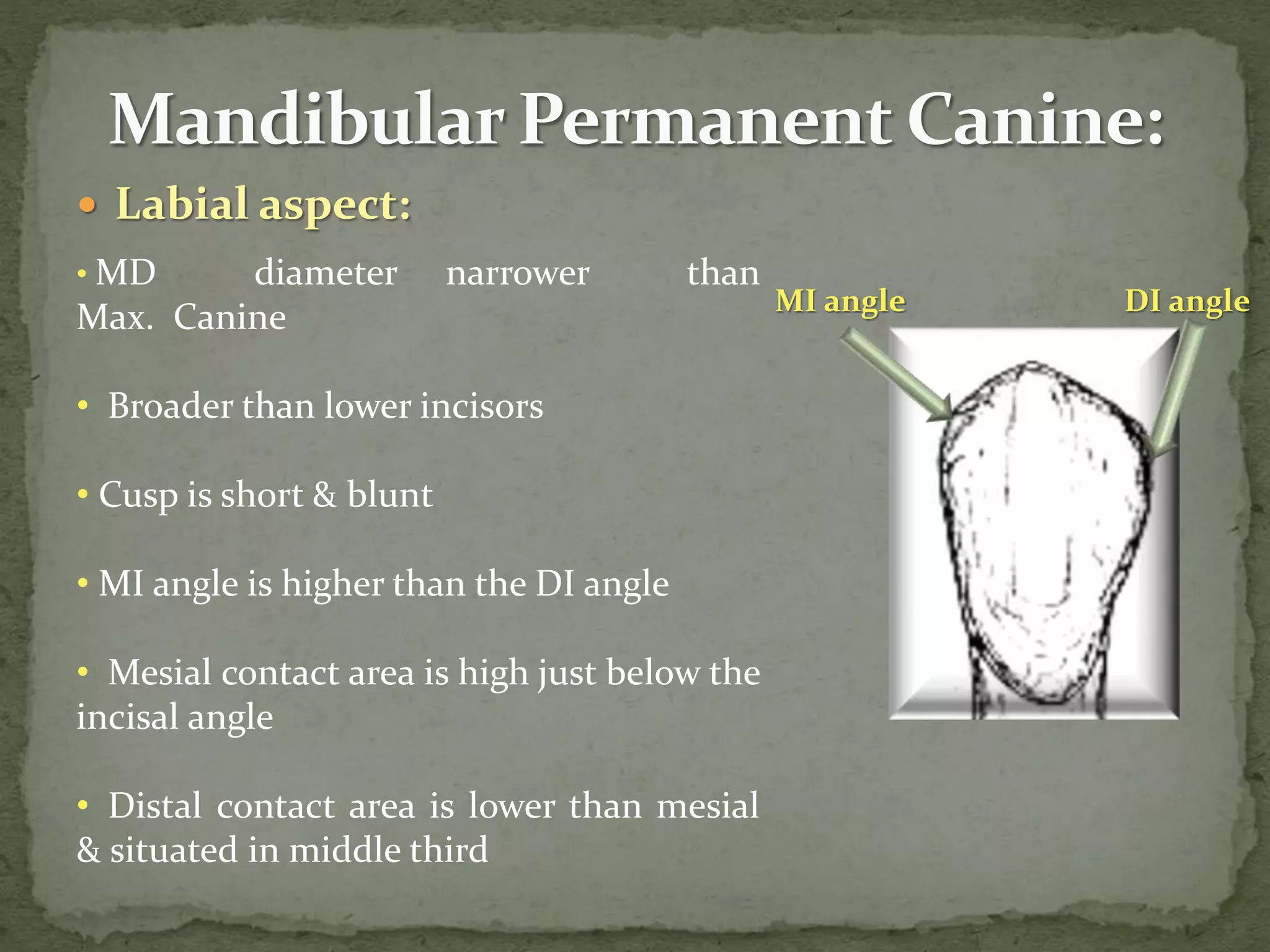
 Labial aspect:
• MD diameter narrower than
Max. Canine
• Broader than lower incisors
• Cusp is short & blunt
• MI angle is higher than the DI angle
• Mesial contact area is high just below the
incisal angle
• Distal contact area is lower than mesial
& situated in middle third
MI angle DI angle
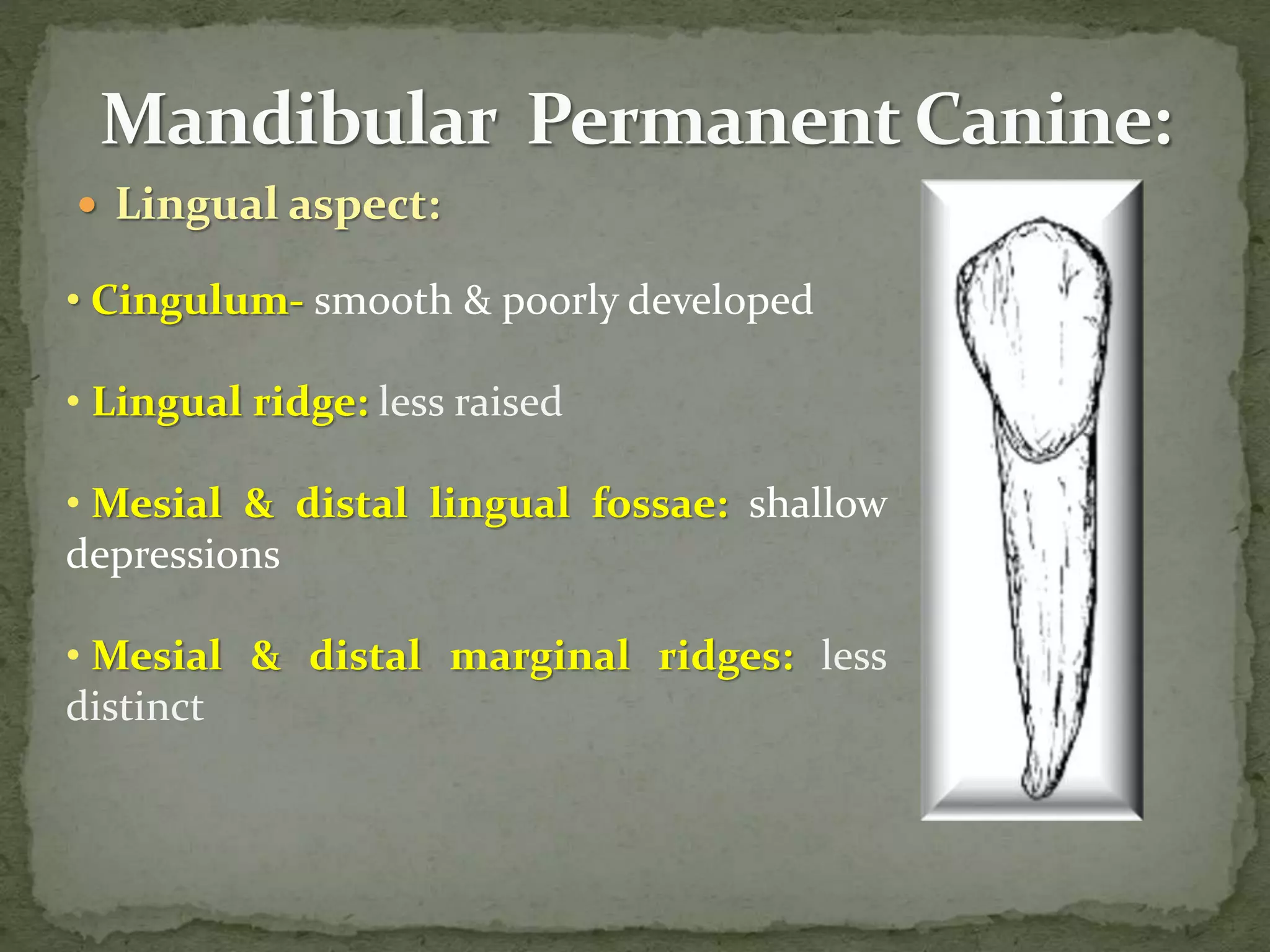
 Lingual aspect:
• Cingulum- smooth & poorly developed
• Lingual ridge: less raised
• Mesial & distal lingual fossae: shallow
depressions
• Mesial & distal marginal ridges: less
distinct
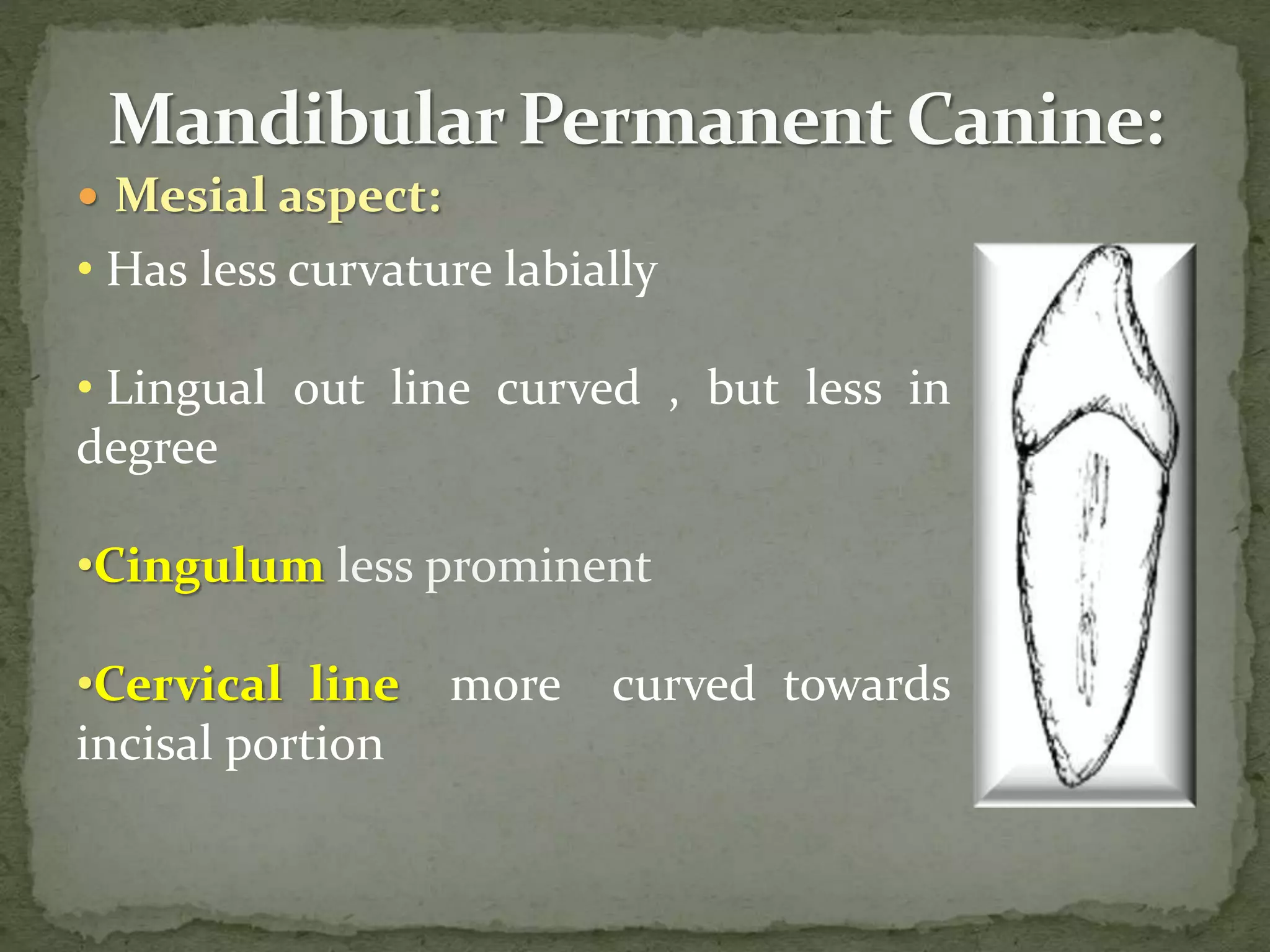
 Mesial aspect:
• Has less curvature labially
• Lingual out line curved , but less in
degree
•Cingulum less prominent
•Cervical line more curved towards
incisal portion
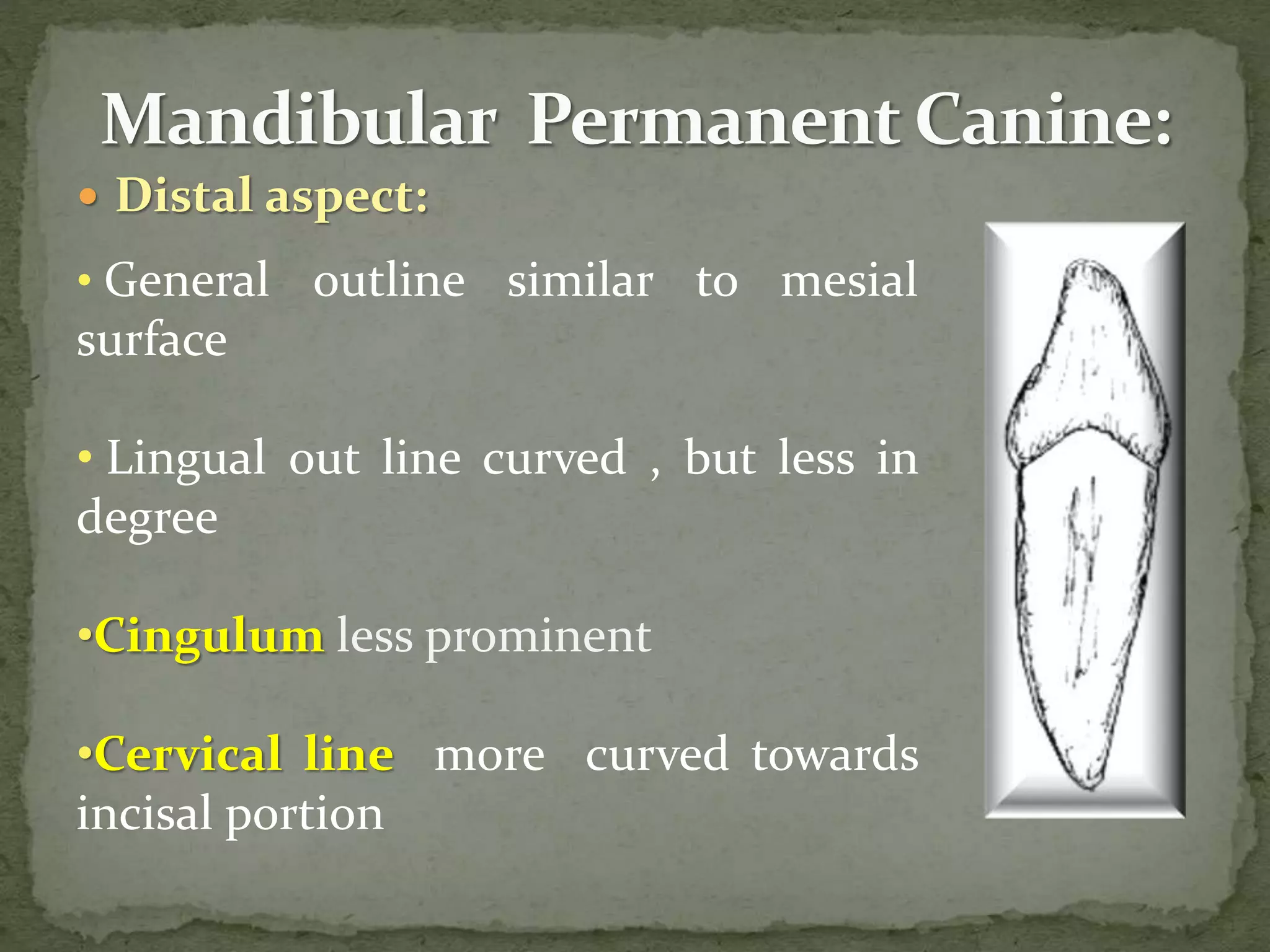
 Distal aspect:
• General outline similar to mesial
surface
• Lingual out line curved , but less in
degree
•Cingulum less prominent
•Cervical line more curved towards
incisal portion
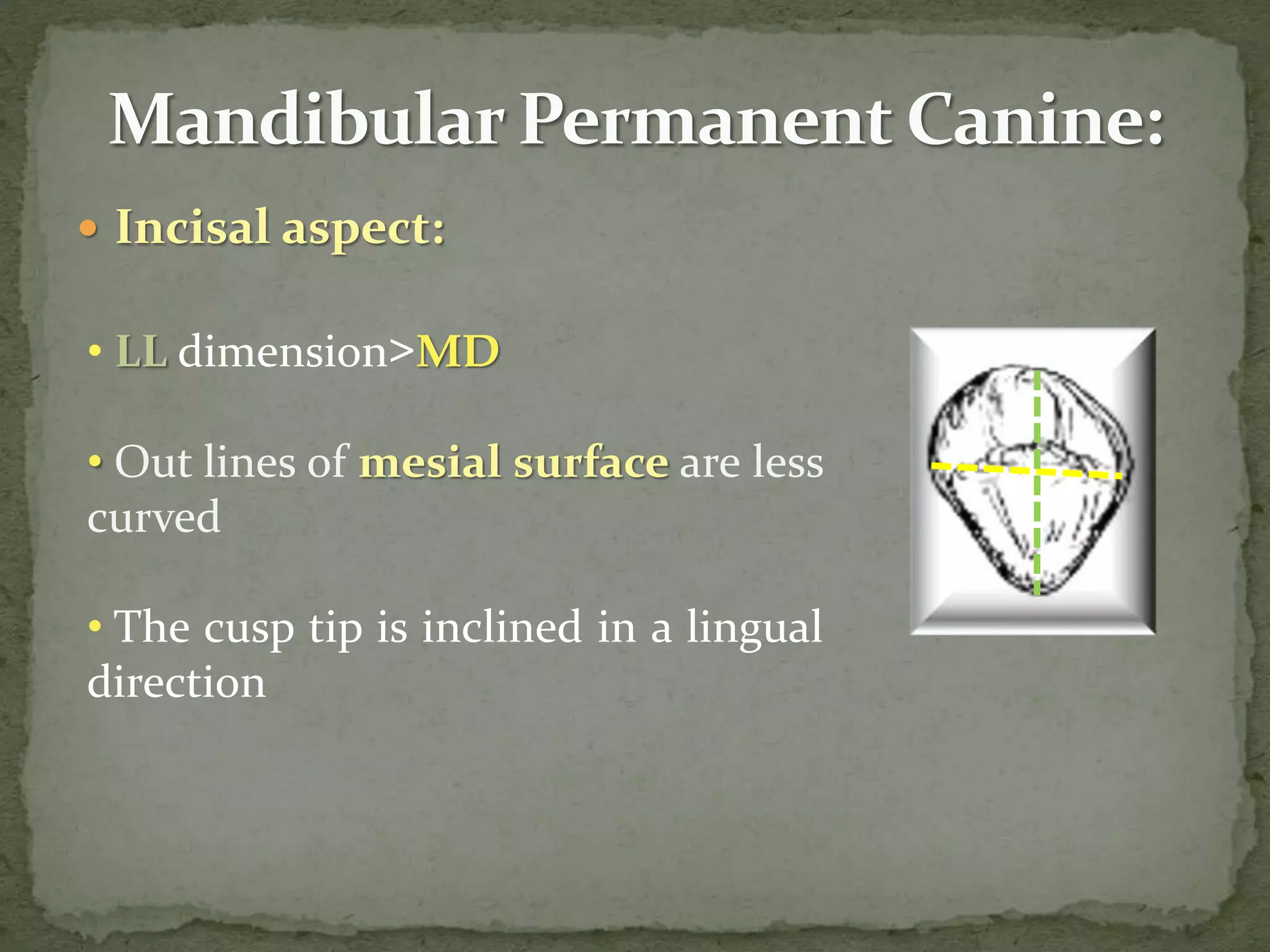
 Incisal aspect:
• LL dimension>MD
• Out lines of mesial surface are less
curved
• The cusp tip is inclined in a lingual
direction
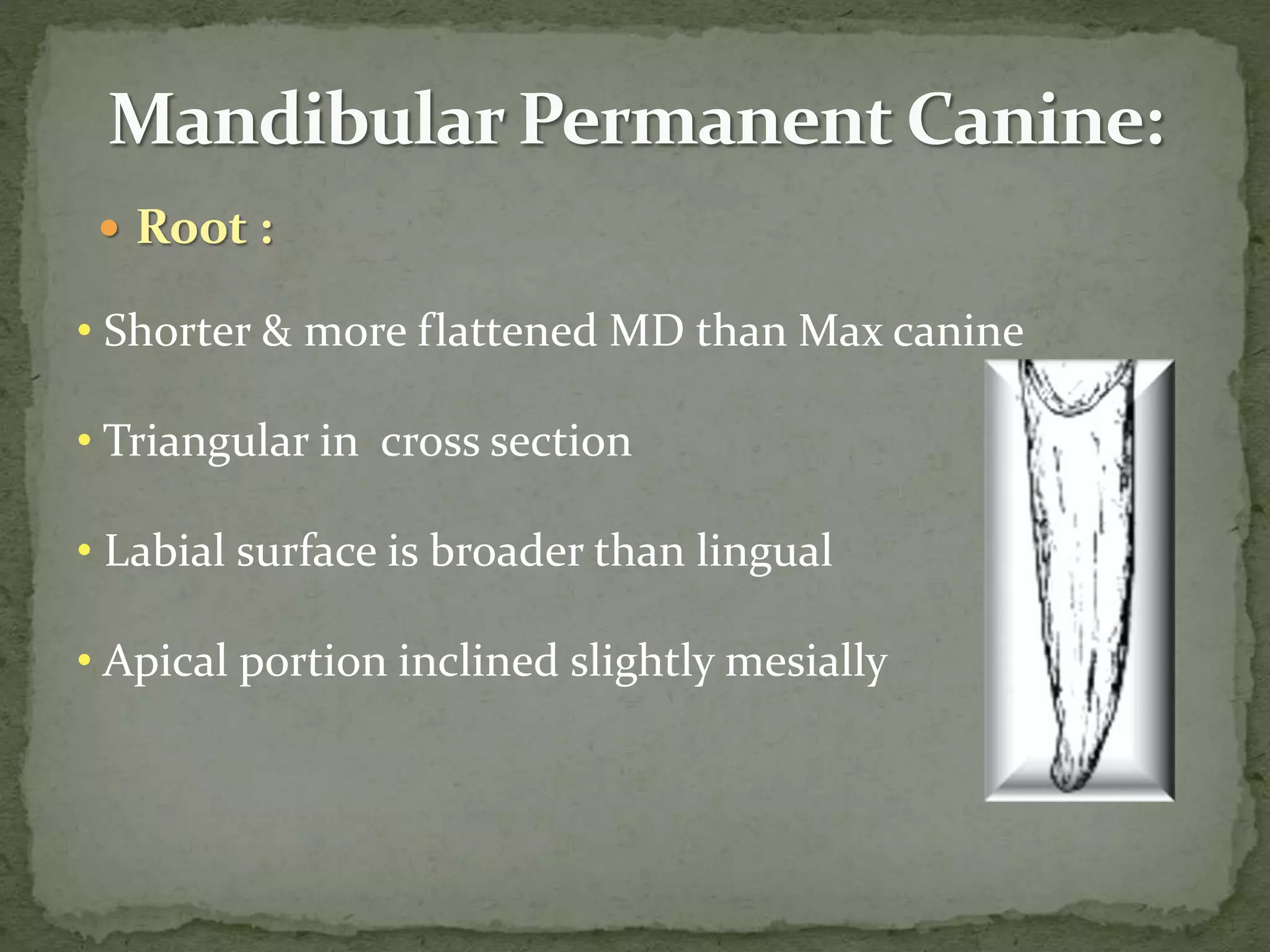
 Root :
• Shorter & more flattened MD than Max canine
• Triangular in cross section
• Labial surface is broader than lingual
• Apical portion inclined slightly mesially
Summary:
Feature common to all canines:
• They have a single root, which is longest &
strongest of all teeth
• They have a single conical cusp
• They have a functional lingual surface

Maxillary Canine.pptx

  • 1.
  • 2.
     A toothhaving a crown of thick conical shape and a long, slightly flattened conical root
  • 3.
     There aretwo canine teeth in each jaw, one on either side adjacent to the distal surface of the lateral incisors, in both the deciduous and the permanent dentition
  • 4.
     Human caninesare the longest and most stable of teeth in the dental arch  Only one tooth of this class is present in each quadrant  Called cuspids, dogteeth, fangs, or eye teeth  Considered as the cornerstones of the dental arch  Only teeth in the dentition with a single cusp
  • 5.
     FDI system:13, 23  Universal numbering system: 6, 11  Zsigmondy/ Palmer notation: 3 3
  • 6.
    Crown Root Labial PalatalProximal Mesial Distal
  • 7.
     Labial aspect: Cervicalline Apex of root Root Crown Cusp tip
  • 8.
     Labial aspect: •MD diameter narrower than Max. Central incisor • Made up of 3 lobes • Middle lobe is prominent → Labial ridge • Distal incisal margin slopes more & longer • Mesio-incisal angle more coronally situated • Mesial slope is shorter than distal slope labial ridge M D MI Angle DI Angle
  • 9.
     Palatal aspect: Cervicalline Apex of root Root Crown Cusp tip
  • 10.
     Palatal aspect: C MMR DMR LR MLFDLF • Well developed cingulum • More curved cervical line • Lingual ridge: well developed & extends from cingulum to cusp tip • Mesial & distal lingual fossae: concave between lingual ridge • Mesial & distal marginal ridges: prominent ridges
  • 11.
     Mesial aspect: •Roughly triangular • Broad cervically & tapers incisally •Lingual profile shows pronounced convexity of cingulum & a shallow concavity in the middle third, followed by a convexity incisally •Contact point in incisal third of crown
  • 12.
     Distal aspect: •General outline similar to mesial surface • More convex & shorter than mesial surface • Contact point in middle third • Cervical line exhibits less curvature • DMR is more irregular
  • 13.
     Incisal aspect: •LL dimension>MD •Distal cusp ridge is slightly longer than the mesial cusp ridge •Cusp is at right angle to the long axis of the tooth •The cusp is formed by labial & lingual ridges & mesial & distal cusp ridges C LR
  • 14.
     Root : •Conical in shape • Flat MD • Apical portion inclined distally • Root depressions on mesial & distal surfaces
  • 15.
     FDI system:33, 43  Universal numbering system: 22,27  Zsigmondy/ Palmer notation: 3 3
  • 16.
    Crown Root Labial PalatalProximal Mesial Distal
  • 17.
     Labial aspect: Cervicalline Apex of root Root Crown Cusp tip
  • 18.
     Labial aspect: •MD diameter narrower than Max. Canine • Broader than lower incisors • Cusp is short & blunt • MI angle is higher than the DI angle • Mesial contact area is high just below the incisal angle • Distal contact area is lower than mesial & situated in middle third MI angle DI angle
  • 19.
     Lingual aspect: •Cingulum- smooth & poorly developed • Lingual ridge: less raised • Mesial & distal lingual fossae: shallow depressions • Mesial & distal marginal ridges: less distinct
  • 20.
     Mesial aspect: •Has less curvature labially • Lingual out line curved , but less in degree •Cingulum less prominent •Cervical line more curved towards incisal portion
  • 21.
     Distal aspect: •General outline similar to mesial surface • Lingual out line curved , but less in degree •Cingulum less prominent •Cervical line more curved towards incisal portion
  • 22.
     Incisal aspect: •LL dimension>MD • Out lines of mesial surface are less curved • The cusp tip is inclined in a lingual direction
  • 23.
     Root : •Shorter & more flattened MD than Max canine • Triangular in cross section • Labial surface is broader than lingual • Apical portion inclined slightly mesially
  • 24.
    Summary: Feature common toall canines: • They have a single root, which is longest & strongest of all teeth • They have a single conical cusp • They have a functional lingual surface