Anatomy of Mandibular premolars
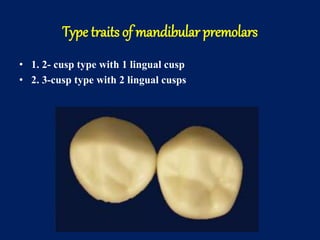
Type traits of mandibular premolars
• 1. 2- cusp type with 1 lingual cusp
• 2. 3-cusp type with 2 lingual cusps
Distinguishing characteristicsof mandibular premolars
• Generally
– The mandibular 1st premolar has a longer crown and a
shorter root than the 2nd premolars.
– The mandibular 1st premolar is longer overall than 2nd
Buccalaspect of mandibular premolars
• 1. Crown shape: (roughly pentagonal)
1st premolar: nearly symmetrical except for a shorter
mesial cusp ridge and a distal bulge of the crown
Buccal aspect of mandibular premolars
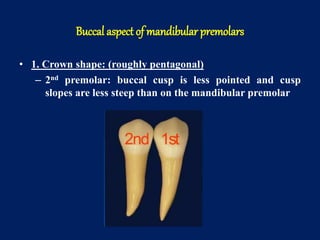
• 1. Crown shape: (roughly pentagonal)
– 2nd premolar: buccal cusp is less pointed and cusp
slopes are less steep than on the mandibular premolar
Buccal aspect
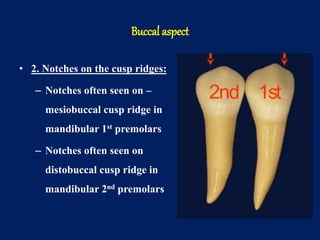
• 2. Notches on the cusp ridges:
– Notches often seen on –
mesiobuccal cusp ridge in
mandibular 1st premolars
– Notches often seen on
distobuccal cusp ridge in
mandibular 2nd premolars
Buccal aspect
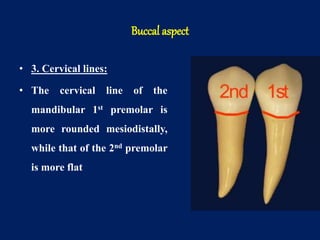
• 3. Cervical lines:
• The cervical line of the
mandibular 1st premolar is
more rounded mesiodistally,
while that of the 2nd premolar
is more flat
Buccal aspect
• 4. Contact areas – Mesial:
– 1st and 2nd premolars –
near junction of occlusal
and middle third
Buccal aspect
• 5. Contact area – Distal
– 1st premolar distal contact
area is more occlusal than
the mesial contact area
Buccal aspect
• 6. Contact area – Distal
– 2nd premolar has a distal
contact located more cervical
than the mesial contact area,
as is usually the case with
posterior teeth
Lingual aspect of mandibular premolars
• 1. Crown shape:
– Mandibular first premolar
crown tapers (converges) to the
lingual (narrower on lingual
side that buccal)
Lingual aspect of mandibular premolars
• 1. Crown Shape:
– Mandibular 2nd premolar with 1
lingual cusp, crown tapers to
lingual
– Mandibular 2nd premolar with 2
lingual cusps, crown is as wide or
wider mesiodistally than the
buccal
Lingual aspect
• 2. Cusp Size and Shape:
– Mandibular 1st premolar
lingual cusp is small and
pointed
– Most of the occlusal surface
can be seen from this aspect
Lingual aspect
• 2. Cusp Size and Shape:
– Mandibular 2nd premolar with 1
lingual cusp:
– Lingual cusp is smaller than
buccal cusp, but larger than
lingual cusp of 1st premolar
Lingual aspect
• 2. Cusp Size and Shape:
– Mandibular 2nd premolar with
2 lingual cusps:
– Ml cusp is larger than the DL
cusp, with the L groove
between them and onto the
lingual crown surface
Lingual aspect
• 3. Marginal Ridges:
– Mandibular 1st premolar:
– Only tooth in the mouth where
the mesial marginal ridge is
more apical than the distal
marginal ridge
Lingual aspect
• 3. Marginal Ridges:
– Mandibular 2nd premolar:
– Mesial marginal ridge is more
occlusal than the distal marginal
ridge (as found in all other teeth)
Lingual aspect
• 4. Mesiolingual groove:
– Frequently seen on
mandibular 1st premolar only
Proximal aspect of mandibular premolars
• 1. Crown Shape – Rhomboid:
– The crowns of both premolars tilt
lingually, but the mandibular 1st
premolar tilts more lingually than
the mandibular 2nd premolar
Proximal aspect of mandibular premolars
• 1. Crown Shape – Rhomboid:
– In both premolars, the
lingual cusps are shorter
than the buccal cusps
Proximal aspect
• 2. Mesiolingual groove:
– Often present on mandibular
first premolar between the mesial
marginal ridge and the mesial
slope of the lingual cusp
– Not present in mandibular
second premolar
Proximal aspect
• 3. Height of Contour:
– Mandibuar 1st premolar
• Buccal- cervical 1/3
• Lingual – middle 1/3
Proximal aspect
• 3. Height of Contour:
– Mandibular 2nd premolar
• Buccal- junction of cervical
and middle 1/3
• Lingual – middle 1/3
Proximal aspect
• 4. Cervical Lines:
– Both premolars have greater
curve on the mesial than the
diastal
Proximal aspect
• 5. Root (proximal):
– Both premolars generally
consists of one root
– The mandibular 1st premolar
occasionally will have a
furcated root
Proximal aspect
• 6. Root Depressions:
– Mandibular 1st premolar – have a
shallow root depression in the apical
and middle third of both mesial and
distal root surface.
Proximal aspect
• 6. Root Depressions:
– Mandibular 2nd Premolar – have
a distal root depression in the
middle third of the root, but no
mesial depression
Occlusal aspect of mandibular first premolars
• 1. Outline:
– Have much variation in
occlusal morphology
– Outline is not symmetrical
(more bulky on the distal)
Occlusal aspect of mandibular first premolars
• 1. Outline:
– Often appears as if the mesial
side has been pushed inward
(mesiolingual corner)
Occlusal aspect of mandibular first premolars
• 1. Outline:
– Tip of the buccal cusp is near
the center from occlusal view
– Lacks a prominent buccal
ridge
– Cusp ridges are nearly
straight lines
Occlusal aspect of mandibular first premolars
• 1. Outline:
– Crown is somewat diamond
shaped converging lingually
– Shape of the crown is
asymmetrical
Occlusal aspect of mandibular first premolars
• 1. Outline:
– Mesial and distal marginal
ridges may converge lingually
Occlusal aspect of mandibular first premolars
• 2. Ridges, Fossae, Grooves:
– Due to size of cusp, the buccal
triangular ridge is long
– Join the shorter lingual
triangular ridge
– Often may meet smoothly and
form a uninterrupted
transverse ridge
Occlusal aspect of mandibular first premolars
• 2. Ridges, Fossae, Grooves:
– The transverse ridge may be
crossed by a shallow central
groove extending from mesial
to distal fossa
– This is rare
Occlusal aspect of mandibular first premolars
• 2. Ridges, Fossae, Grooves:
– The grooves of the first premolar are fewer in number,
but may be deeper than those of the second premolar
(just like the maxillary)
Occlusal aspect of mandibular first premolar
• 2. Ridges, Fossae, Grooves:
– Possess a mesial and distal fossa
– Both are circular, not triangular
– Distal fossa is usually larger and deeper.
Occlusal aspect of mandibular secdond premolar
• 1. Outline – Two cusp version:
– Crown is round or oval shaped with a square occlusal
table
Occlusal aspect of mandibular secdond premolar
• 1. Outline – Two cusp version:
– Ther is slightly more bulk in the mesial half
buccolingually than in the distal half
Occlusal aspect of mandibular secdond premolar
• 2. Ridges, Fossae, Grooves – two cusp version:
– Lingual cusp smaller than buccal cusp
– Possess more supplemental grooves
Occlusal aspect of mandibular secdond premolar
• 2. Ridges, Fossae, Grooves – two cusp version:
– Possess a curved central groove with no lingual groove
– This groove can be fairly straight
Occlusal aspect of mandibular secdond premolar
• 1. Outline – Three cusp version:
– When lingual cusps are large, the occlusal surface is
broader on thwe lingual
Occlusal aspect of mandibular secdond premolar
• 1. Outline – Three cusp version:
– Often have greater bulk buccolingually in the distal not
the mesial
– The ML cusp is usually larger than the dl cusp
Occlusal aspect of mandibular secdond premolar
• 2. Ridges, Fossae, Grooves – three cusp version:
– Possess three triangular ridges converging towards the
central fossa
– There is no transverse ridge
Occlusal aspect of mandibular secdond premolar
• 2. Ridges, Fossae, Grooves – three cusp version:
– Has a central fossa (unique) shifted towards the distal
– Lacks a central groove
– Mesial groove present
Occlusal aspect of mandibular secdond premolar
• 2. Ridges, Fossae, Grooves – three cusp version:
– Possess a lingual groove that separates the two lingual
cusps
– This groove completes the Y shaped occlusal groove
pattern

mandibular premolars.pptx

  • 1.
  • 2.
    Type traits ofmandibular premolars • 1. 2- cusp type with 1 lingual cusp • 2. 3-cusp type with 2 lingual cusps
  • 3.
    Distinguishing characteristicsof mandibularpremolars • Generally – The mandibular 1st premolar has a longer crown and a shorter root than the 2nd premolars. – The mandibular 1st premolar is longer overall than 2nd
  • 4.
    Buccalaspect of mandibularpremolars • 1. Crown shape: (roughly pentagonal) 1st premolar: nearly symmetrical except for a shorter mesial cusp ridge and a distal bulge of the crown
  • 5.
    Buccal aspect ofmandibular premolars • 1. Crown shape: (roughly pentagonal) – 2nd premolar: buccal cusp is less pointed and cusp slopes are less steep than on the mandibular premolar
  • 6.
    Buccal aspect • 2.Notches on the cusp ridges: – Notches often seen on – mesiobuccal cusp ridge in mandibular 1st premolars – Notches often seen on distobuccal cusp ridge in mandibular 2nd premolars
  • 7.
    Buccal aspect • 3.Cervical lines: • The cervical line of the mandibular 1st premolar is more rounded mesiodistally, while that of the 2nd premolar is more flat
  • 8.
    Buccal aspect • 4.Contact areas – Mesial: – 1st and 2nd premolars – near junction of occlusal and middle third
  • 9.
    Buccal aspect • 5.Contact area – Distal – 1st premolar distal contact area is more occlusal than the mesial contact area
  • 10.
    Buccal aspect • 6.Contact area – Distal – 2nd premolar has a distal contact located more cervical than the mesial contact area, as is usually the case with posterior teeth
  • 11.
    Lingual aspect ofmandibular premolars • 1. Crown shape: – Mandibular first premolar crown tapers (converges) to the lingual (narrower on lingual side that buccal)
  • 12.
    Lingual aspect ofmandibular premolars • 1. Crown Shape: – Mandibular 2nd premolar with 1 lingual cusp, crown tapers to lingual – Mandibular 2nd premolar with 2 lingual cusps, crown is as wide or wider mesiodistally than the buccal
  • 13.
    Lingual aspect • 2.Cusp Size and Shape: – Mandibular 1st premolar lingual cusp is small and pointed – Most of the occlusal surface can be seen from this aspect
  • 14.
    Lingual aspect • 2.Cusp Size and Shape: – Mandibular 2nd premolar with 1 lingual cusp: – Lingual cusp is smaller than buccal cusp, but larger than lingual cusp of 1st premolar
  • 15.
    Lingual aspect • 2.Cusp Size and Shape: – Mandibular 2nd premolar with 2 lingual cusps: – Ml cusp is larger than the DL cusp, with the L groove between them and onto the lingual crown surface
  • 16.
    Lingual aspect • 3.Marginal Ridges: – Mandibular 1st premolar: – Only tooth in the mouth where the mesial marginal ridge is more apical than the distal marginal ridge
  • 17.
    Lingual aspect • 3.Marginal Ridges: – Mandibular 2nd premolar: – Mesial marginal ridge is more occlusal than the distal marginal ridge (as found in all other teeth)
  • 18.
    Lingual aspect • 4.Mesiolingual groove: – Frequently seen on mandibular 1st premolar only
  • 19.
    Proximal aspect ofmandibular premolars • 1. Crown Shape – Rhomboid: – The crowns of both premolars tilt lingually, but the mandibular 1st premolar tilts more lingually than the mandibular 2nd premolar
  • 20.
    Proximal aspect ofmandibular premolars • 1. Crown Shape – Rhomboid: – In both premolars, the lingual cusps are shorter than the buccal cusps
  • 21.
    Proximal aspect • 2.Mesiolingual groove: – Often present on mandibular first premolar between the mesial marginal ridge and the mesial slope of the lingual cusp – Not present in mandibular second premolar
  • 22.
    Proximal aspect • 3.Height of Contour: – Mandibuar 1st premolar • Buccal- cervical 1/3 • Lingual – middle 1/3
  • 23.
    Proximal aspect • 3.Height of Contour: – Mandibular 2nd premolar • Buccal- junction of cervical and middle 1/3 • Lingual – middle 1/3
  • 24.
    Proximal aspect • 4.Cervical Lines: – Both premolars have greater curve on the mesial than the diastal
  • 25.
    Proximal aspect • 5.Root (proximal): – Both premolars generally consists of one root – The mandibular 1st premolar occasionally will have a furcated root
  • 26.
    Proximal aspect • 6.Root Depressions: – Mandibular 1st premolar – have a shallow root depression in the apical and middle third of both mesial and distal root surface.
  • 27.
    Proximal aspect • 6.Root Depressions: – Mandibular 2nd Premolar – have a distal root depression in the middle third of the root, but no mesial depression
  • 28.
    Occlusal aspect ofmandibular first premolars • 1. Outline: – Have much variation in occlusal morphology – Outline is not symmetrical (more bulky on the distal)
  • 29.
    Occlusal aspect ofmandibular first premolars • 1. Outline: – Often appears as if the mesial side has been pushed inward (mesiolingual corner)
  • 30.
    Occlusal aspect ofmandibular first premolars • 1. Outline: – Tip of the buccal cusp is near the center from occlusal view – Lacks a prominent buccal ridge – Cusp ridges are nearly straight lines
  • 31.
    Occlusal aspect ofmandibular first premolars • 1. Outline: – Crown is somewat diamond shaped converging lingually – Shape of the crown is asymmetrical
  • 32.
    Occlusal aspect ofmandibular first premolars • 1. Outline: – Mesial and distal marginal ridges may converge lingually
  • 33.
    Occlusal aspect ofmandibular first premolars • 2. Ridges, Fossae, Grooves: – Due to size of cusp, the buccal triangular ridge is long – Join the shorter lingual triangular ridge – Often may meet smoothly and form a uninterrupted transverse ridge
  • 34.
    Occlusal aspect ofmandibular first premolars • 2. Ridges, Fossae, Grooves: – The transverse ridge may be crossed by a shallow central groove extending from mesial to distal fossa – This is rare
  • 35.
    Occlusal aspect ofmandibular first premolars • 2. Ridges, Fossae, Grooves: – The grooves of the first premolar are fewer in number, but may be deeper than those of the second premolar (just like the maxillary)
  • 36.
    Occlusal aspect ofmandibular first premolar • 2. Ridges, Fossae, Grooves: – Possess a mesial and distal fossa – Both are circular, not triangular – Distal fossa is usually larger and deeper.
  • 37.
    Occlusal aspect ofmandibular secdond premolar • 1. Outline – Two cusp version: – Crown is round or oval shaped with a square occlusal table
  • 38.
    Occlusal aspect ofmandibular secdond premolar • 1. Outline – Two cusp version: – Ther is slightly more bulk in the mesial half buccolingually than in the distal half
  • 39.
    Occlusal aspect ofmandibular secdond premolar • 2. Ridges, Fossae, Grooves – two cusp version: – Lingual cusp smaller than buccal cusp – Possess more supplemental grooves
  • 40.
    Occlusal aspect ofmandibular secdond premolar • 2. Ridges, Fossae, Grooves – two cusp version: – Possess a curved central groove with no lingual groove – This groove can be fairly straight
  • 41.
    Occlusal aspect ofmandibular secdond premolar • 1. Outline – Three cusp version: – When lingual cusps are large, the occlusal surface is broader on thwe lingual
  • 42.
    Occlusal aspect ofmandibular secdond premolar • 1. Outline – Three cusp version: – Often have greater bulk buccolingually in the distal not the mesial – The ML cusp is usually larger than the dl cusp
  • 43.
    Occlusal aspect ofmandibular secdond premolar • 2. Ridges, Fossae, Grooves – three cusp version: – Possess three triangular ridges converging towards the central fossa – There is no transverse ridge
  • 44.
    Occlusal aspect ofmandibular secdond premolar • 2. Ridges, Fossae, Grooves – three cusp version: – Has a central fossa (unique) shifted towards the distal – Lacks a central groove – Mesial groove present
  • 45.
    Occlusal aspect ofmandibular secdond premolar • 2. Ridges, Fossae, Grooves – three cusp version: – Possess a lingual groove that separates the two lingual cusps – This groove completes the Y shaped occlusal groove pattern