Morphology of
permanent dentition
DR.Sibtain LiaQat
General information
• Humans have two generations of teeth :
deciduous and permanent
• By the age of 3 years all deciduous teeth have
erupted .
• By 6 years, the first permanent teeth appear
and hence the deciduous teeth are exfoliated
one by one replaced by their permanent
successors.
• A complete permanent dentition is present at
around 18 years .
• 20 teeth – 10 in each jaw. (primary dentition )
• 32 teeth – 16 in each jaw.
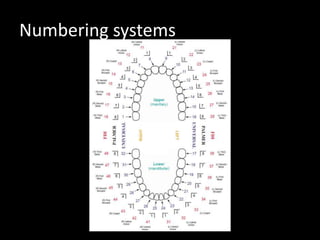
Numbering systems
Differences between deciduous
teeth and permanent :
1.The deciduous teeth are smaller, although the
mesiodistal dimension of the permanent premolars
are generally less than those for deciduous molar .
2. Deciduous teeth have a greater constancy of shape
.
3. The crown of deciduous teeth appear bulbous ,
often having pronounced labial or buccal cingula .
4. the cervical margins of deciduous teeth are more
sharply demarcated and pronounced , enamel
bulging rather than gently tapering .
5. the cusps of newly erupted deciduous teeth are
more pointed .
6. the crowns of deciduous teeth have
thinner enamel ( 0.5-1.0 mm ) than the
crowns of permanent teeth (2.5 mm )
7. the enamel of deciduous teeth are more
opaque , gives the crown a whiter
appearance
8. the enamel is softer and more easily worn
in deciduous teeth .
9. enamel is more permeable in dec. teeth .
10. the aprismatic layer of surface enamel is
wider in dec. teeth .
11. the enamel and dentine of ALL dec . teeth exhibit neonatal
lines .
12. the roots of dec. teeth are shorter and less robust than
those of permanent teeth .
13. the roots of dec. incisors and canines are longer in
proportion to the crown than those of permanent ones.
14. the roots of the dec. molars are widely divergent
extending beyond the dimensions of the crown.
15. the pulp chambers of dec. are proportionally larger in
relation to the crown than those of permanent teeth. the
pulp horns in dec. are more prominent.
16. the root canals of dec. are extremely fine .
17 . the dental arch for dec. dentition are smaller .
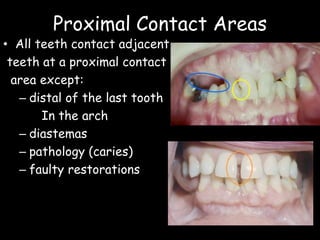
Proximal Contact Areas
• All teeth contact adjacent
teeth at a proximal contact
area except:
– distal of the last tooth
In the arch
– diastemas
– pathology (caries)
– faulty restorations
Importance:
–Ensures food will not be packed between
teeth causing inflammation to the
supporting tissues thereby causing gingivitis
& periodontitis
–It helps stabilize the dental arches by the
combined anchorage of all the teeth in
either arch in positive contact with each
other (exception - third molars.)
–Each tooth is individually supported by
these contact areas.
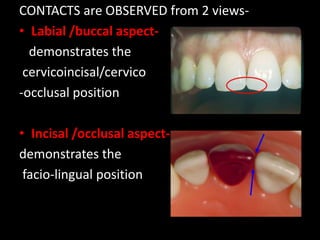
CONTACTS are OBSERVED from 2 views-
• Labial /buccal aspect-
demonstrates the
cervicoincisal/cervico
-occlusal position
• Incisal /occlusal aspect-
demonstrates the
facio-lingual position
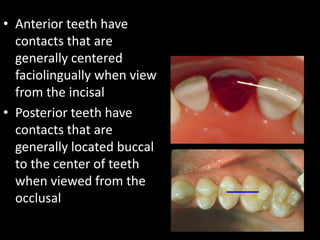
• Anterior teeth have
contacts that are
generally centered
faciolingually when view
from the incisal
• Posterior teeth have
contacts that are
generally located buccal
to the center of teeth
when viewed from the
occlusal
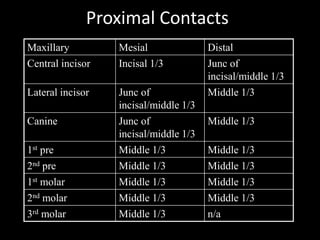
Proximal Contacts
Maxillary Mesial Distal
Central incisor Incisal 1/3 Junc of
incisal/middle 1/3
Lateral incisor Junc of
incisal/middle 1/3
Middle 1/3
Canine Junc of
incisal/middle 1/3
Middle 1/3
1st pre Middle 1/3 Middle 1/3
2nd pre Middle 1/3 Middle 1/3
1st molar Middle 1/3 Middle 1/3
2nd molar Middle 1/3 Middle 1/3
3rd molar Middle 1/3 n/a
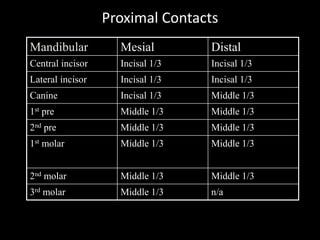
Proximal Contacts
Mandibular Mesial Distal
Central incisor Incisal 1/3 Incisal 1/3
Lateral incisor Incisal 1/3 Incisal 1/3
Canine Incisal 1/3 Middle 1/3
1st pre Middle 1/3 Middle 1/3
2nd pre Middle 1/3 Middle 1/3
1st molar Middle 1/3 Middle 1/3
2nd molar Middle 1/3 Middle 1/3
3rd molar Middle 1/3 n/a
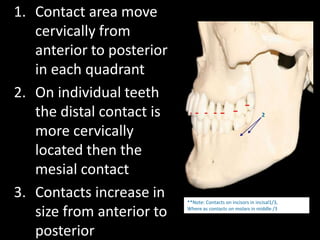
1. Contact area move
cervically from
anterior to posterior
in each quadrant
2. On individual teeth
the distal contact is
more cervically
located then the
mesial contact
3. Contacts increase in
size from anterior to
posterior
2
**Note: Contacts on incisors in incisal1/3,
Where as contacts on molars in middle /3
LMAXILLARY CENTRAL INCISORabial
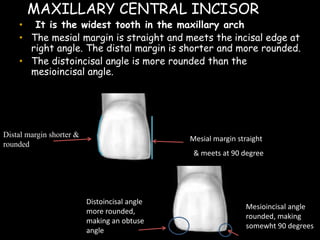
• It is the widest tooth in the maxillary arch.
• The mesial margin is straight and meets the incisal edge at
right angle. The distal margin is shorter and more rounded.
• The distoincisal angle is more rounded than the
mesioincisal angle.
Mesial margin straight
& meets at 90 degree
Distal margin shorter &
rounded
Distoincisal angle
more rounded,
making an obtuse
angle
Mesioincisal angle
rounded, making
somewht 90 degrees
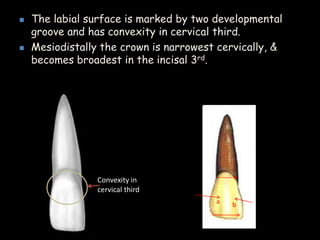
 The labial surface is marked by two developmental
groove and has convexity in cervical third.
 Mesiodistally the crown is narrowest cervically, &
becomes broadest in the incisal 3rd.
Convexity in
cervical third
a b
Lingual aspect
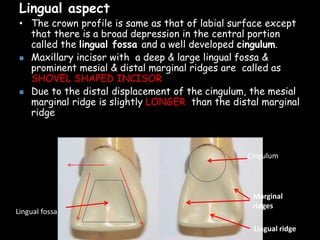
• The crown profile is same as that of labial surface except
that there is a broad depression in the central portion
called the lingual fossa and a well developed cingulum.
 Maxillary incisor with a deep & large lingual fossa &
prominent mesial & distal marginal ridges are called as
SHOVEL SHAPED INCISOR
 Due to the distal displacement of the cingulum, the mesial
marginal ridge is slightly LONGER than the distal marginal
ridge
Lingual fossa
Cingulum
Marginal
ridges
Lingual ridge
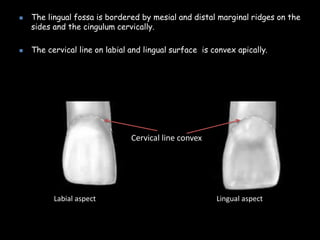
 The lingual fossa is bordered by mesial and distal marginal ridges on the
sides and the cingulum cervically.
 The cervical line on labial and lingual surface is convex apically.
Cervical line convex
Lingual aspectLabial aspect
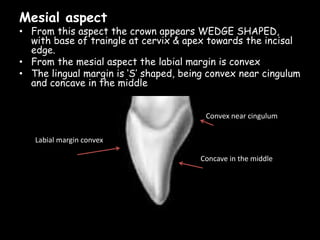
Mesial aspect
• From this aspect the crown appears WEDGE SHAPED,
with base of traingle at cervix & apex towards the incisal
edge.
• From the mesial aspect the labial margin is convex
• The lingual margin is ‘S’ shaped, being convex near cingulum
and concave in the middle
Labial margin convex
Convex near cingulum
Concave in the middle
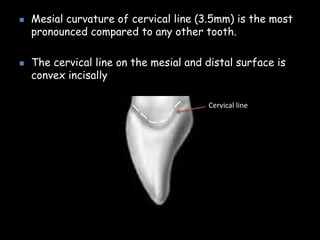
 Mesial curvature of cervical line (3.5mm) is the most
pronounced compared to any other tooth.
 The cervical line on the mesial and distal surface is
convex incisally
Cervical line
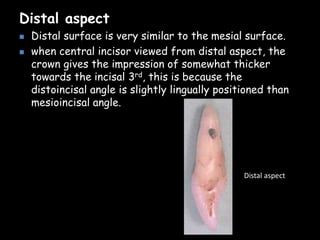
Distal aspect
Distal aspect
 Distal surface is very similar to the mesial surface.
 when central incisor viewed from distal aspect, the
crown gives the impression of somewhat thicker
towards the incisal 3rd, this is because the
distoincisal angle is slightly lingually positioned than
mesioincisal angle.
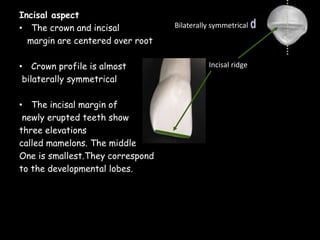
Incisal aspect
• The crown and incisal
margin are centered over root
• Crown profile is almost
bilaterally symmetrical
• The incisal margin of
newly erupted teeth show
three elevations
called mamelons. The middle
One is smallest.They correspond
to the developmental lobes.
Incisal ridge
Bilaterally symmetrical
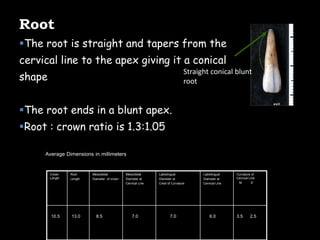
Root
The root is straight and tapers from the
cervical line to the apex giving it a conical
shape
The root ends in a blunt apex.
Root : crown ratio is 1.3:1.05
Straight conical blunt
root
3.5 2.56.07.07.08.513.010.5
Curvature of
Cervical Line
M D
Labiolingual
Diameter at
Cervical Line
Labiolingual
Diameter at
Crest of Curvature
Mesiodistal
Diameter at
Cervical Line
Mesiodistal
Diameter of crown
Root
Length
Crown
Length
Average Dimensions in millimeters
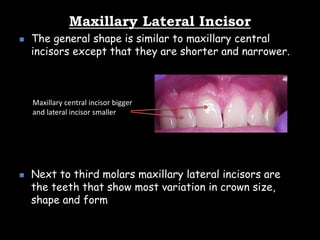
Maxillary Lateral Incisor
 The general shape is similar to maxillary central
incisors except that they are shorter and narrower.
 Next to third molars maxillary lateral incisors are
the teeth that show most variation in crown size,
shape and form
Maxillary central incisor bigger
and lateral incisor smaller
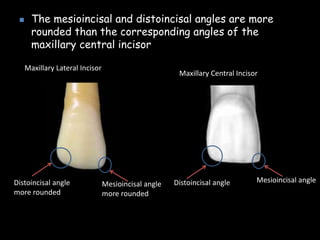
 The mesioincisal and distoincisal angles are more
rounded than the corresponding angles of the
maxillary central incisor
Distoincisal angle
more rounded
Mesioincisal angle
more rounded
Maxillary Lateral Incisor
Maxillary Central Incisor
Mesioincisal angleDistoincisal angle
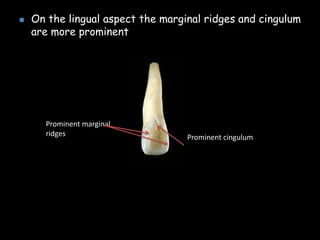
 On the lingual aspect the marginal ridges and cingulum
are more prominent
Prominent cingulum
Prominent marginal
ridges
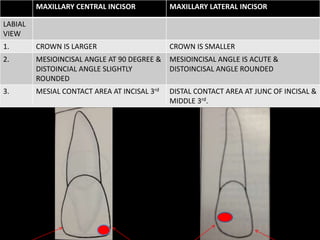
MAXILLARY CENTRAL INCISOR MAXILLARY LATERAL INCISOR
LABIAL
VIEW
1. CROWN IS LARGER CROWN IS SMALLER
2. MESIOINCISAL ANGLE AT 90 DEGREE &
DISTOINCIAL ANGLE SLIGHTLY
ROUNDED
MESIOINCISAL ANGLE IS ACUTE &
DISTOINCISAL ANGLE ROUNDED
3. MESIAL CONTACT AREA AT INCISAL 3rd DISTAL CONTACT AREA AT JUNC OF INCISAL &
MIDDLE 3rd.
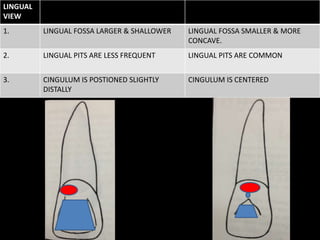
LINGUAL
VIEW
1. LINGUAL FOSSA LARGER & SHALLOWER LINGUAL FOSSA SMALLER & MORE
CONCAVE.
2. LINGUAL PITS ARE LESS FREQUENT LINGUAL PITS ARE COMMON
3. CINGULUM IS POSTIONED SLIGHTLY
DISTALLY
CINGULUM IS CENTERED
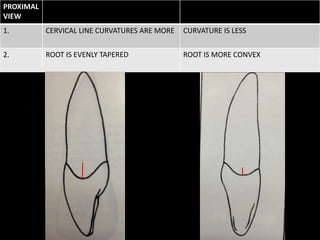
PROXIMAL
VIEW
1. CERVICAL LINE CURVATURES ARE MORE CURVATURE IS LESS
2. ROOT IS EVENLY TAPERED ROOT IS MORE CONVEX
INCISAL
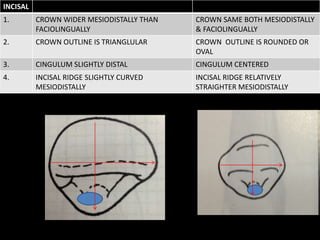
1. CROWN WIDER MESIODISTALLY THAN
FACIOLINGUALLY
CROWN SAME BOTH MESIODISTALLY
& FACIOLINGUALLY
2. CROWN OUTLINE IS TRIANGLULAR CROWN OUTLINE IS ROUNDED OR
OVAL
3. CINGULUM SLIGHTLY DISTAL CINGULUM CENTERED
4. INCISAL RIDGE SLIGHTLY CURVED
MESIODISTALLY
INCISAL RIDGE RELATIVELY
STRAIGHTER MESIODISTALLY
MANDIBULAR INCISOR
Mandibular central incisor and lateral are similar in anatomy
and complement each other in function.
Labial aspect
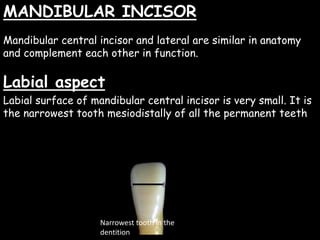
Labial surface of mandibular central incisor is very small. It is
the narrowest tooth mesiodistally of all the permanent teeth
Narrowest tooth in the
dentition
 It is bilaterally symmetrical,that it is difficult to tell
the sides. The only differnce is the greater mesial
than distal curvature.
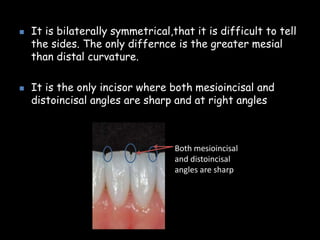
 It is the only incisor where both mesioincisal and
distoincisal angles are sharp and at right angles
Both mesioincisal
and distoincisal
angles are sharp
Lingual aspect
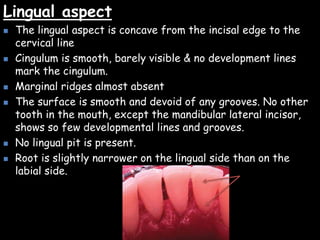
 The lingual aspect is concave from the incisal edge to the
cervical line
 Cingulum is smooth, barely visible & no development lines
mark the cingulum.
 Marginal ridges almost absent
 The surface is smooth and devoid of any grooves. No other
tooth in the mouth, except the mandibular lateral incisor,
shows so few developmental lines and grooves.
 No lingual pit is present.
 Root is slightly narrower on the lingual side than on the
labial side.
Mesial aspect
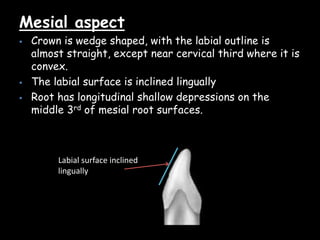
 Crown is wedge shaped, with the labial outline is
almost straight, except near cervical third where it is
convex.
 The labial surface is inclined lingually
 Root has longitudinal shallow depressions on the
middle 3rd of mesial root surfaces.
Labial surface inclined
lingually
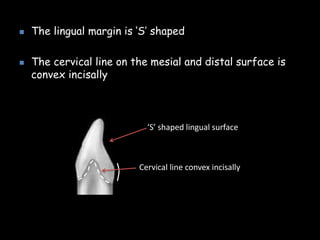
 The lingual margin is ‘S’ shaped
 The cervical line on the mesial and distal surface is
convex incisally
‘S’ shaped lingual surface
Cervical line convex incisally
Distalaspect
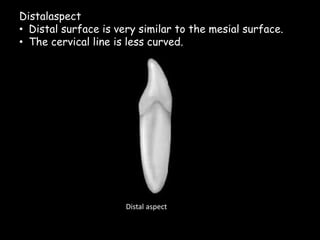
• Distal surface is very similar to the mesial surface.
• The cervical line is less curved.
Distal aspect
Incisal aspect
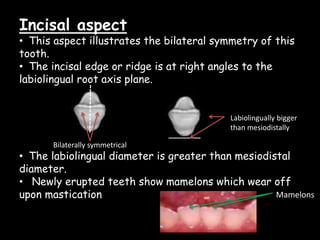
• This aspect illustrates the bilateral symmetry of this
tooth.
• The incisal edge or ridge is at right angles to the
labiolingual root axis plane.
• The labiolingual diameter is greater than mesiodistal
diameter.
• Newly erupted teeth show mamelons which wear off
upon mastication
Bilaterally symmetrical
Labiolingually bigger
than mesiodistally
Mamelons
Root
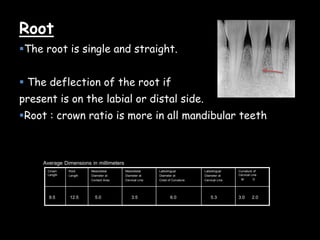
The root is single and straight.
 The deflection of the root if
present is on the labial or distal side.
Root : crown ratio is more in all mandibular teeth
3.0 2.05.36.03.55.012.59.5
Curvature of
Cervical Line
M D
Labiolingual
Diameter at
Cervical Line
Labiolingual
Diameter at
Crest of Curvature
Mesiodistal
Diameter at
Cervical Line
Mesiodistal
Diameter at
Contact Area
Root
Length
Crown
Length
Average Dimensions in millimeters
Mandibular Lateral Incisor
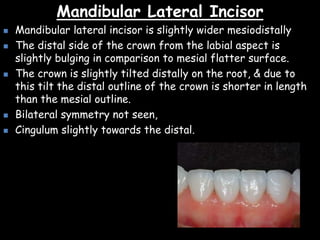
 Mandibular lateral incisor is slightly wider mesiodistally
 The distal side of the crown from the labial aspect is
slightly bulging in comparison to mesial flatter surface.
 The crown is slightly tilted distally on the root, & due to
this tilt the distal outline of the crown is shorter in length
than the mesial outline.
 Bilateral symmetry not seen,
 Cingulum slightly towards the distal.
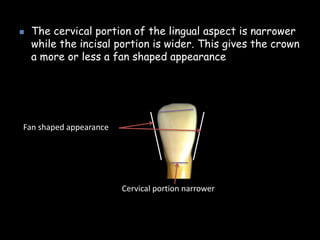
 The cervical portion of the lingual aspect is narrower
while the incisal portion is wider. This gives the crown
a more or less a fan shaped appearance
Cervical portion narrower
Fan shaped appearance
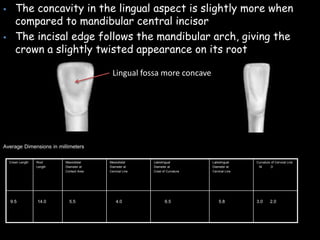
 The concavity in the lingual aspect is slightly more when
compared to mandibular central incisor
 The incisal edge follows the mandibular arch, giving the
crown a slightly twisted appearance on its root
Lingual fossa more concave
3.0 2.05.86.54.05.514.09.5
Curvature of Cervical Line
M D
Labiolingual
Diameter at
Cervical Line
Labiolingual
Diameter at
Crest of Curvature
Mesiodistal
Diameter at
Cervical Line
Mesiodistal
Diameter at
Contact Area
Root
Length
Crown Length
Average Dimensions in millimeters
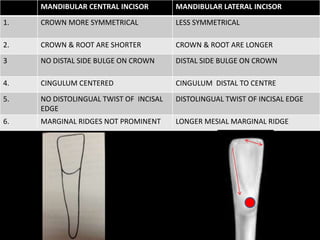
MANDIBULAR CENTRAL INCISOR MANDIBULAR LATERAL INCISOR
1. CROWN MORE SYMMETRICAL LESS SYMMETRICAL
2. CROWN & ROOT ARE SHORTER CROWN & ROOT ARE LONGER
3 NO DISTAL SIDE BULGE ON CROWN DISTAL SIDE BULGE ON CROWN
4. CINGULUM CENTERED CINGULUM DISTAL TO CENTRE
5. NO DISTOLINGUAL TWIST OF INCISAL
EDGE
DISTOLINGUAL TWIST OF INCISAL EDGE
6. MARGINAL RIDGES NOT PROMINENT LONGER MESIAL MARGINAL RIDGE
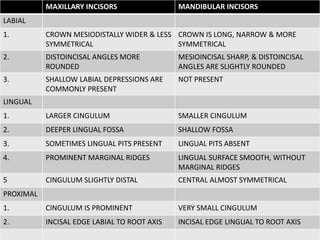
MAXILLARY INCISORS MANDIBULAR INCISORS
LABIAL
1. CROWN MESIODISTALLY WIDER & LESS
SYMMETRICAL
CROWN IS LONG, NARROW & MORE
SYMMETRICAL
2. DISTOINCISAL ANGLES MORE
ROUNDED
MESIOINCISAL SHARP, & DISTOINCISAL
ANGLES ARE SLIGHTLY ROUNDED
3. SHALLOW LABIAL DEPRESSIONS ARE
COMMONLY PRESENT
NOT PRESENT
LINGUAL
1. LARGER CINGULUM SMALLER CINGULUM
2. DEEPER LINGUAL FOSSA SHALLOW FOSSA
3. SOMETIMES LINGUAL PITS PRESENT LINGUAL PITS ABSENT
4. PROMINENT MARGINAL RIDGES LINGUAL SURFACE SMOOTH, WITHOUT
MARGINAL RIDGES
5 CINGULUM SLIGHTLY DISTAL CENTRAL ALMOST SYMMETRICAL
PROXIMAL
1. CINGULUM IS PROMINENT VERY SMALL CINGULUM
2. INCISAL EDGE LABIAL TO ROOT AXIS INCISAL EDGE LINGUAL TO ROOT AXIS
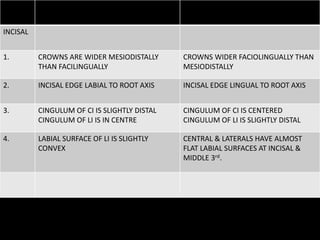
INCISAL
1. CROWNS ARE WIDER MESIODISTALLY
THAN FACILINGUALLY
CROWNS WIDER FACIOLINGUALLY THAN
MESIODISTALLY
2. INCISAL EDGE LABIAL TO ROOT AXIS INCISAL EDGE LINGUAL TO ROOT AXIS
3. CINGULUM OF CI IS SLIGHTLY DISTAL
CINGULUM OF LI IS IN CENTRE
CINGULUM OF CI IS CENTERED
CINGULUM OF LI IS SLIGHTLY DISTAL
4. LABIAL SURFACE OF LI IS SLIGHTLY
CONVEX
CENTRAL & LATERALS HAVE ALMOST
FLAT LABIAL SURFACES AT INCISAL &
MIDDLE 3rd.
MAXILLARY CANINES
Canines are very long and stable teeth
There are four canines placed at the corner of the
mouth and hence called the ‘corner stones’ of the
dentition
They have a single pointed cusp (also called cuspids)
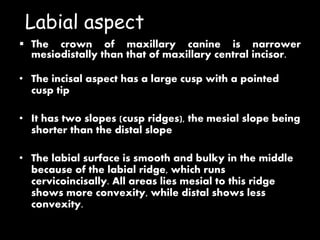
Labial aspect
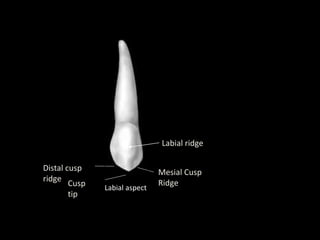
 The crown of maxillary canine is narrower
mesiodistally than that of maxillary central incisor.
• The incisal aspect has a large cusp with a pointed
cusp tip
• It has two slopes (cusp ridges), the mesial slope being
shorter than the distal slope
• The labial surface is smooth and bulky in the middle
because of the labial ridge, which runs
cervicoincisally. All areas lies mesial to this ridge
shows more convexity, while distal shows less
convexity.
Labial aspect
Labial ridge
Cusp
tip
Distal cusp
ridge
Mesial Cusp
Ridge
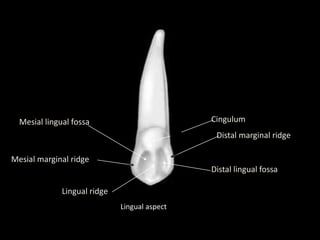
Lingual aspect
• The crown and root are narrower lingually
• The cingulum is well developed, large and sometimes
pointed like a cusp & in center.
• Occasionally a well developed lingual ridge is seen
that divides the lingual fossa into mesial and distal
lingual fossae
• Heavy marginal ridges are associated with well
formed cingulum and fossae
Lingual aspect
Cingulum
Distal marginal ridge
Distal lingual fossa
Lingual ridge
Mesial marginal ridge
Mesial lingual fossa
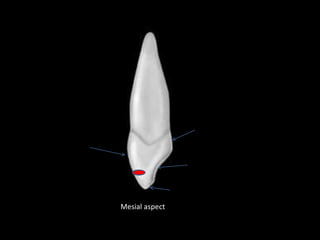
Mesial aspect
• Crown outline is wedge shaped
• From the mesial aspect canine looks similar but
bulkier than maxillary central incisor
• Maxillary canine is the widest anterior tooth
labiolingually
• The cervical line curvature is towards the cusp
(incisally)
• The contact area is near the junction of the incisal
and middle third
• From this aspect the entire labial otline is convex
from the cervical line to the cusp tip, & the lingual
outline is convex at cingulum, thereafter it
straightens out at the middle 3rd & again slight
convex in the incisal 3rd.
Mesial aspect
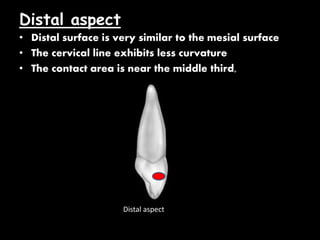
Distal aspect
• Distal surface is very similar to the mesial surface
• The cervical line exhibits less curvature
• The contact area is near the middle third,
Distal aspect
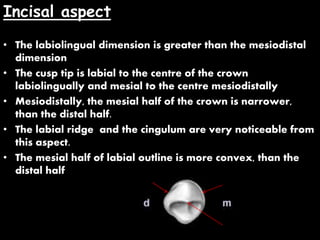
Incisal aspect
• The labiolingual dimension is greater than the mesiodistal
dimension
• The cusp tip is labial to the centre of the crown
labiolingually and mesial to the centre mesiodistally
• Mesiodistally, the mesial half of the crown is narrower,
than the distal half.
• The labial ridge and the cingulum are very noticeable from
this aspect.
• The mesial half of labial outline is more convex, than the
distal half
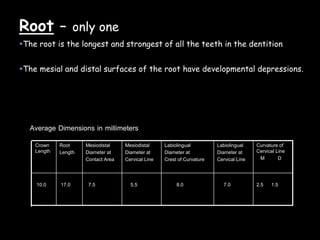
Root – only one
The root is the longest and strongest of all the teeth in the dentition
The mesial and distal surfaces of the root have developmental depressions.
2.5 1.57.08.05.57.517.010.0
Curvature of
Cervical Line
M D
Labiolingual
Diameter at
Cervical Line
Labiolingual
Diameter at
Crest of Curvature
Mesiodistal
Diameter at
Cervical Line
Mesiodistal
Diameter at
Contact Area
Root
Length
Crown
Length
Average Dimensions in millimeters
Mandibular Canine
Labial aspect
 Mandibular canines are similar to maxillary canines except
that they are slightly narrower mesiodistally
 Mesial outline of the crown is almost straight and inline
with the mesial outline of the root. The crown is more
towards the distal to the root axis than mesial to it. Because
of this crown appears to be distally tilted when the roots
are held vertical position.
 Cusp tip forms a more obtuse line (120 degree)
 Labial ridge is very rudimentary, & not as marked as
maxillary canine.
 The mesial cusp ridge is smaller than the distal cusp ridge
Lingual aspect
 The lingual surface of the crown is smooth and flat simulating the
surface of mandibular lateral incisor
 Cingulum is less prominent and marginal ridges are less distinct
Mesial and Distal aspects
 These aspects are very similar and the cervical line curves more on the
mesial aspect
 The contact area on mesial aspect is in the incisal third and a little
higher on the distal third
 Incisal ridge is slightly lingual to the root axis.
 The distoincisal angle is slightly more lingual in position than the cusp tip
to give turn to the arch.
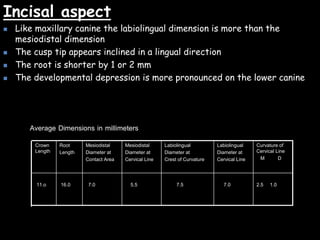
Incisal aspect
 Like maxillary canine the labiolingual dimension is more than the
mesiodistal dimension
 The cusp tip appears inclined in a lingual direction
 The root is shorter by 1 or 2 mm
 The developmental depression is more pronounced on the lower canine
2.5 1.07.07.55.57.016.011.o
Curvature of
Cervical Line
M D
Labiolingual
Diameter at
Cervical Line
Labiolingual
Diameter at
Crest of Curvature
Mesiodistal
Diameter at
Cervical Line
Mesiodistal
Diameter at
Contact Area
Root
Length
Crown
Length
Average Dimensions in millimeters
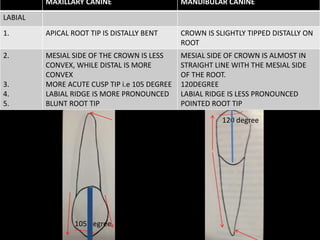
MAXILLARY CANINE MANDIBULAR CANINE
LABIAL
1. APICAL ROOT TIP IS DISTALLY BENT CROWN IS SLIGHTLY TIPPED DISTALLY ON
ROOT
2.
3.
4.
5.
MESIAL SIDE OF THE CROWN IS LESS
CONVEX, WHILE DISTAL IS MORE
CONVEX
MORE ACUTE CUSP TIP i.e 105 DEGREE
LABIAL RIDGE IS MORE PRONOUNCED
BLUNT ROOT TIP
MESIAL SIDE OF CROWN IS ALMOST IN
STRAIGHT LINE WITH THE MESIAL SIDE
OF THE ROOT.
120DEGREE
LABIAL RIDGE IS LESS PRONOUNCED
POINTED ROOT TIP
120 degree
105 degree
LINGUAL
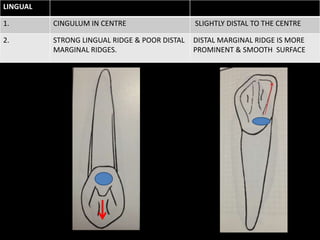
1. CINGULUM IN CENTRE SLIGHTLY DISTAL TO THE CENTRE
2. STRONG LINGUAL RIDGE & POOR DISTAL
MARGINAL RIDGES.
DISTAL MARGINAL RIDGE IS MORE
PROMINENT & SMOOTH SURFACE
PROXIMAL
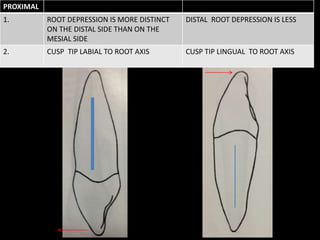
1. ROOT DEPRESSION IS MORE DISTINCT
ON THE DISTAL SIDE THAN ON THE
MESIAL SIDE
DISTAL ROOT DEPRESSION IS LESS
2. CUSP TIP LABIAL TO ROOT AXIS CUSP TIP LINGUAL TO ROOT AXIS
INCISAL
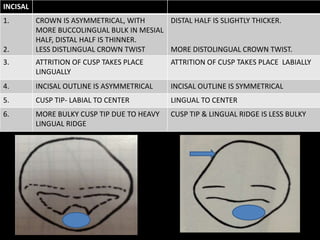
1.
2.
CROWN IS ASYMMETRICAL, WITH
MORE BUCCOLINGUAL BULK IN MESIAL
HALF, DISTAL HALF IS THINNER.
LESS DISTLINGUAL CROWN TWIST
DISTAL HALF IS SLIGHTLY THICKER.
MORE DISTOLINGUAL CROWN TWIST.
3. ATTRITION OF CUSP TAKES PLACE
LINGUALLY
ATTRITION OF CUSP TAKES PLACE LABIALLY
4. INCISAL OUTLINE IS ASYMMETRICAL INCISAL OUTLINE IS SYMMETRICAL
5. CUSP TIP- LABIAL TO CENTER LINGUAL TO CENTER
6. MORE BULKY CUSP TIP DUE TO HEAVY
LINGUAL RIDGE
CUSP TIP & LINGUAL RIDGE IS LESS BULKY
MAXILLARY PREMOLARS
Premolars are so named because they are placed
between the anterior teeth and the molars
Maxillary premolars have two cusps and sometimes one
or two roots
They develop from four lobes, like anterior teeth.
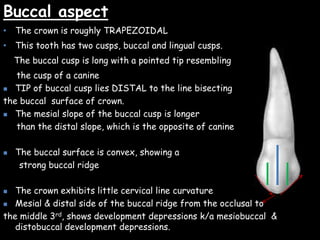
Buccal aspect
• The crown is roughly TRAPEZOIDAL
• This tooth has two cusps, buccal and lingual cusps.
The buccal cusp is long with a pointed tip resembling
the cusp of a canine
 TIP of buccal cusp lies DISTAL to the line bisecting
the buccal surface of crown.
 The mesial slope of the buccal cusp is longer
than the distal slope, which is the opposite of canine
 The buccal surface is convex, showing a
strong buccal ridge
 The crown exhibits little cervical line curvature
 Mesial & distal side of the buccal ridge from the occlusal to
the middle 3rd, shows development depressions k/a mesiobuccal &
distobuccal development depressions.
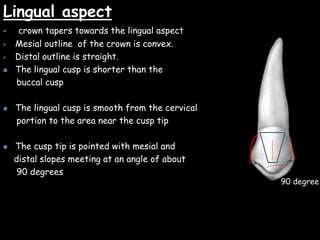
Lingual aspect
 crown tapers towards the lingual aspect
 Mesial outline of the crown is convex.
 Distal outline is straight.
 The lingual cusp is shorter than the
buccal cusp
 The lingual cusp is smooth from the cervical
portion to the area near the cusp tip
 The cusp tip is pointed with mesial and
distal slopes meeting at an angle of about
90 degrees
90 degree
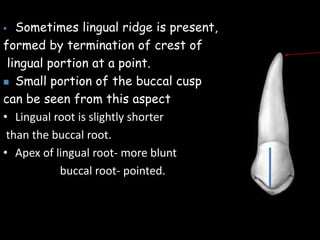
 Sometimes lingual ridge is present,
formed by termination of crest of
lingual portion at a point.
 Small portion of the buccal cusp
can be seen from this aspect
• Lingual root is slightly shorter
than the buccal root.
• Apex of lingual root- more blunt
buccal root- pointed.
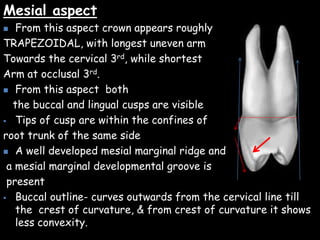
Mesial aspect
 From this aspect crown appears roughly
TRAPEZOIDAL, with longest uneven arm
Towards the cervical 3rd, while shortest
Arm at occlusal 3rd.
 From this aspect both
the buccal and lingual cusps are visible
 Tips of cusp are within the confines of
root trunk of the same side
 A well developed mesial marginal ridge and
a mesial marginal developmental groove is
present
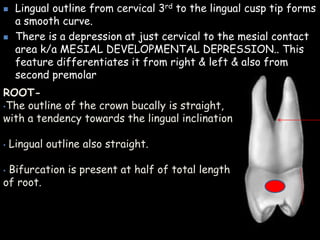
 Buccal outline- curves outwards from the cervical line till
the crest of curvature, & from crest of curvature it shows
less convexity.
 Lingual outline from cervical 3rd to the lingual cusp tip forms
a smooth curve.
 There is a depression at just cervical to the mesial contact
area k/a MESIAL DEVELOPMENTAL DEPRESSION.. This
feature differentiates it from right & left & also from
second premolar
ROOT-
•The outline of the crown bucally is straight,
with a tendency towards the lingual inclination
• Lingual outline also straight.
• Bifurcation is present at half of total length
of root.
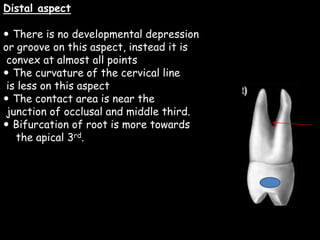
Distal aspect
 There is no developmental depression
or groove on this aspect, instead it is
convex at almost all points
 The curvature of the cervical line
is less on this aspect
 The contact area is near the
junction of occlusal and middle third.
 Bifurcation of root is more towards
the apical 3rd.
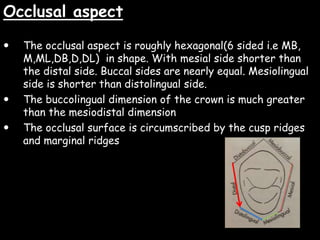
Occlusal aspect
 The occlusal aspect is roughly hexagonal(6 sided i.e MB,
M,ML,DB,D,DL) in shape. With mesial side shorter than
the distal side. Buccal sides are nearly equal. Mesiolingual
side is shorter than distolingual side.
 The buccolingual dimension of the crown is much greater
than the mesiodistal dimension
 The occlusal surface is circumscribed by the cusp ridges
and marginal ridges
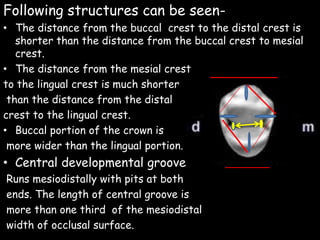
Following structures can be seen-
• The distance from the buccal crest to the distal crest is
shorter than the distance from the buccal crest to mesial
crest.
• The distance from the mesial crest
to the lingual crest is much shorter
than the distance from the distal
crest to the lingual crest.
• Buccal portion of the crown is
more wider than the lingual portion.
• Central developmental groove-
Runs mesiodistally with pits at both
ends. The length of central groove is
more than one third of the mesiodistal
width of occlusal surface.
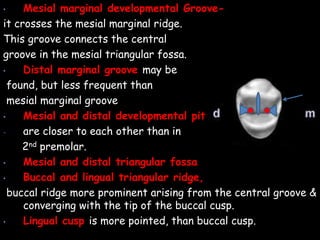
• Mesial marginal developmental Groove-
it crosses the mesial marginal ridge.
This groove connects the central
groove in the mesial triangular fossa.
• Distal marginal groove may be
found, but less frequent than
mesial marginal groove
• Mesial and distal developmental pit
- are closer to each other than in
2nd premolar.
• Mesial and distal triangular fossa
• Buccal and lingual triangular ridge,
buccal ridge more prominent arising from the central groove &
converging with the tip of the buccal cusp.
• Lingual cusp is more pointed, than buccal cusp.
Root
Most Maxillary first premolars have 2 roots, but one and
three roots can also be seen. Two roots; buccal and lingual
 The buccal portion of the root resembles canine
 The root when viewed from the proximal side shows a big
trunk and bifurcation area from where the buccal and
lingual root separate
A developmental depression is seen on the mesial aspect
of the trunk.
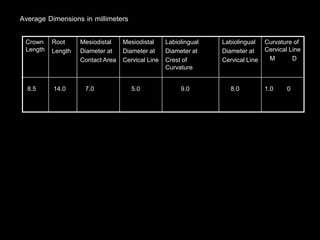
1.0 08.09.05.07.014.08.5
Curvature of
Cervical Line
M D
Labiolingual
Diameter at
Cervical Line
Labiolingual
Diameter at
Crest of
Curvature
Mesiodistal
Diameter at
Cervical Line
Mesiodistal
Diameter at
Contact Area
Root
Length
Crown
Length
Average Dimensions in millimeters
Maxillary 2nd Premolar
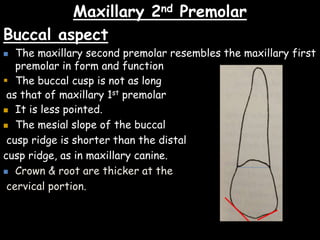
Buccal aspect
 The maxillary second premolar resembles the maxillary first
premolar in form and function
 The buccal cusp is not as long
as that of maxillary 1st premolar
 It is less pointed.
 The mesial slope of the buccal
cusp ridge is shorter than the distal
cusp ridge, as in maxillary canine.
 Crown & root are thicker at the
cervical portion.
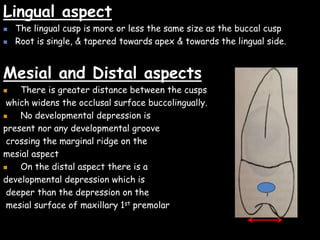
Lingual aspect
 The lingual cusp is more or less the same size as the buccal cusp
 Root is single, & tapered towards apex & towards the lingual side.
Mesial and Distal aspects
 There is greater distance between the cusps
which widens the occlusal surface buccolingually.
 No developmental depression is
present nor any developmental groove
crossing the marginal ridge on the
mesial aspect
 On the distal aspect there is a
developmental depression which is
deeper than the depression on the
mesial surface of maxillary 1st premolar
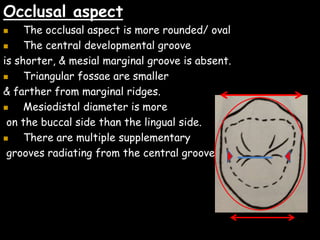
Occlusal aspect
 The occlusal aspect is more rounded/ oval
 The central developmental groove
is shorter, & mesial marginal groove is absent.
 Triangular fossae are smaller
& farther from marginal ridges.
 Mesiodistal diameter is more
on the buccal side than the lingual side.
 There are multiple supplementary
grooves radiating from the central groove
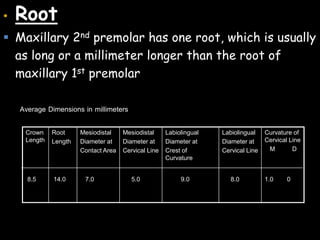
• Root
 Maxillary 2nd premolar has one root, which is usually
as long or a millimeter longer than the root of
maxillary 1st premolar
1.0 08.09.05.07.014.08.5
Curvature of
Cervical Line
M D
Labiolingual
Diameter at
Cervical Line
Labiolingual
Diameter at
Crest of
Curvature
Mesiodistal
Diameter at
Cervical Line
Mesiodistal
Diameter at
Contact Area
Root
Length
Crown
Length
Average Dimensions in millimeters
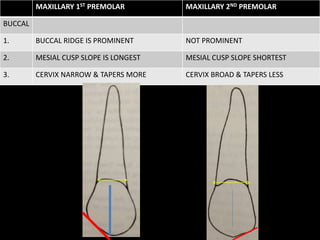
MAXILLARY 1ST PREMOLAR MAXILLARY 2ND PREMOLAR
BUCCAL
1. BUCCAL RIDGE IS PROMINENT NOT PROMINENT
2. MESIAL CUSP SLOPE IS LONGEST MESIAL CUSP SLOPE SHORTEST
3. CERVIX NARROW & TAPERS MORE CERVIX BROAD & TAPERS LESS
LINGUAL
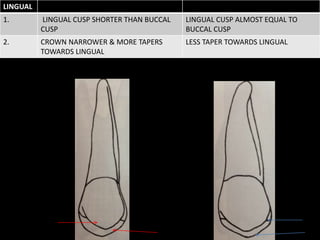
1. LINGUAL CUSP SHORTER THAN BUCCAL
CUSP
LINGUAL CUSP ALMOST EQUAL TO
BUCCAL CUSP
2. CROWN NARROWER & MORE TAPERS
TOWARDS LINGUAL
LESS TAPER TOWARDS LINGUAL
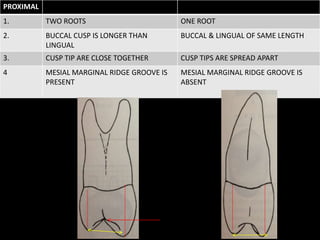
PROXIMAL
1. TWO ROOTS ONE ROOT
2. BUCCAL CUSP IS LONGER THAN
LINGUAL
BUCCAL & LINGUAL OF SAME LENGTH
3. CUSP TIP ARE CLOSE TOGETHER CUSP TIPS ARE SPREAD APART
4 MESIAL MARGINAL RIDGE GROOVE IS
PRESENT
MESIAL MARGINAL RIDGE GROOVE IS
ABSENT
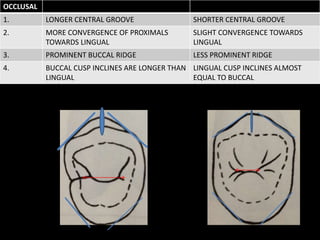
OCCLUSAL
1. LONGER CENTRAL GROOVE SHORTER CENTRAL GROOVE
2. MORE CONVERGENCE OF PROXIMALS
TOWARDS LINGUAL
SLIGHT CONVERGENCE TOWARDS
LINGUAL
3. PROMINENT BUCCAL RIDGE LESS PROMINENT RIDGE
4. BUCCAL CUSP INCLINES ARE LONGER THAN
LINGUAL
LINGUAL CUSP INCLINES ALMOST
EQUAL TO BUCCAL
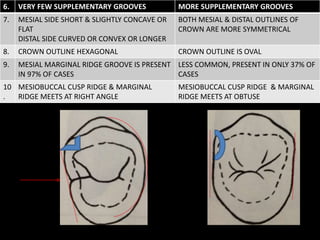
6. VERY FEW SUPPLEMENTARY GROOVES MORE SUPPLEMENTARY GROOVES
7. MESIAL SIDE SHORT & SLIGHTLY CONCAVE OR
FLAT
DISTAL SIDE CURVED OR CONVEX OR LONGER
BOTH MESIAL & DISTAL OUTLINES OF
CROWN ARE MORE SYMMETRICAL
8. CROWN OUTLINE HEXAGONAL CROWN OUTLINE IS OVAL
9. MESIAL MARGINAL RIDGE GROOVE IS PRESENT
IN 97% OF CASES
LESS COMMON, PRESENT IN ONLY 37% OF
CASES
10
.
MESIOBUCCAL CUSP RIDGE & MARGINAL
RIDGE MEETS AT RIGHT ANGLE
MESIOBUCCAL CUSP RIDGE & MARGINAL
RIDGE MEETS AT OBTUSE
Mandibular First Premolar
Buccal aspect
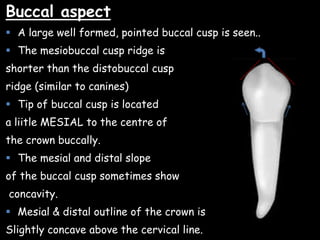
 A large well formed, pointed buccal cusp is seen..
 The mesiobuccal cusp ridge is
shorter than the distobuccal cusp
ridge (similar to canines)
 Tip of buccal cusp is located
a liitle MESIAL to the centre of
the crown buccally.
 The mesial and distal slope
of the buccal cusp sometimes show
concavity.
 Mesial & distal outline of the crown is
Slightly concave above the cervical line.
Lingual aspect
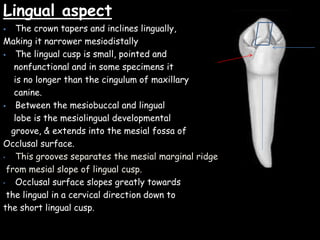
 The crown tapers and inclines lingually,
Making it narrower mesiodistally
 The lingual cusp is small, pointed and
nonfunctional and in some specimens it
is no longer than the cingulum of maxillary
canine.
 Between the mesiobuccal and lingual
lobe is the mesiolingual developmental
groove, & extends into the mesial fossa of
Occlusal surface.
• This grooves separates the mesial marginal ridge
from mesial slope of lingual cusp.
• Occlusal surface slopes greatly towards
the lingual in a cervical direction down to
the short lingual cusp.
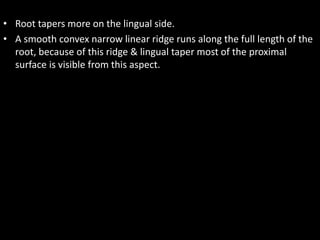
• Root tapers more on the lingual side.
• A smooth convex narrow linear ridge runs along the full length of the
root, because of this ridge & lingual taper most of the proximal
surface is visible from this aspect.
Mesial aspect
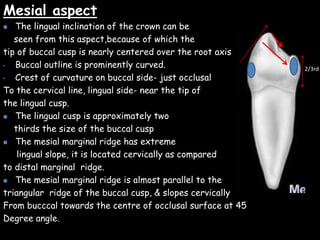
 The lingual inclination of the crown can be
seen from this aspect,because of which the
tip of buccal cusp is nearly centered over the root axis
• Buccal outline is prominently curved.
• Crest of curvature on buccal side- just occlusal
To the cervical line, lingual side- near the tip of
the lingual cusp.
 The lingual cusp is approximately two
thirds the size of the buccal cusp
 The mesial marginal ridge has extreme
lingual slope, it is located cervically as compared
to distal marginal ridge.
 The mesial marginal ridge is almost parallel to the
triangular ridge of the buccal cusp, & slopes cervically
From bucccal towards the centre of occlusal surface at 45
Degree angle.
2/3rd
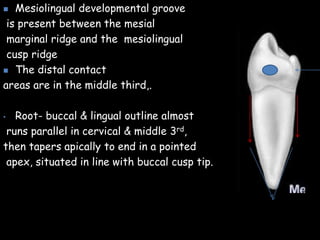
 Mesiolingual developmental groove
is present between the mesial
marginal ridge and the mesiolingual
cusp ridge
 The distal contact
areas are in the middle third,.
• Root- buccal & lingual outline almost
runs parallel in cervical & middle 3rd,
then tapers apically to end in a pointed
apex, situated in line with buccal cusp tip.
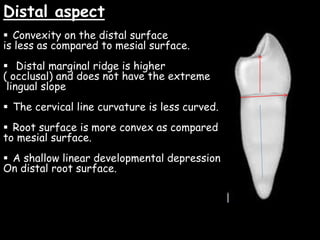
Distal aspect
 Convexity on the distal surface
is less as compared to mesial surface.
 Distal marginal ridge is higher
( occlusal) and does not have the extreme
lingual slope
 The cervical line curvature is less curved.
 Root surface is more convex as compared
to mesial surface.
 A shallow linear developmental depression
On distal root surface.
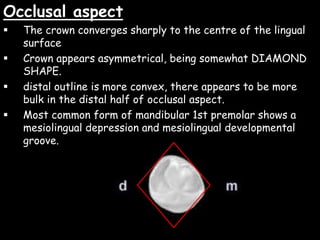
Occlusal aspect
 The crown converges sharply to the centre of the lingual
surface
 Crown appears asymmetrical, being somewhat DIAMOND
SHAPE.
 distal outline is more convex, there appears to be more
bulk in the distal half of occlusal aspect.
 Most common form of mandibular 1st premolar shows a
mesiolingual depression and mesiolingual developmental
groove.
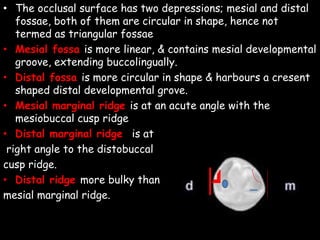
• The occlusal surface has two depressions; mesial and distal
fossae, both of them are circular in shape, hence not
termed as triangular fossae
• Mesial fossa is more linear, & contains mesial developmental
groove, extending buccolingually.
• Distal fossa is more circular in shape & harbours a cresent
shaped distal developmental grove.
• Mesial marginal ridge is at an acute angle with the
mesiobuccal cusp ridge
• Distal marginal ridge is at
right angle to the distobuccal
cusp ridge.
• Distal ridge more bulky than
mesial marginal ridge.
Root
The mandibular 1st premolar has one root
The root is approximately (3-4mm)shorter than the root
of mandibular canine but the outline bears a close
resemblance to the canine
A deep developmental groove is seen on the mesial aspect
on the root
On the distal aspect there is a shallow depression devoid
of any developmental groove.
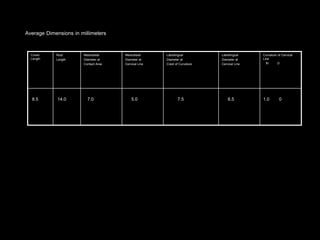
1.0 06.57.55.07.014.08.5
Curvature of Cervical
Line
M D
Labiolingual
Diameter at
Cervical Line
Labiolingual
Diameter at
Crest of Curvature
Mesiodistal
Diameter at
Cervical Line
Mesiodistal
Diameter at
Contact Area
Root
Length
Crown
Length
Average Dimensions in millimeters
Mandibular Second Premolar
 Mandibular 2nd premolar resembles the mandibular 1st
premolar from the buccal aspect only
 The crown assumes two common types.
more common 3-cusp type- more angular
2-cusp type- more rounded
 The two differ mainly in the occlusal design
Buccal aspect
 The buccal cusp is shorter with the cusp slopes presenting
less degree of angulations
Lingual aspect
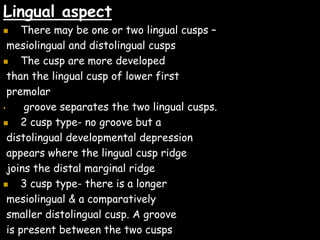
 There may be one or two lingual cusps –
mesiolingual and distolingual cusps
 The cusp are more developed
than the lingual cusp of lower first
premolar
• groove separates the two lingual cusps.
 2 cusp type- no groove but a
distolingual developmental depression
appears where the lingual cusp ridge
joins the distal marginal ridge
 3 cusp type- there is a longer
mesiolingual & a comparatively
smaller distolingual cusp. A groove
is present between the two cusps
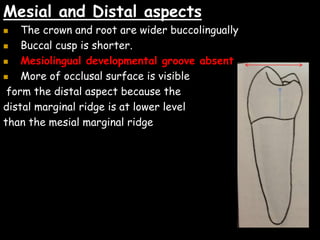
Mesial and Distal aspects
 The crown and root are wider buccolingually
 Buccal cusp is shorter.
 Mesiolingual developmental groove absent
 More of occlusal surface is visible
form the distal aspect because the
distal marginal ridge is at lower level
than the mesial marginal ridge
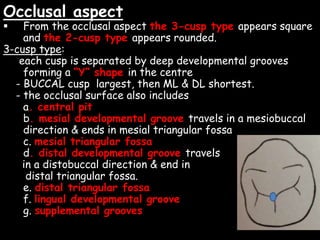
Occlusal aspect
 From the occlusal aspect the 3-cusp type appears square
and the 2-cusp type appears rounded.
3-cusp type:
each cusp is separated by deep developmental grooves
forming a “Y” shape in the centre
- BUCCAL cusp largest, then ML & DL shortest.
- the occlusal surface also includes
a. central pit
b. mesial developmental groove travels in a mesiobuccal
direction & ends in mesial triangular fossa
c. mesial triangular fossa
d. distal developmental groove travels
in a distobuccal direction & end in
distal triangular fossa.
e. distal triangular fossa
f. lingual developmental groove
g. supplemental grooves
2-cusp type:
- one buccal cusp and one well developed lingual cusp is
present
- crown outline is less oval on the lingual side.
- a central groove travels in a mesiodistal direction
and end in mesial and distal fossa (forming ‘H’ shape)
- buccolingual bulk is more in the mesial half than the
distal half
Root-
Mandibular 2nd premolar has a single root which is larger and
longer than the root of mandibular 1st premolar
The root is usually wide with a blunt apex
MANDIBULAR 1ST PREMOLAR MANDIBULAR 2ND PREMOLAR
BUCCAL
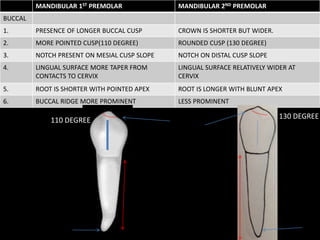
1. PRESENCE OF LONGER BUCCAL CUSP CROWN IS SHORTER BUT WIDER.
2. MORE POINTED CUSP(110 DEGREE) ROUNDED CUSP (130 DEGREE)
3. NOTCH PRESENT ON MESIAL CUSP SLOPE NOTCH ON DISTAL CUSP SLOPE
4. LINGUAL SURFACE MORE TAPER FROM
CONTACTS TO CERVIX
LINGUAL SURFACE RELATIVELY WIDER AT
CERVIX
5. ROOT IS SHORTER WITH POINTED APEX ROOT IS LONGER WITH BLUNT APEX
6. BUCCAL RIDGE MORE PROMINENT LESS PROMINENT
110 DEGREE 130 DEGREE
LINGUAL
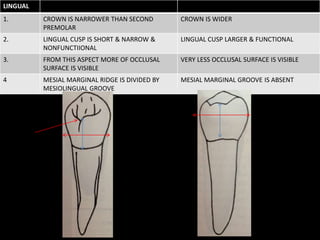
1. CROWN IS NARROWER THAN SECOND
PREMOLAR
CROWN IS WIDER
2. LINGUAL CUSP IS SHORT & NARROW &
NONFUNCTIIONAL
LINGUAL CUSP LARGER & FUNCTIONAL
3. FROM THIS ASPECT MORE OF OCCLUSAL
SURFACE IS VISIBLE
VERY LESS OCCLUSAL SURFACE IS VISIBLE
4 MESIAL MARGINAL RIDGE IS DIVIDED BY
MESIOLINGUAL GROOVE
MESIAL MARGINAL GROOVE IS ABSENT
PROXIMAL
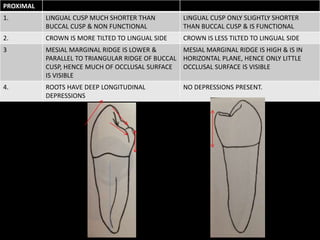
1. LINGUAL CUSP MUCH SHORTER THAN
BUCCAL CUSP & NON FUNCTIONAL
LINGUAL CUSP ONLY SLIGHTLY SHORTER
THAN BUCCAL CUSP & IS FUNCTIONAL
2. CROWN IS MORE TILTED TO LINGUAL SIDE CROWN IS LESS TILTED TO LINGUAL SIDE
3 MESIAL MARGINAL RIDGE IS LOWER &
PARALLEL TO TRIANGULAR RIDGE OF BUCCAL
CUSP, HENCE MUCH OF OCCLUSAL SURFACE
IS VISIBLE
MESIAL MARGINAL RIDGE IS HIGH & IS IN
HORIZONTAL PLANE, HENCE ONLY LITTLE
OCCLUSAL SURFACE IS VISIBLE
4. ROOTS HAVE DEEP LONGITUDINAL
DEPRESSIONS
NO DEPRESSIONS PRESENT.
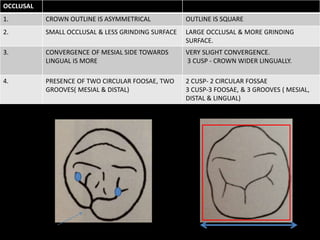
OCCLUSAL
1. CROWN OUTLINE IS ASYMMETRICAL OUTLINE IS SQUARE
2. SMALL OCCLUSAL & LESS GRINDING SURFACE LARGE OCCLUSAL & MORE GRINDING
SURFACE.
3. CONVERGENCE OF MESIAL SIDE TOWARDS
LINGUAL IS MORE
VERY SLIGHT CONVERGENCE.
3 CUSP - CROWN WIDER LINGUALLY.
4. PRESENCE OF TWO CIRCULAR FOOSAE, TWO
GROOVES( MESIAL & DISTAL)
2 CUSP- 2 CIRCULAR FOSSAE
3 CUSP-3 FOOSAE, & 3 GROOVES ( MESIAL,
DISTAL & LINGUAL)
SOME TERMINLOGIES-
• RIDGE- is any linear elevation on the surface of a tooth
& is named according to its location i.e buccal,incisal or
marginal ridge
• FOSSA- it is an irregular depression or concavity. Eg
central fossa are on the occlusal surface of molars, formed
by the convergence of ridges terminating at a central point
in the bottom of the depression where a junction of grooves
occurs.
• SULCUS- it is a long depression or valley in the surface of a
tooth between ridge or cusp
• GROOVE- it is a shallow linear depression on the surface of
the tooth
• DEVELOPMENTAL GROOVE- it is a shallow groove or line
between the primary part of the crown or root.
• SUPPLEMENTAL GROOVES- it is less distinct & does not
mark the junction of primary parts
• PITS- a small pinpoint depression located at the junction of
developmental grooves or at terminals of those grooves
Maxillary First Molar
It has a large crown with four well
developed cusps and occasionally a small
fifth cusp. In addition to the cusps it has
three well formed roots; two buccal and one
lingual.
Buccal aspect
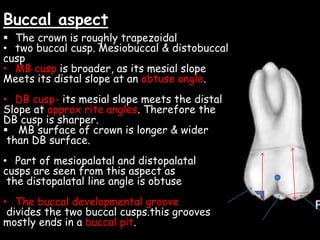
 The crown is roughly trapezoidal
• two buccal cusp. Mesiobuccal & distobuccal
cusp
• MB cusp is broader, as its mesial slope
Meets its distal slope at an obtuse angle.
• DB cusp- its mesial slope meets the distal
Slope at approx rite angles. Therefore the
DB cusp is sharper.
 MB surface of crown is longer & wider
than DB surface.
• Part of mesiopalatal and distopalatal
cusps are seen from this aspect as
the distopalatal line angle is obtuse
• The buccal developmental groove
divides the two buccal cusps.this grooves
mostly ends in a buccal pit.
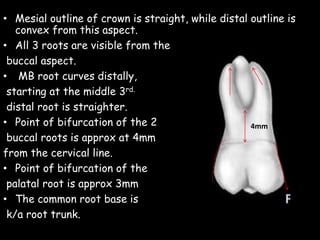
• Mesial outline of crown is straight, while distal outline is
convex from this aspect.
• All 3 roots are visible from the
buccal aspect.
• MB root curves distally,
starting at the middle 3rd.
distal root is straighter.
• Point of bifurcation of the 2
buccal roots is approx at 4mm
from the cervical line.
• Point of bifurcation of the
palatal root is approx 3mm
• The common root base is
k/a root trunk.
4mm
Lingual aspect
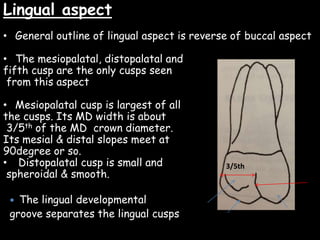
• General outline of lingual aspect is reverse of buccal aspect
• The mesiopalatal, distopalatal and
fifth cusp are the only cusps seen
from this aspect
• Mesiopalatal cusp is largest of all
the cusps. Its MD width is about
3/5th of the MD crown diameter.
Its mesial & distal slopes meet at
90degree or so.
• Distopalatal cusp is small and
spheroidal & smooth.
 The lingual developmental
groove separates the lingual cusps
3/5th
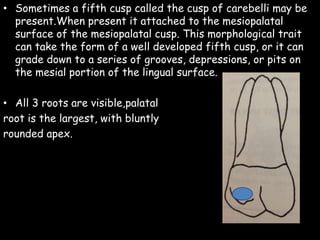
• Sometimes a fifth cusp called the cusp of carebelli may be
present.When present it attached to the mesiopalatal
surface of the mesiopalatal cusp. This morphological trait
can take the form of a well developed fifth cusp, or it can
grade down to a series of grooves, depressions, or pits on
the mesial portion of the lingual surface.
• All 3 roots are visible,palatal
root is the largest, with bluntly
rounded apex.
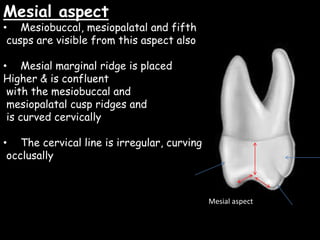
Mesial aspect
• Mesiobuccal, mesiopalatal and fifth
cusps are visible from this aspect also
• Mesial marginal ridge is placed
Higher & is confluent
with the mesiobuccal and
mesiopalatal cusp ridges and
is curved cervically
• The cervical line is irregular, curving
occlusally
Mesial aspect
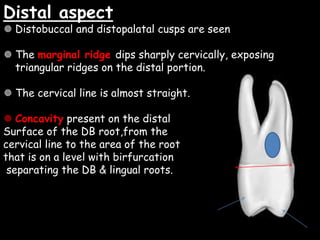
Distal aspect
 Distobuccal and distopalatal cusps are seen
 The marginal ridge dips sharply cervically, exposing
triangular ridges on the distal portion.
 The cervical line is almost straight.
 Concavity present on the distal
Surface of the DB root,from the
cervical line to the area of the root
that is on a level with birfurcation
separating the DB & lingual roots.
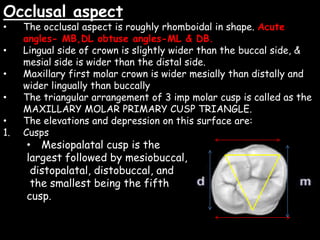
Occlusal aspect
• The occlusal aspect is roughly rhomboidal in shape. Acute
angles- MB,DL obtuse angles-ML & DB.
• Lingual side of crown is slightly wider than the buccal side, &
mesial side is wider than the distal side.
• Maxillary first molar crown is wider mesially than distally and
wider lingually than buccally
• The triangular arrangement of 3 imp molar cusp is called as the
MAXILLARY MOLAR PRIMARY CUSP TRIANGLE.
• The elevations and depression on this surface are:
1. Cusps
• Mesiopalatal cusp is the
largest followed by mesiobuccal,
distopalatal, distobuccal, and
the smallest being the fifth
cusp.
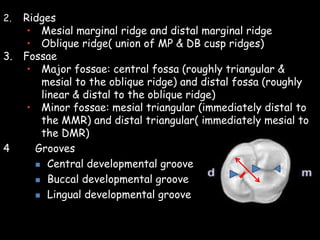
2. Ridges
 Mesial marginal ridge and distal marginal ridge
 Oblique ridge( union of MP & DB cusp ridges)
3. Fossae
 Major fossae: central fossa (roughly triangular &
mesial to the oblique ridge) and distal fossa (roughly
linear & distal to the oblique ridge)
 Minor fossae: mesial triangular (immediately distal to
the MMR) and distal triangular( immediately mesial to
the DMR)
4 Grooves
 Central developmental groove
 Buccal developmental groove
 Lingual developmental groove
 Fifth cusp groove
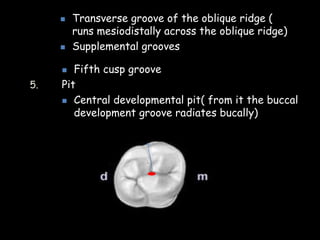
5. Pit
 Central developmental pit( from it the buccal
development groove radiates bucally)
 Transverse groove of the oblique ridge (
runs mesiodistally across the oblique ridge)
 Supplemental grooves
Root
Maxillary first molar has three roots; two buccal and one
palatal
The palatal root is long and slender with bluntly round
apex
 Mesiobuccal root is broader and curves distally while the
distobuccal root is narrower at the base and a lot
straighter
Both the buccal roots are of equal size but smaller than
the palatal root
The level of bifurcation area is more closer to the
cervical area on the mesial side than on the distal side.
1.0 010.011.08.010.0
B L
12 137.5
Curvature of Cervical
Line
M D
Labiolingual
Diameter at
Cervical Line
Labiolingual
Diameter at
Crest of Curvature
Mesiodistal
Diameter at
Cervical Line
Mesiodistal
Diameter at
Contact Area
Root
Length
Crown
Length
Average Dimensions in millimeters
Maxillary Second Molar
The crown is shorter cervico-occlusally(0.5mm) and about the
same width buccolingually when compared with maxillary first
molar.
 The distobuccal cusp is not as well developed and the
distolingual cusp is also small. The fifth cusp is absent
The roots are almost the same size as that of the first molar.
Roots are more inclined distally
The apex of the lingual root is in line with the DL cusp tip
instead of the lingual groove as was found on 1st molar- buccal
aspect.
• Less prominent oblique ridge is present.
• Occlusal parallelogram is more twisted & is
faciolinguallly more oblong, whereas the first molar
is wider & squarish.
• Buccal groove is shorter & mostly without a buccal
pit.
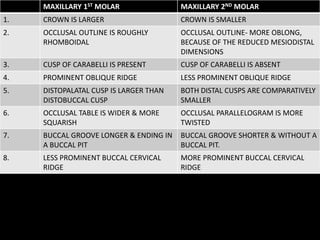
MAXILLARY 1ST MOLAR MAXILLARY 2ND MOLAR
1. CROWN IS LARGER CROWN IS SMALLER
2. OCCLUSAL OUTLINE IS ROUGHLY
RHOMBOIDAL
OCCLUSAL OUTLINE- MORE OBLONG,
BECAUSE OF THE REDUCED MESIODISTAL
DIMENSIONS
3. CUSP OF CARABELLI IS PRESENT CUSP OF CARABELLI IS ABSENT
4. PROMINENT OBLIQUE RIDGE LESS PROMINENT OBLIQUE RIDGE
5. DISTOPALATAL CUSP IS LARGER THAN
DISTOBUCCAL CUSP
BOTH DISTAL CUSPS ARE COMPARATIVELY
SMALLER
6. OCCLUSAL TABLE IS WIDER & MORE
SQUARISH
OCCLUSAL PARALLELOGRAM IS MORE
TWISTED
7. BUCCAL GROOVE LONGER & ENDING IN
A BUCCAL PIT
BUCCAL GROOVE SHORTER & WITHOUT A
BUCCAL PIT.
8. LESS PROMINENT BUCCAL CERVICAL
RIDGE
MORE PROMINENT BUCCAL CERVICAL
RIDGE
Mandibular Molars
Mandibular molars are the biggest teeth in the
mandibular arch.
They have two broad roots for superior
anchorage.
The crown of lower molars are wider
mesiodistally than buccolingually, the opposite is
true of upper molars.
Mandibular First Molar
It has five cusps ; two buccal, two lingual and one
distal
It has two roots; one mesial and one distal
Buccal aspect
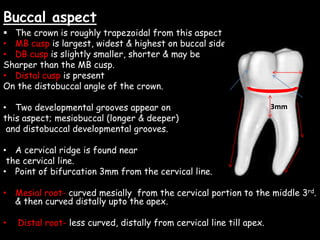
 The crown is roughly trapezoidal from this aspect
• MB cusp is largest, widest & highest on buccal side
• DB cusp is slightly smaller, shorter & may be
Sharper than the MB cusp.
• Distal cusp is present
On the distobuccal angle of the crown.
• Two developmental grooves appear on
this aspect; mesiobuccal (longer & deeper)
and distobuccal developmental grooves.
• A cervical ridge is found near
the cervical line.
• Point of bifurcation 3mm from the cervical line.
• Mesial root- curved mesially from the cervical portion to the middle 3rd.
& then curved distally upto the apex.
• Distal root- less curved, distally from cervical line till apex.
3mm
Lingual aspect
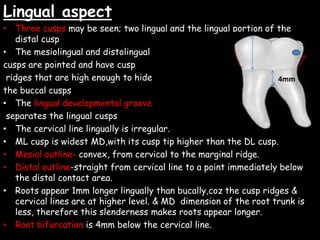
• Three cusps may be seen; two lingual and the lingual portion of the
distal cusp
• The mesiolingual and distolingual
cusps are pointed and have cusp
ridges that are high enough to hide
the buccal cusps
• The lingual developmental groove
separates the lingual cusps
• The cervical line lingually is irregular.
• ML cusp is widest MD,with its cusp tip higher than the DL cusp.
• Mesial outline- convex, from cervical to the marginal ridge.
• Distal outline-straight from cervical line to a point immediately below
the distal contact area.
• Roots appear 1mm longer lingually than bucally,coz the cusp ridges &
cervical lines are at higher level. & MD dimension of the root trunk is
less, therefore this slenderness makes roots appear longer.
• Root bifurcation is 4mm below the cervical line.
4mm
Mesial aspect
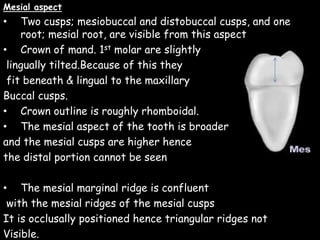
• Two cusps; mesiobuccal and distobuccal cusps, and one
root; mesial root, are visible from this aspect
• Crown of mand. 1st molar are slightly
lingually tilted.Because of this they
fit beneath & lingual to the maxillary
Buccal cusps.
• Crown outline is roughly rhomboidal.
• The mesial aspect of the tooth is broader
and the mesial cusps are higher hence
the distal portion cannot be seen
• The mesial marginal ridge is confluent
with the mesial ridges of the mesial cusps
It is occlusally positioned hence triangular ridges not
Visible.
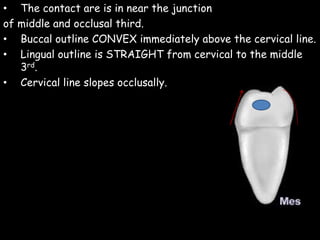
• The contact are is in near the junction
of middle and occlusal third.
• Buccal outline CONVEX immediately above the cervical line.
• Lingual outline is STRAIGHT from cervical to the middle
3rd.
• Cervical line slopes occlusally.
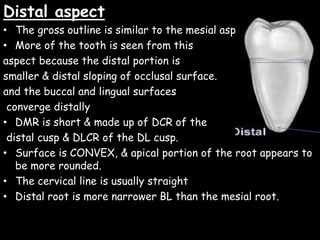
Distal aspect
• The gross outline is similar to the mesial aspect
• More of the tooth is seen from this
aspect because the distal portion is
smaller & distal sloping of occlusal surface.
and the buccal and lingual surfaces
converge distally
• DMR is short & made up of DCR of the
distal cusp & DLCR of the DL cusp.
• Surface is CONVEX, & apical portion of the root appears to
be more rounded.
• The cervical line is usually straight
• Distal root is more narrower BL than the mesial root.
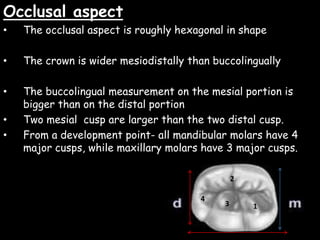
Occlusal aspect
• The occlusal aspect is roughly hexagonal in shape
• The crown is wider mesiodistally than buccolingually
• The buccolingual measurement on the mesial portion is
bigger than on the distal portion
• Two mesial cusp are larger than the two distal cusp.
• From a development point- all mandibular molars have 4
major cusps, while maxillary molars have 3 major cusps.
1
2
3
4
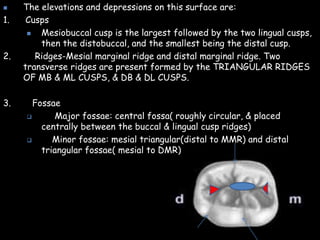
 The elevations and depressions on this surface are:
1. Cusps
 Mesiobuccal cusp is the largest followed by the two lingual cusps,
then the distobuccal, and the smallest being the distal cusp.
2. Ridges-Mesial marginal ridge and distal marginal ridge. Two
transverse ridges are present formed by the TRIANGULAR RIDGES
OF MB & ML CUSPS, & DB & DL CUSPS.
3. Fossae
 Major fossae: central fossa( roughly circular, & placed
centrally between the buccal & lingual cusp ridges)
 Minor fossae: mesial triangular(distal to MMR) and distal
triangular fossae( mesial to DMR)
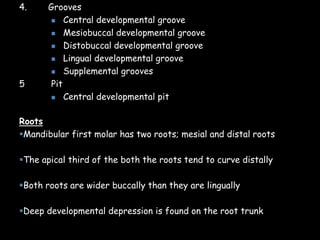
4. Grooves
 Central developmental groove
 Mesiobuccal developmental groove
 Distobuccal developmental groove
 Lingual developmental groove
 Supplemental grooves
5 Pit
 Central developmental pit
Roots
Mandibular first molar has two roots; mesial and distal roots
The apical third of the both the roots tend to curve distally
Both roots are wider buccally than they are lingually
Deep developmental depression is found on the root trunk
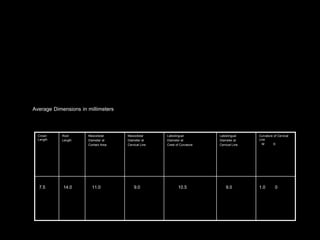
1.0 09.010.59.011.014.07.5
Curvature of Cervical
Line
M D
Labiolingual
Diameter at
Cervical Line
Labiolingual
Diameter at
Crest of Curvature
Mesiodistal
Diameter at
Cervical Line
Mesiodistal
Diameter at
Contact Area
Root
Length
Crown
Length
Average Dimensions in millimeters
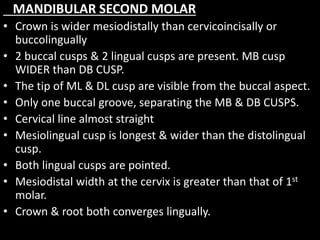
MANDIBULAR SECOND MOLAR
• Crown is wider mesiodistally than cervicoincisally or
buccolingually
• 2 buccal cusps & 2 lingual cusps are present. MB cusp
WIDER than DB CUSP.
• The tip of ML & DL cusp are visible from the buccal aspect.
• Only one buccal groove, separating the MB & DB CUSPS.
• Cervical line almost straight
• Mesiolingual cusp is longest & wider than the distolingual
cusp.
• Both lingual cusps are pointed.
• Mesiodistal width at the cervix is greater than that of 1st
molar.
• Crown & root both converges lingually.
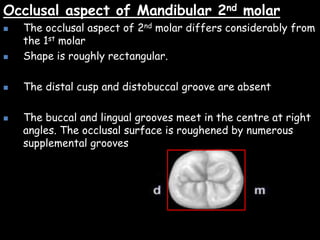
Occlusal aspect of Mandibular 2nd molar
 The occlusal aspect of 2nd molar differs considerably from
the 1st molar
 Shape is roughly rectangular.
 The distal cusp and distobuccal groove are absent
 The buccal and lingual grooves meet in the centre at right
angles. The occlusal surface is roughened by numerous
supplemental grooves
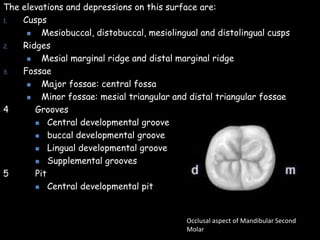
The elevations and depressions on this surface are:
1. Cusps
 Mesiobuccal, distobuccal, mesiolingual and distolingual cusps
2. Ridges
 Mesial marginal ridge and distal marginal ridge
3. Fossae
 Major fossae: central fossa
 Minor fossae: mesial triangular and distal triangular fossae
4 Grooves
 Central developmental groove
 buccal developmental groove
 Lingual developmental groove
 Supplemental grooves
5 Pit
 Central developmental pit
Occlusal aspect of Mandibular Second
Molar
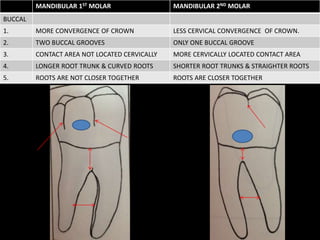
MANDIBULAR 1ST MOLAR MANDIBULAR 2ND MOLAR
BUCCAL
1. MORE CONVERGENCE OF CROWN LESS CERVICAL CONVERGENCE OF CROWN.
2. TWO BUCCAL GROOVES ONLY ONE BUCCAL GROOVE
3. CONTACT AREA NOT LOCATED CERVICALLY MORE CERVICALLY LOCATED CONTACT AREA
4. LONGER ROOT TRUNK & CURVED ROOTS SHORTER ROOT TRUNKS & STRAIGHTER ROOTS
5. ROOTS ARE NOT CLOSER TOGETHER ROOTS ARE CLOSER TOGETHER
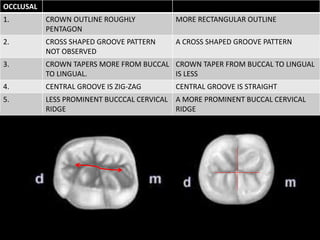
OCCLUSAL
1. CROWN OUTLINE ROUGHLY
PENTAGON
MORE RECTANGULAR OUTLINE
2. CROSS SHAPED GROOVE PATTERN
NOT OBSERVED
A CROSS SHAPED GROOVE PATTERN
3. CROWN TAPERS MORE FROM BUCCAL
TO LINGUAL.
CROWN TAPER FROM BUCCAL TO LINGUAL
IS LESS
4. CENTRAL GROOVE IS ZIG-ZAG CENTRAL GROOVE IS STRAIGHT
5. LESS PROMINENT BUCCCAL CERVICAL
RIDGE
A MORE PROMINENT BUCCAL CERVICAL
RIDGE
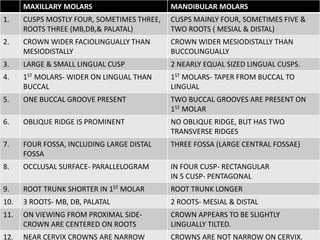
MAXILLARY MOLARS MANDIBULAR MOLARS
1. CUSPS MOSTLY FOUR, SOMETIMES THREE,
ROOTS THREE (MB,DB,& PALATAL)
CUSPS MAINLY FOUR, SOMETIMES FIVE &
TWO ROOTS ( MESIAL & DISTAL)
2. CROWN WIDER FACIOLINGUALLY THAN
MESIODISTALLY
CROWN WIDER MESIODISTALLY THAN
BUCCOLINGUALLY
3. LARGE & SMALL LINGUAL CUSP 2 NEARLY EQUAL SIZED LINGUAL CUSPS.
4. 1ST MOLARS- WIDER ON LINGUAL THAN
BUCCAL
1ST MOLARS- TAPER FROM BUCCAL TO
LINGUAL
5. ONE BUCCAL GROOVE PRESENT TWO BUCCAL GROOVES ARE PRESENT ON
1ST MOLAR
6. OBLIQUE RIDGE IS PROMINENT NO OBLIQUE RIDGE, BUT HAS TWO
TRANSVERSE RIDGES
7. FOUR FOSSA, INCLUDING LARGE DISTAL
FOSSA
THREE FOSSA (LARGE CENTRAL FOSSAE)
8. OCCLUSAL SURFACE- PARALLELOGRAM IN FOUR CUSP- RECTANGULAR
IN 5 CUSP- PENTAGONAL
9. ROOT TRUNK SHORTER IN 1ST MOLAR ROOT TRUNK LONGER
10. 3 ROOTS- MB, DB, PALATAL 2 ROOTS- MESIAL & DISTAL
11. ON VIEWING FROM PROXIMAL SIDE-
CROWN ARE CENTERED ON ROOTS
CROWN APPEARS TO BE SLIGHTLY
LINGUALLY TILTED.
12. NEAR CERVIX CROWNS ARE NARROW CROWNS ARE NOT NARROW ON CERVIX.
REFERENCES-
1. WOELFEL – Dental anatomy & its relevance to dentistry
5th edition
2. WHEELERS- Dental anatomy, Physiology, & Occlusion
8th edition
3.SATISH CHANDRA- Textbook of Dental & oral anatomy,
physiology & occlusion.
• THANK YOU.

Morphology of permanent dentition

  • 1.
  • 2.
    General information • Humanshave two generations of teeth : deciduous and permanent • By the age of 3 years all deciduous teeth have erupted . • By 6 years, the first permanent teeth appear and hence the deciduous teeth are exfoliated one by one replaced by their permanent successors. • A complete permanent dentition is present at around 18 years . • 20 teeth – 10 in each jaw. (primary dentition ) • 32 teeth – 16 in each jaw.
  • 3.
  • 4.
    Differences between deciduous teethand permanent : 1.The deciduous teeth are smaller, although the mesiodistal dimension of the permanent premolars are generally less than those for deciduous molar . 2. Deciduous teeth have a greater constancy of shape . 3. The crown of deciduous teeth appear bulbous , often having pronounced labial or buccal cingula . 4. the cervical margins of deciduous teeth are more sharply demarcated and pronounced , enamel bulging rather than gently tapering . 5. the cusps of newly erupted deciduous teeth are more pointed .
  • 5.
    6. the crownsof deciduous teeth have thinner enamel ( 0.5-1.0 mm ) than the crowns of permanent teeth (2.5 mm ) 7. the enamel of deciduous teeth are more opaque , gives the crown a whiter appearance 8. the enamel is softer and more easily worn in deciduous teeth . 9. enamel is more permeable in dec. teeth . 10. the aprismatic layer of surface enamel is wider in dec. teeth .
  • 6.
    11. the enameland dentine of ALL dec . teeth exhibit neonatal lines . 12. the roots of dec. teeth are shorter and less robust than those of permanent teeth . 13. the roots of dec. incisors and canines are longer in proportion to the crown than those of permanent ones. 14. the roots of the dec. molars are widely divergent extending beyond the dimensions of the crown. 15. the pulp chambers of dec. are proportionally larger in relation to the crown than those of permanent teeth. the pulp horns in dec. are more prominent. 16. the root canals of dec. are extremely fine . 17 . the dental arch for dec. dentition are smaller .
  • 7.
    Proximal Contact Areas •All teeth contact adjacent teeth at a proximal contact area except: – distal of the last tooth In the arch – diastemas – pathology (caries) – faulty restorations
  • 8.
    Importance: –Ensures food willnot be packed between teeth causing inflammation to the supporting tissues thereby causing gingivitis & periodontitis –It helps stabilize the dental arches by the combined anchorage of all the teeth in either arch in positive contact with each other (exception - third molars.) –Each tooth is individually supported by these contact areas.
  • 9.
    CONTACTS are OBSERVEDfrom 2 views- • Labial /buccal aspect- demonstrates the cervicoincisal/cervico -occlusal position • Incisal /occlusal aspect- demonstrates the facio-lingual position
  • 10.
    • Anterior teethhave contacts that are generally centered faciolingually when view from the incisal • Posterior teeth have contacts that are generally located buccal to the center of teeth when viewed from the occlusal
  • 11.
    Proximal Contacts Maxillary MesialDistal Central incisor Incisal 1/3 Junc of incisal/middle 1/3 Lateral incisor Junc of incisal/middle 1/3 Middle 1/3 Canine Junc of incisal/middle 1/3 Middle 1/3 1st pre Middle 1/3 Middle 1/3 2nd pre Middle 1/3 Middle 1/3 1st molar Middle 1/3 Middle 1/3 2nd molar Middle 1/3 Middle 1/3 3rd molar Middle 1/3 n/a
  • 12.
    Proximal Contacts Mandibular MesialDistal Central incisor Incisal 1/3 Incisal 1/3 Lateral incisor Incisal 1/3 Incisal 1/3 Canine Incisal 1/3 Middle 1/3 1st pre Middle 1/3 Middle 1/3 2nd pre Middle 1/3 Middle 1/3 1st molar Middle 1/3 Middle 1/3 2nd molar Middle 1/3 Middle 1/3 3rd molar Middle 1/3 n/a
  • 13.
    1. Contact areamove cervically from anterior to posterior in each quadrant 2. On individual teeth the distal contact is more cervically located then the mesial contact 3. Contacts increase in size from anterior to posterior 2 **Note: Contacts on incisors in incisal1/3, Where as contacts on molars in middle /3
  • 14.
    LMAXILLARY CENTRAL INCISORabial •It is the widest tooth in the maxillary arch. • The mesial margin is straight and meets the incisal edge at right angle. The distal margin is shorter and more rounded. • The distoincisal angle is more rounded than the mesioincisal angle. Mesial margin straight & meets at 90 degree Distal margin shorter & rounded Distoincisal angle more rounded, making an obtuse angle Mesioincisal angle rounded, making somewht 90 degrees
  • 15.
     The labialsurface is marked by two developmental groove and has convexity in cervical third.  Mesiodistally the crown is narrowest cervically, & becomes broadest in the incisal 3rd. Convexity in cervical third a b
  • 16.
    Lingual aspect • Thecrown profile is same as that of labial surface except that there is a broad depression in the central portion called the lingual fossa and a well developed cingulum.  Maxillary incisor with a deep & large lingual fossa & prominent mesial & distal marginal ridges are called as SHOVEL SHAPED INCISOR  Due to the distal displacement of the cingulum, the mesial marginal ridge is slightly LONGER than the distal marginal ridge Lingual fossa Cingulum Marginal ridges Lingual ridge
  • 17.
     The lingualfossa is bordered by mesial and distal marginal ridges on the sides and the cingulum cervically.  The cervical line on labial and lingual surface is convex apically. Cervical line convex Lingual aspectLabial aspect
  • 18.
    Mesial aspect • Fromthis aspect the crown appears WEDGE SHAPED, with base of traingle at cervix & apex towards the incisal edge. • From the mesial aspect the labial margin is convex • The lingual margin is ‘S’ shaped, being convex near cingulum and concave in the middle Labial margin convex Convex near cingulum Concave in the middle
  • 19.
     Mesial curvatureof cervical line (3.5mm) is the most pronounced compared to any other tooth.  The cervical line on the mesial and distal surface is convex incisally Cervical line
  • 20.
    Distal aspect Distal aspect Distal surface is very similar to the mesial surface.  when central incisor viewed from distal aspect, the crown gives the impression of somewhat thicker towards the incisal 3rd, this is because the distoincisal angle is slightly lingually positioned than mesioincisal angle.
  • 21.
    Incisal aspect • Thecrown and incisal margin are centered over root • Crown profile is almost bilaterally symmetrical • The incisal margin of newly erupted teeth show three elevations called mamelons. The middle One is smallest.They correspond to the developmental lobes. Incisal ridge Bilaterally symmetrical
  • 22.
    Root The root isstraight and tapers from the cervical line to the apex giving it a conical shape The root ends in a blunt apex. Root : crown ratio is 1.3:1.05 Straight conical blunt root 3.5 2.56.07.07.08.513.010.5 Curvature of Cervical Line M D Labiolingual Diameter at Cervical Line Labiolingual Diameter at Crest of Curvature Mesiodistal Diameter at Cervical Line Mesiodistal Diameter of crown Root Length Crown Length Average Dimensions in millimeters
  • 23.
    Maxillary Lateral Incisor The general shape is similar to maxillary central incisors except that they are shorter and narrower.  Next to third molars maxillary lateral incisors are the teeth that show most variation in crown size, shape and form Maxillary central incisor bigger and lateral incisor smaller
  • 24.
     The mesioincisaland distoincisal angles are more rounded than the corresponding angles of the maxillary central incisor Distoincisal angle more rounded Mesioincisal angle more rounded Maxillary Lateral Incisor Maxillary Central Incisor Mesioincisal angleDistoincisal angle
  • 25.
     On thelingual aspect the marginal ridges and cingulum are more prominent Prominent cingulum Prominent marginal ridges
  • 26.
    MAXILLARY CENTRAL INCISORMAXILLARY LATERAL INCISOR LABIAL VIEW 1. CROWN IS LARGER CROWN IS SMALLER 2. MESIOINCISAL ANGLE AT 90 DEGREE & DISTOINCIAL ANGLE SLIGHTLY ROUNDED MESIOINCISAL ANGLE IS ACUTE & DISTOINCISAL ANGLE ROUNDED 3. MESIAL CONTACT AREA AT INCISAL 3rd DISTAL CONTACT AREA AT JUNC OF INCISAL & MIDDLE 3rd.
  • 27.
    LINGUAL VIEW 1. LINGUAL FOSSALARGER & SHALLOWER LINGUAL FOSSA SMALLER & MORE CONCAVE. 2. LINGUAL PITS ARE LESS FREQUENT LINGUAL PITS ARE COMMON 3. CINGULUM IS POSTIONED SLIGHTLY DISTALLY CINGULUM IS CENTERED
  • 28.
    PROXIMAL VIEW 1. CERVICAL LINECURVATURES ARE MORE CURVATURE IS LESS 2. ROOT IS EVENLY TAPERED ROOT IS MORE CONVEX
  • 29.
    INCISAL 1. CROWN WIDERMESIODISTALLY THAN FACIOLINGUALLY CROWN SAME BOTH MESIODISTALLY & FACIOLINGUALLY 2. CROWN OUTLINE IS TRIANGLULAR CROWN OUTLINE IS ROUNDED OR OVAL 3. CINGULUM SLIGHTLY DISTAL CINGULUM CENTERED 4. INCISAL RIDGE SLIGHTLY CURVED MESIODISTALLY INCISAL RIDGE RELATIVELY STRAIGHTER MESIODISTALLY
  • 30.
    MANDIBULAR INCISOR Mandibular centralincisor and lateral are similar in anatomy and complement each other in function. Labial aspect Labial surface of mandibular central incisor is very small. It is the narrowest tooth mesiodistally of all the permanent teeth Narrowest tooth in the dentition
  • 31.
     It isbilaterally symmetrical,that it is difficult to tell the sides. The only differnce is the greater mesial than distal curvature.  It is the only incisor where both mesioincisal and distoincisal angles are sharp and at right angles Both mesioincisal and distoincisal angles are sharp
  • 32.
    Lingual aspect  Thelingual aspect is concave from the incisal edge to the cervical line  Cingulum is smooth, barely visible & no development lines mark the cingulum.  Marginal ridges almost absent  The surface is smooth and devoid of any grooves. No other tooth in the mouth, except the mandibular lateral incisor, shows so few developmental lines and grooves.  No lingual pit is present.  Root is slightly narrower on the lingual side than on the labial side.
  • 33.
    Mesial aspect  Crownis wedge shaped, with the labial outline is almost straight, except near cervical third where it is convex.  The labial surface is inclined lingually  Root has longitudinal shallow depressions on the middle 3rd of mesial root surfaces. Labial surface inclined lingually
  • 34.
     The lingualmargin is ‘S’ shaped  The cervical line on the mesial and distal surface is convex incisally ‘S’ shaped lingual surface Cervical line convex incisally
  • 35.
    Distalaspect • Distal surfaceis very similar to the mesial surface. • The cervical line is less curved. Distal aspect
  • 36.
    Incisal aspect • Thisaspect illustrates the bilateral symmetry of this tooth. • The incisal edge or ridge is at right angles to the labiolingual root axis plane. • The labiolingual diameter is greater than mesiodistal diameter. • Newly erupted teeth show mamelons which wear off upon mastication Bilaterally symmetrical Labiolingually bigger than mesiodistally Mamelons
  • 37.
    Root The root issingle and straight.  The deflection of the root if present is on the labial or distal side. Root : crown ratio is more in all mandibular teeth 3.0 2.05.36.03.55.012.59.5 Curvature of Cervical Line M D Labiolingual Diameter at Cervical Line Labiolingual Diameter at Crest of Curvature Mesiodistal Diameter at Cervical Line Mesiodistal Diameter at Contact Area Root Length Crown Length Average Dimensions in millimeters
  • 38.
    Mandibular Lateral Incisor Mandibular lateral incisor is slightly wider mesiodistally  The distal side of the crown from the labial aspect is slightly bulging in comparison to mesial flatter surface.  The crown is slightly tilted distally on the root, & due to this tilt the distal outline of the crown is shorter in length than the mesial outline.  Bilateral symmetry not seen,  Cingulum slightly towards the distal.
  • 39.
     The cervicalportion of the lingual aspect is narrower while the incisal portion is wider. This gives the crown a more or less a fan shaped appearance Cervical portion narrower Fan shaped appearance
  • 40.
     The concavityin the lingual aspect is slightly more when compared to mandibular central incisor  The incisal edge follows the mandibular arch, giving the crown a slightly twisted appearance on its root Lingual fossa more concave 3.0 2.05.86.54.05.514.09.5 Curvature of Cervical Line M D Labiolingual Diameter at Cervical Line Labiolingual Diameter at Crest of Curvature Mesiodistal Diameter at Cervical Line Mesiodistal Diameter at Contact Area Root Length Crown Length Average Dimensions in millimeters
  • 41.
    MANDIBULAR CENTRAL INCISORMANDIBULAR LATERAL INCISOR 1. CROWN MORE SYMMETRICAL LESS SYMMETRICAL 2. CROWN & ROOT ARE SHORTER CROWN & ROOT ARE LONGER 3 NO DISTAL SIDE BULGE ON CROWN DISTAL SIDE BULGE ON CROWN 4. CINGULUM CENTERED CINGULUM DISTAL TO CENTRE 5. NO DISTOLINGUAL TWIST OF INCISAL EDGE DISTOLINGUAL TWIST OF INCISAL EDGE 6. MARGINAL RIDGES NOT PROMINENT LONGER MESIAL MARGINAL RIDGE
  • 42.
    MAXILLARY INCISORS MANDIBULARINCISORS LABIAL 1. CROWN MESIODISTALLY WIDER & LESS SYMMETRICAL CROWN IS LONG, NARROW & MORE SYMMETRICAL 2. DISTOINCISAL ANGLES MORE ROUNDED MESIOINCISAL SHARP, & DISTOINCISAL ANGLES ARE SLIGHTLY ROUNDED 3. SHALLOW LABIAL DEPRESSIONS ARE COMMONLY PRESENT NOT PRESENT LINGUAL 1. LARGER CINGULUM SMALLER CINGULUM 2. DEEPER LINGUAL FOSSA SHALLOW FOSSA 3. SOMETIMES LINGUAL PITS PRESENT LINGUAL PITS ABSENT 4. PROMINENT MARGINAL RIDGES LINGUAL SURFACE SMOOTH, WITHOUT MARGINAL RIDGES 5 CINGULUM SLIGHTLY DISTAL CENTRAL ALMOST SYMMETRICAL PROXIMAL 1. CINGULUM IS PROMINENT VERY SMALL CINGULUM 2. INCISAL EDGE LABIAL TO ROOT AXIS INCISAL EDGE LINGUAL TO ROOT AXIS
  • 43.
    INCISAL 1. CROWNS AREWIDER MESIODISTALLY THAN FACILINGUALLY CROWNS WIDER FACIOLINGUALLY THAN MESIODISTALLY 2. INCISAL EDGE LABIAL TO ROOT AXIS INCISAL EDGE LINGUAL TO ROOT AXIS 3. CINGULUM OF CI IS SLIGHTLY DISTAL CINGULUM OF LI IS IN CENTRE CINGULUM OF CI IS CENTERED CINGULUM OF LI IS SLIGHTLY DISTAL 4. LABIAL SURFACE OF LI IS SLIGHTLY CONVEX CENTRAL & LATERALS HAVE ALMOST FLAT LABIAL SURFACES AT INCISAL & MIDDLE 3rd.
  • 44.
    MAXILLARY CANINES Canines arevery long and stable teeth There are four canines placed at the corner of the mouth and hence called the ‘corner stones’ of the dentition They have a single pointed cusp (also called cuspids)
  • 45.
    Labial aspect  Thecrown of maxillary canine is narrower mesiodistally than that of maxillary central incisor. • The incisal aspect has a large cusp with a pointed cusp tip • It has two slopes (cusp ridges), the mesial slope being shorter than the distal slope • The labial surface is smooth and bulky in the middle because of the labial ridge, which runs cervicoincisally. All areas lies mesial to this ridge shows more convexity, while distal shows less convexity.
  • 46.
    Labial aspect Labial ridge Cusp tip Distalcusp ridge Mesial Cusp Ridge
  • 47.
    Lingual aspect • Thecrown and root are narrower lingually • The cingulum is well developed, large and sometimes pointed like a cusp & in center. • Occasionally a well developed lingual ridge is seen that divides the lingual fossa into mesial and distal lingual fossae • Heavy marginal ridges are associated with well formed cingulum and fossae
  • 48.
    Lingual aspect Cingulum Distal marginalridge Distal lingual fossa Lingual ridge Mesial marginal ridge Mesial lingual fossa
  • 49.
    Mesial aspect • Crownoutline is wedge shaped • From the mesial aspect canine looks similar but bulkier than maxillary central incisor • Maxillary canine is the widest anterior tooth labiolingually • The cervical line curvature is towards the cusp (incisally) • The contact area is near the junction of the incisal and middle third • From this aspect the entire labial otline is convex from the cervical line to the cusp tip, & the lingual outline is convex at cingulum, thereafter it straightens out at the middle 3rd & again slight convex in the incisal 3rd.
  • 50.
  • 51.
    Distal aspect • Distalsurface is very similar to the mesial surface • The cervical line exhibits less curvature • The contact area is near the middle third, Distal aspect
  • 52.
    Incisal aspect • Thelabiolingual dimension is greater than the mesiodistal dimension • The cusp tip is labial to the centre of the crown labiolingually and mesial to the centre mesiodistally • Mesiodistally, the mesial half of the crown is narrower, than the distal half. • The labial ridge and the cingulum are very noticeable from this aspect. • The mesial half of labial outline is more convex, than the distal half
  • 53.
    Root – onlyone The root is the longest and strongest of all the teeth in the dentition The mesial and distal surfaces of the root have developmental depressions. 2.5 1.57.08.05.57.517.010.0 Curvature of Cervical Line M D Labiolingual Diameter at Cervical Line Labiolingual Diameter at Crest of Curvature Mesiodistal Diameter at Cervical Line Mesiodistal Diameter at Contact Area Root Length Crown Length Average Dimensions in millimeters
  • 54.
    Mandibular Canine Labial aspect Mandibular canines are similar to maxillary canines except that they are slightly narrower mesiodistally  Mesial outline of the crown is almost straight and inline with the mesial outline of the root. The crown is more towards the distal to the root axis than mesial to it. Because of this crown appears to be distally tilted when the roots are held vertical position.  Cusp tip forms a more obtuse line (120 degree)  Labial ridge is very rudimentary, & not as marked as maxillary canine.  The mesial cusp ridge is smaller than the distal cusp ridge
  • 55.
    Lingual aspect  Thelingual surface of the crown is smooth and flat simulating the surface of mandibular lateral incisor  Cingulum is less prominent and marginal ridges are less distinct Mesial and Distal aspects  These aspects are very similar and the cervical line curves more on the mesial aspect  The contact area on mesial aspect is in the incisal third and a little higher on the distal third  Incisal ridge is slightly lingual to the root axis.  The distoincisal angle is slightly more lingual in position than the cusp tip to give turn to the arch.
  • 56.
    Incisal aspect  Likemaxillary canine the labiolingual dimension is more than the mesiodistal dimension  The cusp tip appears inclined in a lingual direction  The root is shorter by 1 or 2 mm  The developmental depression is more pronounced on the lower canine 2.5 1.07.07.55.57.016.011.o Curvature of Cervical Line M D Labiolingual Diameter at Cervical Line Labiolingual Diameter at Crest of Curvature Mesiodistal Diameter at Cervical Line Mesiodistal Diameter at Contact Area Root Length Crown Length Average Dimensions in millimeters
  • 57.
    MAXILLARY CANINE MANDIBULARCANINE LABIAL 1. APICAL ROOT TIP IS DISTALLY BENT CROWN IS SLIGHTLY TIPPED DISTALLY ON ROOT 2. 3. 4. 5. MESIAL SIDE OF THE CROWN IS LESS CONVEX, WHILE DISTAL IS MORE CONVEX MORE ACUTE CUSP TIP i.e 105 DEGREE LABIAL RIDGE IS MORE PRONOUNCED BLUNT ROOT TIP MESIAL SIDE OF CROWN IS ALMOST IN STRAIGHT LINE WITH THE MESIAL SIDE OF THE ROOT. 120DEGREE LABIAL RIDGE IS LESS PRONOUNCED POINTED ROOT TIP 120 degree 105 degree
  • 58.
    LINGUAL 1. CINGULUM INCENTRE SLIGHTLY DISTAL TO THE CENTRE 2. STRONG LINGUAL RIDGE & POOR DISTAL MARGINAL RIDGES. DISTAL MARGINAL RIDGE IS MORE PROMINENT & SMOOTH SURFACE
  • 59.
    PROXIMAL 1. ROOT DEPRESSIONIS MORE DISTINCT ON THE DISTAL SIDE THAN ON THE MESIAL SIDE DISTAL ROOT DEPRESSION IS LESS 2. CUSP TIP LABIAL TO ROOT AXIS CUSP TIP LINGUAL TO ROOT AXIS
  • 60.
    INCISAL 1. 2. CROWN IS ASYMMETRICAL,WITH MORE BUCCOLINGUAL BULK IN MESIAL HALF, DISTAL HALF IS THINNER. LESS DISTLINGUAL CROWN TWIST DISTAL HALF IS SLIGHTLY THICKER. MORE DISTOLINGUAL CROWN TWIST. 3. ATTRITION OF CUSP TAKES PLACE LINGUALLY ATTRITION OF CUSP TAKES PLACE LABIALLY 4. INCISAL OUTLINE IS ASYMMETRICAL INCISAL OUTLINE IS SYMMETRICAL 5. CUSP TIP- LABIAL TO CENTER LINGUAL TO CENTER 6. MORE BULKY CUSP TIP DUE TO HEAVY LINGUAL RIDGE CUSP TIP & LINGUAL RIDGE IS LESS BULKY
  • 61.
    MAXILLARY PREMOLARS Premolars areso named because they are placed between the anterior teeth and the molars Maxillary premolars have two cusps and sometimes one or two roots They develop from four lobes, like anterior teeth.
  • 62.
    Buccal aspect • Thecrown is roughly TRAPEZOIDAL • This tooth has two cusps, buccal and lingual cusps. The buccal cusp is long with a pointed tip resembling the cusp of a canine  TIP of buccal cusp lies DISTAL to the line bisecting the buccal surface of crown.  The mesial slope of the buccal cusp is longer than the distal slope, which is the opposite of canine  The buccal surface is convex, showing a strong buccal ridge  The crown exhibits little cervical line curvature  Mesial & distal side of the buccal ridge from the occlusal to the middle 3rd, shows development depressions k/a mesiobuccal & distobuccal development depressions.
  • 63.
    Lingual aspect  crowntapers towards the lingual aspect  Mesial outline of the crown is convex.  Distal outline is straight.  The lingual cusp is shorter than the buccal cusp  The lingual cusp is smooth from the cervical portion to the area near the cusp tip  The cusp tip is pointed with mesial and distal slopes meeting at an angle of about 90 degrees 90 degree
  • 64.
     Sometimes lingualridge is present, formed by termination of crest of lingual portion at a point.  Small portion of the buccal cusp can be seen from this aspect • Lingual root is slightly shorter than the buccal root. • Apex of lingual root- more blunt buccal root- pointed.
  • 65.
    Mesial aspect  Fromthis aspect crown appears roughly TRAPEZOIDAL, with longest uneven arm Towards the cervical 3rd, while shortest Arm at occlusal 3rd.  From this aspect both the buccal and lingual cusps are visible  Tips of cusp are within the confines of root trunk of the same side  A well developed mesial marginal ridge and a mesial marginal developmental groove is present  Buccal outline- curves outwards from the cervical line till the crest of curvature, & from crest of curvature it shows less convexity.
  • 66.
     Lingual outlinefrom cervical 3rd to the lingual cusp tip forms a smooth curve.  There is a depression at just cervical to the mesial contact area k/a MESIAL DEVELOPMENTAL DEPRESSION.. This feature differentiates it from right & left & also from second premolar ROOT- •The outline of the crown bucally is straight, with a tendency towards the lingual inclination • Lingual outline also straight. • Bifurcation is present at half of total length of root.
  • 67.
    Distal aspect  Thereis no developmental depression or groove on this aspect, instead it is convex at almost all points  The curvature of the cervical line is less on this aspect  The contact area is near the junction of occlusal and middle third.  Bifurcation of root is more towards the apical 3rd.
  • 68.
    Occlusal aspect  Theocclusal aspect is roughly hexagonal(6 sided i.e MB, M,ML,DB,D,DL) in shape. With mesial side shorter than the distal side. Buccal sides are nearly equal. Mesiolingual side is shorter than distolingual side.  The buccolingual dimension of the crown is much greater than the mesiodistal dimension  The occlusal surface is circumscribed by the cusp ridges and marginal ridges
  • 69.
    Following structures canbe seen- • The distance from the buccal crest to the distal crest is shorter than the distance from the buccal crest to mesial crest. • The distance from the mesial crest to the lingual crest is much shorter than the distance from the distal crest to the lingual crest. • Buccal portion of the crown is more wider than the lingual portion. • Central developmental groove- Runs mesiodistally with pits at both ends. The length of central groove is more than one third of the mesiodistal width of occlusal surface.
  • 70.
    • Mesial marginaldevelopmental Groove- it crosses the mesial marginal ridge. This groove connects the central groove in the mesial triangular fossa. • Distal marginal groove may be found, but less frequent than mesial marginal groove • Mesial and distal developmental pit - are closer to each other than in 2nd premolar. • Mesial and distal triangular fossa • Buccal and lingual triangular ridge, buccal ridge more prominent arising from the central groove & converging with the tip of the buccal cusp. • Lingual cusp is more pointed, than buccal cusp.
  • 71.
    Root Most Maxillary firstpremolars have 2 roots, but one and three roots can also be seen. Two roots; buccal and lingual  The buccal portion of the root resembles canine  The root when viewed from the proximal side shows a big trunk and bifurcation area from where the buccal and lingual root separate A developmental depression is seen on the mesial aspect of the trunk.
  • 72.
    1.0 08.09.05.07.014.08.5 Curvature of CervicalLine M D Labiolingual Diameter at Cervical Line Labiolingual Diameter at Crest of Curvature Mesiodistal Diameter at Cervical Line Mesiodistal Diameter at Contact Area Root Length Crown Length Average Dimensions in millimeters
  • 73.
    Maxillary 2nd Premolar Buccalaspect  The maxillary second premolar resembles the maxillary first premolar in form and function  The buccal cusp is not as long as that of maxillary 1st premolar  It is less pointed.  The mesial slope of the buccal cusp ridge is shorter than the distal cusp ridge, as in maxillary canine.  Crown & root are thicker at the cervical portion.
  • 74.
    Lingual aspect  Thelingual cusp is more or less the same size as the buccal cusp  Root is single, & tapered towards apex & towards the lingual side. Mesial and Distal aspects  There is greater distance between the cusps which widens the occlusal surface buccolingually.  No developmental depression is present nor any developmental groove crossing the marginal ridge on the mesial aspect  On the distal aspect there is a developmental depression which is deeper than the depression on the mesial surface of maxillary 1st premolar
  • 75.
    Occlusal aspect  Theocclusal aspect is more rounded/ oval  The central developmental groove is shorter, & mesial marginal groove is absent.  Triangular fossae are smaller & farther from marginal ridges.  Mesiodistal diameter is more on the buccal side than the lingual side.  There are multiple supplementary grooves radiating from the central groove
  • 76.
    • Root  Maxillary2nd premolar has one root, which is usually as long or a millimeter longer than the root of maxillary 1st premolar 1.0 08.09.05.07.014.08.5 Curvature of Cervical Line M D Labiolingual Diameter at Cervical Line Labiolingual Diameter at Crest of Curvature Mesiodistal Diameter at Cervical Line Mesiodistal Diameter at Contact Area Root Length Crown Length Average Dimensions in millimeters
  • 77.
    MAXILLARY 1ST PREMOLARMAXILLARY 2ND PREMOLAR BUCCAL 1. BUCCAL RIDGE IS PROMINENT NOT PROMINENT 2. MESIAL CUSP SLOPE IS LONGEST MESIAL CUSP SLOPE SHORTEST 3. CERVIX NARROW & TAPERS MORE CERVIX BROAD & TAPERS LESS
  • 78.
    LINGUAL 1. LINGUAL CUSPSHORTER THAN BUCCAL CUSP LINGUAL CUSP ALMOST EQUAL TO BUCCAL CUSP 2. CROWN NARROWER & MORE TAPERS TOWARDS LINGUAL LESS TAPER TOWARDS LINGUAL
  • 79.
    PROXIMAL 1. TWO ROOTSONE ROOT 2. BUCCAL CUSP IS LONGER THAN LINGUAL BUCCAL & LINGUAL OF SAME LENGTH 3. CUSP TIP ARE CLOSE TOGETHER CUSP TIPS ARE SPREAD APART 4 MESIAL MARGINAL RIDGE GROOVE IS PRESENT MESIAL MARGINAL RIDGE GROOVE IS ABSENT
  • 80.
    OCCLUSAL 1. LONGER CENTRALGROOVE SHORTER CENTRAL GROOVE 2. MORE CONVERGENCE OF PROXIMALS TOWARDS LINGUAL SLIGHT CONVERGENCE TOWARDS LINGUAL 3. PROMINENT BUCCAL RIDGE LESS PROMINENT RIDGE 4. BUCCAL CUSP INCLINES ARE LONGER THAN LINGUAL LINGUAL CUSP INCLINES ALMOST EQUAL TO BUCCAL
  • 81.
    6. VERY FEWSUPPLEMENTARY GROOVES MORE SUPPLEMENTARY GROOVES 7. MESIAL SIDE SHORT & SLIGHTLY CONCAVE OR FLAT DISTAL SIDE CURVED OR CONVEX OR LONGER BOTH MESIAL & DISTAL OUTLINES OF CROWN ARE MORE SYMMETRICAL 8. CROWN OUTLINE HEXAGONAL CROWN OUTLINE IS OVAL 9. MESIAL MARGINAL RIDGE GROOVE IS PRESENT IN 97% OF CASES LESS COMMON, PRESENT IN ONLY 37% OF CASES 10 . MESIOBUCCAL CUSP RIDGE & MARGINAL RIDGE MEETS AT RIGHT ANGLE MESIOBUCCAL CUSP RIDGE & MARGINAL RIDGE MEETS AT OBTUSE
  • 82.
  • 83.
    Buccal aspect  Alarge well formed, pointed buccal cusp is seen..  The mesiobuccal cusp ridge is shorter than the distobuccal cusp ridge (similar to canines)  Tip of buccal cusp is located a liitle MESIAL to the centre of the crown buccally.  The mesial and distal slope of the buccal cusp sometimes show concavity.  Mesial & distal outline of the crown is Slightly concave above the cervical line.
  • 84.
    Lingual aspect  Thecrown tapers and inclines lingually, Making it narrower mesiodistally  The lingual cusp is small, pointed and nonfunctional and in some specimens it is no longer than the cingulum of maxillary canine.  Between the mesiobuccal and lingual lobe is the mesiolingual developmental groove, & extends into the mesial fossa of Occlusal surface. • This grooves separates the mesial marginal ridge from mesial slope of lingual cusp. • Occlusal surface slopes greatly towards the lingual in a cervical direction down to the short lingual cusp.
  • 85.
    • Root tapersmore on the lingual side. • A smooth convex narrow linear ridge runs along the full length of the root, because of this ridge & lingual taper most of the proximal surface is visible from this aspect.
  • 86.
    Mesial aspect  Thelingual inclination of the crown can be seen from this aspect,because of which the tip of buccal cusp is nearly centered over the root axis • Buccal outline is prominently curved. • Crest of curvature on buccal side- just occlusal To the cervical line, lingual side- near the tip of the lingual cusp.  The lingual cusp is approximately two thirds the size of the buccal cusp  The mesial marginal ridge has extreme lingual slope, it is located cervically as compared to distal marginal ridge.  The mesial marginal ridge is almost parallel to the triangular ridge of the buccal cusp, & slopes cervically From bucccal towards the centre of occlusal surface at 45 Degree angle. 2/3rd
  • 87.
     Mesiolingual developmentalgroove is present between the mesial marginal ridge and the mesiolingual cusp ridge  The distal contact areas are in the middle third,. • Root- buccal & lingual outline almost runs parallel in cervical & middle 3rd, then tapers apically to end in a pointed apex, situated in line with buccal cusp tip.
  • 88.
    Distal aspect  Convexityon the distal surface is less as compared to mesial surface.  Distal marginal ridge is higher ( occlusal) and does not have the extreme lingual slope  The cervical line curvature is less curved.  Root surface is more convex as compared to mesial surface.  A shallow linear developmental depression On distal root surface.
  • 89.
    Occlusal aspect  Thecrown converges sharply to the centre of the lingual surface  Crown appears asymmetrical, being somewhat DIAMOND SHAPE.  distal outline is more convex, there appears to be more bulk in the distal half of occlusal aspect.  Most common form of mandibular 1st premolar shows a mesiolingual depression and mesiolingual developmental groove.
  • 90.
    • The occlusalsurface has two depressions; mesial and distal fossae, both of them are circular in shape, hence not termed as triangular fossae • Mesial fossa is more linear, & contains mesial developmental groove, extending buccolingually. • Distal fossa is more circular in shape & harbours a cresent shaped distal developmental grove. • Mesial marginal ridge is at an acute angle with the mesiobuccal cusp ridge • Distal marginal ridge is at right angle to the distobuccal cusp ridge. • Distal ridge more bulky than mesial marginal ridge.
  • 91.
    Root The mandibular 1stpremolar has one root The root is approximately (3-4mm)shorter than the root of mandibular canine but the outline bears a close resemblance to the canine A deep developmental groove is seen on the mesial aspect on the root On the distal aspect there is a shallow depression devoid of any developmental groove.
  • 92.
    1.0 06.57.55.07.014.08.5 Curvature ofCervical Line M D Labiolingual Diameter at Cervical Line Labiolingual Diameter at Crest of Curvature Mesiodistal Diameter at Cervical Line Mesiodistal Diameter at Contact Area Root Length Crown Length Average Dimensions in millimeters
  • 93.
    Mandibular Second Premolar Mandibular 2nd premolar resembles the mandibular 1st premolar from the buccal aspect only  The crown assumes two common types. more common 3-cusp type- more angular 2-cusp type- more rounded  The two differ mainly in the occlusal design Buccal aspect  The buccal cusp is shorter with the cusp slopes presenting less degree of angulations
  • 94.
    Lingual aspect  Theremay be one or two lingual cusps – mesiolingual and distolingual cusps  The cusp are more developed than the lingual cusp of lower first premolar • groove separates the two lingual cusps.  2 cusp type- no groove but a distolingual developmental depression appears where the lingual cusp ridge joins the distal marginal ridge  3 cusp type- there is a longer mesiolingual & a comparatively smaller distolingual cusp. A groove is present between the two cusps
  • 95.
    Mesial and Distalaspects  The crown and root are wider buccolingually  Buccal cusp is shorter.  Mesiolingual developmental groove absent  More of occlusal surface is visible form the distal aspect because the distal marginal ridge is at lower level than the mesial marginal ridge
  • 96.
    Occlusal aspect  Fromthe occlusal aspect the 3-cusp type appears square and the 2-cusp type appears rounded. 3-cusp type: each cusp is separated by deep developmental grooves forming a “Y” shape in the centre - BUCCAL cusp largest, then ML & DL shortest. - the occlusal surface also includes a. central pit b. mesial developmental groove travels in a mesiobuccal direction & ends in mesial triangular fossa c. mesial triangular fossa d. distal developmental groove travels in a distobuccal direction & end in distal triangular fossa. e. distal triangular fossa f. lingual developmental groove g. supplemental grooves
  • 97.
    2-cusp type: - onebuccal cusp and one well developed lingual cusp is present - crown outline is less oval on the lingual side. - a central groove travels in a mesiodistal direction and end in mesial and distal fossa (forming ‘H’ shape) - buccolingual bulk is more in the mesial half than the distal half Root- Mandibular 2nd premolar has a single root which is larger and longer than the root of mandibular 1st premolar The root is usually wide with a blunt apex
  • 98.
    MANDIBULAR 1ST PREMOLARMANDIBULAR 2ND PREMOLAR BUCCAL 1. PRESENCE OF LONGER BUCCAL CUSP CROWN IS SHORTER BUT WIDER. 2. MORE POINTED CUSP(110 DEGREE) ROUNDED CUSP (130 DEGREE) 3. NOTCH PRESENT ON MESIAL CUSP SLOPE NOTCH ON DISTAL CUSP SLOPE 4. LINGUAL SURFACE MORE TAPER FROM CONTACTS TO CERVIX LINGUAL SURFACE RELATIVELY WIDER AT CERVIX 5. ROOT IS SHORTER WITH POINTED APEX ROOT IS LONGER WITH BLUNT APEX 6. BUCCAL RIDGE MORE PROMINENT LESS PROMINENT 110 DEGREE 130 DEGREE
  • 99.
    LINGUAL 1. CROWN ISNARROWER THAN SECOND PREMOLAR CROWN IS WIDER 2. LINGUAL CUSP IS SHORT & NARROW & NONFUNCTIIONAL LINGUAL CUSP LARGER & FUNCTIONAL 3. FROM THIS ASPECT MORE OF OCCLUSAL SURFACE IS VISIBLE VERY LESS OCCLUSAL SURFACE IS VISIBLE 4 MESIAL MARGINAL RIDGE IS DIVIDED BY MESIOLINGUAL GROOVE MESIAL MARGINAL GROOVE IS ABSENT
  • 100.
    PROXIMAL 1. LINGUAL CUSPMUCH SHORTER THAN BUCCAL CUSP & NON FUNCTIONAL LINGUAL CUSP ONLY SLIGHTLY SHORTER THAN BUCCAL CUSP & IS FUNCTIONAL 2. CROWN IS MORE TILTED TO LINGUAL SIDE CROWN IS LESS TILTED TO LINGUAL SIDE 3 MESIAL MARGINAL RIDGE IS LOWER & PARALLEL TO TRIANGULAR RIDGE OF BUCCAL CUSP, HENCE MUCH OF OCCLUSAL SURFACE IS VISIBLE MESIAL MARGINAL RIDGE IS HIGH & IS IN HORIZONTAL PLANE, HENCE ONLY LITTLE OCCLUSAL SURFACE IS VISIBLE 4. ROOTS HAVE DEEP LONGITUDINAL DEPRESSIONS NO DEPRESSIONS PRESENT.
  • 101.
    OCCLUSAL 1. CROWN OUTLINEIS ASYMMETRICAL OUTLINE IS SQUARE 2. SMALL OCCLUSAL & LESS GRINDING SURFACE LARGE OCCLUSAL & MORE GRINDING SURFACE. 3. CONVERGENCE OF MESIAL SIDE TOWARDS LINGUAL IS MORE VERY SLIGHT CONVERGENCE. 3 CUSP - CROWN WIDER LINGUALLY. 4. PRESENCE OF TWO CIRCULAR FOOSAE, TWO GROOVES( MESIAL & DISTAL) 2 CUSP- 2 CIRCULAR FOSSAE 3 CUSP-3 FOOSAE, & 3 GROOVES ( MESIAL, DISTAL & LINGUAL)
  • 102.
    SOME TERMINLOGIES- • RIDGE-is any linear elevation on the surface of a tooth & is named according to its location i.e buccal,incisal or marginal ridge • FOSSA- it is an irregular depression or concavity. Eg central fossa are on the occlusal surface of molars, formed by the convergence of ridges terminating at a central point in the bottom of the depression where a junction of grooves occurs. • SULCUS- it is a long depression or valley in the surface of a tooth between ridge or cusp • GROOVE- it is a shallow linear depression on the surface of the tooth • DEVELOPMENTAL GROOVE- it is a shallow groove or line between the primary part of the crown or root.
  • 103.
    • SUPPLEMENTAL GROOVES-it is less distinct & does not mark the junction of primary parts • PITS- a small pinpoint depression located at the junction of developmental grooves or at terminals of those grooves
  • 104.
    Maxillary First Molar Ithas a large crown with four well developed cusps and occasionally a small fifth cusp. In addition to the cusps it has three well formed roots; two buccal and one lingual.
  • 105.
    Buccal aspect  Thecrown is roughly trapezoidal • two buccal cusp. Mesiobuccal & distobuccal cusp • MB cusp is broader, as its mesial slope Meets its distal slope at an obtuse angle. • DB cusp- its mesial slope meets the distal Slope at approx rite angles. Therefore the DB cusp is sharper.  MB surface of crown is longer & wider than DB surface. • Part of mesiopalatal and distopalatal cusps are seen from this aspect as the distopalatal line angle is obtuse • The buccal developmental groove divides the two buccal cusps.this grooves mostly ends in a buccal pit.
  • 106.
    • Mesial outlineof crown is straight, while distal outline is convex from this aspect. • All 3 roots are visible from the buccal aspect. • MB root curves distally, starting at the middle 3rd. distal root is straighter. • Point of bifurcation of the 2 buccal roots is approx at 4mm from the cervical line. • Point of bifurcation of the palatal root is approx 3mm • The common root base is k/a root trunk. 4mm
  • 107.
    Lingual aspect • Generaloutline of lingual aspect is reverse of buccal aspect • The mesiopalatal, distopalatal and fifth cusp are the only cusps seen from this aspect • Mesiopalatal cusp is largest of all the cusps. Its MD width is about 3/5th of the MD crown diameter. Its mesial & distal slopes meet at 90degree or so. • Distopalatal cusp is small and spheroidal & smooth.  The lingual developmental groove separates the lingual cusps 3/5th
  • 108.
    • Sometimes afifth cusp called the cusp of carebelli may be present.When present it attached to the mesiopalatal surface of the mesiopalatal cusp. This morphological trait can take the form of a well developed fifth cusp, or it can grade down to a series of grooves, depressions, or pits on the mesial portion of the lingual surface. • All 3 roots are visible,palatal root is the largest, with bluntly rounded apex.
  • 109.
    Mesial aspect • Mesiobuccal,mesiopalatal and fifth cusps are visible from this aspect also • Mesial marginal ridge is placed Higher & is confluent with the mesiobuccal and mesiopalatal cusp ridges and is curved cervically • The cervical line is irregular, curving occlusally Mesial aspect
  • 110.
    Distal aspect  Distobuccaland distopalatal cusps are seen  The marginal ridge dips sharply cervically, exposing triangular ridges on the distal portion.  The cervical line is almost straight.  Concavity present on the distal Surface of the DB root,from the cervical line to the area of the root that is on a level with birfurcation separating the DB & lingual roots.
  • 111.
    Occlusal aspect • Theocclusal aspect is roughly rhomboidal in shape. Acute angles- MB,DL obtuse angles-ML & DB. • Lingual side of crown is slightly wider than the buccal side, & mesial side is wider than the distal side. • Maxillary first molar crown is wider mesially than distally and wider lingually than buccally • The triangular arrangement of 3 imp molar cusp is called as the MAXILLARY MOLAR PRIMARY CUSP TRIANGLE. • The elevations and depression on this surface are: 1. Cusps • Mesiopalatal cusp is the largest followed by mesiobuccal, distopalatal, distobuccal, and the smallest being the fifth cusp.
  • 112.
    2. Ridges  Mesialmarginal ridge and distal marginal ridge  Oblique ridge( union of MP & DB cusp ridges) 3. Fossae  Major fossae: central fossa (roughly triangular & mesial to the oblique ridge) and distal fossa (roughly linear & distal to the oblique ridge)  Minor fossae: mesial triangular (immediately distal to the MMR) and distal triangular( immediately mesial to the DMR) 4 Grooves  Central developmental groove  Buccal developmental groove  Lingual developmental groove
  • 113.
     Fifth cuspgroove 5. Pit  Central developmental pit( from it the buccal development groove radiates bucally)  Transverse groove of the oblique ridge ( runs mesiodistally across the oblique ridge)  Supplemental grooves
  • 114.
    Root Maxillary first molarhas three roots; two buccal and one palatal The palatal root is long and slender with bluntly round apex  Mesiobuccal root is broader and curves distally while the distobuccal root is narrower at the base and a lot straighter
  • 115.
    Both the buccalroots are of equal size but smaller than the palatal root The level of bifurcation area is more closer to the cervical area on the mesial side than on the distal side. 1.0 010.011.08.010.0 B L 12 137.5 Curvature of Cervical Line M D Labiolingual Diameter at Cervical Line Labiolingual Diameter at Crest of Curvature Mesiodistal Diameter at Cervical Line Mesiodistal Diameter at Contact Area Root Length Crown Length Average Dimensions in millimeters
  • 116.
    Maxillary Second Molar Thecrown is shorter cervico-occlusally(0.5mm) and about the same width buccolingually when compared with maxillary first molar.  The distobuccal cusp is not as well developed and the distolingual cusp is also small. The fifth cusp is absent The roots are almost the same size as that of the first molar. Roots are more inclined distally The apex of the lingual root is in line with the DL cusp tip instead of the lingual groove as was found on 1st molar- buccal aspect.
  • 117.
    • Less prominentoblique ridge is present. • Occlusal parallelogram is more twisted & is faciolinguallly more oblong, whereas the first molar is wider & squarish. • Buccal groove is shorter & mostly without a buccal pit.
  • 118.
    MAXILLARY 1ST MOLARMAXILLARY 2ND MOLAR 1. CROWN IS LARGER CROWN IS SMALLER 2. OCCLUSAL OUTLINE IS ROUGHLY RHOMBOIDAL OCCLUSAL OUTLINE- MORE OBLONG, BECAUSE OF THE REDUCED MESIODISTAL DIMENSIONS 3. CUSP OF CARABELLI IS PRESENT CUSP OF CARABELLI IS ABSENT 4. PROMINENT OBLIQUE RIDGE LESS PROMINENT OBLIQUE RIDGE 5. DISTOPALATAL CUSP IS LARGER THAN DISTOBUCCAL CUSP BOTH DISTAL CUSPS ARE COMPARATIVELY SMALLER 6. OCCLUSAL TABLE IS WIDER & MORE SQUARISH OCCLUSAL PARALLELOGRAM IS MORE TWISTED 7. BUCCAL GROOVE LONGER & ENDING IN A BUCCAL PIT BUCCAL GROOVE SHORTER & WITHOUT A BUCCAL PIT. 8. LESS PROMINENT BUCCAL CERVICAL RIDGE MORE PROMINENT BUCCAL CERVICAL RIDGE
  • 119.
    Mandibular Molars Mandibular molarsare the biggest teeth in the mandibular arch. They have two broad roots for superior anchorage. The crown of lower molars are wider mesiodistally than buccolingually, the opposite is true of upper molars.
  • 120.
    Mandibular First Molar Ithas five cusps ; two buccal, two lingual and one distal It has two roots; one mesial and one distal
  • 121.
    Buccal aspect  Thecrown is roughly trapezoidal from this aspect • MB cusp is largest, widest & highest on buccal side • DB cusp is slightly smaller, shorter & may be Sharper than the MB cusp. • Distal cusp is present On the distobuccal angle of the crown. • Two developmental grooves appear on this aspect; mesiobuccal (longer & deeper) and distobuccal developmental grooves. • A cervical ridge is found near the cervical line. • Point of bifurcation 3mm from the cervical line. • Mesial root- curved mesially from the cervical portion to the middle 3rd. & then curved distally upto the apex. • Distal root- less curved, distally from cervical line till apex. 3mm
  • 122.
    Lingual aspect • Threecusps may be seen; two lingual and the lingual portion of the distal cusp • The mesiolingual and distolingual cusps are pointed and have cusp ridges that are high enough to hide the buccal cusps • The lingual developmental groove separates the lingual cusps • The cervical line lingually is irregular. • ML cusp is widest MD,with its cusp tip higher than the DL cusp. • Mesial outline- convex, from cervical to the marginal ridge. • Distal outline-straight from cervical line to a point immediately below the distal contact area. • Roots appear 1mm longer lingually than bucally,coz the cusp ridges & cervical lines are at higher level. & MD dimension of the root trunk is less, therefore this slenderness makes roots appear longer. • Root bifurcation is 4mm below the cervical line. 4mm
  • 123.
    Mesial aspect • Twocusps; mesiobuccal and distobuccal cusps, and one root; mesial root, are visible from this aspect • Crown of mand. 1st molar are slightly lingually tilted.Because of this they fit beneath & lingual to the maxillary Buccal cusps. • Crown outline is roughly rhomboidal. • The mesial aspect of the tooth is broader and the mesial cusps are higher hence the distal portion cannot be seen • The mesial marginal ridge is confluent with the mesial ridges of the mesial cusps It is occlusally positioned hence triangular ridges not Visible.
  • 124.
    • The contactare is in near the junction of middle and occlusal third. • Buccal outline CONVEX immediately above the cervical line. • Lingual outline is STRAIGHT from cervical to the middle 3rd. • Cervical line slopes occlusally.
  • 125.
    Distal aspect • Thegross outline is similar to the mesial aspect • More of the tooth is seen from this aspect because the distal portion is smaller & distal sloping of occlusal surface. and the buccal and lingual surfaces converge distally • DMR is short & made up of DCR of the distal cusp & DLCR of the DL cusp. • Surface is CONVEX, & apical portion of the root appears to be more rounded. • The cervical line is usually straight • Distal root is more narrower BL than the mesial root.
  • 126.
    Occlusal aspect • Theocclusal aspect is roughly hexagonal in shape • The crown is wider mesiodistally than buccolingually • The buccolingual measurement on the mesial portion is bigger than on the distal portion • Two mesial cusp are larger than the two distal cusp. • From a development point- all mandibular molars have 4 major cusps, while maxillary molars have 3 major cusps. 1 2 3 4
  • 127.
     The elevationsand depressions on this surface are: 1. Cusps  Mesiobuccal cusp is the largest followed by the two lingual cusps, then the distobuccal, and the smallest being the distal cusp. 2. Ridges-Mesial marginal ridge and distal marginal ridge. Two transverse ridges are present formed by the TRIANGULAR RIDGES OF MB & ML CUSPS, & DB & DL CUSPS. 3. Fossae  Major fossae: central fossa( roughly circular, & placed centrally between the buccal & lingual cusp ridges)  Minor fossae: mesial triangular(distal to MMR) and distal triangular fossae( mesial to DMR)
  • 128.
    4. Grooves  Centraldevelopmental groove  Mesiobuccal developmental groove  Distobuccal developmental groove  Lingual developmental groove  Supplemental grooves 5 Pit  Central developmental pit Roots Mandibular first molar has two roots; mesial and distal roots The apical third of the both the roots tend to curve distally Both roots are wider buccally than they are lingually Deep developmental depression is found on the root trunk
  • 129.
    1.0 09.010.59.011.014.07.5 Curvature ofCervical Line M D Labiolingual Diameter at Cervical Line Labiolingual Diameter at Crest of Curvature Mesiodistal Diameter at Cervical Line Mesiodistal Diameter at Contact Area Root Length Crown Length Average Dimensions in millimeters
  • 130.
    MANDIBULAR SECOND MOLAR •Crown is wider mesiodistally than cervicoincisally or buccolingually • 2 buccal cusps & 2 lingual cusps are present. MB cusp WIDER than DB CUSP. • The tip of ML & DL cusp are visible from the buccal aspect. • Only one buccal groove, separating the MB & DB CUSPS. • Cervical line almost straight • Mesiolingual cusp is longest & wider than the distolingual cusp. • Both lingual cusps are pointed. • Mesiodistal width at the cervix is greater than that of 1st molar. • Crown & root both converges lingually.
  • 131.
    Occlusal aspect ofMandibular 2nd molar  The occlusal aspect of 2nd molar differs considerably from the 1st molar  Shape is roughly rectangular.  The distal cusp and distobuccal groove are absent  The buccal and lingual grooves meet in the centre at right angles. The occlusal surface is roughened by numerous supplemental grooves
  • 132.
    The elevations anddepressions on this surface are: 1. Cusps  Mesiobuccal, distobuccal, mesiolingual and distolingual cusps 2. Ridges  Mesial marginal ridge and distal marginal ridge 3. Fossae  Major fossae: central fossa  Minor fossae: mesial triangular and distal triangular fossae 4 Grooves  Central developmental groove  buccal developmental groove  Lingual developmental groove  Supplemental grooves 5 Pit  Central developmental pit Occlusal aspect of Mandibular Second Molar
  • 133.
    MANDIBULAR 1ST MOLARMANDIBULAR 2ND MOLAR BUCCAL 1. MORE CONVERGENCE OF CROWN LESS CERVICAL CONVERGENCE OF CROWN. 2. TWO BUCCAL GROOVES ONLY ONE BUCCAL GROOVE 3. CONTACT AREA NOT LOCATED CERVICALLY MORE CERVICALLY LOCATED CONTACT AREA 4. LONGER ROOT TRUNK & CURVED ROOTS SHORTER ROOT TRUNKS & STRAIGHTER ROOTS 5. ROOTS ARE NOT CLOSER TOGETHER ROOTS ARE CLOSER TOGETHER
  • 134.
    OCCLUSAL 1. CROWN OUTLINEROUGHLY PENTAGON MORE RECTANGULAR OUTLINE 2. CROSS SHAPED GROOVE PATTERN NOT OBSERVED A CROSS SHAPED GROOVE PATTERN 3. CROWN TAPERS MORE FROM BUCCAL TO LINGUAL. CROWN TAPER FROM BUCCAL TO LINGUAL IS LESS 4. CENTRAL GROOVE IS ZIG-ZAG CENTRAL GROOVE IS STRAIGHT 5. LESS PROMINENT BUCCCAL CERVICAL RIDGE A MORE PROMINENT BUCCAL CERVICAL RIDGE
  • 135.
    MAXILLARY MOLARS MANDIBULARMOLARS 1. CUSPS MOSTLY FOUR, SOMETIMES THREE, ROOTS THREE (MB,DB,& PALATAL) CUSPS MAINLY FOUR, SOMETIMES FIVE & TWO ROOTS ( MESIAL & DISTAL) 2. CROWN WIDER FACIOLINGUALLY THAN MESIODISTALLY CROWN WIDER MESIODISTALLY THAN BUCCOLINGUALLY 3. LARGE & SMALL LINGUAL CUSP 2 NEARLY EQUAL SIZED LINGUAL CUSPS. 4. 1ST MOLARS- WIDER ON LINGUAL THAN BUCCAL 1ST MOLARS- TAPER FROM BUCCAL TO LINGUAL 5. ONE BUCCAL GROOVE PRESENT TWO BUCCAL GROOVES ARE PRESENT ON 1ST MOLAR 6. OBLIQUE RIDGE IS PROMINENT NO OBLIQUE RIDGE, BUT HAS TWO TRANSVERSE RIDGES 7. FOUR FOSSA, INCLUDING LARGE DISTAL FOSSA THREE FOSSA (LARGE CENTRAL FOSSAE) 8. OCCLUSAL SURFACE- PARALLELOGRAM IN FOUR CUSP- RECTANGULAR IN 5 CUSP- PENTAGONAL 9. ROOT TRUNK SHORTER IN 1ST MOLAR ROOT TRUNK LONGER 10. 3 ROOTS- MB, DB, PALATAL 2 ROOTS- MESIAL & DISTAL 11. ON VIEWING FROM PROXIMAL SIDE- CROWN ARE CENTERED ON ROOTS CROWN APPEARS TO BE SLIGHTLY LINGUALLY TILTED. 12. NEAR CERVIX CROWNS ARE NARROW CROWNS ARE NOT NARROW ON CERVIX.
  • 136.
    REFERENCES- 1. WOELFEL –Dental anatomy & its relevance to dentistry 5th edition 2. WHEELERS- Dental anatomy, Physiology, & Occlusion 8th edition 3.SATISH CHANDRA- Textbook of Dental & oral anatomy, physiology & occlusion.
  • 137.