Chapter One:  Shaping Your Health
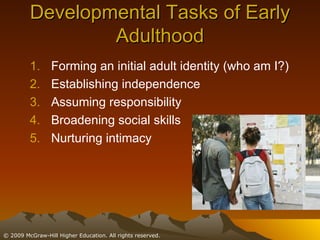
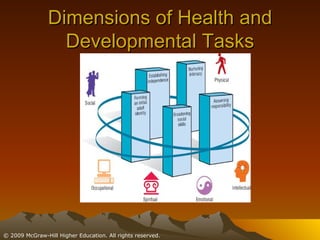
Developmental Tasks of Early Adulthood Forming an initial adult identity (who am I?) Establishing independence Assuming responsibility Broadening social skills Nurturing intimacy
Related Developmental Tasks of Young Adulthood Obtaining entry-level employment Developing parenting skills
Developmental Tasks of Middle Adulthood Achieving generativity—giving back Contributing to the collective good Parenting Traditional way in which people repay society Reassessing plans of young adulthood— one’s original goals and objectives
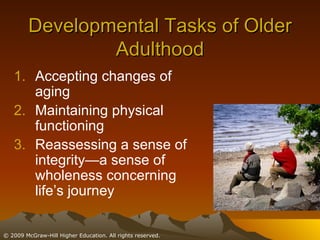
Developmental Tasks of Older Adulthood Accepting changes of aging Maintaining physical functioning Reassessing a sense of integrity—a sense of wholeness concerning life’s journey
Today’s College Students Traditional-age students Nontraditional-age students Minority students  Students with disabilities
Traditional Definitions of Health Concerns Morbidity: pertaining to illness and disease Mortality: pertaining to death Episodic health care Seeking medical treatment when ill or injured Preventive or prospective medicine Identifying risk factors and high-risk health behaviors to lower the risk of illness Empowerment
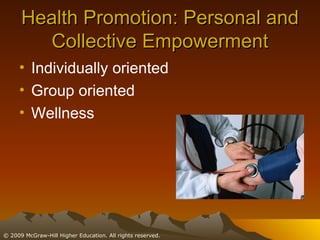
Health Promotion: Personal and Collective Empowerment Individually oriented Group oriented Wellness
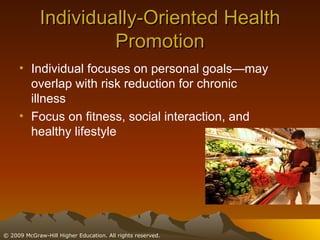
Individually-Oriented Health Promotion Individual focuses on personal goals—may overlap with risk reduction for chronic illness Focus on fitness, social interaction, and healthy lifestyle
Group-Oriented Health Promotion Community places emphasis on a group centered concept to promote  empowerment Empowerment: Gain more self control over one’s health perspective (for example, drug prevention within communities at risk)
Wellness A process intended to aid individuals in unlocking their full potential through the development of an overall wellness lifestyle Emphasis on lifestyle May not focus on mortality and morbidity but in practice shares many risk-reduction activities with health promotion approaches
  Institute of Medicine (2003)  Priority Health Concerns Treat asthma Coordinate care for 60+ million chronic disease sufferers Reduce diabetes Develop evidence-based cancer screenings Enhance rates of flu and pneumonia immunization
Institute of Medicine (2003)  Priority of Health Concerns Improve detection of depression Promote CVD prevention Reduce tobacco dependence Widen availability of prenatal care
Why Behavior Change Is Often Difficult Several factors influence a person’s desire to change a health behavior—the person must Know the behavior is associated with a health problem Accept that the behavior increases personal risk for the health problem Recognize that risk-reduction intervention programs exist and can be effective Believe the benefits of the new behavior justify the change in behavior Feel that significant others will be accepting of such changes
Stages of Change Prochaska et al. (1994) identified the following six stages people go through in changing health behaviors: Precontemplation Contemplation Preparation Action Maintenance Termination
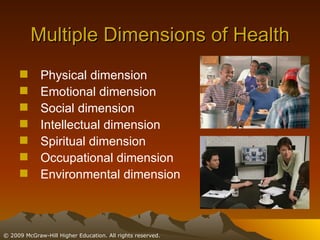
Multiple Dimensions of Health Physical dimension Emotional dimension Social dimension Intellectual dimension Spiritual dimension Occupational dimension Environmental dimension
Dimensions of Health and Developmental Tasks
A New Definition of Health A view less centered on the concepts of morbidity and mortality Two areas of differences  to focus on: 1) The role of health (process of transitions) 2) The composition of health  Intrinsic resources Extrinsic resources
A New Definition of Health One’s ability to use the intrinsic and extrinsic resources related to each dimension of health to participate fully in the activities that contribute to growth and development, with the goal of feeling a sense of well-being as one evaluates one’s progress through life
Chapter One:  Shaping Your Health

Chapter 1

  • 1.
    Chapter One: Shaping Your Health
  • 2.
    Developmental Tasks ofEarly Adulthood Forming an initial adult identity (who am I?) Establishing independence Assuming responsibility Broadening social skills Nurturing intimacy
  • 3.
    Related Developmental Tasksof Young Adulthood Obtaining entry-level employment Developing parenting skills
  • 4.
    Developmental Tasks ofMiddle Adulthood Achieving generativity—giving back Contributing to the collective good Parenting Traditional way in which people repay society Reassessing plans of young adulthood— one’s original goals and objectives
  • 5.
    Developmental Tasks ofOlder Adulthood Accepting changes of aging Maintaining physical functioning Reassessing a sense of integrity—a sense of wholeness concerning life’s journey
  • 6.
    Today’s College StudentsTraditional-age students Nontraditional-age students Minority students Students with disabilities
  • 7.
    Traditional Definitions ofHealth Concerns Morbidity: pertaining to illness and disease Mortality: pertaining to death Episodic health care Seeking medical treatment when ill or injured Preventive or prospective medicine Identifying risk factors and high-risk health behaviors to lower the risk of illness Empowerment
  • 8.
    Health Promotion: Personaland Collective Empowerment Individually oriented Group oriented Wellness
  • 9.
    Individually-Oriented Health PromotionIndividual focuses on personal goals—may overlap with risk reduction for chronic illness Focus on fitness, social interaction, and healthy lifestyle
  • 10.
    Group-Oriented Health PromotionCommunity places emphasis on a group centered concept to promote empowerment Empowerment: Gain more self control over one’s health perspective (for example, drug prevention within communities at risk)
  • 11.
    Wellness A processintended to aid individuals in unlocking their full potential through the development of an overall wellness lifestyle Emphasis on lifestyle May not focus on mortality and morbidity but in practice shares many risk-reduction activities with health promotion approaches
  • 12.
    Instituteof Medicine (2003) Priority Health Concerns Treat asthma Coordinate care for 60+ million chronic disease sufferers Reduce diabetes Develop evidence-based cancer screenings Enhance rates of flu and pneumonia immunization
  • 13.
    Institute of Medicine(2003) Priority of Health Concerns Improve detection of depression Promote CVD prevention Reduce tobacco dependence Widen availability of prenatal care
  • 14.
    Why Behavior ChangeIs Often Difficult Several factors influence a person’s desire to change a health behavior—the person must Know the behavior is associated with a health problem Accept that the behavior increases personal risk for the health problem Recognize that risk-reduction intervention programs exist and can be effective Believe the benefits of the new behavior justify the change in behavior Feel that significant others will be accepting of such changes
  • 15.
    Stages of ChangeProchaska et al. (1994) identified the following six stages people go through in changing health behaviors: Precontemplation Contemplation Preparation Action Maintenance Termination
  • 16.
    Multiple Dimensions ofHealth Physical dimension Emotional dimension Social dimension Intellectual dimension Spiritual dimension Occupational dimension Environmental dimension
  • 17.
    Dimensions of Healthand Developmental Tasks
  • 18.
    A New Definitionof Health A view less centered on the concepts of morbidity and mortality Two areas of differences to focus on: 1) The role of health (process of transitions) 2) The composition of health Intrinsic resources Extrinsic resources
  • 19.
    A New Definitionof Health One’s ability to use the intrinsic and extrinsic resources related to each dimension of health to participate fully in the activities that contribute to growth and development, with the goal of feeling a sense of well-being as one evaluates one’s progress through life
  • 20.
    Chapter One: Shaping Your Health

Editor's Notes

  • #2 Image source: Javier Pierini/Getty Images