Chapter Seventeen Accepting Dying and Death
Definitions of Death Clinical determinants of death Medical death certificate Criteria to establish death Lack of heartbeat and breathing Lack of central nervous system function Presence of rigor mortis
Psychological Stages of Dying Denial Anger Bargaining Depression Acceptance
Near-Death Experiences Acknowledgement of death Out-of-body experience Extreme blackness  Encountering love ones who have died Intense light Sense of well-being and peace Decision whether to enter into the light Return to the body
Interacting with Dying People Be genuine and honest Provide emotional support Allow people to express their feelings
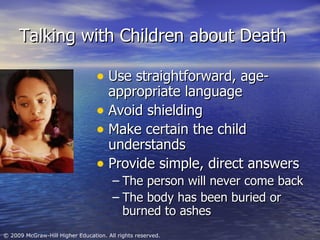
Talking with Children about Death Use straightforward, age-appropriate language Avoid shielding  Make certain the child understands Provide simple, direct answers The person will never come back The body has been buried or burned to ashes
End-of-Life Options and Decisions Hospice care for the terminally ill Goal is to maximize quality of life Strategies Pain control Family involvement Multidisciplinary approach Patient decisions Follow-up and care for survivors
Euthanasia Indirect or passive euthanasia Allowing to die (“do not resuscitate”) Direct or active euthanasia Giving a patient a lethal dose of drugs Physician-assisted suicide Prescribing a patient a lethal dose of drugs Oregon Death with Dignity Act
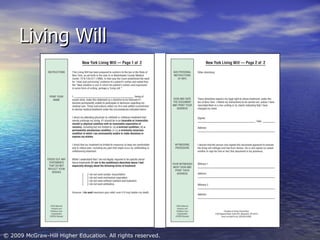
End-of-Life Options and Decisions Advance Healthcare Directives Living will Durable power of attorney for health care
Living Will
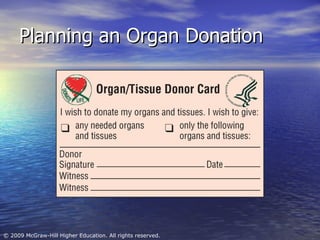
Organ Donation Intention to donate can be stated on driver’s license, but next-of-kin must consent at time of death Significant shortage of donor organs Every day: 77 people receive a transplant 110 people join waiting list for a transplant 19 people die waiting for a transplant
Planning an Organ Donation
Grief and Coping: The Experience of Grief Physical discomfort Sense of numbness Feeling of detachment from others Preoccupation with the image of the deceased Guilt Hostility Disruption in daily schedule Delayed grief
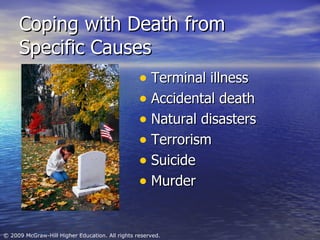
Coping with Death from Specific Causes Terminal illness Accidental death Natural disasters Terrorism Suicide Murder
Coping with the Death of a Loved One Child Miscarriage Lost after birth Grieving  Parent Spouse Sibling
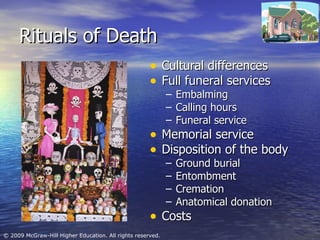
Rituals of Death Cultural differences Full funeral services Embalming Calling hours Funeral service Memorial service Disposition of the body Ground burial Entombment Cremation Anatomical donation Costs
Personal Preparation for Death Will Life insurance Funeral prearrangements Anatomical or organ donation Eulogy Epitaph
Chapter Seventeen Accepting Dying and Death

Death and Dying

  • 1.
  • 2.
    Definitions of DeathClinical determinants of death Medical death certificate Criteria to establish death Lack of heartbeat and breathing Lack of central nervous system function Presence of rigor mortis
  • 3.
    Psychological Stages ofDying Denial Anger Bargaining Depression Acceptance
  • 4.
    Near-Death Experiences Acknowledgementof death Out-of-body experience Extreme blackness Encountering love ones who have died Intense light Sense of well-being and peace Decision whether to enter into the light Return to the body
  • 5.
    Interacting with DyingPeople Be genuine and honest Provide emotional support Allow people to express their feelings
  • 6.
    Talking with Childrenabout Death Use straightforward, age-appropriate language Avoid shielding Make certain the child understands Provide simple, direct answers The person will never come back The body has been buried or burned to ashes
  • 7.
    End-of-Life Options andDecisions Hospice care for the terminally ill Goal is to maximize quality of life Strategies Pain control Family involvement Multidisciplinary approach Patient decisions Follow-up and care for survivors
  • 8.
    Euthanasia Indirect orpassive euthanasia Allowing to die (“do not resuscitate”) Direct or active euthanasia Giving a patient a lethal dose of drugs Physician-assisted suicide Prescribing a patient a lethal dose of drugs Oregon Death with Dignity Act
  • 9.
    End-of-Life Options andDecisions Advance Healthcare Directives Living will Durable power of attorney for health care
  • 10.
  • 11.
    Organ Donation Intentionto donate can be stated on driver’s license, but next-of-kin must consent at time of death Significant shortage of donor organs Every day: 77 people receive a transplant 110 people join waiting list for a transplant 19 people die waiting for a transplant
  • 12.
  • 13.
    Grief and Coping:The Experience of Grief Physical discomfort Sense of numbness Feeling of detachment from others Preoccupation with the image of the deceased Guilt Hostility Disruption in daily schedule Delayed grief
  • 14.
    Coping with Deathfrom Specific Causes Terminal illness Accidental death Natural disasters Terrorism Suicide Murder
  • 15.
    Coping with theDeath of a Loved One Child Miscarriage Lost after birth Grieving Parent Spouse Sibling
  • 16.
    Rituals of DeathCultural differences Full funeral services Embalming Calling hours Funeral service Memorial service Disposition of the body Ground burial Entombment Cremation Anatomical donation Costs
  • 17.
    Personal Preparation forDeath Will Life insurance Funeral prearrangements Anatomical or organ donation Eulogy Epitaph
  • 18.

Editor's Notes

  • #2 Image source: Tracy Montana/PhotoLink/Getty Images