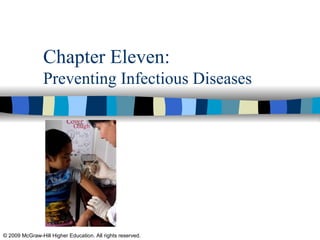
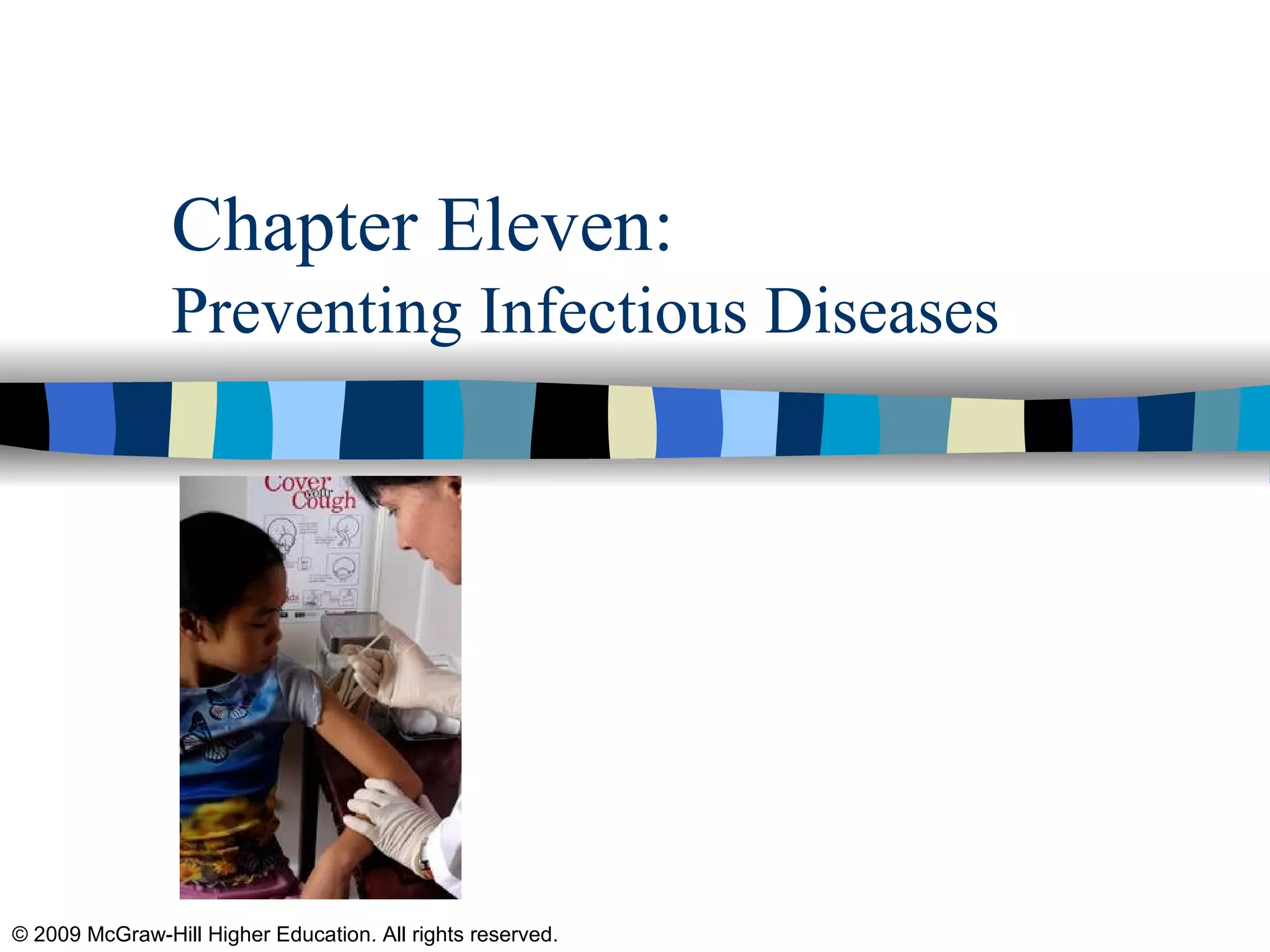
Chapter Eleven:  Preventing Infectious Diseases
Infectious Disease Transmission Pathogen : A disease-causing agent Epidemic : A highly significant increase in the number of cases of an infectious illness existing in a given time period in a given geographical area Pandemic : An epidemic that has crossed national boundaries, thus achieving regional or international status Example: HIV/AIDS
Pathogens Viruses Prions Bacteria Fungi Protozoa Rickettsia Parasitic worms
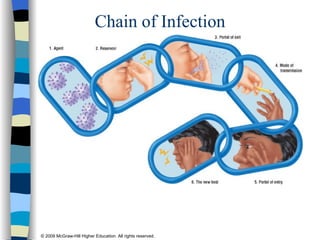
Chain of Infection
Chain of Infection Agent: Causal pathogen Reservoir: Pathogen’s environment Portal of exit Mode of transmission Direct Indirect Port of entry New host
Stages of Infection Incubation stage Prodromal stae Clinical stage Decline stage Recovery stage
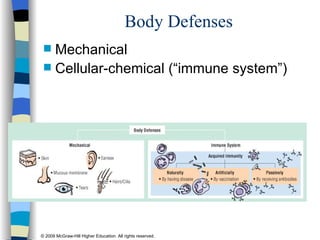
Body Defenses Mechanical Cellular-chemical (“immune system”)
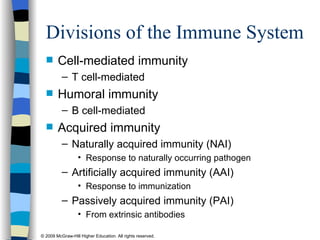
Divisions of the Immune System Cell-mediated immunity T cell-mediated Humoral immunity B cell-mediated Acquired immunity Naturally acquired immunity (NAI) Response to naturally occurring pathogen Artificially acquired immunity (AAI) Response to immunization Passively acquired immunity (PAI) From extrinsic antibodies
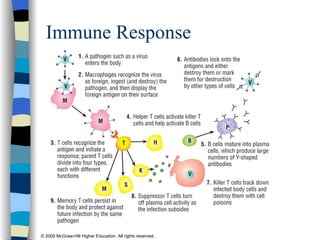
Immune Response
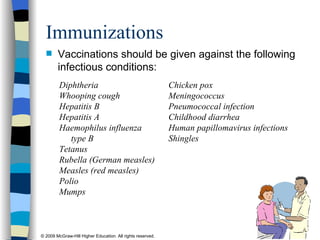
Immunizations Vaccinations should be given against the following infectious conditions: Diphtheria  Whooping cough  Hepatitis B  Hepatitis A  Haemophilus influenza type B  Tetanus Rubella (German measles) Measles (red measles) Polio  Mumps  Chicken pox Meningococcus Pneumococcal infection Childhood diarrhea Human papillomavirus infections Shingles
Nosocomial Infections Infections spread in conjunction with the delivery of health care services Over 100,000 deaths/year are attributed to these infections
The Common Cold  (Acute Rhinitis) Acute upper-respiratory-tract infection Caused by different viruses Common symptoms; usually last several days Treatments manage symptoms but do not cure the infection More severe symptoms may indicate flu, pneumonia, or another infection Prevention: Handwashing
Influenza Acute viral infection More serious than common cold Especially dangerous for young children, pregnant women, older people Annual vaccination Risk of spread of highly virulent avian influenza
Tuberculosis Bacterial infection of the lungs Symptoms Chronic coughing Weight loss Spread through coughing Requires long-term treatment with antibiotics Antibiotic-resistant strains are a concern
Pneumonia Infectious respiratory conditions May be bacterial, viral, fungal, rickettsial, mycoplasmal, or parasitic Bacterial is most common, especially among people with other illnesses Vaccination for pneumococcal pneumonia for children and older adults
Other Infectious Diseases Mononucleosis (“mono”) Viral infection characterized by weakness, fatigue, swollen glands, sore throat, and low-grade fever Chronic fatigue syndrome Characterized by severe exhaustion, fatigue, aches, and depression Bacterial meningitis Infection of the thin membranous coverings of the brain Higher risk among college students living in residence halls Immunization available
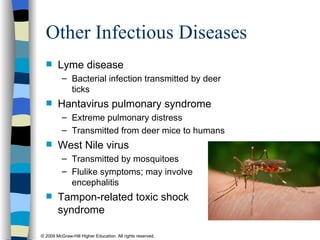
Other Infectious Diseases Lyme disease Bacterial infection transmitted by deer ticks Hantavirus pulmonary syndrome Extreme pulmonary distress Transmitted from deer mice to humans West Nile virus Transmitted by mosquitoes Flulike symptoms; may involve encephalitis Tampon-related toxic shock syndrome
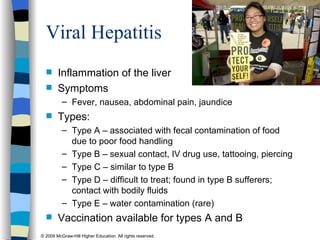
Viral Hepatitis Inflammation of the liver Symptoms Fever, nausea, abdominal pain, jaundice Types:  Type A – associated with fecal contamination of food due to poor food handling Type B – sexual contact, IV drug use, tattooing, piercing Type C – similar to type B Type D – difficult to treat; found in type B sufferers; contact with bodily fluids Type E – water contamination (rare) Vaccination available for types A and B
HIV/AIDS   Human immunodeficiency virus (HIV) Acquired immunodeficiency syndrome (AIDS) HIV attacks the helper T cells of the immune system Spread Direct contact involving the exchange of body fluids (blood, semen, vaginal secretions) Sharing of hypodermic needles Infected blood products Perinatal transmission (mother to fetus or newborn)
HIV/AIDS  HIV cannot be transmitted by sweat, saliva, or tears, even though trace amounts of HIV are observed Women are at higher risk than men of contracting HIV from an infected partner HIV concentration is higher in semen compared with vaginal secretions
Diagnosis of HIV Infection Enzyme linked immunosorbent assay (ELISA) Western BLOT test
The Course of HIV Infection Newly infected may experience flu-like symptoms within 1 or 2 months of exposure Symptoms disappear quickly Immune system is unable to clear HIV from the body Asymptomatic stage Could last for months to over 12 years Length depends on overall health, age, gender, strain of infection Immune system worsens Level of CD4 helper T cells Opportunistic infections
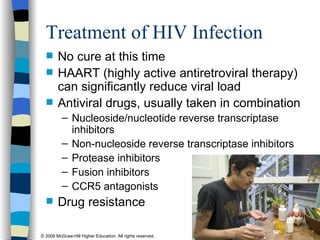
Treatment of HIV Infection No cure at this time HAART (highly active antiretroviral therapy) can significantly reduce viral load Antiviral drugs, usually taken in combination Nucleoside/nucleotide reverse transcriptase inhibitors Non-nucleoside reverse transcriptase inhibitors Protease inhibitors Fusion inhibitors CCR5 antagonists Drug resistance
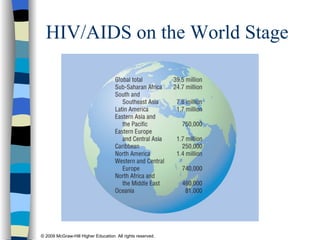
HIV/AIDS on the World Stage
Prevention of HIV Infection Learn the sexual history and HIV status of your partner Limit the number of sexual partners Use condoms correctly and consistently Avoid contact with body fluids Curtail the use of drugs Never share hypodermic needles Refrain from sex with known injectable drug users and other high-risk partners Get regular tests for STDs Do not engage in unprotected anal intercourse
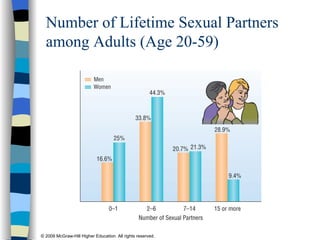
Number of Lifetime Sexual Partners among Adults (Age 20-59)
Sexually Transmitted Diseases HIV/AIDS Chlamydia Human papillomavirus Gonorrhea Herpes simplex Syphilis Pubic lice Vaginal infections  Cystitis and urethritis
Prevalent STDs Chlamydia Bacterium  Chlamydia trachomatis Urethritis Left untreated, can cause pelvic inflammatory disease and infertility in women Human papillomavirus (HPV)  Often asymptomatic Can cause genital warts, cervical cancer Vaccine; not curable
Prevalent STDs Gonorrhea  Bacterium  N. gonorrhoea Symptoms: painful urination, discharge Treated with antibiotics; some strains are drug-resistant Herpes simplex HSV 1 (oral) and HSV II (genital)  Painful blisterlike sores Pattern of recurrences Persistent; treated with antiviral drugs
Prevalent STDs Syphilis  Bacterium  Treponema pallidum   Three stages:  Primary stage: Painless sore called a chancre Secondary stage: General symptoms of illness Late stage: May recur many years after initial contact; profound damage to many body systems Left untreated, can cause death Pubic lice (“crabs”) Cause intense itching Treated with prescription and OTC drugs
Prevalent STDs Vaginal infections  Yeast infection ( Candida albicans ) Bacterial vaginosis (BV) Protozoa  Trichomonas vaginalis Cystitis (infection of bladder) Urethritis (infection of urethra) Caused by various pathogens Treated with antibiotics
Chapter Eleven:  Preventing Infectious Diseases

Preventing Infectious Diseases

  • 1.
    Chapter Eleven: Preventing Infectious Diseases
  • 2.
    Infectious Disease TransmissionPathogen : A disease-causing agent Epidemic : A highly significant increase in the number of cases of an infectious illness existing in a given time period in a given geographical area Pandemic : An epidemic that has crossed national boundaries, thus achieving regional or international status Example: HIV/AIDS
  • 3.
    Pathogens Viruses PrionsBacteria Fungi Protozoa Rickettsia Parasitic worms
  • 4.
  • 5.
    Chain of InfectionAgent: Causal pathogen Reservoir: Pathogen’s environment Portal of exit Mode of transmission Direct Indirect Port of entry New host
  • 6.
    Stages of InfectionIncubation stage Prodromal stae Clinical stage Decline stage Recovery stage
  • 7.
    Body Defenses MechanicalCellular-chemical (“immune system”)
  • 8.
    Divisions of theImmune System Cell-mediated immunity T cell-mediated Humoral immunity B cell-mediated Acquired immunity Naturally acquired immunity (NAI) Response to naturally occurring pathogen Artificially acquired immunity (AAI) Response to immunization Passively acquired immunity (PAI) From extrinsic antibodies
  • 9.
  • 10.
    Immunizations Vaccinations shouldbe given against the following infectious conditions: Diphtheria Whooping cough Hepatitis B Hepatitis A Haemophilus influenza type B Tetanus Rubella (German measles) Measles (red measles) Polio Mumps Chicken pox Meningococcus Pneumococcal infection Childhood diarrhea Human papillomavirus infections Shingles
  • 11.
    Nosocomial Infections Infectionsspread in conjunction with the delivery of health care services Over 100,000 deaths/year are attributed to these infections
  • 12.
    The Common Cold (Acute Rhinitis) Acute upper-respiratory-tract infection Caused by different viruses Common symptoms; usually last several days Treatments manage symptoms but do not cure the infection More severe symptoms may indicate flu, pneumonia, or another infection Prevention: Handwashing
  • 13.
    Influenza Acute viralinfection More serious than common cold Especially dangerous for young children, pregnant women, older people Annual vaccination Risk of spread of highly virulent avian influenza
  • 14.
    Tuberculosis Bacterial infectionof the lungs Symptoms Chronic coughing Weight loss Spread through coughing Requires long-term treatment with antibiotics Antibiotic-resistant strains are a concern
  • 15.
    Pneumonia Infectious respiratoryconditions May be bacterial, viral, fungal, rickettsial, mycoplasmal, or parasitic Bacterial is most common, especially among people with other illnesses Vaccination for pneumococcal pneumonia for children and older adults
  • 16.
    Other Infectious DiseasesMononucleosis (“mono”) Viral infection characterized by weakness, fatigue, swollen glands, sore throat, and low-grade fever Chronic fatigue syndrome Characterized by severe exhaustion, fatigue, aches, and depression Bacterial meningitis Infection of the thin membranous coverings of the brain Higher risk among college students living in residence halls Immunization available
  • 17.
    Other Infectious DiseasesLyme disease Bacterial infection transmitted by deer ticks Hantavirus pulmonary syndrome Extreme pulmonary distress Transmitted from deer mice to humans West Nile virus Transmitted by mosquitoes Flulike symptoms; may involve encephalitis Tampon-related toxic shock syndrome
  • 18.
    Viral Hepatitis Inflammationof the liver Symptoms Fever, nausea, abdominal pain, jaundice Types: Type A – associated with fecal contamination of food due to poor food handling Type B – sexual contact, IV drug use, tattooing, piercing Type C – similar to type B Type D – difficult to treat; found in type B sufferers; contact with bodily fluids Type E – water contamination (rare) Vaccination available for types A and B
  • 19.
    HIV/AIDS Human immunodeficiency virus (HIV) Acquired immunodeficiency syndrome (AIDS) HIV attacks the helper T cells of the immune system Spread Direct contact involving the exchange of body fluids (blood, semen, vaginal secretions) Sharing of hypodermic needles Infected blood products Perinatal transmission (mother to fetus or newborn)
  • 20.
    HIV/AIDS HIVcannot be transmitted by sweat, saliva, or tears, even though trace amounts of HIV are observed Women are at higher risk than men of contracting HIV from an infected partner HIV concentration is higher in semen compared with vaginal secretions
  • 21.
    Diagnosis of HIVInfection Enzyme linked immunosorbent assay (ELISA) Western BLOT test
  • 22.
    The Course ofHIV Infection Newly infected may experience flu-like symptoms within 1 or 2 months of exposure Symptoms disappear quickly Immune system is unable to clear HIV from the body Asymptomatic stage Could last for months to over 12 years Length depends on overall health, age, gender, strain of infection Immune system worsens Level of CD4 helper T cells Opportunistic infections
  • 23.
    Treatment of HIVInfection No cure at this time HAART (highly active antiretroviral therapy) can significantly reduce viral load Antiviral drugs, usually taken in combination Nucleoside/nucleotide reverse transcriptase inhibitors Non-nucleoside reverse transcriptase inhibitors Protease inhibitors Fusion inhibitors CCR5 antagonists Drug resistance
  • 24.
    HIV/AIDS on theWorld Stage
  • 25.
    Prevention of HIVInfection Learn the sexual history and HIV status of your partner Limit the number of sexual partners Use condoms correctly and consistently Avoid contact with body fluids Curtail the use of drugs Never share hypodermic needles Refrain from sex with known injectable drug users and other high-risk partners Get regular tests for STDs Do not engage in unprotected anal intercourse
  • 26.
    Number of LifetimeSexual Partners among Adults (Age 20-59)
  • 27.
    Sexually Transmitted DiseasesHIV/AIDS Chlamydia Human papillomavirus Gonorrhea Herpes simplex Syphilis Pubic lice Vaginal infections Cystitis and urethritis
  • 28.
    Prevalent STDs ChlamydiaBacterium Chlamydia trachomatis Urethritis Left untreated, can cause pelvic inflammatory disease and infertility in women Human papillomavirus (HPV) Often asymptomatic Can cause genital warts, cervical cancer Vaccine; not curable
  • 29.
    Prevalent STDs Gonorrhea Bacterium N. gonorrhoea Symptoms: painful urination, discharge Treated with antibiotics; some strains are drug-resistant Herpes simplex HSV 1 (oral) and HSV II (genital) Painful blisterlike sores Pattern of recurrences Persistent; treated with antiviral drugs
  • 30.
    Prevalent STDs Syphilis Bacterium Treponema pallidum Three stages: Primary stage: Painless sore called a chancre Secondary stage: General symptoms of illness Late stage: May recur many years after initial contact; profound damage to many body systems Left untreated, can cause death Pubic lice (“crabs”) Cause intense itching Treated with prescription and OTC drugs
  • 31.
    Prevalent STDs Vaginalinfections Yeast infection ( Candida albicans ) Bacterial vaginosis (BV) Protozoa Trichomonas vaginalis Cystitis (infection of bladder) Urethritis (infection of urethra) Caused by various pathogens Treated with antibiotics
  • 32.
    Chapter Eleven: Preventing Infectious Diseases

Editor's Notes

  • #2 Image source: The McGraw-Hill Companies, Inc./Jill Braaten