Managing the 21Managing the 21stst
Century ClassroomCentury Classroom
Carlo Magno, PhDCarlo Magno, PhD
De La Salle University, ManilaDe La Salle University, Manila
College of EducationCollege of Education
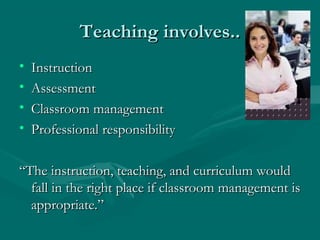
Teaching involves..Teaching involves..
• InstructionInstruction
• AssessmentAssessment
• Classroom managementClassroom management
• Professional responsibilityProfessional responsibility
““The instruction, teaching, and curriculum wouldThe instruction, teaching, and curriculum would
fall in the right place if classroom management isfall in the right place if classroom management is
appropriate.”appropriate.”
What does classroom managementWhat does classroom management
consist?consist?
• Address the challenges of the studentsAddress the challenges of the students
• Teachers and students successfully workingTeachers and students successfully working
togethertogether
• Teacher knows and is confident in monitoringTeacher knows and is confident in monitoring
studentsstudents
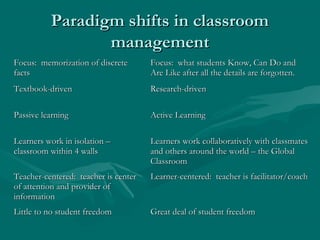
Paradigm shifts in classroomParadigm shifts in classroom
managementmanagement
Focus:  memorization of discreteFocus:  memorization of discrete
factsfacts
Focus:  what students Know, Can Do andFocus:  what students Know, Can Do and
Are Like after all the details are forgotten.Are Like after all the details are forgotten.
Textbook-drivenTextbook-driven Research-drivenResearch-driven
Passive learningPassive learning Active LearningActive Learning
Learners work in isolation –Learners work in isolation –
classroom within 4 wallsclassroom within 4 walls
Learners work collaboratively with classmatesLearners work collaboratively with classmates
and others around the world – the Globaland others around the world – the Global
ClassroomClassroom
Teacher-centered:  teacher is centerTeacher-centered:  teacher is center
of attention and provider ofof attention and provider of
informationinformation
Learner-centered:  teacher is facilitator/coachLearner-centered:  teacher is facilitator/coach
Little to no student freedomLittle to no student freedom Great deal of student freedomGreat deal of student freedom
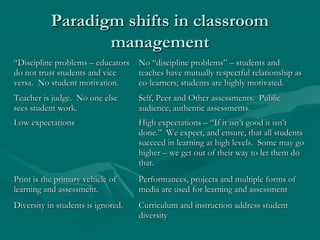
Paradigm shifts in classroomParadigm shifts in classroom
managementmanagement
““Discipline problems – educatorsDiscipline problems – educators
do not trust students and vicedo not trust students and vice
versa.  No student motivation.versa.  No student motivation.
No “discipline problems” – students andNo “discipline problems” – students and
teaches have mutually respectful relationship asteaches have mutually respectful relationship as
co-learners; students are highly motivated.co-learners; students are highly motivated.
Teacher is judge.  No one elseTeacher is judge.  No one else
sees student work.sees student work.
Self, Peer and Other assessments.  PublicSelf, Peer and Other assessments.  Public
audience, authentic assessments.audience, authentic assessments.
Low expectationsLow expectations High expectations – “If it isn’t good it isn’tHigh expectations – “If it isn’t good it isn’t
done.”  We expect, and ensure, that all studentsdone.”  We expect, and ensure, that all students
succeed in learning at high levels.  Some may gosucceed in learning at high levels.  Some may go
higher – we get out of their way to let them dohigher – we get out of their way to let them do
that.that.
Print is the primary vehicle ofPrint is the primary vehicle of
learning and assessment.learning and assessment.
Performances, projects and multiple forms ofPerformances, projects and multiple forms of
media are used for learning and assessmentmedia are used for learning and assessment
Diversity in students is ignored.Diversity in students is ignored. Curriculum and instruction address studentCurriculum and instruction address student
diversitydiversity
Classroom should be able to developClassroom should be able to develop
2121stst
century skillscentury skills
• Critical Thinking and Problem SolvingCritical Thinking and Problem Solving
• Collaboration across Networks and Leading byCollaboration across Networks and Leading by
InfluenceInfluence
• Agility and AdaptabilityAgility and Adaptability
• Initiative and EntrepreneurialismInitiative and Entrepreneurialism
• Effective Oral and Written CommunicationEffective Oral and Written Communication
• Accessing and Analyzing InformationAccessing and Analyzing Information
• Curiosity and ImaginationCuriosity and Imagination
Case ACase A
• Teacher X gave an exercise for students to workTeacher X gave an exercise for students to work
using MS Word in the computer lab. After 20using MS Word in the computer lab. After 20
minutes (the class runs for 40 minutes), Studentminutes (the class runs for 40 minutes), Student
A was seen not to be doing the exercise. StudentA was seen not to be doing the exercise. Student
A is commenting that the activity given by theA is commenting that the activity given by the
teacher is boring.teacher is boring.
• What will you do?What will you do?
Case BCase B
• While you are lecturing about the parts of theWhile you are lecturing about the parts of the
Excel window, you saw that some students areExcel window, you saw that some students are
passing around a paper and each one is giggling.passing around a paper and each one is giggling.
You took the paper and you saw that it is aYou took the paper and you saw that it is a
drawing of you (which looks grotesque!).drawing of you (which looks grotesque!).
• What will you do?What will you do?
Case CCase C
• You are handling 50 students in the computerYou are handling 50 students in the computer
lab. Every time you give the procedure what tolab. Every time you give the procedure what to
click using paintbrush, the students would notclick using paintbrush, the students would not
listen and gets in advance to what you arelisten and gets in advance to what you are
teaching, they are already doing other things andteaching, they are already doing other things and
not following your instructions.not following your instructions.
• What will you do?What will you do?
Some tipsSome tips
• Set the place for learning.Set the place for learning.
• Have physical presence inside the classroom.Have physical presence inside the classroom.
• Spend the early parts of the year teaching your studentsSpend the early parts of the year teaching your students
about routines, rules, and procedures.about routines, rules, and procedures.
• Plan ahead to avoid disruptionsPlan ahead to avoid disruptions
• Treating misbehavior:Treating misbehavior:
– Is it calm, is it polite, is it fairly unobtrusive, does it treat the
kids with dignity?
• Model the behavior you want from your students

Managing the 21st century classroom

  • 1.
    Managing the 21Managingthe 21stst Century ClassroomCentury Classroom Carlo Magno, PhDCarlo Magno, PhD De La Salle University, ManilaDe La Salle University, Manila College of EducationCollege of Education
  • 2.
    Teaching involves..Teaching involves.. •InstructionInstruction • AssessmentAssessment • Classroom managementClassroom management • Professional responsibilityProfessional responsibility ““The instruction, teaching, and curriculum wouldThe instruction, teaching, and curriculum would fall in the right place if classroom management isfall in the right place if classroom management is appropriate.”appropriate.”
  • 3.
    What does classroommanagementWhat does classroom management consist?consist? • Address the challenges of the studentsAddress the challenges of the students • Teachers and students successfully workingTeachers and students successfully working togethertogether • Teacher knows and is confident in monitoringTeacher knows and is confident in monitoring studentsstudents
  • 4.
    Paradigm shifts inclassroomParadigm shifts in classroom managementmanagement Focus:  memorization of discreteFocus:  memorization of discrete factsfacts Focus:  what students Know, Can Do andFocus:  what students Know, Can Do and Are Like after all the details are forgotten.Are Like after all the details are forgotten. Textbook-drivenTextbook-driven Research-drivenResearch-driven Passive learningPassive learning Active LearningActive Learning Learners work in isolation –Learners work in isolation – classroom within 4 wallsclassroom within 4 walls Learners work collaboratively with classmatesLearners work collaboratively with classmates and others around the world – the Globaland others around the world – the Global ClassroomClassroom Teacher-centered:  teacher is centerTeacher-centered:  teacher is center of attention and provider ofof attention and provider of informationinformation Learner-centered:  teacher is facilitator/coachLearner-centered:  teacher is facilitator/coach Little to no student freedomLittle to no student freedom Great deal of student freedomGreat deal of student freedom
  • 5.
    Paradigm shifts inclassroomParadigm shifts in classroom managementmanagement ““Discipline problems – educatorsDiscipline problems – educators do not trust students and vicedo not trust students and vice versa.  No student motivation.versa.  No student motivation. No “discipline problems” – students andNo “discipline problems” – students and teaches have mutually respectful relationship asteaches have mutually respectful relationship as co-learners; students are highly motivated.co-learners; students are highly motivated. Teacher is judge.  No one elseTeacher is judge.  No one else sees student work.sees student work. Self, Peer and Other assessments.  PublicSelf, Peer and Other assessments.  Public audience, authentic assessments.audience, authentic assessments. Low expectationsLow expectations High expectations – “If it isn’t good it isn’tHigh expectations – “If it isn’t good it isn’t done.”  We expect, and ensure, that all studentsdone.”  We expect, and ensure, that all students succeed in learning at high levels.  Some may gosucceed in learning at high levels.  Some may go higher – we get out of their way to let them dohigher – we get out of their way to let them do that.that. Print is the primary vehicle ofPrint is the primary vehicle of learning and assessment.learning and assessment. Performances, projects and multiple forms ofPerformances, projects and multiple forms of media are used for learning and assessmentmedia are used for learning and assessment Diversity in students is ignored.Diversity in students is ignored. Curriculum and instruction address studentCurriculum and instruction address student diversitydiversity
  • 6.
    Classroom should beable to developClassroom should be able to develop 2121stst century skillscentury skills • Critical Thinking and Problem SolvingCritical Thinking and Problem Solving • Collaboration across Networks and Leading byCollaboration across Networks and Leading by InfluenceInfluence • Agility and AdaptabilityAgility and Adaptability • Initiative and EntrepreneurialismInitiative and Entrepreneurialism • Effective Oral and Written CommunicationEffective Oral and Written Communication • Accessing and Analyzing InformationAccessing and Analyzing Information • Curiosity and ImaginationCuriosity and Imagination
  • 7.
    Case ACase A •Teacher X gave an exercise for students to workTeacher X gave an exercise for students to work using MS Word in the computer lab. After 20using MS Word in the computer lab. After 20 minutes (the class runs for 40 minutes), Studentminutes (the class runs for 40 minutes), Student A was seen not to be doing the exercise. StudentA was seen not to be doing the exercise. Student A is commenting that the activity given by theA is commenting that the activity given by the teacher is boring.teacher is boring. • What will you do?What will you do?
  • 8.
    Case BCase B •While you are lecturing about the parts of theWhile you are lecturing about the parts of the Excel window, you saw that some students areExcel window, you saw that some students are passing around a paper and each one is giggling.passing around a paper and each one is giggling. You took the paper and you saw that it is aYou took the paper and you saw that it is a drawing of you (which looks grotesque!).drawing of you (which looks grotesque!). • What will you do?What will you do?
  • 9.
    Case CCase C •You are handling 50 students in the computerYou are handling 50 students in the computer lab. Every time you give the procedure what tolab. Every time you give the procedure what to click using paintbrush, the students would notclick using paintbrush, the students would not listen and gets in advance to what you arelisten and gets in advance to what you are teaching, they are already doing other things andteaching, they are already doing other things and not following your instructions.not following your instructions. • What will you do?What will you do?
  • 10.
    Some tipsSome tips •Set the place for learning.Set the place for learning. • Have physical presence inside the classroom.Have physical presence inside the classroom. • Spend the early parts of the year teaching your studentsSpend the early parts of the year teaching your students about routines, rules, and procedures.about routines, rules, and procedures. • Plan ahead to avoid disruptionsPlan ahead to avoid disruptions • Treating misbehavior:Treating misbehavior: – Is it calm, is it polite, is it fairly unobtrusive, does it treat the kids with dignity? • Model the behavior you want from your students