Effective Questioning and Reacting 
Techniques 
Marilu S. Bandolon 
Facilitator 
References: 
1.http://www.slideshare.net/rowenativoli/effective-questioning- 
2-3427422 
2. Mrs. Maha Al- Harb, Khawla Al Rifa’e, Mrs. Suad Al-shbaily
Children go to school as question 
marks and leave school as periods 
Neil Postman
Focus Questions: 
 For a highly interactive class, what are the various 
types of questions asked? 
What are some questioning skills that teachers should 
develop to generate interaction? 
How can a teacher improve his/he questioning skills? 
What are some effective reacting techniques?
A study was once conducted to find out how teachers 
ask questions. This was observed in a Grade 6 science 
class. A tape recorder was hidden under a demonstration 
table. She conducted a discussion of the lesson for forty 
minutes. 
She was able to ask 29 questions, all of which are of 
the “what” type. Maybe they were all answered. They were 
simple recall. 
Has the teacher developed the pupils’ thinking skills?
The kind of questions we ask determine the level of 
thinking we develop. Low level questions demands low level 
responses. They require responses of the simple recall or 
memory type answers. 
Examples: 
What was the temperature range yesterday? 
What insects transmit dengue fever? 
What part of the plant serves as its factory?
We ask questions based on purpose: 
1.For assessing cognition 
-to determine one’s knowledge in understanding 
-promote high level thinking 
-use divergent questions and open ended 
inquiries that call for analysis and evaluation 
Examples: 
What is likely to happen if the ozone layer of the 
atmosphere continues to deteriorate? 
Why does is sound heard louder when und er water 
than out of it?
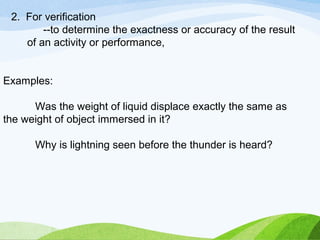
2. For verification 
--to determine the exactness or accuracy of the result 
of an activity or performance, 
Examples: 
Was the weight of liquid displace exactly the same as 
the weight of object immersed in it? 
Why is lightning seen before the thunder is heard?
3. For creative thinking 
--to probe into one’s originality, 
Examples: 
How will you present the layers of the earth to your 
classmates? 
Simulate the eruption of Mt. Mayon. 
How can you demonstrate soil less gardening? 
Notice that the question or the direction asks the pupils to 
present their own ideas or new ways of doing things.
4. For evaluating 
--to elicit responses that include judgment, value, and 
choice 
-it also asks personal opinion about an event, a policy 
or a person 
Examples: 
Was your classmates’ slide presentation well done?
5. For productive thinking 
--includes cognitive reasoning 
-analyses facts, 
-recognizes patterns or trends 
-invokes memory and recall 
- 
Examples: 
How can we apply the concept of the least common 
multiple in other situaitons?
6. For motivating 
-to arouse the interest of students and focus attention 
-situating the students in the right mood. 
Examples: 
How would you like to know how your favorite flower 
can remain fresh longer? 
Did you ever train a pet? 
Can perpendicular lines be intersecting lines?
7. For instructing 
-asking useful information 
-directs, guides and advise on what and how to do an 
activity 
Examples: 
What are the steps in solving problems?
Questions can either be low or high level 
Low level questions 
-include memory questions or those that require simple 
recall 
Example: 
Define energy. 
State the first Law of Motion
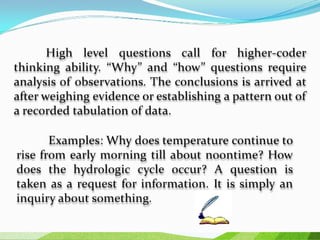
High level questions 
-call for the respondent’s ability to analyze, evaluate, 
and solve problems 
Examples: 
What is the relation between the distance of a planet 
and its period of revolution? 
Why does temperature rise toward noontime? 
Why is repeated addition the same as multiplication?
Divergent questions 
-require the respondents to think in different directions 
-to think of alternative actions 
-arrive at own decision 
-to arrive at several possible answers 
Examples: 
Why are you voting them? 
What will happen if you leave it under direct sunlight 
for a week?
Questioning Skills 
Class interaction is dependent on the questioning skills. 
What questioning skills should teachers ask in order to 
generate maximum interaction among the students? 
1. Ask varying types of questions 
2. Ask non-directing questions 
3. Call in non-volunteers 
4. Rephrasing 
5. Sequencing logically 
6. Requiring abstract thinking 
7. Asking open-ended questions 
8. Allowing for sufficient wait time
Convergent /closed question: 
- They give you facts. 
- They are easy and quick to answer. 
- They keep control of the conversation with the 
questioner. 
Note: They should be used with care – too many closed 
questions can cause frustration and shut down conversation.
Asking varying type of questions 
Ask convergent, divergent and evaluating questions. 
Convergent questions are closed questions that have 
only one correct answer. 
Convergent questions are mostly closed questions that 
can be classified as: 
a. Yes/no questions 
b. Answerable by a single word or short phrase 
(What is the process of food manufacture that takes in 
plant called?)
Divergent Questions 
-open questions and may have more than one acceptable 
answer. 
- They ask the student to think and reflect. 
- They will give you opinions and feelings. 
- They have control of the conversation to the respondent. 
-useful in getting another person to speak. ( The one 
who asks the questions are likely to receive a long 
answer, that’s why they can provide a good deal of I 
information) 
-Sometimes they are statements : “ tell me about” , 
“ give me an example of”
2. Yes / No Questions 
( Closed Questions ) : 
Evaluative questions are divergent questions that 
require judgment concerning the subject focus. 
(What is you evaluation of our manner of election in the country?) 
A tag question is an example of an evaluative questions. 
It is a statement followed by a mini-question whether it is 
positive or negative. The whole sentence is a "tag question", 
and the mini-question at the end is called a "question tag". 
We use tag questions at the end of statements to ask for 
confirmation. They mean something like: "Am I right?" or "Do 
you agree?" They are very common in English.
5. Inference Questions: 
Inference questions are forms of divergent questions that 
require the respondents to give the inferences and assumptions 
based in passages read or heard. The main goal of the 
questions is to assess the ability of the learners to go beyond 
what is on the page. It’s not unusual to face two or more 
inference questions in each passage. 
Ex. They went out at 6. 
They came back at 10 
How long did they stay out?
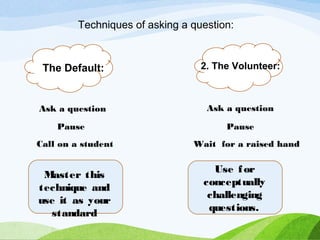
Techniques of asking a question: 
1. The Default: 
Ask a question 
Pause 
Call on a student 
Master this 
technique and 
use it as your 
standard 
2. The Volunteer: 
Ask a question 
Pause 
Wait for a raised hand 
Use for 
conceptually 
challenging 
questions.
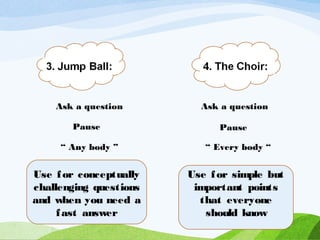
Ask a question 
Pause 
“ Any body ” 
Use for conceptually 
challenging questions 
and when you need a 
fast answer 
Ask a question 
Pause 
“ Every body “ 
Use for simple but 
important points 
that everyone 
should know
When a student asks a question: 
*Clarify it , if necessary. 
* Whenever possible, help the student answer the 
question himself. 
* Ask other students to answer the question. 
* Defer until later, if possible. 
* Answer it yourself, only as a last resort… 
* But, never let a student’s question go 
unanswered.
When a student says ( I don’t know) 
As A General Rule 
Don’t Let Them Off The Hook!
Task 5 
What are the characteristics of a good question? 
A good 
question 
should be 
Thought Provoking 
unambiguous 
Clearly stated 
Relevant 
Related to the objectives 
Common 
Vocabulary 
Comprehensive 
Straight forward 
Short 
Properly Directed
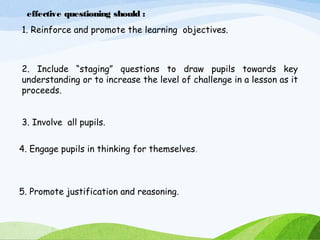
effective questioning should : 
1. Reinforce and promote the learning objectives. 
2. Include “staging” questions to draw pupils towards key 
understanding or to increase the level of challenge in a lesson as it 
proceeds. 
3. Involve all pupils. 
4. Engage pupils in thinking for themselves. 
5. Promote justification and reasoning.
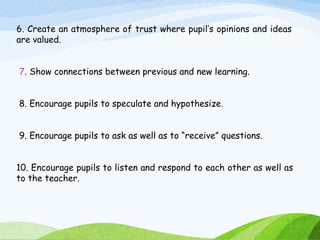
6. Create an atmosphere of trust where pupil’s opinions and ideas 
are valued. 
7. Show connections between previous and new learning. 
8. Encourage pupils to speculate and hypothesize. 
9. Encourage pupils to ask as well as to “receive” questions. 
10. Encourage pupils to listen and respond to each other as well as 
to the teacher.
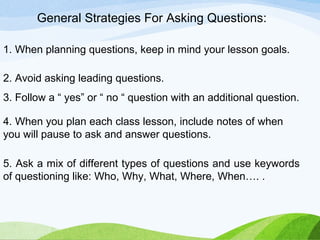
General Strategies For Asking Questions: 
1. When planning questions, keep in mind your lesson goals. 
2. Avoid asking leading questions. 
3. Follow a “ yes” or “ no “ question with an additional question. 
4. When you plan each class lesson, include notes of when 
you will pause to ask and answer questions. 
5. Ask a mix of different types of questions and use keywords 
of questioning like: Who, Why, What, Where, When…. .
6. Wait for students to think and formulate responses. 
7. Encourage students to ask questions at any time. 
8. Scatter questions over the entire class. 
9. Pose questions within the ability of the student to whom 
the question is addressed. 
10. Ask students to give complete answers. 
11. Do not permit frequent group responses. 
12. Avoid asking questions that can be answered by guessing.
As a summary…… 
Good questioning is a 
major determinant of the 
success of teaching.
Questioning techniques

Questioning techniques

  • 1.
    Effective Questioning andReacting Techniques Marilu S. Bandolon Facilitator References: 1.http://www.slideshare.net/rowenativoli/effective-questioning- 2-3427422 2. Mrs. Maha Al- Harb, Khawla Al Rifa’e, Mrs. Suad Al-shbaily
  • 2.
    Children go toschool as question marks and leave school as periods Neil Postman
  • 3.
    Focus Questions: For a highly interactive class, what are the various types of questions asked? What are some questioning skills that teachers should develop to generate interaction? How can a teacher improve his/he questioning skills? What are some effective reacting techniques?
  • 4.
    A study wasonce conducted to find out how teachers ask questions. This was observed in a Grade 6 science class. A tape recorder was hidden under a demonstration table. She conducted a discussion of the lesson for forty minutes. She was able to ask 29 questions, all of which are of the “what” type. Maybe they were all answered. They were simple recall. Has the teacher developed the pupils’ thinking skills?
  • 5.
    The kind ofquestions we ask determine the level of thinking we develop. Low level questions demands low level responses. They require responses of the simple recall or memory type answers. Examples: What was the temperature range yesterday? What insects transmit dengue fever? What part of the plant serves as its factory?
  • 7.
    We ask questionsbased on purpose: 1.For assessing cognition -to determine one’s knowledge in understanding -promote high level thinking -use divergent questions and open ended inquiries that call for analysis and evaluation Examples: What is likely to happen if the ozone layer of the atmosphere continues to deteriorate? Why does is sound heard louder when und er water than out of it?
  • 8.
    2. For verification --to determine the exactness or accuracy of the result of an activity or performance, Examples: Was the weight of liquid displace exactly the same as the weight of object immersed in it? Why is lightning seen before the thunder is heard?
  • 9.
    3. For creativethinking --to probe into one’s originality, Examples: How will you present the layers of the earth to your classmates? Simulate the eruption of Mt. Mayon. How can you demonstrate soil less gardening? Notice that the question or the direction asks the pupils to present their own ideas or new ways of doing things.
  • 10.
    4. For evaluating --to elicit responses that include judgment, value, and choice -it also asks personal opinion about an event, a policy or a person Examples: Was your classmates’ slide presentation well done?
  • 11.
    5. For productivethinking --includes cognitive reasoning -analyses facts, -recognizes patterns or trends -invokes memory and recall - Examples: How can we apply the concept of the least common multiple in other situaitons?
  • 12.
    6. For motivating -to arouse the interest of students and focus attention -situating the students in the right mood. Examples: How would you like to know how your favorite flower can remain fresh longer? Did you ever train a pet? Can perpendicular lines be intersecting lines?
  • 13.
    7. For instructing -asking useful information -directs, guides and advise on what and how to do an activity Examples: What are the steps in solving problems?
  • 14.
    Questions can eitherbe low or high level Low level questions -include memory questions or those that require simple recall Example: Define energy. State the first Law of Motion
  • 15.
    High level questions -call for the respondent’s ability to analyze, evaluate, and solve problems Examples: What is the relation between the distance of a planet and its period of revolution? Why does temperature rise toward noontime? Why is repeated addition the same as multiplication?
  • 16.
    Divergent questions -requirethe respondents to think in different directions -to think of alternative actions -arrive at own decision -to arrive at several possible answers Examples: Why are you voting them? What will happen if you leave it under direct sunlight for a week?
  • 17.
    Questioning Skills Classinteraction is dependent on the questioning skills. What questioning skills should teachers ask in order to generate maximum interaction among the students? 1. Ask varying types of questions 2. Ask non-directing questions 3. Call in non-volunteers 4. Rephrasing 5. Sequencing logically 6. Requiring abstract thinking 7. Asking open-ended questions 8. Allowing for sufficient wait time
  • 18.
    Convergent /closed question: - They give you facts. - They are easy and quick to answer. - They keep control of the conversation with the questioner. Note: They should be used with care – too many closed questions can cause frustration and shut down conversation.
  • 19.
    Asking varying typeof questions Ask convergent, divergent and evaluating questions. Convergent questions are closed questions that have only one correct answer. Convergent questions are mostly closed questions that can be classified as: a. Yes/no questions b. Answerable by a single word or short phrase (What is the process of food manufacture that takes in plant called?)
  • 20.
    Divergent Questions -openquestions and may have more than one acceptable answer. - They ask the student to think and reflect. - They will give you opinions and feelings. - They have control of the conversation to the respondent. -useful in getting another person to speak. ( The one who asks the questions are likely to receive a long answer, that’s why they can provide a good deal of I information) -Sometimes they are statements : “ tell me about” , “ give me an example of”
  • 21.
    2. Yes /No Questions ( Closed Questions ) : Evaluative questions are divergent questions that require judgment concerning the subject focus. (What is you evaluation of our manner of election in the country?) A tag question is an example of an evaluative questions. It is a statement followed by a mini-question whether it is positive or negative. The whole sentence is a "tag question", and the mini-question at the end is called a "question tag". We use tag questions at the end of statements to ask for confirmation. They mean something like: "Am I right?" or "Do you agree?" They are very common in English.
  • 22.
    5. Inference Questions: Inference questions are forms of divergent questions that require the respondents to give the inferences and assumptions based in passages read or heard. The main goal of the questions is to assess the ability of the learners to go beyond what is on the page. It’s not unusual to face two or more inference questions in each passage. Ex. They went out at 6. They came back at 10 How long did they stay out?
  • 23.
    Techniques of askinga question: 1. The Default: Ask a question Pause Call on a student Master this technique and use it as your standard 2. The Volunteer: Ask a question Pause Wait for a raised hand Use for conceptually challenging questions.
  • 24.
    Ask a question Pause “ Any body ” Use for conceptually challenging questions and when you need a fast answer Ask a question Pause “ Every body “ Use for simple but important points that everyone should know
  • 25.
    When a studentasks a question: *Clarify it , if necessary. * Whenever possible, help the student answer the question himself. * Ask other students to answer the question. * Defer until later, if possible. * Answer it yourself, only as a last resort… * But, never let a student’s question go unanswered.
  • 26.
    When a studentsays ( I don’t know) As A General Rule Don’t Let Them Off The Hook!
  • 27.
    Task 5 Whatare the characteristics of a good question? A good question should be Thought Provoking unambiguous Clearly stated Relevant Related to the objectives Common Vocabulary Comprehensive Straight forward Short Properly Directed
  • 28.
    effective questioning should: 1. Reinforce and promote the learning objectives. 2. Include “staging” questions to draw pupils towards key understanding or to increase the level of challenge in a lesson as it proceeds. 3. Involve all pupils. 4. Engage pupils in thinking for themselves. 5. Promote justification and reasoning.
  • 29.
    6. Create anatmosphere of trust where pupil’s opinions and ideas are valued. 7. Show connections between previous and new learning. 8. Encourage pupils to speculate and hypothesize. 9. Encourage pupils to ask as well as to “receive” questions. 10. Encourage pupils to listen and respond to each other as well as to the teacher.
  • 30.
    General Strategies ForAsking Questions: 1. When planning questions, keep in mind your lesson goals. 2. Avoid asking leading questions. 3. Follow a “ yes” or “ no “ question with an additional question. 4. When you plan each class lesson, include notes of when you will pause to ask and answer questions. 5. Ask a mix of different types of questions and use keywords of questioning like: Who, Why, What, Where, When…. .
  • 31.
    6. Wait forstudents to think and formulate responses. 7. Encourage students to ask questions at any time. 8. Scatter questions over the entire class. 9. Pose questions within the ability of the student to whom the question is addressed. 10. Ask students to give complete answers. 11. Do not permit frequent group responses. 12. Avoid asking questions that can be answered by guessing.
  • 32.
    As a summary…… Good questioning is a major determinant of the success of teaching.