

21 st Century 
Classroom Management 
Today’s teachers, belong to 
the most promising 
generation in the history of the world. 
1 09-11-2014
Are you ready to take a unique trip to 
the shores of success tides of 21st 
Century classroom? 
2 09-11-2014
The reality of 21 st century classroom life 
 Students may be late for class, leave early, talk 
inappropriately, or sleep during class. 
 Recently faculty have reported more threatening 
behaviours, physical or verbal attacks. 
 All faculties are confronted with students who 
engage in behaviours that are disruptive to the 
educational process. 
 Teachers unable to control mobile phone in class: 
check mobile phones, uniform, shoes, tie, belt and 
hair style 
 Teachers are not taking job seriously 
3 09-11-2014
4 09-11-2014
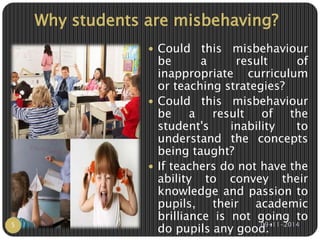
Why students are misbehaving? 
 Could this misbehaviour 
be a result of 
inappropriate curriculum 
or teaching strategies? 
 Could this misbehaviour 
be a result of the 
student's inability to 
understand the concepts 
being taught? 
 If teachers do not have the 
ability to convey their 
knowledge and passion to 
pupils, their academic 
brilliance is not going to 
5 do pupils any good09.-’11-2014
An idea whose time has come 
 The art of teaching rapidly becoming the science 
of teaching 
 30 years ago teaching had not been studied in 
systematically in scientific manner. 
 It doesn’t mean the teaching was not effective or 
taught in systematic manner. 
 Teachers can, and do, change lives. They can 
light candles in the darkest mind. 
7 09-11-2014
No teacher is perfect. We all make mistakes 
 There is and there can be no teaching 
where the attention of the scholar is not 
secured. The teacher who fails to get the 
attention of his scholars, fails totally 
 Willingness of the teacher to accept 
responsibility for classroom control 
 Insight - teacher spends time with 
problem students individually, getting to 
know them personally, attempting to 
instruct and inform them 
 Do not hit or hurt others. Be polite and 
helpful. 
Good classroom management results in the 
students can learn and the teacher can teach 
8 09-11-2014
Teachers boil at different 
degrees and students 
melt at different 
temperatures 
 Once you realize that your students will like you 
more when you are tough and fair with them, you'll 
be on the right track. 
 They want to bring the best out in their students. 
TOUGH TIMES NEVER LAST, 
TOUGH PEOPLE DO 
9 9/11/2014 09-11-2014
Only knows the 
language of 
Business 
A philosopher proud of his 
knowledge hired an illiterate to ferry 
him across a wide river; While 
crossing the turbulent river, the 
philosopher, unable to restrain his 
tongue, constantly lectured to the 
boatman about the nature of 
existence. ‘Have you never studied 
grammar?’ asked the philosopher. 
‘No,’ said the boatman. In that 
case, half your life has been wasted. 
The boatman said nothing. 
 Soon a terrible storm blew up. The 
boat was tosses about by the wind. 
‘Have you ever learned to swim? 
Asked the boatman. ‘No,’ said the 
philosopher. ‘In that case, sir, all 
your life is lost, because the boat is 
sinking.’
All the great men throughout history, had 
one main thing in common. They failed, and 
they failed often. 
3 reasons why failure is the key to success 
1. Success Lies in Seeing Failure as a Tool: Success is about learning 
how to recognize why you failed, and how you’re going to 
compensate for it. Remember, failure is an opportunity, not a burden. 
2. Failure Builds Character: If you look at the events leading up to any 
significant victory, you’ll often discover failure as the biggest 
motivator. So what do you need to consistently test yourself and learn 
from failed attempts? While each success will propel you by a small 
amount, failure will build your career – and your personality . 
3. Failure is a Function of Trying: The best way to measure your 
progress at something is the number of setbacks and “failures” you’ve 
had. Failure is the blacksmith’s hammer that tempers the sword of 
success. 
“Failure is the opportunity to begin again, more 
intelligently.”
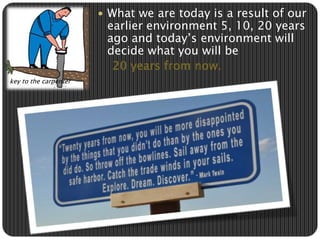
 What we are today is a result of our 
earlier environment 5, 10, 20 years 
ago and today’s environment will 
decide what you will be 
20 years from now. 
key to the carpenter
Time for a rethink! Reimaging and 
Restructure. And to introducing 
something new. 
What can I do to keep them going? 
How can I help my students to get 
started 
“A teacher who is 
attempting to teach 
without inspiring the pupil 
with a desire to learn is 
hammering cold iron.”
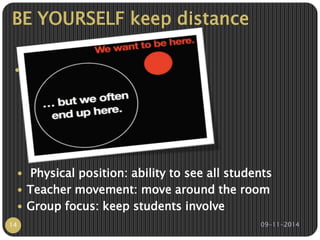
BE YOURSELF keep distance 
 There is something you can do 
better than other, remember 
ordinary and extraordinary is 
“that little extra.” 
 Physical position: ability to see all students 
 Teacher movement: move around the room 
 Group focus: keep students involve 
14 09-11-2014
Uncertainty 
Exposure to uncertainty 
PLUGGED IN 
A man jumps from a sixty story scraps. There would be no 
uncertainty if the man were to jump off the building 
without a parachute, his chance of survival would be zero. 
However If the man were to jump with a parachute, then 
there would be some degree of uncertainty about whether 
the man would live or die. The jumper faces risk because 
he is personally exposed to the uncertainty of the 
parachute failing to open. 
Suppose you are watching this event as a bystander from 
the pavement below this tall building. Are you facing any 
risk even if there is uncertainty in this event? The answer 
is No. because you are not personally exposed- unless the 
jumper is your relative, or has borrowed money from you, 
or you have a coffee shop on the pavement where he may 
crash land.
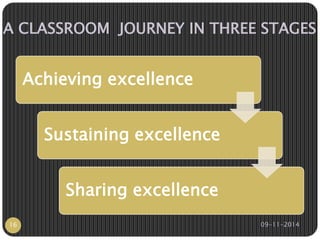
A CLASSROOM JOURNEY IN THREE STAGES 
Achieving excellence 
Sustaining excellence 
Sharing excellence 
16 09-11-2014
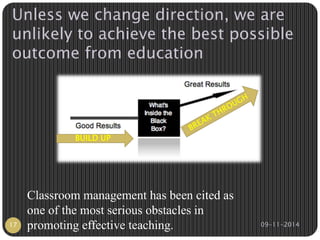
Unless we change direction, we are 
unlikely to achieve the best possible 
outcome from education 
BUILD UP 
Classroom management has been cited as 
one of the most serious obstacles in 
promoting effective teaching. 
17 09-11-2014
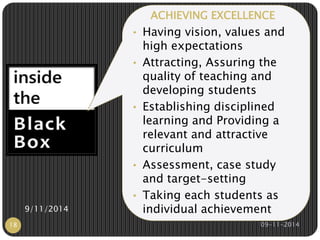
ACHIEVING EXCELLENCE 
• Having vision, values and 
high expectations 
• Attracting, Assuring the 
quality of teaching and 
developing students 
• Establishing disciplined 
learning and Providing a 
relevant and attractive 
curriculum 
• Assessment, case study 
and target-setting 
• Taking each students as 
9/11/2014 individual achievement 
18 09-11-2014
Principles 
of the 
Eagle 
Eagles fly alone at high altitude with 
eagles only. No other bird can go to the 
height of the eagle. 
Eagles have strong vision, the ability to 
focus on something up to five 
kilometers away. No matter what the 
obstacle, the eagle will not move his 
focus from the prey until he grabs it. 
Eagles do not eat dead things. They 
feed only on fresh prey. Clear of 
outdated and old information. 
Eagles love the storm. When clouds 
gather, the eagles get excited. The eagle 
uses the storm's winds to lift it higher. 
This gives the eagle an opportunity to 
glide and rest its wings.
commitment When a female eagle meets a 
male and they want to mate, she 
flies down to earth with the male 
and picks a twig. She flies back 
into the air with the male 
pursuing her. At height high 
enough, fall the twig to the 
ground and watches it as it falls. 
The male chases after the twig. 
He has to catch it before it falls 
to the ground. This goes on for 
hours, with the height increasing 
until the female eagle is assured 
that the male eagle has mastered 
the art of catching the twig which 
shows commitment.
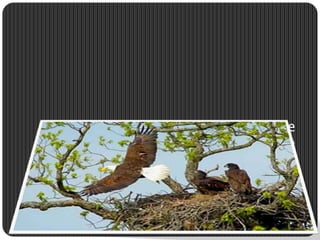
Eagle builds her nest far above the 
tops of the trees in the cliffs, where 
no man or animal can reach her 
young. When they are ready to learn 
fly push them from the edge of the 
rocks to make them fly as Struggle is 
the strength
Hive 
Sprit 
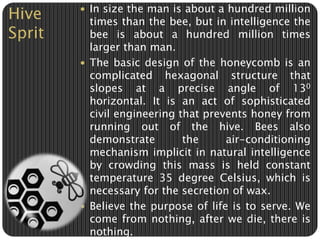
 In size the man is about a hundred million 
times than the bee, but in intelligence the 
bee is about a hundred million times 
larger than man. 
 The basic design of the honeycomb is an 
complicated hexagonal structure that 
slopes at a precise angle of 130 
horizontal. It is an act of sophisticated 
civil engineering that prevents honey from 
running out of the hive. Bees also 
demonstrate the air-conditioning 
mechanism implicit in natural intelligence 
by crowding this mass is held constant 
temperature 35 degree Celsius, which is 
necessary for the secretion of wax. 
 Believe the purpose of life is to serve. We 
come from nothing, after we die, there is 
nothing.
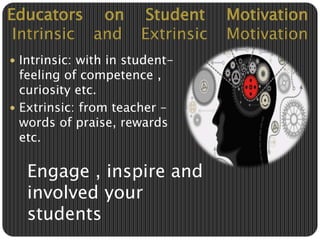
Educators on Student Motivation 
Intrinsic and Extrinsic Motivation 
 Intrinsic: with in student-feeling 
of competence , 
curiosity etc. 
 Extrinsic: from teacher – 
words of praise, rewards 
etc. 
Engage , inspire and 
involved your 
students
Can we make class smart? Potential 
Are we making class smart? Duty 
Have we made class l smart? Performance 
Could we make class smart? Commitment 
 First makes student smart 
 then can be class smart 
 Every generation needs a new introduction to 
a discipline. Pupils come with diverse 
experiences and expectations 
 The greatest sign of teacher’s success – the 
students are working even he/she is not 
inside the class. 
24 9/0191-/121-0210414
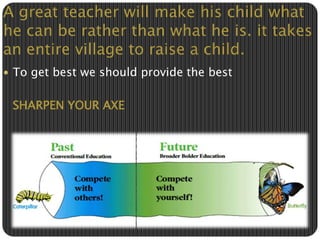
A great teacher will make his child what 
he can be rather than what he is. it takes 
an entire village to raise a child. 
 To get best we should provide the best 
SHARPEN YOUR AXE
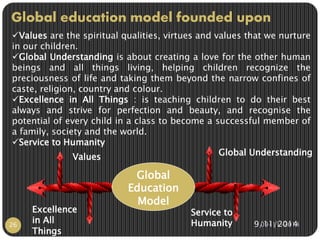
Global education model founded upon 
Values are the spiritual qualities, virtues and values that we nurture 
in our children. 
Global Understanding is about creating a love for the other human 
beings and all things living, helping children recognize the 
preciousness of life and taking them beyond the narrow confines of 
caste, religion, country and colour. 
Excellence in All Things : is teaching children to do their best 
always and strive for perfection and beauty, and recognise the 
potential of every child in a class to become a successful member of 
a family, society and the world. 
Service to Humanity 
Global Understanding 
Global 
Education 
Model 
Values 
Excellence 
in All 
Things 
Service to 
Humanity 
26 9/0191-1/12-0201144
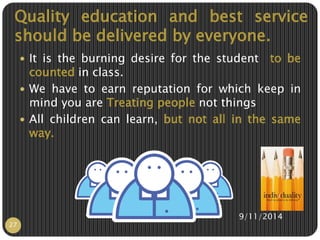
Quality education and best service 
should be delivered by everyone. 
 It is the burning desire for the student to be 
counted in class. 
 We have to earn reputation for which keep in 
mind you are Treating people not things 
 All children can learn, but not all in the same 
way. 
9/11/2014 
27
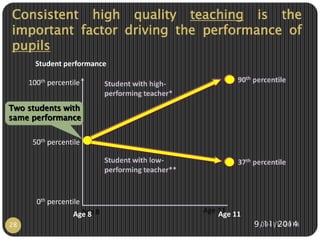
Consistent high quality teaching is the 
important factor driving the performance of 
pupils 
Student performance 
Student with low-performing 
teacher** 
37th percentile 
Student with high-performing 
teacher* 
90th percentile 
100th percentile 
50th percentile 
0th percentile 
Age 8 Age 11 
Two students with 
same performance 
Age 8 Age 11 
28 9/0191-1/12-0201144
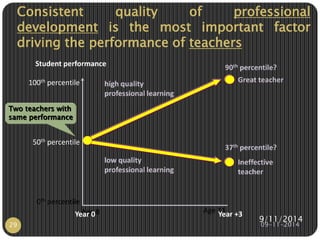
Consistent quality of professional 
development is the most important factor 
driving the performance of teachers 
Student performance 
low quality 
professional learning 
90th percentile? 
37th percentile? 
Ineffective 
teacher 
high quality 
professional learning 
Great teacher 
100th percentile 
50th percentile 
0th percentile 
Age 8 Age 11 
Two teachers with 
same performance 
Year 0 Year +3 
9/11/2014 
29 09-11-2014
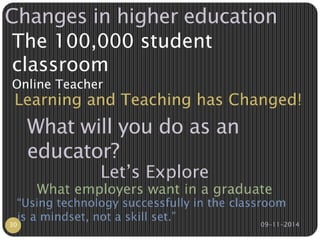
Changes in higher education 
The 100,000 student 
classroom 
Online Teacher 
Learning and Teaching has Changed! 
What will you do as an 
educator? 
Let’s Explore 
What employers want in a graduate 
“Using technology successfully in the classroom 
is a mindset, not a skill set.” 
30 09-11-2014
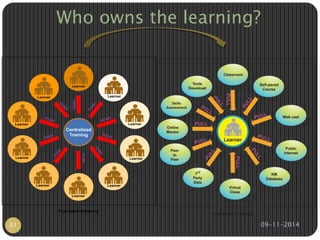
Who owns the learning? 
31 09-11-2014
32 09-11-2014
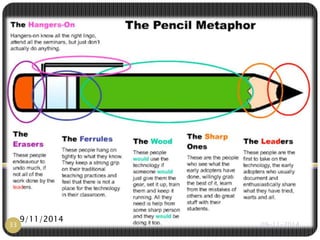
Which type of teacher will you be? 
9/11/2014 
33 09-11-2014
34 09-11-2014
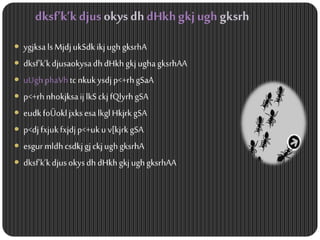
dksf’k’k djus okys dh dHkh gkj ugh gksrh 
 ygjksa ls Mjdj ukSdk ikj ugh gksrhA 
 dksf’k’k djusaokysa dh dHkh gkj ugha gksrhAA 
 uUgh phaVh tc nkuk ysdj p<+rh gSaA 
 p<+rh nhokjksa ij lkS ckj fQlyrh gSA 
 eudk foÜokl jxks esa lkgl Hkjrk gSA 
 p<dj fxjuk fxjdj p<+uk u v[kjrk gSA 
 esgur mldh csdkj gj ckj ugh gksrhA 
 dksf’k’k djus okys dh dHkh gkj ugh gksrhAA
• Mqcfd;ka fla/kqesa xksrk[kksj yxrk gSaA 
• Tkk tk dj [kkyhgkFk ykSV vkrk gSA 
• feyrs u lgt gh eksrh xgjsa ikuh esaA 
• c<+rk nwuk foÜokl bl gSjkuh esaA 
• eqðh mldh [kkyh gjckj ugh gksrh] 
• dksf’k’k djuaasokys dh dHkhgkj ugha gksrhAA 
• vlQyrk ,d pqukSrh gSa fLodkj djksA 
• D;k deh jg x;h ns[kks vkSj lq/kkj djksA 
• tc rd u lQy gks uhan pSu dh R;kxks rqeA 
• la?k"kksaZdk eSnku NksM er Hkkxksa rqeA 
• dqN fd;s fcuk gh t;t;dkj ugh gksrhA 
• dksf’k’k djusaokys dh dHkh gkj ugh gksrhAA
Join me on: www.linkedin.com and 
www.facebook.com 
Visit: www.subhashjain.com 
email your feedback : 
subhashedu@yahoo.co.in 
37 09-11-2014

21 st century Classroom management

  • 1.
    21 st Century Classroom Management Today’s teachers, belong to the most promising generation in the history of the world. 1 09-11-2014
  • 2.
    Are you readyto take a unique trip to the shores of success tides of 21st Century classroom? 2 09-11-2014
  • 3.
    The reality of21 st century classroom life  Students may be late for class, leave early, talk inappropriately, or sleep during class.  Recently faculty have reported more threatening behaviours, physical or verbal attacks.  All faculties are confronted with students who engage in behaviours that are disruptive to the educational process.  Teachers unable to control mobile phone in class: check mobile phones, uniform, shoes, tie, belt and hair style  Teachers are not taking job seriously 3 09-11-2014
  • 4.
  • 5.
    Why students aremisbehaving?  Could this misbehaviour be a result of inappropriate curriculum or teaching strategies?  Could this misbehaviour be a result of the student's inability to understand the concepts being taught?  If teachers do not have the ability to convey their knowledge and passion to pupils, their academic brilliance is not going to 5 do pupils any good09.-’11-2014
  • 7.
    An idea whosetime has come  The art of teaching rapidly becoming the science of teaching  30 years ago teaching had not been studied in systematically in scientific manner.  It doesn’t mean the teaching was not effective or taught in systematic manner.  Teachers can, and do, change lives. They can light candles in the darkest mind. 7 09-11-2014
  • 8.
    No teacher isperfect. We all make mistakes  There is and there can be no teaching where the attention of the scholar is not secured. The teacher who fails to get the attention of his scholars, fails totally  Willingness of the teacher to accept responsibility for classroom control  Insight - teacher spends time with problem students individually, getting to know them personally, attempting to instruct and inform them  Do not hit or hurt others. Be polite and helpful. Good classroom management results in the students can learn and the teacher can teach 8 09-11-2014
  • 9.
    Teachers boil atdifferent degrees and students melt at different temperatures  Once you realize that your students will like you more when you are tough and fair with them, you'll be on the right track.  They want to bring the best out in their students. TOUGH TIMES NEVER LAST, TOUGH PEOPLE DO 9 9/11/2014 09-11-2014
  • 10.
    Only knows the language of Business A philosopher proud of his knowledge hired an illiterate to ferry him across a wide river; While crossing the turbulent river, the philosopher, unable to restrain his tongue, constantly lectured to the boatman about the nature of existence. ‘Have you never studied grammar?’ asked the philosopher. ‘No,’ said the boatman. In that case, half your life has been wasted. The boatman said nothing.  Soon a terrible storm blew up. The boat was tosses about by the wind. ‘Have you ever learned to swim? Asked the boatman. ‘No,’ said the philosopher. ‘In that case, sir, all your life is lost, because the boat is sinking.’
  • 11.
    All the greatmen throughout history, had one main thing in common. They failed, and they failed often. 3 reasons why failure is the key to success 1. Success Lies in Seeing Failure as a Tool: Success is about learning how to recognize why you failed, and how you’re going to compensate for it. Remember, failure is an opportunity, not a burden. 2. Failure Builds Character: If you look at the events leading up to any significant victory, you’ll often discover failure as the biggest motivator. So what do you need to consistently test yourself and learn from failed attempts? While each success will propel you by a small amount, failure will build your career – and your personality . 3. Failure is a Function of Trying: The best way to measure your progress at something is the number of setbacks and “failures” you’ve had. Failure is the blacksmith’s hammer that tempers the sword of success. “Failure is the opportunity to begin again, more intelligently.”
  • 12.
     What weare today is a result of our earlier environment 5, 10, 20 years ago and today’s environment will decide what you will be 20 years from now. key to the carpenter
  • 13.
    Time for arethink! Reimaging and Restructure. And to introducing something new. What can I do to keep them going? How can I help my students to get started “A teacher who is attempting to teach without inspiring the pupil with a desire to learn is hammering cold iron.”
  • 14.
    BE YOURSELF keepdistance  There is something you can do better than other, remember ordinary and extraordinary is “that little extra.”  Physical position: ability to see all students  Teacher movement: move around the room  Group focus: keep students involve 14 09-11-2014
  • 15.
    Uncertainty Exposure touncertainty PLUGGED IN A man jumps from a sixty story scraps. There would be no uncertainty if the man were to jump off the building without a parachute, his chance of survival would be zero. However If the man were to jump with a parachute, then there would be some degree of uncertainty about whether the man would live or die. The jumper faces risk because he is personally exposed to the uncertainty of the parachute failing to open. Suppose you are watching this event as a bystander from the pavement below this tall building. Are you facing any risk even if there is uncertainty in this event? The answer is No. because you are not personally exposed- unless the jumper is your relative, or has borrowed money from you, or you have a coffee shop on the pavement where he may crash land.
  • 16.
    A CLASSROOM JOURNEYIN THREE STAGES Achieving excellence Sustaining excellence Sharing excellence 16 09-11-2014
  • 17.
    Unless we changedirection, we are unlikely to achieve the best possible outcome from education BUILD UP Classroom management has been cited as one of the most serious obstacles in promoting effective teaching. 17 09-11-2014
  • 18.
    ACHIEVING EXCELLENCE •Having vision, values and high expectations • Attracting, Assuring the quality of teaching and developing students • Establishing disciplined learning and Providing a relevant and attractive curriculum • Assessment, case study and target-setting • Taking each students as 9/11/2014 individual achievement 18 09-11-2014
  • 19.
    Principles of the Eagle Eagles fly alone at high altitude with eagles only. No other bird can go to the height of the eagle. Eagles have strong vision, the ability to focus on something up to five kilometers away. No matter what the obstacle, the eagle will not move his focus from the prey until he grabs it. Eagles do not eat dead things. They feed only on fresh prey. Clear of outdated and old information. Eagles love the storm. When clouds gather, the eagles get excited. The eagle uses the storm's winds to lift it higher. This gives the eagle an opportunity to glide and rest its wings.
  • 20.
    commitment When afemale eagle meets a male and they want to mate, she flies down to earth with the male and picks a twig. She flies back into the air with the male pursuing her. At height high enough, fall the twig to the ground and watches it as it falls. The male chases after the twig. He has to catch it before it falls to the ground. This goes on for hours, with the height increasing until the female eagle is assured that the male eagle has mastered the art of catching the twig which shows commitment.
  • 21.
    Eagle builds hernest far above the tops of the trees in the cliffs, where no man or animal can reach her young. When they are ready to learn fly push them from the edge of the rocks to make them fly as Struggle is the strength
  • 22.
    Hive Sprit In size the man is about a hundred million times than the bee, but in intelligence the bee is about a hundred million times larger than man.  The basic design of the honeycomb is an complicated hexagonal structure that slopes at a precise angle of 130 horizontal. It is an act of sophisticated civil engineering that prevents honey from running out of the hive. Bees also demonstrate the air-conditioning mechanism implicit in natural intelligence by crowding this mass is held constant temperature 35 degree Celsius, which is necessary for the secretion of wax.  Believe the purpose of life is to serve. We come from nothing, after we die, there is nothing.
  • 23.
    Educators on StudentMotivation Intrinsic and Extrinsic Motivation  Intrinsic: with in student-feeling of competence , curiosity etc.  Extrinsic: from teacher – words of praise, rewards etc. Engage , inspire and involved your students
  • 24.
    Can we makeclass smart? Potential Are we making class smart? Duty Have we made class l smart? Performance Could we make class smart? Commitment  First makes student smart  then can be class smart  Every generation needs a new introduction to a discipline. Pupils come with diverse experiences and expectations  The greatest sign of teacher’s success – the students are working even he/she is not inside the class. 24 9/0191-/121-0210414
  • 25.
    A great teacherwill make his child what he can be rather than what he is. it takes an entire village to raise a child.  To get best we should provide the best SHARPEN YOUR AXE
  • 26.
    Global education modelfounded upon Values are the spiritual qualities, virtues and values that we nurture in our children. Global Understanding is about creating a love for the other human beings and all things living, helping children recognize the preciousness of life and taking them beyond the narrow confines of caste, religion, country and colour. Excellence in All Things : is teaching children to do their best always and strive for perfection and beauty, and recognise the potential of every child in a class to become a successful member of a family, society and the world. Service to Humanity Global Understanding Global Education Model Values Excellence in All Things Service to Humanity 26 9/0191-1/12-0201144
  • 27.
    Quality education andbest service should be delivered by everyone.  It is the burning desire for the student to be counted in class.  We have to earn reputation for which keep in mind you are Treating people not things  All children can learn, but not all in the same way. 9/11/2014 27
  • 28.
    Consistent high qualityteaching is the important factor driving the performance of pupils Student performance Student with low-performing teacher** 37th percentile Student with high-performing teacher* 90th percentile 100th percentile 50th percentile 0th percentile Age 8 Age 11 Two students with same performance Age 8 Age 11 28 9/0191-1/12-0201144
  • 29.
    Consistent quality ofprofessional development is the most important factor driving the performance of teachers Student performance low quality professional learning 90th percentile? 37th percentile? Ineffective teacher high quality professional learning Great teacher 100th percentile 50th percentile 0th percentile Age 8 Age 11 Two teachers with same performance Year 0 Year +3 9/11/2014 29 09-11-2014
  • 30.
    Changes in highereducation The 100,000 student classroom Online Teacher Learning and Teaching has Changed! What will you do as an educator? Let’s Explore What employers want in a graduate “Using technology successfully in the classroom is a mindset, not a skill set.” 30 09-11-2014
  • 31.
    Who owns thelearning? 31 09-11-2014
  • 32.
  • 33.
    Which type ofteacher will you be? 9/11/2014 33 09-11-2014
  • 34.
  • 35.
    dksf’k’k djus okysdh dHkh gkj ugh gksrh  ygjksa ls Mjdj ukSdk ikj ugh gksrhA  dksf’k’k djusaokysa dh dHkh gkj ugha gksrhAA  uUgh phaVh tc nkuk ysdj p<+rh gSaA  p<+rh nhokjksa ij lkS ckj fQlyrh gSA  eudk foÜokl jxks esa lkgl Hkjrk gSA  p<dj fxjuk fxjdj p<+uk u v[kjrk gSA  esgur mldh csdkj gj ckj ugh gksrhA  dksf’k’k djus okys dh dHkh gkj ugh gksrhAA
  • 36.
    • Mqcfd;ka fla/kqesaxksrk[kksj yxrk gSaA • Tkk tk dj [kkyhgkFk ykSV vkrk gSA • feyrs u lgt gh eksrh xgjsa ikuh esaA • c<+rk nwuk foÜokl bl gSjkuh esaA • eqðh mldh [kkyh gjckj ugh gksrh] • dksf’k’k djuaasokys dh dHkhgkj ugha gksrhAA • vlQyrk ,d pqukSrh gSa fLodkj djksA • D;k deh jg x;h ns[kks vkSj lq/kkj djksA • tc rd u lQy gks uhan pSu dh R;kxks rqeA • la?k"kksaZdk eSnku NksM er Hkkxksa rqeA • dqN fd;s fcuk gh t;t;dkj ugh gksrhA • dksf’k’k djusaokys dh dHkh gkj ugh gksrhAA
  • 37.
    Join me on:www.linkedin.com and www.facebook.com Visit: www.subhashjain.com email your feedback : subhashedu@yahoo.co.in 37 09-11-2014

Editor's Notes