Impactful
Management
Strategies
for the Modern Classroom
Team A:
Ian Glasmann,
Kristin McDonald,
Bryan Etheridge,
Lucilla Chapoy-Mancilla
Student-Centered
Classroom Management Theory
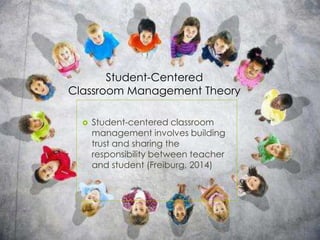
 Student-centered classroom
management involves building
trust and sharing the
responsibility between teacher
and student (Freiburg, 2014)
 Teachers caring for
a student’s social
and emotional
needs
 Making sure all
students feel a
bond with their
school, classroom
and peers
 Students feel safe
in their school and
classroom while
trusting their
teacher and peers
 Students learn
discipline by being
responsible for their
own actions and
share respect and
responsibility with
others
Student-Centered
Classroom
Management
Theory
Consistency Management
and Cooperative Discipline
Student-Centered Classroom
Management Theory
 Classroom management strategies:
 Provide a flexible but predictable and consistent learning
environment
 List homework, lesson objectives and the daily schedule on the
board for all students to see
 Ask every student questions by pulling names randomly
 Engage every student in active participation
 Share the responsibility and roles of the classroom with the
students
 assign jobs and have them create the rules/procedures
 Teach students how to solve or prevent problems
 Give students the trust of doing things on their own and the trust
will be reciprocated
(Freiburg & Lamb, 2009)
Environmental Modifications to
Increase Student Learning
 Classroom structure
 Create areas in the room that are designated for certain tasks
 Reduce distractions
 Assign areas on the floor, desks or supply areas for each student
 Rules and routines
 Visually represent rules and routines
 Use cue words like first and then when establishing a new
routine
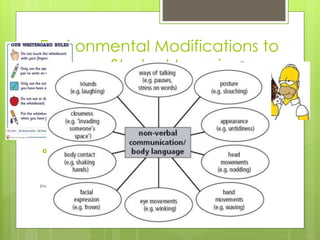
 Communication
 Use visuals or symbols to communicate objects or tasks
 Utilize nonverbal cues
 Simplify language
(Howley & Rose, 2006)
Classroom Management
Compared to Discipline
Management
Classroom
Management
 For students with special
learning needs, a classroom
management plan should
address those special needs by
considering
 The classroom arrangement
 A welcoming environment for all
students
 Engaging all students in class
discussion
 Consider learning styles and
learning needs when establishing
any classroom procedures
 Built in lesson strategies that
address specific learning needs
(Kirkpatrick, n.d.)
Discipline
Management
 For students with special learning needs, a
discipline management plan should
address those special needs by
considering
 In accordance with the Individuals
with Disabilities Education Act (IDEA)
2004 any student may be disciplined
using the student code of conduct
 Students with an IEP may have
discipline measures spelled out and
that all school employees must follow
 When making a determination about
discipline, IDEA gives school
employees the rights to make a case-
by-case determination of discipline
with students that have a disability
(GreatSchools Staff, n.d.)
CHOICE THEORY
 Behavior of children is related to five basic
needs; survival, love and belonging,
power and significance, freedom and
autonomy, and fun. (Incredible Art
Department, 2008)
.
STRATEGIES
 Build positive relationships with students.
 Give students opportunities to choose projects
and to feel power and control by giving them
choices. (Sullo, 2011)
 Focus on quality of work and their ability to use
what they have learned.
 Shows students how to satisfy their needs using
more appropriate and effective methods to
decrease undesirable behaviors (Sullo, 2011)
 Self-Evaluation; students will take ownership of their
learning.
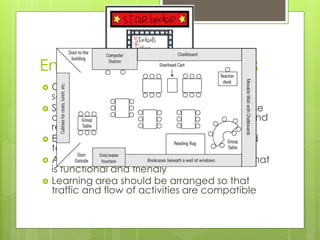
Environmental Modifications
 Organize resources to maximize
student's sense of control and minimize
chaos
 Small group activities- Gives students a
sense of belonging, motivates student
learning, and reduces reliance on
teacher.
 Establish clear work spaces for students
and teachers
 Analyze student needs to design a
space that is functional and friendly
 Learning area should be arranged so
that traffic and flow of activities are
compatible
For Exceptional Learners
Class
management
 Stress student
responsibility
 Setting routines to
structure students
 Posting classroom rules
and consequences
 Arrangement of
furniture to facilitate
orderly rotation of tasks
Discipline
Management
 Invoke reasonable
consequences
 Establishing and
enforcing
consequences for
ignoring rules or routines
 Individuals with
exceptional needs have
opportunities to choose
disciplinary
consequences
Kohn’s Student Directed
Learning
Classroom management strategies
 Create a positive learning environment.
 Create a caring community where students
collaboratively work together to solve problems.
(Kohn, n.d)
 Active participation, high interest activities, and
discovery.
 Rewards are unnecessary
 Provide opportunities for students to help students
 Demonstrate patience as student discovers their
learning style and strengths
Environmental Modification
that Contributes to Student
Learning
 Install a love for learning
 Provide hands on activities that reflect life
experiences
 Create an environment which allows for
student opinion and choice
Class management vs
Discipline Management
Class Management
 Classroom centered on
students, not teacher.
 Be patient with
students, allow them to
make their own
decisions and learn
from them.
 Settling for Self-
Discipline
Discipline
Management
 Discipline creates
problems; implies
student is at fault
 Evaluate what is being
asked of students and
can they perform such
task
 Find ways to help
students stay on task
instead of punishment
when off task
Positive Behavior Support (PBS)
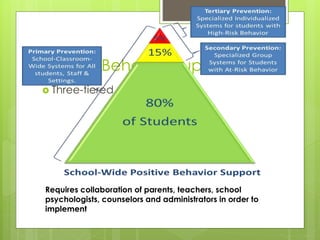
 Three-tiered approach
Requires collaboration of parents, teachers, school psychologists, counselors and
administrators in order to implement
Benefits
 All students can benefit
 Appropriate implementation can lead to
dramatic improvements that have long-
term effects on student lifestyle
 Its use decreases the need for more
intrusive and aversive interventions
Classroom
Strategies Explicit strategic
instruction
 Active student
engagement
 Provide opportunities for
students to make choices
and honor their choice
 Increase predictability
and scheduling
 Keep schedules posted
outlining times and
activities
 Prepare students for
changes - explain how
these will affect their day
Environmental Modifications
 Redesign classroom
environment
 Create clearly defined
work spaces
 Reduce distractions
 Room arrangement
 Manage traffic patterns
 Increase predictability
 Create daily routines so
that students always
know what to do and
what to expect
For Exceptional Learners
Classroom
Management
 Make curricular
adaptations for
activities/tasks, length or
pace and difficulty level
 Plan for preferred
activities to occur
consistently and
predictably
 Self-monitoring
 Teach appropriate
behaviors
Classroom Discipline
 Continual teaching
and reinforcement
of positive
behavior will
support student’s
positive behaviors
and reduce
behavior problems
References
 Classroom management. (2014). In S. Abbott (Ed.), The glossary of education reform. Retrieved
from http://edglossary.org/classroom-management/
 Freiberg, H. (2014). Rogers, carl: freedom to learn. In D. Phillips (Ed.), Encyclopedia of
educational theory and philosophy. (pp. 719-721). Thousand Oaks,, CA: SAGE Publications, Inc.
doi: http://dx.doi.org.contentproxy.phoenix.edu/10.4135/9781483346229.n291
 Freiberg, H. J., & Lamb, S. M. (2009). Dimensions of Person-Centered Classroom Management.
Theory Into Practice, 48(2), 99-105. doi:10.1080/00405840902776228
 GreatSchools Staff. (n.d.). IDEA 2004 close up: Disciplining students with disabilities. Retrieved
from http://www.greatschools.org/gk/articles/idea-2004-close-up-disciplining-students- with-
disabilities/
 Howley, M., & Rose, R. (2006). Practical Guide to Special Educational Needs in Inclusive
Primary Classrooms. London, GBR: SAGE Publications Inc. (US). Retrieved from
http://www.ebrary.com
 Kirkpatrick, S. (n.d.). Classroom management: 7 tips from an experience teacher. Retrieved
from http://www.specialeducationguide.com/pre-k-12/behavior-and-classroom-
management/classroom-management-7-tips-from-an-experienced-teacher/
 Kohn, A. (n.d). Alfie Kohn. Retrieved from http://www.alfiekohn.org/
articles_subject.htm#null
 Incredible Art Department. (2008). Classroom Discipline. Retrieved from
http://www.incredibleart.org
 Sullo, B. (2011, July 23). Choice Theory. Retrieved from http://www.funderstanding.com
 http://digitalcommons.calpoly.edu/cgi/viewcontent.cgi?article=1032&context=gse_fac
 http://www.pbisworld.com/
 http://www.edutopia.org/classroom-management-relationships-strategies-tips

Classroom management theory presentation.notes.pptx.pdf

  • 1.
    Impactful Management Strategies for the ModernClassroom Team A: Ian Glasmann, Kristin McDonald, Bryan Etheridge, Lucilla Chapoy-Mancilla
  • 2.
    Student-Centered Classroom Management Theory Student-centered classroom management involves building trust and sharing the responsibility between teacher and student (Freiburg, 2014)
  • 3.
     Teachers caringfor a student’s social and emotional needs  Making sure all students feel a bond with their school, classroom and peers  Students feel safe in their school and classroom while trusting their teacher and peers  Students learn discipline by being responsible for their own actions and share respect and responsibility with others Student-Centered Classroom Management Theory Consistency Management and Cooperative Discipline
  • 4.
    Student-Centered Classroom Management Theory Classroom management strategies:  Provide a flexible but predictable and consistent learning environment  List homework, lesson objectives and the daily schedule on the board for all students to see  Ask every student questions by pulling names randomly  Engage every student in active participation  Share the responsibility and roles of the classroom with the students  assign jobs and have them create the rules/procedures  Teach students how to solve or prevent problems  Give students the trust of doing things on their own and the trust will be reciprocated (Freiburg & Lamb, 2009)
  • 5.
    Environmental Modifications to IncreaseStudent Learning  Classroom structure  Create areas in the room that are designated for certain tasks  Reduce distractions  Assign areas on the floor, desks or supply areas for each student  Rules and routines  Visually represent rules and routines  Use cue words like first and then when establishing a new routine  Communication  Use visuals or symbols to communicate objects or tasks  Utilize nonverbal cues  Simplify language (Howley & Rose, 2006)
  • 7.
    Classroom Management Compared toDiscipline Management Classroom Management  For students with special learning needs, a classroom management plan should address those special needs by considering  The classroom arrangement  A welcoming environment for all students  Engaging all students in class discussion  Consider learning styles and learning needs when establishing any classroom procedures  Built in lesson strategies that address specific learning needs (Kirkpatrick, n.d.) Discipline Management  For students with special learning needs, a discipline management plan should address those special needs by considering  In accordance with the Individuals with Disabilities Education Act (IDEA) 2004 any student may be disciplined using the student code of conduct  Students with an IEP may have discipline measures spelled out and that all school employees must follow  When making a determination about discipline, IDEA gives school employees the rights to make a case- by-case determination of discipline with students that have a disability (GreatSchools Staff, n.d.)
  • 8.
    CHOICE THEORY  Behaviorof children is related to five basic needs; survival, love and belonging, power and significance, freedom and autonomy, and fun. (Incredible Art Department, 2008) .
  • 9.
    STRATEGIES  Build positiverelationships with students.  Give students opportunities to choose projects and to feel power and control by giving them choices. (Sullo, 2011)  Focus on quality of work and their ability to use what they have learned.  Shows students how to satisfy their needs using more appropriate and effective methods to decrease undesirable behaviors (Sullo, 2011)  Self-Evaluation; students will take ownership of their learning.
  • 10.
    Environmental Modifications  Organizeresources to maximize student's sense of control and minimize chaos  Small group activities- Gives students a sense of belonging, motivates student learning, and reduces reliance on teacher.  Establish clear work spaces for students and teachers  Analyze student needs to design a space that is functional and friendly  Learning area should be arranged so that traffic and flow of activities are compatible
  • 11.
    For Exceptional Learners Class management Stress student responsibility  Setting routines to structure students  Posting classroom rules and consequences  Arrangement of furniture to facilitate orderly rotation of tasks Discipline Management  Invoke reasonable consequences  Establishing and enforcing consequences for ignoring rules or routines  Individuals with exceptional needs have opportunities to choose disciplinary consequences
  • 12.
    Kohn’s Student Directed Learning Classroommanagement strategies  Create a positive learning environment.  Create a caring community where students collaboratively work together to solve problems. (Kohn, n.d)  Active participation, high interest activities, and discovery.  Rewards are unnecessary  Provide opportunities for students to help students  Demonstrate patience as student discovers their learning style and strengths
  • 13.
    Environmental Modification that Contributesto Student Learning  Install a love for learning  Provide hands on activities that reflect life experiences  Create an environment which allows for student opinion and choice
  • 14.
    Class management vs DisciplineManagement Class Management  Classroom centered on students, not teacher.  Be patient with students, allow them to make their own decisions and learn from them.  Settling for Self- Discipline Discipline Management  Discipline creates problems; implies student is at fault  Evaluate what is being asked of students and can they perform such task  Find ways to help students stay on task instead of punishment when off task
  • 15.
    Positive Behavior Support(PBS)  Three-tiered approach Requires collaboration of parents, teachers, school psychologists, counselors and administrators in order to implement
  • 16.
    Benefits  All studentscan benefit  Appropriate implementation can lead to dramatic improvements that have long- term effects on student lifestyle  Its use decreases the need for more intrusive and aversive interventions
  • 17.
    Classroom Strategies Explicit strategic instruction Active student engagement  Provide opportunities for students to make choices and honor their choice  Increase predictability and scheduling  Keep schedules posted outlining times and activities  Prepare students for changes - explain how these will affect their day
  • 18.
    Environmental Modifications  Redesignclassroom environment  Create clearly defined work spaces  Reduce distractions  Room arrangement  Manage traffic patterns  Increase predictability  Create daily routines so that students always know what to do and what to expect
  • 19.
    For Exceptional Learners Classroom Management Make curricular adaptations for activities/tasks, length or pace and difficulty level  Plan for preferred activities to occur consistently and predictably  Self-monitoring  Teach appropriate behaviors Classroom Discipline  Continual teaching and reinforcement of positive behavior will support student’s positive behaviors and reduce behavior problems
  • 20.
    References  Classroom management.(2014). In S. Abbott (Ed.), The glossary of education reform. Retrieved from http://edglossary.org/classroom-management/  Freiberg, H. (2014). Rogers, carl: freedom to learn. In D. Phillips (Ed.), Encyclopedia of educational theory and philosophy. (pp. 719-721). Thousand Oaks,, CA: SAGE Publications, Inc. doi: http://dx.doi.org.contentproxy.phoenix.edu/10.4135/9781483346229.n291  Freiberg, H. J., & Lamb, S. M. (2009). Dimensions of Person-Centered Classroom Management. Theory Into Practice, 48(2), 99-105. doi:10.1080/00405840902776228  GreatSchools Staff. (n.d.). IDEA 2004 close up: Disciplining students with disabilities. Retrieved from http://www.greatschools.org/gk/articles/idea-2004-close-up-disciplining-students- with- disabilities/  Howley, M., & Rose, R. (2006). Practical Guide to Special Educational Needs in Inclusive Primary Classrooms. London, GBR: SAGE Publications Inc. (US). Retrieved from http://www.ebrary.com  Kirkpatrick, S. (n.d.). Classroom management: 7 tips from an experience teacher. Retrieved from http://www.specialeducationguide.com/pre-k-12/behavior-and-classroom- management/classroom-management-7-tips-from-an-experienced-teacher/  Kohn, A. (n.d). Alfie Kohn. Retrieved from http://www.alfiekohn.org/ articles_subject.htm#null  Incredible Art Department. (2008). Classroom Discipline. Retrieved from http://www.incredibleart.org  Sullo, B. (2011, July 23). Choice Theory. Retrieved from http://www.funderstanding.com  http://digitalcommons.calpoly.edu/cgi/viewcontent.cgi?article=1032&context=gse_fac  http://www.pbisworld.com/  http://www.edutopia.org/classroom-management-relationships-strategies-tips

Editor's Notes

  • #3 Developed in 1950s by Carl Rogers Adjusted in 1960s, with help of Freiburg, to be used in education field Solutions rest within the individual student Contrasted traditional behavior theories
  • #4 Rogers worked with Jerome Freiburg to establish a comprehensive approach to classroom management.
  • #9 Belief that students can control their own behaviors. Teachers responsibility is to help develop this ability and personal responsibility. This is done through curriculum that is related to real world concepts.
  • #11 Student notebooks, or folders, that allow students to keep themselves ordered
  • #16 Reward positive behavior Eliminate negative behaviors and replace them with prosocial skills Environment plays a major role Teachers use functional behavior assessment (FBA) to reveal antecedents, consequences, and frequency of challenging behavior.
  • #19 Traffic patterns are a major influence, especially during passing periods.