SALAM ALAIKUM!
24Novamber 2016
Professional Development Training
Day 1 Agenda
9:30-9:45 Celebration Warm-Up
Getting to know one another - icebreaker
9:45-10:30 Session 1: Introduction to the Classroom Management
Scale
10:30-10:45 Why is CRM important ?
10:45-11:00 Session 2: Successful CRM principles
11:00-11:15 5 Steps and dealing with Misbehaviour
11:15-11:55 classroom management scenarios workshops
11:55 – 12:25 : Break
12:25 -1:25 complete scenarios workshops
1:25 -1:40 feedback
1:40 -2:05 : Exit ticket and closure
Today’s Agenda
Getting to know one another - icebreaker
Materials
Workshop Objectives
Introduction to CRM
Successful CRM principles
 5 Steps and dealing with misbehaviour
 classroom management scenarios workshops
Getting to Know One Another
Ice Breaker
Introductions
 Name
 Current position in the school?
 Why do you wish to be a teacher ?
 What do you hope to learn or want me to cover during next
training session s?
Workshop Objectives
Workshop Objectives
Identify knowledge and skills needed to be effective
educator
Explore factors associated with effective student discipline
Determine factors associated with creating a climate
(culture) conducive to learning
Examine how to work effectively with teachers, parents and
students
Classroom
Management
Let’s watch this video , then
answer the question :
what is the deference
between effective CRM and
ineffective CRM?
https://www.youtube.com/wa
tch?v=tW0wPYEloF8
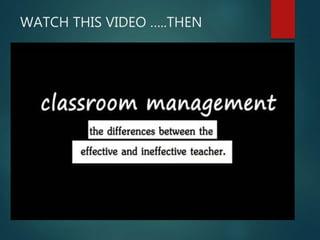
WATCH THIS VIDEO …..THEN
What is Classroom Management?
 It’s effective discipline
 It’s being prepared for class
 It’s motivating your students
 It’s providing a safe, comfortable learning environment
 It’s building your students’ self esteem
 It’s being creative and imaginative in daily lessons
 And . . .
. . . It’s different for EVERYONE!!
WHY?
 Teaching Styles
 Personality/Attitudes
 Student population
 Not all management strategies are effective for every
teacher
 Try different strategies to see if they work for you
Why is Classroom Management
Important?
Satisfaction and enjoyment in
teaching are dependent upon
leading students to cooperate
Classroom management
issues are of highest concern
for beginning teachers
Principles for successful
classroom management
 Deal with disruptive behaviors but also
manage to minimize off-task, non-
disruptive behaviors
 Teach students to manage their own
behavior
 Students learn to be on-task and
engaged in the learning activities you
have planned for them
 It is more natural to be off-task than on
Techniques for Better
Classroom Control
 Focus attention on entire class
 Don’t talk over student chatter
 Silence can be effective
 Use softer voice so students really have to listen to
what you’re saying
 Direct your instruction so that students know what is
going to happen
Techniques for Better
Classroom Control
 Monitor groups of students to check
progress
 Move around the room so students
have to pay attention more readily
 Give students non-verbal cues
 Engage in low profile intervention of
disruptions
 Make sure classroom is comfortable
and safe
Techniques for Better
Classroom Control
 Over plan your
lessons to ensure
you fill the period
with learning
activities
 Come to class
prepared
 Show confidence in
your teaching
 Learn student
names as quickly as
possible
Transition vs. Allocated Time
 Allocated time: the time periods you
intend for your students to be engaged
in learning activities
 Transition time: time periods that exist
between times allocated for learning
activities
 Examples
 Getting students assembled and attentive
 Assigning reading and directing to begin
 Getting students’ attention away from reading
and preparing for class discussion
Transition vs. Allocated Time
The Goal:
Increase the variety of learning
activities but decrease transition
time.
Student engagement and on-
task behaviors are dependent
on how smoothly and
efficiently teachers move from
one learning activity to
another
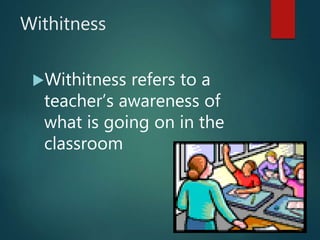
Withitness
Withitness refers to a
teacher’s awareness of
what is going on in the
classroom
A teacher has “withitness” if:
 When discipline problems occur, the
teacher consistently takes action to
suppress the misbehavior of exactly
those students who instigated the
problem
 When two discipline problems arise
concurrently, the teacher deals with the
most serious first
 The teacher decisively handles
instances of off-task behavior before
the behaviors either get out of hand or
are modeled by others
Withitness (continued)
 When handling misbehavior – make sure all students
learn what is unacceptable about that behavior
 Getting angry or stressed does not reduce future
misbehavior
 Deal with misbehavior without disrupting the learning
activity
What studies say about
off-task behaviors
 99% of off-task behaviors take one of several forms
 Talking out of turn
 Clowning
 Daydreaming
 Moving about without permission
 Antisocial, dangerous behaviors make up a fraction of
the time students spend off-task
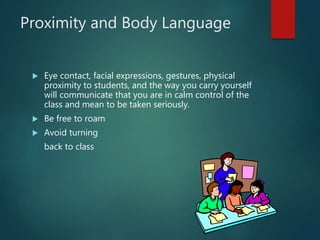
Proximity and Body Language
 Eye contact, facial expressions, gestures, physical
proximity to students, and the way you carry yourself
will communicate that you are in calm control of the
class and mean to be taken seriously.
 Be free to roam
 Avoid turning
back to class
Cooperation through
communication
 Verbalize descriptions of behaviors and
never value judgments about individuals
 Verbalize feelings but remain in control
 DO NOT USE SARCASM
 Do not place labels (good or bad)
 Do not get students hooked on praise
 Praise the work and behavior – not the
students themselves
 Speak only to people when they are ready
to listen
Classroom Rules For Conduct
 Formalized statements that provide
students with general guidelines for
the types of behaviors that are
required and the types that are
prohibited
 A few rules are easier to remember
than many rules
 Each rule in a small set of rules is more
important than each rule in a large set
of rules
Necessary classroom rules of
conduct
 Maximizes on-task behaviors and
minimize off-task (esp. disruptive)
behaviors
 Secures the safety and comfort of the
learning environment
 Prevents the activities of the class from
disturbing other classes
 Maintains acceptable standards of
decorum among students, school
personnel, and visitors to the school
campus
5 steps
1. Take advantage of the new school
year or term to set the stage for
cooperation
2. Be particularly prepared and
organized
3. Minimize transition time
4. Utilize a communication style that
establishing non-threatening,
comfortable environment
5. Clearly establish expectations for
conduct
Beginning a new year
 Take advantage of initial uncertainty
 Ride your “fences”
 PLAN for a favorable beginning
 Classroom/lab organization
 Ongoing routines
 Use learning activities with easy-to-follow,
uncomplicated directions
 Use a disclosure statement
Disclosure Statement
 Used to clearly communicate expectations to students
and parents
 Refer back to the guidelines throughout the term
 Not a legally binding document
Components of Disclosure
Statement
 Basic Course Outline
 Grading Procedures
 Include procedures for making up missed work,
extra credit, homework expected, etc.
 Attendance Policies (should be consistent with school
policy)
 Other class rules, policies, procedures
 Safety considerations as necessary
 Accommodation for disabilities statement
 Signature of student and parent/guardian
These are the templates we all use in our school
Summits American Internationals School
Room/lab arrangement
 Make sure all students can see and
hear clearly (and you can see them
clearly)
 Arrangement is determined by learning
activity (lecture, class discussion, small
group work, etc.)
 Allow room and easy access for
proximity control
 Think through class procedures and
learning activities and arrange the
room in the best possible way
Dealing with
misbehavior
WORKSHOPS
Functions of Behavior
 Every behavior has a function
 Four primary reasons for disruptive
behavior in the classroom
 Power
 Revenge
 Attention
 Want to be left alone (i.e., disinterest or
feelings of inadequacy)
Functions of Behavior
 Many misbehaviors exhibited by students
are responses to a behavior exhibited by
the teacher
 Do not tolerate undesirable behaviors no
matter what the excuse
 Understanding why a person exhibits a
behavior is no reason to tolerate it
 Understanding the function of a behavior
will help in knowing how to deal with that
behavior
Attention Seeking Behavior
 Attention-seeking students prefer being punished,
admonished, or criticized to being ignored
 Give attention to this student when he or she is on-
task and cooperating
 “Catch them being good!” – and let them know you
caught them
Power Seeking Behavior
 Power-seeking students attempt to provoke teachers
into a struggle of wills
 In most cases, the teacher should direct attention to
other members of the class
Workshop’s procedures and steps
1-Break into groups
2-In your group, talk about and
summarize the following on chart paper.
3-Use technique T.P.S
Student’s behavior
Rambling -- wandering around and off the subject.
Using far-fetched examples or analogies.
1-Direct questions to group that is back on the subject
2-Ask how topic relates to current topic being
discussed.
3-Use visual aids, begin to write on board, turn on
overhead projector.
4-Say: "Would you summarize your main point
please?" or "Are you asking...?"
Student’s behavior
Shyness or Silence -- lack of participation
1. Change teaching strategies from group
discussion to individual written exercises
or a videotape
2. Give strong positive reinforcement for any
contribution.
3. Involve by directly asking him/her a
question.
4. Make eye contact.
5. Appoint to be small group leader.
Student’s behavior
Talkativeness -- knowing everything,
manipulation, chronic whining.
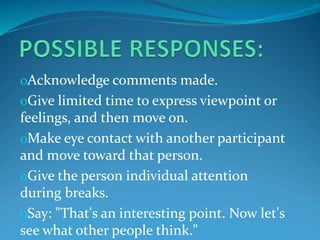
oAcknowledge comments made.
oGive limited time to express viewpoint or
feelings, and then move on.
oMake eye contact with another participant
and move toward that person.
oGive the person individual attention
during breaks.
oSay: "That's an interesting point. Now let's
see what other people think."
School Policies
HOW TO STAY OUT OF TROUBLE
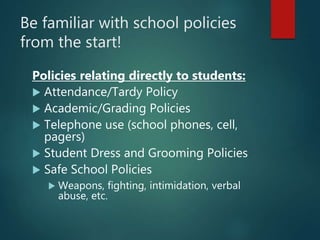
Be familiar with school policies
from the start!
Policies relating directly to students:
 Attendance/Tardy Policy
 Academic/Grading Policies
 Telephone use (school phones, cell,
pagers)
 Student Dress and Grooming Policies
 Safe School Policies
 Weapons, fighting, intimidation, verbal
abuse, etc.
EXIT TICKET
 Use a clean sheet of paper
 Write in English, please
 Don’t forget your name
 3 things you learned today
 2 things you still have
questions about
 1 thing you would still like to
know about the Classroom
Observation Scale
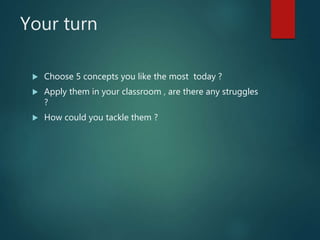
Your turn
 Choose 5 concepts you like the most today ?
 Apply them in your classroom , are there any struggles
?
 How could you tackle them ?
Thank you….fore your time

Classroom management 2016 2017

  • 1.
  • 2.
    Day 1 Agenda 9:30-9:45Celebration Warm-Up Getting to know one another - icebreaker 9:45-10:30 Session 1: Introduction to the Classroom Management Scale 10:30-10:45 Why is CRM important ? 10:45-11:00 Session 2: Successful CRM principles 11:00-11:15 5 Steps and dealing with Misbehaviour 11:15-11:55 classroom management scenarios workshops 11:55 – 12:25 : Break 12:25 -1:25 complete scenarios workshops 1:25 -1:40 feedback 1:40 -2:05 : Exit ticket and closure
  • 3.
    Today’s Agenda Getting toknow one another - icebreaker Materials Workshop Objectives Introduction to CRM Successful CRM principles
  • 4.
     5 Stepsand dealing with misbehaviour  classroom management scenarios workshops
  • 5.
    Getting to KnowOne Another Ice Breaker
  • 6.
    Introductions  Name  Currentposition in the school?  Why do you wish to be a teacher ?  What do you hope to learn or want me to cover during next training session s?
  • 7.
  • 8.
    Workshop Objectives Identify knowledgeand skills needed to be effective educator Explore factors associated with effective student discipline Determine factors associated with creating a climate (culture) conducive to learning Examine how to work effectively with teachers, parents and students
  • 9.
  • 10.
    Let’s watch thisvideo , then answer the question : what is the deference between effective CRM and ineffective CRM? https://www.youtube.com/wa tch?v=tW0wPYEloF8
  • 11.
  • 12.
    What is ClassroomManagement?  It’s effective discipline  It’s being prepared for class  It’s motivating your students  It’s providing a safe, comfortable learning environment  It’s building your students’ self esteem  It’s being creative and imaginative in daily lessons  And . . .
  • 13.
    . . .It’s different for EVERYONE!! WHY?  Teaching Styles  Personality/Attitudes  Student population  Not all management strategies are effective for every teacher  Try different strategies to see if they work for you
  • 14.
    Why is ClassroomManagement Important? Satisfaction and enjoyment in teaching are dependent upon leading students to cooperate Classroom management issues are of highest concern for beginning teachers
  • 15.
    Principles for successful classroommanagement  Deal with disruptive behaviors but also manage to minimize off-task, non- disruptive behaviors  Teach students to manage their own behavior  Students learn to be on-task and engaged in the learning activities you have planned for them  It is more natural to be off-task than on
  • 16.
    Techniques for Better ClassroomControl  Focus attention on entire class  Don’t talk over student chatter  Silence can be effective  Use softer voice so students really have to listen to what you’re saying  Direct your instruction so that students know what is going to happen
  • 17.
    Techniques for Better ClassroomControl  Monitor groups of students to check progress  Move around the room so students have to pay attention more readily  Give students non-verbal cues  Engage in low profile intervention of disruptions  Make sure classroom is comfortable and safe
  • 18.
    Techniques for Better ClassroomControl  Over plan your lessons to ensure you fill the period with learning activities  Come to class prepared  Show confidence in your teaching  Learn student names as quickly as possible
  • 19.
    Transition vs. AllocatedTime  Allocated time: the time periods you intend for your students to be engaged in learning activities  Transition time: time periods that exist between times allocated for learning activities  Examples  Getting students assembled and attentive  Assigning reading and directing to begin  Getting students’ attention away from reading and preparing for class discussion
  • 20.
    Transition vs. AllocatedTime The Goal: Increase the variety of learning activities but decrease transition time. Student engagement and on- task behaviors are dependent on how smoothly and efficiently teachers move from one learning activity to another
  • 21.
    Withitness Withitness refers toa teacher’s awareness of what is going on in the classroom
  • 22.
    A teacher has“withitness” if:  When discipline problems occur, the teacher consistently takes action to suppress the misbehavior of exactly those students who instigated the problem  When two discipline problems arise concurrently, the teacher deals with the most serious first  The teacher decisively handles instances of off-task behavior before the behaviors either get out of hand or are modeled by others
  • 23.
    Withitness (continued)  Whenhandling misbehavior – make sure all students learn what is unacceptable about that behavior  Getting angry or stressed does not reduce future misbehavior  Deal with misbehavior without disrupting the learning activity
  • 24.
    What studies sayabout off-task behaviors  99% of off-task behaviors take one of several forms  Talking out of turn  Clowning  Daydreaming  Moving about without permission  Antisocial, dangerous behaviors make up a fraction of the time students spend off-task
  • 25.
    Proximity and BodyLanguage  Eye contact, facial expressions, gestures, physical proximity to students, and the way you carry yourself will communicate that you are in calm control of the class and mean to be taken seriously.  Be free to roam  Avoid turning back to class
  • 26.
    Cooperation through communication  Verbalizedescriptions of behaviors and never value judgments about individuals  Verbalize feelings but remain in control  DO NOT USE SARCASM  Do not place labels (good or bad)  Do not get students hooked on praise  Praise the work and behavior – not the students themselves  Speak only to people when they are ready to listen
  • 27.
    Classroom Rules ForConduct  Formalized statements that provide students with general guidelines for the types of behaviors that are required and the types that are prohibited  A few rules are easier to remember than many rules  Each rule in a small set of rules is more important than each rule in a large set of rules
  • 28.
    Necessary classroom rulesof conduct  Maximizes on-task behaviors and minimize off-task (esp. disruptive) behaviors  Secures the safety and comfort of the learning environment  Prevents the activities of the class from disturbing other classes  Maintains acceptable standards of decorum among students, school personnel, and visitors to the school campus
  • 29.
    5 steps 1. Takeadvantage of the new school year or term to set the stage for cooperation 2. Be particularly prepared and organized 3. Minimize transition time 4. Utilize a communication style that establishing non-threatening, comfortable environment 5. Clearly establish expectations for conduct
  • 30.
    Beginning a newyear  Take advantage of initial uncertainty  Ride your “fences”  PLAN for a favorable beginning  Classroom/lab organization  Ongoing routines  Use learning activities with easy-to-follow, uncomplicated directions  Use a disclosure statement
  • 31.
    Disclosure Statement  Usedto clearly communicate expectations to students and parents  Refer back to the guidelines throughout the term  Not a legally binding document
  • 32.
    Components of Disclosure Statement Basic Course Outline  Grading Procedures  Include procedures for making up missed work, extra credit, homework expected, etc.  Attendance Policies (should be consistent with school policy)  Other class rules, policies, procedures  Safety considerations as necessary  Accommodation for disabilities statement  Signature of student and parent/guardian These are the templates we all use in our school Summits American Internationals School
  • 33.
    Room/lab arrangement  Makesure all students can see and hear clearly (and you can see them clearly)  Arrangement is determined by learning activity (lecture, class discussion, small group work, etc.)  Allow room and easy access for proximity control  Think through class procedures and learning activities and arrange the room in the best possible way
  • 34.
  • 35.
    Functions of Behavior Every behavior has a function  Four primary reasons for disruptive behavior in the classroom  Power  Revenge  Attention  Want to be left alone (i.e., disinterest or feelings of inadequacy)
  • 36.
    Functions of Behavior Many misbehaviors exhibited by students are responses to a behavior exhibited by the teacher  Do not tolerate undesirable behaviors no matter what the excuse  Understanding why a person exhibits a behavior is no reason to tolerate it  Understanding the function of a behavior will help in knowing how to deal with that behavior
  • 37.
    Attention Seeking Behavior Attention-seeking students prefer being punished, admonished, or criticized to being ignored  Give attention to this student when he or she is on- task and cooperating  “Catch them being good!” – and let them know you caught them
  • 38.
    Power Seeking Behavior Power-seeking students attempt to provoke teachers into a struggle of wills  In most cases, the teacher should direct attention to other members of the class
  • 39.
    Workshop’s procedures andsteps 1-Break into groups 2-In your group, talk about and summarize the following on chart paper. 3-Use technique T.P.S
  • 40.
    Student’s behavior Rambling --wandering around and off the subject. Using far-fetched examples or analogies.
  • 41.
    1-Direct questions togroup that is back on the subject 2-Ask how topic relates to current topic being discussed. 3-Use visual aids, begin to write on board, turn on overhead projector. 4-Say: "Would you summarize your main point please?" or "Are you asking...?"
  • 42.
    Student’s behavior Shyness orSilence -- lack of participation
  • 43.
    1. Change teachingstrategies from group discussion to individual written exercises or a videotape 2. Give strong positive reinforcement for any contribution. 3. Involve by directly asking him/her a question. 4. Make eye contact. 5. Appoint to be small group leader.
  • 44.
    Student’s behavior Talkativeness --knowing everything, manipulation, chronic whining.
  • 45.
    oAcknowledge comments made. oGivelimited time to express viewpoint or feelings, and then move on. oMake eye contact with another participant and move toward that person. oGive the person individual attention during breaks. oSay: "That's an interesting point. Now let's see what other people think."
  • 46.
    School Policies HOW TOSTAY OUT OF TROUBLE
  • 47.
    Be familiar withschool policies from the start! Policies relating directly to students:  Attendance/Tardy Policy  Academic/Grading Policies  Telephone use (school phones, cell, pagers)  Student Dress and Grooming Policies  Safe School Policies  Weapons, fighting, intimidation, verbal abuse, etc.
  • 48.
    EXIT TICKET  Usea clean sheet of paper  Write in English, please  Don’t forget your name  3 things you learned today  2 things you still have questions about  1 thing you would still like to know about the Classroom Observation Scale
  • 49.
    Your turn  Choose5 concepts you like the most today ?  Apply them in your classroom , are there any struggles ?  How could you tackle them ?
  • 50.