Preparation for Effective
Instruction
• Gathering Pre-Instructional Background
Information
• Serving Students with Special Needs
• Classroom Management
MARK C. BUO
MAEd Social Science
0321-0401@lspu.edu.ph
Presented by:
Understand the key concepts of
Gathering Pre-Instructional
Background Information, Serving
Students with Special Needs Classroom
Management.
1
2
3
LESSON
OBJECTIVES
Interpret personal and social
experiences relevant approaches in
the classroom management through
differentiated instructions.
Analyze and reflect the basic
concepts and principles of the
teaching and learning process.
GATHERING PRE-INSTRUCTIONAL
BACKGROUND INFORMATION
W H A T I S T H E P R O C E S S O F G A T H E R I N G
I N F O R M A T I O N O N S T U D E N T L E A R N I N G ?
Assessment is the process of gathering and discussing
information from multiple and diverse sources in order
to develop a deep understanding of what students
know, understand, and can do with their knowledge as
a result of their educational experiences; the process
culminates when assessment results are used to
improve subsequent learning.
• Students see the connection between previous
and current learning.
• We establish a set of conceptual “hooks” on which
students can “hang” new learning.
• Students get on the same page with us.
• We receive formative-assessment data we can use
throughout the learning experience.
W H E N W E A C T I V A T E A N D B U I L D S T U D E N T S ’
B A C K G R O U N D K N O W L E D G E :
Examples
• Some students in a class had not been exposed to relevant
material since their early high school years, while others more
recently took a similar class and scored well on an advanced
placement exam in their senior year. These students began
performing better in class and were at a distinct academic
advantage. In response, the instructor used placement test data
to assess students’ level of knowledge and provided optional
enrichment to students on a voluntary basis outside of class.
B U I L D I N G U P O N S T U D E N T S ’ P R I O R K N O W L E D G E
A N D S K I L L S
Examples
• Students did not develop strong writing skills in high school, but
chose to pursue a major that involved essays and other written
assignments. After the first writing assignment, the instructor
noticed disparities in students’ writing capabilities and
encouraged students who needed extra support to hone their
writing skills by working on their essays with the university writing
center.
B U I L D I N G U P O N S T U D E N T S ’ P R I O R K N O W L E D G E
A N D S K I L L S
R E C O M M E N D A T I O N S O N G A T H E R I N G P R E -
I N S T R U C T I O N A L B A C K G R O U N D I N F O R M A T I O N
• Implement a diagnostic assessment
• Use multiple assessment strategies
• Target misconceptions directly
• Build upon prior knowledge
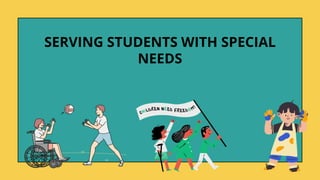
SERVING STUDENTS WITH SPECIAL
NEEDS
Special education is of great importance for
children with learning disabilities, because it gives
them the opportunity to get quality education in line
with their unique needs.
Special education enables every student to gain
a high level of independence and reach their full
potential.
W H Y S E R V I C E S F O R S T U D E N T S W I T H S P E C I A L
N E E D S A R E N E C E S S A R Y ?
• Collective responsibility
• Rigorous academic opportunities
• Respect difference
• Inclusive professional development
• Inclusion-first instruction
F I V E K E Y V A L U E S W E N E E D T O I N S T I L L I N O U R
L E A D E R S
• Discover your students’ strengths
• Provide positive role models with disabilities
• Develop strength-based learning strategies
• Use assistive technologies and Universal Design for
Learning tools
• Maximize the Power of your students’ social networks
• Help students envision positive future careers
• Create positive modifications in the learning
environment
7 W A Y S T O B R I N G O U T T H E B E S T I N S P E C I A L -
N E E D S S T U D E N T S
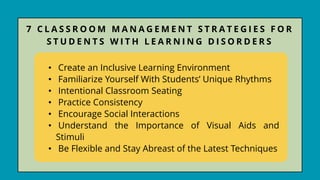
• Create an Inclusive Learning Environment
• Familiarize Yourself With Students’ Unique Rhythms
• Intentional Classroom Seating
• Practice Consistency
• Encourage Social Interactions
• Understand the Importance of Visual Aids and
Stimuli
• Be Flexible and Stay Abreast of the Latest Techniques
7 C L A S S R O O M M A N A G E M E N T S T R A T E G I E S F O R
S T U D E N T S W I T H L E A R N I N G D I S O R D E R S
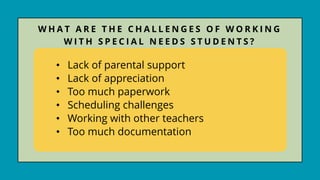
• Lack of parental support
• Lack of appreciation
• Too much paperwork
• Scheduling challenges
• Working with other teachers
• Too much documentation
W H A T A R E T H E C H A L L E N G E S O F W O R K I N G
W I T H S P E C I A L N E E D S S T U D E N T S ?
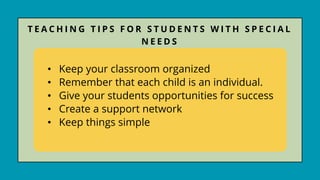
• Keep your classroom organized
• Remember that each child is an individual.
• Give your students opportunities for success
• Create a support network
• Keep things simple
T E A C H I N G T I P S F O R S T U D E N T S W I T H S P E C I A L
N E E D S
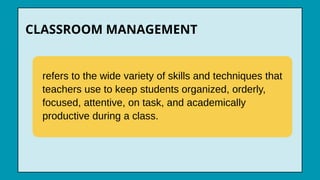
CLASSROOM MANAGEMENT
refers to the wide variety of skills and techniques that
teachers use to keep students organized, orderly,
focused, attentive, on task, and academically
productive during a class.
CLASSROOM MANAGEMENT
refers to the various ways that teachers ensure that
their classrooms are conducive to learning. This can
involve everything from preventing and intervening in
disruptive behavior to creating the right environment
and setting clear expectations.
Good classroom management isn't simply
about keeping everyone in their seats and quiet. It's
about building strong relationships with your
students, encouraging them to take part in their own
learning, and sharing a little of yourself. A classroom
culture that is good for kids is good for teachers, too.
W H A T I S A G O O D C L A S S R O O M M A N A G E M E N T ?
• Developing effective working relationships with students
• Training students on how learning takes place in your
classroom
• Protecting and leveraging time
• Anticipating student behaviors in well-written lesson
plans
• Establishing standards of behavior that promote student
learning
F I V E C O M P O N E N T S O F E F F E C T I V E C L A S S R O O M
M A N A G E M E N T
• Take care of yourself to take care of your students
• Focus on building relationships
• Set rules, boundaries and expectations
• Take a Strength-based Approach
• Involve Parents and Guardians
F I V E P R I N C I P L E S O F O U T S T A N D I N G
C L A S S R O O M M A N A G E M E N T
1. Authoritarian Classroom Management Style
refers to a teacher who has complete control over
their classroom. Authoritarian teachers create a highly-
structured learning environment with a strong emphasis on
the rules.
They expect undisputed compliance from their
students and do not tolerate inappropriate behavior in the
classroom. If students don’t behave exactly as expected, then
they are strictly punished, regardless of their circumstances.
4 D I F F E R E N T T Y P E S O F C L A S S R O O M
M A N A G E M E N T S T Y L E S
2. Authoritative Classroom Management Style
Authoritative teachers are firm, yet fair. They set up
rules and consistently enforce them, but they also value their
students’ input.
If a student has feedback regarding class rules or
ideas to improve the learning environment, the teacher will
graciously accept the suggestions and make changes as they
see fit.
4 D I F F E R E N T T Y P E S O F C L A S S R O O M
M A N A G E M E N T S T Y L E S
3. Permissive Classroom Management Style
Permissive teachers do not establish rules or punish
poor behavior. Students have too much freedom, resulting in
a disorderly and unproductive learning environment. With the
permissive classroom being so non-punitive and lacking
structure, students often take control over it with little to no
challenge from the teacher.
4 D I F F E R E N T T Y P E S O F C L A S S R O O M
M A N A G E M E N T S T Y L E S
4. Indulgent Classroom Management Style
Indulgent teachers have a very high level of involvement
with their students. They care deeply about their students and
what is going on in their lives but tend to be too friendly.
Consequently, indulgent teachers are generally well-liked by
their students who feel comfortable talking to them. However,
these teachers frequently lose their authority as the students
see them only as a friend.
4 D I F F E R E N T T Y P E S O F C L A S S R O O M
M A N A G E M E N T S T Y L E S
R E F E R E N C E S
https://blog.vancity.com/6-ways-can-support-people-disabilities/
https://insightstobehavior.com/blog/7-classroom-management-
strategies-students-learning-disorders/
https://www.continentalpress.com/blog/classroom-management-
styles/
https://www.readingrockets.org/article/building-background-
knowledge
https://poorvucenter.yale.edu/StudentsPriorKnowledge
T H A N K Y O U !
MARK C. BUO
MAEd Social Science
0321-0401@lspu.edu.ph
Presented by:

SocSci 203_Preparation for Effective Instruction_M.BUO.pptx

  • 1.
    Preparation for Effective Instruction •Gathering Pre-Instructional Background Information • Serving Students with Special Needs • Classroom Management MARK C. BUO MAEd Social Science 0321-0401@lspu.edu.ph Presented by:
  • 2.
    Understand the keyconcepts of Gathering Pre-Instructional Background Information, Serving Students with Special Needs Classroom Management. 1 2 3 LESSON OBJECTIVES Interpret personal and social experiences relevant approaches in the classroom management through differentiated instructions. Analyze and reflect the basic concepts and principles of the teaching and learning process.
  • 3.
  • 4.
    W H AT I S T H E P R O C E S S O F G A T H E R I N G I N F O R M A T I O N O N S T U D E N T L E A R N I N G ? Assessment is the process of gathering and discussing information from multiple and diverse sources in order to develop a deep understanding of what students know, understand, and can do with their knowledge as a result of their educational experiences; the process culminates when assessment results are used to improve subsequent learning.
  • 5.
    • Students seethe connection between previous and current learning. • We establish a set of conceptual “hooks” on which students can “hang” new learning. • Students get on the same page with us. • We receive formative-assessment data we can use throughout the learning experience. W H E N W E A C T I V A T E A N D B U I L D S T U D E N T S ’ B A C K G R O U N D K N O W L E D G E :
  • 6.
    Examples • Some studentsin a class had not been exposed to relevant material since their early high school years, while others more recently took a similar class and scored well on an advanced placement exam in their senior year. These students began performing better in class and were at a distinct academic advantage. In response, the instructor used placement test data to assess students’ level of knowledge and provided optional enrichment to students on a voluntary basis outside of class. B U I L D I N G U P O N S T U D E N T S ’ P R I O R K N O W L E D G E A N D S K I L L S
  • 7.
    Examples • Students didnot develop strong writing skills in high school, but chose to pursue a major that involved essays and other written assignments. After the first writing assignment, the instructor noticed disparities in students’ writing capabilities and encouraged students who needed extra support to hone their writing skills by working on their essays with the university writing center. B U I L D I N G U P O N S T U D E N T S ’ P R I O R K N O W L E D G E A N D S K I L L S
  • 8.
    R E CO M M E N D A T I O N S O N G A T H E R I N G P R E - I N S T R U C T I O N A L B A C K G R O U N D I N F O R M A T I O N • Implement a diagnostic assessment • Use multiple assessment strategies • Target misconceptions directly • Build upon prior knowledge
  • 9.
    SERVING STUDENTS WITHSPECIAL NEEDS
  • 10.
    Special education isof great importance for children with learning disabilities, because it gives them the opportunity to get quality education in line with their unique needs. Special education enables every student to gain a high level of independence and reach their full potential. W H Y S E R V I C E S F O R S T U D E N T S W I T H S P E C I A L N E E D S A R E N E C E S S A R Y ?
  • 11.
    • Collective responsibility •Rigorous academic opportunities • Respect difference • Inclusive professional development • Inclusion-first instruction F I V E K E Y V A L U E S W E N E E D T O I N S T I L L I N O U R L E A D E R S
  • 12.
    • Discover yourstudents’ strengths • Provide positive role models with disabilities • Develop strength-based learning strategies • Use assistive technologies and Universal Design for Learning tools • Maximize the Power of your students’ social networks • Help students envision positive future careers • Create positive modifications in the learning environment 7 W A Y S T O B R I N G O U T T H E B E S T I N S P E C I A L - N E E D S S T U D E N T S
  • 13.
    • Create anInclusive Learning Environment • Familiarize Yourself With Students’ Unique Rhythms • Intentional Classroom Seating • Practice Consistency • Encourage Social Interactions • Understand the Importance of Visual Aids and Stimuli • Be Flexible and Stay Abreast of the Latest Techniques 7 C L A S S R O O M M A N A G E M E N T S T R A T E G I E S F O R S T U D E N T S W I T H L E A R N I N G D I S O R D E R S
  • 14.
    • Lack ofparental support • Lack of appreciation • Too much paperwork • Scheduling challenges • Working with other teachers • Too much documentation W H A T A R E T H E C H A L L E N G E S O F W O R K I N G W I T H S P E C I A L N E E D S S T U D E N T S ?
  • 15.
    • Keep yourclassroom organized • Remember that each child is an individual. • Give your students opportunities for success • Create a support network • Keep things simple T E A C H I N G T I P S F O R S T U D E N T S W I T H S P E C I A L N E E D S
  • 16.
  • 17.
    refers to thewide variety of skills and techniques that teachers use to keep students organized, orderly, focused, attentive, on task, and academically productive during a class. CLASSROOM MANAGEMENT
  • 18.
    CLASSROOM MANAGEMENT refers tothe various ways that teachers ensure that their classrooms are conducive to learning. This can involve everything from preventing and intervening in disruptive behavior to creating the right environment and setting clear expectations.
  • 19.
    Good classroom managementisn't simply about keeping everyone in their seats and quiet. It's about building strong relationships with your students, encouraging them to take part in their own learning, and sharing a little of yourself. A classroom culture that is good for kids is good for teachers, too. W H A T I S A G O O D C L A S S R O O M M A N A G E M E N T ?
  • 20.
    • Developing effectiveworking relationships with students • Training students on how learning takes place in your classroom • Protecting and leveraging time • Anticipating student behaviors in well-written lesson plans • Establishing standards of behavior that promote student learning F I V E C O M P O N E N T S O F E F F E C T I V E C L A S S R O O M M A N A G E M E N T
  • 21.
    • Take careof yourself to take care of your students • Focus on building relationships • Set rules, boundaries and expectations • Take a Strength-based Approach • Involve Parents and Guardians F I V E P R I N C I P L E S O F O U T S T A N D I N G C L A S S R O O M M A N A G E M E N T
  • 22.
    1. Authoritarian ClassroomManagement Style refers to a teacher who has complete control over their classroom. Authoritarian teachers create a highly- structured learning environment with a strong emphasis on the rules. They expect undisputed compliance from their students and do not tolerate inappropriate behavior in the classroom. If students don’t behave exactly as expected, then they are strictly punished, regardless of their circumstances. 4 D I F F E R E N T T Y P E S O F C L A S S R O O M M A N A G E M E N T S T Y L E S
  • 23.
    2. Authoritative ClassroomManagement Style Authoritative teachers are firm, yet fair. They set up rules and consistently enforce them, but they also value their students’ input. If a student has feedback regarding class rules or ideas to improve the learning environment, the teacher will graciously accept the suggestions and make changes as they see fit. 4 D I F F E R E N T T Y P E S O F C L A S S R O O M M A N A G E M E N T S T Y L E S
  • 24.
    3. Permissive ClassroomManagement Style Permissive teachers do not establish rules or punish poor behavior. Students have too much freedom, resulting in a disorderly and unproductive learning environment. With the permissive classroom being so non-punitive and lacking structure, students often take control over it with little to no challenge from the teacher. 4 D I F F E R E N T T Y P E S O F C L A S S R O O M M A N A G E M E N T S T Y L E S
  • 25.
    4. Indulgent ClassroomManagement Style Indulgent teachers have a very high level of involvement with their students. They care deeply about their students and what is going on in their lives but tend to be too friendly. Consequently, indulgent teachers are generally well-liked by their students who feel comfortable talking to them. However, these teachers frequently lose their authority as the students see them only as a friend. 4 D I F F E R E N T T Y P E S O F C L A S S R O O M M A N A G E M E N T S T Y L E S
  • 26.
    R E FE R E N C E S https://blog.vancity.com/6-ways-can-support-people-disabilities/ https://insightstobehavior.com/blog/7-classroom-management- strategies-students-learning-disorders/ https://www.continentalpress.com/blog/classroom-management- styles/ https://www.readingrockets.org/article/building-background- knowledge https://poorvucenter.yale.edu/StudentsPriorKnowledge
  • 27.
    T H AN K Y O U ! MARK C. BUO MAEd Social Science 0321-0401@lspu.edu.ph Presented by: