International Journal of Technical Research and Applications e-ISSN: 2320-8163,
www.ijtra.com Volume 2, Issue 4 (July-Aug 2014), PP. 218-224
218 | P a g e
MANAGING INTERFERENCE IN
COLLABORATIVE NETWORKS BY FLOW
CONTROL AND SIGNAL POWER CONTROL
BASED PRIORITY
Amar A. Mahawish1, Virendra D. Pawar2
Computer Science and information technology
Vishwakarma Institute of Technology
Pune, India
1
ammaralkhafaji@gmail.com
2
virendra.pawar@vit.edu
Abstract—The performance of wireless sensor network (WSN)
can be effect by interference. The many devices in network
capable of causing interference and this can cause dropping
packets or block the transmission channel. In this paper we study
how manage the interference in WSN. This managing can be
done by flow control and power level control. We used
heterogeneous collaborative network nodes like PIC
microcontroller, ARM microcontroller and Personal Computer
(PC) to build our network. Also we assign priority level for each
node to allow the node with high priority to manage the flow and
power level of other node within same network and same used
channel. The time synchronization required due to different
nodes used. The protocol used for time synchronization is
Timing-sync Protocol for Sensor Networks (TPSN).
Key Words: WSN, PIC, ARM, PC and TPSN.
I. INTRODUCTION
A Wireless Sensor Network (WSN) of spatially distribution
autonomous sensors to observe physical or environmental
activities, like temperature, sound, pressure, etc. and then these
sensor nodes pass their data through the network to a
destination location. A lot of new networks are bidirectional,
also enabling management of sensing activity. The
development of WSN was motivate by military applications
like battlefield surveillance, nowadays such networks are
employed in several industrial and client applications, such as
observance activity, management, machine health monitoring
and so on.
The WSN is constructed of "nodes" from a few to hundreds
or even thousands nodes, where every node is connected to a
minimum of one or many sensors. Each such sensor network
node has typically several parts: a radio transceiver with an
internal antenna or connection to an external antenna, a
microcontroller, an electronic circuit for interfacing with the
sensors and an energy source, usually a battery. The design of
the sensor network is effect by many factors including
scalability, operation system, fault tolerance, network topology,
hardware constraints, transmission media, congestion,
interference and power consumption. In this paper we concern
on congestion and interference as well as saving power
consumption.
High-rate streaming in WSN is required for future
applications to produce high-quality information of an
application. The recent advances have enabled large-scale
WSN to be deployed supported by high-bandwidth backbone
network for high-rate streaming, the WSN remains the
shortcoming in service due to the low-rate radios used and also
the effects of wireless interferences. The potential sources of
interference will occur in collaborative network when other
nodes send data in high rate or in high power level signal.
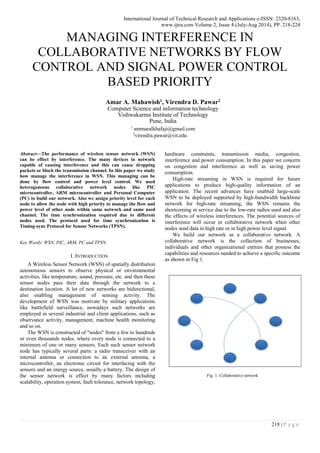
We build our network as a collaborative network. A
collaborative network is the collection of businesses,
individuals and other organizational entities that possess the
capabilities and resources needed to achieve a specific outcome
as shown in Fig 1.
Fig. 1. Collaborative network
International Journal of Technical Research and Applications e-ISSN: 2320-8163,
www.ijtra.com Volume 2, Issue 4 (July-Aug 2014), PP. 218-224
219 | P a g e
The Congestion is one of the main reasons of interference
because congestion means that there are huge data in channel
that increase the probability of interference with other data that
sent from other devices.
There is other factor effect on channel interference e.g.
signal strength of other devices. So if we need to avoid
interference in our network we need to take in consideration
the speed of sending data as well as control the power level
signal of other nodes. One of the main characteristic in WSN is
power consumption constraints for nodes using batteries or
energy harvesting so we need to take in consideration the
saving power.
The interference leading drop packet or block the channel
therefor we need to retransmit the lost packet or retrieve the
channel. The retransmitting packet means consuming time as
well as consuming energy. So we need to managing
interference to saving time and saving power in the
collaborative network.
The collaborative network that we used in our experiment
has many types of node so in collaborative network all nodes
starts at different time instants. The WSN need to be time
synchronized. The protocol used for time synchronization is
Timing-sync Protocol for Sensor Networks (TPSN).
In this paper, we propose two parameters (flow control and
power level) to manage interference in WSN. We evaluate our
algorithm by design collaborative network with following
devices:
 PIC microcontroller node [1].
 ARM microcontroller node [2].
 PC node.
 Wireless device used to attach with these above nodes
[3].
The reminder of the paper is organized as follows: in
section 2 we provide a background of interference solution as a
related work. In section 3 we describe the motivation behind
the manage interference. In section 4 we describe the
methodology and nodes design and the pre-algorithms used for
design the network. In section 5 we discuss the synchronization
protocol that used in our network. Section 6 show us the
interference control algorithm. The results obtain after
execution in section 7. The result’s evaluation discussed in
section 8 and concludes our paper in Section 9.
II. RELATED WORK
Wireless sensor networks will play an important role in
many applications; these applications typically fall under
sensor-based systems and autonomous systems. For example,
many wireless sensor networks monitor some aspects of the
environment and relay the processed information to a central
node. Many different wireless communication technologies,
such as ZigBee and Wi-Fi, have been witnessed recently to be
deployed in more and more applications. Thus, the cross
technology interference has drawn attention of the researchers.
Now, the WSN community has acknowledged the impact of
Wi-Fi interference on WSN applications in various settings.
Most research work done on benefit of multichannel available
in 2.4 GHz band. Some study work on interference-aware
channel assignment algorithm and protocol for multi-radio
wireless mesh networks that address this interference problem.
The proposed solution assigns channels to radios to minimize
interference within the network co-located wireless networks.
It utilizes a novel interference estimation technique
implemented at each mesh router as done in [4]. Simple local-
balancing and interference-aware channel allocation algorithms
for reducing the overall interference in the network studied [5].
Also some study don on evaluate the relative performance of
an algorithms using actual implementations on a multichannel,
multi-radio test bed. Using overall network throughput as a
metric, we show through experiments that the channel
allocation that is aware of the node’s transmission activity
performs better than the simple local balancing algorithm,
irrespective of the number of channels used for allocation as
discussed in [5].
In most paper the solution of interference either select
channel that have less use from other network or balancing the
interference among the channels. Other paper when detect the
interference simply change the channel with other.in our
solution is depend on solve the interference without depend on
changing channel, when interference occur in the collaborative
network the node with high priority take responsibility to
remove the interfacing while this node need to send data.
III. MOTIVATION
Performance of a deployed Wireless Sensor Network
(WSN) is greatly influenced by the interference it is subject to
during operation. Degradation happens because of interference
leading to packet drops, retransmissions, link instability and
inconsistent protocol behavior. Therefor to save time, save
energy and increase the Quality of Service (QoS) in network
(such as increase the throughput) we need to eliminate or
reduce the effect of interference. We have conducted
experiments that highlight the fact that interference caused by
same channel used by other devices and/or co-channel
contention significantly degrades the network performance of
protocols, especially when these devices send data in high rate
or in high power level signal. These potential sources of
interference must therefore be accounted for during the design
stage of a WSN in order to achieve acceptable network
performance. Based on these observations one solution for
increasing the network throughput of a WSN is managing
interference.
IV. METHODOLOGY AND IMPLEMENTATION
A. Network design
We designed collaborative network and these network
contain PIC, ARM and PC as a node attached with them
wireless device we assume:
1) Each node in network is known to each other.
2) Each node has own priority.
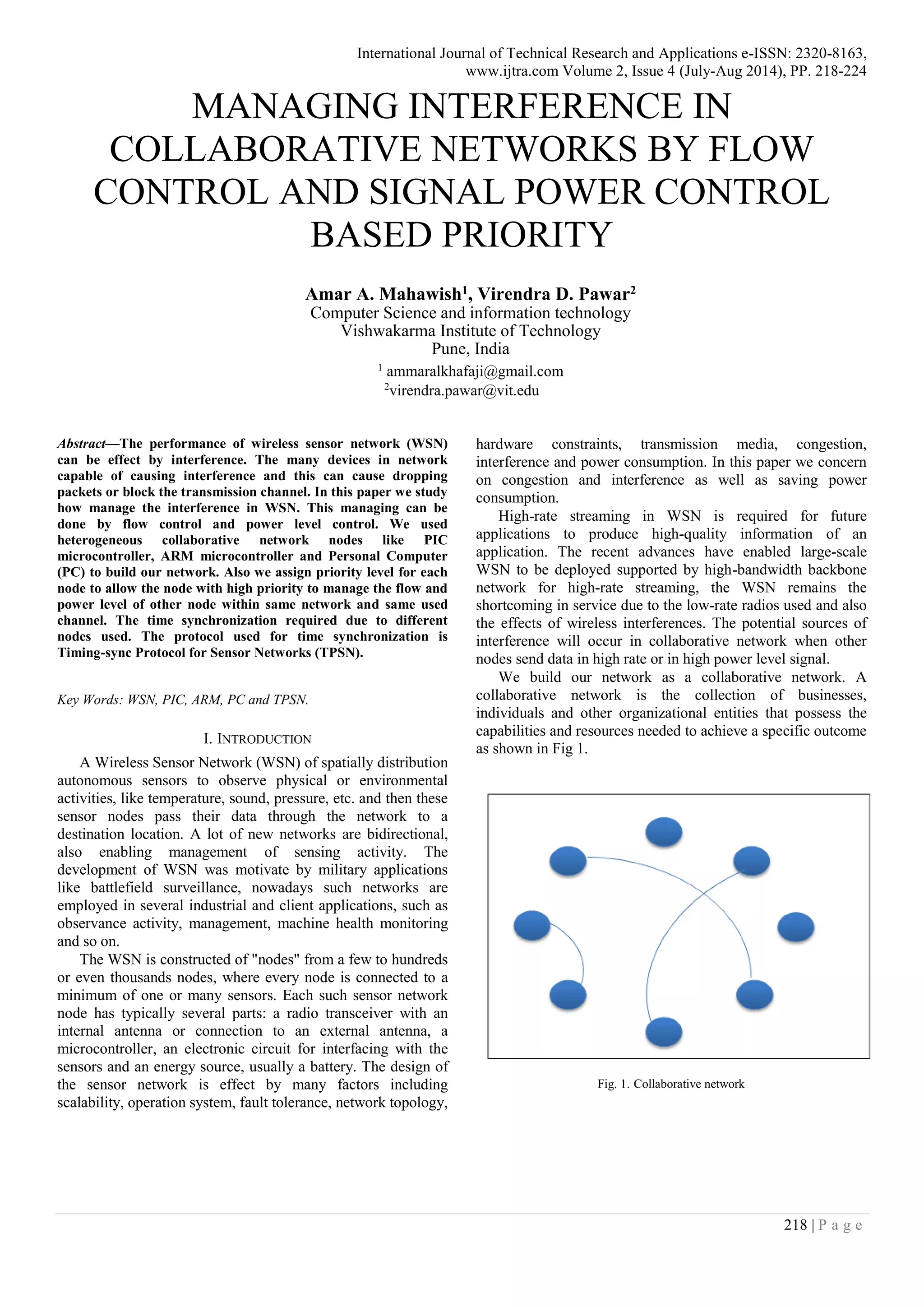
3) Two nodes (Node 1 & Node 2) communicate with each
other as shown in Fig 2.
International Journal of Technical Research and Applications e-ISSN: 2320-8163,
www.ijtra.com Volume 2, Issue 4 (July-Aug 2014), PP. 218-224
220 | P a g e
4) The distance between these two nodes is 10 meter.
5) Node 3 work as interference and send packet in same
channel of Node 1 & Node 2 as shown in Fig 3.
As shown in Fig 3, the Node 3 send data on same channel
of Node 1 & Node 2.
Fig. 2. Two nodes in collaborative network without interference
Fig. 3. Two nodes in collaborative network with interference from other node
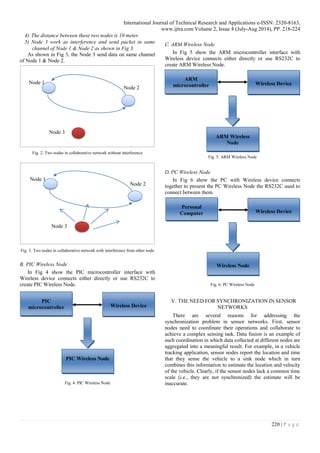
B. PIC Wireless Node
In Fig 4 show the PIC microcontroller interface with
Wireless device connects either directly or use RS232C to
create PIC Wireless Node.
Fig. 4. PIC Wireless Node
C. ARM Wireless Node
In Fig 5 show the ARM microcontroller interface with
Wireless device connects either directly or use RS232C to
create ARM Wireless Node.
Fig. 5. ARM Wireless Node
D. PC Wireless Node
In Fig 6 show the PC with Wireless device connects
together to present the PC Wireless Node the RS232C used to
connect between them.
Fig. 6. PC Wireless Node
V. THE NEED FOR SYNCHRONIZATION IN SENSOR
NETWORKS
There are several reasons for addressing the
synchronization problem in sensor networks. First, sensor
nodes need to coordinate their operations and collaborate to
achieve a complex sensing task. Data fusion is an example of
such coordination in which data collected at different nodes are
aggregated into a meaningful result. For example, in a vehicle
tracking application, sensor nodes report the location and time
that they sense the vehicle to a sink node which in turn
combines this information to estimate the location and velocity
of the vehicle. Clearly, if the sensor nodes lack a common time
scale (i.e., they are not synchronized) the estimate will be
inaccurate.
Node 3
Node 2
Node 1
Node 3
Node 2
Node 1
PIC Wireless Node
Wireless Device
PIC
microcontroller
ARM Wireless
Node
Wireless Device
ARM
microcontroller
Wireless Node
Wireless Device
Personal
Computer
International Journal of Technical Research and Applications e-ISSN: 2320-8163,
www.ijtra.com Volume 2, Issue 4 (July-Aug 2014), PP. 218-224
221 | P a g e
Second, synchronization can be used by power saving
schemes to increase network lifetime. For example, sensors
may sleep at appropriate times, and wake up when necessary.
When using power-saving modes, the nodes should sleep and
wake-up at coordinated times, such that the radio receiver of a
node is not turned when there is some data directed to it. This
requires a precise timing between sensor nodes. Scheduling
algorithms such as TDMA can be used to share the
transmission medium in the time domain to eliminate
transmission collisions and conserve energy. Thus,
synchronization is an essential part of transmission scheduling.
Timing-Sync Protocol for Sensor Networks (TPSN):
A network-wide time synchronization protocol for sensor
networks, which they call Timing-Sync Protocol for Sensor
Networks (TPSN) [6]. Their protocol works in two phases:
“level discovery phase” and “synchronization phase”. The aim
of the first phase is to create a hierarchical topology in the
network, where each node is assigned a level. Only one node is
assigned level 0, called the root node. In the second phase, a
node of level i synchronize to a node of level i-1. At the end of
the synchronization phase, all nodes are synchronized to the
root node and the network-wide synchronization is achieved.
A. Level Discovery Phase
This phase is run once at the network deployment. First a
node should be determined as the root node. The root node is
assigned level 0, and initiates the level discovery phase by
broadcasting a level discovery packet. This packet contains the
identity and level of the sender node. Upon receiving this
packet, the neighbors of the root node assign themselves level
1. Then each level 1 node broadcasts a level discovery packet
with its level and identity in the packet. Once a node is
assigned a level, it discards further incoming level discovery
packets. This broadcast chain goes on through the network, and
the phase is completed when all nodes are assigned a level.
B. Synchronization Phase
The basic building block of the synchronization phase is the
two-way message exchange between a pair of nodes. The
authors assume that the clock drift between a pair of nodes is
constant in the small time period during a single message
exchange. The propagation delay is also assumed to be
constant in both directions.
Consider a two-way message exchange between nodes A
and B as shown in Fig 7. Node A initiates the synchronization
by sending a synchronization pulse packet at T1 (according to
its local clock). This packet includes A's level number, and the
value T1. B receives this packet (according to its local clock) at
T2 = T1+Δ+ d, where Δ is the relative clock drift between the
nodes, and d is the propagation delay of the pulse. B responds
at time T3 with an acknowledgement packet, which includes
the level number of B and the values T1, T2, and T3. Then,
node A can calculate the clock drift and propagation delay as in
formula, and synchronize itself to B.
Fig. 8. Two way message exchange between a pair of nodes
VI. INTERFERENCE CONTROL ALGORITHM
Node A
T2
T1
Local time
Local time
Node B
T3
T4
ALGORITHM:
Setting parameter of nodes (Baud rate, buffer size, delay,
pin selection, I/O directions, register selection, port
initialization)
Assign: when two nodes start sending data to each other
 Assign priority to all nodes one of these two node
as a master node
 flow=TRUE , power=TRUE
 size = No. of packet need to send
While (sending packet < size)
{
 Two nodes start sending data
 Master node monitors the throughput of
transmission
If (drop packets occur) THEN
{
If (flow==FALSE&&power==TRUE)
{
 Master node send notification packet with
its priority value to inform other nodes in
network to reduce the power level of
packet
 Power=FALSE
 If(interference node priority < master
priority)
{
Reduce the level power of receive node
}
}
Else if (flow==TRUE)
{
 Master node send notification packet to
inform other nodes in network to reduce
the flow rate of packet
 flow=FALSE
 If(interference node priority < master
priority)
{
Reduce the flow speed of receiver node
}
}
Else
{
 Change Channel
}
}
}
International Journal of Technical Research and Applications e-ISSN: 2320-8163,
www.ijtra.com Volume 2, Issue 4 (July-Aug 2014), PP. 218-224
222 | P a g e
1) Setting nodes for communication.
2) Assign priority to all nodes.
3) Assign master node (Node 1).
4) Node 1 & Node 2 start sending data.
5) Monitor the throughput between these two nodes from
master node.
6) If there is drop packet discovered that mean the
interference occurred as shown in Fig 3.
7) The master node start send notification packet to all
nodes within range telling them to reduce the speed of
sending data.
8) If the drop packets still the master node start send
notification packet to all nodes within range telling them
to reduce the power level of sending data.
9) If packet drop remain then change channel.
VII. RESULT
In this section we read the result of our experiment after
design the collaborative network as shown in Fig 2 and Fig 3.
These results show the effect our algorithm on interference and
how improve the throughput during communication. We
collect these results when Node 1 and Node 2 have two cases:
1) High power level for sending signal as shown in Table
(1).
2) Low power level for sending signal as shown in Table (2).
TABLE 1.Percentage read the interference experiment (HIGH POWER
LEVEL)
Node1 & Node2 Node 3 (interference) Throughput
HIGH POWER
PL=18 dBm
RO=1ms
PL RO in (ms)
10 dBm 0 98%
18 dBm 0 60%
10 dBm 1 98%
18 dBm 1 98%
`
PL=18 dBm
RO=2 ms
10 dBm 0 97%
18 dBm 0 43%
10 dBm 1 97%
18 dBm 1 97%
PL=18 dBm
RO=3 ms
10 dBm 0 97%
18 dBm 0 57%
10 dBm 1 97%
18 dBm 1 97%
PL=18 dBm
RO=4 ms
10 dBm 0 98%
18 dBm 0 71%
10 dBm 1 98%
18 dBm 1 98%
Where:
RO: Speed of flow data
PL: Power level of sending signal
TABLE 2.Percentage read the interference experiment (LOW POWER
LEVEL)
Node1 & Node2 Node 3 (interference) Throughput
LOW POWER
PL=10 dBm
RO=1 ms
PL RO in (ms)
10 dBm 0 72%
18 dBm 0 0%
10 dBm 1 96%
18 dBm 1 95%
PL=10 dBm
RO=2 ms
10 dBm 0 30%
18 dBm 0 21%
10 dBm 1 97%
18 dBm 1 97%
PL=10 dBm
RO=3 ms
10 dBm 0 19%
18 dBm 0 0%
10 dBm 1 93%
18 dBm 1 98%
PL=10 dBm
RO=4 ms
10 dBm 0 19%
18 dBm 0 0%
10 dBm 1 95%
18 dBm 1 97%
Table (1) and (2) show the percentage values of throughput
in two cases above with different values of flow speed. Also
the Node 3 has different value of power level as well as
different values of flow speed.
VIII. EVALUATION
As a result of execute the interference algorithm we can
manage the interference in our network we use the reading in
table (1) and (2) as shown in figures bellow.
International Journal of Technical Research and Applications e-ISSN: 2320-8163,
www.ijtra.com Volume 2, Issue 4 (July-Aug 2014), PP. 218-224
223 | P a g e
Fig. 8. Effect of Node 3 on Node1 & Node2 when high power with different
data speeds
In Fig 8 the interference node (Node 3) use different value
of power level and value of the speed of flow data, and the
Node1 & Node2 use high power (PL=18 dBm) and different
flow speed. The Fig 8 can show us the ratio of the throughputs
during communication.
In Fig 9 the interference node use different value of power
level and value of speed the deliver data, and the Node1 &
Node2 use low power and different flow speed. Also as Fig 8
the Fig 9 show us the throughputs.
Fig. 9. Effect of Node 3 on Node1 & Node2 when low power with different
data speed
As we can see in Fig 8 the effect of interference is less
when comparing in Fig 9. The different due to the Node1 &
Node2 use high power in Fig 8 and reverse in Fig 9. Because
of Node 1& Node 2 use high power level the effect of
interference node less than when Node 1& Node 2 use low
power level, as shown in Fig 8 the minimum value of
throughputs we got is 42% when interference Node use high
power level and high flow speed (PL=18dBm & RO=0 ms).but
when Node 1& Node 2 use low power level we got 0% of
throughputs when interference Node use high power level and
high flow speed (PL=18dBm & RO=0 ms).
The Fig 10 show comparison between two value case 1
when Node 1& Node 2 = (PL=18 dBm & RO=1 ms) means
high power with speed 1ms of data flow and the case 2 Node
1& Node 2 = (PL=10 dBm & RO=1 ms) this value means low
power used by Node 1& Node 2.
We can recognize from the Fig 10 the case 1 give best
result then case 2. We can see the node 3 effect much more
when sending packet in high rate and high power signal so the
result is block the channel as we see 0% of throughput in case
2 when Node1 & Node2 use low power and in case 1 that
interference effect about 60% when Node1 & Node2 use high
power signal but in case 2 we are consuming the energy by
sending signals with high power level. To save energy in our
network we need to work on case 2 low level of power for
Node1 & Node2 and at same time avoid the interference so to
solve this problem we can reduce the flow of packet or reduce
the power level of sending data from interference node (Node
3) as we can see in Fig 10 when the Node 3 values (PL=10
dBm & RO=0 ms) and (PL=18 dBm & RO=1 ms) we get
around 98% of throughput.
Fig. 10. Effect of Node 3 on Node1 & Node2 when high power and low
power
This interference algorithm work on priority of node if the
high priority suffering from interference then the low priority
reduce the flow of packet or reduce the power level of sending
data from interference node. In case that all interference nodes
have high priority then master node then the best solution to
avoid the interference is by changing channel. So by applying
our algorithm we eliminate the interference as well as saving
the energy.
IX. CONCLUSIONS
As we can see the interference effect on the performance of
network as reduce the throughput or may block the channel. As
we need to eliminate the retransmission to save energy by
applying our algorithm we can avoid the interference and
increase the throughput also we saved energy by allow Node1
& Node2 sending the packet in low level energy.
ACKNOWLEDGEMENT
I would like to express my very great appreciation to Prof.
Virendra D. Pawar for his valuable and constructive
suggestions during the planning and development of this
research work. His willingness to give his time so generously
has been very much appreciated.
International Journal of Technical Research and Applications e-ISSN: 2320-8163,
www.ijtra.com Volume 2, Issue 4 (July-Aug 2014), PP. 218-224
224 | P a g e
REFERENCES
[1] http://ww1.microchip.com/downloads/en/DeviceDoc/41
412F.pdf, PIC18F46K22 datasheet Microchip.
[2] www.nxp.com/documents/user_manual/UM10120.pdf
LPC2131/2/4/6/8 User manual Rev. 4 — 23 April 2012.
[3] http://www.digi.com/pdf/ds_xbeemultipointmodules.pdf
[4] Krishna N. Ramachandran, Elizabeth M. Belding, Kevin
C. Almeroth, Milind M. Buddhikot,” Interference- ware
Channel Assignment in Multi-Radio Wireless Mesh
Networks”, IEEE, April 2006.
[5] Vijay Raman, Nitin H. Vaidya,” Adjacent Channel
Interference Reduction in multichannel Wireless
Networks Using Intelligent Channel Allocation”, NSF
grant 06-27074, Technical Report (August 2009).
[6] Saurabh Ganeriwal Ram Kumar Mani B. Srivastava,
“Timing-sync Protocol for Sensor Networks”, ACM,
2003.

MANAGING INTERFERENCE IN COLLABORATIVE NETWORKS BY FLOW CONTROL AND SIGNAL POWER CONTROL BASED PRIORITY

  • 1.
    International Journal ofTechnical Research and Applications e-ISSN: 2320-8163, www.ijtra.com Volume 2, Issue 4 (July-Aug 2014), PP. 218-224 218 | P a g e MANAGING INTERFERENCE IN COLLABORATIVE NETWORKS BY FLOW CONTROL AND SIGNAL POWER CONTROL BASED PRIORITY Amar A. Mahawish1, Virendra D. Pawar2 Computer Science and information technology Vishwakarma Institute of Technology Pune, India 1 ammaralkhafaji@gmail.com 2 virendra.pawar@vit.edu Abstract—The performance of wireless sensor network (WSN) can be effect by interference. The many devices in network capable of causing interference and this can cause dropping packets or block the transmission channel. In this paper we study how manage the interference in WSN. This managing can be done by flow control and power level control. We used heterogeneous collaborative network nodes like PIC microcontroller, ARM microcontroller and Personal Computer (PC) to build our network. Also we assign priority level for each node to allow the node with high priority to manage the flow and power level of other node within same network and same used channel. The time synchronization required due to different nodes used. The protocol used for time synchronization is Timing-sync Protocol for Sensor Networks (TPSN). Key Words: WSN, PIC, ARM, PC and TPSN. I. INTRODUCTION A Wireless Sensor Network (WSN) of spatially distribution autonomous sensors to observe physical or environmental activities, like temperature, sound, pressure, etc. and then these sensor nodes pass their data through the network to a destination location. A lot of new networks are bidirectional, also enabling management of sensing activity. The development of WSN was motivate by military applications like battlefield surveillance, nowadays such networks are employed in several industrial and client applications, such as observance activity, management, machine health monitoring and so on. The WSN is constructed of "nodes" from a few to hundreds or even thousands nodes, where every node is connected to a minimum of one or many sensors. Each such sensor network node has typically several parts: a radio transceiver with an internal antenna or connection to an external antenna, a microcontroller, an electronic circuit for interfacing with the sensors and an energy source, usually a battery. The design of the sensor network is effect by many factors including scalability, operation system, fault tolerance, network topology, hardware constraints, transmission media, congestion, interference and power consumption. In this paper we concern on congestion and interference as well as saving power consumption. High-rate streaming in WSN is required for future applications to produce high-quality information of an application. The recent advances have enabled large-scale WSN to be deployed supported by high-bandwidth backbone network for high-rate streaming, the WSN remains the shortcoming in service due to the low-rate radios used and also the effects of wireless interferences. The potential sources of interference will occur in collaborative network when other nodes send data in high rate or in high power level signal. We build our network as a collaborative network. A collaborative network is the collection of businesses, individuals and other organizational entities that possess the capabilities and resources needed to achieve a specific outcome as shown in Fig 1. Fig. 1. Collaborative network
  • 2.
    International Journal ofTechnical Research and Applications e-ISSN: 2320-8163, www.ijtra.com Volume 2, Issue 4 (July-Aug 2014), PP. 218-224 219 | P a g e The Congestion is one of the main reasons of interference because congestion means that there are huge data in channel that increase the probability of interference with other data that sent from other devices. There is other factor effect on channel interference e.g. signal strength of other devices. So if we need to avoid interference in our network we need to take in consideration the speed of sending data as well as control the power level signal of other nodes. One of the main characteristic in WSN is power consumption constraints for nodes using batteries or energy harvesting so we need to take in consideration the saving power. The interference leading drop packet or block the channel therefor we need to retransmit the lost packet or retrieve the channel. The retransmitting packet means consuming time as well as consuming energy. So we need to managing interference to saving time and saving power in the collaborative network. The collaborative network that we used in our experiment has many types of node so in collaborative network all nodes starts at different time instants. The WSN need to be time synchronized. The protocol used for time synchronization is Timing-sync Protocol for Sensor Networks (TPSN). In this paper, we propose two parameters (flow control and power level) to manage interference in WSN. We evaluate our algorithm by design collaborative network with following devices:  PIC microcontroller node [1].  ARM microcontroller node [2].  PC node.  Wireless device used to attach with these above nodes [3]. The reminder of the paper is organized as follows: in section 2 we provide a background of interference solution as a related work. In section 3 we describe the motivation behind the manage interference. In section 4 we describe the methodology and nodes design and the pre-algorithms used for design the network. In section 5 we discuss the synchronization protocol that used in our network. Section 6 show us the interference control algorithm. The results obtain after execution in section 7. The result’s evaluation discussed in section 8 and concludes our paper in Section 9. II. RELATED WORK Wireless sensor networks will play an important role in many applications; these applications typically fall under sensor-based systems and autonomous systems. For example, many wireless sensor networks monitor some aspects of the environment and relay the processed information to a central node. Many different wireless communication technologies, such as ZigBee and Wi-Fi, have been witnessed recently to be deployed in more and more applications. Thus, the cross technology interference has drawn attention of the researchers. Now, the WSN community has acknowledged the impact of Wi-Fi interference on WSN applications in various settings. Most research work done on benefit of multichannel available in 2.4 GHz band. Some study work on interference-aware channel assignment algorithm and protocol for multi-radio wireless mesh networks that address this interference problem. The proposed solution assigns channels to radios to minimize interference within the network co-located wireless networks. It utilizes a novel interference estimation technique implemented at each mesh router as done in [4]. Simple local- balancing and interference-aware channel allocation algorithms for reducing the overall interference in the network studied [5]. Also some study don on evaluate the relative performance of an algorithms using actual implementations on a multichannel, multi-radio test bed. Using overall network throughput as a metric, we show through experiments that the channel allocation that is aware of the node’s transmission activity performs better than the simple local balancing algorithm, irrespective of the number of channels used for allocation as discussed in [5]. In most paper the solution of interference either select channel that have less use from other network or balancing the interference among the channels. Other paper when detect the interference simply change the channel with other.in our solution is depend on solve the interference without depend on changing channel, when interference occur in the collaborative network the node with high priority take responsibility to remove the interfacing while this node need to send data. III. MOTIVATION Performance of a deployed Wireless Sensor Network (WSN) is greatly influenced by the interference it is subject to during operation. Degradation happens because of interference leading to packet drops, retransmissions, link instability and inconsistent protocol behavior. Therefor to save time, save energy and increase the Quality of Service (QoS) in network (such as increase the throughput) we need to eliminate or reduce the effect of interference. We have conducted experiments that highlight the fact that interference caused by same channel used by other devices and/or co-channel contention significantly degrades the network performance of protocols, especially when these devices send data in high rate or in high power level signal. These potential sources of interference must therefore be accounted for during the design stage of a WSN in order to achieve acceptable network performance. Based on these observations one solution for increasing the network throughput of a WSN is managing interference. IV. METHODOLOGY AND IMPLEMENTATION A. Network design We designed collaborative network and these network contain PIC, ARM and PC as a node attached with them wireless device we assume: 1) Each node in network is known to each other. 2) Each node has own priority. 3) Two nodes (Node 1 & Node 2) communicate with each other as shown in Fig 2.
  • 3.
    International Journal ofTechnical Research and Applications e-ISSN: 2320-8163, www.ijtra.com Volume 2, Issue 4 (July-Aug 2014), PP. 218-224 220 | P a g e 4) The distance between these two nodes is 10 meter. 5) Node 3 work as interference and send packet in same channel of Node 1 & Node 2 as shown in Fig 3. As shown in Fig 3, the Node 3 send data on same channel of Node 1 & Node 2. Fig. 2. Two nodes in collaborative network without interference Fig. 3. Two nodes in collaborative network with interference from other node B. PIC Wireless Node In Fig 4 show the PIC microcontroller interface with Wireless device connects either directly or use RS232C to create PIC Wireless Node. Fig. 4. PIC Wireless Node C. ARM Wireless Node In Fig 5 show the ARM microcontroller interface with Wireless device connects either directly or use RS232C to create ARM Wireless Node. Fig. 5. ARM Wireless Node D. PC Wireless Node In Fig 6 show the PC with Wireless device connects together to present the PC Wireless Node the RS232C used to connect between them. Fig. 6. PC Wireless Node V. THE NEED FOR SYNCHRONIZATION IN SENSOR NETWORKS There are several reasons for addressing the synchronization problem in sensor networks. First, sensor nodes need to coordinate their operations and collaborate to achieve a complex sensing task. Data fusion is an example of such coordination in which data collected at different nodes are aggregated into a meaningful result. For example, in a vehicle tracking application, sensor nodes report the location and time that they sense the vehicle to a sink node which in turn combines this information to estimate the location and velocity of the vehicle. Clearly, if the sensor nodes lack a common time scale (i.e., they are not synchronized) the estimate will be inaccurate. Node 3 Node 2 Node 1 Node 3 Node 2 Node 1 PIC Wireless Node Wireless Device PIC microcontroller ARM Wireless Node Wireless Device ARM microcontroller Wireless Node Wireless Device Personal Computer
  • 4.
    International Journal ofTechnical Research and Applications e-ISSN: 2320-8163, www.ijtra.com Volume 2, Issue 4 (July-Aug 2014), PP. 218-224 221 | P a g e Second, synchronization can be used by power saving schemes to increase network lifetime. For example, sensors may sleep at appropriate times, and wake up when necessary. When using power-saving modes, the nodes should sleep and wake-up at coordinated times, such that the radio receiver of a node is not turned when there is some data directed to it. This requires a precise timing between sensor nodes. Scheduling algorithms such as TDMA can be used to share the transmission medium in the time domain to eliminate transmission collisions and conserve energy. Thus, synchronization is an essential part of transmission scheduling. Timing-Sync Protocol for Sensor Networks (TPSN): A network-wide time synchronization protocol for sensor networks, which they call Timing-Sync Protocol for Sensor Networks (TPSN) [6]. Their protocol works in two phases: “level discovery phase” and “synchronization phase”. The aim of the first phase is to create a hierarchical topology in the network, where each node is assigned a level. Only one node is assigned level 0, called the root node. In the second phase, a node of level i synchronize to a node of level i-1. At the end of the synchronization phase, all nodes are synchronized to the root node and the network-wide synchronization is achieved. A. Level Discovery Phase This phase is run once at the network deployment. First a node should be determined as the root node. The root node is assigned level 0, and initiates the level discovery phase by broadcasting a level discovery packet. This packet contains the identity and level of the sender node. Upon receiving this packet, the neighbors of the root node assign themselves level 1. Then each level 1 node broadcasts a level discovery packet with its level and identity in the packet. Once a node is assigned a level, it discards further incoming level discovery packets. This broadcast chain goes on through the network, and the phase is completed when all nodes are assigned a level. B. Synchronization Phase The basic building block of the synchronization phase is the two-way message exchange between a pair of nodes. The authors assume that the clock drift between a pair of nodes is constant in the small time period during a single message exchange. The propagation delay is also assumed to be constant in both directions. Consider a two-way message exchange between nodes A and B as shown in Fig 7. Node A initiates the synchronization by sending a synchronization pulse packet at T1 (according to its local clock). This packet includes A's level number, and the value T1. B receives this packet (according to its local clock) at T2 = T1+Δ+ d, where Δ is the relative clock drift between the nodes, and d is the propagation delay of the pulse. B responds at time T3 with an acknowledgement packet, which includes the level number of B and the values T1, T2, and T3. Then, node A can calculate the clock drift and propagation delay as in formula, and synchronize itself to B. Fig. 8. Two way message exchange between a pair of nodes VI. INTERFERENCE CONTROL ALGORITHM Node A T2 T1 Local time Local time Node B T3 T4 ALGORITHM: Setting parameter of nodes (Baud rate, buffer size, delay, pin selection, I/O directions, register selection, port initialization) Assign: when two nodes start sending data to each other  Assign priority to all nodes one of these two node as a master node  flow=TRUE , power=TRUE  size = No. of packet need to send While (sending packet < size) {  Two nodes start sending data  Master node monitors the throughput of transmission If (drop packets occur) THEN { If (flow==FALSE&&power==TRUE) {  Master node send notification packet with its priority value to inform other nodes in network to reduce the power level of packet  Power=FALSE  If(interference node priority < master priority) { Reduce the level power of receive node } } Else if (flow==TRUE) {  Master node send notification packet to inform other nodes in network to reduce the flow rate of packet  flow=FALSE  If(interference node priority < master priority) { Reduce the flow speed of receiver node } } Else {  Change Channel } } }
  • 5.
    International Journal ofTechnical Research and Applications e-ISSN: 2320-8163, www.ijtra.com Volume 2, Issue 4 (July-Aug 2014), PP. 218-224 222 | P a g e 1) Setting nodes for communication. 2) Assign priority to all nodes. 3) Assign master node (Node 1). 4) Node 1 & Node 2 start sending data. 5) Monitor the throughput between these two nodes from master node. 6) If there is drop packet discovered that mean the interference occurred as shown in Fig 3. 7) The master node start send notification packet to all nodes within range telling them to reduce the speed of sending data. 8) If the drop packets still the master node start send notification packet to all nodes within range telling them to reduce the power level of sending data. 9) If packet drop remain then change channel. VII. RESULT In this section we read the result of our experiment after design the collaborative network as shown in Fig 2 and Fig 3. These results show the effect our algorithm on interference and how improve the throughput during communication. We collect these results when Node 1 and Node 2 have two cases: 1) High power level for sending signal as shown in Table (1). 2) Low power level for sending signal as shown in Table (2). TABLE 1.Percentage read the interference experiment (HIGH POWER LEVEL) Node1 & Node2 Node 3 (interference) Throughput HIGH POWER PL=18 dBm RO=1ms PL RO in (ms) 10 dBm 0 98% 18 dBm 0 60% 10 dBm 1 98% 18 dBm 1 98% ` PL=18 dBm RO=2 ms 10 dBm 0 97% 18 dBm 0 43% 10 dBm 1 97% 18 dBm 1 97% PL=18 dBm RO=3 ms 10 dBm 0 97% 18 dBm 0 57% 10 dBm 1 97% 18 dBm 1 97% PL=18 dBm RO=4 ms 10 dBm 0 98% 18 dBm 0 71% 10 dBm 1 98% 18 dBm 1 98% Where: RO: Speed of flow data PL: Power level of sending signal TABLE 2.Percentage read the interference experiment (LOW POWER LEVEL) Node1 & Node2 Node 3 (interference) Throughput LOW POWER PL=10 dBm RO=1 ms PL RO in (ms) 10 dBm 0 72% 18 dBm 0 0% 10 dBm 1 96% 18 dBm 1 95% PL=10 dBm RO=2 ms 10 dBm 0 30% 18 dBm 0 21% 10 dBm 1 97% 18 dBm 1 97% PL=10 dBm RO=3 ms 10 dBm 0 19% 18 dBm 0 0% 10 dBm 1 93% 18 dBm 1 98% PL=10 dBm RO=4 ms 10 dBm 0 19% 18 dBm 0 0% 10 dBm 1 95% 18 dBm 1 97% Table (1) and (2) show the percentage values of throughput in two cases above with different values of flow speed. Also the Node 3 has different value of power level as well as different values of flow speed. VIII. EVALUATION As a result of execute the interference algorithm we can manage the interference in our network we use the reading in table (1) and (2) as shown in figures bellow.
  • 6.
    International Journal ofTechnical Research and Applications e-ISSN: 2320-8163, www.ijtra.com Volume 2, Issue 4 (July-Aug 2014), PP. 218-224 223 | P a g e Fig. 8. Effect of Node 3 on Node1 & Node2 when high power with different data speeds In Fig 8 the interference node (Node 3) use different value of power level and value of the speed of flow data, and the Node1 & Node2 use high power (PL=18 dBm) and different flow speed. The Fig 8 can show us the ratio of the throughputs during communication. In Fig 9 the interference node use different value of power level and value of speed the deliver data, and the Node1 & Node2 use low power and different flow speed. Also as Fig 8 the Fig 9 show us the throughputs. Fig. 9. Effect of Node 3 on Node1 & Node2 when low power with different data speed As we can see in Fig 8 the effect of interference is less when comparing in Fig 9. The different due to the Node1 & Node2 use high power in Fig 8 and reverse in Fig 9. Because of Node 1& Node 2 use high power level the effect of interference node less than when Node 1& Node 2 use low power level, as shown in Fig 8 the minimum value of throughputs we got is 42% when interference Node use high power level and high flow speed (PL=18dBm & RO=0 ms).but when Node 1& Node 2 use low power level we got 0% of throughputs when interference Node use high power level and high flow speed (PL=18dBm & RO=0 ms). The Fig 10 show comparison between two value case 1 when Node 1& Node 2 = (PL=18 dBm & RO=1 ms) means high power with speed 1ms of data flow and the case 2 Node 1& Node 2 = (PL=10 dBm & RO=1 ms) this value means low power used by Node 1& Node 2. We can recognize from the Fig 10 the case 1 give best result then case 2. We can see the node 3 effect much more when sending packet in high rate and high power signal so the result is block the channel as we see 0% of throughput in case 2 when Node1 & Node2 use low power and in case 1 that interference effect about 60% when Node1 & Node2 use high power signal but in case 2 we are consuming the energy by sending signals with high power level. To save energy in our network we need to work on case 2 low level of power for Node1 & Node2 and at same time avoid the interference so to solve this problem we can reduce the flow of packet or reduce the power level of sending data from interference node (Node 3) as we can see in Fig 10 when the Node 3 values (PL=10 dBm & RO=0 ms) and (PL=18 dBm & RO=1 ms) we get around 98% of throughput. Fig. 10. Effect of Node 3 on Node1 & Node2 when high power and low power This interference algorithm work on priority of node if the high priority suffering from interference then the low priority reduce the flow of packet or reduce the power level of sending data from interference node. In case that all interference nodes have high priority then master node then the best solution to avoid the interference is by changing channel. So by applying our algorithm we eliminate the interference as well as saving the energy. IX. CONCLUSIONS As we can see the interference effect on the performance of network as reduce the throughput or may block the channel. As we need to eliminate the retransmission to save energy by applying our algorithm we can avoid the interference and increase the throughput also we saved energy by allow Node1 & Node2 sending the packet in low level energy. ACKNOWLEDGEMENT I would like to express my very great appreciation to Prof. Virendra D. Pawar for his valuable and constructive suggestions during the planning and development of this research work. His willingness to give his time so generously has been very much appreciated.
  • 7.
    International Journal ofTechnical Research and Applications e-ISSN: 2320-8163, www.ijtra.com Volume 2, Issue 4 (July-Aug 2014), PP. 218-224 224 | P a g e REFERENCES [1] http://ww1.microchip.com/downloads/en/DeviceDoc/41 412F.pdf, PIC18F46K22 datasheet Microchip. [2] www.nxp.com/documents/user_manual/UM10120.pdf LPC2131/2/4/6/8 User manual Rev. 4 — 23 April 2012. [3] http://www.digi.com/pdf/ds_xbeemultipointmodules.pdf [4] Krishna N. Ramachandran, Elizabeth M. Belding, Kevin C. Almeroth, Milind M. Buddhikot,” Interference- ware Channel Assignment in Multi-Radio Wireless Mesh Networks”, IEEE, April 2006. [5] Vijay Raman, Nitin H. Vaidya,” Adjacent Channel Interference Reduction in multichannel Wireless Networks Using Intelligent Channel Allocation”, NSF grant 06-27074, Technical Report (August 2009). [6] Saurabh Ganeriwal Ram Kumar Mani B. Srivastava, “Timing-sync Protocol for Sensor Networks”, ACM, 2003.