International Research Journal of Engineering and Technology (IRJET) e-ISSN: 2395-0056
Volume: 06 Issue: 03 | Mar 2019 www.irjet.net p-ISSN: 2395-0072
© 2019, IRJET | Impact Factor value: 7.211 | ISO 9001:2008 Certified Journal | Page 4882
Achieving Cognitive Radio for Improved Spectrum Utilization: An
Implementation
Mareena Susan John1, Soumya J W2
1P.G Scholar Dept. of Electronics and Communication Engineering, Believers Church Caarmel Engineering College,
Perunad, Pathanamthitta, Kerala, India,
2Asst. Prof. Soumya J W, Dept of Electronics and Communication Engineering, Believers Church Caarmel
Engineering College, Perunad, Pathanamthitta, Kerala, India
---------------------------------------------------------------------***----------------------------------------------------------------------
Abstract - To achieve an efficient communication system,
need for dynamic spectrum allocation capability is required.
Cognitive Radio technology helps the current communication
network to identify the issues and can make intellectual
decisions. Spectrum Sensing, an important factor to achieve
Cognitive Radio, periodically monitor the frequency spectrum
to find out unused frequency userbands. Thispaperproposesa
full Cognitive Radio Package which consists of different
communication parameters like protocols, networking,
modulation format etc.
Key Words: Software Defined Radio, Cognitive Radio,
Spectrum Sensing,Opportunistic sharing,Dynamic Spectrum
Management, Distributed Coordination Function.
1. INTRODUCTION
This Frequency allocation scheme used in the
communication network is static in nature. To utilize the
frequency spectrum efficiently, we need dynamic spectrum
allocation methods. The frequency allocation methods are
dynamic within the technologies but are static in between.
IEEE 802.22 is a consortium where it provides the rules for
the access of secondary users. The unused primary bands
which is called white spaces have to be found out in turn the
secondary users can be opportunistically shared.
To identify the white spaces, there are lot of techniques
available like database registry, beacon signals, spectrum
sensing etc. But the first two methods give primary user, the
job of providing information about the availability of white
spaces in turn results the system morecomplex.Considering
this, Spectrum Sensing is an efficient method for this
purpose.
Spectrum Sensing is a periodically monitoring process in
which it gives the status of the frequency band whether a
primary user is available on a specific period or not.Itcan be
done using Software Defined Radio. Software Defined Radio
is a radio system where the hardware components which is
traditionally implemented which is instead implemented on
software like processors, embedded system etc.
A higher version of Software Defined Radio is Cognitive
Radio which can implement an efficient communication
system by changing various communicationparameters.Itis
capable of reprogrammingin a dynamicmanner.Thisresults
for selecting better channels. It helps to reduce congestion
and interference in communication networks.
Cognitive Radio are of two types: First, Full Cognitive Radio
which can improve the communication system by changing
the communication parameters like networking, protocol,
modulation format etc. Second, Spectrum Sensing Cognitive
Radio which is only concentrated on spectrum sensing and
not any other parameters. Cognitive Radio protocols are
cross layered; so that any change in the lower layer will
cause same impact on upper layers. This is a majorchallenge
in implementing cognitive radio networks. Because the
cognitive radio can control a variety of parameters, it makes
the testing time increased dramatically. Testing of each
parameter make the cognitive radio system more complex
for implementation. And, the new functions implemented in
the cognitive radio like spectrum sensing,handoffneedto be
embedded in the simulator also.
2. SOFTWARE DEFINED RADIO
Software Defined Radio is a system where wecan implement
software technologies which is capable of functioning as
hardwares. The SDR have all the operating functions of a
radio. These can operate on technologies like General
Purpose Processors, FPGA etc.
3. COGNITIVE RADIO
Cognitive Radio [2] is a radio communication system which
can sense the electromagnetic environment by adjusting the
communication protocol dynamicallytousethebestwireless
channels. To achieve Cognitive Radio, the important
component which wemust considerisspectrumsensing.The
main aim of spectrum sensing is to reduce congestion and
interference. The unused primary bands can be efficiently
utilized by this method. Sharing of frequency bands can be
done either by opportunistic sharing or by power control.
The frequency which are allowedforspecificapplicationsare
rarely used in current scenario. Fixed frequency allocation
schemes denied the usage of rarely used frequencies even
though the unlicensed user does not result in congestion and
interference.
International Research Journal of Engineering and Technology (IRJET) e-ISSN: 2395-0056
Volume: 06 Issue: 03 | Mar 2019 www.irjet.net p-ISSN: 2395-0072
© 2019, IRJET | Impact Factor value: 7.211 | ISO 9001:2008 Certified Journal | Page 4883
Decision should have taken by regulatory bodies to allowthe
unlicensed users to use the unused licensed band to allow
smoother functioning of the system. We can automatically
detect the unused frequency bands through a technology
called Dynamic Spectrum Management. Once detected it
changes its parametersaccording to the need forapplication.
This cognition process which reduce congestion in
communication network was put forward by Joseph Mitola.
Radio system parameters comprises of waveform, protocol,
operating frequency and networking. Based on self-
monitoring performance, it uses this information to
determine channel conditions, link performance etc.
Cognitive Radio can adjust the parameters with the help of
user requirements, operational limitations and regulatory
constraints.
4. IMPLEMENTATION
As stated earlier, this paper implemented a full cognitive
radio where the parameters like spectrum sensing,
modulation format, networking etc. are considered. This
process is done by variousAPIsconnectedtodifferentblocks.
We can change operating time by writing start time and stop
time as a pair.
4.1 BUILDING BLOCKS OF COGNITION PROCESS
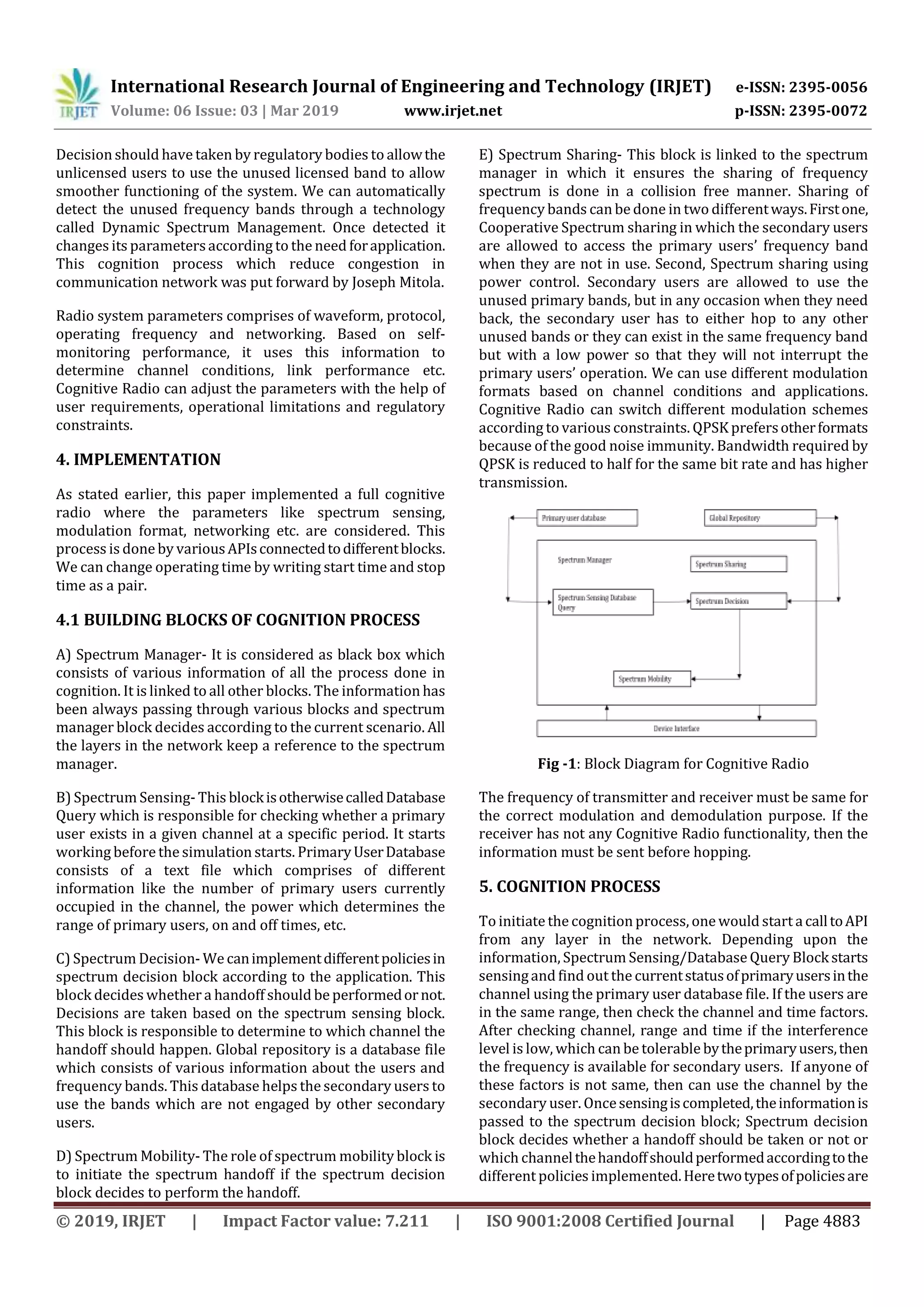
A) Spectrum Manager- It is considered as black box which
consists of various information of all the process done in
cognition. It is linked to all other blocks. The information has
been always passing through various blocks and spectrum
manager block decides according to the current scenario. All
the layers in the network keep a reference to the spectrum
manager.
B) Spectrum Sensing- This blockisotherwisecalledDatabase
Query which is responsible for checking whether a primary
user exists in a given channel at a specific period. It starts
working before the simulation starts. PrimaryUserDatabase
consists of a text file which comprises of different
information like the number of primary users currently
occupied in the channel, the power which determines the
range of primary users, on and off times, etc.
C) Spectrum Decision- We canimplementdifferentpoliciesin
spectrum decision block according to the application. This
block decides whether a handoff should be performedornot.
Decisions are taken based on the spectrum sensing block.
This block is responsible to determine to which channel the
handoff should happen. Global repository is a database file
which consists of various information about the users and
frequency bands. This database helps the secondary users to
use the bands which are not engaged by other secondary
users.
D) Spectrum Mobility- The role of spectrum mobility block is
to initiate the spectrum handoff if the spectrum decision
block decides to perform the handoff.
E) Spectrum Sharing- This block is linked to the spectrum
manager in which it ensures the sharing of frequency
spectrum is done in a collision free manner. Sharing of
frequency bands can be done in two differentways.Firstone,
Cooperative Spectrum sharing in which the secondary users
are allowed to access the primary users’ frequency band
when they are not in use. Second, Spectrum sharing using
power control. Secondary users are allowed to use the
unused primary bands, but in any occasion when they need
back, the secondary user has to either hop to any other
unused bands or they can exist in the same frequency band
but with a low power so that they will not interrupt the
primary users’ operation. We can use different modulation
formats based on channel conditions and applications.
Cognitive Radio can switch different modulation schemes
according to various constraints. QPSK prefersotherformats
because of the good noise immunity. Bandwidth required by
QPSK is reduced to half for the same bit rate and has higher
transmission.
Fig -1: Block Diagram for Cognitive Radio
The frequency of transmitter and receiver must be same for
the correct modulation and demodulation purpose. If the
receiver has not any Cognitive Radio functionality, then the
information must be sent before hopping.
5. COGNITION PROCESS
To initiatethe cognition process, one would start acalltoAPI
from any layer in the network. Depending upon the
information, Spectrum Sensing/Database Query Blockstarts
sensingand find out the currentstatusofprimaryusersinthe
channel using the primary user database file. If the users are
in the same range, then check the channel and time factors.
After checking channel, range and time if the interference
level is low, which can be tolerable bytheprimaryusers,then
the frequency is available for secondary users. If anyone of
these factors is not same, then can use the channel by the
secondary user. Oncesensingiscompleted,theinformationis
passed to the spectrum decision block; Spectrum decision
block decides whether a handoff should be taken or not or
which channelthehandoffshouldperformedaccordingtothe
different policies implemented.Heretwotypesofpoliciesare
International Research Journal of Engineering and Technology (IRJET) e-ISSN: 2395-0056
Volume: 06 Issue: 03 | Mar 2019 www.irjet.net p-ISSN: 2395-0072
© 2019, IRJET | Impact Factor value: 7.211 | ISO 9001:2008 Certified Journal | Page 4884
implemented: Decision policies and Spectrum policies.
Frequency hopping and Queuing are the two decision
policies. Round Robin and Random Switch are two spectrum
policies implemented here. These results will be passed to
the spectrum mobility block where it initiates the handoff
based on spectrum decision block results. All processes are
sensed by spectrum sharing block, whether to check the
sharing is done in a collision free manner. Once the cycle is
completed, the transmission process can be resumed.
Every equipment isalways ina state of operation. Here there
are eight states during the operationofCognitiveRadio.They
are: a) IDLE- ON state but it’s not active b) CCA BSY- Clear
Channel Assessment, Channel is busy, so to be wait in a
queue. c) TX- Data is actively transmitting. d) RX- Data is
actively receiving. e) SWITCHING- Switching to and from
different states. f) SLEEP- Non-urgency hardware is in OFF
state. g) OFF- Physical and MAC layer is in OFF state. h)
SENSING- State related to the Cognitive Radio.
If one user in idle state, it can switch to the sensing state so
that they can find out the unused frequency band. But if in
any other states DCF has the job to give permission for the
usage of secondary users.
Fig -2: Functional Block Diagram.
6. LAYERS IN COGNITIVE RADIO
6.1 Higher layers
Cognitive Radio interfaces are not directly linked to upper
layers. L1 and L2 are physical and Mac layer in networking
interconnection. When consideringnetworking,upperlayers
L3 and L4 must be considered. Spectrum manager is
interconnected with all layers.
6.2 Lower Layers
Here, Cognitive Radio parameters are implementedonlower
layers like Link and Physical layers. A new concept is
introduced known as cognitive interface which can be
connected to lower layers. A cognitive radio node can be
connected to any number of cognitive interfaces. Each
cognitive interface consists of three separate PHY-MAC
layers. Each physical and MAC layer is interconnected as a
pair. The first layer is for control packet information for a
common control channel. This is known as control interface.
This interface is considered for transmitting and receiving
control packets. And it is responsible for handoff process.
The second layer is for transmitting interface which is
switchable in nature.Itisusedfortransmissionandreception
of packets between different layers which are destined to
different nodes. The third PHY-MAC layer is intended for
reception. The receiving interface is mostly concentrated on
primary user activity like the handoff when detected unused
primary bands, hence it is called as a sensing interface.
Transmission interface is connected to different routing
protocols. Receiving and Control interface are excludedfrom
the routing protocol implementation. Routing protocol
provide information regarding different interfaces on a
computer.
Distributed Coordination Function (DCF) [1] is also serves
and functions as spectrum manager. These blocks help in the
smoother functioning of network layers. It gives a reference
for cross-layer functionalities in different layers in the
network. IEEE has formed a consortium (IEEE 802.22) to
providea standard interface in which demands a centralized
database in order to get all user information globally for the
smooth functioning of spectrum sharing.
International Research Journal of Engineering and Technology (IRJET) e-ISSN: 2395-0056
Volume: 06 Issue: 03 | Mar 2019 www.irjet.net p-ISSN: 2395-0072
© 2019, IRJET | Impact Factor value: 7.211 | ISO 9001:2008 Certified Journal | Page 4885
Cognitive Radio monitors any one of the frequencies at a
specific time in the spectrum. Each frequency is allocated to
different users. Even if the primary user database consists of
information of all users, weneed three interfaceswhichisfor
control, transmission and reception. For all users even if it’s
primary or secondary, there are two separate nodes for
transmission and reception. To check the current
environmentduringtransmissiontheinterfacewhichhelpsis
Cognitive Radio interface.
CognitiveRadiotechnologyisnotpracticallyimplementedfor
thecurrentcommunicationnetwork.Andtheimplementation
is a big challenge because every equipments must be flexible
with new technology which is impractical for some extent.
The information of userslikeONandOFFtimes,powerwhich
determines range,presenceandabsenceofprimaryusersetc.
are stored in a primary user database. But there are devices
which are not flexible with new standards which results in
system error. So, to get accurate information, we need a
control interface to sense channels also during the
transmission process. This interface helps to sense the
frequency spectrum and provide uninterrupted services to
the secondary users.
7. APPLICATION
The Cognitive Radio can effectively use in emergency and
public safety communications by utilizing white space by
spectrum sharing. CognitiveRadio allows dynamicspectrum
access which makes the communicationnetworkflexibleand
efficient. This can make hugeapplication in military services
that is for command control, evaluation of battle damage,
intelligence etc.
CONCLUSION
In this paper we introduce a Cognitive Radio package which
leads to dynamic spectrum management which helps to
reduce congestion and interference for congested
communicationnetwork.Theunavailabilityofnewfrequency
spectrum leads problems for smooth functioning of the
communication network. Cognitive Radio comprises of
different parameters like modulation format, networking,
frequency etc. which can change to use the best wireless
channels to reduce congestion and system interference. This
paper can extend by changing other parameters in cognitive
radio thereby we can achieve a full cognitive radio.
REFERENCES
[1] A. Al-Ali, K. Chowdhury, “Simulating Dynamic Spectrum
Access using ns-3 for wireless Networks in Smart
Environments”, IEEE 2014.
[2] J. R. Machado-Fernandez, “Software Defined Radio:Basic
Principles and Applications”, Facultad de ingenieria, vol 24
(38), pp. 79-96. 2015.
[3] M. A. Azza, A. El Moussati and R. Barrak,“Implementation
of Cognitive Radio Applications on a Software DefinedRadio
Plateform”, IEEE multimedia computing and systems
conference (ICMCS), pp. 1037- 1041, April 2014.
[4] T. Yucek, and H. Arslan, “A Survey of Spectrum Sensing
Algorithms for Cognitive Radio Applications”, IEEE
communications surveys & tutorials, vol 11(1), pp.116-130,
2009.
[5] J. Mitola, “The Software Radio Architecture”, IEEE
Communications Magazines, May 95, pp. 26-38.
[6] A. Ghasemi and E. S. Sousa, “Spectrum Sensing in
Cognitive Radio Networks: Requirements, challenges and
design trade-offs”, IEEE Communications Magazine, vol.
46(4), 2008.

IRJET- Achieving Cognitive Radio for Improved Spectrum Utilization: An Implementation

  • 1.
    International Research Journalof Engineering and Technology (IRJET) e-ISSN: 2395-0056 Volume: 06 Issue: 03 | Mar 2019 www.irjet.net p-ISSN: 2395-0072 © 2019, IRJET | Impact Factor value: 7.211 | ISO 9001:2008 Certified Journal | Page 4882 Achieving Cognitive Radio for Improved Spectrum Utilization: An Implementation Mareena Susan John1, Soumya J W2 1P.G Scholar Dept. of Electronics and Communication Engineering, Believers Church Caarmel Engineering College, Perunad, Pathanamthitta, Kerala, India, 2Asst. Prof. Soumya J W, Dept of Electronics and Communication Engineering, Believers Church Caarmel Engineering College, Perunad, Pathanamthitta, Kerala, India ---------------------------------------------------------------------***---------------------------------------------------------------------- Abstract - To achieve an efficient communication system, need for dynamic spectrum allocation capability is required. Cognitive Radio technology helps the current communication network to identify the issues and can make intellectual decisions. Spectrum Sensing, an important factor to achieve Cognitive Radio, periodically monitor the frequency spectrum to find out unused frequency userbands. Thispaperproposesa full Cognitive Radio Package which consists of different communication parameters like protocols, networking, modulation format etc. Key Words: Software Defined Radio, Cognitive Radio, Spectrum Sensing,Opportunistic sharing,Dynamic Spectrum Management, Distributed Coordination Function. 1. INTRODUCTION This Frequency allocation scheme used in the communication network is static in nature. To utilize the frequency spectrum efficiently, we need dynamic spectrum allocation methods. The frequency allocation methods are dynamic within the technologies but are static in between. IEEE 802.22 is a consortium where it provides the rules for the access of secondary users. The unused primary bands which is called white spaces have to be found out in turn the secondary users can be opportunistically shared. To identify the white spaces, there are lot of techniques available like database registry, beacon signals, spectrum sensing etc. But the first two methods give primary user, the job of providing information about the availability of white spaces in turn results the system morecomplex.Considering this, Spectrum Sensing is an efficient method for this purpose. Spectrum Sensing is a periodically monitoring process in which it gives the status of the frequency band whether a primary user is available on a specific period or not.Itcan be done using Software Defined Radio. Software Defined Radio is a radio system where the hardware components which is traditionally implemented which is instead implemented on software like processors, embedded system etc. A higher version of Software Defined Radio is Cognitive Radio which can implement an efficient communication system by changing various communicationparameters.Itis capable of reprogrammingin a dynamicmanner.Thisresults for selecting better channels. It helps to reduce congestion and interference in communication networks. Cognitive Radio are of two types: First, Full Cognitive Radio which can improve the communication system by changing the communication parameters like networking, protocol, modulation format etc. Second, Spectrum Sensing Cognitive Radio which is only concentrated on spectrum sensing and not any other parameters. Cognitive Radio protocols are cross layered; so that any change in the lower layer will cause same impact on upper layers. This is a majorchallenge in implementing cognitive radio networks. Because the cognitive radio can control a variety of parameters, it makes the testing time increased dramatically. Testing of each parameter make the cognitive radio system more complex for implementation. And, the new functions implemented in the cognitive radio like spectrum sensing,handoffneedto be embedded in the simulator also. 2. SOFTWARE DEFINED RADIO Software Defined Radio is a system where wecan implement software technologies which is capable of functioning as hardwares. The SDR have all the operating functions of a radio. These can operate on technologies like General Purpose Processors, FPGA etc. 3. COGNITIVE RADIO Cognitive Radio [2] is a radio communication system which can sense the electromagnetic environment by adjusting the communication protocol dynamicallytousethebestwireless channels. To achieve Cognitive Radio, the important component which wemust considerisspectrumsensing.The main aim of spectrum sensing is to reduce congestion and interference. The unused primary bands can be efficiently utilized by this method. Sharing of frequency bands can be done either by opportunistic sharing or by power control. The frequency which are allowedforspecificapplicationsare rarely used in current scenario. Fixed frequency allocation schemes denied the usage of rarely used frequencies even though the unlicensed user does not result in congestion and interference.
  • 2.
    International Research Journalof Engineering and Technology (IRJET) e-ISSN: 2395-0056 Volume: 06 Issue: 03 | Mar 2019 www.irjet.net p-ISSN: 2395-0072 © 2019, IRJET | Impact Factor value: 7.211 | ISO 9001:2008 Certified Journal | Page 4883 Decision should have taken by regulatory bodies to allowthe unlicensed users to use the unused licensed band to allow smoother functioning of the system. We can automatically detect the unused frequency bands through a technology called Dynamic Spectrum Management. Once detected it changes its parametersaccording to the need forapplication. This cognition process which reduce congestion in communication network was put forward by Joseph Mitola. Radio system parameters comprises of waveform, protocol, operating frequency and networking. Based on self- monitoring performance, it uses this information to determine channel conditions, link performance etc. Cognitive Radio can adjust the parameters with the help of user requirements, operational limitations and regulatory constraints. 4. IMPLEMENTATION As stated earlier, this paper implemented a full cognitive radio where the parameters like spectrum sensing, modulation format, networking etc. are considered. This process is done by variousAPIsconnectedtodifferentblocks. We can change operating time by writing start time and stop time as a pair. 4.1 BUILDING BLOCKS OF COGNITION PROCESS A) Spectrum Manager- It is considered as black box which consists of various information of all the process done in cognition. It is linked to all other blocks. The information has been always passing through various blocks and spectrum manager block decides according to the current scenario. All the layers in the network keep a reference to the spectrum manager. B) Spectrum Sensing- This blockisotherwisecalledDatabase Query which is responsible for checking whether a primary user exists in a given channel at a specific period. It starts working before the simulation starts. PrimaryUserDatabase consists of a text file which comprises of different information like the number of primary users currently occupied in the channel, the power which determines the range of primary users, on and off times, etc. C) Spectrum Decision- We canimplementdifferentpoliciesin spectrum decision block according to the application. This block decides whether a handoff should be performedornot. Decisions are taken based on the spectrum sensing block. This block is responsible to determine to which channel the handoff should happen. Global repository is a database file which consists of various information about the users and frequency bands. This database helps the secondary users to use the bands which are not engaged by other secondary users. D) Spectrum Mobility- The role of spectrum mobility block is to initiate the spectrum handoff if the spectrum decision block decides to perform the handoff. E) Spectrum Sharing- This block is linked to the spectrum manager in which it ensures the sharing of frequency spectrum is done in a collision free manner. Sharing of frequency bands can be done in two differentways.Firstone, Cooperative Spectrum sharing in which the secondary users are allowed to access the primary users’ frequency band when they are not in use. Second, Spectrum sharing using power control. Secondary users are allowed to use the unused primary bands, but in any occasion when they need back, the secondary user has to either hop to any other unused bands or they can exist in the same frequency band but with a low power so that they will not interrupt the primary users’ operation. We can use different modulation formats based on channel conditions and applications. Cognitive Radio can switch different modulation schemes according to various constraints. QPSK prefersotherformats because of the good noise immunity. Bandwidth required by QPSK is reduced to half for the same bit rate and has higher transmission. Fig -1: Block Diagram for Cognitive Radio The frequency of transmitter and receiver must be same for the correct modulation and demodulation purpose. If the receiver has not any Cognitive Radio functionality, then the information must be sent before hopping. 5. COGNITION PROCESS To initiatethe cognition process, one would start acalltoAPI from any layer in the network. Depending upon the information, Spectrum Sensing/Database Query Blockstarts sensingand find out the currentstatusofprimaryusersinthe channel using the primary user database file. If the users are in the same range, then check the channel and time factors. After checking channel, range and time if the interference level is low, which can be tolerable bytheprimaryusers,then the frequency is available for secondary users. If anyone of these factors is not same, then can use the channel by the secondary user. Oncesensingiscompleted,theinformationis passed to the spectrum decision block; Spectrum decision block decides whether a handoff should be taken or not or which channelthehandoffshouldperformedaccordingtothe different policies implemented.Heretwotypesofpoliciesare
  • 3.
    International Research Journalof Engineering and Technology (IRJET) e-ISSN: 2395-0056 Volume: 06 Issue: 03 | Mar 2019 www.irjet.net p-ISSN: 2395-0072 © 2019, IRJET | Impact Factor value: 7.211 | ISO 9001:2008 Certified Journal | Page 4884 implemented: Decision policies and Spectrum policies. Frequency hopping and Queuing are the two decision policies. Round Robin and Random Switch are two spectrum policies implemented here. These results will be passed to the spectrum mobility block where it initiates the handoff based on spectrum decision block results. All processes are sensed by spectrum sharing block, whether to check the sharing is done in a collision free manner. Once the cycle is completed, the transmission process can be resumed. Every equipment isalways ina state of operation. Here there are eight states during the operationofCognitiveRadio.They are: a) IDLE- ON state but it’s not active b) CCA BSY- Clear Channel Assessment, Channel is busy, so to be wait in a queue. c) TX- Data is actively transmitting. d) RX- Data is actively receiving. e) SWITCHING- Switching to and from different states. f) SLEEP- Non-urgency hardware is in OFF state. g) OFF- Physical and MAC layer is in OFF state. h) SENSING- State related to the Cognitive Radio. If one user in idle state, it can switch to the sensing state so that they can find out the unused frequency band. But if in any other states DCF has the job to give permission for the usage of secondary users. Fig -2: Functional Block Diagram. 6. LAYERS IN COGNITIVE RADIO 6.1 Higher layers Cognitive Radio interfaces are not directly linked to upper layers. L1 and L2 are physical and Mac layer in networking interconnection. When consideringnetworking,upperlayers L3 and L4 must be considered. Spectrum manager is interconnected with all layers. 6.2 Lower Layers Here, Cognitive Radio parameters are implementedonlower layers like Link and Physical layers. A new concept is introduced known as cognitive interface which can be connected to lower layers. A cognitive radio node can be connected to any number of cognitive interfaces. Each cognitive interface consists of three separate PHY-MAC layers. Each physical and MAC layer is interconnected as a pair. The first layer is for control packet information for a common control channel. This is known as control interface. This interface is considered for transmitting and receiving control packets. And it is responsible for handoff process. The second layer is for transmitting interface which is switchable in nature.Itisusedfortransmissionandreception of packets between different layers which are destined to different nodes. The third PHY-MAC layer is intended for reception. The receiving interface is mostly concentrated on primary user activity like the handoff when detected unused primary bands, hence it is called as a sensing interface. Transmission interface is connected to different routing protocols. Receiving and Control interface are excludedfrom the routing protocol implementation. Routing protocol provide information regarding different interfaces on a computer. Distributed Coordination Function (DCF) [1] is also serves and functions as spectrum manager. These blocks help in the smoother functioning of network layers. It gives a reference for cross-layer functionalities in different layers in the network. IEEE has formed a consortium (IEEE 802.22) to providea standard interface in which demands a centralized database in order to get all user information globally for the smooth functioning of spectrum sharing.
  • 4.
    International Research Journalof Engineering and Technology (IRJET) e-ISSN: 2395-0056 Volume: 06 Issue: 03 | Mar 2019 www.irjet.net p-ISSN: 2395-0072 © 2019, IRJET | Impact Factor value: 7.211 | ISO 9001:2008 Certified Journal | Page 4885 Cognitive Radio monitors any one of the frequencies at a specific time in the spectrum. Each frequency is allocated to different users. Even if the primary user database consists of information of all users, weneed three interfaceswhichisfor control, transmission and reception. For all users even if it’s primary or secondary, there are two separate nodes for transmission and reception. To check the current environmentduringtransmissiontheinterfacewhichhelpsis Cognitive Radio interface. CognitiveRadiotechnologyisnotpracticallyimplementedfor thecurrentcommunicationnetwork.Andtheimplementation is a big challenge because every equipments must be flexible with new technology which is impractical for some extent. The information of userslikeONandOFFtimes,powerwhich determines range,presenceandabsenceofprimaryusersetc. are stored in a primary user database. But there are devices which are not flexible with new standards which results in system error. So, to get accurate information, we need a control interface to sense channels also during the transmission process. This interface helps to sense the frequency spectrum and provide uninterrupted services to the secondary users. 7. APPLICATION The Cognitive Radio can effectively use in emergency and public safety communications by utilizing white space by spectrum sharing. CognitiveRadio allows dynamicspectrum access which makes the communicationnetworkflexibleand efficient. This can make hugeapplication in military services that is for command control, evaluation of battle damage, intelligence etc. CONCLUSION In this paper we introduce a Cognitive Radio package which leads to dynamic spectrum management which helps to reduce congestion and interference for congested communicationnetwork.Theunavailabilityofnewfrequency spectrum leads problems for smooth functioning of the communication network. Cognitive Radio comprises of different parameters like modulation format, networking, frequency etc. which can change to use the best wireless channels to reduce congestion and system interference. This paper can extend by changing other parameters in cognitive radio thereby we can achieve a full cognitive radio. REFERENCES [1] A. Al-Ali, K. Chowdhury, “Simulating Dynamic Spectrum Access using ns-3 for wireless Networks in Smart Environments”, IEEE 2014. [2] J. R. Machado-Fernandez, “Software Defined Radio:Basic Principles and Applications”, Facultad de ingenieria, vol 24 (38), pp. 79-96. 2015. [3] M. A. Azza, A. El Moussati and R. Barrak,“Implementation of Cognitive Radio Applications on a Software DefinedRadio Plateform”, IEEE multimedia computing and systems conference (ICMCS), pp. 1037- 1041, April 2014. [4] T. Yucek, and H. Arslan, “A Survey of Spectrum Sensing Algorithms for Cognitive Radio Applications”, IEEE communications surveys & tutorials, vol 11(1), pp.116-130, 2009. [5] J. Mitola, “The Software Radio Architecture”, IEEE Communications Magazines, May 95, pp. 26-38. [6] A. Ghasemi and E. S. Sousa, “Spectrum Sensing in Cognitive Radio Networks: Requirements, challenges and design trade-offs”, IEEE Communications Magazine, vol. 46(4), 2008.