PC Hardware Servicing
Chapter 29: Managing Files
Chapter 29 Objectives
• Understand and identify file systems
• Manage files under Windows
• Display and close a command prompt
• Manage files via command prompt
File System
• A logical method of storing on a disk
• Determines what identifiers mark the
beginning and end of a file
• Determines what information will be stored
about the file
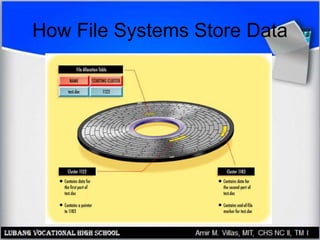
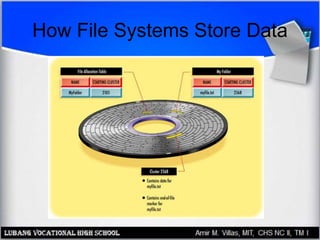
How File Systems Store Data
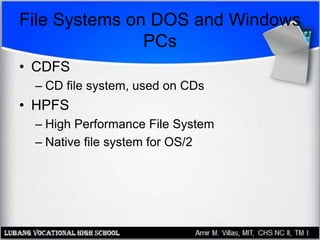
File Systems on DOS and Windows
PCs
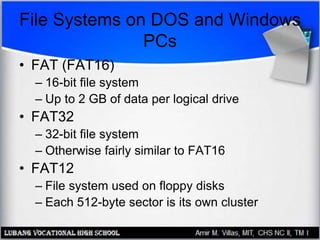
• FAT (FAT16)
– 16-bit file system
– Up to 2 GB of data per logical drive
• FAT32
– 32-bit file system
– Otherwise fairly similar to FAT16
• FAT12
– File system used on floppy disks
– Each 512-byte sector is its own cluster
File Systems on DOS and Windows
PCs
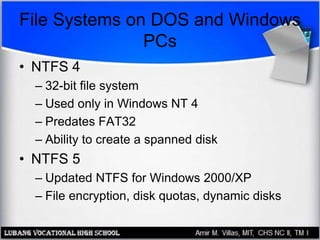
• NTFS 4
– 32-bit file system
– Used only in Windows NT 4
– Predates FAT32
– Ability to create a spanned disk
• NTFS 5
– Updated NTFS for Windows 2000/XP
– File encryption, disk quotas, dynamic disks
File Systems on DOS and Windows
PCs
• CDFS
– CD file system, used on CDs
• HPFS
– High Performance File System
– Native file system for OS/2
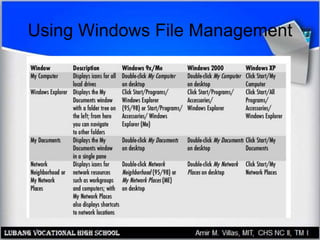
Using Windows File Management
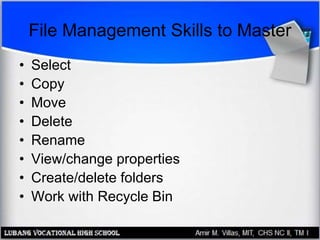
File Management Skills to Master
• Select
• Copy
• Move
• Delete
• Rename
• View/change properties
• Create/delete folders
• Work with Recycle Bin
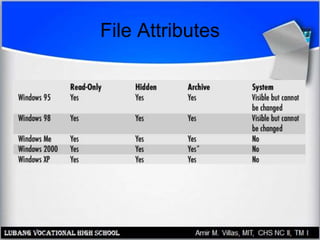
File Attributes
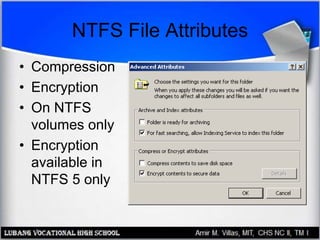
NTFS File Attributes
• Compression
• Encryption
• On NTFS
volumes only
• Encryption
available in
NTFS 5 only
Troubleshooting File Errors
• General failure reading drive X
– Disk is not formatted
– Disk has gone bad
– Drive is inaccessible
– Possible virus infection
– Possible physical problem
Troubleshooting File Errors
• Data error reading (or writing) drive x
– Physically bad spot on the disk
– Wrong drive type in BIOS setup
• Access denied
– Permission setting preventing file modification
– Disk is write-protected
• Insufficient disk space
– Disk is full
– Directory is full
Backing Up and Restoring Files
• Copy files to another drive manually
– Hard drive
– CD
– Tape
• Copy an entire drive
– Ghosting
• Backup application (ex. Microsoft Backup)
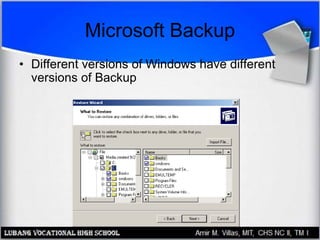
Microsoft Backup
• Different versions of Windows have different
versions of Backup
Working with a Command Prompt
• Getting to the prompt:
– Boot from a Windows 9x startup floppy
– Start/Run, Command in 9x
– Start/Run, Cmd in 2000/XP
• Exiting the prompt
– Close the window
– Type EXIT and press Enter
Changing Drives and Directories
• Directory = Folder
• Change drive: Type drive letter and a
colon
– Example: C:
• Change directory: CD and the directory
name
– Example: CD WINDOWS
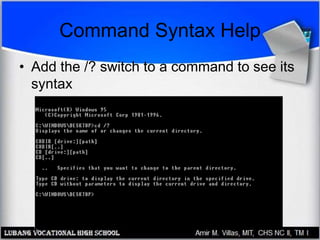
Command Syntax Help
• Add the /? switch to a command to see its
syntax
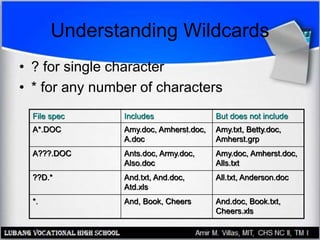
Understanding Wildcards
• ? for single character
• * for any number of characters
File spec Includes But does not include
A*.DOC Amy.doc, Amherst.doc,
A.doc
Amy.txt, Betty.doc,
Amherst.grp
A???.DOC Ants.doc, Army.doc,
Also.doc
Amy.doc, Amherst.doc,
Alls.txt
??D.* And.txt, And.doc,
Atd.xls
All.txt, Anderson.doc
*. And, Book, Cheers And.doc, Book.txt,
Cheers.xls
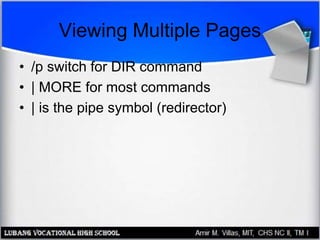
Viewing Multiple Pages
• /p switch for DIR command
• | MORE for most commands
• | is the pipe symbol (redirector)
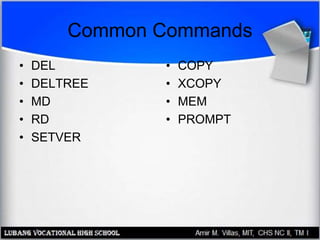
Common Commands
• DEL
• DELTREE
• MD
• RD
• SETVER
• COPY
• XCOPY
• MEM
• PROMPT

Managing Files

  • 1.
  • 2.
    Chapter 29 Objectives •Understand and identify file systems • Manage files under Windows • Display and close a command prompt • Manage files via command prompt
  • 3.
    File System • Alogical method of storing on a disk • Determines what identifiers mark the beginning and end of a file • Determines what information will be stored about the file
  • 4.
    How File SystemsStore Data
  • 5.
    How File SystemsStore Data
  • 6.
    File Systems onDOS and Windows PCs • FAT (FAT16) – 16-bit file system – Up to 2 GB of data per logical drive • FAT32 – 32-bit file system – Otherwise fairly similar to FAT16 • FAT12 – File system used on floppy disks – Each 512-byte sector is its own cluster
  • 7.
    File Systems onDOS and Windows PCs • NTFS 4 – 32-bit file system – Used only in Windows NT 4 – Predates FAT32 – Ability to create a spanned disk • NTFS 5 – Updated NTFS for Windows 2000/XP – File encryption, disk quotas, dynamic disks
  • 8.
    File Systems onDOS and Windows PCs • CDFS – CD file system, used on CDs • HPFS – High Performance File System – Native file system for OS/2
  • 9.
  • 10.
    File Management Skillsto Master • Select • Copy • Move • Delete • Rename • View/change properties • Create/delete folders • Work with Recycle Bin
  • 11.
  • 12.
    NTFS File Attributes •Compression • Encryption • On NTFS volumes only • Encryption available in NTFS 5 only
  • 13.
    Troubleshooting File Errors •General failure reading drive X – Disk is not formatted – Disk has gone bad – Drive is inaccessible – Possible virus infection – Possible physical problem
  • 14.
    Troubleshooting File Errors •Data error reading (or writing) drive x – Physically bad spot on the disk – Wrong drive type in BIOS setup • Access denied – Permission setting preventing file modification – Disk is write-protected • Insufficient disk space – Disk is full – Directory is full
  • 15.
    Backing Up andRestoring Files • Copy files to another drive manually – Hard drive – CD – Tape • Copy an entire drive – Ghosting • Backup application (ex. Microsoft Backup)
  • 16.
    Microsoft Backup • Differentversions of Windows have different versions of Backup
  • 17.
    Working with aCommand Prompt • Getting to the prompt: – Boot from a Windows 9x startup floppy – Start/Run, Command in 9x – Start/Run, Cmd in 2000/XP • Exiting the prompt – Close the window – Type EXIT and press Enter
  • 18.
    Changing Drives andDirectories • Directory = Folder • Change drive: Type drive letter and a colon – Example: C: • Change directory: CD and the directory name – Example: CD WINDOWS
  • 19.
    Command Syntax Help •Add the /? switch to a command to see its syntax
  • 20.
    Understanding Wildcards • ?for single character • * for any number of characters File spec Includes But does not include A*.DOC Amy.doc, Amherst.doc, A.doc Amy.txt, Betty.doc, Amherst.grp A???.DOC Ants.doc, Army.doc, Also.doc Amy.doc, Amherst.doc, Alls.txt ??D.* And.txt, And.doc, Atd.xls All.txt, Anderson.doc *. And, Book, Cheers And.doc, Book.txt, Cheers.xls
  • 21.
    Viewing Multiple Pages •/p switch for DIR command • | MORE for most commands • | is the pipe symbol (redirector)
  • 22.
    Common Commands • DEL •DELTREE • MD • RD • SETVER • COPY • XCOPY • MEM • PROMPT