Understanding Operating Systems 5th Edition McHoes Solutions Manual
1.
Understanding Operating Systems5th Edition
McHoes Solutions Manual download
https://testbankdeal.com/product/understanding-operating-
systems-5th-edition-mchoes-solutions-manual/
Find test banks or solution manuals at testbankdeal.com today!
2.
We believe theseproducts will be a great fit for you. Click
the link to download now, or visit testbankdeal.com
to discover even more!
Understanding Operating Systems 5th Edition McHoes Test
Bank
https://testbankdeal.com/product/understanding-operating-systems-5th-
edition-mchoes-test-bank/
Understanding Operating Systems 7th Edition McHoes
Solutions Manual
https://testbankdeal.com/product/understanding-operating-systems-7th-
edition-mchoes-solutions-manual/
Understanding Operating Systems 8th Edition McHoes
Solutions Manual
https://testbankdeal.com/product/understanding-operating-systems-8th-
edition-mchoes-solutions-manual/
Principles of Electronic Communication Systems 4th Edition
Frenzel Test Bank
https://testbankdeal.com/product/principles-of-electronic-
communication-systems-4th-edition-frenzel-test-bank/
3.
Biology Science forLife with Physiology 5th Edition Belk
Test Bank
https://testbankdeal.com/product/biology-science-for-life-with-
physiology-5th-edition-belk-test-bank/
Concepts of Database Management 8th Edition Pratt
Solutions Manual
https://testbankdeal.com/product/concepts-of-database-management-8th-
edition-pratt-solutions-manual/
American Promise Value Volume 1 7th Edition Roark Test
Bank
https://testbankdeal.com/product/american-promise-value-volume-1-7th-
edition-roark-test-bank/
Data And Computer Communications 10th Edition Stallings
Test Bank
https://testbankdeal.com/product/data-and-computer-
communications-10th-edition-stallings-test-bank/
Foundations of Behavioral Neuroscience 9th Edition Carlson
Test Bank
https://testbankdeal.com/product/foundations-of-behavioral-
neuroscience-9th-edition-carlson-test-bank/
4.
Data Mining ATutorial Based Primer 1st Edition Roiger
Solutions Manual
https://testbankdeal.com/product/data-mining-a-tutorial-based-
primer-1st-edition-roiger-solutions-manual/
Understanding Operating Systems,Fifth Edition 8 -2
Lecture Notes
Overview
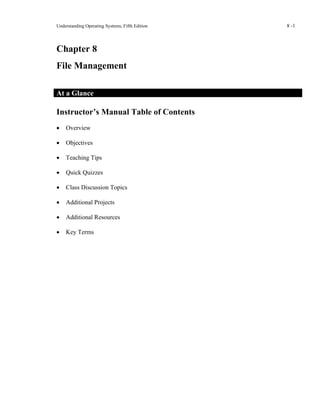
The File Manager controls every file in the system. The chapter begins with an introduction
to this file management system. This is followed by a presentation on definitions for
commonly used terms. The chapter explains how files are organized logically, how they are
stored physically, how they are accessed, and who is allowed to access them. The chapter
also describes the interaction between the File Manager and the Device Manager. The
efficiency of the File Manager depends on how the system’s files are organized (sequential,
direct, or indexed sequential); how they are stored (contiguously, noncontiguously, or
indexed); how each file’s records are structured (fixed-length or variable-length); and how
access to these files is controlled. The chapter concludes with a discussion on data
compression.
Learning Objectives
After completing this chapter, the student should be able to describe:
• The fundamentals of file management and the structure of the file management system
• File-naming conventions, including the role of extensions
• The difference between fixed-length and variable-length record format
• The advantages and disadvantages of contiguous, noncontiguous, and indexed file
storage techniques
• Comparisons of sequential and direct file access
• The security ramifications of access control techniques and how they compare
• The role of data compression in file storage
Teaching Tips
The File Manager
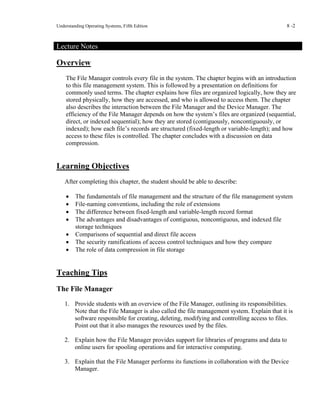
1. Provide students with an overview of the File Manager, outlining its responsibilities.
Note that the File Manager is also called the file management system. Explain that it is
software responsible for creating, deleting, modifying and controlling access to files.
Point out that it also manages the resources used by the files.
2. Explain how the File Manager provides support for libraries of programs and data to
online users for spooling operations and for interactive computing.
3. Explain that the File Manager performs its functions in collaboration with the Device
Manager.
7.
Understanding Operating Systems,Fifth Edition 8 -3
Teaching
Tip
Refer to the following Web site in order to learn more about File Manager tasks:
http://publib.boulder.ibm.com/iseries/v5r2/ic2924/index.htm?info/ddm/rbae5mst
02.htm
Responsibilities of the File Manager
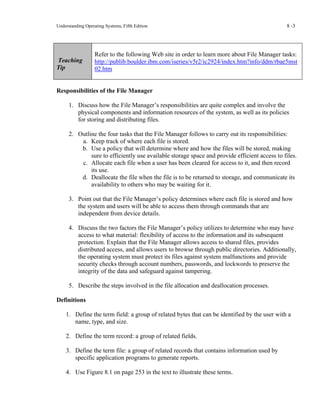
1. Discuss how the File Manager’s responsibilities are quite complex and involve the
physical components and information resources of the system, as well as its policies
for storing and distributing files.
2. Outline the four tasks that the File Manager follows to carry out its responsibilities:
a. Keep track of where each file is stored.
b. Use a policy that will determine where and how the files will be stored, making
sure to efficiently use available storage space and provide efficient access to files.
c. Allocate each file when a user has been cleared for access to it, and then record
its use.
d. Deallocate the file when the file is to be returned to storage, and communicate its
availability to others who may be waiting for it.
3. Point out that the File Manager’s policy determines where each file is stored and how
the system and users will be able to access them through commands that are
independent from device details.
4. Discuss the two factors the File Manager’s policy utilizes to determine who may have
access to what material: flexibility of access to the information and its subsequent
protection. Explain that the File Manager allows access to shared files, provides
distributed access, and allows users to browse through public directories. Additionally,
the operating system must protect its files against system malfunctions and provide
security checks through account numbers, passwords, and lockwords to preserve the
integrity of the data and safeguard against tampering.
5. Describe the steps involved in the file allocation and deallocation processes.
Definitions
1. Define the term field: a group of related bytes that can be identified by the user with a
name, type, and size.
2. Define the term record: a group of related fields.
3. Define the term file: a group of related records that contains information used by
specific application programs to generate reports.
4. Use Figure 8.1 on page 253 in the text to illustrate these terms.
8.
Understanding Operating Systems,Fifth Edition 8 -4
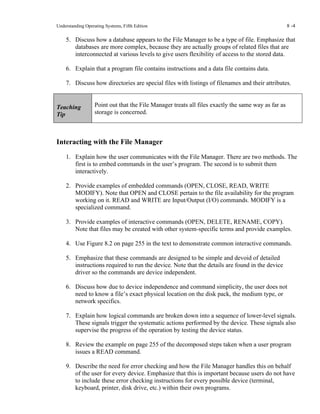
5. Discuss how a database appears to the File Manager to be a type of file. Emphasize that
databases are more complex, because they are actually groups of related files that are
interconnected at various levels to give users flexibility of access to the stored data.
6. Explain that a program file contains instructions and a data file contains data.
7. Discuss how directories are special files with listings of filenames and their attributes.
Teaching
Tip
Point out that the File Manager treats all files exactly the same way as far as
storage is concerned.
Interacting with the File Manager
1. Explain how the user communicates with the File Manager. There are two methods. The
first is to embed commands in the user’s program. The second is to submit them
interactively.
2. Provide examples of embedded commands (OPEN, CLOSE, READ, WRITE
MODIFY). Note that OPEN and CLOSE pertain to the file availability for the program
working on it. READ and WRITE are Input/Output (I/O) commands. MODIFY is a
specialized command.
3. Provide examples of interactive commands (OPEN, DELETE, RENAME, COPY).
Note that files may be created with other system-specific terms and provide examples.
4. Use Figure 8.2 on page 255 in the text to demonstrate common interactive commands.
5. Emphasize that these commands are designed to be simple and devoid of detailed
instructions required to run the device. Note that the details are found in the device
driver so the commands are device independent.
6. Discuss how due to device independence and command simplicity, the user does not
need to know a file’s exact physical location on the disk pack, the medium type, or
network specifics.
7. Explain how logical commands are broken down into a sequence of lower-level signals.
These signals trigger the systematic actions performed by the device. These signals also
supervise the progress of the operation by testing the device status.
8. Review the example on page 255 of the decomposed steps taken when a user program
issues a READ command.
9. Describe the need for error checking and how the File Manager handles this on behalf
of the user for every device. Emphasize that this is important because users do not have
to include these error checking instructions for every possible device (terminal,
keyboard, printer, disk drive, etc.) within their own programs.
9.
Understanding Operating Systems,Fifth Edition 8 -5
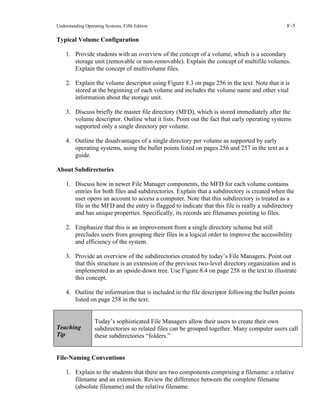
Typical Volume Configuration
1. Provide students with an overview of the concept of a volume, which is a secondary
storage unit (removable or non-removable). Explain the concept of multifile volumes.
Explain the concept of multivolume files.
2. Explain the volume descriptor using Figure 8.3 on page 256 in the text. Note that it is
stored at the beginning of each volume and includes the volume name and other vital
information about the storage unit.
3. Discuss briefly the master file directory (MFD), which is stored immediately after the
volume descriptor. Outline what it lists. Point out the fact that early operating systems
supported only a single directory per volume.
4. Outline the disadvantages of a single directory per volume as supported by early
operating systems, using the bullet points listed on pages 256 and 257 in the text as a
guide.
About Subdirectories
1. Discuss how in newer File Manager components, the MFD for each volume contains
entries for both files and subdirectories. Explain that a subdirectory is created when the
user opens an account to access a computer. Note that this subdirectory is treated as a
file in the MFD and the entry is flagged to indicate that this file is really a subdirectory
and has unique properties. Specifically, its records are filenames pointing to files.
2. Emphasize that this is an improvement from a single directory scheme but still
precludes users from grouping their files in a logical order to improve the accessibility
and efficiency of the system.
3. Provide an overview of the subdirectories created by today’s File Managers. Point out
that this structure is an extension of the previous two-level directory organization and is
implemented as an upside-down tree. Use Figure 8.4 on page 258 in the text to illustrate
this concept.
4. Outline the information that is included in the file descriptor following the bullet points
listed on page 258 in the text.
Teaching
Tip
Today’s sophisticated File Managers allow their users to create their own
subdirectories so related files can be grouped together. Many computer users call
these subdirectories “folders.”
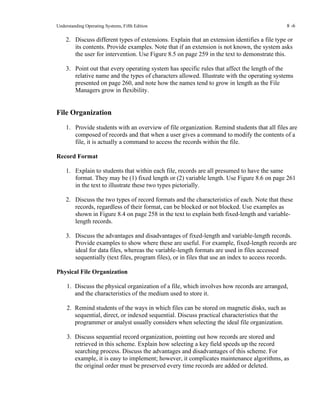
File-Naming Conventions
1. Explain to the students that there are two components comprising a filename: a relative
filename and an extension. Review the difference between the complete filename
(absolute filename) and the relative filename.
10.
Understanding Operating Systems,Fifth Edition 8 -6
2. Discuss different types of extensions. Explain that an extension identifies a file type or
its contents. Provide examples. Note that if an extension is not known, the system asks
the user for intervention. Use Figure 8.5 on page 259 in the text to demonstrate this.
3. Point out that every operating system has specific rules that affect the length of the
relative name and the types of characters allowed. Illustrate with the operating systems
presented on page 260, and note how the names tend to grow in length as the File
Managers grow in flexibility.
File Organization
1. Provide students with an overview of file organization. Remind students that all files are
composed of records and that when a user gives a command to modify the contents of a
file, it is actually a command to access the records within the file.
Record Format
1. Explain to students that within each file, records are all presumed to have the same
format. They may be (1) fixed length or (2) variable length. Use Figure 8.6 on page 261
in the text to illustrate these two types pictorially.
2. Discuss the two types of record formats and the characteristics of each. Note that these
records, regardless of their format, can be blocked or not blocked. Use examples as
shown in Figure 8.4 on page 258 in the text to explain both fixed-length and variable-
length records.
3. Discuss the advantages and disadvantages of fixed-length and variable-length records.
Provide examples to show where these are useful. For example, fixed-length records are
ideal for data files, whereas the variable-length formats are used in files accessed
sequentially (text files, program files), or in files that use an index to access records.
Physical File Organization
1. Discuss the physical organization of a file, which involves how records are arranged,
and the characteristics of the medium used to store it.
2. Remind students of the ways in which files can be stored on magnetic disks, such as
sequential, direct, or indexed sequential. Discuss practical characteristics that the
programmer or analyst usually considers when selecting the ideal file organization.
3. Discuss sequential record organization, pointing out how records are stored and
retrieved in this scheme. Explain how selecting a key field speeds up the record
searching process. Discuss the advantages and disadvantages of this scheme. For
example, it is easy to implement; however, it complicates maintenance algorithms, as
the original order must be preserved every time records are added or deleted.
11.
Understanding Operating Systems,Fifth Edition 8 -7
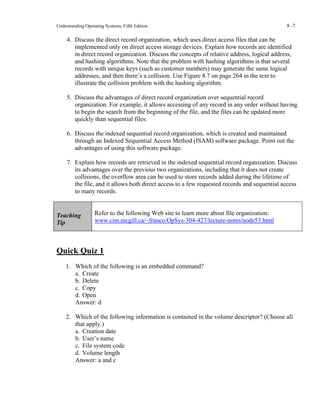
4. Discuss the direct record organization, which uses direct access files that can be
implemented only on direct access storage devices. Explain how records are identified
in direct record organization. Discuss the concepts of relative address, logical address,
and hashing algorithms. Note that the problem with hashing algorithms is that several
records with unique keys (such as customer numbers) may generate the same logical
addresses, and then there’s a collision. Use Figure 8.7 on page 264 in the text to
illustrate the collision problem with the hashing algorithm.
5. Discuss the advantages of direct record organization over sequential record
organization. For example, it allows accessing of any record in any order without having
to begin the search from the beginning of the file, and the files can be updated more
quickly than sequential files.
6. Discuss the indexed sequential record organization, which is created and maintained
through an Indexed Sequential Access Method (ISAM) software package. Point out the
advantages of using this software package.
7. Explain how records are retrieved in the indexed sequential record organization. Discuss
its advantages over the previous two organizations, including that it does not create
collisions, the overflow area can be used to store records added during the lifetime of
the file, and it allows both direct access to a few requested records and sequential access
to many records.
Teaching
Tip
Refer to the following Web site to learn more about file organization:
www.cim.mcgill.ca/~franco/OpSys-304-427/lecture-notes/node53.html
Quick Quiz 1
1. Which of the following is an embedded command?
a. Create
b. Delete
c. Copy
d. Open
Answer: d
2. Which of the following information is contained in the volume descriptor? (Choose all
that apply.)
a. Creation date
b. User’s name
c. File system code
d. Volume length
Answer: a and c
12.
Understanding Operating Systems,Fifth Edition 8 -8
3. Which of the following organization schemes uses a hashing algorithm?
a. Direct record organization
b. Sequential record organization
c. Indexed sequential record organization
d. Indexed direct record organization
Answer: a
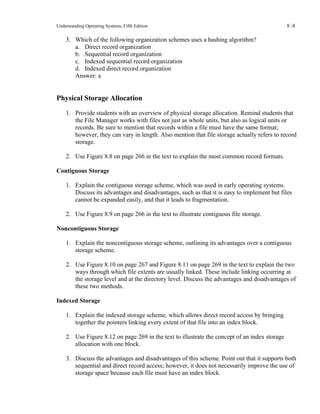
Physical Storage Allocation
1. Provide students with an overview of physical storage allocation. Remind students that
the File Manager works with files not just as whole units, but also as logical units or
records. Be sure to mention that records within a file must have the same format;
however, they can vary in length. Also mention that file storage actually refers to record
storage.
2. Use Figure 8.8 on page 266 in the text to explain the most common record formats.
Contiguous Storage
1. Explain the contiguous storage scheme, which was used in early operating systems.
Discuss its advantages and disadvantages, such as that it is easy to implement but files
cannot be expanded easily, and that it leads to fragmentation.
2. Use Figure 8.9 on page 266 in the text to illustrate contiguous file storage.
Noncontiguous Storage
1. Explain the noncontiguous storage scheme, outlining its advantages over a contiguous
storage scheme.
2. Use Figure 8.10 on page 267 and Figure 8.11 on page 269 in the text to explain the two
ways through which file extents are usually linked. These include linking occurring at
the storage level and at the directory level. Discuss the advantages and disadvantages of
these two methods.
Indexed Storage
1. Explain the indexed storage scheme, which allows direct record access by bringing
together the pointers linking every extent of that file into an index block.
2. Use Figure 8.12 on page 269 in the text to illustrate the concept of an index storage
allocation with one block.
3. Discuss the advantages and disadvantages of this scheme. Point out that it supports both
sequential and direct record access; however, it does not necessarily improve the use of
storage space because each file must have an index block.
13.
Understanding Operating Systems,Fifth Edition 8 -9
Teaching
Tip
Refer to the following Web site in order to learn more about physical storage
allocation:
www.unet.univie.ac.at/aix/aixprggd/genprogc/file_space_allocation.htm
Access Methods
1. Provide students with an overview of access methods. Point out that access methods are
dictated by a file’s organization. That is, a file that has been organized in sequential
fashion can support only sequential access to its records and these records can be of
either fixed or variable length.
2. Explain how the File Manager uses the address of the last byte read to access the next
sequential record. Therefore, the current byte address (CBA) must be updated every
time a record is accessed.
3. Use Figure 8.13 on page 270 to illustrate the difference between the storage of fixed-
length and of variable-length records.
Sequential Access
1. Explain how the CBA is updated for sequential access of fixed-length records and
sequential access of variable-length records.
Direct Access
1. Explain how the CBA is updated for direct access with fixed-length records.
2. Explain why it is virtually impossible to access a record directly if the file is organized
for direct access with variable-length records. Discuss the alternatives.
3. Explain how an indexed sequential file can be accessed. Point out that the index file
must be searched for the pointer to the block where the data is stored.
Levels in a File Management System
1. Explain that the efficient management of files cannot be separated from the efficient
management of the devices housing them. Note that for an I/O system to perform
efficiently, there are a wide range of functions that have to be organized and managed.
Point out that hierarchies are used to perform these functions.
2. Discuss the levels in a file management system, and explain how information is passed
from the File Manager at the top of the hierarchy to the Device Manager at the bottom.
14.
Understanding Operating Systems,Fifth Edition 8 -10
3. Use Figure 8.14 on page 272 in the text to illustrate the typical modules of the file
management system. Point out that the highest-level module is called the “basic file
system,” and it passes information to the logical file system, which, in turn notifies the
physical file system, which works with the Device Manager.
4. Explain that each level of the file management system is implemented using structured
and modular programming techniques that set up the hierarchy. Explain that in the
hierarchy, higher-level modules pass information to the lower-level modules, and the
process continues down the chain until the lowest module that communicates with the
physical device and interacts with the Device Manager is reached.
5. Note that each module is subdivided into tasks that are more specific. Walk through the
example provided on page 273 with the students to follow an I/O instruction through the
file management system. Refer to Table 8.1 on page 273 of the text.
6. Discuss the various levels at which verification occurs in the file management system.
First, verification occurs in the directory level. Second, verification occurs in the access
control verification module. Third, it happens in the logical file system. Fourth,
verification occurs in the device interface module. Emphasize the coordinated effort
required by every part of the file management system for correct operation.
Access Control Verification Module
1. Provide students with an overview of the need for an access control verification module,
discussing early operating systems and today’s operating systems from the file-sharing
capabilities point of view. Note that all files may be shared. Point out the advantages
and disadvantages of file sharing and the need for access control.
2. Outline five possible actions that can be performed on a file. They include the ability to
READ only, WRITE only, EXECUTE only, DELETE only, or some combination of the
four. Point out that each file management system has its own method to control file
access.
3. Outline the four methods to control file access. They include the access control matrix,
access control lists, capability lists, and lockword control.
Access Control Matrix
1. Explain the access control matrix method using Table 8.2 on page 275 and Table 8.3 on
page 276 in the text. Discuss the advantages of this method, such as the fact that it is
easy to implement and works well for systems with few files and few users. Discuss the
disadvantages, noting that as the number of files and users increases, the matrix
becomes larger, perhaps too large to fit into main memory. In addition, it results in
wasted space because of null entries.
Understanding Operating Systems,Fifth Edition 8 -11
Access Control Lists
1. Explain the access control lists method using Table 8.4 on page 276 in the text. Point
out that this method requires less storage space than an access control matrix and that it
explicitly names each user allowed access to each file.
2. Explain how some systems shorten the access control list even more by putting every
user into different categories. Examples of categories include system, owner, group, and
world. Explain each of these categories briefly as described on page 277 in the text.
Capability Lists
1. Explain the capability lists method using Table 8.5 on page 277 in the text. Point out its
advantages. For example, it requires less storage space than an access control matrix,
and it is easier to maintain than an access control list when users are added or deleted
from the system. Moreover, it can control access to devices as well as to files.
Lockwords
1. Provide students with an overview of the use of a lockword, a protection technique
similar to a password. Note that it protects a single file. Discuss its advantages and
disadvantages. For example, it requires the smallest amount of storage for file
protection; however, it can be guessed by hackers or passed on to unauthorized users.
Moreover, it does not control the type of access to a file. That is, anyone who knows the
lockword can read, write, execute, or delete the file.
Data Compression
1. Explain data compression techniques briefly, which are used to save space in files.
Text Compression
1. Discuss different methods that are used in text compression. These include compressing
text records with repeated characters, with repeated terms, or by using a front-end
compression scheme. Provide examples as shown in the text on page 278 to clarify each
of these methods.
2. Point out that there is always a trade-off in data compression. For example, storage
space is gained but processing time is lost. Be sure to mention that for all data
compression schemes, the system must be able to distinguish between compressed and
uncompressed data.
Other Compression Schemes
1. Inform the students that there are other compression standards for large files such as
video, music, and photograph files. Explain to the students that the International
Organization for Standardization has a mission to issue standards that all systems and
users may abide by when working with these files.
17.
Understanding Operating Systems,Fifth Edition 8 -12
Teaching
Tip
Refer to the following Web site to learn more about data compression
techniques: www.vectorsite.net/ttdcmp.html
Teaching
Tip
For more on the International Organization for Standardization, go to
www.iso.org.
Quick Quiz 2
1. Which of the following storage allocation schemes results in the problem of
fragmentation?
a. Contiguous storage
b. Noncontiguous storage
c. Indexed storage
d. Direct storage
Answer: a
2. Which of the following methods can control access to files as well as to devices?
a. Capability list
b. Access control list
c. Access control matrix
d. All of the above
Answer: a
3. Which of the following data compression techniques compresses text, using symbols to
represent most commonly used words?
a. Records with repeated characters
b. Repeated terms
c. Front-end compression
d. All of the above
Answer: b
Class Discussion Topics
1. Have students discuss different types of file organization schemes. If they were
approached by a hospital to maintain the data records of the patients, which file
organization would they prefer? Why?
2. Have students discuss different access control verification methods. What are the
advantages and disadvantages of each method? Which of these methods would they
prefer for a highly secure system with several files and several users? Have students
substantiate their choices with reasons.
18.
Understanding Operating Systems,Fifth Edition 8 -13
Additional Projects
1. Have students research multiple file systems for hard disks supported in Windows, such
as MS DOS’s FAT file system, the 32-bit FAT file system, and the NTFS file
management system.
2. Have students perform research to compile a list of various data-compression
techniques that are commonly employed in today’s computer systems. Which of these
techniques provides the best efficiency – that is, the maximum gain in storage space
with the least effect on processing time?
Additional Resources
1. Microsoft.com:
www.microsoft.com
2. IBM.com:
www.ibm.com
3. A History of Operating Systems:
www.osdata.com/kind/history.htm
4. Intel.com:
www.intel.com
5. Freescale.com:
www.freescale.com
6. Sun Microsystems:
www.sun.com/
7. International Organization for Standardization:
www.iso.org
Key Terms
➢ Absolute filename: a file’s name, as given by the user, preceded by the directory (or
directories) where the file is found and, when necessary, the specific device label.
➢ Access control list: an access control method that lists each file, the names of the users
who are allowed to access it, and the type of access each is permitted.
➢ Access control matrix: an access control method that uses a matrix with every file,
every user, and the type of access each user is permitted on each file.
➢ Capability list: an access control method that lists every user, the files to which each
has access, and the type of access allowed to those files.
➢ Contiguous storage: a type of file storage in which all the information is stored in
adjacent locations in a storage medium.
19.
Understanding Operating Systems,Fifth Edition 8 -14
➢ Current byte address (CBA): the address of the last byte read. It is used by the File
Manager to access records in secondary storage and must be updated every time a
record is accessed.
➢ Current directory: the directory or subdirectory in which the user is working.
➢ Data compression: a procedure used to reduce the amount of space required to store
data by reducing, encoding, or abbreviating repetitive terms or characters.
➢ Data file: a file that contains only data.
➢ Database: a group of related files that are interconnected at various levels to give users
flexibility of access to the data stored.
➢ Device independent: programs that are devoid of the detailed instructions required to
interact with any I/O device present in the computer system.
➢ Direct record organization: files stored in a direct access storage device and organized
to give users the flexibility of accessing any record at random, regardless of its position
in the file.
➢ Directory: a storage area in a secondary storage volume (disk, disk pack, etc.)
containing information about files stored in that volume.
➢ Extension: in some operating systems, it’s the part of the filename that indicates which
compiler or software package is needed to run the files. In UNIX and Linux, it is
optional and called a suffix.
➢ Extents: any remaining records and all other additions to the file that are stored in other
sections of the disk.
➢ Field: a group of related bytes that can be identified by the user with a name, type, and
size. A record is made up of fields.
➢ File: a group of related records that contains information to be used by specific
application programs to generate reports.
➢ File descriptor: information kept in the directory to describe a file or file extent.
➢ Fixed-length record: a record that always contains the same number of characters.
➢ Hashing algorithm: the set of instructions used to perform a key-to-address
transformation in which a record’s key field determines its location.
➢ Indexed sequential record organization: a way of organizing data in a direct access
storage device. An index is created to show where the data records are stored. Any data
record can be retrieved by consulting the index first.
➢ Key field: (1) a unique field or combination of fields in a record that uniquely identifies
that record; or (2) the field that determines the position of a record in a sorted sequence.
➢ Lockword: a sequence of letters and/or numbers provided by users to prevent
unauthorized tampering with their files.
➢ Logical address: the result of a key-to-address transformation.
➢ Master file directory (MFD): a file stored immediately after the volume descriptor. It
lists the names and characteristics of every file contained in that volume.
➢ Noncontiguous storage: a type of file storage in which the information is stored in
nonadjacent locations in a storage medium.
➢ Program file: a file that contains instructions for the computer.
➢ Record: a group of related fields treated as a unit. A file is a group of related records.
➢ Relative address: in a direct organization environment, it indicates the position of a
record relative to the beginning of the file.
➢ Relative filename: a file’s name and extension that differentiates it from other files in
the same directory.
➢ Sequential record organization: the organization of records in a specific sequence.
Records in a sequential file must be processed one after another.
20.
Understanding Operating Systems,Fifth Edition 8 -15
➢ Subdirectory: a directory created by the user within the boundaries of an existing
directory. Some operating systems call this a folder.
➢ Variable-length record: a record that isn’t of uniform length, doesn’t leave empty
storage space, and doesn’t truncate any characters, thus eliminating the two
disadvantages of fixed-length records.
➢ Volume: any secondary storage unit, such as hard disks, disk packs, CDs, DVDs,
removable disks, or tapes.
➢ Working directory: the directory or subdirectory in which the user is currently
working.
This ebook isfor the use of anyone anywhere in the United
States and most other parts of the world at no cost and with
almost no restrictions whatsoever. You may copy it, give it away
or re-use it under the terms of the Project Gutenberg License
included with this ebook or online at www.gutenberg.org. If you
are not located in the United States, you will have to check the
laws of the country where you are located before using this
eBook.
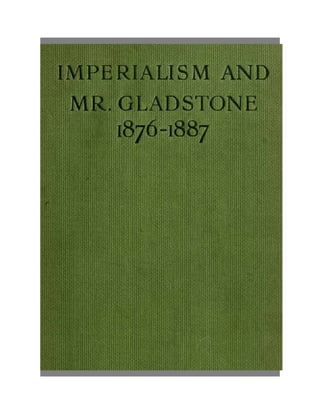
Title: Imperialism and Mr. Gladstone (1876-1887)
Compiler: R. H. Gretton
Editor: Kenneth Bell
S. E. Winbolt
Release date: October 23, 2016 [eBook #53354]
Most recently updated: October 23, 2024
Language: English
Credits: Produced by John Campbell and the Online Distributed
Proofreading Team at http://www.pgdp.net (This file
was
produced from images generously made available by
The
Internet Archive)
*** START OF THE PROJECT GUTENBERG EBOOK IMPERIALISM
AND MR. GLADSTONE (1876-1887) ***
27.
TRANSCRIBER'S NOTE
Obvious typographicalerrors and punctuation errors have been corrected after
careful comparison with other occurrences within the text and consultation of
external sources.
More detail can be found at the end of the book.
28.
BEL L SENGL ISH HISTO RY SO UR CE B O O KS
General Editors: S. E. Winbolt, M.A., and Kenneth Bell, M.A.
IMPERIALISM AND MR. GLADSTONE
29.
BELL'S ENGLISH HISTORY
SOURCEBOOKS.
Volumes now Ready. 1s. net each.
1154–1216. The Angevins and the Charter.
Edited by S. M. Toyne, M.A., Headmaster of St.
Peter's School, York, and late Assistant Master
at Haileybury College.
1307–1399. War and Misrule (special period
for the School Certificate Examination, July
and December, 1913). Edited by A. A. Locke.
1485–1547. The Reformation and the
Renaissance. Edited by F. W. Bewsher,
Assistant Master at St. Paul's School.
1547–1603. The Age of Elizabeth. Edited by
Arundell Esdaile, M.A.
1603–1660. Puritanism and Liberty. Edited
by Kenneth Bell, M.A.
1660–1714. A Constitution in Making.
Edited by G. B. Perrett, M.A.
1714–1760. Walpole and Chatham. Edited
by K. A. Esdaile.
1760–1801. American Independence and
the French Revolution. Edited by S. E.
Winbolt, M.A.
1801–1815. England and Napoleon. Edited
by S. E. Winbolt, M.A.
1816–1836. Peace and Reform. Edited by A.
C. W. Edwards, Assistant Master at Christ's
Hospital.
1876–1887. Imperialism and Mr.
Gladstone. Edited by R. H. Gretton.
30.
1535–Present-Day. Canada. Editedby H. J.
Munro, M.A.
Other volumes, covering the whole range of
English History from Roman Britain are in
active preparation, and will be issued at short
intervals.
LONDON: G. BELL AND SONS, LTD.
31.
IMPERIALISM AND
MR. GLADSTONE
(1 8 7 6 — 1 8 8 7 )
COMPILED BY
R. H. GRETTON
FORMERLY DEMY OF MAGDALEN COLLEGE, OXFORD
AUTHOR OF "A MODERN HISTORY OF THE ENGLISH PEOPLE"
LONDON
G. BELL & SONS, LTD.
1913
32.
INTRODUCTION
This series ofEnglish History Source Books is intended for use with
any ordinary textbook of English History. Experience has conclusively
shown that such apparatus is a valuable—nay, an indispensable—
adjunct to the history lesson. It is capable of two main uses: either
by way of lively illustration at the close of a lesson, or by way of
inference-drawing, before the textbook is read, at the beginning of
the lesson. The kind of problems and exercises that may be based
on the documents are legion, and are admirably illustrated in a
History of England for Schools, Part I., by Keatinge and Frazer, pp.
377-381. However, we have no wish to prescribe for the teacher the
manner in which he shall exercise his craft, but simply to provide
him and his pupils with materials hitherto not readily accessible for
school purposes. The very moderate price of the books in this series
should bring them within reach of every secondary school. Source
books enable the pupil to take a more active part than hitherto in
the history lesson. Here is the apparatus, the raw material: its use
we leave to teacher and taught.
Our belief is that the books may profitably be used by all grades of
historical students between the standards of fourth-form boys in
secondary schools and undergraduates at Universities. What
differentiates students at one extreme from those at the other is not
so much the kind of subject-matter dealt with, as the amount they
can read into or extract from it.
In regard to choice of subject-matter, while trying to satisfy the
natural demand for certain "stock" documents of vital importance,
we hope to introduce much fresh and novel matter. It is our
intention that the majority of the extracts should be lively in style—
that is, personal, or descriptive, or rhetorical, or even strongly
partisan—and should not so much profess to give the truth as supply
33.
data for inference.We aim at the greatest possible variety, and lay
under contribution letters, biographies, ballads and poems, diaries,
debates, and newspaper accounts. Economics, London, municipal,
and social life generally, and local history, are represented in these
pages.
The order of the extracts is strictly chronological, each being
numbered, titled, and dated, and its authority given. The text is
modernized, where necessary, to the extent of leaving no difficulties
in reading.
We shall be most grateful to teachers and students who may send
us suggestions for improvement.
S. E. WINBOLT.
KENNETH BELL.
NOTE TO THIS VOLUME
I acknowledge, with thanks to the authors concerned, and to Messrs.
Macmillan and Co., their kind permission to reprint in this volume the
following passages: that on p. 102, from the Life of Lord Randolph
Churchill, by the Right Hon. Winston Churchill; three extracts, on pp. 59,
62, 83, from Mahdiism and the Egyptian Soudan, by Sir Francis Wingate;
the passages from Lord Morley's Life of Gladstone, on pp. 97, 98, 101,
110; and the passages from Lord Cromer's Modern Egypt, on pp. 68, 69,
70, 87. I acknowledge also with thanks the permission of the proprietors
of The Times to reprint the various extracts from that journal; and the
permission of the proprietors of The Saturday Review to reprint the
extract on p. 35. In dealing with a period so recent, I have inevitably been
very dependent upon the courtesy of the owners of copyright, and I wish
to express my gratitude for the readiness with which that courtesy has
been extended in these important cases.
I am also indebted to Messrs. Longmans, Green and Co. for permission
to print extracts from Professor Mackail's Life of William Morris, and from
Mr. Bernard Holland's Life of the late Duke of Devonshire, and to Messrs.
Kegan Paul and Co. for similar permission to quote from General Gordon's
Journal.
R. H. G.
35.
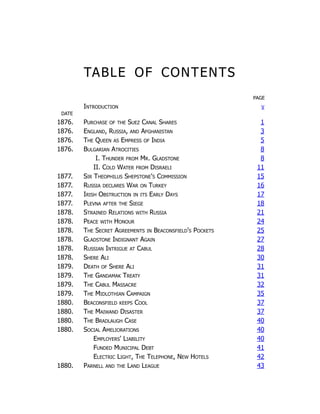
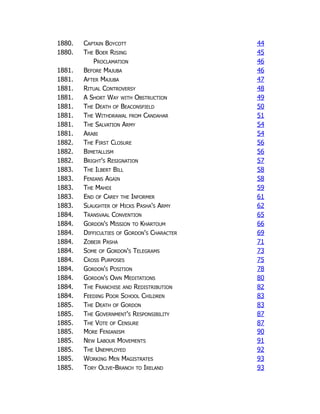
TABLE OF CONTENTS
PAGE
Introductionv
DATE
1876. Purchase of the Suez Canal Shares 1
1876. England, Russia, and Afghanistan 3
1876. The Queen as Empress of India 5
1876. Bulgarian Atrocities 8
I. Thunder from Mr. Gladstone 8
II. Cold Water from Disraeli 11
1877. Sir Theophilus Shepstone's Commission 15
1877. Russia declares War on Turkey 16
1877. Irish Obstruction in its Early Days 17
1877. Plevna after the Siege 18
1878. Strained Relations with Russia 21
1878. Peace with Honour 24
1878. The Secret Agreements in Beaconsfield's Pockets 25
1878. Gladstone Indignant Again 27
1878. Russian Intrigue at Cabul 28
1878. Shere Ali 30
1879. Death of Shere Ali 31
1879. The Gandamak Treaty 31
1879. The Cabul Massacre 32
1879. The Midlothian Campaign 35
1880. Beaconsfield keeps Cool 37
1880. The Maiwand Disaster 37
1880. The Bradlaugh Case 40
1880. Social Ameliorations 40
Employers' Liability 40
Funded Municipal Debt 41
Electric Light, The Telephone, New Hotels 42
1880. Parnell and the Land League 43
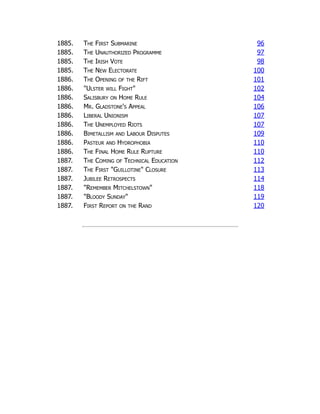
36.
1880. Captain Boycott44
1880. The Boer Rising 45
Proclamation 46
1881. Before Majuba 46
1881. After Majuba 47
1881. Ritual Controversy 48
1881. A Short Way with Obstruction 49
1881. The Death of Beaconsfield 50
1881. The Withdrawal from Candahar 51
1881. The Salvation Army 54
1881. Arabi 54
1882. The First Closure 56
1882. Bimetallism 56
1882. Bright's Resignation 57
1883. The Ilbert Bill 58
1883. Fenians Again 58
1883. The Mahdi 59
1883. End of Carey the Informer 61
1883. Slaughter of Hicks Pasha's Army 62
1884. Transvaal Convention 65
1884. Gordon's Mission to Khartoum 66
1884. Difficulties of Gordon's Character 69
1884. Zobeir Pasha 71
1884. Some of Gordon's Telegrams 73
1884. Cross Purposes 75
1884. Gordon's Position 78
1884. Gordon's Own Meditations 80
1884. The Franchise and Redistribution 82
1884. Feeding Poor School Children 83
1885. The Death of Gordon 83
1885. The Government's Responsibility 87
1885. The Vote of Censure 87
1885. More Fenianism 90
1885. New Labour Movements 91
1885. The Unemployed 92
1885. Working Men Magistrates 93
1885. Tory Olive-Branch to Ireland 93
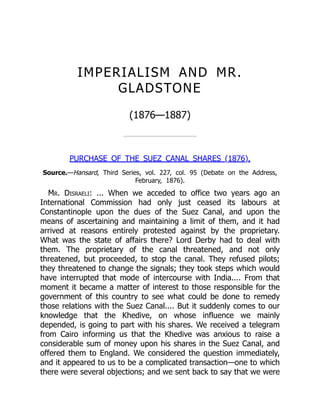
37.
1885. The FirstSubmarine 96
1885. The Unauthorized Programme 97
1885. The Irish Vote 98
1885. The New Electorate 100
1886. The Opening of the Rift 101
1886. "Ulster will Fight" 102
1886. Salisbury on Home Rule 104
1886. Mr. Gladstone's Appeal 106
1886. Liberal Unionism 107
1886. The Unemployed Riots 107
1886. Bimetallism and Labour Disputes 109
1886. Pasteur and Hydrophobia 110
1886. The Final Home Rule Rupture 110
1887. The Coming of Technical Education 112
1887. The First "Guillotine" Closure 113
1887. Jubilee Retrospects 114
1887. "Remember Mitchelstown" 118
1887. "Bloody Sunday" 119
1887. First Report on the Rand 120
38.
IMPERIALISM AND MR.
GLADSTONE
(1876—1887)
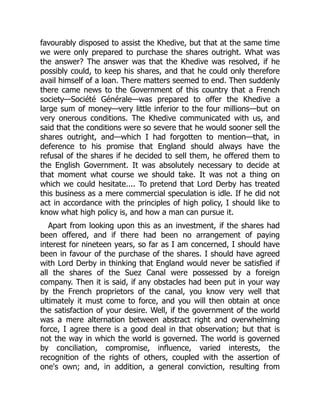
PURCHASEOF THE SUEZ CANAL SHARES (1876).
Source.—Hansard, Third Series, vol. 227, col. 95 (Debate on the Address,
February, 1876).
Mr. Disraeli: ... When we acceded to office two years ago an
International Commission had only just ceased its labours at
Constantinople upon the dues of the Suez Canal, and upon the
means of ascertaining and maintaining a limit of them, and it had
arrived at reasons entirely protested against by the proprietary.
What was the state of affairs there? Lord Derby had to deal with
them. The proprietary of the canal threatened, and not only
threatened, but proceeded, to stop the canal. They refused pilots;
they threatened to change the signals; they took steps which would
have interrupted that mode of intercourse with India.... From that
moment it became a matter of interest to those responsible for the
government of this country to see what could be done to remedy
those relations with the Suez Canal.... But it suddenly comes to our
knowledge that the Khedive, on whose influence we mainly
depended, is going to part with his shares. We received a telegram
from Cairo informing us that the Khedive was anxious to raise a
considerable sum of money upon his shares in the Suez Canal, and
offered them to England. We considered the question immediately,
and it appeared to us to be a complicated transaction—one to which
there were several objections; and we sent back to say that we were
39.
favourably disposed toassist the Khedive, but that at the same time
we were only prepared to purchase the shares outright. What was
the answer? The answer was that the Khedive was resolved, if he
possibly could, to keep his shares, and that he could only therefore
avail himself of a loan. There matters seemed to end. Then suddenly
there came news to the Government of this country that a French
society—Société Générale—was prepared to offer the Khedive a
large sum of money—very little inferior to the four millions—but on
very onerous conditions. The Khedive communicated with us, and
said that the conditions were so severe that he would sooner sell the
shares outright, and—which I had forgotten to mention—that, in
deference to his promise that England should always have the
refusal of the shares if he decided to sell them, he offered them to
the English Government. It was absolutely necessary to decide at
that moment what course we should take. It was not a thing on
which we could hesitate.... To pretend that Lord Derby has treated
this business as a mere commercial speculation is idle. If he did not
act in accordance with the principles of high policy, I should like to
know what high policy is, and how a man can pursue it.
Apart from looking upon this as an investment, if the shares had
been offered, and if there had been no arrangement of paying
interest for nineteen years, so far as I am concerned, I should have
been in favour of the purchase of the shares. I should have agreed
with Lord Derby in thinking that England would never be satisfied if
all the shares of the Suez Canal were possessed by a foreign
company. Then it is said, if any obstacles had been put in your way
by the French proprietors of the canal, you know very well that
ultimately it must come to force, and you will then obtain at once
the satisfaction of your desire. Well, if the government of the world
was a mere alternation between abstract right and overwhelming
force, I agree there is a good deal in that observation; but that is
not the way in which the world is governed. The world is governed
by conciliation, compromise, influence, varied interests, the
recognition of the rights of others, coupled with the assertion of
one's own; and, in addition, a general conviction, resulting from
40.
explanation and goodunderstanding, that it is for the interests of all
parties that matters should be conducted in a satisfactory and
peaceful manner.... I cannot doubt that the moral influence of
England possessing two-fifths of the shares in this great undertaking
must have made itself felt, must have a considerable influence upon
the conduct of those who manage the company.... England is a
Mediterranean Power; a great Mediterranean Power. This is shown
by the fact that in time of war always, and frequently in time of
peace, she has the greatest force upon those waters. Furthermore,
she has strongholds upon those waters which she will never
relinquish. The policy of England, however, is not one of aggression.
It is not provinces she wants. She will not interest herself in the
redistribution of territory on the shores of the Mediterranean, as long
as the redistribution does not imperil the freedom of the seas and
the dominion which she legitimately exercises. And therefore I look
upon this, that in the great chain of fortresses which we possess,
almost from the Metropolis to India, that the Suez Canal is a means
of securing the free intercourse of the waters, is a great addition to
that security, and one we should prize.
ENGLAND, RUSSIA, AND AFGHANISTAN (1876).
Source.—Parliamentary Publications, "Afghanistan," C 2, 190, of 1878, p.
156.
Extract from Lord Salisbury's Despatch to the Viceroy of India,
dated February 28, 1876.
The increasing weakness and uncertainty of British influence in
Afghanistan constitutes a prospective peril to British interests; the
deplorable interruption of it in Khelat inflicts upon them an
immediate inconvenience by involving the cessation of all effective
control over the turbulent and predatory habits of the trans-Indus
tribes. In view of these considerations, Her Majesty's Government
have ... instructed the Viceroy to find an early occasion for sending
41.
to Cabul atemporary mission, furnished with such instructions as
may, perhaps, enable it to overcome the Ameer's apparent
reluctance to the establishment of permanent British Agencies in
Afghanistan, by convincing His Highness that the Government of
India is ... willing to afford him material support in the defence of his
territories from any actual and unprovoked external aggression, but
that it cannot practically avert or provide for such a contingency
without timely and unrestricted permission to place its own agents in
those parts of his dominions whence they may best watch the
course of events. It appears to Her Majesty's Government that the
present moment is favourable for the execution of this last-
mentioned instruction. The Queen's assumption of the Imperial title
in relation to Her Majesty's Indian subjects, feudatories, and allies
will now for the first time conspicuously transfer to her Indian
dominion, in form as well as in fact, the supreme authority of the
Indian Empire.... The maintenance in Afghanistan of a strong and
friendly power has at all times been the object of British policy. The
attainment of this object is now to be considered with due reference
to the situation created by the recent and rapid advance of the
Russian arms in Central Asia towards the Northern frontiers of British
India. Her Majesty's Government cannot view with complete
indifference the probable influence of that situation upon the
uncertain character of an Oriental Chief whose ill-defined dominions
are thus brought, within a steadily narrowing circle, between the
conflicting pressures of two great military Empires, one of which
expostulates and remains passive, whilst the other apologizes and
continues to move forward. It is well known that not only the English
newspapers, but also all works published in England upon Indian
questions, are rapidly translated for the information of the Ameer,
and carefully studied by His Highness. Sentiments of irritation and
alarm at the advancing power of Russia in Central Asia find frequent
expression through the English press, in language which, if taken by
Shere Ali for a revelation of the mind of the English Government,
must have long been accumulating in his mind impressions
unfavourable to its confidence in British power.... Her Majesty's
Government would not, therefore, view with indifference any
42.
attempt on thepart of Russia to compete with British influence in
Afghanistan, nor could the Ameer's reception of a British Agent
(whatever be the official rank or function of that Agent) in any part
of the dominions of His Highness afford for his subsequent reception
of a Russian Agent any pretext to which the Government of Her
Majesty would not be entitled to, except as incompatible with the
assurances spontaneously offered to it by the Cabinet of St.
Petersburg. You will bear in mind these facts when framing
instructions for your mission to Cabul.... The conduct of Shere Ali
has more than once been characterized by so significant a disregard
of the wishes and interests of the Government of India that the
irretrievable alienation of his confidence in the sincerity and power of
that Government is a contingency which cannot be dismissed as
impossible. Should such a fear be confirmed by the result of the
proposed negotiation, no time must be lost in reconsidering, from a
new point of view, the policy to be pursued in reference to
Afghanistan.
THE QUEEN AS EMPRESS OF INDIA (1876).
Source.—Hansard, Third Series, vol. 227, col. 1,736 (Debate on Royal
Titles Bill, March 9, 1876).
Mr. Gladstone: ... In my opinion this is a matter of the greatest
importance. We have had some declarations in this House with
respect to India. The hon. member for West Cumberland (Mr. Percy
Wyndham), on the night when the right hon. gentleman first made
his proposal, said that an Imperial title would be the one most
suitable, because it would signify that Her Majesty governed India
without the restraints of law or constitution.
Mr. Percy Wyndham: I said that the Government of India was a
despotic Government, not in the hands of one person, and not, as in
this country, a constitutional Government in the hands of the Queen
and the Houses of Lords and Commons. The Government of India is
43.
essentially a despoticGovernment as administered by us, although it
includes more than one individual.
Mr. Gladstone: I am very much obliged, and I perceive completely
the hon. member's meaning; but I am sorry that to that meaning, as
it stands, I take the greatest objection. If it be true—and it is true—
that we govern India without the restraints of law, except such law
as we make ourselves; if it be true that we have not been able to
give to India the benefit and blessings of free institutions, I leave it
to the hon. gentleman—I leave it to the right hon. gentleman if he
thinks fit—to boast that he is about to place that fact solemnly upon
record. By the assumption of the title of Empress, I for one will not
attempt to turn into glory that which, so far as it is true, I feel to be
our weakness and our calamity.... It is plain that the government of
India—that is, the entire India—never has yet, by statute, been
vested in Her Majesty; but that which has been vested is the
government of the countries which were held in trust for Her
Majesty by the East India Company. I would be the last man to raise
this question if it were a mere verbal quibble. It is as far as possible
from being a question merely verbal.... I am under the belief that to
this moment there are important Princes and States in India over
which we have never assumed dominion, whatever may have been
our superiority of strength. We are now going, by Act of Parliament,
to assume that dominion, the possible consequences of which no
man can foresee; and when the right hon. gentleman tells us the
Princes desire this change to be made, does he really mean to
assure us that this is the case? If so, I require distinct evidence of
the fact. There are Princes in India who, no doubt, have hitherto
enjoyed no more than a theoretical political supremacy, but do they
desire to surrender even that under the provisions of this Bill? The
right hon. gentleman is going to advise the Queen to become
Empress of India. I raise the question, What is India? I have said
that the dominion now vested in Her Majesty is limited to the
territories vested in the East India Company. I ask whether the
supremacy of certain important Native States in India ever was
vested in the Company, or whether it was not? We are bound to ask
44.
the right hon.gentleman—and I think he is bound to answer the
question through the medium of his best legal authorities—whether
this supremacy is so vested or not, and whether he can assure us
upon his responsibility that no political change in the condition of the
Native Princes of India will be effected by this Bill. If there is a
political change effected, I do not hesitate to say I do not think it
would be possible to offer too determined an opposition to the
proposal of the Government.... I feel with the right hon. gentleman
—indeed, I feel a little more than the right hon. gentleman—the
greatness, the unsullied greatness, of the title which is now borne by
the Queen of England. I think I use the language of moderation
when I say that it is a title unequalled for its dignity and weight,
unequalled for the glory of its historic associations, unequalled for
the promise which it offers to the future, among the titles of the
Sovereigns of Europe, among all the states and nations on earth. Sir,
I have a jealousy of touching that title, and I am not to be told that
this is a small matter. There is nothing small in a matter, in my
judgment, which touches the honour and dignity of the Crown of
England.... The right hon. gentleman has indeed manfully contended
that there is no inferiority in the title of King as compared with that
of Emperor.... I want to know why I am to be dragged into novelties,
or into comparisons on a subject of this sort?... There is one other
point on which I am anxious to make a few comments. I was, I own,
struck by what fell from my right hon. friend the member for the
University of London (Mr. Lowe) the other evening in reference to
the colonies. Whether it be desirable to make any recital with regard
to the colonies or not, it is a subject which requires much
consideration whether we can wisely introduce reference to India in
the title of the Sovereign, while we at the same time take no notice
of the colonies.
BULGARIAN ATROCITIES (1876).
45.
I. Thunder fromMr. Gladstone.
Source.—Mr. Gladstone's pamphlet, Bulgarian Horrors and the Question of
the East, 1876, p. 10.
In default of Parliamentary action, and a public concentrated as
usual, we must proceed as we can, with impaired means of appeal.
But honour, duty, compassion, and I must add shame, are
sentiments never in a state of coma. The working-men of the
country, whose condition is less affected than that of others by the
season, have to their honour led the way, and shown that the great
heart of Britain has not ceased to beat. And the large towns and
cities, now following in troops, are echoing back, each from its own
place, the mingled notes of horror, pain, and indignation.... A curtain
opaque and dense, which at the prorogation had been lifted but a
few inches from the ground, has since then, from day to day, been
slowly rising. And what a scene it has disclosed! And where!
... I have the fullest confidence in the honour and in the
intelligence of Mr. Baring, who has been inquiring on behalf of
England. But he was not sent to examine the matter until the 19th
of July, three months after the rising, and nearly one month after
the first inquiries in Parliament. He had been but two days at
Philippopolis, when he sent home, with all the despatch he could
use, some few rudiments of a future report. Among them was his
estimate of the murders, necessarily far from final, at the figure of
twelve thousand.
We know that we had a well-manned Embassy at Constantinople,
and a network of Consulates and Vice-Consulates, really discharging
diplomatic duties, all over the provinces of European Turkey. That
villages could be burned down by scores, and men, women, and
children murdered, or worse than murdered, by thousands, in a
Turkish province lying between the capital and the scene of the
recent excitements, and that our Embassy and Consulates could
know nothing of it? The thing was impossible. It could not be. So
silence was obtained, and relief; and the well-oiled machinery of our
luxurious, indifferent life worked smoothly on....
46.
It was onthe 20th of April that the insurrection broke out in
Bulgaria.... On the 9th of May Sir Henry Elliot ... observing a great
Mohammedan excitement, and an extensive purchase of arms in
Constantinople, wisely telegraphed to the British Admiral in the
Mediterranean expressing a desire that he would bring his squadron
to Besika Bay. The purpose was for the protection of British subjects,
and of the Christians in general.... These measures were
substantially wise, and purely pacific. They had, if understood
rightly, no political aspect, or, if any, one rather anti-Turkish than
Turkish. But there were reasons, and strong reasons, why the public
should not have been left to grope out for itself the meaning of a
step so serious as the movement of a naval squadron towards a
country disturbed both by revolt and by an outbreak of murderous
fanaticism. In the year 1853, when the negotiations with Russia had
assumed a gloomy and almost a hopeless aspect, the English and
French fleets were sent eastwards; not as a measure of war, but as a
measure of preparation for war, and proximate to war. The
proceedings marked a transition of discussion into that angry stage
which immediately precedes a blow; and the place, to which the
fleets were then sent, was Besika Bay. In the absence of
information, how could the British nation avoid supposing that the
same act, as that done in 1853, bore also the same meaning?... The
expectation of a rupture pervaded the public mind. The Russian
funds fell very heavily, under a war panic; partisans exulted in a
diplomatic victory, and in the increase of what is called our prestige,
the bane, in my opinion, of all upright politics. The Turk was
encouraged in his humour of resistance. And this, as we now know,
while his hands were so reddened with Bulgarian blood. Foreign
capitals were amazed at the martial excitement in London. But the
Government spoke never a word.... And this ostentatious protection
to Turkey, this wanton disturbance of Europe, was continued by our
Ministry, with what I must call a strange perversity, for weeks and
weeks....
What we have to guard against is imposture—that Proteus with a
thousand forms. A few months ago the new Sultan served the turn,
47.
and very well.Men affirmed that he must have time. And now
another new Sultan is in the offing. I suppose it will be argued that
he must have time too. Then there will be, perhaps, new
constitutions; firmans of reforms; proclamations to commanders of
Turkish armies, enjoining extra humanity. All these should be quietly
set down as simply zero. At this moment we hear of the adoption by
the Turks of the last and most enlightened rule of warfare—namely,
the Geneva Convention. They might just as well adopt the Vatican
Council or the British Constitution. All these things are not even the
oysters before the dinner. Still worse is any plea founded upon any
reports made by Turkish authority upon the Bulgarian outrages.... I
return to, and I end with, that which is the Omega as well as the
Alpha of this great and most mournful case. An old servant of the
Crown and State, I entreat my countrymen, upon whom far more
than perhaps any other people of Europe it depends, to require, and
to insist, that our Government, which has been working in one
direction, shall work in the other, and shall apply all its vigour to
concur with the other States of Europe in obtaining the extinction of
the Turkish executive power in Bulgaria. Let the Turks now carry
away their abuses in the only possible manner—namely, by carrying
off themselves. Their Zaptiehs and their Mudirs, their Bimbashis and
their Yuzbachis, their Kaimakams and their Pashas, one and all, bag
and baggage, shall, I hope, clear out from the province they have
desolated and profaned. This thorough riddance, this most blessed
deliverance, is the only reparation we can make to the memory of
those heaps on heaps of dead; to the violated purity alike of matron,
of maiden, and of child; to the civilization which has been affronted
and shamed; to the laws of God, or, if you like, of Allah; to the moral
sense of mankind at large. There is not a criminal in a European
gaol, there is not a cannibal in the South Sea Islands, whose
indignation would not rise and overboil at the recital of that which
has been done, which has left behind all the foul and all the fierce
passions that produced it, and which may again spring up, in
another murderous harvest, from the soil soaked and reeking with
blood, and in the air tainted with every imaginable deed of crime
and shame.
48.
II. Cold Waterfrom Disraeli.
Source.—Hansard, Third Series, vol. 231, col. 1,138, August 11, 1876 (Third
Reading of the Appropriation Bill; Bulgarian Atrocities raised).
Mr. Disraeli: ... Let me at once place before the House what I
believe is the true view of the circumstances which principally
interest us to-night, for, after the Rhodian eloquence to which we
have just listened, it is rather difficult for the House to see clearly
the point which is before it. The Queen's Ambassador at
Constantinople, who has at all times no easy duty to fulfil, found
himself at the end of April and in the first three weeks of May in a
position of extreme difficulty and danger. Affairs in Constantinople
never had assumed—at least in our time, certainly—a more perilous
character. It was difficult to ascertain what was going to happen; but
that something was going to happen, and something of a character
which might disturb the relations of the Porte with all the Powers of
Europe, and might even bring about a revolution, the effect of which
would be felt in distant countries, there was no doubt.... In the
present instance the hon. and learned gentleman has made one
assumption throughout his speech—that there has been no
communication whatever between the Queen's Ambassador at
Constantinople and Her Majesty's Ministers upon the subject in
discussion; that we never heard of those affairs until the newspapers
published accounts. The state of the facts is the reverse. From the
very first period that these transactions occurred—from the very
commencement—the Ambassador was in constant communication
with Her Majesty's Ministers. (No, no.) Why, that may be proved by
the papers on the table. Throughout the months of May and June
the Ambassador is constantly referring to the atrocities occurring in
Bulgaria and to the repeated protests which he is making to the
Turkish Government, and informing Her Majesty's Government of
interviews and conversations with the Grand Vizier on that subject.
The hon. and learned gentleman says that when questions were
addressed to me in this House I was perfectly ignorant of what was
taking place. But that is exactly the question we have to settle to-
night. I say that we were not perfectly ignorant of what was taking
49.
place.... I agreethat even the slightest estimate of the horrors that
occurred in Bulgaria is quite enough to excite the indignation of this
country and of Parliament; but when you come to say that we were
ignorant of all that was occurring, and did nothing to counteract it,
because we said in answer to Questions that the information which
had reached us did not warrant the statements that were quoted in
the House—these are two entirely different questions. In the
newspaper which has been referred to the first account was, if I
recollect aright, that 30,000 or 32,000 persons had been slain; that
10,000 were in prison; it was also stated that 1,000 girls had been
sold in the open market, that 40 girls had been burnt alive in a
stable; and cartloads of human heads paraded through the streets of
the cities of Bulgaria—these were some of, though not all, the
statements made; and I was perfectly justified in saying that the
information which had reached us did not justify these statements,
and therefore we believed them to be exaggerated.... Lord Derby
telegraphed to Sir Henry Elliot that it was very important that Her
Majesty's Government should be able to reply to the inquiries made
in Parliament respecting these and other statements, and directed
Sir Henry Elliot to inquire by telegram of the Consuls, and report as
soon as he could. All these statements are untrue. There never were
forty maidens locked up in a stable and burnt alive. That was
ascertained with great care by Mr. Baring, and I am surprised that
the right hon. gentleman the member for Bradford should still speak
of it as a statement in which he has confidence. I believe it to be an
entire fabrication. I believe also it is an entire fabrication that 1,000
young women were sold in the market as slaves. We have not
received the slightest evidence of a single sale, even in those
journals on which the right hon. gentleman the member for Bradford
founded his erratic speech. I have been attacked for saying that I
did not believe it was possible to have 10,000 persons in prison in
Bulgaria. So far as I can ascertain from the papers, there never
could have been more than 3,000. As to the 10,000 cases of torture,
what evidence is there of a single case of torture? We know very
well that there has been considerable slaughter; that there must
have been isolated and individual cases of most atrocious rapine,
50.
and outrages ofa most atrocious kind; but still we have had
communications with Sir Henry Elliot, and he has always assumed
from what he knew that these cases of individual rapine and outrage
were occurring. He knew that civil war there was carried on under
conditions of brutality which, unfortunately, are not unprecedented
in that country; and the question is whether the information we had
justified the extravagant statements made in Parliament, which no
one pretends to uphold and defend.... The hon. and learned member
(Sir W. Harcourt) has done full justice to the Bulgarian atrocities. He
has assumed as absolutely true everything that criticism and more
authentic information had modified, and in some cases had proved
not merely to be exaggeration but to be absolute falsehoods. And
then the hon. and learned gentleman says—"By your policy you have
depopulated a province." Well, sir, certainly the slaughter of 12,000
individuals, whether Turks or Bulgarians, whether they were
innocent peasants or even brigands, is a horrible event which no one
can think of without emotion. But when I remember that the
population of Bulgaria is 3,700,000 persons, and that it is a very
large country, is it not a most extravagant abuse of rhetoric to say
that the slaughter of so considerable a number as 12,000 is the
depopulation of a province? Well, the hon. and learned gentleman
said also that Her Majesty's Government had incurred a responsibility
which is not possessed by any other country as regards our relations
with and our influence with the Turks. I say that we have incurred
no responsibility which is not shared with us by all the other
contracting Powers to the Treaty of Paris. I utterly disclaim any
peculiar responsibility.... That an hon. and learned gentleman, once
a member of a Government and an ornament of that Government,
should counsel as the solution of all these difficulties that Her
Majesty's Government should enter into an immediate combination
to expel the Turkish nation from Eastern Europe does indeed
surprise me. And because we are not prepared to enter into a
scheme so quixotic as that would be, we are held up as having given
our moral, not to say our material, support to Turkey.... We are, it is
true, the allies of Turkey; so is Austria, so is Russia, so is France,
and so are others. We are also their partners in a tripartite Treaty, in
51.
Welcome to ourwebsite – the perfect destination for book lovers and
knowledge seekers. We believe that every book holds a new world,
offering opportunities for learning, discovery, and personal growth.
That’s why we are dedicated to bringing you a diverse collection of
books, ranging from classic literature and specialized publications to
self-development guides and children's books.
More than just a book-buying platform, we strive to be a bridge
connecting you with timeless cultural and intellectual values. With an
elegant, user-friendly interface and a smart search system, you can
quickly find the books that best suit your interests. Additionally,
our special promotions and home delivery services help you save time
and fully enjoy the joy of reading.
Join us on a journey of knowledge exploration, passion nurturing, and
personal growth every day!
testbankdeal.com







![This ebook is for the use of anyone anywhere in the United
States and most other parts of the world at no cost and with
almost no restrictions whatsoever. You may copy it, give it away
or re-use it under the terms of the Project Gutenberg License
included with this ebook or online at www.gutenberg.org. If you
are not located in the United States, you will have to check the
laws of the country where you are located before using this
eBook.
Title: Imperialism and Mr. Gladstone (1876-1887)
Compiler: R. H. Gretton
Editor: Kenneth Bell
S. E. Winbolt
Release date: October 23, 2016 [eBook #53354]
Most recently updated: October 23, 2024
Language: English
Credits: Produced by John Campbell and the Online Distributed
Proofreading Team at http://www.pgdp.net (This file
was
produced from images generously made available by
The
Internet Archive)
*** START OF THE PROJECT GUTENBERG EBOOK IMPERIALISM
AND MR. GLADSTONE (1876-1887) ***](https://image.slidesharecdn.com/5676-250502152616-f4922b84/85/Understanding-Operating-Systems-5th-Edition-McHoes-Solutions-Manual-26-320.jpg)