ELASTICIT
Y
OF DEMANDBY : SOMYA GAUR & ATUL TRIPATHI ®
TERMS TO BE
DISCUSS• Types of elasticity of demand
1. Income elasticity
2. Price elasticity
3. Cross Elasticity
4. Adversity of elasticity
• Measurement of elasticity
• Degree of elasticity
• Determinations of Elasticity
• Factors Influencing Elasticity
• Long and short run elasticity
• Case Study
What is an Elasticity?
Measurement of the percentage
change in one variable that results
from a % change in another
variable, and the other variables
will remain constant .
Types Of Elasticity Of
Demand
Demand
Price
Elasticity
Cross Price
Elasticity
Advertisement
Elasticity
Income
Elasticity
The price elasticity of Demand may be defined as the
ratio of the relative change in demand and price
variables.
ed= percentage/proportional change in quantity demanded
percentage/proportional change in price
Price Elasticity Of Demand
EXAMPLE
If is to be noted that each individual may respond
differently to the change in price.
If P increases by 10 per cent, and if as a result Mrs.
Rashid buys, 5% less of a commodity, whereas Mrs.
Abdul­lah buys 20 per cent less of the commodity,
we can say that Mrs. Abdullah’s demand for the
commodity for the price range is more elastic than that
of Mrs. Rashid. Conversely, Mrs. Rashid’s demand for the
commodity with the given price range is less elastic than
Mrs. Abdullah’s.
GRAPH EXPLAINATION
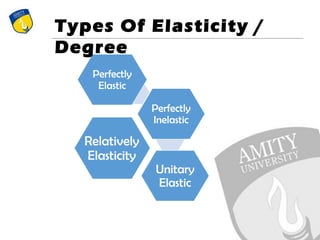
Relatively
Elasticity
Perfectly
Elastic
Perfectly
Inelastic
Unitary
Elastic
Types Of Elasticity /
Degree
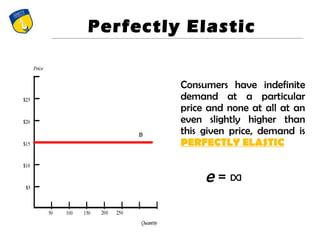
Perfectly Elastic
Consumers have indefinite
demand at a particular
price and none at all at an
even slightly higher than
this given price, demand is
PERFECTLY ELASTIC
e = ∞
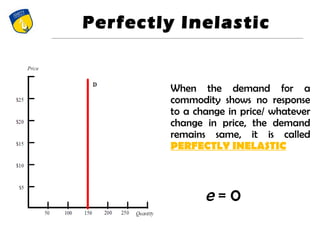
Perfectly Inelastic
When the demand for a
commodity shows no response
to a change in price/ whatever
change in price, the demand
remains same, it is called
PERFECTLY INELASTIC
e = 0
Relatively
Inelastic
When the proportion of
change in the quantity
demanded is less than that of
price the demand is
considered to be
RELATIVELY INELASTIC
e < 1
Unitary Elastic
When the proportion of
change in demand is
exactly the same as the
change in price, the
demand is said to be
UNITARY ELASTIC
e = 1
Cross Elasticity Of
Demand
The cross elasticity of demand refers to the degree
of responsiveness of demand for a commodity to a
given change in the price of some related
commodity.
Cross Elasticity Of Demand =
Proportionate/percentage change in demand for x
Proportionate/percentage change in price of y
Advertising
Elasticity
Advertising elasticity is a measure of an advertising
campaign's effectiveness in generating new sales. It is
calculated by dividing the percentage change in the
quantity demanded by the percentage change in
advertising expenditures. A positive advertising
elasticity indicates that an increase in advertising
leads to an increase in demand for the advertised
good or service.
Income Elasticity Of
Demand
The income elasticity is defined as a ratio
percentage change in the quantity demanded
to the percentage or proportional change in
income.
Income Elasticity = percentage change in quantity demanded
percentage change in income
Measurement Of Price Elastici
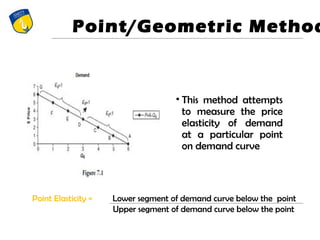
Point/Geometric Method
• This method attempts
to measure the price
elasticity of demand
at a particular point
on demand curve
Point Elasticity = Lower segment of demand curve below the point
Upper segment of demand curve below the point
The Percentage
Method
The price elasticity of demand is
measured by its coefficient Ep. This
coefficient Ep measures the percentage
change in the quantity of a commodity
demanded resulting from a given
percentage change in its price
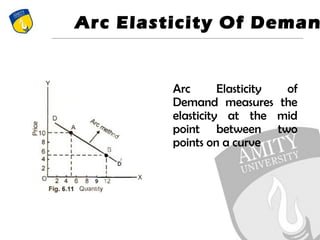
Arc Elasticity Of Deman
Arc Elasticity of
Demand measures the
elasticity at the mid
point between two
points on a curve
Degrees Of Elasticity
•A small fall in the price of a product may lead to a
considerable increase in the quantity demanded,
but sometimes even a considerable fall in price
may not lead to any increase in demand.
5 Types
1.Unit Elasticity:
2.Relatively elastic demand (ed > 1):
3.Relatively inelastic demand (ed < 1):
4.Perfectly inelastic demand (ed = 0):
5.Perfectly elastic demand (ed = ∞):
Unit Elasticity
Demand is unit elastic when percentage
change in quantity demand and percentage
in price are equal.
In case of unit elastic demand the demand
curve is a Rectangular Hyperbola. In practice
it is difficult to find such commodities as have
a demand curve whose elasticity is unit
throughout.
Relatively elastic demand (ed
> 1
The demand is relative elastic or more than
unity when relative change in quantity
demanded is more than the relative change
in price. In such cases the demand curve is of
less slope.
Relatively
inelastic
Demand (ed < 1)
Demand is said to be relatively inelastic or
less than unity when proportionate change in
demand is less than proportionate change in
price. In such cases the slope of demand curve
falls rapidly.
Perfectly inelastic demand
(ed = 0)
When there is no change in demand as a
result of increase or decrease in price
then the demand is perfectly inelastic.
The demand curve is vertical on OX axis
Perfectly elastic demand (ed =
oc)
The demand is perfectly elastic when
even a small change in price cause an
infinite large change in amount
demanded.
A small rise in price on the part of a
seller reduces the demand to zero. In such
cases the demand curve is parallel to OX
axis.
Factors Influencing
Elasticity
Of Demand
• Nature of commodity
• Availability of substitutes
• Number of uses
• Consumers income
• Height of price and
range of price change
• Proportion of
expenditure
• Durability of the
commodity
• Habit
• Complementary goods
• Time
• Recurrence of demand
• Possibility of
postponement
Determinants of
Elasticity
• Time period
the longer the time under consideration the more elastic a
good is likely to be
• Number and closeness of substitutes
the greater the number of substitutes,
the more elastic
• The proportion of income taken up by the product
the smaller the proportion the more inelastic
• Luxury or Necessity
for example, addictive drugs
Elasticity of Demand in
Short Run/ Long Run
In the short run demand is likely to be more inelastic .
In the long run demand is likely to be Cross elasticity.
If people are used to buying a good, then when the price goes
up, they will tend to keep buying it out of habit. However,
when they realise the price rise is permanent they will expend
more energy and time in looking for alternatives. Therefore,
over time, people are more likely to find alternatives.
CASE – Windows
Also, if a firm like Microsoft increase price of windows
operating system, in the short term demand is likely to be
inelastic (people are used to using windows so continue to pay
higher price) However, over time, people may get fed up with
paying high price for windows and consider switching systems 
CASE STUDY
The first seven rows of Table 3-3 give the estimated value of the
short-run and long-run price elasticity's of demand (Ep) for
selected commodities in New Delhi. These elasticity's are
computed based on primary survey with a sample of 115
consumers from different regions of Delhi. The rest of the table
shows elasticity's for selected commodities in the United States.
The table shows that the long-run price elasticity of demand for
most commodities is much larger than the corresponding short-
run price elasticity.
For example, the table shows that the price elasticity of
demand for clothing in Delhi is 1.1 in the short run but becomes
Price elasticity of demand in real world
Commodity Short Run Long Run
Urban India"
Butter 1.478 2.78
Petrol 0.3 0.9
Tea 0.712 1.14
Coffee* 0.292 0.685
Beer 0.85 1.18
Burger 1.49 2.79
Clothing 1.1 2.88
US
Clothing" 0.90 2.90
Tobacco products'' 0.46 1.89
Beer" 1.72 2.17
Electricity (household)'' 0.13 1.89
Gasoline^ 0.25 0.92
Elasticity chart
2.88 in the long run. This means that a 1 percent
increase in price leads to a reproduction in the
quantity demanded of clothing of 1.1 percent in the
short run but 2.88 percent in the long run. Although
the price elasticity of demand for petrol is about three
times higher in the long run than in the short run, the
demand for petrol remains price inelastic.
It should be noted that the estimated price
elasticity of demand for any commodity is likely to
vary (sometimes widely) depending on the nation
under consideration, the time period examined, and
the estimation technique used. Thus, estimated price
elasticity values should be used with caution
Thanks' For Patience

Elastisity of demand - case study

  • 1.
    ELASTICIT Y OF DEMANDBY :SOMYA GAUR & ATUL TRIPATHI ®
  • 2.
    TERMS TO BE DISCUSS•Types of elasticity of demand 1. Income elasticity 2. Price elasticity 3. Cross Elasticity 4. Adversity of elasticity • Measurement of elasticity • Degree of elasticity • Determinations of Elasticity • Factors Influencing Elasticity • Long and short run elasticity • Case Study
  • 3.
    What is anElasticity? Measurement of the percentage change in one variable that results from a % change in another variable, and the other variables will remain constant .
  • 4.
    Types Of ElasticityOf Demand Demand Price Elasticity Cross Price Elasticity Advertisement Elasticity Income Elasticity
  • 5.
    The price elasticityof Demand may be defined as the ratio of the relative change in demand and price variables. ed= percentage/proportional change in quantity demanded percentage/proportional change in price Price Elasticity Of Demand
  • 6.
    EXAMPLE If is tobe noted that each individual may respond differently to the change in price. If P increases by 10 per cent, and if as a result Mrs. Rashid buys, 5% less of a commodity, whereas Mrs. Abdul­lah buys 20 per cent less of the commodity, we can say that Mrs. Abdullah’s demand for the commodity for the price range is more elastic than that of Mrs. Rashid. Conversely, Mrs. Rashid’s demand for the commodity with the given price range is less elastic than Mrs. Abdullah’s.
  • 7.
  • 8.
  • 9.
    Perfectly Elastic Consumers haveindefinite demand at a particular price and none at all at an even slightly higher than this given price, demand is PERFECTLY ELASTIC e = ∞
  • 10.
    Perfectly Inelastic When thedemand for a commodity shows no response to a change in price/ whatever change in price, the demand remains same, it is called PERFECTLY INELASTIC e = 0
  • 11.
    Relatively Inelastic When the proportionof change in the quantity demanded is less than that of price the demand is considered to be RELATIVELY INELASTIC e < 1
  • 12.
    Unitary Elastic When theproportion of change in demand is exactly the same as the change in price, the demand is said to be UNITARY ELASTIC e = 1
  • 13.
    Cross Elasticity Of Demand Thecross elasticity of demand refers to the degree of responsiveness of demand for a commodity to a given change in the price of some related commodity. Cross Elasticity Of Demand = Proportionate/percentage change in demand for x Proportionate/percentage change in price of y
  • 14.
    Advertising Elasticity Advertising elasticity isa measure of an advertising campaign's effectiveness in generating new sales. It is calculated by dividing the percentage change in the quantity demanded by the percentage change in advertising expenditures. A positive advertising elasticity indicates that an increase in advertising leads to an increase in demand for the advertised good or service.
  • 15.
    Income Elasticity Of Demand Theincome elasticity is defined as a ratio percentage change in the quantity demanded to the percentage or proportional change in income. Income Elasticity = percentage change in quantity demanded percentage change in income
  • 16.
  • 17.
    Point/Geometric Method • Thismethod attempts to measure the price elasticity of demand at a particular point on demand curve Point Elasticity = Lower segment of demand curve below the point Upper segment of demand curve below the point
  • 18.
    The Percentage Method The priceelasticity of demand is measured by its coefficient Ep. This coefficient Ep measures the percentage change in the quantity of a commodity demanded resulting from a given percentage change in its price
  • 19.
    Arc Elasticity OfDeman Arc Elasticity of Demand measures the elasticity at the mid point between two points on a curve
  • 20.
    Degrees Of Elasticity •Asmall fall in the price of a product may lead to a considerable increase in the quantity demanded, but sometimes even a considerable fall in price may not lead to any increase in demand. 5 Types 1.Unit Elasticity: 2.Relatively elastic demand (ed > 1): 3.Relatively inelastic demand (ed < 1): 4.Perfectly inelastic demand (ed = 0): 5.Perfectly elastic demand (ed = ∞):
  • 21.
    Unit Elasticity Demand isunit elastic when percentage change in quantity demand and percentage in price are equal. In case of unit elastic demand the demand curve is a Rectangular Hyperbola. In practice it is difficult to find such commodities as have a demand curve whose elasticity is unit throughout.
  • 22.
    Relatively elastic demand(ed > 1 The demand is relative elastic or more than unity when relative change in quantity demanded is more than the relative change in price. In such cases the demand curve is of less slope.
  • 23.
    Relatively inelastic Demand (ed <1) Demand is said to be relatively inelastic or less than unity when proportionate change in demand is less than proportionate change in price. In such cases the slope of demand curve falls rapidly.
  • 24.
    Perfectly inelastic demand (ed= 0) When there is no change in demand as a result of increase or decrease in price then the demand is perfectly inelastic. The demand curve is vertical on OX axis
  • 25.
    Perfectly elastic demand(ed = oc) The demand is perfectly elastic when even a small change in price cause an infinite large change in amount demanded. A small rise in price on the part of a seller reduces the demand to zero. In such cases the demand curve is parallel to OX axis.
  • 26.
    Factors Influencing Elasticity Of Demand •Nature of commodity • Availability of substitutes • Number of uses • Consumers income • Height of price and range of price change • Proportion of expenditure • Durability of the commodity • Habit • Complementary goods • Time • Recurrence of demand • Possibility of postponement
  • 27.
    Determinants of Elasticity • Timeperiod the longer the time under consideration the more elastic a good is likely to be • Number and closeness of substitutes the greater the number of substitutes, the more elastic • The proportion of income taken up by the product the smaller the proportion the more inelastic • Luxury or Necessity for example, addictive drugs
  • 28.
    Elasticity of Demandin Short Run/ Long Run In the short run demand is likely to be more inelastic . In the long run demand is likely to be Cross elasticity. If people are used to buying a good, then when the price goes up, they will tend to keep buying it out of habit. However, when they realise the price rise is permanent they will expend more energy and time in looking for alternatives. Therefore, over time, people are more likely to find alternatives. CASE – Windows Also, if a firm like Microsoft increase price of windows operating system, in the short term demand is likely to be inelastic (people are used to using windows so continue to pay higher price) However, over time, people may get fed up with paying high price for windows and consider switching systems 
  • 29.
    CASE STUDY The firstseven rows of Table 3-3 give the estimated value of the short-run and long-run price elasticity's of demand (Ep) for selected commodities in New Delhi. These elasticity's are computed based on primary survey with a sample of 115 consumers from different regions of Delhi. The rest of the table shows elasticity's for selected commodities in the United States. The table shows that the long-run price elasticity of demand for most commodities is much larger than the corresponding short- run price elasticity. For example, the table shows that the price elasticity of demand for clothing in Delhi is 1.1 in the short run but becomes Price elasticity of demand in real world
  • 30.
    Commodity Short RunLong Run Urban India" Butter 1.478 2.78 Petrol 0.3 0.9 Tea 0.712 1.14 Coffee* 0.292 0.685 Beer 0.85 1.18 Burger 1.49 2.79 Clothing 1.1 2.88 US Clothing" 0.90 2.90 Tobacco products'' 0.46 1.89 Beer" 1.72 2.17 Electricity (household)'' 0.13 1.89 Gasoline^ 0.25 0.92 Elasticity chart
  • 31.
    2.88 in thelong run. This means that a 1 percent increase in price leads to a reproduction in the quantity demanded of clothing of 1.1 percent in the short run but 2.88 percent in the long run. Although the price elasticity of demand for petrol is about three times higher in the long run than in the short run, the demand for petrol remains price inelastic. It should be noted that the estimated price elasticity of demand for any commodity is likely to vary (sometimes widely) depending on the nation under consideration, the time period examined, and the estimation technique used. Thus, estimated price elasticity values should be used with caution
  • 32.