Objectives List and describe the classic functions of managers – planning, organizing, staffing, directing, and controlling Describe the purpose and components of a management information system (MIS) Explain how ICT Projects for Development
Module I Management Functions Management Levels Information System Personal Computer Management MIS Leads into the Future
High level (strategic) Long-range view Planning
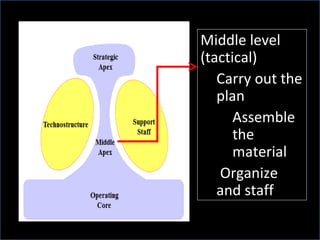
Middle level (tactical) Carry out the plan Assemble the material Organize and staff
Low level (operational) Supervisor Directing and controlling
Management Functions Get the job done on time Within budget Satisfactorily Using available resources Planning Devise short-range and long-range plans and set goals to help achieve the plans Organizing How to use resources Staffing  Directing Guiding employees to perform their work Controlling Monitoring progress towards goals
MIS Management Information System Why Do People Need Information? Decision making, problem solving and control
Data, Information, and Systems Data vs. Information Data A “given,” or fact; a number, a statement, or a picture Represents something in the real world The raw materials in the production of information Information Data that have meaning within a context Data in relationships Data after manipulation
Data, Information, and Systems Generating Information Computer-based IS  take data as raw material, process it, and produce information as output. Figure 1.1 Input-process-output
Data, Information,  and Systems The Four Stages of Data Processing Input: Data is collected and entered into computer. Data processing: Data is manipulated into information using mathematical, statistical, and other tools. Output: Information is displayed or presented. Storage: Data and information are maintained for later use.
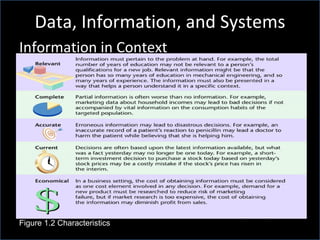
Information in Context Data, Information, and Systems relevant complete accurate current economical
Data, Information, and Systems Information in Context Figure 1.2 Characteristics  of useful information
Data, Information, and Systems Information and Managers Systems thinking Creates a framework for problem solving and decision making. Keeps managers focused on overall goals and operations of business.
Data, Information, and Systems Figure 1.6  Components of an information system
Ethical and Societal Issues The Not-So-Bright Side   Freedom of Speech IT increases opportunities for pornography, hate speech, intellectual property crime, an d other intrusions; prevention may abridge free speech.  IT  Professionalism No mandatory or enforced code of ethics for IT professionals--unlike other professions.  Social Inequality Less than 20% of the world’s population have ever used a PC; less than 3% have Internet access.
www.csus.edu/indiv/e/eatonr/mis http://www.drawpack.com  http:// www.drawpack.com

Management Information System

  • 1.
  • 2.
    Objectives List anddescribe the classic functions of managers – planning, organizing, staffing, directing, and controlling Describe the purpose and components of a management information system (MIS) Explain how ICT Projects for Development
  • 3.
    Module I ManagementFunctions Management Levels Information System Personal Computer Management MIS Leads into the Future
  • 4.
    High level (strategic)Long-range view Planning
  • 5.
    Middle level (tactical)Carry out the plan Assemble the material Organize and staff
  • 6.
    Low level (operational)Supervisor Directing and controlling
  • 7.
    Management Functions Getthe job done on time Within budget Satisfactorily Using available resources Planning Devise short-range and long-range plans and set goals to help achieve the plans Organizing How to use resources Staffing Directing Guiding employees to perform their work Controlling Monitoring progress towards goals
  • 8.
    MIS Management InformationSystem Why Do People Need Information? Decision making, problem solving and control
  • 9.
    Data, Information, andSystems Data vs. Information Data A “given,” or fact; a number, a statement, or a picture Represents something in the real world The raw materials in the production of information Information Data that have meaning within a context Data in relationships Data after manipulation
  • 10.
    Data, Information, andSystems Generating Information Computer-based IS take data as raw material, process it, and produce information as output. Figure 1.1 Input-process-output
  • 11.
    Data, Information, and Systems The Four Stages of Data Processing Input: Data is collected and entered into computer. Data processing: Data is manipulated into information using mathematical, statistical, and other tools. Output: Information is displayed or presented. Storage: Data and information are maintained for later use.
  • 12.
    Information in ContextData, Information, and Systems relevant complete accurate current economical
  • 13.
    Data, Information, andSystems Information in Context Figure 1.2 Characteristics of useful information
  • 14.
    Data, Information, andSystems Information and Managers Systems thinking Creates a framework for problem solving and decision making. Keeps managers focused on overall goals and operations of business.
  • 15.
    Data, Information, andSystems Figure 1.6 Components of an information system
  • 16.
    Ethical and SocietalIssues The Not-So-Bright Side Freedom of Speech IT increases opportunities for pornography, hate speech, intellectual property crime, an d other intrusions; prevention may abridge free speech. IT Professionalism No mandatory or enforced code of ethics for IT professionals--unlike other professions. Social Inequality Less than 20% of the world’s population have ever used a PC; less than 3% have Internet access.
  • 17.