Lecture notes on
Perspectives in Management of Educational
Institutions
by
Dr. Chandra P. Rijal
Kathmandu, Nepal
August 15, 2011 1
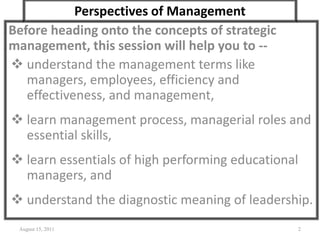
Perspectives of Management
Before heading onto the concepts of strategic
management, this session will help you to --
 understand the management terms like
managers, employees, efficiency and
effectiveness, and management,
 learn management process, managerial roles and
essential skills,
 learn essentials of high performing educational
managers, and
 understand the diagnostic meaning of leadership.
August 15, 2011 2
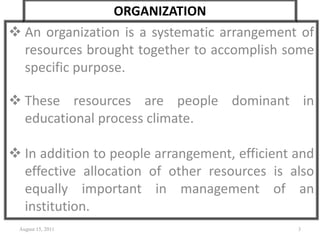
ORGANIZATION
 An organization is a systematic arrangement of
resources brought together to accomplish some
specific purpose.
 These resources are people dominant in
educational process climate.
 In addition to people arrangement, efficient and
effective allocation of other resources is also
equally important in management of an
institution.
August 15, 2011 3
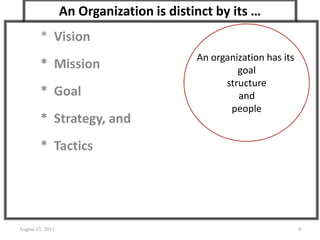
An Organization is distinct by its …
* Vision
* Mission
* Goal
* Strategy, and
* Tactics
August 15, 2011 4
An organization has its
goal
structure
and
people
Operatives
• People who work directly on a job or task
and have no responsibility for overseeing
the work of others.
• Known as employees.
• Operatives at a school?
August 15, 2011 5
Managers …
Individuals in an organization, who direct
the activities of others (operatives)
Questions for discussion:
1. How are managers different from operatives at
schools?
2. How operatives and managers contribute for the
betterment of the school as a social institution?
August 15, 2011 6
MANAGERS Vs. ENTREPRENEURS
¤ Entrepreneurs are the people who pursue business
opportunities, fulfilling needs and wants through
innovation.
¤ Entrepreneurs are the innovative people who give
birth to the new businesses regardless small or big
in size. They are the creators.
¤ All entrepreneurs are managers but all managers
may not be entrepreneurs.
¤ Can you identify about five successful educational
entrepreneurs of Nepal?
August 15, 2011 7
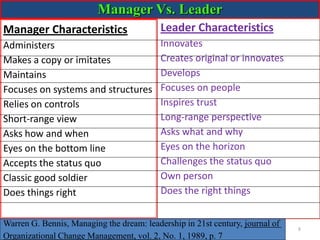
Manager Characteristics
Administers
Makes a copy or imitates
Maintains
Focuses on systems and structures
Relies on controls
Short-range view
Asks how and when
Eyes on the bottom line
Accepts the status quo
Classic good soldier
Does things right
August 15, 2011 8
Manager Vs. Leader
Leader Characteristics
Innovates
Creates original or innovates
Develops
Focuses on people
Inspires trust
Long-range perspective
Asks what and why
Eyes on the horizon
Challenges the status quo
Own person
Does the right things
Warren G. Bennis, Managing the dream: leadership in 21st century, journal of
Organizational Change Management, vol. 2, No. 1, 1989, p. 7
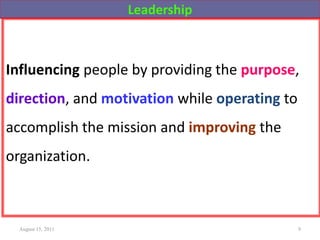
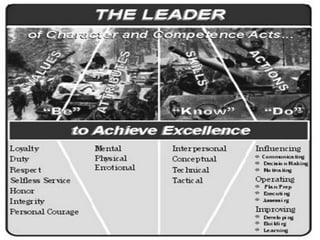
Leadership
Influencing people by providing the purpose,
direction, and motivation while operating to
accomplish the mission and improving the
organization.
August 15, 2011 9
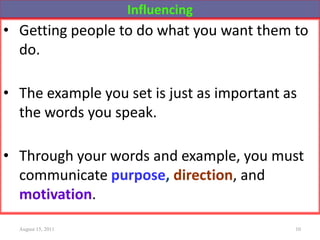
Influencing
• Getting people to do what you want them to
do.
• The example you set is just as important as
the words you speak.
• Through your words and example, you must
communicate purpose, direction, and
motivation.
August 15, 2011 10
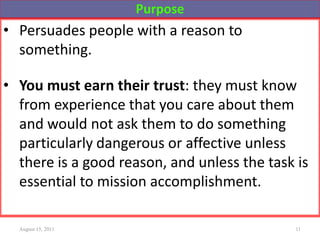
Purpose
• Persuades people with a reason to
something.
• You must earn their trust: they must know
from experience that you care about them
and would not ask them to do something
particularly dangerous or affective unless
there is a good reason, and unless the task is
essential to mission accomplishment.
August 15, 2011 11
Direction
• Communicate the way you want the mission
be accomplished.
• Prioritize tasks.
• Assign responsibility and communicate;
delegate authority when necessary.
• Make sure your people understand the
standard.
• Listen, and correct the limitations that
oppose your direction.
August 15, 2011 12
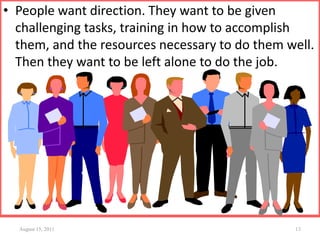
• People want direction. They want to be given
challenging tasks, training in how to accomplish
them, and the resources necessary to do them well.
Then they want to be left alone to do the job.
August 15, 2011 13
Motivation
• Motivation gives subordinates the will to do everything
they can to accomplish a mission.
• To motivate your people, give them challenging goals.
• Get to know your people and their capabilities.
• Give them as much responsibility as they can.
• When they succeed, praise them.
• When they fall short, give credit for what they have done
and coach/counsel how to do better next time.
• Make sure that the example you set is as important as what
you say and how well you manage the work.
August 15, 2011 14
Operating
• Actions taken to influence others serve to
accomplish operating actions
• Take those actions that help accomplish the stated
goals.
• All leaders execute operating actions, which
become more complex as they assume positions of
increasing responsibility.
August 15, 2011 15
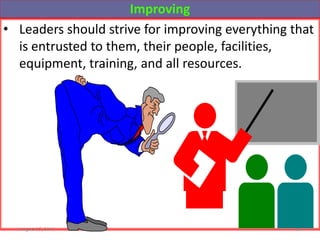
Improving
• Leaders should strive for improving everything that
is entrusted to them, their people, facilities,
equipment, training, and all resources.
August 15, 2011 16
August 15, 2011 17
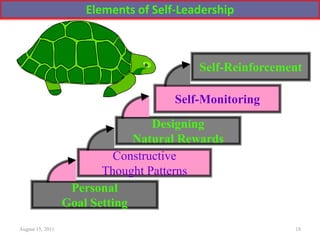
Elements of Self-Leadership
August 15, 2011 18
Personal
Goal Setting
Constructive
Thought Patterns
Designing
Natural Rewards
Self-Monitoring
Self-Reinforcement
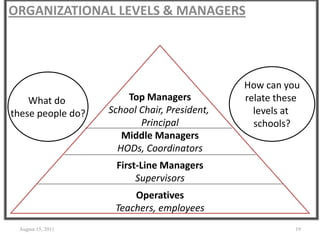
ORGANIZATIONAL LEVELS & MANAGERS
August 15, 2011 19
Top Managers
School Chair, President,
Principal
Middle Managers
HODs, Coordinators
First-Line Managers
Supervisors
Operatives
Teachers, employees
What do
these people do?
How can you
relate these
levels at
schools?
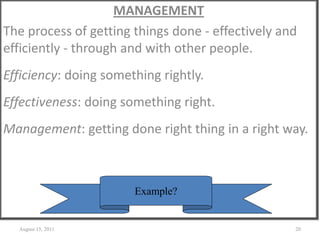
MANAGEMENT
The process of getting things done - effectively and
efficiently - through and with other people.
Efficiency: doing something rightly.
Effectiveness: doing something right.
Management: getting done right thing in a right way.
August 15, 2011 20
Example?
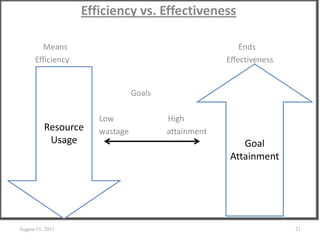
Efficiency vs. Effectiveness
Means Ends
Efficiency Effectiveness
Goals
Low High
wastage attainment
August 15, 2011 21
Resource
Usage Goal
Attainment
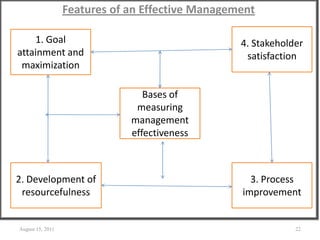
Features of an Effective Management
August 15, 2011 22
1. Goal
attainment and
maximization
2. Development of
resourcefulness
4. Stakeholder
satisfaction
3. Process
improvement
Bases of
measuring
management
effectiveness
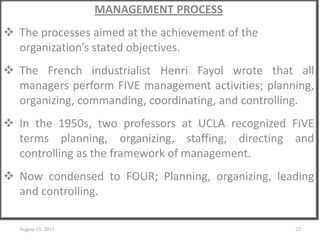
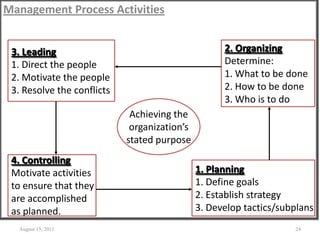
MANAGEMENT PROCESS
 The processes aimed at the achievement of the
organization’s stated objectives.
 The French industrialist Henri Fayol wrote that all
managers perform FIVE management activities; planning,
organizing, commanding, coordinating, and controlling.
 In the 1950s, two professors at UCLA recognized FIVE
terms planning, organizing, staffing, directing and
controlling as the framework of management.
 Now condensed to FOUR; Planning, organizing, leading
and controlling.
August 15, 2011 23
Management Process Activities
August 15, 2011 24
1. Planning
1. Define goals
2. Establish strategy
3. Develop tactics/subplans
3. Leading
1. Direct the people
2. Motivate the people
3. Resolve the conflicts
2. Organizing
Determine:
1. What to be done
2. How to be done
3. Who is to do
4. Controlling
Motivate activities
to ensure that they
are accomplished
as planned.
Achieving the
organization’s
stated purpose
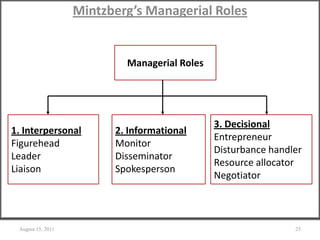
Mintzberg’s Managerial Roles
August 15, 2011 25
Managerial Roles
1. Interpersonal
Figurehead
Leader
Liaison
2. Informational
Monitor
Disseminator
Spokesperson
3. Decisional
Entrepreneur
Disturbance handler
Resource allocator
Negotiator
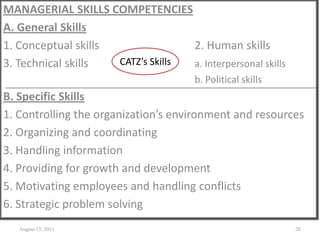
MANAGERIAL SKILLS COMPETENCIES
A. General Skills
1. Conceptual skills 2. Human skills
3. Technical skills a. Interpersonal skills
b. Political skills
B. Specific Skills
1. Controlling the organization’s environment and resources
2. Organizing and coordinating
3. Handling information
4. Providing for growth and development
5. Motivating employees and handling conflicts
6. Strategic problem solving
August 15, 2011 26
CATZ’s Skills
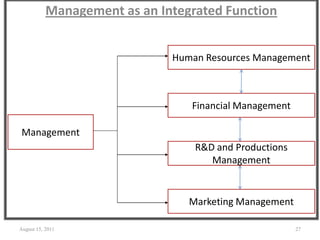
Management as an Integrated Function
August 15, 2011 27
Management
Human Resources Management
R&D and Productions
Management
Financial Management
Marketing Management
WHY STUDY MANAGEMENT?
General Reason
1. Gain conceptual insights in general management of
any institution
Specific Reasons
1. To improve organization’s overall management
2. To develop career
August 15, 2011 28
Universality of Management
 Management is a universal discipline.
 Application of management may be modified as
per the contexts and environments but the main
essence of management principles remains same
worldwide.
 For example, employee motivation is a universal
tool of productivity but the factors considered for
motivation may be different from country to
country and context to context.
August 15, 2011 29
Universality of management should be studied in the
following basis
1. Levels in the organization: lower, upper, middle
2. Organizational objectives: profit or not-for-profit
3. Size: big or small
4. National borders: similar management concepts
5. Decision making: synonymous to management
6. Dealing with change: main challenge worldwide
7. Competencies and skills: required worldwide
August 15, 2011 30
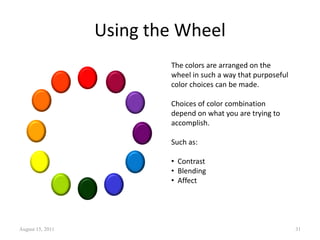
Using the Wheel
The colors are arranged on the
wheel in such a way that purposeful
color choices can be made.
Choices of color combination
depend on what you are trying to
accomplish.
Such as:
• Contrast
• Blending
• Affect
August 15, 2011 31

Management in perspective

  • 1.
    Lecture notes on Perspectivesin Management of Educational Institutions by Dr. Chandra P. Rijal Kathmandu, Nepal August 15, 2011 1
  • 2.
    Perspectives of Management Beforeheading onto the concepts of strategic management, this session will help you to --  understand the management terms like managers, employees, efficiency and effectiveness, and management,  learn management process, managerial roles and essential skills,  learn essentials of high performing educational managers, and  understand the diagnostic meaning of leadership. August 15, 2011 2
  • 3.
    ORGANIZATION  An organizationis a systematic arrangement of resources brought together to accomplish some specific purpose.  These resources are people dominant in educational process climate.  In addition to people arrangement, efficient and effective allocation of other resources is also equally important in management of an institution. August 15, 2011 3
  • 4.
    An Organization isdistinct by its … * Vision * Mission * Goal * Strategy, and * Tactics August 15, 2011 4 An organization has its goal structure and people
  • 5.
    Operatives • People whowork directly on a job or task and have no responsibility for overseeing the work of others. • Known as employees. • Operatives at a school? August 15, 2011 5
  • 6.
    Managers … Individuals inan organization, who direct the activities of others (operatives) Questions for discussion: 1. How are managers different from operatives at schools? 2. How operatives and managers contribute for the betterment of the school as a social institution? August 15, 2011 6
  • 7.
    MANAGERS Vs. ENTREPRENEURS ¤Entrepreneurs are the people who pursue business opportunities, fulfilling needs and wants through innovation. ¤ Entrepreneurs are the innovative people who give birth to the new businesses regardless small or big in size. They are the creators. ¤ All entrepreneurs are managers but all managers may not be entrepreneurs. ¤ Can you identify about five successful educational entrepreneurs of Nepal? August 15, 2011 7
  • 8.
    Manager Characteristics Administers Makes acopy or imitates Maintains Focuses on systems and structures Relies on controls Short-range view Asks how and when Eyes on the bottom line Accepts the status quo Classic good soldier Does things right August 15, 2011 8 Manager Vs. Leader Leader Characteristics Innovates Creates original or innovates Develops Focuses on people Inspires trust Long-range perspective Asks what and why Eyes on the horizon Challenges the status quo Own person Does the right things Warren G. Bennis, Managing the dream: leadership in 21st century, journal of Organizational Change Management, vol. 2, No. 1, 1989, p. 7
  • 9.
    Leadership Influencing people byproviding the purpose, direction, and motivation while operating to accomplish the mission and improving the organization. August 15, 2011 9
  • 10.
    Influencing • Getting peopleto do what you want them to do. • The example you set is just as important as the words you speak. • Through your words and example, you must communicate purpose, direction, and motivation. August 15, 2011 10
  • 11.
    Purpose • Persuades peoplewith a reason to something. • You must earn their trust: they must know from experience that you care about them and would not ask them to do something particularly dangerous or affective unless there is a good reason, and unless the task is essential to mission accomplishment. August 15, 2011 11
  • 12.
    Direction • Communicate theway you want the mission be accomplished. • Prioritize tasks. • Assign responsibility and communicate; delegate authority when necessary. • Make sure your people understand the standard. • Listen, and correct the limitations that oppose your direction. August 15, 2011 12
  • 13.
    • People wantdirection. They want to be given challenging tasks, training in how to accomplish them, and the resources necessary to do them well. Then they want to be left alone to do the job. August 15, 2011 13
  • 14.
    Motivation • Motivation givessubordinates the will to do everything they can to accomplish a mission. • To motivate your people, give them challenging goals. • Get to know your people and their capabilities. • Give them as much responsibility as they can. • When they succeed, praise them. • When they fall short, give credit for what they have done and coach/counsel how to do better next time. • Make sure that the example you set is as important as what you say and how well you manage the work. August 15, 2011 14
  • 15.
    Operating • Actions takento influence others serve to accomplish operating actions • Take those actions that help accomplish the stated goals. • All leaders execute operating actions, which become more complex as they assume positions of increasing responsibility. August 15, 2011 15
  • 16.
    Improving • Leaders shouldstrive for improving everything that is entrusted to them, their people, facilities, equipment, training, and all resources. August 15, 2011 16
  • 17.
  • 18.
    Elements of Self-Leadership August15, 2011 18 Personal Goal Setting Constructive Thought Patterns Designing Natural Rewards Self-Monitoring Self-Reinforcement
  • 19.
    ORGANIZATIONAL LEVELS &MANAGERS August 15, 2011 19 Top Managers School Chair, President, Principal Middle Managers HODs, Coordinators First-Line Managers Supervisors Operatives Teachers, employees What do these people do? How can you relate these levels at schools?
  • 20.
    MANAGEMENT The process ofgetting things done - effectively and efficiently - through and with other people. Efficiency: doing something rightly. Effectiveness: doing something right. Management: getting done right thing in a right way. August 15, 2011 20 Example?
  • 21.
    Efficiency vs. Effectiveness MeansEnds Efficiency Effectiveness Goals Low High wastage attainment August 15, 2011 21 Resource Usage Goal Attainment
  • 22.
    Features of anEffective Management August 15, 2011 22 1. Goal attainment and maximization 2. Development of resourcefulness 4. Stakeholder satisfaction 3. Process improvement Bases of measuring management effectiveness
  • 23.
    MANAGEMENT PROCESS  Theprocesses aimed at the achievement of the organization’s stated objectives.  The French industrialist Henri Fayol wrote that all managers perform FIVE management activities; planning, organizing, commanding, coordinating, and controlling.  In the 1950s, two professors at UCLA recognized FIVE terms planning, organizing, staffing, directing and controlling as the framework of management.  Now condensed to FOUR; Planning, organizing, leading and controlling. August 15, 2011 23
  • 24.
    Management Process Activities August15, 2011 24 1. Planning 1. Define goals 2. Establish strategy 3. Develop tactics/subplans 3. Leading 1. Direct the people 2. Motivate the people 3. Resolve the conflicts 2. Organizing Determine: 1. What to be done 2. How to be done 3. Who is to do 4. Controlling Motivate activities to ensure that they are accomplished as planned. Achieving the organization’s stated purpose
  • 25.
    Mintzberg’s Managerial Roles August15, 2011 25 Managerial Roles 1. Interpersonal Figurehead Leader Liaison 2. Informational Monitor Disseminator Spokesperson 3. Decisional Entrepreneur Disturbance handler Resource allocator Negotiator
  • 26.
    MANAGERIAL SKILLS COMPETENCIES A.General Skills 1. Conceptual skills 2. Human skills 3. Technical skills a. Interpersonal skills b. Political skills B. Specific Skills 1. Controlling the organization’s environment and resources 2. Organizing and coordinating 3. Handling information 4. Providing for growth and development 5. Motivating employees and handling conflicts 6. Strategic problem solving August 15, 2011 26 CATZ’s Skills
  • 27.
    Management as anIntegrated Function August 15, 2011 27 Management Human Resources Management R&D and Productions Management Financial Management Marketing Management
  • 28.
    WHY STUDY MANAGEMENT? GeneralReason 1. Gain conceptual insights in general management of any institution Specific Reasons 1. To improve organization’s overall management 2. To develop career August 15, 2011 28
  • 29.
    Universality of Management Management is a universal discipline.  Application of management may be modified as per the contexts and environments but the main essence of management principles remains same worldwide.  For example, employee motivation is a universal tool of productivity but the factors considered for motivation may be different from country to country and context to context. August 15, 2011 29
  • 30.
    Universality of managementshould be studied in the following basis 1. Levels in the organization: lower, upper, middle 2. Organizational objectives: profit or not-for-profit 3. Size: big or small 4. National borders: similar management concepts 5. Decision making: synonymous to management 6. Dealing with change: main challenge worldwide 7. Competencies and skills: required worldwide August 15, 2011 30
  • 31.
    Using the Wheel Thecolors are arranged on the wheel in such a way that purposeful color choices can be made. Choices of color combination depend on what you are trying to accomplish. Such as: • Contrast • Blending • Affect August 15, 2011 31