1
NEPAL MANAGEMENT DEVELOPMENT SCENARIO 2018
Chandra P Rijal
Abstract
Nepal has achieved much awaited political stability and attainment of policy stability has been
undergoing as one of the most important drivers of sustainable development. The national
leadership has been able to create high hope on development among common people and
institutions. The general public and their representatives at all levels of government have been
quite sensitized with new paradigms of thinking on national development. All it may require
effective management development systems and practices at all levels of governments, public and
private enterprises, national security and defense, and development sector having a shared vision
for national transformation with consistency of purpose, efficient resourcing, technical enactment,
total participation, continuous system and process improvement, compliance of accountability and
good governance, and more importantly, ‘people focused’ service and development interventions.
It is high time to prioritize and enact with development initiatives along system defined approach
to nation building. Robust policy transformation, effective state facilitation, management of
comparative cost effectiveness of doing business in Nepal and maintenance of congenial
international relationship would support the national mission for overall socio-economic
development. This all requires adequate prioritization of effective management development
policies and actions for rest of sectors of the country.
At the same time, Management Association of Nepal (MAN) needs redefining its role by effectively
responding to changing national and global realities demanding transformation in management
systems and approaches. MAN may have a wider spectrum of partnership opportunities to serve
as a responsible institution by providing with policy advocacy and technical support services to
empower national management efficiency for all sectors of politics and governance, internal
security and defense, general administration, socio-economic development, and international
advocacy leading to attainment of national prosperity.
Author
Chandra P. Rijal, MBA, MPhil and PhD in Leadership
Provides with leadership and innovation for transforming effective learning and development,
research and innovation, policies and programs, human and institutional system capacity
development with focus on sustainable development leading to attainment of national prosperity.
1. INTRODUCTION
1.1. Preamble
Year 2018 has gifted a remarkable historical identity for Nepal in course of successful transition
to federal democratic republican system with a vision to ultimately proceed onto socialism in long-
run. Successful accomplishment of the first federal system-based general elections and formation
of federal, provincial and local level stable governments by the publicly elected representatives is
the biggest success of the decade and it will serve as a milestone for the overall national
development for achieving prosperity in future. Successful accomplishment of this noble task of
general elections management as per mandated spirit of the Constitution of Nepal with
overwhelming public participation should be recognized as the biggest milestone of effective
management in 2017-2018 in Nepal.
Such an achievement would have not been possible without effective commitment, cooperation,
collaboration and tireless joint efforts of the Election Commission (EC), political parties, security
2
forces, public sector line organizations, civil society organizations, national and international
agencies, media, independent and associated observers, the general public who exercised their
civic rights through this national event, and most importantly, thousands of candidates betting for
the battle guided by the spirit of the Constitution of Federal Democratic Republic of Nepal.
Through this discourse, the nation achieved a common goal of empowering gender equality and
social inclusion in line with the mandated spirit of the Constitution of Nepal. May it be
remembered as a case of effective management with task imperfection amid numerous differences
among the key actors, a big lesson of achievement for rest of the world! Truly benchmarking
achievement, indeed!
Numerous evidences reveal that the road to success was not smooth for Nepal till the time of its
entry into a completely new paradigm of total transformation of national structural systems
(political-legal, national bureaucracy and general administration, and governance systems). Since
long, Nepal and Nepalese common people remained victims of ineffective management surpassed
by culture of corruption, social injustice, inequality, red-tapeism, systemic delay and service denial
to common people by the state machinery (Gyawali 2019; & Shrestha, 2014). In fact, prevalence
of all these negative symptoms might have contributed to outbreak of internal insurrection which
consumed almost two decades of national productive time for peaceful settlement with demise of
traditional institutions power centers having ineffective management of crises. Amid the process
of peace building, a never expected catastrophe, ‘Gorkha Earthquake 2015’ broke out resulting in
national emergency situation and demanding for effective management of immediate disaster risk
response initiatives, mid-term psycho-social and economic resilience inputs, and long-term
infrastructure reconstruction initiatives.
Such developing situations urged the nation to move ahead with a three-fold primary task – a.
mitigating the consequences invited by the national disaster, b. giving the final shape to the process
of crafting and promulgating much needed National Constitution, and c. finally accomplishing
general election to form the governments at all three levels of federal political governance as a key
to national development. However, it took time, later two tasks have been accomplished with high
level of performance results with overwhelming participation and acceptance of wider spectrum
of stakeholders at national and international arena, accomplishment of former objective is in the
making with satisfactory initial performance results. All this must have been possible as a result
of unified national and international effort with perfection in management. In fact, the world today
has been surprised the way Nepal could overcome such a pile of mountainous challenges. Thus,
we proclaim, “Effective management has power to produce results with impacts beyond
imagination despite limitations in resources, processes and technologies.”
On the other hand, there evolved another national goal with global linkage -- to move ahead with
the world of sustainable development for achieving national prosperity at a time when the country
had just recovered from internal insurrection and natural catastrophe. And it is an apparent fact
that achievement of sustainable development and prosperity faces a continued pattern of low socio-
economic development and growth, natural spatial complexities, political instability, structurally
generated and deeply entrenched forms of exclusion, poverty and inequality. These are a few
systematically rooted challenges that Nepal has to face in politically and socially fragile, post-
conflict situation (National Planning Commission [NPC], 2015). Despite its tremendous effort in
accomplishing impressive human development gains over past two decades, Nepal still has a low
human development status as it commenced from a very low base.
More recently, United Nations Development Program ([UNDP], 2018) has suggested that the
nations should place high priority to achieve effective human development status in three aspects
– transforming a long and healthy life of people, providing access to knowledge and confirmation
3
of a decent standard of living. As Nepal is set to graduate from the least developed country (LDC)
status by 2022 and emerging as a prosperous middle-income bearing country by inducing effective
management philosophies and practices for the attainment of ‘Welfare-State’ recognition in the
world, and also by standing strong on its commitment to achieve sustainable development goals
(SDGs) by 2030, the suggestions made by UN may be highly relevant to consider. In fact, all this
would require introduction of breakthrough paradigms of strategic thinking, collective vision with
willpower, robust political and structural governance systems in place, effective public
administration, empowerment of private and development sectors with shared responsibility and
national accountability, at large. Year 2018 must have served as a baseline stage to systematically
address the issue of SDG and Nepal’s commitment on it, and at the same time, attainment of
national happiness and prosperity.
When a national policy input guided by love, respect and commitment of all becomes the part of
an action, it results with prosperous outcomes for long-run (depicted from the historic teachings
of Chanakya, B. G. to Mourya, C. G.; making a king by transforming a son of soil of Greater
India). How can we limit the meaning of prosperity within the boundary of words, whereas it
uncovers a horizon of happiness beyond our imagination? Let the days of hatred be over; suspicion
end up here; and the new vibrant nation should take off its flight. The overall scenarios appeal us
to respect, raise and move ahead in action for what we are capable of. Even smaller jobs delivered
well, will hopefully contribute significantly in achieving national success leading the attainment
of much needed national prosperity.
The World Bank (2019), one of the long-standing policy reform and development partners for
Nepal, has recognized as Nepal has been undergoing a historic transition toward a federal and
secular republic, it represents a window of opportunity for the country to further reduce poverty,
increase income of bottom 40 percent of national population and pursue its ambitious agenda of
inclusive growth and accountable service delivery. Here, we should not miss adding up adherence
to ethical compliances as a key to accomplish the goal of nation building by making the entire
system organs accountable for their defined responsibilities (Aryal, 2019) as the cases of abuse of
authority, corruption and ethical derailment are quite rampant since long. It is time, we must
address these issues within the national framework of effective management development and
control mechanism. Any development without complying with disciplinary code of conduct, may
invite unexpected consequences. It should be addressed by means of ethical teaching and
enactment of basic moral value systems of our eastern mythology.
Along the course of institutionalization of Federalism through the enactment of new Constitution,
there has been shifts in the general management scenarios leading national transformation towards
prosperity. The general public also may have multi-fold expectations from recently elected Local,
Provincial and Federal Governments after a prolonged and chaotic situation following national
insurgency, process of peace building, new Constitution drafting and emergency response to
devastating ‘Gorkha Earthquake’ of April 2015. At this juncture, the public expectations for
change and development may be considered quite reasonable as the insurgency is over; national
Constitution is in place; post-earthquake development and reconstruction initiatives are in
successful execution; most of the socio-economic development indicators have turned favorable;
and there are functional governments at all levels with defined responsibilities.
There has emerged quite positive sense of political stability and happening of good governance is
on its making. Thus, it is imperative for all to move ahead having a shared vision aiming the
attainment of total prosperity and shared-happiness. A triangulated vesting of effective knowledge,
right skill competencies and positive willpower or hunger to make it happen may lead to success.
It is all about effective managing.
4
At this juncture, let the truth be told well, Nepal has been welcoming a varying initiatives for socio-
economic development and prosperity at a time when public private partnership (PPP) approach
(Ministry of Finance [MOF], 2015) has emerged and recognized as a powerful instrument for
sustainable development of the country as PPP model has been already proven successful in global
contexts. Government of Nepal has accepted PPP as a strategic tool for sustainable development
in all sectors of national economy and social well-being.
Thus, it is quite obvious for the governments at different levels seeking opportunities to have
mutual bonding with the private sector. Accordingly, the private sector also may be ready to
materialize such arrangements, provided it firmly understands that all the socio-economic
development and welfare initiatives have been crafted and implemented based on mutual trust,
interest and capacity. Again, it is a job for effective management development of national system
capacity.
Numerous goals have been already spelled at different levels. Now, the nation requires swift action
with consistency of purpose, focus on people at the bottom of the pyramid, total participation,
system standardization, robust measurements, continuous improvement, confirmed national and
international compliances, and most importantly, leadership commitment for change (Rijal, 2011),
and there is no substitute to effective management for this all to happen. Also, there is immediate
need to have an independent assessment of prevailing national competitiveness, emerging
scenarios and strategic ways forward to national development and change (NDC). There is
immense need of an integrated assessment of these aspects with coverage of multi-sectorial
disciplines. For this, the task of writing Management Development Scenario 2018 may serve
instrumental for all actors of national governance, administration and socio-economic
development.
1.2. Problem Statements
For this paper, a two-fold statement of problem was devised to guide the overall exploration in a
systematic and scientific manner – how is the overall management development scenario (MDS)
evolved till the end of year 2018, and what strategic measures should be taken to transform
effective management in different sectors of national concern?
The primary objective of the present work was to establish management development scenario
evolved until 2018 from the perspectives of effective national structural system development,
governance, policy discourses, national infrastructure development, social sector development,
international relations and advocacy, management of national resources and socio-economic
development. More specifically, the present work aimed to –
a. revisit the scope of transformation in management development system practices in
addressing the issue of national restructuring under the changed situation,
b. identify the policy gaps facing transformation of general management development and
system practices for overall national development and prosperity,
c. assess effectiveness of management system practices and issues pertaining to development
and enhancement of Nepal’s country competitiveness in appealing the national and
international investor community for their participation in socio-economic development by
promoting trade and commerce,
d. perform relevant policy revisits for strengthening Nepal’s management competence in
addressing its international advocacy and relationship evaluate the effectiveness of
management competence and system practices in setting national priorities, resources
allocated and achievements made,
5
e. assess the general status and situation of management development leading effective
promotion of Nepalese trade and commerce, and
f. explore management development best practices and exemplary institutional cultures in
place replicable for rest of sectors.
In reflection with the above-stated, pre-determined statements of problem and objectives, the
present work was guided by a set of specific concerns of inquiry, which are as follows:
a. How supportive is the process of ongoing national structural system transformation, policy
development, and strategic execution from the perspectives of management development
leading to overall socio-economic development in Nepal to achieve national prosperity?
b. How is the level of fitness of the prevailing management development system practices in
establishing national development priorities and plans aiming at sustainable development
to achieve socio-economic growth and national prosperity in context of Nepal?
c. What are the key success factors and exemplary management practices that can be
replicated in rest of sectors of national development?
At the time of ongoing national transformation, this MDS 2018 paper may have its own
significance in different respects. For instance:
a. National political, governance and administrative system leadership would be benefitted
from the suggested strategic direction aimed at effective leadership and management in the
very special course of sustainable development.
b. Leadership and governing bodies in public and private sector institutions would find it a
pathfinder in setting national, regional and institutional working principles and priorities
for development and prosperity.
c. Private institutions and individuals having intensity to finance in business would be
benefitted from the sectorial assessment of Nepal’s potential for socio-economic
development by promoting effective management of trade and commerce based initiatives.
d. National and international agencies serving with development initiatives may take it as an
independent institutional work to align best management development practices in their
development and welfare initiatives in the world of dynamism.
e. For national and international professional societies, associations and knowledge
community, it will serve as a referred source of information to identify gaps, design and
implement a series of other studies with focus on effective management development.
1.3. Methodology and Scope of Works
As a purely exploratory discourse of learning, the present work was mostly confined to desk
reviews of documents related to development advocacy, planning and policy interventions,
research and innovation, scholarly publications, public, private and development sector agency
reports, and personal observation and interaction with key stakeholders from diverse field of
specializations. Similarly, key informant interviews (KII) and panel discussions were used to
gather expert experiential information pertaining to the assessment of national competitiveness
and evolving management development scenarios in the country.
The overall approach and style of documenting the paper has been a blend of narratives, content
analyses, subjective and objective assessment of the latest policy and execution level developments
resulting in management development scenario. Accordingly, needful replications have been made
by analyzing national and international case studies and management development best practices.
6
The overall exploration and paper documentation has been accomplished by applying a positivist-
constructivist perspective of qualitative discourse with some room for policy dialectics.
1.4. Conceptual Framework of the Paper
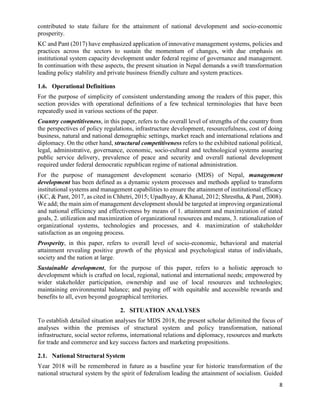
Overall work of writing MDS 2018 was governed by a pre-determined premises as outlined below:
Figure 1.1: Conceptual Framework of the Paper
As presented in above figure, the overall paper has been documented in four specific sections
where the first section deals with the introduction part of the paper, followed by review and
discussions on different perspectives to accomplish the analyses of general prevailing situation
and context. Similarly, the third section presents with deduction of general management
development scenario in reflection with the key thematic areas of observation considered in the
present work. Finally, the fourth section of the paper attempts to establish needful policy
implications and learning conclusions.
1.5. MDS 2017 a Recap
In 2019, Management Association of Nepal (MAN) is set to celebrate 39 years of its glorious
history. As part of its mandated institutional function and a responsibility in promoting advocacy
Situation Analyses
1. National Structural System [spirit of federalism:
politics, bureaucracy, governance, law and order
situation, power sharing and local autonomy]
2. Policy Development [national economic
development policies, planned approach and
priorities to national development; Nepal on SDG]
3. Development of National Infrastructure
[transportation, transmission, information
communication technologies (ICTs); infrastructure
for public service]
4. Social Sector Development [education, health, social
security, employment and livelihood]
5. International Relations and Diplomacy [political,
economic and cultural relations; adoption of
universal principals of relationship]
6. Resources and Markets for Trade and Commerce
[national spatial location, natural resources and
markets; bank and financial institutions (BFIs);
foreign direct investment (FDI)]
7. National Economy [GDP; federal fiscal imbalances]
8. Key Success Factors and Marketing Propositions
[experience of conflict resolution, indigenous
knowledge, resource abundance and diversity]
9. Country SWOT Analyses [analyses of national
strengths, weaknesses, opportunities, threats,
strategic constraints and challenges]
Management Development Scenarios
1. National Structural Systems Transformation
[paradigm shifts in political, legal,
governance, administrative systems, law and
order situation, power sharing across the
levels of governments, national policies on
socio-economic development and evolution of
welfare-state mechanism]
2. National Infrastructure Development
[national and international networks of land,
air and water based transportation, power
projects, communication broadways;
technology breakthroughs; public
infrastructure development for planned
communities, education, public health and
tourism]
3. Economic Transformation [skills for
employment and livelihood promotion,
planned priorities on promoting commercial
agriculture, tourism, power production, forest
and mines based industries; motivation for
private sector participation national
productivity and BOP; moving towards
welfare-state mechanism]
4. Exemplary Practices and Breakthroughs
[brief cases from public sector, private sector
and development sector organizations]
Defining the Context
1. Defining the Problem [Setting preamble; crafting the objectives, statement of problem, concerns of inquiry, and
significance of the study; defining methodological perspectives; revisiting MDS 2017]
Policy Implications and Conclusions
1. Strategic revisits [general national level and for MAN]
2. Conclusions [visualization of road to success with a positive hope for better]
7
for effective management in all sectors, MAN has been publishing Management Development
Scenario (MDS) since 1984 as one of its annual publications. MDS has been positioned as a tool
to help the nation in course of informed decision-making in the matters of public concern. To give
continuity of this culture of inquiry, it would be relevant to briefly discuss the main challenges,
opportunities and ways forward envisaged in the previous publication.
In MDS 2017, two scholars have recognized the global political dynamics that would impact
overall national socio-economic and political aspects of Nepal. For example, the changes
undergoing in the United States of America (USA) after the presidential election 2016 may have
global impacts (KC, & Pant, 2017) and Nepal may be affected accordingly. Accordingly, the
USA’s moves on pulling out of North American Free Trade Agreement (NAFTA), withdrawal
from Transpacific Partnership and Paris Climate Agreement, intention to build a wall across
Mexican borders to America, supporting the political faction of United Kingdom (UK) on ‘Brexit’,
recognizing Jerusalem as the capital of Israel, and stand on North Korea and Qatar would have
global impacts.
Continued and emerging scenes of terrorism would further crunch in global socio-economic and
cultural bonding and strengths amid the world’s attempt to recover from a decade-long economic
turmoil resulting in decreasing rate of economic growth in China and India also alarm Nepal as a
dependent economy. Accordingly, introduction of goods and service tax (GST) in India would
have deeper consequences in the Nepalese economy (KC, & Pant, 2017).
MDS 2017 has also highlighted that successful conduction of local, provincial and federal level
elections as an integral part of political stability under federalism would serve as a milestone in
the process of implementation of new constitution which envisions empowering local bodies (KC,
& Pant, 2017) by strengthening systems, procedures and management practices at all levels of
national governance and general administration. At the same time, political instability, followed
by continuing slow rate of economic growth, inability to spend allocated capital budget, high rate
of inflation, inconsistency in fiscal and monetary policies, higher degree of economic dependency
on remittance, slow pace of post-earthquake reconstruction and lower level of national
achievement in global competitiveness were a few impediments described in the paper. Most of
these symptoms have been continuing this year too.
KC and Pant (2017) have identified that private sector could witness several positive changes and
gain confidence as a result of restoration of political stability, transformation in financial sector
via merger and acquisition, promotion of private equity management systems, increased level of
confidence of insurance sector, launch of special economic zones, promotion of entrepreneurship
and innovation, promotion of media and improved national efficiency in managing the supply of
electricity. However, these scholars have not assessed the consequences of local government
imposing various types of taxes on business.
On the other hand, increased level of use of information communication technologies (ICTs) in
various public sector organizations including bank and financial institutions, initial public offering
(IPO) and stock exchange system supported garnishing private sector confidence. Improved
performance of Nepal Electricity Authority (NEA), Election Commission (EC), state priority on
public private partnership (PPP) in economic development, reform of public administration
system, introduction of compulsory health insurance of general public, de-regulation on various
policy frameworks with an aim to strengthen private sector have been recognized as equally
important achievements of the year 2017. These scholars have also identified a few weaknesses of
the public sector including failure of Nepal Reconstruction Authority (NRA) to achieve its post-
earthquake reconstruction targets, slow pace of development in aviation sector, unstable
government policies and poor performance in education, which would have collectively
8
contributed to state failure for the attainment of national development and socio-economic
prosperity.
KC and Pant (2017) have emphasized application of innovative management systems, policies and
practices across the sectors to sustain the momentum of changes, with due emphasis on
institutional system capacity development under federal regime of governance and management.
In continuation with these aspects, the present situation in Nepal demands a swift transformation
leading policy stability and private business friendly culture and system practices.
1.6. Operational Definitions
For the purpose of simplicity of consistent understanding among the readers of this paper, this
section provides with operational definitions of a few technical terminologies that have been
repeatedly used in various sections of the paper.
Country competitiveness, in this paper, refers to the overall level of strengths of the country from
the perspectives of policy regulations, infrastructure development, resourcefulness, cost of doing
business, natural and national demographic settings, market reach and international relations and
diplomacy. On the other hand, structural competitiveness refers to the exhibited national political,
legal, administrative, governance, economic, socio-cultural and technological systems assuring
public service delivery, prevalence of peace and security and overall national development
required under federal democratic republican regime of national administration.
For the purpose of management development scenario (MDS) of Nepal, management
development has been defined as a dynamic system processes and methods applied to transform
institutional systems and management capabilities to ensure the attainment of institutional efficacy
(KC, & Pant, 2017, as cited in Chhetri, 2015; Upadhyay, & Khanal, 2012; Shrestha, & Pant, 2008).
We add; the main aim of management development should be targeted at improving organizational
and national efficiency and effectiveness by means of 1. attainment and maximization of stated
goals, 2. utilization and maximization of organizational resources and means, 3. rationalization of
organizational systems, technologies and processes, and 4. maximization of stakeholder
satisfaction as an ongoing process.
Prosperity, in this paper, refers to overall level of socio-economic, behavioral and material
attainment revealing positive growth of the physical and psychological status of individuals,
society and the nation at large.
Sustainable development, for the purpose of this paper, refers to a holistic approach to
development which is crafted on local, regional, national and international needs; empowered by
wider stakeholder participation, ownership and use of local resources and technologies;
maintaining environmental balance; and paying off with equitable and accessible rewards and
benefits to all, even beyond geographical territories.
2. SITUATION ANALYSES
To establish detailed situation analyses for MDS 2018, the present scholar delimited the focus of
analyses within the premises of structural system and policy transformation, national
infrastructure, social sector reforms, international relations and diplomacy, resources and markets
for trade and commerce and key success factors and marketing propositions.
2.1. National Structural System
Year 2018 will be remembered in future as a baseline year for historic transformation of the
national structural system by the spirit of federalism leading the attainment of socialism. Guided
9
by the spirit of local empowerment with participation and ownership in overall governance and
social development under the newly enacted federal structure, the present national political system,
governance and administrative structure have been streamed with genuine effort to transfer the
power from ‘Singhadurbar to local bodies’ as an ongoing outcome of federalism in action. In this
discourse, development of local and provincial system capacities, policy guidelines and quality
human resource planning and development have emerged as immediate needs from the
perspectives of management development.
The Federal, Provincial and Local Governments are mandated with 25, 21 and 22 executive powers
respectively. Similarly, there is a provision of 25 powers sharing between Federal and Provincial
Governments and 15 powers are shared by all tires (Karki, 2018; Dhakal, 2017; & Khanal, 2017)
of governments and empowerment of local governance is the central governing philosophy of this
newly enacted structural system. In this context, public service delivery mechanism and
management system practices at local, provincial and federal levels may require timely revisits.
More recently, a study team had recommended to have only 15 Ministries (including 1 Office of
the Prime Minister and Council of Ministers) at Federal Level and 7 Ministries (including 1 office
of the Chief Minister and Council of Ministers) at each Provincial Level (Editorial, October 9,
2017) governments. In reality, there are 21 Ministries, 1 Office of the Prime Minister and Council
of Ministers and 54 Federal Departments at the center and each provincial government comprises
of 7 ministries including 1 Office of the Chief Minister and Council of Ministers. There are
altogether 753 Local Governments having 6,742 Ward Councils in place with mandated powers
(Editorial, June 6, 2018; & Dhakal, 2017) of local governance and development. It is yet to be
confirmed what could be the right size of such structural system for a country like Nepal as a new
practitioner of Federalism, especially from the perspective of management of cost effectiveness.
In such respects, the Constitution of Nepal is set open for any systematic changes to be
incorporated in future following a defined procedure.
Moreover, along the size of presently adopted national structural mechanism, the criteria to
determine the provinces, districts, local units and also the number of representatives to be elected
and nominated for different federal levels may change over time, provided there is shared
willpower for transformation of national structural system. Even there is space for adaptation on
present approach of maintaining inclusiveness through the process of direct election and
proportionate nomination of the representatives in assemblies and municipal corporations by
addressing the prevailing issues on compliance in respect with empowerment of women, Dalits,
Janajatis and other minority groups with scientific representation from all geographic clusters,
provincial regions, and local administrative territories. To make the national bureaucracy, defense
and police service systems more effective, numerous tires of hierarchy and positions may require
revisits. For this all reasons, there is immense need for having a mandated institution to address
these issues. The overall developments achieved by the end of 2018 confirm that the above-stated
matters should remain the subjects for further discourses.
Bajracharya and Grace (2014) have indicated that Nepal faces a huge challenge in moving to a
federal, secular and democratic state whereby making the government more efficient and receptive
to the public demands by improving the system and employee efficiency and motivation in entire
public sector employment. These scholars have pointed out lack of conducive professional
behavior of the public sector employees as one of the biggest challenges at structural, managerial
and bottom-line functional levels. These scholars also have hinted for the possibility of either
having a uniform public administration system or uniquely different one across the provincial
regions.
10
In the sphere of good governance, developing scenarios reveal that Nepal needs to work swiftly
with tangible results as its global rating has declined whereas other countries doing worse in past
have improved significantly (Gyawali, 2019; & Himalayan News Service, 2019). The national
political leadership having gained popular public mandate needs to think seriously and act swiftly
in this respect. Strengthened public administration system, general compliance with rule of law,
strict nation-wide monitoring and supervision and non-tolerance of corruption, control of fraud
behavior of public sector employees and strict enactment of corporate governance in all sectors of
national economy and social development would serve instrumental.
The Nepalese bureaucracy has been recognized as a mixture of traditional and modern features,
where traditional forces are comparatively stronger than the modern ones. For example, Shrestha
(2014) has questioned the significance of having political party affiliated civil service trade unions
as it pushes back the national bureaucracy onto a traditional and more challenging path with
divided mentality, ultimately making bureaucracy a weaker and dependent organism. Nepalese
bureaucracy has been charged as one of the world’s weakest and non-performing systems because
of its lengthy decision-making process, power and position-oriented system rather than being
results-oriented. Faulty promotions, sluggish implementation, inefficient service delivery,
‘tomorrow’ driven response of the service providers, and quite expensive to receive the public
services are additional continuing impediments. As a result, the government has been charged to
be losing public confidence, development projects have failed to achieve their targets and the rate
of capital expenditure has been continuously declining. For these all reasons too, having in place
robust management system practices becomes an imperative need of the nation. In fact, year 2018
has lit a hope that full exercise of their mandated roles by the local bodies will help address these
issues, challenges and problems in the days to come.
Accordingly, the developing situation in the country demands for a total overhauling in the national
bureaucracy and administrative systems making it operationally efficient, financially cost effective
and beneficiary responsive. Here are a few real-life stories of our national bureaucracy --
… equally important other reasons resulting inefficiency of bureaucracy include
low level of motivation, unnecessary expansion, lack of effective mechanism of
reward and punishment, over-politicization, too many layers in decision-making
process, weak mechanism to make individual officials accountable and difficulty
in adapting new technology (Shrestha, 2014). Thus, the government must take
careful steps to make the bureaucracy ‘intact’ and free of influence of politicians,
elites and trade unions; there should be distinction between the politicians and
bureaucrats; they should not interfere each other.
Nepalese bureaucracy is a composition of civil servants, teachers, and employees
of public corporations, medical institutions and other organizations under
government control and ownership. Civil servants are, however, the strongest
component. The employees of public corporations and teachers are more
responsible for delivering better service to the general public and quality education.
But they seem to be weak in rendering their services, while being highly politically
motivated and difficult to control or discipline. For this, it has become imperative
to have an effective system to instill high moral values with goal-oriented mind-
sets in the bureaucracy with non-interference of political leaders and optimal use of
technology to simplify and make credible the process of flow of services. Other
equally important steps required include emphasis on human resource
development, time-bound promotions, career development, scientific transfer,
financial incentive and proper evaluation as defining features of goal-oriented
11
bureaucracy. Networking and collaboration with the private sector and civil society
would further benefit the service seekers. Capacity building of civil servants by
proper training and education would enhance responsibility exhibiting capacity
among the civil servants. Good governance is a demand of the time and expectation
of general public. Since the entire machinery of the government is responsible for
good governance, it should not be limited to administrative reforms; rather,
people’s participation is a must while redesigning administrative services. It is
necessary to reform the electoral and political systems, judiciary and police along
with civil service (Shrestha, 2014). For this all, it requires strong political will and
commitment as the first step towards bringing bureaucratic reforms and placing the
right person in the right place with right duties and responsibilities, right in time…
At this outset, Lama (2018) has emphasized immediate need for moving forward by extending the
civil bureaucracy upto grassroots to create shared-happiness among the people living in rural areas
by means of national administrative service delivery at their doorsteps. What, if the national
bureaucracy is well prepared in this mission? It is one of the biggest challenges Nepal has to face
immediately. Civil service policies, guidelines, facilities and training and development has to be
transformed making it a center of attraction for the new generations. However, the present level of
strategic knowledge and systems preparedness may not be enough to make national bureaucracy a
public service friendly. For this, need for a number of management development initiatives arises.
Another biggest challenge facing national bureaucracy is to keep it away from politics. Politics
has been deeply rooted in each element of national bureaucracy; unless it is kept aloof from the
political interference and protection, public administrative service system may not be promoted
effectively with a vision ‘reaching to unreached at the grassroots’ and ‘transfer of power from
Singhadurbar to grassroots’. It requires strong commitment, willpower and action from all levels
of governments, leading political parties, civil society organizations, development agencies and
private sector to promote national bureaucracy as a ‘neutral’ national organism. The existing union
system and general practice of having political party affiliation or membership by the civil
servants, and also prevalence of political protection to civil servants in different circumstances
need be harshly addressed in respective civil service acts, rules and regulations and code of conduct
to be crafted on the universal grounds that politically affiliated civil servants can no longer serve
the general public with equal treatment and truthful spirit of service for humanity.
It has emerged as another important matter to address with urgency the issue of mandated authority
and compliance of protocols while working with district public administration, security forces and
other law and order situation as there has been conflicting endorsements more recently. These
aspects need be transformed in line with the best management principles and practices evolved
more recently in other federal regimes.
2.2. Policy Development
After the restoration of stable governments at all levels of federal structure, working on policy
level stability has emerged as a dominant responsibility at all levels of national governance.
National planning and economic development policies need to function in congruence with the
changing national structural scenarios and mission to achieve prosperity. Year 2018 has left with
quite positive hope in this respect as entire national machinery has been already engaged in the
process of transformation of different policies, acts, guidelines, rules and regulations.
Among a number of policy development revisits taking place at present, revisits on existing
Industrial Act is in its making. In a more recently organized program seeking stakeholder inputs,
a panel of major stakeholders shared their expectations on a number of immediately required
12
changes in the existing national Industrial Act (Kantipur Reporter, 2019). A collection of prologues
has been developed as follows:
Wagley, B., Secretary, Government of Nepal: The Act needs be private sector
friendly in terms of motivation for investment and its protection.
Golchha, S., Senior Vice-President, FNCCI: The existing acts, rules and
regulations are not in favor of industries and various provisions made in such policy
premises are counterproductive for the industries in maintaining cost effectiveness.
The cost of doing business in Nepal is big and there is lack of uniform provision on
tax exemption in various policy regulations.
Shrestha, H. B., President, Confederation of Nepalese Industries (CNI): Nepal
needs to increase state support for industries. Due to lapses in providing effective
state support, doing business in Nepal has become almost 37 percent dearer
compared to India. So, how can we motivate an investor to invest in Nepal? The
customs duty on industrial production inputs should be reduced to 1 percent.
Sharma, S., Former Vice Chairman, NPC: Two years earlier revised Industrial Act
must be brought to implementation with single-door policy. The investors may not
take bigger risks in smaller economy. There must be effective coordination between
the Ministry of Finance and Ministry of Industries.
Gyawali, K., Former Secretary, Ministry of Industries: The focus of Ministry of
Finance on generating income tax should be shifted towards industrial development
by energizing the industries.
Shrivastava, B. P., Chairman, Industries and Commerce, and Labor and Consumer
Welfare Committee: The Act must have adequate provision for an attractive
package for investment and domestic employment generation. There should be an
appealing provision for exemption on duties and taxes for the industries promoting
national employment. The culture of labor-based Bandh and Hadtaal must end.
Rijal, P., Chairperson, SAARC Chamber Council for Women Entrepreneurs:
Government of Nepal should help women entrepreneurs by having a separate
industrial zone for women and constructing required physical infrastructure
thereon.
Banskota, S., Secretary, Federation of Small and Cottage Industries: Nepal needs
to have separate rules and regulations to govern and promote small and cottage
industries. The Act must spell ways forward to improve quality of production to
promote export.
Khatiwada, Y. K., Secretary, Ministry of Industries: Among the various Acts under
development or revision, Industrial Act will come the strongest one (Kantipur
Reporter, January10, 2019, p. 13).
Above all discourses confirm the need of swift policy revisits to make Nepal an industry-friendly
regime for trade and commerce by attracting national and international private investment. Since
there has been political stability in place, year 2018 has witnessed the significance of policy level
stability as an equally important and urgent task to transform efficiency for management
development leading overall socio-economic empowerment.
As Nepal follows a system approach to national planning and development with defined priorities
for industrial development, national priorities need be revisited from time to time. It has been quite
13
a long time that Nepal has been stressing poverty reduction through planned approach to national
development. For example, the 10th
plan was developed and enacted positioning itself as a strategic
document for poverty alleviation (National Planning Commission [NPC], 2007) with generous
efforts made to make easier for inflow of foreign investment by means of several administrative
and legal reforms. Also, the plan firmly recognized prevailing peace and security situation, socio-
economic structures and scarcity of resources as the impeding challenges facing planned approach
to national development. Further, NPC (2013) recognized at least three additional impediments to
national development – illiteracy, backwardness and youth and intelligentsia brain-drain making
it a daunting task to achieve sustainable development supporting the national vision to upgrade
itself as a developing nation by 2022.
In assessing prevailing situation while framing up the national roadmap 2016 – 2030 for Nepal on
Sustainable Development Goals, NPC (2017) has recognized, “Nepal’s relative underdevelopment
is somewhat of a paradox with compelling potentials of a uniquely attractive country sitting
underutilized because of politico-institutional weaknesses” (p. 1). The Commission has further
visualized, “We envision Nepal as an enterprise friendly, middle-income country by 2030, peopled
by a vibrant and youthful middleclass living in a healthy environment, with absolute poverty in
the low single digits” (p. 2). The commission has also recognized government bureaucracy as one
of the impediments contributing to slow pace of decision-making, which hindered overall
development. This provides with a grounded evidence to confirm the significance of inducing
effective management development systems and practices.
NPC (2017) has recognized the nation’s spatial location as a source of game changer for
generating, sharing and sustaining prosperity by means of effective adaptation of new patterns of
trade and commerce, transformation of overall education system making it more affordable and
quality focused, adoption of natural disaster and climate change resilient models of human
development and complete switchover to clean energy production and consumption in all spheres
of public livelihood and industrial development by 2030.
It would be equally important to raise a developing milestone in relation to the latest policy
development in planned approach to national development. The government has been establishing
a National Project Bank within NPC. More recently, through the initiation of NPC, Government
of Nepal directed all ministries to submit their planned development projects for future (Tamang,
2019), however the response from the respective ministries was not so appealing. The main aim
of such an initiative is to undertake a coordinated and scientific approach in project selection,
prioritization and allocating resources to make sure that all developmental projects are fully
implemented with less deviation in required resources, timelines and expected outcomes. On
effective management of implementation process of this new initiative, the current practice of
selecting large scale projects on ad hoc basic will end and the nation will be benefitted by
incorporating the right projects, right in time, in right places, in support with right scale of
resources and funding with improved level of inter-departmental coordination and facilitation
(Bhatta, S., Member, NPC; based on sharing in a panel discussion on January, 25, 2019).
Hopefully, this initiative on its successful rollover, would serve as a game changing approach in
project planning, design and implementation in a more coordinated manner. For this, NPC may be
required to be capacitated with resources and knowledge to transform this dream into a reality.
Such an initiative also may require a robust policy development and changes in national projects
planning framework.
The Constitution of Nepal, 2015 envisages a three-tiered, devolved and decentralized architecture
of governance, comprising of the Federal, Provincial and Local governments (NPC, 2017). The
aim is clearly to bring the government closer to the people and enhancing the speed and quality of
14
development by providing space for peoples’ participation in development and governance. As the
Constitution aims to transform its vision to build an inclusive nation, it ensures that key
government services are accessible to all citizens and are delivered in a transparent and accountable
manner at all tiers of the government. Year 2018 has witnessed reflection of this vision into reality
as the country has already been in the hands of first publicly elected people’s representatives.
In this discourse, the Constitution refers to spheres of governance and service deliveries as (a)
Exclusively Federal Functions, (b) Exclusively Provincial Functions, (c) Exclusively Local
Functions, (d) Concurrent Functions of Federal and Provincial Governments, and (e) Concurrent
Functions of Federal, Provincial and Local Governments. Accordingly, many of the SDGs, such
as basic and secondary education, basic health and sanitation, agriculture, cooperatives, local
infrastructure, water supply and sanitation, environment and biodiversity, social protection, and
disaster management fall under Local Government responsibility and a few of these functions are
concurrent with the Federal and Provincial Governments as well. As these functions are have yet
to be unbundled and specified to each level of the government, confusion and conflict may arise
among different tiers of governments for integrating SDGs into their own plans and programs,
resulting to a risk of under-delivery of SDGs and inefficient delivery of basic services. The
government has taken some initiatives to specify the concurrent functions of each tier but it is yet
to come up with enabling laws for effective enforcement (NPC, 2017, p. 22). This reality is still
on await as of the end of the year 2018.
At the same time, to enable each tier of government with management efficiency to execute their
mandated powers and functions, it is equally important to segregate the duties and responsibilities
of public and private sector operators and development agencies to contribute collectively in the
process of goals attainment in SDG framework of Nepal. As the SDGs have to be operationalized
at provincial and local levels for their effective implementation and properly addressing the issues
of targeted group of people, elected governments at those levels would be critical for public
accountability. In this process, a milestone has been already achieved with successful completion
of general election and formation of governments at all levels of federal political regime after
electing more than 36 thousand people’s representatives, with at least 40 percent women (inclusive
of one dalit woman in each ward of the local government units), to run the local governments.
These elected representatives would be critically important foundation for the implementation of
SDGs with accountability to the local community as the concept of sustainable development is
deeply aligned with local empowerment by means of participation, use of local resources and
technologies and local benefits sharing (Rijal, 2016).
More recently, Government of Nepal has promulgated and implemented public private partnership
policy with a vision to ensure public access to infrastructure and services through their
participation in qualitative and sustainable development. Its goal is to enhance the joint investment
by public and private sector on development and operation of public undertaking through the
adoption of PPP model for comprehensive socio-economic development (MOF, 2015). The two-
fold objective of this policy aims to – i. create an environment that attracts private investment to
meet requirement of capital, means and resources for development, reconstruction and operation
of public infrastructure and services, from private sector, and ii. utilize professionalism, work
efficiency, entrepreneurship and technical skills available with the private sector to render
qualitative public infrastructure services needed for the country.
The policy directions set in this arrangement aim to --
a. promote PPP related current principles and norms of international standards in all feasible
areas, apparatus, organs and entities of the state,
15
b. create conducive atmosphere for investment of additional capital, means and resources
required for the development, reconstruction, management and operation of infrastructure
services from private (domestic and foreign) sector, and
c. make optimal utilization of professionalism, entrepreneurship, ability, competency and
latest technologies of private (domestic and foreign) sector in the development,
reconstruction, up-gradation, operation and management of infrastructure service for
country’s overall development.
The present national situation demands more tangible contribution of private sector through such
arrangements of partnerships with governments and enterprises owned by the governments as it is
quite easier to gain public trust and confidence to invest in entities where government ownership
is prevalent. For this too, Nepal needs to develop technical human resources, management system
capacity and functional practices to leverage diversity and intensity of partnerships to help the
nation gain economies of scale. Year 2018 has served with policy materialization for public-private
partnership (PPP) to establish and promote a number polytechnic institutions, training and
development centers and other initiatives under public-private investment and ownership to
safeguard much needed sustainable development.
2.3. Development of National Infrastructure
The government of Nepal has recognized public private partnership (PPP) as one of the working
propositions to initiate sustainable infrastructure development as a powerful means of shouldering
rest of development activities across the nation. One of the most recent developments taken place
in 2018 is the joint initiative taken by the public and private sector to establish a ‘special category’
bank - Nepal Infrastructure Bank Limited under PPP model of investment and institutional
management. The institution is jointly promoted by the Government of Nepal, financial institutions
and the private sector. The prime objective of this bank is to foster economic development by
investing and providing allied services to the infrastructure development projects. Presently, the
institution is in the final stage of obtaining permission from Nepal Rastra Bank (NSB) for
commencement of operations. It has been expected to serve as the backbone for infrastructure
development through PPP model of investment (Setopati, 2018).
In addition, a number of national pride projects are in different phases of their inception,
development and implementation. Completion of these pride projects will, of course, strengthen
the transportation, hydropower production, transmission and agricultural irrigation. More
importantly, effective management of these projects with timely execution would produce a
massive trained workforce, empowerment of technical knowhow and happening of more trade and
commerce situation in future as each of these pride projects has been visualized as a ‘game
changer’ in the national economy. For example, completion of Kathmandu-Terai Fast Track and
development of international airport in eastern Terai would result in establishment of more than
1000 small, medium and large size industries creating at least 100 times more employment
opportunities, it is near to universal reality. Successful completion of Bheri-Babai Diversion
Project and Shikta Irrigation Project would multiply the scale of household and commercial
agricultural outputs in Banke and Bardia districts.
Similarly, US$ 630 million joint initiative of Government of Nepal and US Federal Government
supported Millennium Challenge Compact (MCC) is going to commence project implementation
activities from September 1, 2019 with focus on national road and transmission sector
development and development. The contribution of MCC Nepal Compact will increase the
availability of electricity and lower the cost of transportation, and thus serve instrumental to spur
16
investments, accelerate economic growth and reduce poverty (Office of the Millennium Challenge
Compact Nepal [OMCN], 2019).
One of the biggest challenges Nepal faces in executing large scale projects is delayed recruitment,
selection and development of required project staff. As a result, many collaborative development
projects carried out by the Government of Nepal could not either be accomplished in time, or they
could not achieve the expected results, or both. At this context, MCC maintains an exemplary
management practice of having total project and program staff in place with their roles, duties and
needful training and development inputs before the launch of project implementation. Hopefully,
the project management approaches applied by MCC in Nepal will serve instrumental in
developing Nepal’s national capacity and knowhow in managing large scale projects by engaging
a large pool of Nepalese workforce at work while implementing the project following its
standardized plan of action.
Different studies confirm that the backbone of national infrastructure development comprises of
transmission, transportation, communication, education and development of other public and
business utility facilities. Accordingly, there emerges wider scope for the application of effective
management development in the nation. In this respect, the latest initiatives taken up by Nepal
Electricity Authority (NEA) under the leadership of Er. Kulman Ghisingh are appreciable but the
mission of developing national transmission system capacity has been obstructed from time to time
at local and regional levels and it requires strict national rule for paving the path to establish and/or
upgrade hydroelectricity transmission lines across the country (Setopati Reporter, January 28,
2019).
Effective policy intervention is equally important component to be considered while developing
national infrastructure for development. In this respect, in addition to giving continuity to a number
of ‘national pride projects’, the newly formed government of Nepal has placed high priority on
strengthening East-West Highway, connecting mountains, hills and Terai by constructing different
roads, bridges and cable car systems, and conducting feasibility study of railways and metro links
(Ministry of Finance [MOF], 2018). The process of transforming Hulaki Maarga into a hill-to-
hill-to-Terai connecting highway is also given continuity in the year 2018. Inception and
construction of a number of transportation projects including the construction of Kathmandu-Terai
Fast Track, Kathmandu-Chitwan tunnel way, Kathmandu-Dhulikhel Metro System, Kathmandu
Ring-Road Projects I and II, various Metropolitancity, Sub-Metropolitancity and Municipality
based roads and upgradation of many domestic airports is underway. Renovation of school, health
and communication sector infrastructure has been widely emphasized.
Accordingly, agricultural corridor development has also been prioritized by the state as well as
development agencies. For example, agricultural value-chain infrastructure development support
provided by High Value Agriculture Project (HVAP, 2009-2017), Improved Seeds for the Farmers
Program (ISFP, 2013-2019), Knowledge-Based Integrated Sustainable Agriculture in Nepal
(KISAN-II, 2017-2022), Rural Enterprises and Remittance Project (RERP-Samriddhi, 2015-
2022), Prime Minister Agriculture Modernization Project (PMAMP, 2016-2025), Adaptation for
Smallholders in Hilly Areas (ASHA, 2015-2021) Project are a few examples of game changer
initiatives in agricultural innovation, modernization and commercialization. From the perspectives
of management development, these projects must have produced a large pool of qualified and
trained technical and administrative workforce in the country by now, as most of the projects are
either nearer to accomplishment or in the mid of their duration.
The process of upgrading existing airports in Dhangadhi, Nepalgunj, Bhairahawa and Pokhara to
connect these locations internationally is underway. The only international airport in operation in
Kathmandu needs multi-fold transformation to promote at par with international airports abroad.
17
The agenda for the development of a new international airport in the Eastern Terai has been on
rollover.
Hydropower production and effective management of transmission has been a national priority to
fuel overall national development with attainment of some success more recently. However,
financing of mega hydropower projects is another daunting task for Nepal. At the same time, Nepal
requires a number of high capacity transmission lines and systems in place to be able to export
hydropower to the neighboring countries in near future. Accordingly, the nation is in need of
establishing agreements with different neighboring countries for trading of electricity as per the
need and market demands, especially in the SAARC region. In this respect, more recent
government achievements to establish such agreements with Bangladesh and India should be
considered as the policy level strategic milestones. For instance, more recently, Nepal has signed
an agreement with India on energy exchange as per the needs of one another (Pariyar, 2019).
Again, lack of own technology and poor financing capacity of the country would prolong the dream
of economic empowerment by addressing the issue of deficits in balance of payment and federal
fiscal imbalance through export of electricity as a primary source of revenue for all tiers of
governments, public and private enterprises and the general public at large. Managing this vision
with materialization of policies and projects is a big job emerged from the perspectives of national
project management capacity development.
Nepal has been already connected with Chinese gateway of fiber-optic networks but the country
needs to develop adequate infrastructure connecting major market zones within itself. In this
respect too, the nation must have realized materialization of local technologies and innovative
breakthroughs to connect communities with resources and life support system available across the
world.
The process of disinvestment of Nepal Telecom, Nepal Airlines, Nepal Oil Corporation, Nepal
Drugs Limited and a number of other state-owned corporations has been taken into consideration
by the present federal government. Effective execution of PPP Policy 2015 (MOF, 2015) would
leverage this mission as the country already has stable governments at all levels since 2018.
It has been much delay for Nepal to equip various sectors of national infrastructure development
with relevant technologies and knowledge base. As a result, a large share of investment on
infrastructure development has been drained abroad while procuring such technologies and
knowledge. If the nation intends to build railway tracks, metros, irrigation channels, large scale
drinking water supply systems, varying scales of hydropower production projects and international
airports, it should have its own, cost-effective and output efficient supply of required technologies
and ‘knowledge management’ in place. Turbine, irrigation and tunnel projects are yet to be made
the mandatory part of national engineering education curriculum in Nepal across all universities
providing engineering education, research and innovation.
In this respect, the early breakthroughs made at different laboratories established in Kathmandu
University (Turbine Testing Lab, Technical Training Centre, Biomass Stove Testing Lab,
Renewable Energy Lab, Machine Vision Lab, CAD/CAM Lab, Heat Transfer
Lab/Thermodynamics Lab, Fluid Mechanics Lab, Metrology Lab, Engine Combustion and
Gasification Lab, Welding, Smithy and Foundry Shops, Machine Shop and Automobile Lab may
serve as technological milestones (Kathmandu University, Department of Mechanical Engineering
[KUDME], 2018). In fact, the early results of innovation at Turbine Testing Lab in Kathmandu
University are encouraging with comparatively better performance efficiency of hydropower
generation turbines compared with the global leading innovations in selected segments. These
institutions need more national and international support to capacitate with world-class
technological workforce leading the innovation of breakthrough technologies.
18
More recently, a new dimension of strategic thinking has emerged in Nepal with the idea of having
own ships, rail connectivity with China and India and replacing the consumption of petroleum fuel
by electric charging systems. Required policy interventions leading the development of national
infrastructure and institutions for these all initiatives is on await as of now. Department of
Railways, Department of Shipping and Department of Mining need be empowered with required
policies, strategic guidelines, technologies, financing, effective workforce and adequate learning
exposure.
Moreover, Nepal has been continuously facing a number of apparent and hidden international
obstacles against its mission to develop sustainable national infrastructure to promote trade,
commerce and human development. Nepal has to work very much cautiously and strategically
with the closer neighboring countries by promoting and strengthening its trade and cultural
bonding, especially with India, China, Bangladesh and Pakistan. For this, the nation requires a
permanent body to function as a think-tank to provide with policy and strategic advisory inputs to
the federal government (KC, B., 2019; depicted from the personal interview on January 22, 2019).
On top of all, Nepal has been a severe victim of massive corruption and system induced procedural
delay in national infrastructure development sector. Almost all missions of national infrastructure
development are victimized by multi-fold nexus of different players having their vested interests;
vested purpose-driven behavior and ‘power center’ created misappropriations. The grapevines
formed by selected national contractors of physical infrastructure development, license holders of
large scale hydropower projects, political leaders, top administrators in the bureaucracy, business
persons, even the national judiciary professionals and leadership in the governments have
remained rampantly disputed from time to time. Time and again, the responsible actors from
private and public sectors have been reportedly observed to be abusing their authorities, duties,
roles and general norms of administration and governance by using political influence over
expected accountability and responsibility. Year 2018 has served as an open source of disclosing
numerous stories in this respect.
Similarly, the nation is in urgent need of ending the present practice of implementing numerous
projects on ad hoc and scattered basis with lack of consistency in project prioritization and
continuity over time. A project, once it is adopted by a government, should remain in the pool of
national priority till its completion, no matter whatever changes occur in government or national
administration (Bhatta, S., Member, NPC; based on sharing in a panel discussion on January, 25,
2019) as well as external environment. For this reason too, there is high significance of establishing
National Projects Bank within National Planning Commission (NPC) and all national development
projects of different ministries should be pooled in the bank and government approval should be
provided only after necessary technical assessment of such projects. Year 2018 may receive big
credit in future on this dimension of thinking on project development and management.
2.4. Social Sector Development
Among many elements of social sector development, education serves as the life-blood to
empower rest of sectors. Numerous studies carried out by the state as well as private and
development sectors confirm that education is one of most victimized sectors since last 7 decades
of systematic development in Nepal, despite many pragmatic policy as well as action level
recommendations made from time to time. Lack of consistency of purpose, absence of defined
national priority in action, failure to implement various policy documents and plan of action in
real-life administration and management of education sector, absence of application of measures
for universally accepted quality assessment and accreditation (QAA) and lack of adequate
investment on infrastructure and educational resources nation are a few continuing challenges and
problems of Nepalese education sector (Rijal, 2011). In addition, high political interference and
19
direct engagement of teaching force in political party system have also been witnessed as
dangerous scenarios in education, especially in public sector education. Private sector has been
continuously vesting its best efforts with delivery of best performance results at institutional level
and engaging actively in policy negotiations for the betterment of overall education sector in the
country. There is severe lapses from the side of national administrative and governance system to
provide with effective protection for the private sector which has been delivering with high
performance results. Nepal is in urgent need of having defined roles, responsibilities and duties of
the public and private sector on education of all types at all levels.
More recently, Government of Nepal formed a fifty-member High Level Education Commission
and eleven-member High Level Taskforce to come up with policies, programs and organizational
structure suited to federal education system (Ministry of Education [MOE], 2018; & myRepublica,
September 8, 2018). However, the committee could not establish consensus among all members
involved in respect with addressing the issue of giving continuity to the private participation in
education, majority of the ways forward envisaged in the proposed mechanism seem to serve as
game changing phenomenon in national education system, if effective policy development and its
implementation is assured.
Health sector is another equally important social sector of development and prosperity. Nepal has
been able to provide with essential public health services through a nation-wide network of public
health service institutions including Primary Healthcenters, Healthposts, District Hospitals, Zonal
Hospitals, Regional Hospitals, National Hospitals and various university Teaching Hospitals.
These days, presence of private sector is equally evidential in health education and service,
especially in the urban areas.
Effective delivery of public health education and services has been at a stake due to lack of
adequate and quality human resources, non-availability of modern technologies and medicines and
inadequate financing. At the same time, development of health sector has always remained a
national priority but with minimum tangible action. Again, extreme political interference and
engagement of health service providers in general politics has been equally hindering this sector.
Accordingly, Nepal may require to establish effective projection of various types of human
resources, technologies, medicines and infrastructure needed for effective delivery of health sector
services. More recently, the Federal Assembly has passed a bill, National Medical Education Bill
2018, which was high in public demand for promulgation (Setopati Reporter, January 28, 2019)
but equally disputed and now it requires a national consensus on its effective implementation so
as to enhance the national system capacity and public affordability on medical education as well
as safeguarding the access to medical services for common people.
Nepal is on its mission to proclaim as a ‘welfare-state’ by 2030, for which providing with
numerous measures for social security and protection becomes a mandatory task. Year 2018 also
marked a historical achievement of the Government of Nepal as the country launched for the first
time the much awaited social security scheme entitled Contribution-Based Social Security Scheme
(International Labor Organization [ILO], 2018; & THT Reporter, 2018). The scheme has been
funded through the contributions made by the workers and the employers. This is a historical step
towards achieving decent work for all, which is a stated commitment of Nepal on sustainable
development goals (SDGs). The Decent Work Country Program 2013-17 (ILO, 2014) serves as
the main vehicle for delivering ILO support in Nepal in realization with the overall goal of decent
work for all and reflects the priorities of the tripartite constituents in Nepal, as expressed through
rounds of discussions and consultations. The program has been aligned with the national
development priorities of the government, strategic priorities of the ILO and the United Nations
Development Assistance Framework (UNDAF). Initially, the newly enacted participatory scheme
20
would cover medical, health and maternity benefits; accidental and disability benefits; dependent
members and old-age benefits, and soon the scheme would also cover the benefits of the workers
of informal sector. However, the financing capacity of the government and private sector has been
raised an issue in this respect.
It has been visualized that the tourism sector alone may generate millions of new employment
within a decade. More recent development taking place for establishing Nepal Academy of
Tourism Studies (NATS) as an autonomous university to undertake the responsibility of
developing quality human resources and accomplishing necessary research and innovation in
tourism sector of the country under the initiation of Ministry of Tourism and Civil Aviation
(MOTCA, 2018) will serve as equally important achievement of year 2018.
In agriculture, inception of cooperative and commercial farming systems, agricultural value-chain
systems, launching of mega projects for national infrastructure development, etc. would generate
large scale of employment at various skill levels but all what is required is maintaining adequate
political distance from these sectors of national development. The mission to promote quality of
life through general livelihood promotion should not be hindered by any political interest or
intervention.
Although Nepal is a small country, it is full of diversity in many respects. Soulful appealing
diversity of natural settings, people and cultural practices provide unique experiences in each
community settlement of the country, making it a perfect tourism product as a whole. Nepal is
quite reach in languages; secular in terms of religious faiths; and three belts of geographic construct
of the country – Himalayas, Hills and Terai – provide with a unique feature of unity within
diversity. The new Constitution of Nepal has placed high priority to respect diversity by means of
social inclusion and empowerment of people at all levels of national administration, politics and
other walks of welfare-state mechanism (Secretariat of the Constituent Assembly, 2015). The
constitution also provides with provision for rights based approach to follow social cultures and
religious practices.
2.5. International Relations and Diplomacy
Since long, Nepal believes in and treats to the rest of the world by the spirit of Principles of
Panchsheel (Cheyenne, 2018), probably first crafted and agreed between India and China after
world war II in their treaty, initiated by the vision of Jwaharlal Neharu, the then Indian Prime
Minister (Verma, 1989) creating a breakthrough in international law in Asia. Nepal firmly believes
in universally significant these Principles of Panchsheel and its presence in the UN system,
advocacy on promoting peace and global brotherhood has been widely appreciated in the global
forums. Nepal’s long-standing cultural linkages with China and India as well as open-border to
India are instrumental in promoting cultural and economic exchanges between these two
economically powerful nations in the world.
As of January 26, 2018, Nepal has established and has been continuing with 158 diplomatic
relations, 163 bilateral relations and at least 4 membership in the regional and economic
cooperations (Ministry of Foreign Affairs [MOFA], 2018), 39 Nepalese missions overseas (30
Embassies, 6 Consulates and 3 permanent missions to UN), 26 Residential and 83 Non-Residential
Foreign Missions Accredited to Nepal.
As a result of its liberal foreign policy and varying needs of the country, more than 200
International Non-Government Organizations (INGOs) and many international institutions, donor
agencies and development partners have been working in Nepal to address multi-fold issues,
challenges and problems.
21
Guided by the UN Charter, the fundamental objective of Nepal’s foreign policy is to enhance the
dignity of the nation by safeguarding sovereignty, territorial integrity, independence, and
promoting economic wellbeing and prosperity of Nepal. It is also aimed at contributing to global
peace, harmony and security (MOFA, 2018). Nepal’s foreign policy is guided by the following
seven basic principles:
a. Mutual respect for each other’s territorial integrity and sovereignty,
b. Non-interference in each other’s internal affairs,
c. Respect for mutual equality,
d. Non-aggression and the peaceful settlement of disputes,
e. Cooperation for mutual benefit,
f. Abiding faith in the Charter of the United Nations, and
g. Value of world peace.
Precisely, these policies have been directly depicted from the Principles of Panchsheel (Cheyenne,
2018; Second Constituent Assembly, 2015) whereby Article 5.1 of the Constitution of Nepal 2015
has made provision on National Interest and Foreign Policy by safeguarding the freedom,
sovereignty, territorial integrity, nationality, independence and national dignity, the rights of the
Nepalese people, border security, economic wellbeing and prosperity as the basic elements of
Nepal’s national interest. Similarly, the directive principles (Article 50.4) state that the state shall
direct its international relations towards enhancing the nation’s dignity in the world by maintaining
international relations on the basis of sovereign equality, while safeguarding the freedom,
sovereignty, territorial integrity and independence as the national interests of Nepal. Finally,
Article 51, on state policy, aims to conduct an independent foreign policy based on the Charter of
the United Nations, non-alignment, principles of Panchasheel, international law and the norms of
world peace, taking into consideration of the overall interest of the nation, while remaining active
in safeguarding the sovereignty, territorial integrity, independence and national interest of Nepal.
It also provides legitimacy to review treaties concluded in the past and make treaties and
agreements based on equality and mutual interest. Now, the government, with attainment of
political stability, has to deliver its level best in line with the mandated spirit of the national
Constitution.
2.6. Resources and Markets for Trade and Commerce
From the perspectives of promoting manufacturing industries, Nepal is full of resources for
industries specializing in agriculture, forest, water, mine and minerals based inputs. Various
destinations, local cultures and traditions could serve as the nature gifted resources for tourism
development and promotion. For the business process outsourcing services, cheaper availability
of young workforce could be regarded as equally potential resources.
Adaptation of modern information communication technologies (ICTs) has been taking place in
diverse sectors of business and service operations; communication superhighways are in the
process of making; production of hydroelectricity is likely to replace almost rest of fuel
consumption in households, offices, industries and road based transportation.
Similarly, abundance of natural spring water is likely to be regarded as one of the cheapest natural
resources gifted for Nepal in closing the historical deficit in balance of payment. For this,
establishment of pure drinking water refining projects with economies of scale would be required
in near future. India and rest of South Asian region is likely to be the major market for exporting
electricity and processed drinking water. For tourism services, Nepal may have tremendous scope
of marketing in the developed economies by crafting premium service packages. Nepal may find
a superior market position in the global market places for its organic paper and traditional crafts.
22
Despite very high expectations of diverse sectors from the present government to deliver with
effective results in response to public mandate for political stability after a long period of
uncertainty and instability, the early results indicate need for additional works taking benefit of
strong political mandate provided by the general public to transform into policy level stability.
Still the private sector seems to have little confidence in Nepalese economy. For example, Nepal
received total foreign direct investment (FDI) of worth NRs. 4.95 billion within the first four
months of running fiscal year (FY 2075/076), whereas this figure was NRs. 10.17 billion in the
same period of the last fiscal year (Dhungana, 2018), information released by Nepal Rastra Bank
(NRB) states. This information gives an impression that political stability alone may have little to
offer in absence of policy stability. Dhungaga (2018) has further stressed that one of the major
reasons of such a slow-down in FDI inflows could be failure of leadership in the Ministry of
Finance and Ministry of Industries to create conducive environment for private investors – the
government role needs to be shifted to effective ‘facilitation’ rather than ‘intimidating’ the
investors and business institutions. Let’s add one concurrent happening, the perceived risk of high
tax imposition by the local autonomous governments also might have created ‘wait and see’
situation among the existing and likely private investors.
Nyaupane (2018) has recalled the opinions of different high profile personalities speaking on
current behavior of private investment inflow and observed that there are competitive options
available to the foreign investors and they obviously choose the easiest and safest locations for
investment (based on open response of Sharma, H. B., President CIIN), whereas another
contemporary expert was of the opinion that present situation of having controlled political
environment and administrative hurdles are the key obstacles facing FDI flow in Nepal (based on
open response of Gyawali, K., retired Secretary, Government of Nepal [GON]). Similarly, a
renowned corporate leader in Nepal cited problems in legal and policy frameworks as a majority
of laws and policies governing private investment are yet to be transformed (Based on open
response of Shrestha, R. K., President, Nepal Chamber of Commerce [NCC]).
2.7. National Economy
The economic growth rate in Nepal was projected to be 5.89 percent in the fiscal year 2017/2018
(Editorial, 2018). The national accounts statistics of the fiscal year launched by Central Bureau of
Statistics ([CBS], 2018) revealed that the contributions of primary sector to the Gross Domestic
Product (GDP) were on decreasing trend whereas the contributions by service sector were on the
rise, based on trends produced from the real figures of last nine months. The per capita income for
year 2017/2018 stood at US$ 1004 with an increment by US$142 compared to that of previous
fiscal year. The top three sectors of contribution in the national economy comprised service sector
(58 percent), agriculture (28 percent) and production sector (11 percent), giving an economic
baseline for an estimated annual national economy of US$ 30 billion for the subsequent fiscal year
with closer to 7 percent of implicit GDP deflator.
According to the GDP accounts data made public, agriculture and forestry, fishery and mining
under the primary sector is estimated to contribute 28.21 percent to GDP. Though the agriculture
sector did not see substantial growth in the current fiscal, use of forest timber for reconstruction
had caused rise in the production in this sector. Meanwhile, construction, industry and electricity,
gas and water, under secondary sector, were estimated to have contributions of 14.18 percent to
the national GDP. Acceleration in reconstruction and other construction works, expansion of
energy sector and production rise in industrial sector contributed much to that sector. Likewise,
retail and wholesale transaction, hotel and restaurant, transport, communications, financial
mediation, real estate and commercial services, public administration, education and health have
contributed 57.61 percent to GDP.
23
Rise in production of domestic goods, increase in in-flow of tourists and smooth power supply
have triggered substantial improvements towards social service. CBS sources indicate that
agriculture sector was primarily estimated to contribute 27.10 and non-agriculture sector 72.90
percent to the national GDP. The agriculture sector was estimated to experience an inflation of
2.82 percent in fiscal year 2017/2018.
In a recent study, Wagley (2018) has confirmed that the most overarching and universally accepted
imperative to federalize any unitary nation-state is to reduce, both vertical and horizontal, fiscal
imbalances by ensuring the availability of financial resources to augment all forms of well-being
and prosperity. This scholar has claimed that such imbalances hinder the attainment of desired
economic outcomes. This study shows that mainly vertical fiscal imbalance alarmingly persists in
Nepal even after federalization and it would impact on the fiscal federalism framework and
functionality of the country. The Panel Corrected Standard Error (PCSE) model examines how
these imbalances between the federation and the sub-national units (vertical) and, also among the
States themselves (horizontal) are likely to act and it contends that highly skewed distribution and
mobilization of financial resources essentially defeats the very rationale of federalizing Nepal and,
much debated identity consideration in federalism has no positive welfare implication. This is an
alarming imperial evidence of likely consequences of promoting federalism only under the
political will whereby ignoring rest of equally important pillars of federalism development and
promotion. The immediate need here is to enact a robust decentralized economic development
framework under federal structural system.
The first federal budget of Nepal accounting NRs. 1.31 trillion for the fiscal year 2018/19 has set
an ambitious goal of achieving 8 percent economic growth with targeted annual revenue growth
of 29.8 percent having disproportionate allocation of NRs. 113.43 billion to seven provinces and
NRs. 195.05 billion to 753 local bodies as equalization and conditional grants. Under the revenue-
sharing scheme, the provinces and local bodies have been provisioned for NRs. 60.42 billion and
NRs. 53.82 billion respectively (MOF, 2018).
From the perspectives of management development, two key thresholds of the budget include
attempt for job creation and creating appealing environment for foreign direct investment (FDI) in
Nepal. For the purpose of job creation, the government has allocated NRs. 3.10 billion to initiate
Prime Minister Employment Program with an aim to generate employment opportunities.
Accordingly, a provision for providing a concessional loan of upto NRs. 700,000 at 5 percent
interest rate backed by educational certificates to help young entrepreneurs to launch their small
and innovative ventures with special emphasis on promotion of entrepreneurship and job-skill
development training programs (MOF, 2018) initiated by the young graduates may equally serve
as another benchmark, provided the rate of interest is reconsidered to make it less than 5 percent.
Similarly, from the perspective of FDI attraction, the budget has provisioned 5 percent cash
incentive on exports to leverage industrial development of selected products including cement,
sugar, iron rod and others. The budget also has specified that the companies of the real-estate sector
with capital above NRs. 1 billion should be converted into public limited form and be listed in the
stock exchange market. However, such a vision may serve counterproductive against the present
Finance Minister’s pledge to clear the hurdles in doing business and encourage foreign investment
in Nepal as not all the foreign investors would be willing to convert a private limited company to
a public limited company. For this purpose also, it may require some point of attraction to
strengthen management efficiency of the firms during their transition to public limited form.
For the purpose of effective mitigation of the issue of tax misappropriation and leakage by the
business institutions and individuals, enforcement of integrated tax-payers management system
followed by implementation of electronic billing system to register tax payers into the central
24
billing monitoring system is part of enhancing efficiency in revenue management system of the
country.
These all growing situations in the country demand a robust system enactment to address the
various affairs of national economy from the perspective of promoting with effective systems and
practices pertaining to this special sector of national development. There equal significance of
effective management development for this sector.
2.8. Key Success Factors and Marketing Propositions
For the purpose of promoting trade and commerce activities in the country, various levels of
governments, civil society and development agencies should focus on full utilization of a number
of success factors of Nepal. Such factors include – 1. patriotic citizens and cultural diversity, 2.
abundance of natural resources, 3. fame of Gorkhas, 4. spatial location between two economically
powerful nations in the world, 5. growing size of productive national population, 6. Nepal’s
national identity as a peaceful nation, and 7. successful experience of transition from internal
conflict and insurrection. There is equal chance of achieving success by means of innovative
breakthroughs and social entrepreneurship.
Similarly, Nepal may have tremendous scope for marketing and promotion of touristic
destinations, indigenous products, services and knowledge. Since all these aspects have been very
well accepted by the world today, proper scoping of these concepts coupled with global marketing
and promotions would serve instrumental in exploring new investment and also the marketing
opportunities. However, it has become already late to act swiftly in terms of identifying and
redefining various indigenous knowledge elements inherent in Nepal and transforming them as
part of intellectual property rights protection and promotion. Such an act today, would serve as a
noble investment for the generations tomorrow.
We can promote Nepali products and services by branding and promoting them in tune with the
concepts of Origin of Himalayas, From the Footprints of Lord Buddha, Grown in Virgin Land,
etc. to tap the global markets and acquire deeper consumer imagery over products and services
made in Nepal.
Key marketing propositions (KMP) refer to the specific positioning aspects of Nepal and its
marketable entities which could be promoted globally. Purity of resources from Himalayas,
bravery of Gorkhas, internationally acclaimed zone of peace, birthplace of global ambassadors
like Siddharta Gautam, Janaki, Bhrikuti and Araniko, Nepal’s continued stand on global
brotherhood, peace and harmony, and most importantly, highly patriotic Nepalese people with
smile may be noted as a few marketing propositions of Nepal in the global politics and economy.
Key success factors (KSF) refer to the factors that can be counted for the success of any initiative.
KSFs are the factors serving as professional and institutional credentials or measures of success.
Nepal’s friendly relations with other countries (especially in the South Asian Region), proven
contribution in the United Nation’s (UN) peace keeping missions, national experience of handling
conflict, abundance of natural resources, natural beauty, spatial location and availability of cheaper
labor force could be regarded as the KSFs of Nepal.
2.9. Country Competitiveness
On the basis of overall assessment present national situation, a very brief outline of country
competitiveness has been portrayed as follows:
Table 2.1: Nepal Country Competitiveness Analyses
Positive or Driving Factors Negative or Restraining Factors
25
Strengths Weaknesses
Increasing public faith on federal
democratic republican system resulting
with high degree of public participation in
national missions of general politics,
governance and development.
Spatial location of the country between
two economic powerhouses in the world –
India and China, Nepal can be promoted
as an important point of transit economy.
Rich in history of independence,
patriotism and international brotherhood.
A state guided by the Principles of
Panchsheel (United Nations [UN], 1958)
and Eastern Mythologies whereby Nepal
is known for its firm commitment on
international brotherhood.
Stable governments in place at all levels as
a result of overwhelming public
participation during the general elections.
Lack of national experience and efficiency
of management development in federal
regime.
Spatial location of the country; Nepal
being land-locked and sandwitched
between India and China faces problem in
international business with no direct
access to the sea.
Poor initial delivery of first elected
governments at all levels under federal
regime; Nepal being very new to practice
federalism.
Too small economy to bear the multi-level
federal structural costs of governance and
general administration.
Continued instability of policy
development and implementation for
socio-economic and human development.
Lack of own technology required for large
scale development projects.
Poor national infrastructure base to
support overall national development and
prosperity.
Opportunities Threats
Private sector friendly government policy
by emphasizing promoting public private
partnership (PPP) based model of socio-
economic development.
Abundance of natural resources for water,
agriculture, forest and mine based
industries.
Appealing touristic destinations and
unified national diversity to promote as a
source country of memorable experience
economy.
Chance of promoting innovative
breakthroughs and entrepreneurship by
blending between Nepalese indigenous
knowledge and modern technological
advents across the world.
High chance of promoting public private
partnership (PPP) based models of
development of national infrastructure,
trade and commerce.
Risk of entrepreneur/investment-drain to
appealing destinations as a result of
additional and unaffordable fees, duties
and taxes levied by the local autonomous
governments, with different rates in
different provinces and local units.
Higher cost of doing business in Nepal
compared to other neighboring countries.
Brain-drain of youth and intellectual
community as a result of lack of
opportunities and respectful structural
environment.
High political interferences in almost all
sectors of socio-economic development
and general administration.
Risk of likely national financial crises in
mitigating the mounting structural costs of
federal administration and welfare-state
delivery.
Based on proceedings of an in-depth interview with a prominent professor of management sciences
in the country (KC, B. 2019, based on personal discussion on January 22, 2019), following critical
views have been deducted as part of Nepal’s competitiveness:
26
a. Public participation in national politics is overwhelming in Nepal, thus the
expectation from the elected governments at different levels of federal system
may be much higher.
b. Political stability is a basic requisite for policy stability, which is crucial for
sustainable development of a country, and still there is a lot of work due for
Nepal to respond swiftly with adequate and effective policy reforms in its
course of strengthening federalism. Only a blend of good policy, good people
and good action in place would serve instrumental in gaining confidence of
private investors.
c. Lack of clarity and consistency of national policies, failure to address the
immediate public needs at micro level and untimely intervention taking place
in respect with social security related issues would serve counterproductive
against the national mission to economic development.
d. Increasing cost of doing business in Nepal hits uncertainty for the future of
industrial development. The present practices of local units on taxation may not
appeal the private investors.
e. There is a big gap between promised national development goals and local,
provincial and federal responsibility and accountability. In fact, such
responsibilities are yet to be materialized.
f. The government seems stuck in multiple piles of micro management issues. As
a result, the task of establishing a clear strategic roadmap with long-term,
visionary thinking supported by relevant policies, rules and regulations leading
sustainable national development and prosperity is still at stake.
g. There is immense need for having an institutionalized practice of national
development projects inception, development and implementation with defined
priorities and continuity of state support throughout the implementation
process.
h. Equally important is that quite a few national pride projects need immediate
reengineering and overhauling of the implementation approach.
3. MANAGEMENT DEVELOPMENT SCENARIOS 2018
Based on prevailing national situation analyses, a number of management development scenarios
have been traced taking into account five key aspects of consideration – 1. national structural
system transformation, 2. development of national infrastructure, 3. economic system
transformation, 4. shifts in national priorities for economic development, and 5. exemplary
management development practices and breakthroughs as presented in the following sub-sections.
3.1. Scenarios on National Structural System Transformation
The various discussions produced in the previous section confirm that the following management
development scenarios have appeared till the end of 2018 with respect to national structural and
governance system transformation:
a. By the end of 2018, Nepal has received long-awaited success in internal peace building
and political stability and there is national Constitution in implementation confirming
Federal Democratic Republic system of national restructuring. As a result, local, provincial
and federal governments are in action with popular public mandate received via first
general election of all levels accomplished in 2017/2018.
b. The country has been undergoing a post-conflict, peaceful, national administrative systems
transformation with multiple layers of national bureaucracy covering at least three
27
structural levels in congruence with the spirit of new Constitution of Federal Democratic
Republic of Nepal by enacting various government systems and institutions under federal
structure of administrative power division and decentralization.
c. Different studies and global best practices reveal that Nepal has been progressing rapidly
with continued peace building, policy enactment and system practice transformation and
also addressing the issues of general compliance and promotion of gender empowerment
and social inclusion with respect to promotion of diversity in the national structural
framework of politics, bureaucracy and governance.
d. The nation has now realized the need for enactment of various game changer projects and
initiatives to transform national structural system. As a result, in immediate future the
nation will witness a number of policy interventions and technical game changer
breakthroughs taking place in the country across various levels of general administration
and governance in course of institutionalization of federalism as per the spirit of new
Constitution.
e. The need for addressing the issues of corruption, accountability, transparency, process
delay and other general compliances has been widely raised. As a result, national political,
governance and administrative systems are expected to have swift response in these issues
to maintain effective compliance of law and order with due respect to general ethical
compliances.
f. Nepal’s global rating on good governance has further declined in year 2018 by 2 positions
compared to that of year 2017 (122nd
position of year 2017 and 124th
position for 2018) as
a result of continuity of the prevalence of abuse of authority and corruption at different
levels.
g. The overall developments taken place in Nepal until the end of year 2018, especially in
field of restructuring national bureaucracy and administrative system as well as its
governance, have raised urgency for establishing a national institution to provide with
policy advocacy and leadership for enacting a system approach with effective plans and
policies on HRD covering the HR needs of local, provincial and federal governments to
assure Nepal’s transition to ‘welfare-state’ and achieving shared happiness and prosperity
by means of effective public administration services.
h. Collectively, these scenarios raise the immediate need for having a robust plan of action
with its implementation for having adequate and quality human resources and management
development system practices as well as program initiatives in place to promote
management efficiency of national structural system under newly enacted federalism. For
this, the autonomous institutions like MAN may have bigger roles to play in future by
offering a series of innovative solutions.
3.2. Scenarios on Development of National Infrastructure
Based on the analyses of present fiscal, administrative and national governance policies, priorities
system practices and achievements made with respect to national infrastructure development,
following key scenarios have been established in reflection with the happenings till the end of year
2018:
a. Provincial and federal level governments are likely to focus their unified attention on
development of transportation, hydropower generation, transmission and information
communication technology (ICT) adaptation and upgradation as the primary drivers for
rest of development, innovation and growth.
28
b. Development and reconstruction of physical infrastructure and ICT platforms for public
education health sector is more likely to gear up under newly enacted policies in the federal
regime of national administration so as to move onto ‘welfare-state’ mechanism with
effective management development initiatives.
c. Formation of advanced centers for research and innovation, breakthrough technologies and
game changer policy and program initiatives and management approaches supporting
infrastructure sector development is likely to emerge as a new milestone to achieve national
prosperity. For example, the present discourse on establishing National Projects Bank
(NPB) within the structural framework of National Planning Commission (NPC) and
establishing a ‘special category’ bank to support development project financing under PPP
model may serve as far-sighted achievements and national commitment on national
infrastructure development as one of the credentials of national competitiveness.
d. There has emerged urgent need for rethinking in existing national system practices of
selection, design, development, resourcing, financing, implementation and continuity of
various national development projects. The developing scenarios and policy enactments in
progress confirm need for immediate enactment of a national system defined approach to
replace all ad hoc and malfunctioning practices in this sector to provide with a concrete
vision and policy stability for national development projects, especially the national pride
projects.
e. Nepal is more likely to acquire stronger identity and pride at the international arena by
stepping into, and also by building infrastructure for riverways, seaways, railways and
sporting. Year 2018 has laid a foundation of strategic thinking in this respect.
f. The developing symptoms indicate that there will be an overwhelming public participation
for financing in national infrastructure development projects specializing in hydropower
production, transmission, information communication technology (ICT) development,
sports and recreation and other various types of large scale projects to be implemented
under PPP model of ownership and management.
g. Year 2018 also has witnessed very high public response and participation with exemplary
success in the field of building unified community settlements using safer housing
technologies by the help of general public, civil society organizations, NGOs, INGOs and
national role models. The projects accomplished by Dhurmus Suntali Foundation and
BATAS Foundation in Nepal may be considered exemplary models for replication in future
initiatives.
h. All these scenarios collectively support the agenda to have a planned system approach to
management development policies, programs, breakthrough innovations and indigenous
technologies aiming at the overall transformation of national infrastructure development
mission.
i. The developing scenarios also urge MAN for its timely response by formulating and
implementing an effective plan of action and program initiatives to contribute responsively
in developing national management system capacity by shouldering the national mission
of infrastructure development for rest of development leading prosperity.
3.3. Scenarios on Economic System Transformation
The to-date developments in Nepal confirm the following scenarios to have long-term socio-
economic impact in the process of nation-building:
29
a. Transit-transportation and transmission sectors are likely to commence generating revenue
from international earning as a result of improved connectivity with India and China
whereby addressing the national need to mitigate continued deficit in the balance of
payment (BOP) and also addressing the likely issues concerning federal fiscal imbalances.
b. The early results of commercialization in agriculture sector is motivating the general
public, local governments, development partners and donor agencies. This sector is going
to demand more support from various levels of governments. Any investment in this sector
is likely to produce more results for achieving sustainable development goals of the nation.
More projects specializing in national system capacity development are likely to be
launched through PPP initiatives.
c. Export of processed herbs, medicines, water, fresh vegetables, fruits, spices, vegetable
seeds and fruit plants is likely to gain multi-fold increment, again leading to effective
mitigation of BOP and federal fiscal imbalances of the country.
d. The nation is in immediate need for defining and enacting the roles, duties, responsibilities
and accountability of different levels of governments, public administrative system,
development partners, civil society organizations and local communities for gearing up
effective initiatives aimed at economic transformation of the country. Successful execution
and attainment of Nepal’s SDGs also requires this type of arrangement at the earliest.
e. Various research and development activities are likely to be initiated by the public and
private sectors as well as advanced education institutions to explore possibilities and
relevance of industrialization in different sub-sectors, especially in tourism, snow, water,
mines, forests and agriculture.
f. A small scale of social role models and organizations, more specifically the private
business houses, are coming forward with a number of corporate social responsibility
(CSR), social entrepreneurship (social start-up), social welfare and empowerment
initiatives as their perceived responsibility towards the society. For example, the works of
Three Sisters, Mahabir Pun, Dhurmus Suntali Foundation, BATAS Foundation, Maiti
Nepal, Kopila Valley School, Rato Bangla Education Foundation, etc. may be replicated
in upcoming development planning and implementation mechanism aiming at community
well-being and livelihood promotion.
g. Accordingly, the stated overall national commitments and policy enactments made so far
evolve a new dimension of national thinking on promoting Nepal into a ‘welfare-state’ for
which there is immediate need of defining basic measures, indicators, plans and programs
required and scoping required technologies, financing and management practices.
h. All these developments raise an immediate need for having a functional plan of action on
HRD, entrepreneurship development, promotion of breakthrough technologies and
innovative management development system and practices to empower national capacity
by making it able to produce and lead with effective socio-economic development
interventions resulting in attainment of national prosperity and various commitments of
Nepal on SDG, specially on poverty and gender equality and social empowerment (GESI).
i. At this outset the evolving scenarios urge MAN, as a leading professional association
advocating for socio-economic development, to undertake adequate pathways of advocacy,
research and innovation and management development initiatives as its institutional
responsibility to contribute in the process of national socio-economic development.
3.4. Scenarios on Shifts in National Priorities for Economic Development
30
Analyzing the latest ongoing developments in the country, its grounded needs, level of
sensitization, visualization and commitment of national political and administrative leadership as
well as responsible institutions providing advocacy and functional leadership in national planning
and development, following scenarios are deducted:
a. Water, tourism and agriculture will remain the dominant sectors of focus across all
provinces of the country for a holistic national development.
b. Promotion of transit economic activities is likely to emerge another equally important
sector for Nepal after China and India are connected via Nepal through railways, roadways,
airways and cloudways. Year 2018 has already established a few milestones in this respect.
c. Enhancement of national system capacity is likely to happen by improving management
development capacity at all levels of national system bureaucracy, governance, political
leadership, trade and commerce and social welfare and development sectors and sub-
sectors.
d. Nepal is likely to consider entrepreneurship promotion, research and innovation,
development of breakthrough technologies and human resource development (HRD) as
equally important national priorities with an aim to achieve national prosperity.
e. Collectively, these scenarios confirm urgency for MAN to commence its advocacy
development and communication strategies with impacting national policies and priorities
on overall socio-economic welfare and development.
3.5. Exemplary Management Development Practices and Breakthroughs
On the basis of present scholar’s personal observation and recommendations of the professional
communities, following institutions and their management practices have been recognized as
‘exemplary management practices’ for the year 2018:
Kathmandu University, School of Management: Established in 1993 as the first school within
Kathmandu University system to provide graduate studies in management education with
application of modern philosophy of management education, KUSOM has been operating as one
of the finest business schools in Nepal. Having a motto, ‘ahead in management education’ and
aim to ‘professionalize management education’, KUSOM has a vision to become one of the top
twenty management schools in South Asia by 2022 while continuing leadership position in
management education and development in the country.
In addition to be continuously awarded with the best rated institution among the business schools
in Nepal, KUSOM follows a unique system of enrolling more deserving candidates at
undergraduate, graduate and postgraduate levels using a globally proven merit-based system of
graduate selection, enrolment and financial assistance. Prevalence of fully functionalized
institutional calendar of operation, full time students’ engagement in learning and development,
real-time examinations and results publication, industry-academia linkage, student initiated
learning system, creation of global learning interfaces, teaching-learning resourcefulness, cost
effectiveness, preemptive move, and autonomous management system practices would have
served instrumental in transforming institutional vision into reality. On top of all, KUSOM has
been maintaining highest level of industry preference for employment of KUSOM graduates. Since
last 25 years, KUSOM continues to serve as the finest managed institution within Kathmandu
University. In fact, Kathmandu University itself serves as one of the best models of public private
partnership (PPP) for national development in Nepal.
Nepal Academy of Tourism and Hotel Management (NATHM): Promoted as one of the finest
business schools for tourism and hotel management education, training and development in South
31
Asia, Hotel Management and Tourism Training Center (HMTTC) was established in 1972 as an
autonomous, public sector Development Committee by the initiative of the then His Majesty’s
Government of Nepal (HMG) and in 1999 it was renamed as NATHM with the same mandated
institutional objectives. By the end of 2018, NATHM has produced almost 48,000 workforce for
tourism sector (NATHM, 2018) with 100 percent reported rate of employment and
entrepreneurship engagement.
Throughout year 2018, NATHM has been playing a pivotal role in transforming itself into a
Deemed University -- Nepal Academy of Tourism Studies (NATS) which has been envisioned to
be promoted with the existing national policy on public private partnership (PPP) for socio-
economic and institutional development.
The defining features of NATHM include development and delivery of market needs based
training programs, reaching to the unreached by means of mobile and satellite tourism training
programs, 100 percent transfer of training skills, one of the biggest suppliers of training and
development solutions for tourism sector, overwhelming international recognition, collaboration
and acceptance of human resources produced by the institution, self-sufficient in financing of
academic and training and development programs. In addition, NATHM also achieved a notable
contribution in 2018 by conducting a research to forecast the total size of human resources required
for the entire tourism sector of the country (final research results are on await). NATHM is one of
the leading institutions among 84 acclaimed hotel schools globally. From 2018, under financial
assistance of Vocational Skill Development Academy, NATHM has commenced providing 100
percent free of cost training to 120 (Cook: 80; & Waiter: 40) candidates annually.
Dhurmus Suntali Foundation: Following a devastating catastrophe of ‘Gorkha Earthquake
2015’, Dhurmus Suntali Foundation was established by the soulful initiatives of popular Nepali
comedians duo Sitaram Kattel (Bhurmus) and Kunjana Ghimire (Suntali) with a purpose to help
communities re-build the destructed household settlements and offer other needs based social
development, welfare and service initiatives. Right from its inception, the performance and social
contribution of the Foundation has remained exemplary to generate financial, technical and moral
support from the national as well as internal arena. Within very short span of time, the Foundation
has successfully accomplished construction of as many as four unified villages in severely
earthquake hit areas and very poor community settlements in Nepal and three other impacting
campaigns.
These projects include Unified Pahari Model Village (Panchkhal, Kavre; construction of 20
houses with basic arrangements of safer community settlement for earthquake displaced total
population of 90 people living in Pahari Village; project period: May 31, 2015 to August 12, 2015,
2.5 months); Unified Giranchaur Model Village (Giranchaur, Sindhupalchowk; construction of
66 houses, 1 community hall, 1 view tower, 3 childrens’ parks, clean drinking water supply system
and other arrangements of safe community settlement for a total population of 800 people; project
period: April 24, 2016 to October 28, 2016, 7 months); Unified Musahar Model Village
(Bardibash, Mahottari; construction of 53 houses and other basic community requirements for
under-privileged groups living in isolated community; project period: January 9, 2018 to April 14,
2018, 95 days); Unified Shantapur Model Village (Chandrapur, Rautahat; construction of 47
houses with other basic requirements of safer community settlement for badly flood affected
marginalized ethnic groups comprising Majhi, Dusadh, Lohar, Musahar and Hajan community;
project period: October 2017 to February 6, 2018, 114 days); Flood Victims Relief 2017 (provided
with immediate rescue, primary relief and rehabilitation support to the flood victims of Eastern
Terai in Nepal); Bir Hospital Cleaning Campaign (a successful 2018 pilot project to offer entire
cleaning and maintenance of public hospitals of Nepal), and Gautam Buddha International
32
Cricket Stadium (a more recent national dream project at Chitwan to establish a multipurpose
cricket academy of international standard to be funded by the general public with an aim to bring
international cricketing and other sporting events to Nepal). The benchmarking best practices of
these projects include swift commencement and completion before scheduled time, wider public
participation from across the world in raising funds, financial transparency, on-the-job
commitment of the campaign/project initiators. The cases of these projects will serve as a solid
source of information for the people aspiring to learn, design and implement social welfare, social
development and national infrastructure development initiatives at the time of rising ethical crises.
Chandragiri Hills Pvt. Ltd.: Located at 2550 meters of altitude from sea level and an aerial
distance of 7 Kilometers from Thankot, Kathmandu, Chandragiri Hills has been developed and
promoted as a new model of sustainable, integrated tourism destination development and
promotion in Nepal, perfectly visualized and crafted on enchanting oasis right outside the city. The
destination has been promoted as the nearest natural haven from Kathmandu Valley and
surrounded by temperate wilderness with a fantastic panorama of the Himalayas as the backdrop.
The closest location from Kathmandu to get a view of the majestic Mount Everest is probably a
sure destination to visit for everyone. The business model has been embedded with Thankot-
Chandragiri cable car service, reconstruction of Bhaleshwor Mahadev Temple (a religious
destination where the wishes are expected to come true) at the hill-spot, motivation to local
populations for the production and supply of agricultural proceeds, providing with a panoramic
view tower service, child-park facility, world-class accommodation services, food and beverage
services, and appealing facility for business conference. Within very short span of time of service
inception, the destination has received overwhelming public acceptance in search of peace, love
for nature, pilgrimage or leisure time with their loved ones, and learning of glorious history of
unified Nepal. In fact, development and promotion of this touristic destination would continue
contributing in the national mission of extending the tourist stay. It has been promoted as a
destination pioneering spirit for all three generations of a family to be together for memorable
experiences.
The management philosophy in practice at Chandragiri Hills is rooted with typical Nepali family
system and schooling. They claim themselves as not only a team but also a family, working
together to provide their guests and stakeholders with the best possible level of experiences. They
work with the wider community to protect the ecosystem and traditional cultural practices and they
always strive for creating local community benefits as a result of their presence. Right from its
inception, the institution has been placing high priority on maintaining good governance and
transparency.
Nepal Electricity Authority (NEA): More recent performance improvements achieved by NEA
confirm that public sector organizations also can achieve success if they are provided with right
leadership and vision. Under the team leadership of present Managing Director, Kulman Ghising
and associates, NEA has been able to eliminate long-standing problems of load-shedding, power
leakage and initiating a number of social initiatives including ‘Ujjyalo Nepal Abhiyan’ (NEA,
2017). The institution has been transformed to a profit making entity after more than three decades
of its institutional history.
After many years, NEA has managed to generate operational profit from the fiscal year 2016/17.
The total revenue generated from energy sales and other income reached NRs 50,229.48 million
as compared to NRs. 35,073.54 million in the previous year with annual increment by 43 percent
compared to previous year. NEA's overall operating expenses including power purchase increased
from NRs. 36,087.53 million in the FY 2015/16 to NRs. 45,572.09 million in the FY 2016/17 with
an increase of 26 percent (NEA, 2017). NEA achieved a historical breakthrough on its operational
33
profit after many years, amounting to NRs 2,407.38 million surplus against the operational loss of
NRs. 3,063.98 million in previous year, reducing the volume of its annual net loss from NRs.
978.92 million of FY 2015/2016 to NRs. 8,890.19 million. Reduction in system losses, reduction
in average rate of power import, increment in retail tariff, continuous supply of power in major
cities and partial endorsement of financial restructuring all contributed to decrease in financial
losses. There are very strong predictions that NEA would be gaining a continuous improvement in
its financial performance as a result of various reforms taken place within last 5 years.
Upper Tamakoshi Hydropower Project: It is a Dolakha district based 456 MW peaking run-off-
river (PRoR) power generation national priority project being established in line with the spirit of
public private partnership (PPP) model of investment (approx. NRs. 4,125 million) whereby 51
percent of its stock holding belongs to four public enterprises of Nepal including Nepal Electricity
Authority (NEA 41%), Nepal Telecom Company (NTC 6%), Citizen’s Investment Trust (CIT 2%),
and Rastriya Beema Sansthan (RBS, 2%); next 10 percent of the investment has been reserved for
the local general public of Dolakha district; 15 percent for general public of all over Nepal, and
remaining 24 percent for the employees working at different partner public entities. Such an
arrangement of financing in national infrastructure development project could be taken as an
exemplary example of PPP model of development undertaken by the government more recently.
Other Exemplary Achievements: In addition to above-mentioned brief cases, year 2018 has
witnessed evolution of a number of other innovative entrepreneurship and management
breakthroughs in the country. A few such initiatives include participation of private enterprises in
public waste management and housekeeping services in selected public entities like airports and
hospitals; higher education teaching, research and innovation in agribusiness and management
education for non-profit sector; advent of direct and online business and marketing services;
improvement and scaling up of public transportation system, especially in the metropolitan cities;
online banking services; advent of various computer, mobile and internet based applications (apps)
to smoothen complicated jobs; ICT enabled publications for children; use of smart teaching
technologies in classrooms; connecting classrooms with global partner institutions; online media
services; high definition television channels; fiber-optic transmission based cable TV and internet
services; ICT enabled after sales service in telecommunication, automobile and heavy equipment
segments; and promotion of a range of social start-ups with environmental sensitivity (for example,
Aero Roots, Khali Sisi, etc.) have helped in establishing new paradigms of management thinking
and development.
More recently launched professional loan facility of Global IME Bank will serve as a powerful
intellect financing tool (Setopati Reporter, January 28, 2019) for the working professionals to
arrange basic financing while funding in their small and medium scale start-ups. In fact, this
initiative reflects in practice the spirit of ongoing national fiscal policy and the youth
empowerment strategy (MOF, 2018) incorporated in ongoing national budget. The newly
institutionalized idea of pooling all national development projects of various ministries to the
National Project Bank established at NPC would serve as a milestone to applying a scientific
system approach to project scrutiny, prioritization and placing consistent emphasis on selected
projects till their final execution, thereby eliminating the ad hoc and influence-based approach of
project selection and implementation.
Similarly, the Friday Talk Program of Management Association of Nepal can be promoted as a
signature program of MAN serving as an institutional responsibility for effective information
communication and dissemination pertaining to various aspects of general life, institutional system
practices as well as national and international affairs.
4. STRATEGIC IMPLICATIONS & CONCLUSIONS
34
Finally, based on above all scenario analyses and discussions following recommendations for
strategic implications and conclusions have been made:
4.1. Strategic Implications
Finally, on the basis of analyses of prevailing national situation and management development
scenarios taken into account of this paper, following recommendations have been made for
necessary strategic revisits at different levels:
a. The nation needs to have in place a permanent body to provide with advisory, steering
support to the government in strategic thinking and policy directions governing all sectors
of national development with consistency of purpose and national vision. Establishment of
National Policy Advisory Council (NPAC) has been proposed functional mechanism in
figure 4.1 below:
Figure 4.1: Proposed National Policy Advisory Council (NPAC) with its Functions
b. The federal government should enact a system of having periodic plan of action with
projection of national human resources requirements and development strategies by
adapting the functional process as recommended in figure 4.2 below:
Figure 4.2: Proposed National Plan of Action on HRD and Management Development
System
c. The national bureaucracy, governments at all levels, judiciary systems and surveillance
agencies should be guided and governed with autonomy to function smoothly in an
integrated manner. There should be strict provisions for legal and social treatment of
proven cases of corruption, service denial, systematic-delay of services and other
National Policy
Advisory Council
(NPAC)
Advisory on International
relations and diplomacy
Advisory support on
constitutional strengthening and
promotions
State restructuring
and capacitating
Advisory
State decision-advisory support
and performance appraisal
National Plan of Action
on HRD and Management
Development
Forecasting National HRD and
management development
initiatives
Sectorial jobs and management
development analyses
Policies, plans and program
initiatives on HRD and
management development
Gaps analyses of HRD and
management development
initiatives
35
behavioral misconducts in all sectors. Political influence over law and order, rule of law
and rule of system must be abolished.
d. The governments at all levels, national bureaucracy, development missions, civil society
organizations and rest of stakeholders should have tangible plan of action and working
strategies with their effective roles to promote good governance situation in changing
national context.
e. The prevailing practices of appointing public service personnel (both in-service and post-
service personnel of high profile) in different bilateral and multi-lateral development
projects initiated by the government must end with urgency of responding swiftly against
the culture of systematic corruption. Such a move is also important to provide opportunities
to the dynamic and innovative workforce in such projects to avoid possible brain-drain.
Most of the national and sectorial development projects could not achieve agreed
performance targets partly because of continuity of traditional bureaucratic practices with
prevalence of corruption. The basic requirements and desired qualifications for senior
project management positions must be revisited making them appealing for dynamic
aspiring professionals.
f. The nation should commence with effective strategic plans and policies on promoting
research and innovation, indigenous knowledge, breakthrough technologies, social start-
up and entrepreneurship promotion programs to empower socio-economic development
leading to achieve much desired national prosperity. For this, the ceiling of financing and
rate of interest in financing must be revisited. The nation should commence interest-free
investment on breakthrough entrepreneurship and technologies.
g. Reducing the cost of doing business in Nepal should be regarded as a national agenda to
promote trade and commerce situation in the country and help its citizens achieve higher
rate of growth in per capita income and national gross domestic production (GDP) as an
instrument to achieve socio-economic prosperity in the long-run.
h. The national institutions providing with monetary, fiscal and administrative policy
regulations should work collectively to transform the present situation of mostly the bank
and financial institutions making profit from operations and production and rest of service
sectors facing continuous losses.
i. The nation should define the roles, duties and responsibilities of all actors representing
public, private and development sectors to achieve the national goals on sustainable
development.
j. The federal government, in collaboration and cooperation with the provincial and local
governments as well as other responsible actors on sustainable socio-economic
development, should establish a shared national vision on overall development with an aim
to achieve national prosperity being guided by a defined national framework as proposed
in figure 4.3 below:
Figure 4.3: Proposed National Framework on Achieving National Prosperity
Attainment and continuity
with political stability
Attainment and continuity
with policy stability
National compliance
system in place
National infrastructure
development
National socio-economic
development
Attainment of
National
Prosperity
Continuous change and
development
36
k. Government of Nepal should devise a holistic framework on expected ‘Welfare-State’
regime with respect to universal considerations and overall state delivery mechanism
should be directed accordingly in the same direction. A tentative framework comprising
ten pillars of consideration has been proposed as follows:
Pillar 1: Prevalence of internal peace, security and law and order situation
Pillar 2: Dignified public life, social security, conveniently free access to basic
human development and life-support systems
Pillar 3: Equal opportunity, social security, justice and respect to diversity
Pillar 4: Adherence to universal human rights and social justice
Pillar 5: Shared national commitment, accountability and responsiveness
Pillar 6: People at the bottom of the pyramid focused welfare and development
interventions
Pillar 7: Socio-economic empowerment
Pillar 8: International non-alliance in situations of conflict of mutual interest
Pillar 9: Shared patriotism and unified national identity
Pillar 10: Shared national happiness
l. A national culture of rewarding the best performing institutions, individuals and
professional associations should be promoted at the earliest with state recognition of
services rendered by various actors of national security and defense, law and order, public
administration, education, health, financing, community livelihood and welfare, trade and
commerce to boost the morale of high performing national community and to recognize
their noble contributions and best practices developed to contribute in the mission of
developing overall national system capacity for the attainment of prosperity, at large.
m. Alike other state recognized Councils and Associations, Management Association of Nepal
(MAN) should be provided with state recognition as a steering member institution to
provide with management development advocacy support in various national policy
development, planning and implementation discourses.
n. As presented in following figure, MAN should establish a structural organ within its
headquarters and come up with a detailed plan of action on ‘advocacy support, policy
negotiations and multi-sectorial management capacity development’ initiative for helping
the nation to achieve its stated goals on SDG as well as transforming into ‘welfare-state’
mechanism by means of effective promulgation and execution of respective policies, plans,
strategies and actions.
Figure 4.4: Proposed Structural Organ of MAN on Management Development Initiatives
MAN, Center for
Management Capacity
Development
International relations,
global promotion and
diplomacy support
Executive education, training
and management development
Research, innovation and
quality assurance on
management development
National management
development dialogues and
policy negotiation
37
MAN should be provided with autonomy and state recognition to design, deliver, perform
testing, certify and offer accreditation of these service inputs to individuals, institutions
and the governments, at large, with universal relevance.
4.2. Conclusions
Based on overall learning acquired through this experiential discourse, the present scholar firmly
understands the imperative need for Nepal to induce overall system transformation leading to a
vibrant federal economy. Much awaited political stability has been achieved. Policy stability is in
its making the pathways. The issue systematic delay need be resolved along with new federal
structural policy interventions. Long-standing issue of corruption need be immediately and very
strictly addressed from different social platforms, national system governance, bureaucracy,
politics, judiciary and law and order enforcement systems. Nepal needs more favorable policies
addressing building national management competence leading good governance and overall
development on its road to national transformation leading onto prosperity within federal ‘welfare-
state’ regime.
REFERENCES
Aryal, S. R. (2019). Open letter to Rabindra Mishra from Burma. Setopati, January 18, 2019.
Available at: https://www.setopati.com/readers-opinion/173645. Retrieved on: January 25,
2019.
Bajracharya, P, & Grace, C. (2014). The Nepal civil service and restructuring of the state.
Kathmandu: Government of Nepal, Ministry of General Administration and United
Nations Development Program (UNDP).
Central Bureau of Statistics (CBS), Government of Nepal. (2018). Per capita income at record
high. Kathmandu: Author.
Central Bureau of Statistics (CBS), Government of Nepal. (2014). Population monograph of
Nepal: Volume II, Social Demography. Kathmandu: Author. Available at:
http://cbs.gov.np/image/data/Population/Population%20Monograph%20of%20Nepal%20
2014/Population%20Monograph%20V02.pdf. Retrieved on December 14, 2018.
Chandragiri Hills Pvt. Ltd. (2018). Chandragiri hills. Available at:
http://www.chandragirihills.com/about/company/. Retrieved on: January 23, 2019.
Cheyenno, O. (2018). Panchsheel treaty: definition and principles. Chapter 34. Available at:
https://study.com/academy/lesson/panchsheel-treaty-definition-principles.html. Retrieved
on: December 24, 2018.
Constituent Assembly of Nepal. (2015). Constitution of Nepal – 2015. Kathmandu: Author.
Dhakal, A. (2017). Power to the local units. myRepublica, March 18, 2017. Available at:
https://myrepublica.nagariknetwork.com/news/power-to-the-local-units/. Retrieved on:
December 22, 2018.
Dhungana, S. (2018). Business confidence of investors at its nadir. The Himalayan Times,
Wednesday, December 26, 2018. Kathmandu: The Himalayan Times.
Editorial. (June 6, 2018). Only 54 departments under federal ministries. myRepublica, June 6,
2018. Available at: https://myrepublica.nagariknetwork.com/news/only-54-departments-
under-federal-ministries/. Retrieved on: December 17, 2018.
Editorial. (April 25, 2018). Per capita income at record high. New Business Age. Available at:
http://www.newbusinessage.com/Articles/view/8079. Retrieved on: February 5, 2019.
Editorial. (October 9, 2017). Proposal suggests 15 ministries at center and 7 in provinces. The
Himalayan Times, October 9, 2017. Available at:
38
https://thehimalayantimes.com/kathmandu/proposal-suggests-15-ministries-at-centre-
and-7-in-provinces/. Retrieved on: December 22, 2018.
Gyawali, K. (2019). Good governance further declined. Kantipur National Daily, January 30,
2019, pp. 1-2. Kathmandu: Kantipur Publications Pvt. Ltd.
Himalayan News Service. (2019). Nepal slips two notches in global corruption index. The
Himalayan Times, January 30, 2019, p. 2. Kathmandu: International Media Network
Nepal Pvt. Ltd.
International Labor Organization (ILO). (2018). Nepal launches contribution-based social
security scheme. Press Release, November 27, 2018. Available at:
https://www.ilo.org/kathmandu/info/public/pr/WCMS_651182/lang--en/index.htm.
Retrieved on: January 30, 2019.
International Labor Organization (ILO). (2014). Nepal descent work country program, 2013-
2017. Available at: https://www.ilo.org/wcmsp5/groups/public/---asia/---ro-bangkok/---
ilo-kathmandu/documents/publication/wcms_235929.pdf. Retrieved on: January 30,
2019.
Kantipur Reporter. (2019). Suggestions for making private sector friendly. Kantipur National
Daily; January 10, 2019; p. 13. Kathmandu: Kantipur Publications.
Karki, S. (2018). What is the present federal structure of Nepal and what are the significances?
Quora. February 8, 2018. Available at: https://www.quora.com/What-is-the-present-
federal-structure-of-Nepal-and-what-are-the-significances. Retrieved on: December 22,
2018.
Kathmandu University, Department of Mechanical Engineering (KUDME). (2018). Laboratories
and research facilities. Available at: http://www.ku.edu.np/med/lab.html. Retrieved on:
December 24, 2018. Dhulikhel: Author.
KC, B., & Pant, S. (2017). Management development scenario 2017. Kathmandu: Management
Association of Nepal (MAN).
Khanal, D. (2017). Federalism in Nepal. Available at:
https://www.academia.edu/22206066/Federalism_in_Nepal. Retrieved on: December 22,
2018.
Lama, S. S. (2018). Bureaucracy reforms: taking Singhadurbar to grassroots. The Himalayan
Times, Opinion, January 30, 2018. Available at:
https://thehimalayantimes.com/opinion/bureaucracy-reforms-taking-singha-durbar-
grassroots/. Retrieved on: December 21, 2018.
Ministry of Education (MOE), Government of Nepal. (2018). Press release, September 7, 2018.
Kathmandu: Author.
Ministry of Finance (MOF), Government of Nepal. (2018). Budget speech 2018-2019. Available
at: https://mof.gov.np/en/archive-documents/budget-speech-17.html?lang=. Retrieved on:
January 6, 2019. Kathmandu: Author.
Ministry of Finance (MOF), Government of Nepal. (2015). Public-Private Partnership Policy,
2015. Available at: https://ppp.worldbank.org/public-private-
partnership/sites/ppp.worldbank.org/files/documents/PPP%20Policy%202015%20unoffic
ial%20translation.pdf. Retrieved on: January 25, 2019. Kathmandu: Author.
Ministry of Foreign Affairs (MOFA), Government of Nepal. (2019). Foreign Relations;
Diplomatic Missions. Available at: https://mofa.gov.np/. Retrieved on: January 25, 2019.
Kathmandu: Author.
Ministry of Tourism and Civil Aviation (MOCTA), Government of Nepal. (2018). Draft bill on
establishing Nepal Tourism and Hotel Management University (NTHMU). Kathmandu:
Author.
39
myRepublica. (2018). High level commission to federate education system, September 8, 2018.
Kathmandu: myRepublica.
National Planning Commission (NPC), Government of Nepal. (2017). Demographic changes of
Nepal: trends and policy implications. Kathmandu: Author. Available at:
https://www.npc.gov.np/images/category/Demographic_Dividend_Report_May_2017_fi
nal_for_circulation1.pdf. Retrieved on December 14, 2018.
National Planning Commission (NPC), Government of Nepal. (2017). Nepal’s sustainable
development goals: baseline report. Kathmandu: Author.
National Planning Commission (NPC), Government of Nepal. (2017). Nepal sustainable
development goals: status and roadmap 2016 – 2030. Kathmandu: Author.
National Planning Commission (NPC), Government of Nepal. (2015). Sustainable development
goals 2016-2030 national (preliminary) report. Kathmandu: Author.
National Planning Commission (NPC), Government of Nepal. (2013). An approach paper to
thirteenth plan (2013 – 2016). Kathmandu: Author.
National Planning Commission (NPC), Government of Nepal. (2002). Tenth plan (2002 – 2007).
Kathmandu: Author.
Nepal Academy of Tourism and Hotel Management (NATHM). (2018). Annual report on
tourism human resource development by NATHM – 2018. Kathmandu: Author.
Nepal Electricity Authority. (NEA). (2017). A year in review 2016/2017. Author: Kathmandu.
Neupane, S. (2018). Investment could not come even in two-third majority. Nagarik, p. 1,
December 27, 2018.
Office of the Millennium Challenge Compact Nepal (OMCN). (2019). Nepal compact. Available
at: https://www.mcc.gov/where-we-work/country/nepal. Retrieved on: January 25, 2019.
Pariyar, D. (2019). Nepal-India energy banking agreement. Kantipur, p. 2, January 25, 2019.
Kathmandu: Kantipur National Daily.
Rijal, C. P. (2016). Hilarity of the Sherpa spirit leading sustainable mountain tourism
development in the Khumbu region of Nepal. Fourth National Conference in
Management and Higher Education. Bangkok: Stamford International University, Asoke
Campus. Available at: http://conference.stamford.edu/. pp. 235-260.
Rijal, C. P. (2011). Leadership readiness: road to TQM implementation. Germany: Lambert
Academic Publications. ISBN-10: 3843376514; ISBN-13: 978-3843376518.
Secretariat of the Constituent Assembly. (2015). Constitution of Nepal, 2015. Kathmandu:
Author.
Setopati Reporter. (2019). Global IME Bank to provide loans upto NRs. 1.5 million to the
working professionals without collateral. Setopati Nepal’s Digital Newspaper, January
28, 2019. Available at: https://www.setopati.com/kinmel/banking/174296. Retrieved on:
January 29, 2019.
Setopati Reporter. (2019). National Assembly passes the National Medical Education Bill amid
the slogans of Congress Party. Setopati Nepal’s Digital Newspaper, January 28, 2019.
Available at: https://www.setopati.com/politics/174252. Retrieved on: January 29, 2019.
Setopati Reporter. (2019). Kulman’s question: How can energy be produced if obstructed from
around? Setopati Nepal’s Digital Newspaper, January 28, 2019. Available at:
https://www.setopati.com/kinmel/others/174281. Retrieved on: January 29, 2019.
ShareSansar. (2018). Nepal Infrastructure Bank to come in operation within 6 months.
ShareSansar, May 22, 2018. Available at:
https://www.sharesansar.com/newsdetail/nepal-infrastructure-bank-to-come-in-operation-
within-6-months-40-percent-shares-to-be-issued-to-ordinary-shareholders-worth-rs-8-
arba. Retrieved on: January 22, 2019.
40
Shrestha, H. P. (2014). Nepalese bureaucracy: need for reform. The Rising Nepal.
http://therisingnepal.org.np/news/12939. Retrieved on December 22, 2018.
Tamang, B. (2019). Government readiness to have project bank: Leaning ministries not
interested to send the projects. Nagarik Aarthik, January 23, 2019, p. Ka. Kathmandu:
Nepal Republic Media.
THT Reporter. (2018). Government unveils social security scheme. The Himalayan Times, THT
Online, November 27, 2018. Available at:
https://thehimalayantimes.com/nepal/government-unveils-social-security-scheme/.
Retrieved on: January 30, 2019.
The World Bank. (2019). Official Homepage. Available at:
https://www.worldbank.org/en/country/nepal. Retrieved on: January 2, 2019.
United Nations (1958). United Nations Treaty Series, Vol. 299. Treaties and international
agreements registered or filed and recorded with the secretariat of the United Nations,
April 25, 1958 – May 7, 1958. Available at:
https://treaties.un.org/doc/publication/unts/volume%20299/v299.pdf. Retrieved on:
January 6, 2019.
United National Development Program. (2018). Human development indices and indicators:
2018 statistical update; Briefing note for countries on the 2018 statistical update –
Nepal. Available at: http://hdr.undp.org/sites/all/themes/hdr_theme/country-
notes/NPL.pdf. Retrieved on: December 22, 2018.
Verma, D. P. (1989). Jawaharlal Nehru: Panchsheel and India’s constitutional vision of
international order. India Quarterly: A Journal of International Affairs. Sage Journals.
Available at: https://journals.sagepub.com/doi/10.1177/097492848904500401. Retrieved
on: January 29, 2019.

Nepal management development scenario 2018

  • 1.
    1 NEPAL MANAGEMENT DEVELOPMENTSCENARIO 2018 Chandra P Rijal Abstract Nepal has achieved much awaited political stability and attainment of policy stability has been undergoing as one of the most important drivers of sustainable development. The national leadership has been able to create high hope on development among common people and institutions. The general public and their representatives at all levels of government have been quite sensitized with new paradigms of thinking on national development. All it may require effective management development systems and practices at all levels of governments, public and private enterprises, national security and defense, and development sector having a shared vision for national transformation with consistency of purpose, efficient resourcing, technical enactment, total participation, continuous system and process improvement, compliance of accountability and good governance, and more importantly, ‘people focused’ service and development interventions. It is high time to prioritize and enact with development initiatives along system defined approach to nation building. Robust policy transformation, effective state facilitation, management of comparative cost effectiveness of doing business in Nepal and maintenance of congenial international relationship would support the national mission for overall socio-economic development. This all requires adequate prioritization of effective management development policies and actions for rest of sectors of the country. At the same time, Management Association of Nepal (MAN) needs redefining its role by effectively responding to changing national and global realities demanding transformation in management systems and approaches. MAN may have a wider spectrum of partnership opportunities to serve as a responsible institution by providing with policy advocacy and technical support services to empower national management efficiency for all sectors of politics and governance, internal security and defense, general administration, socio-economic development, and international advocacy leading to attainment of national prosperity. Author Chandra P. Rijal, MBA, MPhil and PhD in Leadership Provides with leadership and innovation for transforming effective learning and development, research and innovation, policies and programs, human and institutional system capacity development with focus on sustainable development leading to attainment of national prosperity. 1. INTRODUCTION 1.1. Preamble Year 2018 has gifted a remarkable historical identity for Nepal in course of successful transition to federal democratic republican system with a vision to ultimately proceed onto socialism in long- run. Successful accomplishment of the first federal system-based general elections and formation of federal, provincial and local level stable governments by the publicly elected representatives is the biggest success of the decade and it will serve as a milestone for the overall national development for achieving prosperity in future. Successful accomplishment of this noble task of general elections management as per mandated spirit of the Constitution of Nepal with overwhelming public participation should be recognized as the biggest milestone of effective management in 2017-2018 in Nepal. Such an achievement would have not been possible without effective commitment, cooperation, collaboration and tireless joint efforts of the Election Commission (EC), political parties, security
  • 2.
    2 forces, public sectorline organizations, civil society organizations, national and international agencies, media, independent and associated observers, the general public who exercised their civic rights through this national event, and most importantly, thousands of candidates betting for the battle guided by the spirit of the Constitution of Federal Democratic Republic of Nepal. Through this discourse, the nation achieved a common goal of empowering gender equality and social inclusion in line with the mandated spirit of the Constitution of Nepal. May it be remembered as a case of effective management with task imperfection amid numerous differences among the key actors, a big lesson of achievement for rest of the world! Truly benchmarking achievement, indeed! Numerous evidences reveal that the road to success was not smooth for Nepal till the time of its entry into a completely new paradigm of total transformation of national structural systems (political-legal, national bureaucracy and general administration, and governance systems). Since long, Nepal and Nepalese common people remained victims of ineffective management surpassed by culture of corruption, social injustice, inequality, red-tapeism, systemic delay and service denial to common people by the state machinery (Gyawali 2019; & Shrestha, 2014). In fact, prevalence of all these negative symptoms might have contributed to outbreak of internal insurrection which consumed almost two decades of national productive time for peaceful settlement with demise of traditional institutions power centers having ineffective management of crises. Amid the process of peace building, a never expected catastrophe, ‘Gorkha Earthquake 2015’ broke out resulting in national emergency situation and demanding for effective management of immediate disaster risk response initiatives, mid-term psycho-social and economic resilience inputs, and long-term infrastructure reconstruction initiatives. Such developing situations urged the nation to move ahead with a three-fold primary task – a. mitigating the consequences invited by the national disaster, b. giving the final shape to the process of crafting and promulgating much needed National Constitution, and c. finally accomplishing general election to form the governments at all three levels of federal political governance as a key to national development. However, it took time, later two tasks have been accomplished with high level of performance results with overwhelming participation and acceptance of wider spectrum of stakeholders at national and international arena, accomplishment of former objective is in the making with satisfactory initial performance results. All this must have been possible as a result of unified national and international effort with perfection in management. In fact, the world today has been surprised the way Nepal could overcome such a pile of mountainous challenges. Thus, we proclaim, “Effective management has power to produce results with impacts beyond imagination despite limitations in resources, processes and technologies.” On the other hand, there evolved another national goal with global linkage -- to move ahead with the world of sustainable development for achieving national prosperity at a time when the country had just recovered from internal insurrection and natural catastrophe. And it is an apparent fact that achievement of sustainable development and prosperity faces a continued pattern of low socio- economic development and growth, natural spatial complexities, political instability, structurally generated and deeply entrenched forms of exclusion, poverty and inequality. These are a few systematically rooted challenges that Nepal has to face in politically and socially fragile, post- conflict situation (National Planning Commission [NPC], 2015). Despite its tremendous effort in accomplishing impressive human development gains over past two decades, Nepal still has a low human development status as it commenced from a very low base. More recently, United Nations Development Program ([UNDP], 2018) has suggested that the nations should place high priority to achieve effective human development status in three aspects – transforming a long and healthy life of people, providing access to knowledge and confirmation
  • 3.
    3 of a decentstandard of living. As Nepal is set to graduate from the least developed country (LDC) status by 2022 and emerging as a prosperous middle-income bearing country by inducing effective management philosophies and practices for the attainment of ‘Welfare-State’ recognition in the world, and also by standing strong on its commitment to achieve sustainable development goals (SDGs) by 2030, the suggestions made by UN may be highly relevant to consider. In fact, all this would require introduction of breakthrough paradigms of strategic thinking, collective vision with willpower, robust political and structural governance systems in place, effective public administration, empowerment of private and development sectors with shared responsibility and national accountability, at large. Year 2018 must have served as a baseline stage to systematically address the issue of SDG and Nepal’s commitment on it, and at the same time, attainment of national happiness and prosperity. When a national policy input guided by love, respect and commitment of all becomes the part of an action, it results with prosperous outcomes for long-run (depicted from the historic teachings of Chanakya, B. G. to Mourya, C. G.; making a king by transforming a son of soil of Greater India). How can we limit the meaning of prosperity within the boundary of words, whereas it uncovers a horizon of happiness beyond our imagination? Let the days of hatred be over; suspicion end up here; and the new vibrant nation should take off its flight. The overall scenarios appeal us to respect, raise and move ahead in action for what we are capable of. Even smaller jobs delivered well, will hopefully contribute significantly in achieving national success leading the attainment of much needed national prosperity. The World Bank (2019), one of the long-standing policy reform and development partners for Nepal, has recognized as Nepal has been undergoing a historic transition toward a federal and secular republic, it represents a window of opportunity for the country to further reduce poverty, increase income of bottom 40 percent of national population and pursue its ambitious agenda of inclusive growth and accountable service delivery. Here, we should not miss adding up adherence to ethical compliances as a key to accomplish the goal of nation building by making the entire system organs accountable for their defined responsibilities (Aryal, 2019) as the cases of abuse of authority, corruption and ethical derailment are quite rampant since long. It is time, we must address these issues within the national framework of effective management development and control mechanism. Any development without complying with disciplinary code of conduct, may invite unexpected consequences. It should be addressed by means of ethical teaching and enactment of basic moral value systems of our eastern mythology. Along the course of institutionalization of Federalism through the enactment of new Constitution, there has been shifts in the general management scenarios leading national transformation towards prosperity. The general public also may have multi-fold expectations from recently elected Local, Provincial and Federal Governments after a prolonged and chaotic situation following national insurgency, process of peace building, new Constitution drafting and emergency response to devastating ‘Gorkha Earthquake’ of April 2015. At this juncture, the public expectations for change and development may be considered quite reasonable as the insurgency is over; national Constitution is in place; post-earthquake development and reconstruction initiatives are in successful execution; most of the socio-economic development indicators have turned favorable; and there are functional governments at all levels with defined responsibilities. There has emerged quite positive sense of political stability and happening of good governance is on its making. Thus, it is imperative for all to move ahead having a shared vision aiming the attainment of total prosperity and shared-happiness. A triangulated vesting of effective knowledge, right skill competencies and positive willpower or hunger to make it happen may lead to success. It is all about effective managing.
  • 4.
    4 At this juncture,let the truth be told well, Nepal has been welcoming a varying initiatives for socio- economic development and prosperity at a time when public private partnership (PPP) approach (Ministry of Finance [MOF], 2015) has emerged and recognized as a powerful instrument for sustainable development of the country as PPP model has been already proven successful in global contexts. Government of Nepal has accepted PPP as a strategic tool for sustainable development in all sectors of national economy and social well-being. Thus, it is quite obvious for the governments at different levels seeking opportunities to have mutual bonding with the private sector. Accordingly, the private sector also may be ready to materialize such arrangements, provided it firmly understands that all the socio-economic development and welfare initiatives have been crafted and implemented based on mutual trust, interest and capacity. Again, it is a job for effective management development of national system capacity. Numerous goals have been already spelled at different levels. Now, the nation requires swift action with consistency of purpose, focus on people at the bottom of the pyramid, total participation, system standardization, robust measurements, continuous improvement, confirmed national and international compliances, and most importantly, leadership commitment for change (Rijal, 2011), and there is no substitute to effective management for this all to happen. Also, there is immediate need to have an independent assessment of prevailing national competitiveness, emerging scenarios and strategic ways forward to national development and change (NDC). There is immense need of an integrated assessment of these aspects with coverage of multi-sectorial disciplines. For this, the task of writing Management Development Scenario 2018 may serve instrumental for all actors of national governance, administration and socio-economic development. 1.2. Problem Statements For this paper, a two-fold statement of problem was devised to guide the overall exploration in a systematic and scientific manner – how is the overall management development scenario (MDS) evolved till the end of year 2018, and what strategic measures should be taken to transform effective management in different sectors of national concern? The primary objective of the present work was to establish management development scenario evolved until 2018 from the perspectives of effective national structural system development, governance, policy discourses, national infrastructure development, social sector development, international relations and advocacy, management of national resources and socio-economic development. More specifically, the present work aimed to – a. revisit the scope of transformation in management development system practices in addressing the issue of national restructuring under the changed situation, b. identify the policy gaps facing transformation of general management development and system practices for overall national development and prosperity, c. assess effectiveness of management system practices and issues pertaining to development and enhancement of Nepal’s country competitiveness in appealing the national and international investor community for their participation in socio-economic development by promoting trade and commerce, d. perform relevant policy revisits for strengthening Nepal’s management competence in addressing its international advocacy and relationship evaluate the effectiveness of management competence and system practices in setting national priorities, resources allocated and achievements made,
  • 5.
    5 e. assess thegeneral status and situation of management development leading effective promotion of Nepalese trade and commerce, and f. explore management development best practices and exemplary institutional cultures in place replicable for rest of sectors. In reflection with the above-stated, pre-determined statements of problem and objectives, the present work was guided by a set of specific concerns of inquiry, which are as follows: a. How supportive is the process of ongoing national structural system transformation, policy development, and strategic execution from the perspectives of management development leading to overall socio-economic development in Nepal to achieve national prosperity? b. How is the level of fitness of the prevailing management development system practices in establishing national development priorities and plans aiming at sustainable development to achieve socio-economic growth and national prosperity in context of Nepal? c. What are the key success factors and exemplary management practices that can be replicated in rest of sectors of national development? At the time of ongoing national transformation, this MDS 2018 paper may have its own significance in different respects. For instance: a. National political, governance and administrative system leadership would be benefitted from the suggested strategic direction aimed at effective leadership and management in the very special course of sustainable development. b. Leadership and governing bodies in public and private sector institutions would find it a pathfinder in setting national, regional and institutional working principles and priorities for development and prosperity. c. Private institutions and individuals having intensity to finance in business would be benefitted from the sectorial assessment of Nepal’s potential for socio-economic development by promoting effective management of trade and commerce based initiatives. d. National and international agencies serving with development initiatives may take it as an independent institutional work to align best management development practices in their development and welfare initiatives in the world of dynamism. e. For national and international professional societies, associations and knowledge community, it will serve as a referred source of information to identify gaps, design and implement a series of other studies with focus on effective management development. 1.3. Methodology and Scope of Works As a purely exploratory discourse of learning, the present work was mostly confined to desk reviews of documents related to development advocacy, planning and policy interventions, research and innovation, scholarly publications, public, private and development sector agency reports, and personal observation and interaction with key stakeholders from diverse field of specializations. Similarly, key informant interviews (KII) and panel discussions were used to gather expert experiential information pertaining to the assessment of national competitiveness and evolving management development scenarios in the country. The overall approach and style of documenting the paper has been a blend of narratives, content analyses, subjective and objective assessment of the latest policy and execution level developments resulting in management development scenario. Accordingly, needful replications have been made by analyzing national and international case studies and management development best practices.
  • 6.
    6 The overall explorationand paper documentation has been accomplished by applying a positivist- constructivist perspective of qualitative discourse with some room for policy dialectics. 1.4. Conceptual Framework of the Paper Overall work of writing MDS 2018 was governed by a pre-determined premises as outlined below: Figure 1.1: Conceptual Framework of the Paper As presented in above figure, the overall paper has been documented in four specific sections where the first section deals with the introduction part of the paper, followed by review and discussions on different perspectives to accomplish the analyses of general prevailing situation and context. Similarly, the third section presents with deduction of general management development scenario in reflection with the key thematic areas of observation considered in the present work. Finally, the fourth section of the paper attempts to establish needful policy implications and learning conclusions. 1.5. MDS 2017 a Recap In 2019, Management Association of Nepal (MAN) is set to celebrate 39 years of its glorious history. As part of its mandated institutional function and a responsibility in promoting advocacy Situation Analyses 1. National Structural System [spirit of federalism: politics, bureaucracy, governance, law and order situation, power sharing and local autonomy] 2. Policy Development [national economic development policies, planned approach and priorities to national development; Nepal on SDG] 3. Development of National Infrastructure [transportation, transmission, information communication technologies (ICTs); infrastructure for public service] 4. Social Sector Development [education, health, social security, employment and livelihood] 5. International Relations and Diplomacy [political, economic and cultural relations; adoption of universal principals of relationship] 6. Resources and Markets for Trade and Commerce [national spatial location, natural resources and markets; bank and financial institutions (BFIs); foreign direct investment (FDI)] 7. National Economy [GDP; federal fiscal imbalances] 8. Key Success Factors and Marketing Propositions [experience of conflict resolution, indigenous knowledge, resource abundance and diversity] 9. Country SWOT Analyses [analyses of national strengths, weaknesses, opportunities, threats, strategic constraints and challenges] Management Development Scenarios 1. National Structural Systems Transformation [paradigm shifts in political, legal, governance, administrative systems, law and order situation, power sharing across the levels of governments, national policies on socio-economic development and evolution of welfare-state mechanism] 2. National Infrastructure Development [national and international networks of land, air and water based transportation, power projects, communication broadways; technology breakthroughs; public infrastructure development for planned communities, education, public health and tourism] 3. Economic Transformation [skills for employment and livelihood promotion, planned priorities on promoting commercial agriculture, tourism, power production, forest and mines based industries; motivation for private sector participation national productivity and BOP; moving towards welfare-state mechanism] 4. Exemplary Practices and Breakthroughs [brief cases from public sector, private sector and development sector organizations] Defining the Context 1. Defining the Problem [Setting preamble; crafting the objectives, statement of problem, concerns of inquiry, and significance of the study; defining methodological perspectives; revisiting MDS 2017] Policy Implications and Conclusions 1. Strategic revisits [general national level and for MAN] 2. Conclusions [visualization of road to success with a positive hope for better]
  • 7.
    7 for effective managementin all sectors, MAN has been publishing Management Development Scenario (MDS) since 1984 as one of its annual publications. MDS has been positioned as a tool to help the nation in course of informed decision-making in the matters of public concern. To give continuity of this culture of inquiry, it would be relevant to briefly discuss the main challenges, opportunities and ways forward envisaged in the previous publication. In MDS 2017, two scholars have recognized the global political dynamics that would impact overall national socio-economic and political aspects of Nepal. For example, the changes undergoing in the United States of America (USA) after the presidential election 2016 may have global impacts (KC, & Pant, 2017) and Nepal may be affected accordingly. Accordingly, the USA’s moves on pulling out of North American Free Trade Agreement (NAFTA), withdrawal from Transpacific Partnership and Paris Climate Agreement, intention to build a wall across Mexican borders to America, supporting the political faction of United Kingdom (UK) on ‘Brexit’, recognizing Jerusalem as the capital of Israel, and stand on North Korea and Qatar would have global impacts. Continued and emerging scenes of terrorism would further crunch in global socio-economic and cultural bonding and strengths amid the world’s attempt to recover from a decade-long economic turmoil resulting in decreasing rate of economic growth in China and India also alarm Nepal as a dependent economy. Accordingly, introduction of goods and service tax (GST) in India would have deeper consequences in the Nepalese economy (KC, & Pant, 2017). MDS 2017 has also highlighted that successful conduction of local, provincial and federal level elections as an integral part of political stability under federalism would serve as a milestone in the process of implementation of new constitution which envisions empowering local bodies (KC, & Pant, 2017) by strengthening systems, procedures and management practices at all levels of national governance and general administration. At the same time, political instability, followed by continuing slow rate of economic growth, inability to spend allocated capital budget, high rate of inflation, inconsistency in fiscal and monetary policies, higher degree of economic dependency on remittance, slow pace of post-earthquake reconstruction and lower level of national achievement in global competitiveness were a few impediments described in the paper. Most of these symptoms have been continuing this year too. KC and Pant (2017) have identified that private sector could witness several positive changes and gain confidence as a result of restoration of political stability, transformation in financial sector via merger and acquisition, promotion of private equity management systems, increased level of confidence of insurance sector, launch of special economic zones, promotion of entrepreneurship and innovation, promotion of media and improved national efficiency in managing the supply of electricity. However, these scholars have not assessed the consequences of local government imposing various types of taxes on business. On the other hand, increased level of use of information communication technologies (ICTs) in various public sector organizations including bank and financial institutions, initial public offering (IPO) and stock exchange system supported garnishing private sector confidence. Improved performance of Nepal Electricity Authority (NEA), Election Commission (EC), state priority on public private partnership (PPP) in economic development, reform of public administration system, introduction of compulsory health insurance of general public, de-regulation on various policy frameworks with an aim to strengthen private sector have been recognized as equally important achievements of the year 2017. These scholars have also identified a few weaknesses of the public sector including failure of Nepal Reconstruction Authority (NRA) to achieve its post- earthquake reconstruction targets, slow pace of development in aviation sector, unstable government policies and poor performance in education, which would have collectively
  • 8.
    8 contributed to statefailure for the attainment of national development and socio-economic prosperity. KC and Pant (2017) have emphasized application of innovative management systems, policies and practices across the sectors to sustain the momentum of changes, with due emphasis on institutional system capacity development under federal regime of governance and management. In continuation with these aspects, the present situation in Nepal demands a swift transformation leading policy stability and private business friendly culture and system practices. 1.6. Operational Definitions For the purpose of simplicity of consistent understanding among the readers of this paper, this section provides with operational definitions of a few technical terminologies that have been repeatedly used in various sections of the paper. Country competitiveness, in this paper, refers to the overall level of strengths of the country from the perspectives of policy regulations, infrastructure development, resourcefulness, cost of doing business, natural and national demographic settings, market reach and international relations and diplomacy. On the other hand, structural competitiveness refers to the exhibited national political, legal, administrative, governance, economic, socio-cultural and technological systems assuring public service delivery, prevalence of peace and security and overall national development required under federal democratic republican regime of national administration. For the purpose of management development scenario (MDS) of Nepal, management development has been defined as a dynamic system processes and methods applied to transform institutional systems and management capabilities to ensure the attainment of institutional efficacy (KC, & Pant, 2017, as cited in Chhetri, 2015; Upadhyay, & Khanal, 2012; Shrestha, & Pant, 2008). We add; the main aim of management development should be targeted at improving organizational and national efficiency and effectiveness by means of 1. attainment and maximization of stated goals, 2. utilization and maximization of organizational resources and means, 3. rationalization of organizational systems, technologies and processes, and 4. maximization of stakeholder satisfaction as an ongoing process. Prosperity, in this paper, refers to overall level of socio-economic, behavioral and material attainment revealing positive growth of the physical and psychological status of individuals, society and the nation at large. Sustainable development, for the purpose of this paper, refers to a holistic approach to development which is crafted on local, regional, national and international needs; empowered by wider stakeholder participation, ownership and use of local resources and technologies; maintaining environmental balance; and paying off with equitable and accessible rewards and benefits to all, even beyond geographical territories. 2. SITUATION ANALYSES To establish detailed situation analyses for MDS 2018, the present scholar delimited the focus of analyses within the premises of structural system and policy transformation, national infrastructure, social sector reforms, international relations and diplomacy, resources and markets for trade and commerce and key success factors and marketing propositions. 2.1. National Structural System Year 2018 will be remembered in future as a baseline year for historic transformation of the national structural system by the spirit of federalism leading the attainment of socialism. Guided
  • 9.
    9 by the spiritof local empowerment with participation and ownership in overall governance and social development under the newly enacted federal structure, the present national political system, governance and administrative structure have been streamed with genuine effort to transfer the power from ‘Singhadurbar to local bodies’ as an ongoing outcome of federalism in action. In this discourse, development of local and provincial system capacities, policy guidelines and quality human resource planning and development have emerged as immediate needs from the perspectives of management development. The Federal, Provincial and Local Governments are mandated with 25, 21 and 22 executive powers respectively. Similarly, there is a provision of 25 powers sharing between Federal and Provincial Governments and 15 powers are shared by all tires (Karki, 2018; Dhakal, 2017; & Khanal, 2017) of governments and empowerment of local governance is the central governing philosophy of this newly enacted structural system. In this context, public service delivery mechanism and management system practices at local, provincial and federal levels may require timely revisits. More recently, a study team had recommended to have only 15 Ministries (including 1 Office of the Prime Minister and Council of Ministers) at Federal Level and 7 Ministries (including 1 office of the Chief Minister and Council of Ministers) at each Provincial Level (Editorial, October 9, 2017) governments. In reality, there are 21 Ministries, 1 Office of the Prime Minister and Council of Ministers and 54 Federal Departments at the center and each provincial government comprises of 7 ministries including 1 Office of the Chief Minister and Council of Ministers. There are altogether 753 Local Governments having 6,742 Ward Councils in place with mandated powers (Editorial, June 6, 2018; & Dhakal, 2017) of local governance and development. It is yet to be confirmed what could be the right size of such structural system for a country like Nepal as a new practitioner of Federalism, especially from the perspective of management of cost effectiveness. In such respects, the Constitution of Nepal is set open for any systematic changes to be incorporated in future following a defined procedure. Moreover, along the size of presently adopted national structural mechanism, the criteria to determine the provinces, districts, local units and also the number of representatives to be elected and nominated for different federal levels may change over time, provided there is shared willpower for transformation of national structural system. Even there is space for adaptation on present approach of maintaining inclusiveness through the process of direct election and proportionate nomination of the representatives in assemblies and municipal corporations by addressing the prevailing issues on compliance in respect with empowerment of women, Dalits, Janajatis and other minority groups with scientific representation from all geographic clusters, provincial regions, and local administrative territories. To make the national bureaucracy, defense and police service systems more effective, numerous tires of hierarchy and positions may require revisits. For this all reasons, there is immense need for having a mandated institution to address these issues. The overall developments achieved by the end of 2018 confirm that the above-stated matters should remain the subjects for further discourses. Bajracharya and Grace (2014) have indicated that Nepal faces a huge challenge in moving to a federal, secular and democratic state whereby making the government more efficient and receptive to the public demands by improving the system and employee efficiency and motivation in entire public sector employment. These scholars have pointed out lack of conducive professional behavior of the public sector employees as one of the biggest challenges at structural, managerial and bottom-line functional levels. These scholars also have hinted for the possibility of either having a uniform public administration system or uniquely different one across the provincial regions.
  • 10.
    10 In the sphereof good governance, developing scenarios reveal that Nepal needs to work swiftly with tangible results as its global rating has declined whereas other countries doing worse in past have improved significantly (Gyawali, 2019; & Himalayan News Service, 2019). The national political leadership having gained popular public mandate needs to think seriously and act swiftly in this respect. Strengthened public administration system, general compliance with rule of law, strict nation-wide monitoring and supervision and non-tolerance of corruption, control of fraud behavior of public sector employees and strict enactment of corporate governance in all sectors of national economy and social development would serve instrumental. The Nepalese bureaucracy has been recognized as a mixture of traditional and modern features, where traditional forces are comparatively stronger than the modern ones. For example, Shrestha (2014) has questioned the significance of having political party affiliated civil service trade unions as it pushes back the national bureaucracy onto a traditional and more challenging path with divided mentality, ultimately making bureaucracy a weaker and dependent organism. Nepalese bureaucracy has been charged as one of the world’s weakest and non-performing systems because of its lengthy decision-making process, power and position-oriented system rather than being results-oriented. Faulty promotions, sluggish implementation, inefficient service delivery, ‘tomorrow’ driven response of the service providers, and quite expensive to receive the public services are additional continuing impediments. As a result, the government has been charged to be losing public confidence, development projects have failed to achieve their targets and the rate of capital expenditure has been continuously declining. For these all reasons too, having in place robust management system practices becomes an imperative need of the nation. In fact, year 2018 has lit a hope that full exercise of their mandated roles by the local bodies will help address these issues, challenges and problems in the days to come. Accordingly, the developing situation in the country demands for a total overhauling in the national bureaucracy and administrative systems making it operationally efficient, financially cost effective and beneficiary responsive. Here are a few real-life stories of our national bureaucracy -- … equally important other reasons resulting inefficiency of bureaucracy include low level of motivation, unnecessary expansion, lack of effective mechanism of reward and punishment, over-politicization, too many layers in decision-making process, weak mechanism to make individual officials accountable and difficulty in adapting new technology (Shrestha, 2014). Thus, the government must take careful steps to make the bureaucracy ‘intact’ and free of influence of politicians, elites and trade unions; there should be distinction between the politicians and bureaucrats; they should not interfere each other. Nepalese bureaucracy is a composition of civil servants, teachers, and employees of public corporations, medical institutions and other organizations under government control and ownership. Civil servants are, however, the strongest component. The employees of public corporations and teachers are more responsible for delivering better service to the general public and quality education. But they seem to be weak in rendering their services, while being highly politically motivated and difficult to control or discipline. For this, it has become imperative to have an effective system to instill high moral values with goal-oriented mind- sets in the bureaucracy with non-interference of political leaders and optimal use of technology to simplify and make credible the process of flow of services. Other equally important steps required include emphasis on human resource development, time-bound promotions, career development, scientific transfer, financial incentive and proper evaluation as defining features of goal-oriented
  • 11.
    11 bureaucracy. Networking andcollaboration with the private sector and civil society would further benefit the service seekers. Capacity building of civil servants by proper training and education would enhance responsibility exhibiting capacity among the civil servants. Good governance is a demand of the time and expectation of general public. Since the entire machinery of the government is responsible for good governance, it should not be limited to administrative reforms; rather, people’s participation is a must while redesigning administrative services. It is necessary to reform the electoral and political systems, judiciary and police along with civil service (Shrestha, 2014). For this all, it requires strong political will and commitment as the first step towards bringing bureaucratic reforms and placing the right person in the right place with right duties and responsibilities, right in time… At this outset, Lama (2018) has emphasized immediate need for moving forward by extending the civil bureaucracy upto grassroots to create shared-happiness among the people living in rural areas by means of national administrative service delivery at their doorsteps. What, if the national bureaucracy is well prepared in this mission? It is one of the biggest challenges Nepal has to face immediately. Civil service policies, guidelines, facilities and training and development has to be transformed making it a center of attraction for the new generations. However, the present level of strategic knowledge and systems preparedness may not be enough to make national bureaucracy a public service friendly. For this, need for a number of management development initiatives arises. Another biggest challenge facing national bureaucracy is to keep it away from politics. Politics has been deeply rooted in each element of national bureaucracy; unless it is kept aloof from the political interference and protection, public administrative service system may not be promoted effectively with a vision ‘reaching to unreached at the grassroots’ and ‘transfer of power from Singhadurbar to grassroots’. It requires strong commitment, willpower and action from all levels of governments, leading political parties, civil society organizations, development agencies and private sector to promote national bureaucracy as a ‘neutral’ national organism. The existing union system and general practice of having political party affiliation or membership by the civil servants, and also prevalence of political protection to civil servants in different circumstances need be harshly addressed in respective civil service acts, rules and regulations and code of conduct to be crafted on the universal grounds that politically affiliated civil servants can no longer serve the general public with equal treatment and truthful spirit of service for humanity. It has emerged as another important matter to address with urgency the issue of mandated authority and compliance of protocols while working with district public administration, security forces and other law and order situation as there has been conflicting endorsements more recently. These aspects need be transformed in line with the best management principles and practices evolved more recently in other federal regimes. 2.2. Policy Development After the restoration of stable governments at all levels of federal structure, working on policy level stability has emerged as a dominant responsibility at all levels of national governance. National planning and economic development policies need to function in congruence with the changing national structural scenarios and mission to achieve prosperity. Year 2018 has left with quite positive hope in this respect as entire national machinery has been already engaged in the process of transformation of different policies, acts, guidelines, rules and regulations. Among a number of policy development revisits taking place at present, revisits on existing Industrial Act is in its making. In a more recently organized program seeking stakeholder inputs, a panel of major stakeholders shared their expectations on a number of immediately required
  • 12.
    12 changes in theexisting national Industrial Act (Kantipur Reporter, 2019). A collection of prologues has been developed as follows: Wagley, B., Secretary, Government of Nepal: The Act needs be private sector friendly in terms of motivation for investment and its protection. Golchha, S., Senior Vice-President, FNCCI: The existing acts, rules and regulations are not in favor of industries and various provisions made in such policy premises are counterproductive for the industries in maintaining cost effectiveness. The cost of doing business in Nepal is big and there is lack of uniform provision on tax exemption in various policy regulations. Shrestha, H. B., President, Confederation of Nepalese Industries (CNI): Nepal needs to increase state support for industries. Due to lapses in providing effective state support, doing business in Nepal has become almost 37 percent dearer compared to India. So, how can we motivate an investor to invest in Nepal? The customs duty on industrial production inputs should be reduced to 1 percent. Sharma, S., Former Vice Chairman, NPC: Two years earlier revised Industrial Act must be brought to implementation with single-door policy. The investors may not take bigger risks in smaller economy. There must be effective coordination between the Ministry of Finance and Ministry of Industries. Gyawali, K., Former Secretary, Ministry of Industries: The focus of Ministry of Finance on generating income tax should be shifted towards industrial development by energizing the industries. Shrivastava, B. P., Chairman, Industries and Commerce, and Labor and Consumer Welfare Committee: The Act must have adequate provision for an attractive package for investment and domestic employment generation. There should be an appealing provision for exemption on duties and taxes for the industries promoting national employment. The culture of labor-based Bandh and Hadtaal must end. Rijal, P., Chairperson, SAARC Chamber Council for Women Entrepreneurs: Government of Nepal should help women entrepreneurs by having a separate industrial zone for women and constructing required physical infrastructure thereon. Banskota, S., Secretary, Federation of Small and Cottage Industries: Nepal needs to have separate rules and regulations to govern and promote small and cottage industries. The Act must spell ways forward to improve quality of production to promote export. Khatiwada, Y. K., Secretary, Ministry of Industries: Among the various Acts under development or revision, Industrial Act will come the strongest one (Kantipur Reporter, January10, 2019, p. 13). Above all discourses confirm the need of swift policy revisits to make Nepal an industry-friendly regime for trade and commerce by attracting national and international private investment. Since there has been political stability in place, year 2018 has witnessed the significance of policy level stability as an equally important and urgent task to transform efficiency for management development leading overall socio-economic empowerment. As Nepal follows a system approach to national planning and development with defined priorities for industrial development, national priorities need be revisited from time to time. It has been quite
  • 13.
    13 a long timethat Nepal has been stressing poverty reduction through planned approach to national development. For example, the 10th plan was developed and enacted positioning itself as a strategic document for poverty alleviation (National Planning Commission [NPC], 2007) with generous efforts made to make easier for inflow of foreign investment by means of several administrative and legal reforms. Also, the plan firmly recognized prevailing peace and security situation, socio- economic structures and scarcity of resources as the impeding challenges facing planned approach to national development. Further, NPC (2013) recognized at least three additional impediments to national development – illiteracy, backwardness and youth and intelligentsia brain-drain making it a daunting task to achieve sustainable development supporting the national vision to upgrade itself as a developing nation by 2022. In assessing prevailing situation while framing up the national roadmap 2016 – 2030 for Nepal on Sustainable Development Goals, NPC (2017) has recognized, “Nepal’s relative underdevelopment is somewhat of a paradox with compelling potentials of a uniquely attractive country sitting underutilized because of politico-institutional weaknesses” (p. 1). The Commission has further visualized, “We envision Nepal as an enterprise friendly, middle-income country by 2030, peopled by a vibrant and youthful middleclass living in a healthy environment, with absolute poverty in the low single digits” (p. 2). The commission has also recognized government bureaucracy as one of the impediments contributing to slow pace of decision-making, which hindered overall development. This provides with a grounded evidence to confirm the significance of inducing effective management development systems and practices. NPC (2017) has recognized the nation’s spatial location as a source of game changer for generating, sharing and sustaining prosperity by means of effective adaptation of new patterns of trade and commerce, transformation of overall education system making it more affordable and quality focused, adoption of natural disaster and climate change resilient models of human development and complete switchover to clean energy production and consumption in all spheres of public livelihood and industrial development by 2030. It would be equally important to raise a developing milestone in relation to the latest policy development in planned approach to national development. The government has been establishing a National Project Bank within NPC. More recently, through the initiation of NPC, Government of Nepal directed all ministries to submit their planned development projects for future (Tamang, 2019), however the response from the respective ministries was not so appealing. The main aim of such an initiative is to undertake a coordinated and scientific approach in project selection, prioritization and allocating resources to make sure that all developmental projects are fully implemented with less deviation in required resources, timelines and expected outcomes. On effective management of implementation process of this new initiative, the current practice of selecting large scale projects on ad hoc basic will end and the nation will be benefitted by incorporating the right projects, right in time, in right places, in support with right scale of resources and funding with improved level of inter-departmental coordination and facilitation (Bhatta, S., Member, NPC; based on sharing in a panel discussion on January, 25, 2019). Hopefully, this initiative on its successful rollover, would serve as a game changing approach in project planning, design and implementation in a more coordinated manner. For this, NPC may be required to be capacitated with resources and knowledge to transform this dream into a reality. Such an initiative also may require a robust policy development and changes in national projects planning framework. The Constitution of Nepal, 2015 envisages a three-tiered, devolved and decentralized architecture of governance, comprising of the Federal, Provincial and Local governments (NPC, 2017). The aim is clearly to bring the government closer to the people and enhancing the speed and quality of
  • 14.
    14 development by providingspace for peoples’ participation in development and governance. As the Constitution aims to transform its vision to build an inclusive nation, it ensures that key government services are accessible to all citizens and are delivered in a transparent and accountable manner at all tiers of the government. Year 2018 has witnessed reflection of this vision into reality as the country has already been in the hands of first publicly elected people’s representatives. In this discourse, the Constitution refers to spheres of governance and service deliveries as (a) Exclusively Federal Functions, (b) Exclusively Provincial Functions, (c) Exclusively Local Functions, (d) Concurrent Functions of Federal and Provincial Governments, and (e) Concurrent Functions of Federal, Provincial and Local Governments. Accordingly, many of the SDGs, such as basic and secondary education, basic health and sanitation, agriculture, cooperatives, local infrastructure, water supply and sanitation, environment and biodiversity, social protection, and disaster management fall under Local Government responsibility and a few of these functions are concurrent with the Federal and Provincial Governments as well. As these functions are have yet to be unbundled and specified to each level of the government, confusion and conflict may arise among different tiers of governments for integrating SDGs into their own plans and programs, resulting to a risk of under-delivery of SDGs and inefficient delivery of basic services. The government has taken some initiatives to specify the concurrent functions of each tier but it is yet to come up with enabling laws for effective enforcement (NPC, 2017, p. 22). This reality is still on await as of the end of the year 2018. At the same time, to enable each tier of government with management efficiency to execute their mandated powers and functions, it is equally important to segregate the duties and responsibilities of public and private sector operators and development agencies to contribute collectively in the process of goals attainment in SDG framework of Nepal. As the SDGs have to be operationalized at provincial and local levels for their effective implementation and properly addressing the issues of targeted group of people, elected governments at those levels would be critical for public accountability. In this process, a milestone has been already achieved with successful completion of general election and formation of governments at all levels of federal political regime after electing more than 36 thousand people’s representatives, with at least 40 percent women (inclusive of one dalit woman in each ward of the local government units), to run the local governments. These elected representatives would be critically important foundation for the implementation of SDGs with accountability to the local community as the concept of sustainable development is deeply aligned with local empowerment by means of participation, use of local resources and technologies and local benefits sharing (Rijal, 2016). More recently, Government of Nepal has promulgated and implemented public private partnership policy with a vision to ensure public access to infrastructure and services through their participation in qualitative and sustainable development. Its goal is to enhance the joint investment by public and private sector on development and operation of public undertaking through the adoption of PPP model for comprehensive socio-economic development (MOF, 2015). The two- fold objective of this policy aims to – i. create an environment that attracts private investment to meet requirement of capital, means and resources for development, reconstruction and operation of public infrastructure and services, from private sector, and ii. utilize professionalism, work efficiency, entrepreneurship and technical skills available with the private sector to render qualitative public infrastructure services needed for the country. The policy directions set in this arrangement aim to -- a. promote PPP related current principles and norms of international standards in all feasible areas, apparatus, organs and entities of the state,
  • 15.
    15 b. create conduciveatmosphere for investment of additional capital, means and resources required for the development, reconstruction, management and operation of infrastructure services from private (domestic and foreign) sector, and c. make optimal utilization of professionalism, entrepreneurship, ability, competency and latest technologies of private (domestic and foreign) sector in the development, reconstruction, up-gradation, operation and management of infrastructure service for country’s overall development. The present national situation demands more tangible contribution of private sector through such arrangements of partnerships with governments and enterprises owned by the governments as it is quite easier to gain public trust and confidence to invest in entities where government ownership is prevalent. For this too, Nepal needs to develop technical human resources, management system capacity and functional practices to leverage diversity and intensity of partnerships to help the nation gain economies of scale. Year 2018 has served with policy materialization for public-private partnership (PPP) to establish and promote a number polytechnic institutions, training and development centers and other initiatives under public-private investment and ownership to safeguard much needed sustainable development. 2.3. Development of National Infrastructure The government of Nepal has recognized public private partnership (PPP) as one of the working propositions to initiate sustainable infrastructure development as a powerful means of shouldering rest of development activities across the nation. One of the most recent developments taken place in 2018 is the joint initiative taken by the public and private sector to establish a ‘special category’ bank - Nepal Infrastructure Bank Limited under PPP model of investment and institutional management. The institution is jointly promoted by the Government of Nepal, financial institutions and the private sector. The prime objective of this bank is to foster economic development by investing and providing allied services to the infrastructure development projects. Presently, the institution is in the final stage of obtaining permission from Nepal Rastra Bank (NSB) for commencement of operations. It has been expected to serve as the backbone for infrastructure development through PPP model of investment (Setopati, 2018). In addition, a number of national pride projects are in different phases of their inception, development and implementation. Completion of these pride projects will, of course, strengthen the transportation, hydropower production, transmission and agricultural irrigation. More importantly, effective management of these projects with timely execution would produce a massive trained workforce, empowerment of technical knowhow and happening of more trade and commerce situation in future as each of these pride projects has been visualized as a ‘game changer’ in the national economy. For example, completion of Kathmandu-Terai Fast Track and development of international airport in eastern Terai would result in establishment of more than 1000 small, medium and large size industries creating at least 100 times more employment opportunities, it is near to universal reality. Successful completion of Bheri-Babai Diversion Project and Shikta Irrigation Project would multiply the scale of household and commercial agricultural outputs in Banke and Bardia districts. Similarly, US$ 630 million joint initiative of Government of Nepal and US Federal Government supported Millennium Challenge Compact (MCC) is going to commence project implementation activities from September 1, 2019 with focus on national road and transmission sector development and development. The contribution of MCC Nepal Compact will increase the availability of electricity and lower the cost of transportation, and thus serve instrumental to spur
  • 16.
    16 investments, accelerate economicgrowth and reduce poverty (Office of the Millennium Challenge Compact Nepal [OMCN], 2019). One of the biggest challenges Nepal faces in executing large scale projects is delayed recruitment, selection and development of required project staff. As a result, many collaborative development projects carried out by the Government of Nepal could not either be accomplished in time, or they could not achieve the expected results, or both. At this context, MCC maintains an exemplary management practice of having total project and program staff in place with their roles, duties and needful training and development inputs before the launch of project implementation. Hopefully, the project management approaches applied by MCC in Nepal will serve instrumental in developing Nepal’s national capacity and knowhow in managing large scale projects by engaging a large pool of Nepalese workforce at work while implementing the project following its standardized plan of action. Different studies confirm that the backbone of national infrastructure development comprises of transmission, transportation, communication, education and development of other public and business utility facilities. Accordingly, there emerges wider scope for the application of effective management development in the nation. In this respect, the latest initiatives taken up by Nepal Electricity Authority (NEA) under the leadership of Er. Kulman Ghisingh are appreciable but the mission of developing national transmission system capacity has been obstructed from time to time at local and regional levels and it requires strict national rule for paving the path to establish and/or upgrade hydroelectricity transmission lines across the country (Setopati Reporter, January 28, 2019). Effective policy intervention is equally important component to be considered while developing national infrastructure for development. In this respect, in addition to giving continuity to a number of ‘national pride projects’, the newly formed government of Nepal has placed high priority on strengthening East-West Highway, connecting mountains, hills and Terai by constructing different roads, bridges and cable car systems, and conducting feasibility study of railways and metro links (Ministry of Finance [MOF], 2018). The process of transforming Hulaki Maarga into a hill-to- hill-to-Terai connecting highway is also given continuity in the year 2018. Inception and construction of a number of transportation projects including the construction of Kathmandu-Terai Fast Track, Kathmandu-Chitwan tunnel way, Kathmandu-Dhulikhel Metro System, Kathmandu Ring-Road Projects I and II, various Metropolitancity, Sub-Metropolitancity and Municipality based roads and upgradation of many domestic airports is underway. Renovation of school, health and communication sector infrastructure has been widely emphasized. Accordingly, agricultural corridor development has also been prioritized by the state as well as development agencies. For example, agricultural value-chain infrastructure development support provided by High Value Agriculture Project (HVAP, 2009-2017), Improved Seeds for the Farmers Program (ISFP, 2013-2019), Knowledge-Based Integrated Sustainable Agriculture in Nepal (KISAN-II, 2017-2022), Rural Enterprises and Remittance Project (RERP-Samriddhi, 2015- 2022), Prime Minister Agriculture Modernization Project (PMAMP, 2016-2025), Adaptation for Smallholders in Hilly Areas (ASHA, 2015-2021) Project are a few examples of game changer initiatives in agricultural innovation, modernization and commercialization. From the perspectives of management development, these projects must have produced a large pool of qualified and trained technical and administrative workforce in the country by now, as most of the projects are either nearer to accomplishment or in the mid of their duration. The process of upgrading existing airports in Dhangadhi, Nepalgunj, Bhairahawa and Pokhara to connect these locations internationally is underway. The only international airport in operation in Kathmandu needs multi-fold transformation to promote at par with international airports abroad.
  • 17.
    17 The agenda forthe development of a new international airport in the Eastern Terai has been on rollover. Hydropower production and effective management of transmission has been a national priority to fuel overall national development with attainment of some success more recently. However, financing of mega hydropower projects is another daunting task for Nepal. At the same time, Nepal requires a number of high capacity transmission lines and systems in place to be able to export hydropower to the neighboring countries in near future. Accordingly, the nation is in need of establishing agreements with different neighboring countries for trading of electricity as per the need and market demands, especially in the SAARC region. In this respect, more recent government achievements to establish such agreements with Bangladesh and India should be considered as the policy level strategic milestones. For instance, more recently, Nepal has signed an agreement with India on energy exchange as per the needs of one another (Pariyar, 2019). Again, lack of own technology and poor financing capacity of the country would prolong the dream of economic empowerment by addressing the issue of deficits in balance of payment and federal fiscal imbalance through export of electricity as a primary source of revenue for all tiers of governments, public and private enterprises and the general public at large. Managing this vision with materialization of policies and projects is a big job emerged from the perspectives of national project management capacity development. Nepal has been already connected with Chinese gateway of fiber-optic networks but the country needs to develop adequate infrastructure connecting major market zones within itself. In this respect too, the nation must have realized materialization of local technologies and innovative breakthroughs to connect communities with resources and life support system available across the world. The process of disinvestment of Nepal Telecom, Nepal Airlines, Nepal Oil Corporation, Nepal Drugs Limited and a number of other state-owned corporations has been taken into consideration by the present federal government. Effective execution of PPP Policy 2015 (MOF, 2015) would leverage this mission as the country already has stable governments at all levels since 2018. It has been much delay for Nepal to equip various sectors of national infrastructure development with relevant technologies and knowledge base. As a result, a large share of investment on infrastructure development has been drained abroad while procuring such technologies and knowledge. If the nation intends to build railway tracks, metros, irrigation channels, large scale drinking water supply systems, varying scales of hydropower production projects and international airports, it should have its own, cost-effective and output efficient supply of required technologies and ‘knowledge management’ in place. Turbine, irrigation and tunnel projects are yet to be made the mandatory part of national engineering education curriculum in Nepal across all universities providing engineering education, research and innovation. In this respect, the early breakthroughs made at different laboratories established in Kathmandu University (Turbine Testing Lab, Technical Training Centre, Biomass Stove Testing Lab, Renewable Energy Lab, Machine Vision Lab, CAD/CAM Lab, Heat Transfer Lab/Thermodynamics Lab, Fluid Mechanics Lab, Metrology Lab, Engine Combustion and Gasification Lab, Welding, Smithy and Foundry Shops, Machine Shop and Automobile Lab may serve as technological milestones (Kathmandu University, Department of Mechanical Engineering [KUDME], 2018). In fact, the early results of innovation at Turbine Testing Lab in Kathmandu University are encouraging with comparatively better performance efficiency of hydropower generation turbines compared with the global leading innovations in selected segments. These institutions need more national and international support to capacitate with world-class technological workforce leading the innovation of breakthrough technologies.
  • 18.
    18 More recently, anew dimension of strategic thinking has emerged in Nepal with the idea of having own ships, rail connectivity with China and India and replacing the consumption of petroleum fuel by electric charging systems. Required policy interventions leading the development of national infrastructure and institutions for these all initiatives is on await as of now. Department of Railways, Department of Shipping and Department of Mining need be empowered with required policies, strategic guidelines, technologies, financing, effective workforce and adequate learning exposure. Moreover, Nepal has been continuously facing a number of apparent and hidden international obstacles against its mission to develop sustainable national infrastructure to promote trade, commerce and human development. Nepal has to work very much cautiously and strategically with the closer neighboring countries by promoting and strengthening its trade and cultural bonding, especially with India, China, Bangladesh and Pakistan. For this, the nation requires a permanent body to function as a think-tank to provide with policy and strategic advisory inputs to the federal government (KC, B., 2019; depicted from the personal interview on January 22, 2019). On top of all, Nepal has been a severe victim of massive corruption and system induced procedural delay in national infrastructure development sector. Almost all missions of national infrastructure development are victimized by multi-fold nexus of different players having their vested interests; vested purpose-driven behavior and ‘power center’ created misappropriations. The grapevines formed by selected national contractors of physical infrastructure development, license holders of large scale hydropower projects, political leaders, top administrators in the bureaucracy, business persons, even the national judiciary professionals and leadership in the governments have remained rampantly disputed from time to time. Time and again, the responsible actors from private and public sectors have been reportedly observed to be abusing their authorities, duties, roles and general norms of administration and governance by using political influence over expected accountability and responsibility. Year 2018 has served as an open source of disclosing numerous stories in this respect. Similarly, the nation is in urgent need of ending the present practice of implementing numerous projects on ad hoc and scattered basis with lack of consistency in project prioritization and continuity over time. A project, once it is adopted by a government, should remain in the pool of national priority till its completion, no matter whatever changes occur in government or national administration (Bhatta, S., Member, NPC; based on sharing in a panel discussion on January, 25, 2019) as well as external environment. For this reason too, there is high significance of establishing National Projects Bank within National Planning Commission (NPC) and all national development projects of different ministries should be pooled in the bank and government approval should be provided only after necessary technical assessment of such projects. Year 2018 may receive big credit in future on this dimension of thinking on project development and management. 2.4. Social Sector Development Among many elements of social sector development, education serves as the life-blood to empower rest of sectors. Numerous studies carried out by the state as well as private and development sectors confirm that education is one of most victimized sectors since last 7 decades of systematic development in Nepal, despite many pragmatic policy as well as action level recommendations made from time to time. Lack of consistency of purpose, absence of defined national priority in action, failure to implement various policy documents and plan of action in real-life administration and management of education sector, absence of application of measures for universally accepted quality assessment and accreditation (QAA) and lack of adequate investment on infrastructure and educational resources nation are a few continuing challenges and problems of Nepalese education sector (Rijal, 2011). In addition, high political interference and
  • 19.
    19 direct engagement ofteaching force in political party system have also been witnessed as dangerous scenarios in education, especially in public sector education. Private sector has been continuously vesting its best efforts with delivery of best performance results at institutional level and engaging actively in policy negotiations for the betterment of overall education sector in the country. There is severe lapses from the side of national administrative and governance system to provide with effective protection for the private sector which has been delivering with high performance results. Nepal is in urgent need of having defined roles, responsibilities and duties of the public and private sector on education of all types at all levels. More recently, Government of Nepal formed a fifty-member High Level Education Commission and eleven-member High Level Taskforce to come up with policies, programs and organizational structure suited to federal education system (Ministry of Education [MOE], 2018; & myRepublica, September 8, 2018). However, the committee could not establish consensus among all members involved in respect with addressing the issue of giving continuity to the private participation in education, majority of the ways forward envisaged in the proposed mechanism seem to serve as game changing phenomenon in national education system, if effective policy development and its implementation is assured. Health sector is another equally important social sector of development and prosperity. Nepal has been able to provide with essential public health services through a nation-wide network of public health service institutions including Primary Healthcenters, Healthposts, District Hospitals, Zonal Hospitals, Regional Hospitals, National Hospitals and various university Teaching Hospitals. These days, presence of private sector is equally evidential in health education and service, especially in the urban areas. Effective delivery of public health education and services has been at a stake due to lack of adequate and quality human resources, non-availability of modern technologies and medicines and inadequate financing. At the same time, development of health sector has always remained a national priority but with minimum tangible action. Again, extreme political interference and engagement of health service providers in general politics has been equally hindering this sector. Accordingly, Nepal may require to establish effective projection of various types of human resources, technologies, medicines and infrastructure needed for effective delivery of health sector services. More recently, the Federal Assembly has passed a bill, National Medical Education Bill 2018, which was high in public demand for promulgation (Setopati Reporter, January 28, 2019) but equally disputed and now it requires a national consensus on its effective implementation so as to enhance the national system capacity and public affordability on medical education as well as safeguarding the access to medical services for common people. Nepal is on its mission to proclaim as a ‘welfare-state’ by 2030, for which providing with numerous measures for social security and protection becomes a mandatory task. Year 2018 also marked a historical achievement of the Government of Nepal as the country launched for the first time the much awaited social security scheme entitled Contribution-Based Social Security Scheme (International Labor Organization [ILO], 2018; & THT Reporter, 2018). The scheme has been funded through the contributions made by the workers and the employers. This is a historical step towards achieving decent work for all, which is a stated commitment of Nepal on sustainable development goals (SDGs). The Decent Work Country Program 2013-17 (ILO, 2014) serves as the main vehicle for delivering ILO support in Nepal in realization with the overall goal of decent work for all and reflects the priorities of the tripartite constituents in Nepal, as expressed through rounds of discussions and consultations. The program has been aligned with the national development priorities of the government, strategic priorities of the ILO and the United Nations Development Assistance Framework (UNDAF). Initially, the newly enacted participatory scheme
  • 20.
    20 would cover medical,health and maternity benefits; accidental and disability benefits; dependent members and old-age benefits, and soon the scheme would also cover the benefits of the workers of informal sector. However, the financing capacity of the government and private sector has been raised an issue in this respect. It has been visualized that the tourism sector alone may generate millions of new employment within a decade. More recent development taking place for establishing Nepal Academy of Tourism Studies (NATS) as an autonomous university to undertake the responsibility of developing quality human resources and accomplishing necessary research and innovation in tourism sector of the country under the initiation of Ministry of Tourism and Civil Aviation (MOTCA, 2018) will serve as equally important achievement of year 2018. In agriculture, inception of cooperative and commercial farming systems, agricultural value-chain systems, launching of mega projects for national infrastructure development, etc. would generate large scale of employment at various skill levels but all what is required is maintaining adequate political distance from these sectors of national development. The mission to promote quality of life through general livelihood promotion should not be hindered by any political interest or intervention. Although Nepal is a small country, it is full of diversity in many respects. Soulful appealing diversity of natural settings, people and cultural practices provide unique experiences in each community settlement of the country, making it a perfect tourism product as a whole. Nepal is quite reach in languages; secular in terms of religious faiths; and three belts of geographic construct of the country – Himalayas, Hills and Terai – provide with a unique feature of unity within diversity. The new Constitution of Nepal has placed high priority to respect diversity by means of social inclusion and empowerment of people at all levels of national administration, politics and other walks of welfare-state mechanism (Secretariat of the Constituent Assembly, 2015). The constitution also provides with provision for rights based approach to follow social cultures and religious practices. 2.5. International Relations and Diplomacy Since long, Nepal believes in and treats to the rest of the world by the spirit of Principles of Panchsheel (Cheyenne, 2018), probably first crafted and agreed between India and China after world war II in their treaty, initiated by the vision of Jwaharlal Neharu, the then Indian Prime Minister (Verma, 1989) creating a breakthrough in international law in Asia. Nepal firmly believes in universally significant these Principles of Panchsheel and its presence in the UN system, advocacy on promoting peace and global brotherhood has been widely appreciated in the global forums. Nepal’s long-standing cultural linkages with China and India as well as open-border to India are instrumental in promoting cultural and economic exchanges between these two economically powerful nations in the world. As of January 26, 2018, Nepal has established and has been continuing with 158 diplomatic relations, 163 bilateral relations and at least 4 membership in the regional and economic cooperations (Ministry of Foreign Affairs [MOFA], 2018), 39 Nepalese missions overseas (30 Embassies, 6 Consulates and 3 permanent missions to UN), 26 Residential and 83 Non-Residential Foreign Missions Accredited to Nepal. As a result of its liberal foreign policy and varying needs of the country, more than 200 International Non-Government Organizations (INGOs) and many international institutions, donor agencies and development partners have been working in Nepal to address multi-fold issues, challenges and problems.
  • 21.
    21 Guided by theUN Charter, the fundamental objective of Nepal’s foreign policy is to enhance the dignity of the nation by safeguarding sovereignty, territorial integrity, independence, and promoting economic wellbeing and prosperity of Nepal. It is also aimed at contributing to global peace, harmony and security (MOFA, 2018). Nepal’s foreign policy is guided by the following seven basic principles: a. Mutual respect for each other’s territorial integrity and sovereignty, b. Non-interference in each other’s internal affairs, c. Respect for mutual equality, d. Non-aggression and the peaceful settlement of disputes, e. Cooperation for mutual benefit, f. Abiding faith in the Charter of the United Nations, and g. Value of world peace. Precisely, these policies have been directly depicted from the Principles of Panchsheel (Cheyenne, 2018; Second Constituent Assembly, 2015) whereby Article 5.1 of the Constitution of Nepal 2015 has made provision on National Interest and Foreign Policy by safeguarding the freedom, sovereignty, territorial integrity, nationality, independence and national dignity, the rights of the Nepalese people, border security, economic wellbeing and prosperity as the basic elements of Nepal’s national interest. Similarly, the directive principles (Article 50.4) state that the state shall direct its international relations towards enhancing the nation’s dignity in the world by maintaining international relations on the basis of sovereign equality, while safeguarding the freedom, sovereignty, territorial integrity and independence as the national interests of Nepal. Finally, Article 51, on state policy, aims to conduct an independent foreign policy based on the Charter of the United Nations, non-alignment, principles of Panchasheel, international law and the norms of world peace, taking into consideration of the overall interest of the nation, while remaining active in safeguarding the sovereignty, territorial integrity, independence and national interest of Nepal. It also provides legitimacy to review treaties concluded in the past and make treaties and agreements based on equality and mutual interest. Now, the government, with attainment of political stability, has to deliver its level best in line with the mandated spirit of the national Constitution. 2.6. Resources and Markets for Trade and Commerce From the perspectives of promoting manufacturing industries, Nepal is full of resources for industries specializing in agriculture, forest, water, mine and minerals based inputs. Various destinations, local cultures and traditions could serve as the nature gifted resources for tourism development and promotion. For the business process outsourcing services, cheaper availability of young workforce could be regarded as equally potential resources. Adaptation of modern information communication technologies (ICTs) has been taking place in diverse sectors of business and service operations; communication superhighways are in the process of making; production of hydroelectricity is likely to replace almost rest of fuel consumption in households, offices, industries and road based transportation. Similarly, abundance of natural spring water is likely to be regarded as one of the cheapest natural resources gifted for Nepal in closing the historical deficit in balance of payment. For this, establishment of pure drinking water refining projects with economies of scale would be required in near future. India and rest of South Asian region is likely to be the major market for exporting electricity and processed drinking water. For tourism services, Nepal may have tremendous scope of marketing in the developed economies by crafting premium service packages. Nepal may find a superior market position in the global market places for its organic paper and traditional crafts.
  • 22.
    22 Despite very highexpectations of diverse sectors from the present government to deliver with effective results in response to public mandate for political stability after a long period of uncertainty and instability, the early results indicate need for additional works taking benefit of strong political mandate provided by the general public to transform into policy level stability. Still the private sector seems to have little confidence in Nepalese economy. For example, Nepal received total foreign direct investment (FDI) of worth NRs. 4.95 billion within the first four months of running fiscal year (FY 2075/076), whereas this figure was NRs. 10.17 billion in the same period of the last fiscal year (Dhungana, 2018), information released by Nepal Rastra Bank (NRB) states. This information gives an impression that political stability alone may have little to offer in absence of policy stability. Dhungaga (2018) has further stressed that one of the major reasons of such a slow-down in FDI inflows could be failure of leadership in the Ministry of Finance and Ministry of Industries to create conducive environment for private investors – the government role needs to be shifted to effective ‘facilitation’ rather than ‘intimidating’ the investors and business institutions. Let’s add one concurrent happening, the perceived risk of high tax imposition by the local autonomous governments also might have created ‘wait and see’ situation among the existing and likely private investors. Nyaupane (2018) has recalled the opinions of different high profile personalities speaking on current behavior of private investment inflow and observed that there are competitive options available to the foreign investors and they obviously choose the easiest and safest locations for investment (based on open response of Sharma, H. B., President CIIN), whereas another contemporary expert was of the opinion that present situation of having controlled political environment and administrative hurdles are the key obstacles facing FDI flow in Nepal (based on open response of Gyawali, K., retired Secretary, Government of Nepal [GON]). Similarly, a renowned corporate leader in Nepal cited problems in legal and policy frameworks as a majority of laws and policies governing private investment are yet to be transformed (Based on open response of Shrestha, R. K., President, Nepal Chamber of Commerce [NCC]). 2.7. National Economy The economic growth rate in Nepal was projected to be 5.89 percent in the fiscal year 2017/2018 (Editorial, 2018). The national accounts statistics of the fiscal year launched by Central Bureau of Statistics ([CBS], 2018) revealed that the contributions of primary sector to the Gross Domestic Product (GDP) were on decreasing trend whereas the contributions by service sector were on the rise, based on trends produced from the real figures of last nine months. The per capita income for year 2017/2018 stood at US$ 1004 with an increment by US$142 compared to that of previous fiscal year. The top three sectors of contribution in the national economy comprised service sector (58 percent), agriculture (28 percent) and production sector (11 percent), giving an economic baseline for an estimated annual national economy of US$ 30 billion for the subsequent fiscal year with closer to 7 percent of implicit GDP deflator. According to the GDP accounts data made public, agriculture and forestry, fishery and mining under the primary sector is estimated to contribute 28.21 percent to GDP. Though the agriculture sector did not see substantial growth in the current fiscal, use of forest timber for reconstruction had caused rise in the production in this sector. Meanwhile, construction, industry and electricity, gas and water, under secondary sector, were estimated to have contributions of 14.18 percent to the national GDP. Acceleration in reconstruction and other construction works, expansion of energy sector and production rise in industrial sector contributed much to that sector. Likewise, retail and wholesale transaction, hotel and restaurant, transport, communications, financial mediation, real estate and commercial services, public administration, education and health have contributed 57.61 percent to GDP.
  • 23.
    23 Rise in productionof domestic goods, increase in in-flow of tourists and smooth power supply have triggered substantial improvements towards social service. CBS sources indicate that agriculture sector was primarily estimated to contribute 27.10 and non-agriculture sector 72.90 percent to the national GDP. The agriculture sector was estimated to experience an inflation of 2.82 percent in fiscal year 2017/2018. In a recent study, Wagley (2018) has confirmed that the most overarching and universally accepted imperative to federalize any unitary nation-state is to reduce, both vertical and horizontal, fiscal imbalances by ensuring the availability of financial resources to augment all forms of well-being and prosperity. This scholar has claimed that such imbalances hinder the attainment of desired economic outcomes. This study shows that mainly vertical fiscal imbalance alarmingly persists in Nepal even after federalization and it would impact on the fiscal federalism framework and functionality of the country. The Panel Corrected Standard Error (PCSE) model examines how these imbalances between the federation and the sub-national units (vertical) and, also among the States themselves (horizontal) are likely to act and it contends that highly skewed distribution and mobilization of financial resources essentially defeats the very rationale of federalizing Nepal and, much debated identity consideration in federalism has no positive welfare implication. This is an alarming imperial evidence of likely consequences of promoting federalism only under the political will whereby ignoring rest of equally important pillars of federalism development and promotion. The immediate need here is to enact a robust decentralized economic development framework under federal structural system. The first federal budget of Nepal accounting NRs. 1.31 trillion for the fiscal year 2018/19 has set an ambitious goal of achieving 8 percent economic growth with targeted annual revenue growth of 29.8 percent having disproportionate allocation of NRs. 113.43 billion to seven provinces and NRs. 195.05 billion to 753 local bodies as equalization and conditional grants. Under the revenue- sharing scheme, the provinces and local bodies have been provisioned for NRs. 60.42 billion and NRs. 53.82 billion respectively (MOF, 2018). From the perspectives of management development, two key thresholds of the budget include attempt for job creation and creating appealing environment for foreign direct investment (FDI) in Nepal. For the purpose of job creation, the government has allocated NRs. 3.10 billion to initiate Prime Minister Employment Program with an aim to generate employment opportunities. Accordingly, a provision for providing a concessional loan of upto NRs. 700,000 at 5 percent interest rate backed by educational certificates to help young entrepreneurs to launch their small and innovative ventures with special emphasis on promotion of entrepreneurship and job-skill development training programs (MOF, 2018) initiated by the young graduates may equally serve as another benchmark, provided the rate of interest is reconsidered to make it less than 5 percent. Similarly, from the perspective of FDI attraction, the budget has provisioned 5 percent cash incentive on exports to leverage industrial development of selected products including cement, sugar, iron rod and others. The budget also has specified that the companies of the real-estate sector with capital above NRs. 1 billion should be converted into public limited form and be listed in the stock exchange market. However, such a vision may serve counterproductive against the present Finance Minister’s pledge to clear the hurdles in doing business and encourage foreign investment in Nepal as not all the foreign investors would be willing to convert a private limited company to a public limited company. For this purpose also, it may require some point of attraction to strengthen management efficiency of the firms during their transition to public limited form. For the purpose of effective mitigation of the issue of tax misappropriation and leakage by the business institutions and individuals, enforcement of integrated tax-payers management system followed by implementation of electronic billing system to register tax payers into the central
  • 24.
    24 billing monitoring systemis part of enhancing efficiency in revenue management system of the country. These all growing situations in the country demand a robust system enactment to address the various affairs of national economy from the perspective of promoting with effective systems and practices pertaining to this special sector of national development. There equal significance of effective management development for this sector. 2.8. Key Success Factors and Marketing Propositions For the purpose of promoting trade and commerce activities in the country, various levels of governments, civil society and development agencies should focus on full utilization of a number of success factors of Nepal. Such factors include – 1. patriotic citizens and cultural diversity, 2. abundance of natural resources, 3. fame of Gorkhas, 4. spatial location between two economically powerful nations in the world, 5. growing size of productive national population, 6. Nepal’s national identity as a peaceful nation, and 7. successful experience of transition from internal conflict and insurrection. There is equal chance of achieving success by means of innovative breakthroughs and social entrepreneurship. Similarly, Nepal may have tremendous scope for marketing and promotion of touristic destinations, indigenous products, services and knowledge. Since all these aspects have been very well accepted by the world today, proper scoping of these concepts coupled with global marketing and promotions would serve instrumental in exploring new investment and also the marketing opportunities. However, it has become already late to act swiftly in terms of identifying and redefining various indigenous knowledge elements inherent in Nepal and transforming them as part of intellectual property rights protection and promotion. Such an act today, would serve as a noble investment for the generations tomorrow. We can promote Nepali products and services by branding and promoting them in tune with the concepts of Origin of Himalayas, From the Footprints of Lord Buddha, Grown in Virgin Land, etc. to tap the global markets and acquire deeper consumer imagery over products and services made in Nepal. Key marketing propositions (KMP) refer to the specific positioning aspects of Nepal and its marketable entities which could be promoted globally. Purity of resources from Himalayas, bravery of Gorkhas, internationally acclaimed zone of peace, birthplace of global ambassadors like Siddharta Gautam, Janaki, Bhrikuti and Araniko, Nepal’s continued stand on global brotherhood, peace and harmony, and most importantly, highly patriotic Nepalese people with smile may be noted as a few marketing propositions of Nepal in the global politics and economy. Key success factors (KSF) refer to the factors that can be counted for the success of any initiative. KSFs are the factors serving as professional and institutional credentials or measures of success. Nepal’s friendly relations with other countries (especially in the South Asian Region), proven contribution in the United Nation’s (UN) peace keeping missions, national experience of handling conflict, abundance of natural resources, natural beauty, spatial location and availability of cheaper labor force could be regarded as the KSFs of Nepal. 2.9. Country Competitiveness On the basis of overall assessment present national situation, a very brief outline of country competitiveness has been portrayed as follows: Table 2.1: Nepal Country Competitiveness Analyses Positive or Driving Factors Negative or Restraining Factors
  • 25.
    25 Strengths Weaknesses Increasing publicfaith on federal democratic republican system resulting with high degree of public participation in national missions of general politics, governance and development. Spatial location of the country between two economic powerhouses in the world – India and China, Nepal can be promoted as an important point of transit economy. Rich in history of independence, patriotism and international brotherhood. A state guided by the Principles of Panchsheel (United Nations [UN], 1958) and Eastern Mythologies whereby Nepal is known for its firm commitment on international brotherhood. Stable governments in place at all levels as a result of overwhelming public participation during the general elections. Lack of national experience and efficiency of management development in federal regime. Spatial location of the country; Nepal being land-locked and sandwitched between India and China faces problem in international business with no direct access to the sea. Poor initial delivery of first elected governments at all levels under federal regime; Nepal being very new to practice federalism. Too small economy to bear the multi-level federal structural costs of governance and general administration. Continued instability of policy development and implementation for socio-economic and human development. Lack of own technology required for large scale development projects. Poor national infrastructure base to support overall national development and prosperity. Opportunities Threats Private sector friendly government policy by emphasizing promoting public private partnership (PPP) based model of socio- economic development. Abundance of natural resources for water, agriculture, forest and mine based industries. Appealing touristic destinations and unified national diversity to promote as a source country of memorable experience economy. Chance of promoting innovative breakthroughs and entrepreneurship by blending between Nepalese indigenous knowledge and modern technological advents across the world. High chance of promoting public private partnership (PPP) based models of development of national infrastructure, trade and commerce. Risk of entrepreneur/investment-drain to appealing destinations as a result of additional and unaffordable fees, duties and taxes levied by the local autonomous governments, with different rates in different provinces and local units. Higher cost of doing business in Nepal compared to other neighboring countries. Brain-drain of youth and intellectual community as a result of lack of opportunities and respectful structural environment. High political interferences in almost all sectors of socio-economic development and general administration. Risk of likely national financial crises in mitigating the mounting structural costs of federal administration and welfare-state delivery. Based on proceedings of an in-depth interview with a prominent professor of management sciences in the country (KC, B. 2019, based on personal discussion on January 22, 2019), following critical views have been deducted as part of Nepal’s competitiveness:
  • 26.
    26 a. Public participationin national politics is overwhelming in Nepal, thus the expectation from the elected governments at different levels of federal system may be much higher. b. Political stability is a basic requisite for policy stability, which is crucial for sustainable development of a country, and still there is a lot of work due for Nepal to respond swiftly with adequate and effective policy reforms in its course of strengthening federalism. Only a blend of good policy, good people and good action in place would serve instrumental in gaining confidence of private investors. c. Lack of clarity and consistency of national policies, failure to address the immediate public needs at micro level and untimely intervention taking place in respect with social security related issues would serve counterproductive against the national mission to economic development. d. Increasing cost of doing business in Nepal hits uncertainty for the future of industrial development. The present practices of local units on taxation may not appeal the private investors. e. There is a big gap between promised national development goals and local, provincial and federal responsibility and accountability. In fact, such responsibilities are yet to be materialized. f. The government seems stuck in multiple piles of micro management issues. As a result, the task of establishing a clear strategic roadmap with long-term, visionary thinking supported by relevant policies, rules and regulations leading sustainable national development and prosperity is still at stake. g. There is immense need for having an institutionalized practice of national development projects inception, development and implementation with defined priorities and continuity of state support throughout the implementation process. h. Equally important is that quite a few national pride projects need immediate reengineering and overhauling of the implementation approach. 3. MANAGEMENT DEVELOPMENT SCENARIOS 2018 Based on prevailing national situation analyses, a number of management development scenarios have been traced taking into account five key aspects of consideration – 1. national structural system transformation, 2. development of national infrastructure, 3. economic system transformation, 4. shifts in national priorities for economic development, and 5. exemplary management development practices and breakthroughs as presented in the following sub-sections. 3.1. Scenarios on National Structural System Transformation The various discussions produced in the previous section confirm that the following management development scenarios have appeared till the end of 2018 with respect to national structural and governance system transformation: a. By the end of 2018, Nepal has received long-awaited success in internal peace building and political stability and there is national Constitution in implementation confirming Federal Democratic Republic system of national restructuring. As a result, local, provincial and federal governments are in action with popular public mandate received via first general election of all levels accomplished in 2017/2018. b. The country has been undergoing a post-conflict, peaceful, national administrative systems transformation with multiple layers of national bureaucracy covering at least three
  • 27.
    27 structural levels incongruence with the spirit of new Constitution of Federal Democratic Republic of Nepal by enacting various government systems and institutions under federal structure of administrative power division and decentralization. c. Different studies and global best practices reveal that Nepal has been progressing rapidly with continued peace building, policy enactment and system practice transformation and also addressing the issues of general compliance and promotion of gender empowerment and social inclusion with respect to promotion of diversity in the national structural framework of politics, bureaucracy and governance. d. The nation has now realized the need for enactment of various game changer projects and initiatives to transform national structural system. As a result, in immediate future the nation will witness a number of policy interventions and technical game changer breakthroughs taking place in the country across various levels of general administration and governance in course of institutionalization of federalism as per the spirit of new Constitution. e. The need for addressing the issues of corruption, accountability, transparency, process delay and other general compliances has been widely raised. As a result, national political, governance and administrative systems are expected to have swift response in these issues to maintain effective compliance of law and order with due respect to general ethical compliances. f. Nepal’s global rating on good governance has further declined in year 2018 by 2 positions compared to that of year 2017 (122nd position of year 2017 and 124th position for 2018) as a result of continuity of the prevalence of abuse of authority and corruption at different levels. g. The overall developments taken place in Nepal until the end of year 2018, especially in field of restructuring national bureaucracy and administrative system as well as its governance, have raised urgency for establishing a national institution to provide with policy advocacy and leadership for enacting a system approach with effective plans and policies on HRD covering the HR needs of local, provincial and federal governments to assure Nepal’s transition to ‘welfare-state’ and achieving shared happiness and prosperity by means of effective public administration services. h. Collectively, these scenarios raise the immediate need for having a robust plan of action with its implementation for having adequate and quality human resources and management development system practices as well as program initiatives in place to promote management efficiency of national structural system under newly enacted federalism. For this, the autonomous institutions like MAN may have bigger roles to play in future by offering a series of innovative solutions. 3.2. Scenarios on Development of National Infrastructure Based on the analyses of present fiscal, administrative and national governance policies, priorities system practices and achievements made with respect to national infrastructure development, following key scenarios have been established in reflection with the happenings till the end of year 2018: a. Provincial and federal level governments are likely to focus their unified attention on development of transportation, hydropower generation, transmission and information communication technology (ICT) adaptation and upgradation as the primary drivers for rest of development, innovation and growth.
  • 28.
    28 b. Development andreconstruction of physical infrastructure and ICT platforms for public education health sector is more likely to gear up under newly enacted policies in the federal regime of national administration so as to move onto ‘welfare-state’ mechanism with effective management development initiatives. c. Formation of advanced centers for research and innovation, breakthrough technologies and game changer policy and program initiatives and management approaches supporting infrastructure sector development is likely to emerge as a new milestone to achieve national prosperity. For example, the present discourse on establishing National Projects Bank (NPB) within the structural framework of National Planning Commission (NPC) and establishing a ‘special category’ bank to support development project financing under PPP model may serve as far-sighted achievements and national commitment on national infrastructure development as one of the credentials of national competitiveness. d. There has emerged urgent need for rethinking in existing national system practices of selection, design, development, resourcing, financing, implementation and continuity of various national development projects. The developing scenarios and policy enactments in progress confirm need for immediate enactment of a national system defined approach to replace all ad hoc and malfunctioning practices in this sector to provide with a concrete vision and policy stability for national development projects, especially the national pride projects. e. Nepal is more likely to acquire stronger identity and pride at the international arena by stepping into, and also by building infrastructure for riverways, seaways, railways and sporting. Year 2018 has laid a foundation of strategic thinking in this respect. f. The developing symptoms indicate that there will be an overwhelming public participation for financing in national infrastructure development projects specializing in hydropower production, transmission, information communication technology (ICT) development, sports and recreation and other various types of large scale projects to be implemented under PPP model of ownership and management. g. Year 2018 also has witnessed very high public response and participation with exemplary success in the field of building unified community settlements using safer housing technologies by the help of general public, civil society organizations, NGOs, INGOs and national role models. The projects accomplished by Dhurmus Suntali Foundation and BATAS Foundation in Nepal may be considered exemplary models for replication in future initiatives. h. All these scenarios collectively support the agenda to have a planned system approach to management development policies, programs, breakthrough innovations and indigenous technologies aiming at the overall transformation of national infrastructure development mission. i. The developing scenarios also urge MAN for its timely response by formulating and implementing an effective plan of action and program initiatives to contribute responsively in developing national management system capacity by shouldering the national mission of infrastructure development for rest of development leading prosperity. 3.3. Scenarios on Economic System Transformation The to-date developments in Nepal confirm the following scenarios to have long-term socio- economic impact in the process of nation-building:
  • 29.
    29 a. Transit-transportation andtransmission sectors are likely to commence generating revenue from international earning as a result of improved connectivity with India and China whereby addressing the national need to mitigate continued deficit in the balance of payment (BOP) and also addressing the likely issues concerning federal fiscal imbalances. b. The early results of commercialization in agriculture sector is motivating the general public, local governments, development partners and donor agencies. This sector is going to demand more support from various levels of governments. Any investment in this sector is likely to produce more results for achieving sustainable development goals of the nation. More projects specializing in national system capacity development are likely to be launched through PPP initiatives. c. Export of processed herbs, medicines, water, fresh vegetables, fruits, spices, vegetable seeds and fruit plants is likely to gain multi-fold increment, again leading to effective mitigation of BOP and federal fiscal imbalances of the country. d. The nation is in immediate need for defining and enacting the roles, duties, responsibilities and accountability of different levels of governments, public administrative system, development partners, civil society organizations and local communities for gearing up effective initiatives aimed at economic transformation of the country. Successful execution and attainment of Nepal’s SDGs also requires this type of arrangement at the earliest. e. Various research and development activities are likely to be initiated by the public and private sectors as well as advanced education institutions to explore possibilities and relevance of industrialization in different sub-sectors, especially in tourism, snow, water, mines, forests and agriculture. f. A small scale of social role models and organizations, more specifically the private business houses, are coming forward with a number of corporate social responsibility (CSR), social entrepreneurship (social start-up), social welfare and empowerment initiatives as their perceived responsibility towards the society. For example, the works of Three Sisters, Mahabir Pun, Dhurmus Suntali Foundation, BATAS Foundation, Maiti Nepal, Kopila Valley School, Rato Bangla Education Foundation, etc. may be replicated in upcoming development planning and implementation mechanism aiming at community well-being and livelihood promotion. g. Accordingly, the stated overall national commitments and policy enactments made so far evolve a new dimension of national thinking on promoting Nepal into a ‘welfare-state’ for which there is immediate need of defining basic measures, indicators, plans and programs required and scoping required technologies, financing and management practices. h. All these developments raise an immediate need for having a functional plan of action on HRD, entrepreneurship development, promotion of breakthrough technologies and innovative management development system and practices to empower national capacity by making it able to produce and lead with effective socio-economic development interventions resulting in attainment of national prosperity and various commitments of Nepal on SDG, specially on poverty and gender equality and social empowerment (GESI). i. At this outset the evolving scenarios urge MAN, as a leading professional association advocating for socio-economic development, to undertake adequate pathways of advocacy, research and innovation and management development initiatives as its institutional responsibility to contribute in the process of national socio-economic development. 3.4. Scenarios on Shifts in National Priorities for Economic Development
  • 30.
    30 Analyzing the latestongoing developments in the country, its grounded needs, level of sensitization, visualization and commitment of national political and administrative leadership as well as responsible institutions providing advocacy and functional leadership in national planning and development, following scenarios are deducted: a. Water, tourism and agriculture will remain the dominant sectors of focus across all provinces of the country for a holistic national development. b. Promotion of transit economic activities is likely to emerge another equally important sector for Nepal after China and India are connected via Nepal through railways, roadways, airways and cloudways. Year 2018 has already established a few milestones in this respect. c. Enhancement of national system capacity is likely to happen by improving management development capacity at all levels of national system bureaucracy, governance, political leadership, trade and commerce and social welfare and development sectors and sub- sectors. d. Nepal is likely to consider entrepreneurship promotion, research and innovation, development of breakthrough technologies and human resource development (HRD) as equally important national priorities with an aim to achieve national prosperity. e. Collectively, these scenarios confirm urgency for MAN to commence its advocacy development and communication strategies with impacting national policies and priorities on overall socio-economic welfare and development. 3.5. Exemplary Management Development Practices and Breakthroughs On the basis of present scholar’s personal observation and recommendations of the professional communities, following institutions and their management practices have been recognized as ‘exemplary management practices’ for the year 2018: Kathmandu University, School of Management: Established in 1993 as the first school within Kathmandu University system to provide graduate studies in management education with application of modern philosophy of management education, KUSOM has been operating as one of the finest business schools in Nepal. Having a motto, ‘ahead in management education’ and aim to ‘professionalize management education’, KUSOM has a vision to become one of the top twenty management schools in South Asia by 2022 while continuing leadership position in management education and development in the country. In addition to be continuously awarded with the best rated institution among the business schools in Nepal, KUSOM follows a unique system of enrolling more deserving candidates at undergraduate, graduate and postgraduate levels using a globally proven merit-based system of graduate selection, enrolment and financial assistance. Prevalence of fully functionalized institutional calendar of operation, full time students’ engagement in learning and development, real-time examinations and results publication, industry-academia linkage, student initiated learning system, creation of global learning interfaces, teaching-learning resourcefulness, cost effectiveness, preemptive move, and autonomous management system practices would have served instrumental in transforming institutional vision into reality. On top of all, KUSOM has been maintaining highest level of industry preference for employment of KUSOM graduates. Since last 25 years, KUSOM continues to serve as the finest managed institution within Kathmandu University. In fact, Kathmandu University itself serves as one of the best models of public private partnership (PPP) for national development in Nepal. Nepal Academy of Tourism and Hotel Management (NATHM): Promoted as one of the finest business schools for tourism and hotel management education, training and development in South
  • 31.
    31 Asia, Hotel Managementand Tourism Training Center (HMTTC) was established in 1972 as an autonomous, public sector Development Committee by the initiative of the then His Majesty’s Government of Nepal (HMG) and in 1999 it was renamed as NATHM with the same mandated institutional objectives. By the end of 2018, NATHM has produced almost 48,000 workforce for tourism sector (NATHM, 2018) with 100 percent reported rate of employment and entrepreneurship engagement. Throughout year 2018, NATHM has been playing a pivotal role in transforming itself into a Deemed University -- Nepal Academy of Tourism Studies (NATS) which has been envisioned to be promoted with the existing national policy on public private partnership (PPP) for socio- economic and institutional development. The defining features of NATHM include development and delivery of market needs based training programs, reaching to the unreached by means of mobile and satellite tourism training programs, 100 percent transfer of training skills, one of the biggest suppliers of training and development solutions for tourism sector, overwhelming international recognition, collaboration and acceptance of human resources produced by the institution, self-sufficient in financing of academic and training and development programs. In addition, NATHM also achieved a notable contribution in 2018 by conducting a research to forecast the total size of human resources required for the entire tourism sector of the country (final research results are on await). NATHM is one of the leading institutions among 84 acclaimed hotel schools globally. From 2018, under financial assistance of Vocational Skill Development Academy, NATHM has commenced providing 100 percent free of cost training to 120 (Cook: 80; & Waiter: 40) candidates annually. Dhurmus Suntali Foundation: Following a devastating catastrophe of ‘Gorkha Earthquake 2015’, Dhurmus Suntali Foundation was established by the soulful initiatives of popular Nepali comedians duo Sitaram Kattel (Bhurmus) and Kunjana Ghimire (Suntali) with a purpose to help communities re-build the destructed household settlements and offer other needs based social development, welfare and service initiatives. Right from its inception, the performance and social contribution of the Foundation has remained exemplary to generate financial, technical and moral support from the national as well as internal arena. Within very short span of time, the Foundation has successfully accomplished construction of as many as four unified villages in severely earthquake hit areas and very poor community settlements in Nepal and three other impacting campaigns. These projects include Unified Pahari Model Village (Panchkhal, Kavre; construction of 20 houses with basic arrangements of safer community settlement for earthquake displaced total population of 90 people living in Pahari Village; project period: May 31, 2015 to August 12, 2015, 2.5 months); Unified Giranchaur Model Village (Giranchaur, Sindhupalchowk; construction of 66 houses, 1 community hall, 1 view tower, 3 childrens’ parks, clean drinking water supply system and other arrangements of safe community settlement for a total population of 800 people; project period: April 24, 2016 to October 28, 2016, 7 months); Unified Musahar Model Village (Bardibash, Mahottari; construction of 53 houses and other basic community requirements for under-privileged groups living in isolated community; project period: January 9, 2018 to April 14, 2018, 95 days); Unified Shantapur Model Village (Chandrapur, Rautahat; construction of 47 houses with other basic requirements of safer community settlement for badly flood affected marginalized ethnic groups comprising Majhi, Dusadh, Lohar, Musahar and Hajan community; project period: October 2017 to February 6, 2018, 114 days); Flood Victims Relief 2017 (provided with immediate rescue, primary relief and rehabilitation support to the flood victims of Eastern Terai in Nepal); Bir Hospital Cleaning Campaign (a successful 2018 pilot project to offer entire cleaning and maintenance of public hospitals of Nepal), and Gautam Buddha International
  • 32.
    32 Cricket Stadium (amore recent national dream project at Chitwan to establish a multipurpose cricket academy of international standard to be funded by the general public with an aim to bring international cricketing and other sporting events to Nepal). The benchmarking best practices of these projects include swift commencement and completion before scheduled time, wider public participation from across the world in raising funds, financial transparency, on-the-job commitment of the campaign/project initiators. The cases of these projects will serve as a solid source of information for the people aspiring to learn, design and implement social welfare, social development and national infrastructure development initiatives at the time of rising ethical crises. Chandragiri Hills Pvt. Ltd.: Located at 2550 meters of altitude from sea level and an aerial distance of 7 Kilometers from Thankot, Kathmandu, Chandragiri Hills has been developed and promoted as a new model of sustainable, integrated tourism destination development and promotion in Nepal, perfectly visualized and crafted on enchanting oasis right outside the city. The destination has been promoted as the nearest natural haven from Kathmandu Valley and surrounded by temperate wilderness with a fantastic panorama of the Himalayas as the backdrop. The closest location from Kathmandu to get a view of the majestic Mount Everest is probably a sure destination to visit for everyone. The business model has been embedded with Thankot- Chandragiri cable car service, reconstruction of Bhaleshwor Mahadev Temple (a religious destination where the wishes are expected to come true) at the hill-spot, motivation to local populations for the production and supply of agricultural proceeds, providing with a panoramic view tower service, child-park facility, world-class accommodation services, food and beverage services, and appealing facility for business conference. Within very short span of time of service inception, the destination has received overwhelming public acceptance in search of peace, love for nature, pilgrimage or leisure time with their loved ones, and learning of glorious history of unified Nepal. In fact, development and promotion of this touristic destination would continue contributing in the national mission of extending the tourist stay. It has been promoted as a destination pioneering spirit for all three generations of a family to be together for memorable experiences. The management philosophy in practice at Chandragiri Hills is rooted with typical Nepali family system and schooling. They claim themselves as not only a team but also a family, working together to provide their guests and stakeholders with the best possible level of experiences. They work with the wider community to protect the ecosystem and traditional cultural practices and they always strive for creating local community benefits as a result of their presence. Right from its inception, the institution has been placing high priority on maintaining good governance and transparency. Nepal Electricity Authority (NEA): More recent performance improvements achieved by NEA confirm that public sector organizations also can achieve success if they are provided with right leadership and vision. Under the team leadership of present Managing Director, Kulman Ghising and associates, NEA has been able to eliminate long-standing problems of load-shedding, power leakage and initiating a number of social initiatives including ‘Ujjyalo Nepal Abhiyan’ (NEA, 2017). The institution has been transformed to a profit making entity after more than three decades of its institutional history. After many years, NEA has managed to generate operational profit from the fiscal year 2016/17. The total revenue generated from energy sales and other income reached NRs 50,229.48 million as compared to NRs. 35,073.54 million in the previous year with annual increment by 43 percent compared to previous year. NEA's overall operating expenses including power purchase increased from NRs. 36,087.53 million in the FY 2015/16 to NRs. 45,572.09 million in the FY 2016/17 with an increase of 26 percent (NEA, 2017). NEA achieved a historical breakthrough on its operational
  • 33.
    33 profit after manyyears, amounting to NRs 2,407.38 million surplus against the operational loss of NRs. 3,063.98 million in previous year, reducing the volume of its annual net loss from NRs. 978.92 million of FY 2015/2016 to NRs. 8,890.19 million. Reduction in system losses, reduction in average rate of power import, increment in retail tariff, continuous supply of power in major cities and partial endorsement of financial restructuring all contributed to decrease in financial losses. There are very strong predictions that NEA would be gaining a continuous improvement in its financial performance as a result of various reforms taken place within last 5 years. Upper Tamakoshi Hydropower Project: It is a Dolakha district based 456 MW peaking run-off- river (PRoR) power generation national priority project being established in line with the spirit of public private partnership (PPP) model of investment (approx. NRs. 4,125 million) whereby 51 percent of its stock holding belongs to four public enterprises of Nepal including Nepal Electricity Authority (NEA 41%), Nepal Telecom Company (NTC 6%), Citizen’s Investment Trust (CIT 2%), and Rastriya Beema Sansthan (RBS, 2%); next 10 percent of the investment has been reserved for the local general public of Dolakha district; 15 percent for general public of all over Nepal, and remaining 24 percent for the employees working at different partner public entities. Such an arrangement of financing in national infrastructure development project could be taken as an exemplary example of PPP model of development undertaken by the government more recently. Other Exemplary Achievements: In addition to above-mentioned brief cases, year 2018 has witnessed evolution of a number of other innovative entrepreneurship and management breakthroughs in the country. A few such initiatives include participation of private enterprises in public waste management and housekeeping services in selected public entities like airports and hospitals; higher education teaching, research and innovation in agribusiness and management education for non-profit sector; advent of direct and online business and marketing services; improvement and scaling up of public transportation system, especially in the metropolitan cities; online banking services; advent of various computer, mobile and internet based applications (apps) to smoothen complicated jobs; ICT enabled publications for children; use of smart teaching technologies in classrooms; connecting classrooms with global partner institutions; online media services; high definition television channels; fiber-optic transmission based cable TV and internet services; ICT enabled after sales service in telecommunication, automobile and heavy equipment segments; and promotion of a range of social start-ups with environmental sensitivity (for example, Aero Roots, Khali Sisi, etc.) have helped in establishing new paradigms of management thinking and development. More recently launched professional loan facility of Global IME Bank will serve as a powerful intellect financing tool (Setopati Reporter, January 28, 2019) for the working professionals to arrange basic financing while funding in their small and medium scale start-ups. In fact, this initiative reflects in practice the spirit of ongoing national fiscal policy and the youth empowerment strategy (MOF, 2018) incorporated in ongoing national budget. The newly institutionalized idea of pooling all national development projects of various ministries to the National Project Bank established at NPC would serve as a milestone to applying a scientific system approach to project scrutiny, prioritization and placing consistent emphasis on selected projects till their final execution, thereby eliminating the ad hoc and influence-based approach of project selection and implementation. Similarly, the Friday Talk Program of Management Association of Nepal can be promoted as a signature program of MAN serving as an institutional responsibility for effective information communication and dissemination pertaining to various aspects of general life, institutional system practices as well as national and international affairs. 4. STRATEGIC IMPLICATIONS & CONCLUSIONS
  • 34.
    34 Finally, based onabove all scenario analyses and discussions following recommendations for strategic implications and conclusions have been made: 4.1. Strategic Implications Finally, on the basis of analyses of prevailing national situation and management development scenarios taken into account of this paper, following recommendations have been made for necessary strategic revisits at different levels: a. The nation needs to have in place a permanent body to provide with advisory, steering support to the government in strategic thinking and policy directions governing all sectors of national development with consistency of purpose and national vision. Establishment of National Policy Advisory Council (NPAC) has been proposed functional mechanism in figure 4.1 below: Figure 4.1: Proposed National Policy Advisory Council (NPAC) with its Functions b. The federal government should enact a system of having periodic plan of action with projection of national human resources requirements and development strategies by adapting the functional process as recommended in figure 4.2 below: Figure 4.2: Proposed National Plan of Action on HRD and Management Development System c. The national bureaucracy, governments at all levels, judiciary systems and surveillance agencies should be guided and governed with autonomy to function smoothly in an integrated manner. There should be strict provisions for legal and social treatment of proven cases of corruption, service denial, systematic-delay of services and other National Policy Advisory Council (NPAC) Advisory on International relations and diplomacy Advisory support on constitutional strengthening and promotions State restructuring and capacitating Advisory State decision-advisory support and performance appraisal National Plan of Action on HRD and Management Development Forecasting National HRD and management development initiatives Sectorial jobs and management development analyses Policies, plans and program initiatives on HRD and management development Gaps analyses of HRD and management development initiatives
  • 35.
    35 behavioral misconducts inall sectors. Political influence over law and order, rule of law and rule of system must be abolished. d. The governments at all levels, national bureaucracy, development missions, civil society organizations and rest of stakeholders should have tangible plan of action and working strategies with their effective roles to promote good governance situation in changing national context. e. The prevailing practices of appointing public service personnel (both in-service and post- service personnel of high profile) in different bilateral and multi-lateral development projects initiated by the government must end with urgency of responding swiftly against the culture of systematic corruption. Such a move is also important to provide opportunities to the dynamic and innovative workforce in such projects to avoid possible brain-drain. Most of the national and sectorial development projects could not achieve agreed performance targets partly because of continuity of traditional bureaucratic practices with prevalence of corruption. The basic requirements and desired qualifications for senior project management positions must be revisited making them appealing for dynamic aspiring professionals. f. The nation should commence with effective strategic plans and policies on promoting research and innovation, indigenous knowledge, breakthrough technologies, social start- up and entrepreneurship promotion programs to empower socio-economic development leading to achieve much desired national prosperity. For this, the ceiling of financing and rate of interest in financing must be revisited. The nation should commence interest-free investment on breakthrough entrepreneurship and technologies. g. Reducing the cost of doing business in Nepal should be regarded as a national agenda to promote trade and commerce situation in the country and help its citizens achieve higher rate of growth in per capita income and national gross domestic production (GDP) as an instrument to achieve socio-economic prosperity in the long-run. h. The national institutions providing with monetary, fiscal and administrative policy regulations should work collectively to transform the present situation of mostly the bank and financial institutions making profit from operations and production and rest of service sectors facing continuous losses. i. The nation should define the roles, duties and responsibilities of all actors representing public, private and development sectors to achieve the national goals on sustainable development. j. The federal government, in collaboration and cooperation with the provincial and local governments as well as other responsible actors on sustainable socio-economic development, should establish a shared national vision on overall development with an aim to achieve national prosperity being guided by a defined national framework as proposed in figure 4.3 below: Figure 4.3: Proposed National Framework on Achieving National Prosperity Attainment and continuity with political stability Attainment and continuity with policy stability National compliance system in place National infrastructure development National socio-economic development Attainment of National Prosperity Continuous change and development
  • 36.
    36 k. Government ofNepal should devise a holistic framework on expected ‘Welfare-State’ regime with respect to universal considerations and overall state delivery mechanism should be directed accordingly in the same direction. A tentative framework comprising ten pillars of consideration has been proposed as follows: Pillar 1: Prevalence of internal peace, security and law and order situation Pillar 2: Dignified public life, social security, conveniently free access to basic human development and life-support systems Pillar 3: Equal opportunity, social security, justice and respect to diversity Pillar 4: Adherence to universal human rights and social justice Pillar 5: Shared national commitment, accountability and responsiveness Pillar 6: People at the bottom of the pyramid focused welfare and development interventions Pillar 7: Socio-economic empowerment Pillar 8: International non-alliance in situations of conflict of mutual interest Pillar 9: Shared patriotism and unified national identity Pillar 10: Shared national happiness l. A national culture of rewarding the best performing institutions, individuals and professional associations should be promoted at the earliest with state recognition of services rendered by various actors of national security and defense, law and order, public administration, education, health, financing, community livelihood and welfare, trade and commerce to boost the morale of high performing national community and to recognize their noble contributions and best practices developed to contribute in the mission of developing overall national system capacity for the attainment of prosperity, at large. m. Alike other state recognized Councils and Associations, Management Association of Nepal (MAN) should be provided with state recognition as a steering member institution to provide with management development advocacy support in various national policy development, planning and implementation discourses. n. As presented in following figure, MAN should establish a structural organ within its headquarters and come up with a detailed plan of action on ‘advocacy support, policy negotiations and multi-sectorial management capacity development’ initiative for helping the nation to achieve its stated goals on SDG as well as transforming into ‘welfare-state’ mechanism by means of effective promulgation and execution of respective policies, plans, strategies and actions. Figure 4.4: Proposed Structural Organ of MAN on Management Development Initiatives MAN, Center for Management Capacity Development International relations, global promotion and diplomacy support Executive education, training and management development Research, innovation and quality assurance on management development National management development dialogues and policy negotiation
  • 37.
    37 MAN should beprovided with autonomy and state recognition to design, deliver, perform testing, certify and offer accreditation of these service inputs to individuals, institutions and the governments, at large, with universal relevance. 4.2. Conclusions Based on overall learning acquired through this experiential discourse, the present scholar firmly understands the imperative need for Nepal to induce overall system transformation leading to a vibrant federal economy. Much awaited political stability has been achieved. Policy stability is in its making the pathways. The issue systematic delay need be resolved along with new federal structural policy interventions. Long-standing issue of corruption need be immediately and very strictly addressed from different social platforms, national system governance, bureaucracy, politics, judiciary and law and order enforcement systems. Nepal needs more favorable policies addressing building national management competence leading good governance and overall development on its road to national transformation leading onto prosperity within federal ‘welfare- state’ regime. REFERENCES Aryal, S. R. (2019). Open letter to Rabindra Mishra from Burma. Setopati, January 18, 2019. Available at: https://www.setopati.com/readers-opinion/173645. Retrieved on: January 25, 2019. Bajracharya, P, & Grace, C. (2014). The Nepal civil service and restructuring of the state. Kathmandu: Government of Nepal, Ministry of General Administration and United Nations Development Program (UNDP). Central Bureau of Statistics (CBS), Government of Nepal. (2018). Per capita income at record high. Kathmandu: Author. Central Bureau of Statistics (CBS), Government of Nepal. (2014). Population monograph of Nepal: Volume II, Social Demography. Kathmandu: Author. Available at: http://cbs.gov.np/image/data/Population/Population%20Monograph%20of%20Nepal%20 2014/Population%20Monograph%20V02.pdf. Retrieved on December 14, 2018. Chandragiri Hills Pvt. Ltd. (2018). Chandragiri hills. Available at: http://www.chandragirihills.com/about/company/. Retrieved on: January 23, 2019. Cheyenno, O. (2018). Panchsheel treaty: definition and principles. Chapter 34. Available at: https://study.com/academy/lesson/panchsheel-treaty-definition-principles.html. Retrieved on: December 24, 2018. Constituent Assembly of Nepal. (2015). Constitution of Nepal – 2015. Kathmandu: Author. Dhakal, A. (2017). Power to the local units. myRepublica, March 18, 2017. Available at: https://myrepublica.nagariknetwork.com/news/power-to-the-local-units/. Retrieved on: December 22, 2018. Dhungana, S. (2018). Business confidence of investors at its nadir. The Himalayan Times, Wednesday, December 26, 2018. Kathmandu: The Himalayan Times. Editorial. (June 6, 2018). Only 54 departments under federal ministries. myRepublica, June 6, 2018. Available at: https://myrepublica.nagariknetwork.com/news/only-54-departments- under-federal-ministries/. Retrieved on: December 17, 2018. Editorial. (April 25, 2018). Per capita income at record high. New Business Age. Available at: http://www.newbusinessage.com/Articles/view/8079. Retrieved on: February 5, 2019. Editorial. (October 9, 2017). Proposal suggests 15 ministries at center and 7 in provinces. The Himalayan Times, October 9, 2017. Available at:
  • 38.
    38 https://thehimalayantimes.com/kathmandu/proposal-suggests-15-ministries-at-centre- and-7-in-provinces/. Retrieved on:December 22, 2018. Gyawali, K. (2019). Good governance further declined. Kantipur National Daily, January 30, 2019, pp. 1-2. Kathmandu: Kantipur Publications Pvt. Ltd. Himalayan News Service. (2019). Nepal slips two notches in global corruption index. The Himalayan Times, January 30, 2019, p. 2. Kathmandu: International Media Network Nepal Pvt. Ltd. International Labor Organization (ILO). (2018). Nepal launches contribution-based social security scheme. Press Release, November 27, 2018. Available at: https://www.ilo.org/kathmandu/info/public/pr/WCMS_651182/lang--en/index.htm. Retrieved on: January 30, 2019. International Labor Organization (ILO). (2014). Nepal descent work country program, 2013- 2017. Available at: https://www.ilo.org/wcmsp5/groups/public/---asia/---ro-bangkok/--- ilo-kathmandu/documents/publication/wcms_235929.pdf. Retrieved on: January 30, 2019. Kantipur Reporter. (2019). Suggestions for making private sector friendly. Kantipur National Daily; January 10, 2019; p. 13. Kathmandu: Kantipur Publications. Karki, S. (2018). What is the present federal structure of Nepal and what are the significances? Quora. February 8, 2018. Available at: https://www.quora.com/What-is-the-present- federal-structure-of-Nepal-and-what-are-the-significances. Retrieved on: December 22, 2018. Kathmandu University, Department of Mechanical Engineering (KUDME). (2018). Laboratories and research facilities. Available at: http://www.ku.edu.np/med/lab.html. Retrieved on: December 24, 2018. Dhulikhel: Author. KC, B., & Pant, S. (2017). Management development scenario 2017. Kathmandu: Management Association of Nepal (MAN). Khanal, D. (2017). Federalism in Nepal. Available at: https://www.academia.edu/22206066/Federalism_in_Nepal. Retrieved on: December 22, 2018. Lama, S. S. (2018). Bureaucracy reforms: taking Singhadurbar to grassroots. The Himalayan Times, Opinion, January 30, 2018. Available at: https://thehimalayantimes.com/opinion/bureaucracy-reforms-taking-singha-durbar- grassroots/. Retrieved on: December 21, 2018. Ministry of Education (MOE), Government of Nepal. (2018). Press release, September 7, 2018. Kathmandu: Author. Ministry of Finance (MOF), Government of Nepal. (2018). Budget speech 2018-2019. Available at: https://mof.gov.np/en/archive-documents/budget-speech-17.html?lang=. Retrieved on: January 6, 2019. Kathmandu: Author. Ministry of Finance (MOF), Government of Nepal. (2015). Public-Private Partnership Policy, 2015. Available at: https://ppp.worldbank.org/public-private- partnership/sites/ppp.worldbank.org/files/documents/PPP%20Policy%202015%20unoffic ial%20translation.pdf. Retrieved on: January 25, 2019. Kathmandu: Author. Ministry of Foreign Affairs (MOFA), Government of Nepal. (2019). Foreign Relations; Diplomatic Missions. Available at: https://mofa.gov.np/. Retrieved on: January 25, 2019. Kathmandu: Author. Ministry of Tourism and Civil Aviation (MOCTA), Government of Nepal. (2018). Draft bill on establishing Nepal Tourism and Hotel Management University (NTHMU). Kathmandu: Author.
  • 39.
    39 myRepublica. (2018). Highlevel commission to federate education system, September 8, 2018. Kathmandu: myRepublica. National Planning Commission (NPC), Government of Nepal. (2017). Demographic changes of Nepal: trends and policy implications. Kathmandu: Author. Available at: https://www.npc.gov.np/images/category/Demographic_Dividend_Report_May_2017_fi nal_for_circulation1.pdf. Retrieved on December 14, 2018. National Planning Commission (NPC), Government of Nepal. (2017). Nepal’s sustainable development goals: baseline report. Kathmandu: Author. National Planning Commission (NPC), Government of Nepal. (2017). Nepal sustainable development goals: status and roadmap 2016 – 2030. Kathmandu: Author. National Planning Commission (NPC), Government of Nepal. (2015). Sustainable development goals 2016-2030 national (preliminary) report. Kathmandu: Author. National Planning Commission (NPC), Government of Nepal. (2013). An approach paper to thirteenth plan (2013 – 2016). Kathmandu: Author. National Planning Commission (NPC), Government of Nepal. (2002). Tenth plan (2002 – 2007). Kathmandu: Author. Nepal Academy of Tourism and Hotel Management (NATHM). (2018). Annual report on tourism human resource development by NATHM – 2018. Kathmandu: Author. Nepal Electricity Authority. (NEA). (2017). A year in review 2016/2017. Author: Kathmandu. Neupane, S. (2018). Investment could not come even in two-third majority. Nagarik, p. 1, December 27, 2018. Office of the Millennium Challenge Compact Nepal (OMCN). (2019). Nepal compact. Available at: https://www.mcc.gov/where-we-work/country/nepal. Retrieved on: January 25, 2019. Pariyar, D. (2019). Nepal-India energy banking agreement. Kantipur, p. 2, January 25, 2019. Kathmandu: Kantipur National Daily. Rijal, C. P. (2016). Hilarity of the Sherpa spirit leading sustainable mountain tourism development in the Khumbu region of Nepal. Fourth National Conference in Management and Higher Education. Bangkok: Stamford International University, Asoke Campus. Available at: http://conference.stamford.edu/. pp. 235-260. Rijal, C. P. (2011). Leadership readiness: road to TQM implementation. Germany: Lambert Academic Publications. ISBN-10: 3843376514; ISBN-13: 978-3843376518. Secretariat of the Constituent Assembly. (2015). Constitution of Nepal, 2015. Kathmandu: Author. Setopati Reporter. (2019). Global IME Bank to provide loans upto NRs. 1.5 million to the working professionals without collateral. Setopati Nepal’s Digital Newspaper, January 28, 2019. Available at: https://www.setopati.com/kinmel/banking/174296. Retrieved on: January 29, 2019. Setopati Reporter. (2019). National Assembly passes the National Medical Education Bill amid the slogans of Congress Party. Setopati Nepal’s Digital Newspaper, January 28, 2019. Available at: https://www.setopati.com/politics/174252. Retrieved on: January 29, 2019. Setopati Reporter. (2019). Kulman’s question: How can energy be produced if obstructed from around? Setopati Nepal’s Digital Newspaper, January 28, 2019. Available at: https://www.setopati.com/kinmel/others/174281. Retrieved on: January 29, 2019. ShareSansar. (2018). Nepal Infrastructure Bank to come in operation within 6 months. ShareSansar, May 22, 2018. Available at: https://www.sharesansar.com/newsdetail/nepal-infrastructure-bank-to-come-in-operation- within-6-months-40-percent-shares-to-be-issued-to-ordinary-shareholders-worth-rs-8- arba. Retrieved on: January 22, 2019.
  • 40.
    40 Shrestha, H. P.(2014). Nepalese bureaucracy: need for reform. The Rising Nepal. http://therisingnepal.org.np/news/12939. Retrieved on December 22, 2018. Tamang, B. (2019). Government readiness to have project bank: Leaning ministries not interested to send the projects. Nagarik Aarthik, January 23, 2019, p. Ka. Kathmandu: Nepal Republic Media. THT Reporter. (2018). Government unveils social security scheme. The Himalayan Times, THT Online, November 27, 2018. Available at: https://thehimalayantimes.com/nepal/government-unveils-social-security-scheme/. Retrieved on: January 30, 2019. The World Bank. (2019). Official Homepage. Available at: https://www.worldbank.org/en/country/nepal. Retrieved on: January 2, 2019. United Nations (1958). United Nations Treaty Series, Vol. 299. Treaties and international agreements registered or filed and recorded with the secretariat of the United Nations, April 25, 1958 – May 7, 1958. Available at: https://treaties.un.org/doc/publication/unts/volume%20299/v299.pdf. Retrieved on: January 6, 2019. United National Development Program. (2018). Human development indices and indicators: 2018 statistical update; Briefing note for countries on the 2018 statistical update – Nepal. Available at: http://hdr.undp.org/sites/all/themes/hdr_theme/country- notes/NPL.pdf. Retrieved on: December 22, 2018. Verma, D. P. (1989). Jawaharlal Nehru: Panchsheel and India’s constitutional vision of international order. India Quarterly: A Journal of International Affairs. Sage Journals. Available at: https://journals.sagepub.com/doi/10.1177/097492848904500401. Retrieved on: January 29, 2019.