Lecture Notes
on
Basic Concepts of Management
by
Chandra P. Rijal, PhD in Leadership
Vivek Dhakal, MBA
Nepal College of Management
Nepal
March 11, 2015 1
Perspectives of Management
This session will help you to --
understand the management terms like
managers, employees, efficiency and effectiveness,
and management,
learn management process, managerial roles and
essential skills,
understand the various evolutionary concepts of
management as a discipline, and
learn essentials of high performing managers.
March 11, 2015 2
ORGANIZATION
 The term ‘organization’ may be referred to as a
systematic arrangement of resources brought
together to accomplish some specific purpose of
an institution.
 These resources are people dominant in an
organizational process climate.
 In addition to people arrangement, efficient and
effective allocation of other resources is also
equally important in management of an
institution.March 11, 2015 3
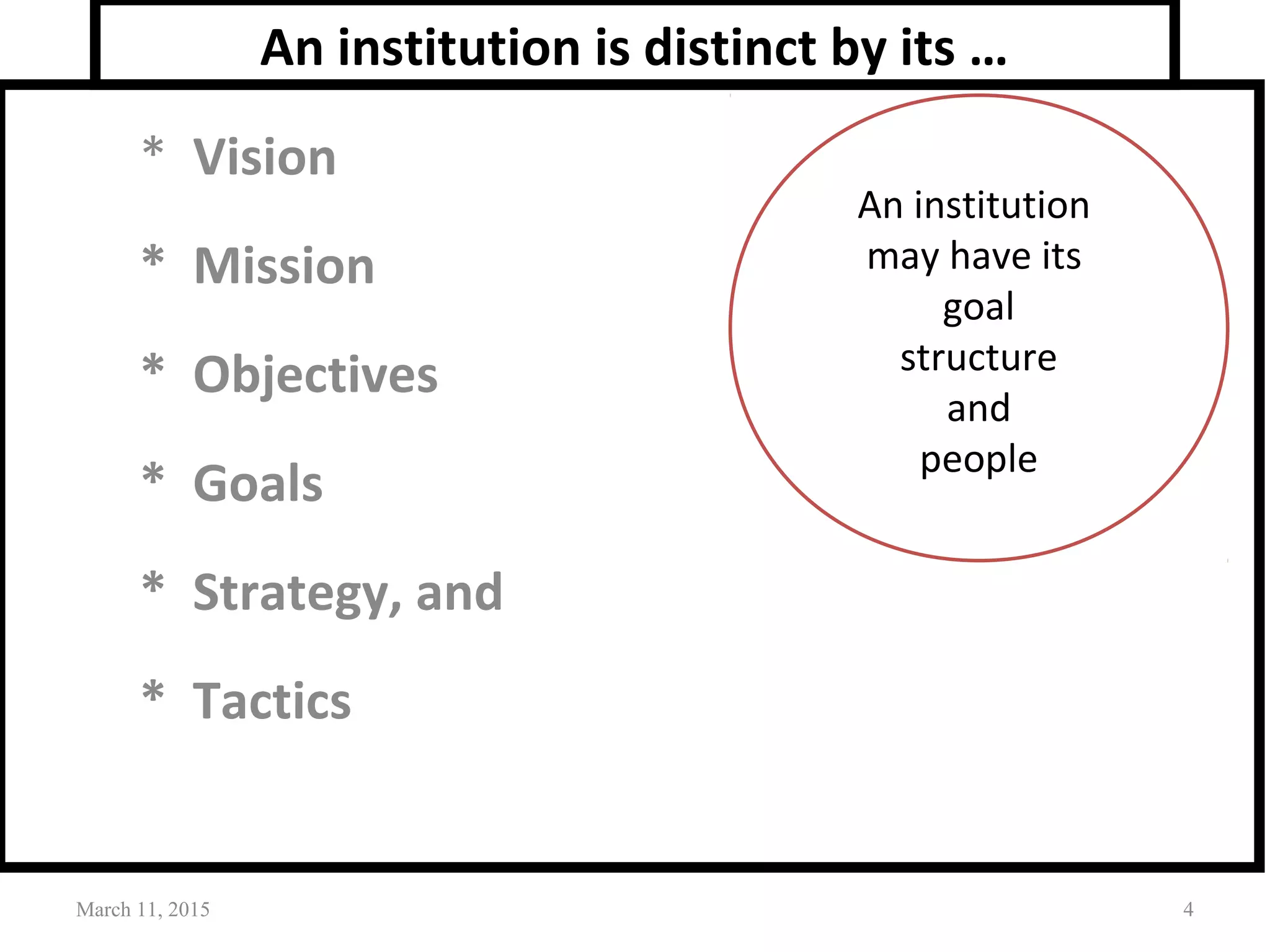
An institution is distinct by its …
* Vision
* Mission
* Objectives
* Goals
* Strategy, and
* Tactics
March 11, 2015 4
An institution
may have its
goal
structure
and
people
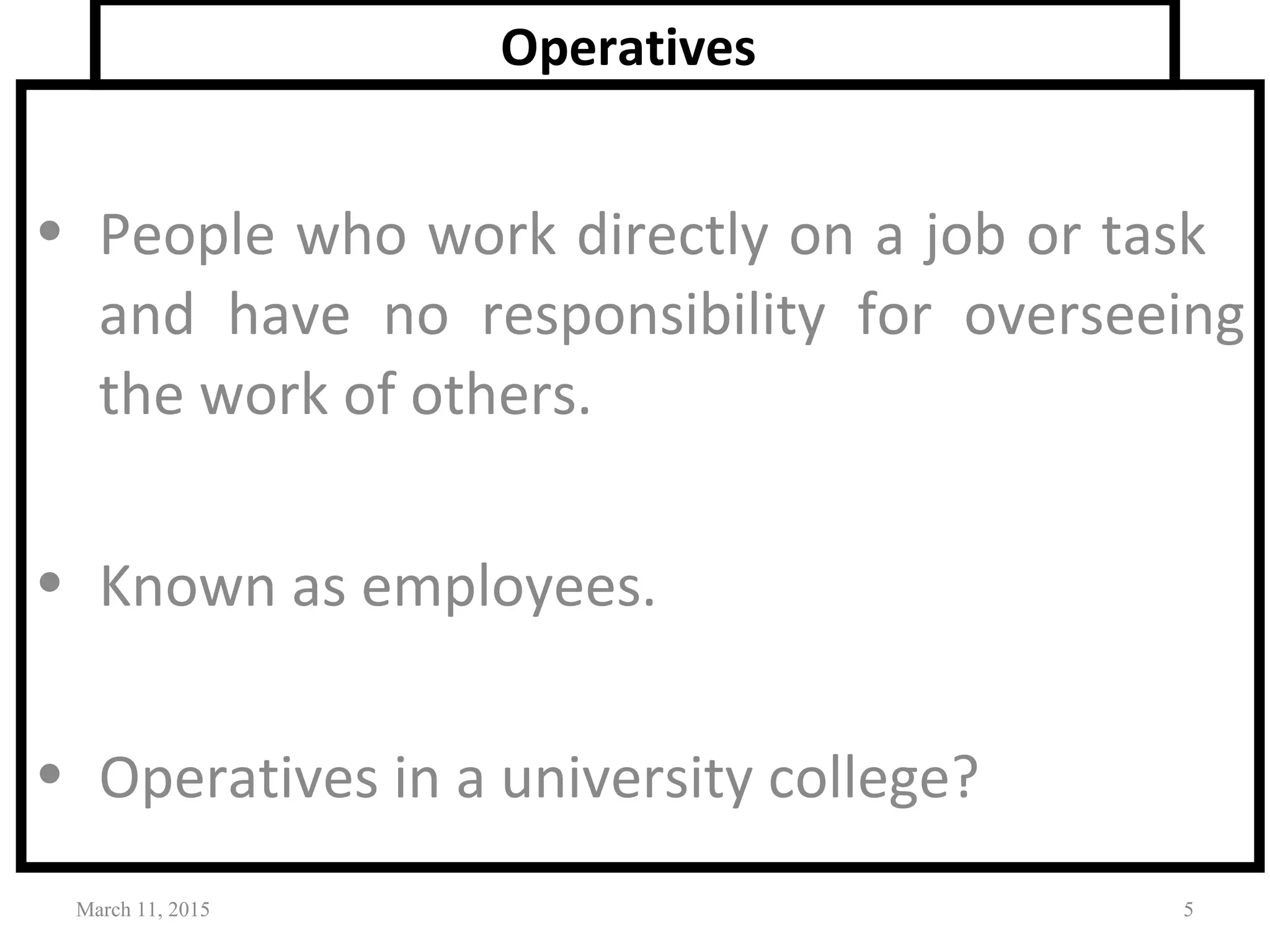
Operatives
• People who work directly on a job or task
and have no responsibility for overseeing
the work of others.
• Known as employees.
• Operatives in a university college?
March 11, 2015 5
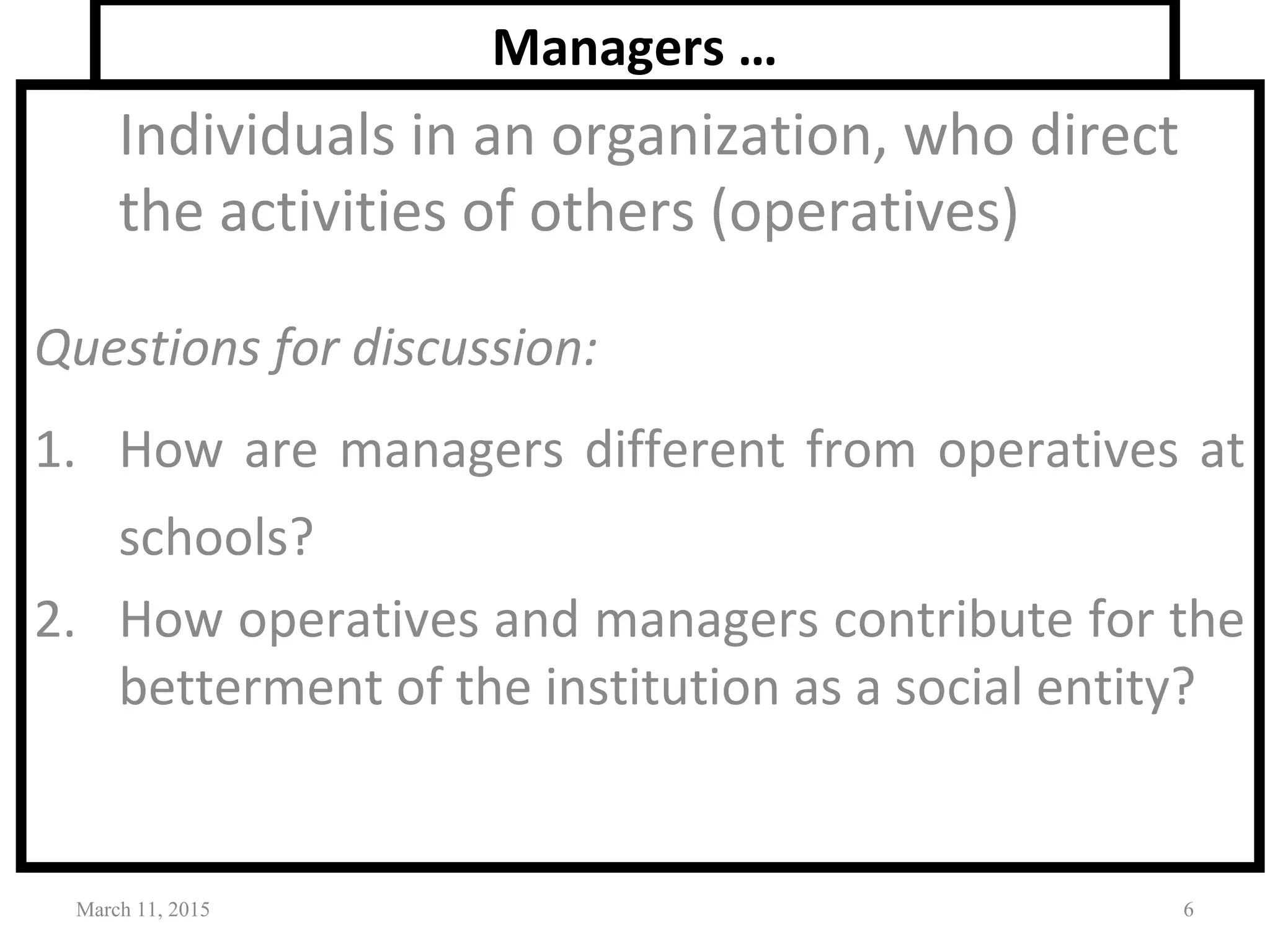
Managers …
Individuals in an organization, who direct
the activities of others (operatives)
Questions for discussion:
1. How are managers different from operatives at
schools?
2. How operatives and managers contribute for the
betterment of the institution as a social entity?
March 11, 2015 6
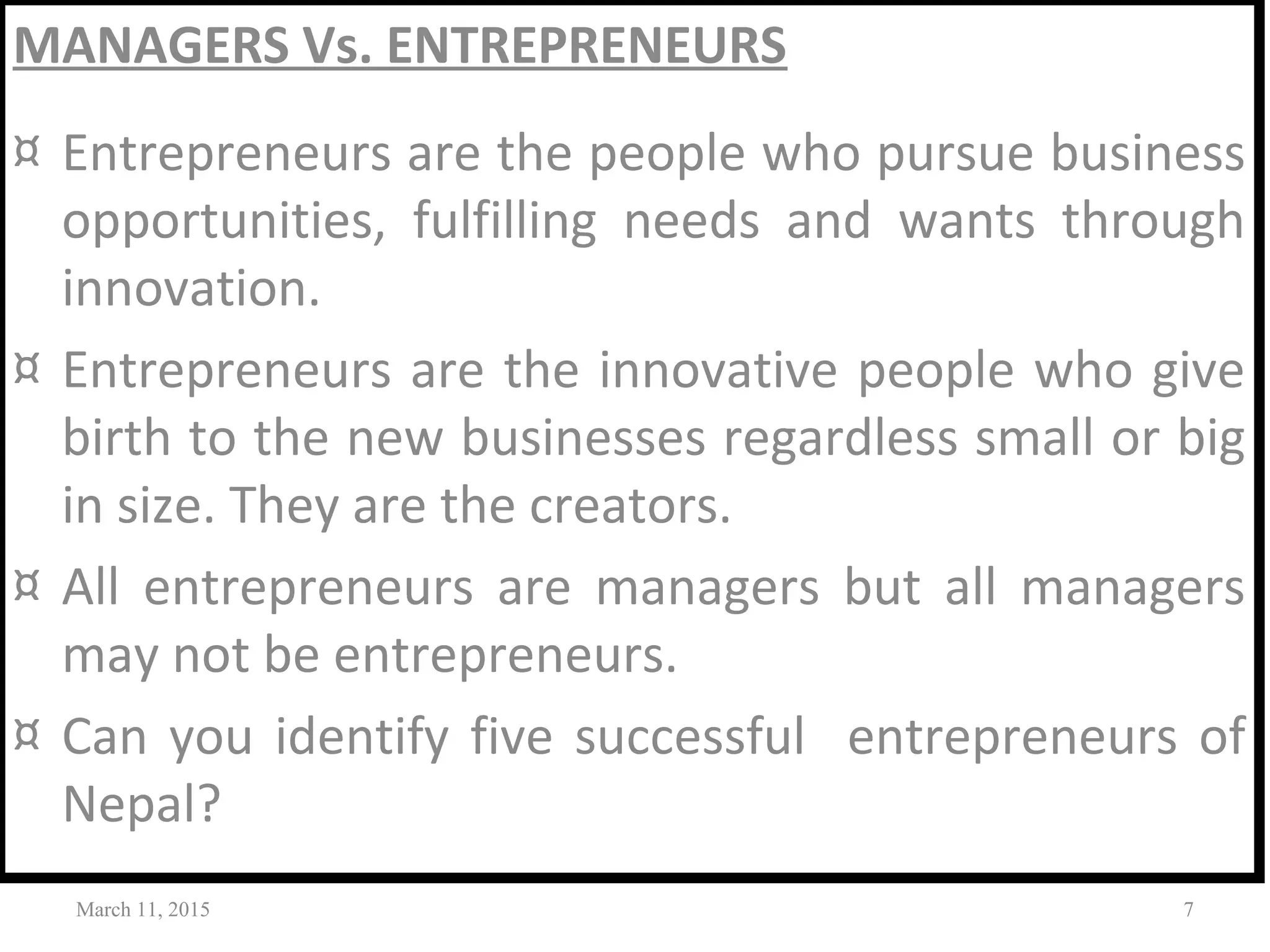
MANAGERS Vs. ENTREPRENEURS
¤ Entrepreneurs are the people who pursue business
opportunities, fulfilling needs and wants through
innovation.
¤ Entrepreneurs are the innovative people who give
birth to the new businesses regardless small or big
in size. They are the creators.
¤ All entrepreneurs are managers but all managers
may not be entrepreneurs.
¤ Can you identify five successful entrepreneurs of
Nepal?
March 11, 2015 7
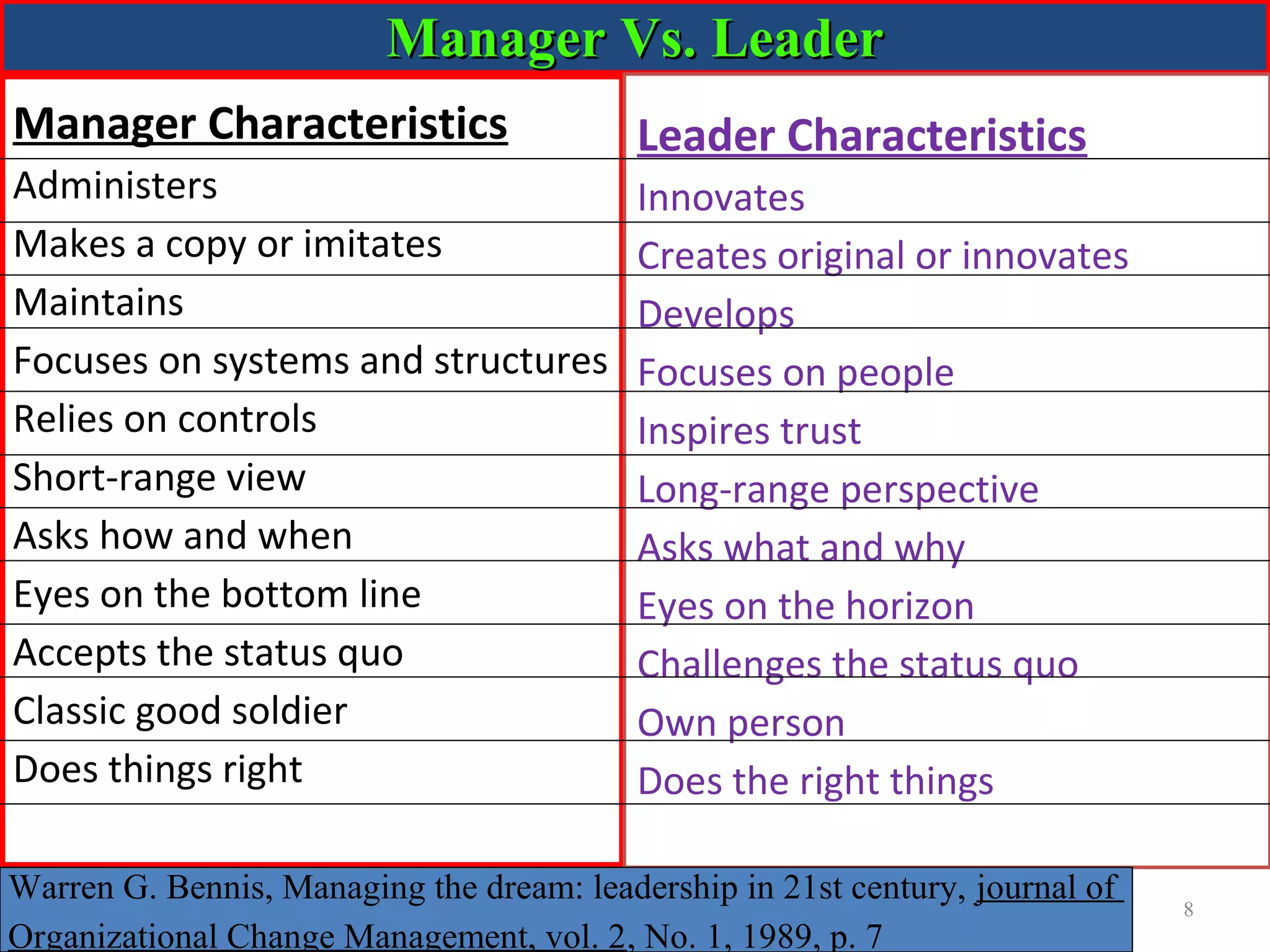
Manager Characteristics
Administers
Makes a copy or imitates
Maintains
Focuses on systems and structures
Relies on controls
Short-range view
Asks how and when
Eyes on the bottom line
Accepts the status quo
Classic good soldier
Does things right
March 11, 2015 8
Manager Vs. LeaderManager Vs. Leader
Leader Characteristics
Innovates
Creates original or innovates
Develops
Focuses on people
Inspires trust
Long-range perspective
Asks what and why
Eyes on the horizon
Challenges the status quo
Own person
Does the right things
Warren G. Bennis, Managing the dream: leadership in 21st century, journal of
Organizational Change Management, vol. 2, No. 1, 1989, p. 7
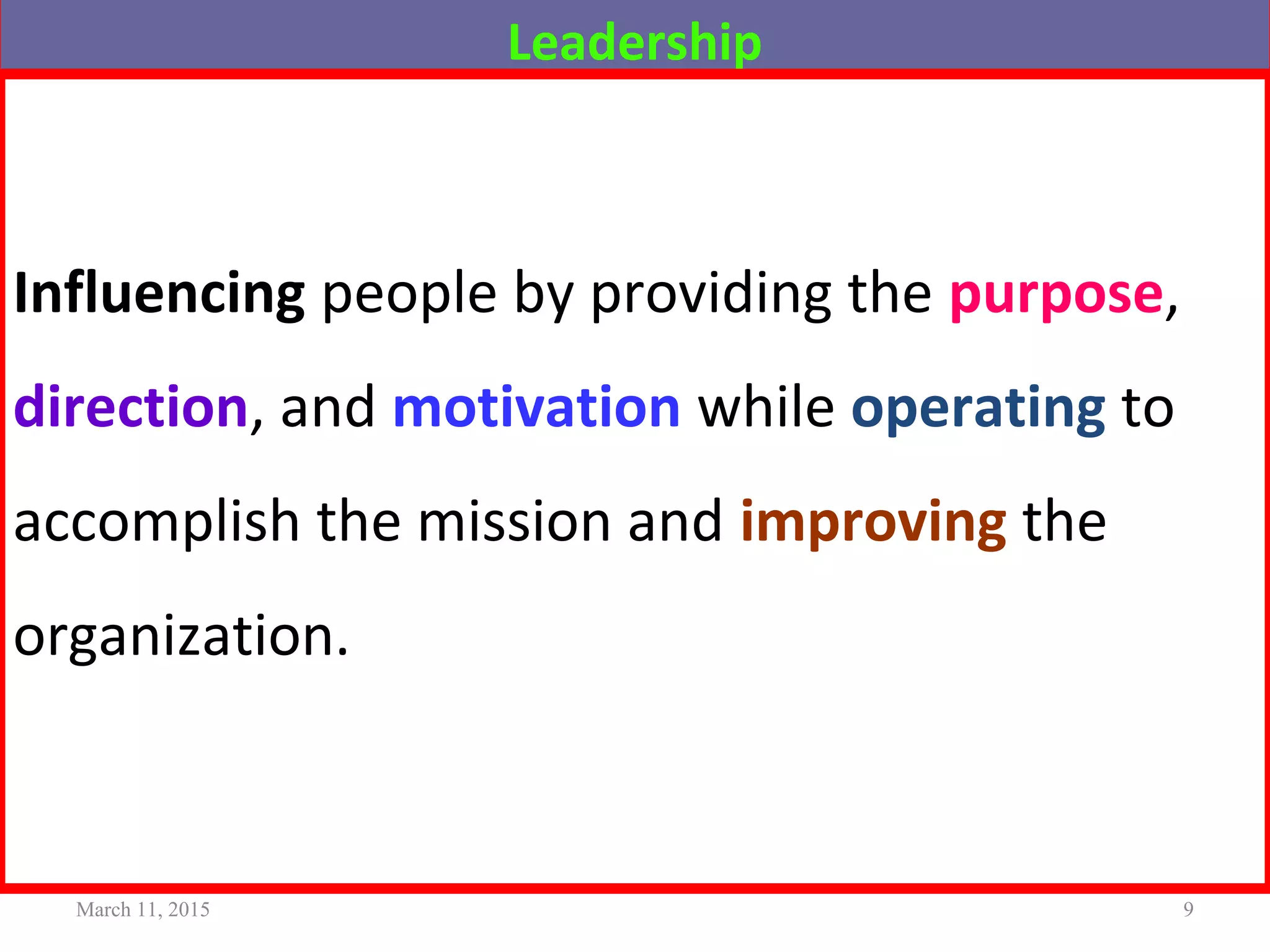
Leadership
Influencing people by providing the purpose,
direction, and motivation while operating to
accomplish the mission and improving the
organization.
March 11, 2015 9
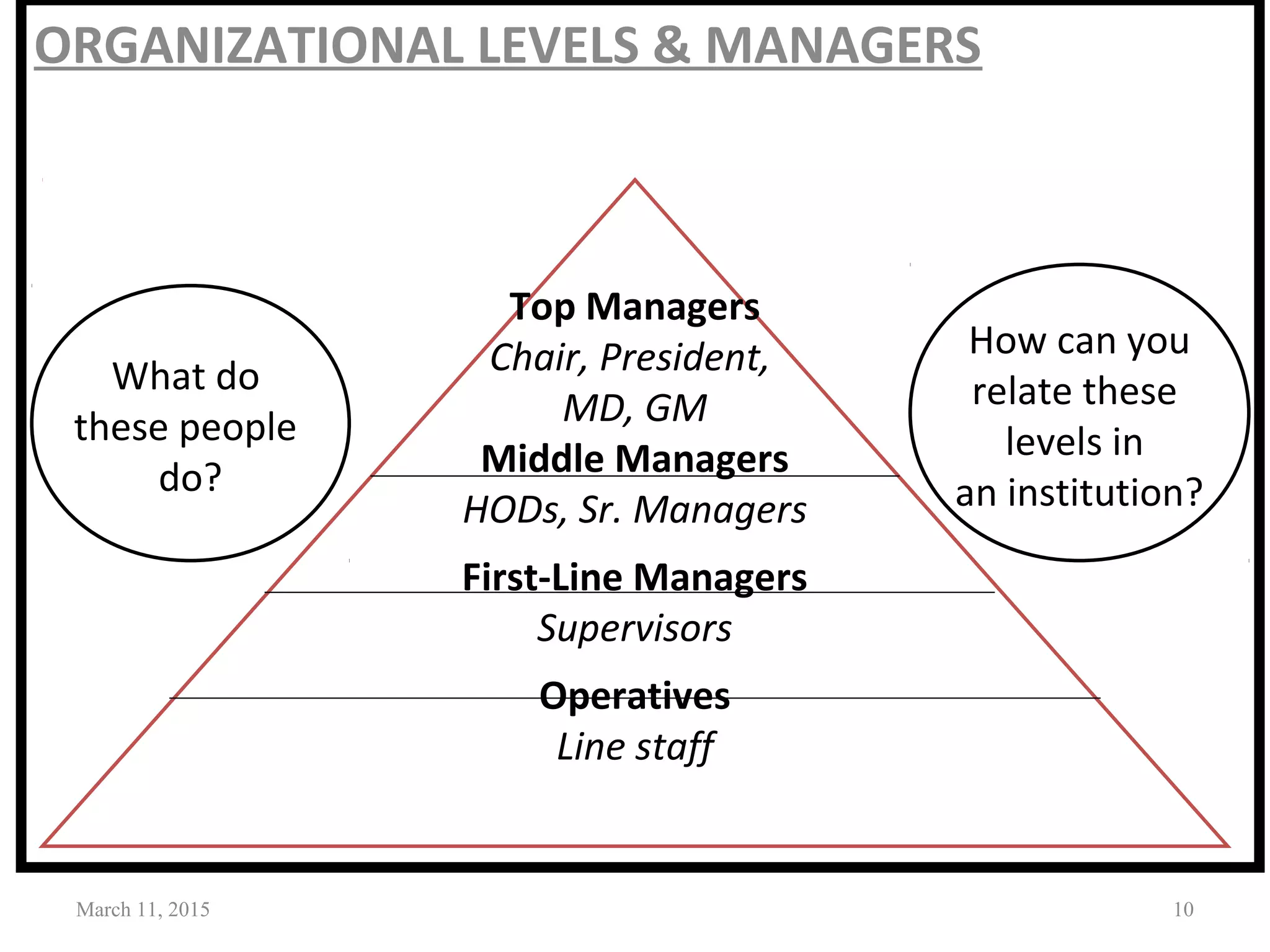
ORGANIZATIONAL LEVELS & MANAGERS
March 11, 2015 10
Top Managers
Chair, President,
MD, GM
Middle Managers
HODs, Sr. Managers
First-Line Managers
Supervisors
Operatives
Line staff
What do
these people
do?
How can you
relate these
levels in
an institution?
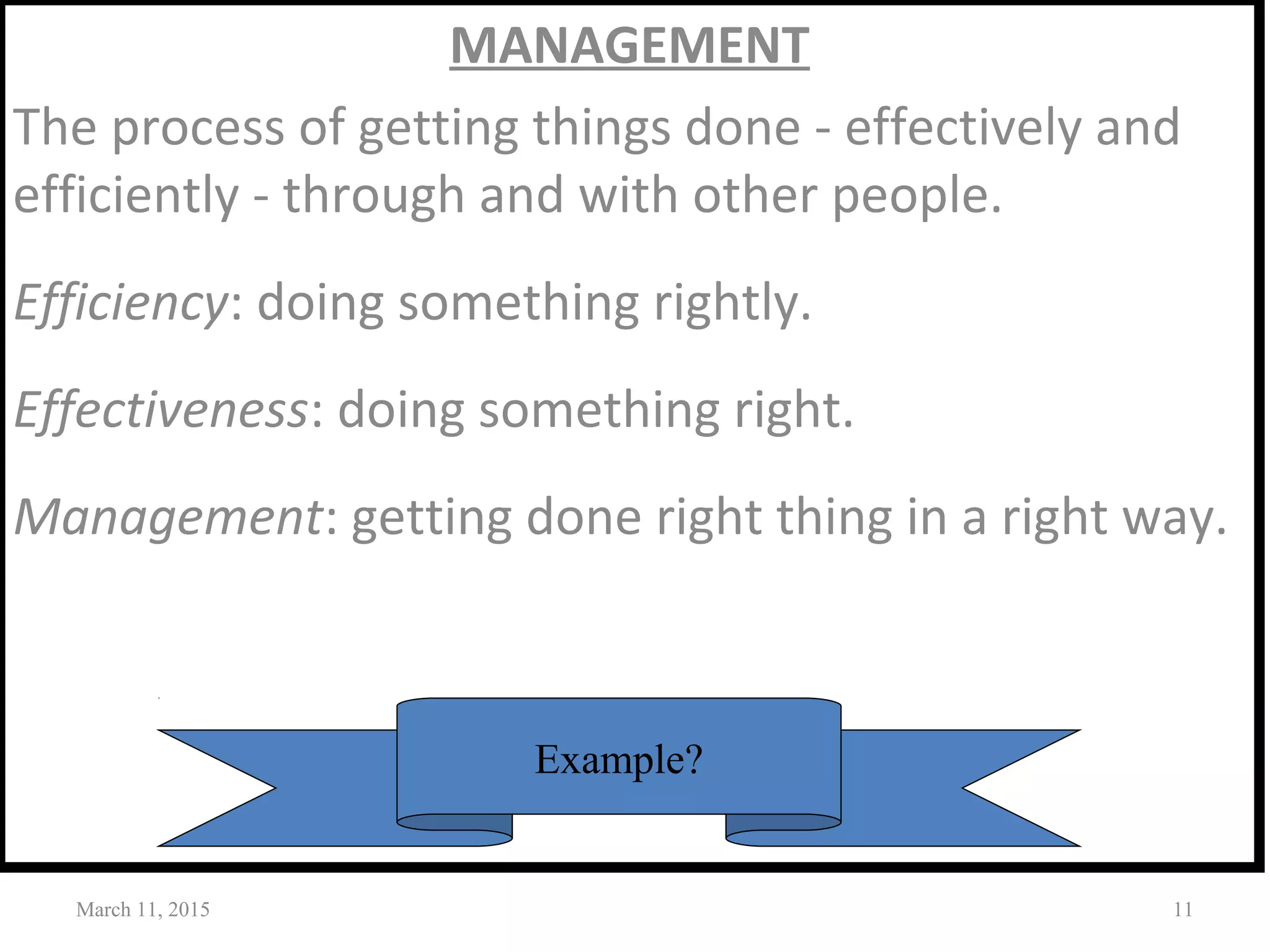
MANAGEMENT
The process of getting things done - effectively and
efficiently - through and with other people.
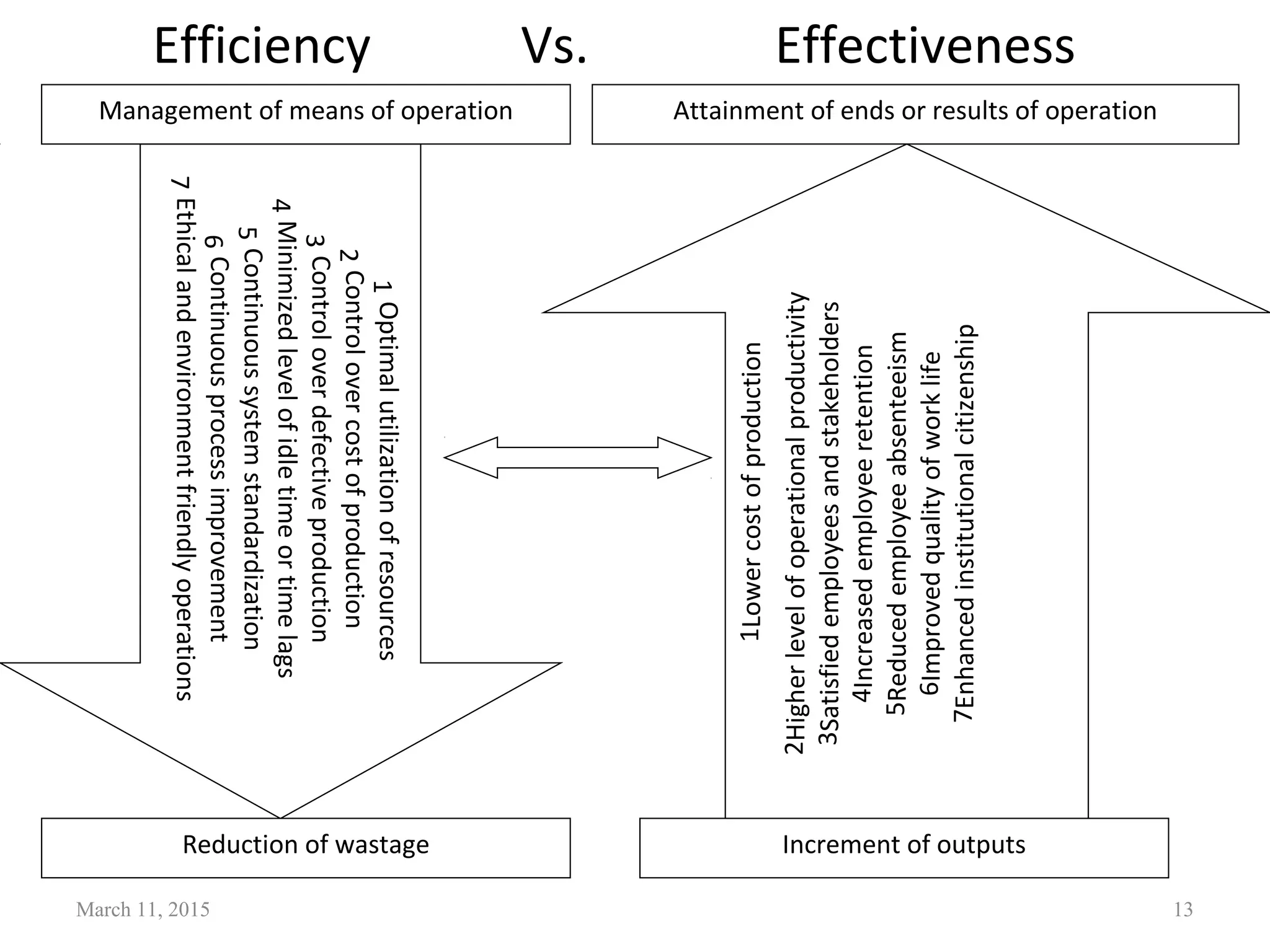
Efficiency: doing something rightly.
Effectiveness: doing something right.
Management: getting done right thing in a right way.
March 11, 2015 11
Example?
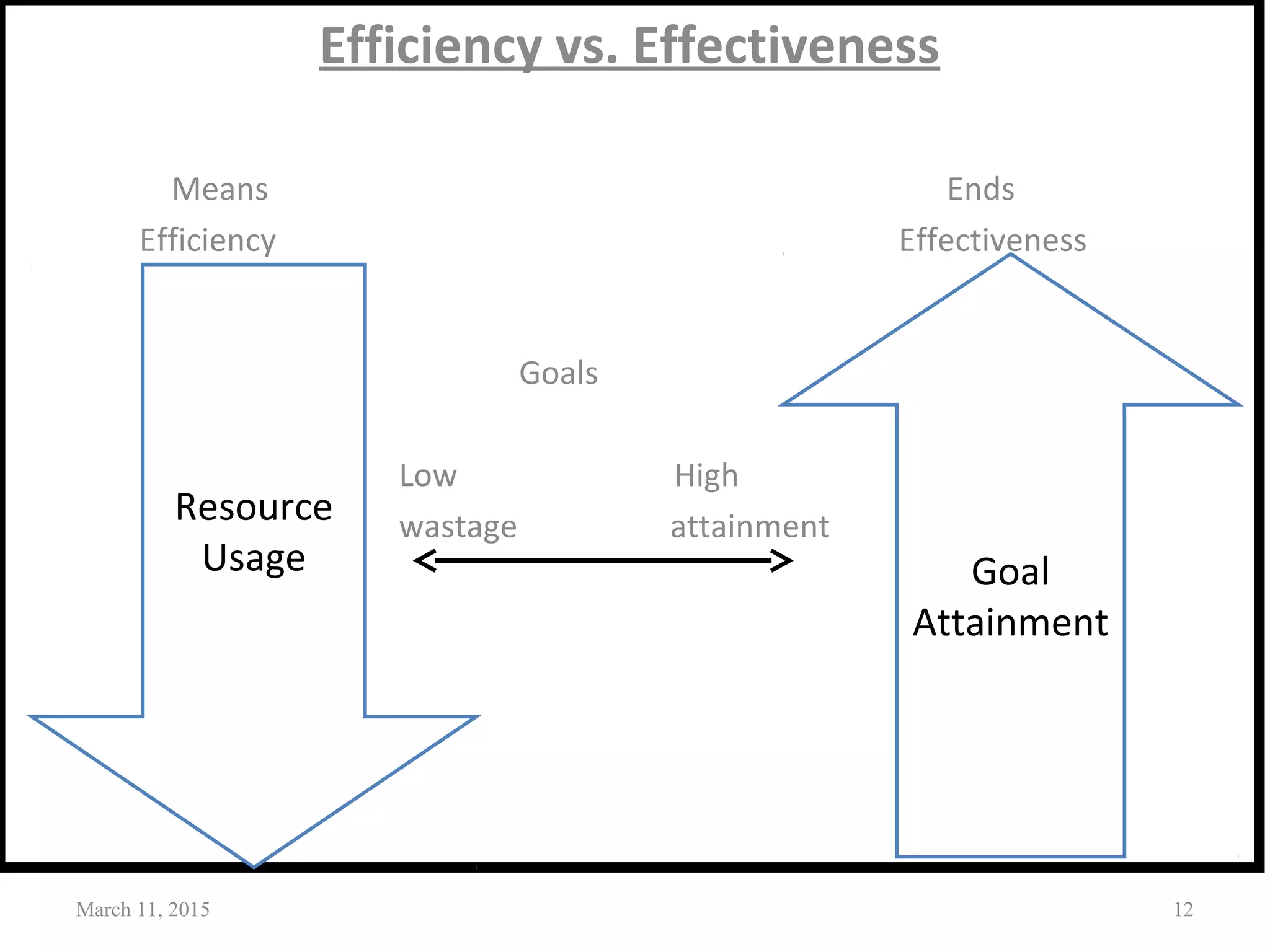
Efficiency vs. Effectiveness
Means Ends
Efficiency Effectiveness
Goals
Low High
wastage attainment
March 11, 2015 12
Resource
Usage Goal
Attainment
Efficiency Vs. Effectiveness
March 11, 2015 13
1Optimalutilizationofresources
2Controlovercostofproduction
3Controloverdefectiveproduction
4Minimizedlevelofidletimeortimelags
5Continuoussystemstandardization
6Continuousprocessimprovement
7Ethicalandenvironmentfriendlyoperations
Management of means of operation Attainment of ends or results of operation
1Lowercostofproduction
2Higherlevelofoperationalproductivity
3Satisfiedemployeesandstakeholders
4Increasedemployeeretention
5Reducedemployeeabsenteeism
6Improvedqualityofworklife
7Enhancedinstitutionalcitizenship
Reduction of wastage Increment of outputs
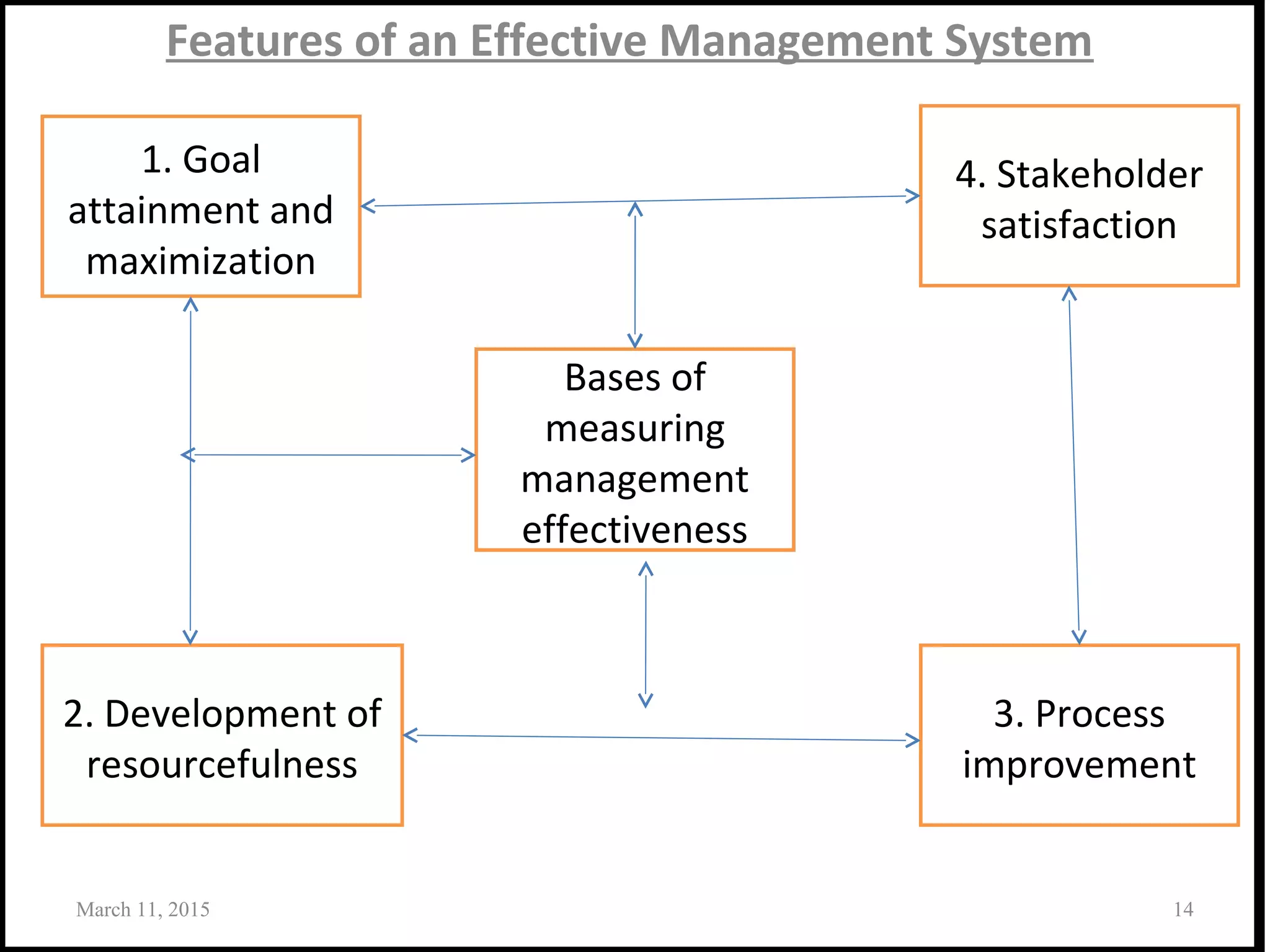
Features of an Effective Management System
March 11, 2015 14
1. Goal
attainment and
maximization
2. Development of
resourcefulness
4. Stakeholder
satisfaction
3. Process
improvement
Bases of
measuring
management
effectiveness
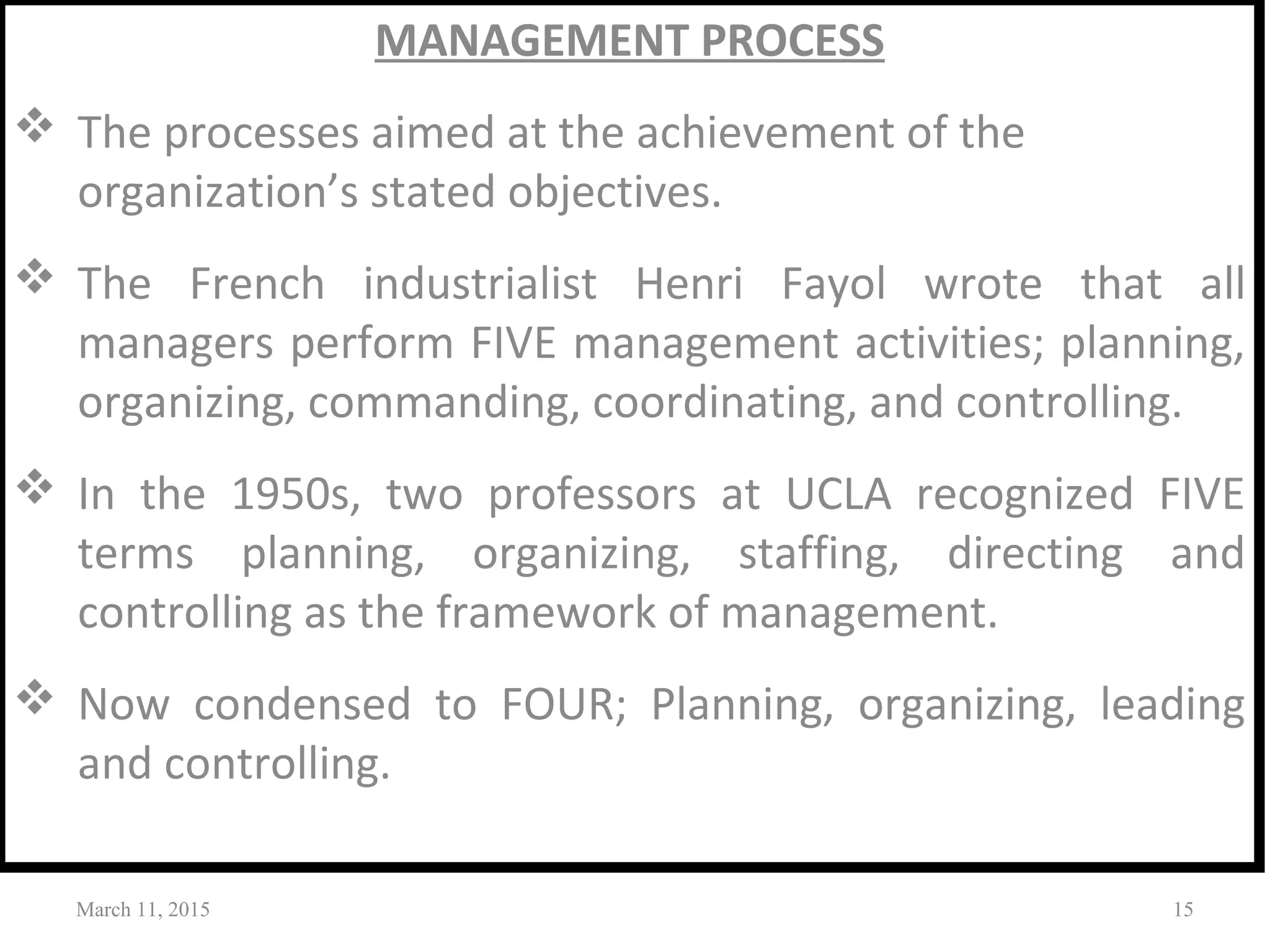
MANAGEMENT PROCESS
 The processes aimed at the achievement of the
organization’s stated objectives.
 The French industrialist Henri Fayol wrote that all
managers perform FIVE management activities; planning,
organizing, commanding, coordinating, and controlling.
 In the 1950s, two professors at UCLA recognized FIVE
terms planning, organizing, staffing, directing and
controlling as the framework of management.
 Now condensed to FOUR; Planning, organizing, leading
and controlling.
March 11, 2015 15
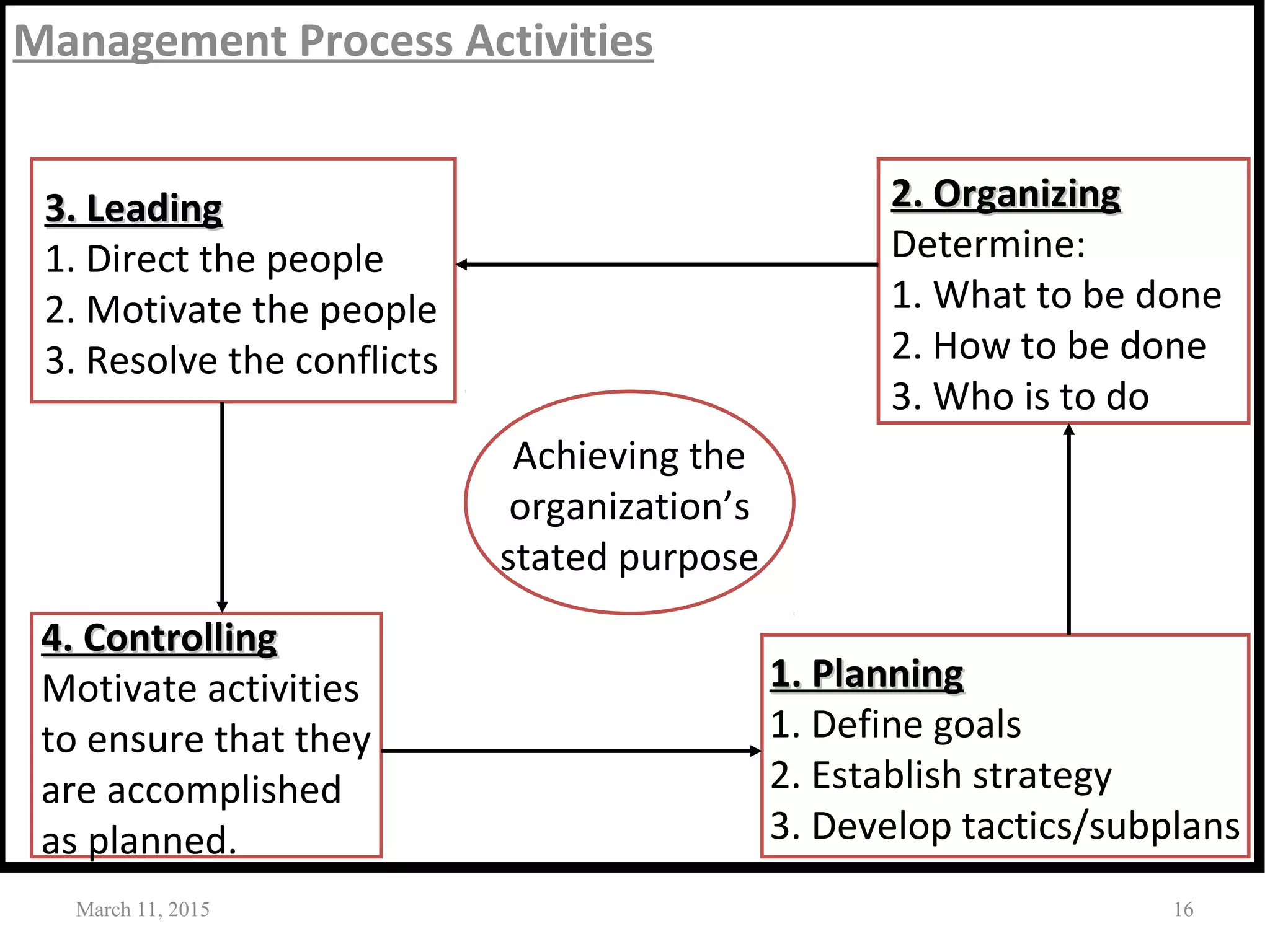
Management Process Activities
March 11, 2015 16
1. Planning1. Planning
1. Define goals
2. Establish strategy
3. Develop tactics/subplans
3. Leading3. Leading
1. Direct the people
2. Motivate the people
3. Resolve the conflicts
2. Organizing2. Organizing
Determine:
1. What to be done
2. How to be done
3. Who is to do
4. Controlling4. Controlling
Motivate activities
to ensure that they
are accomplished
as planned.
Achieving the
organization’s
stated purpose
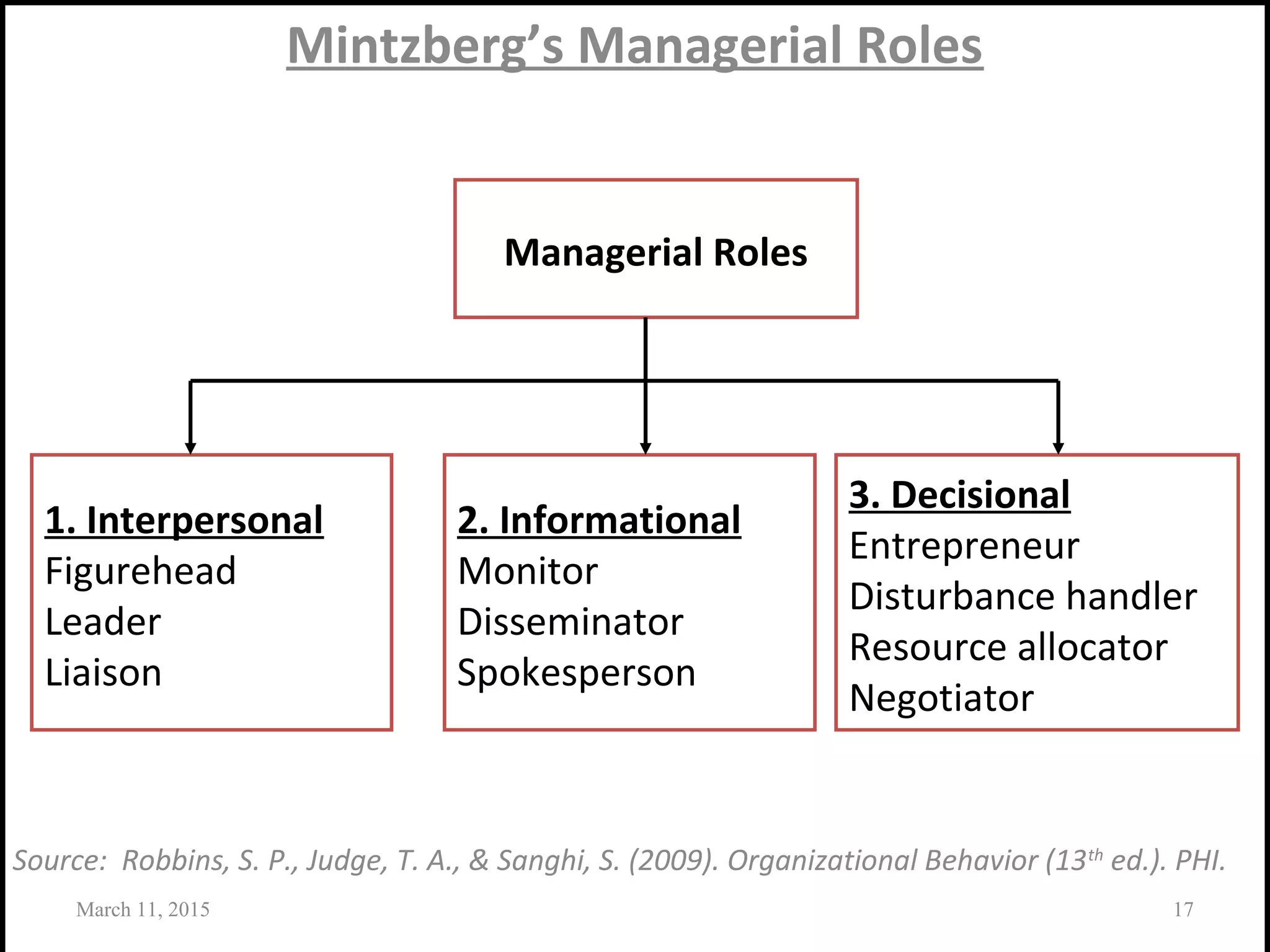
Mintzberg’s Managerial Roles
Source: Robbins, S. P., Judge, T. A., & Sanghi, S. (2009). Organizational Behavior (13th
ed.). PHI.
Managerial Roles
1. Interpersonal
Figurehead
Leader
Liaison
2. Informational
Monitor
Disseminator
Spokesperson
3. Decisional
Entrepreneur
Disturbance handler
Resource allocator
Negotiator
March 11, 2015 17
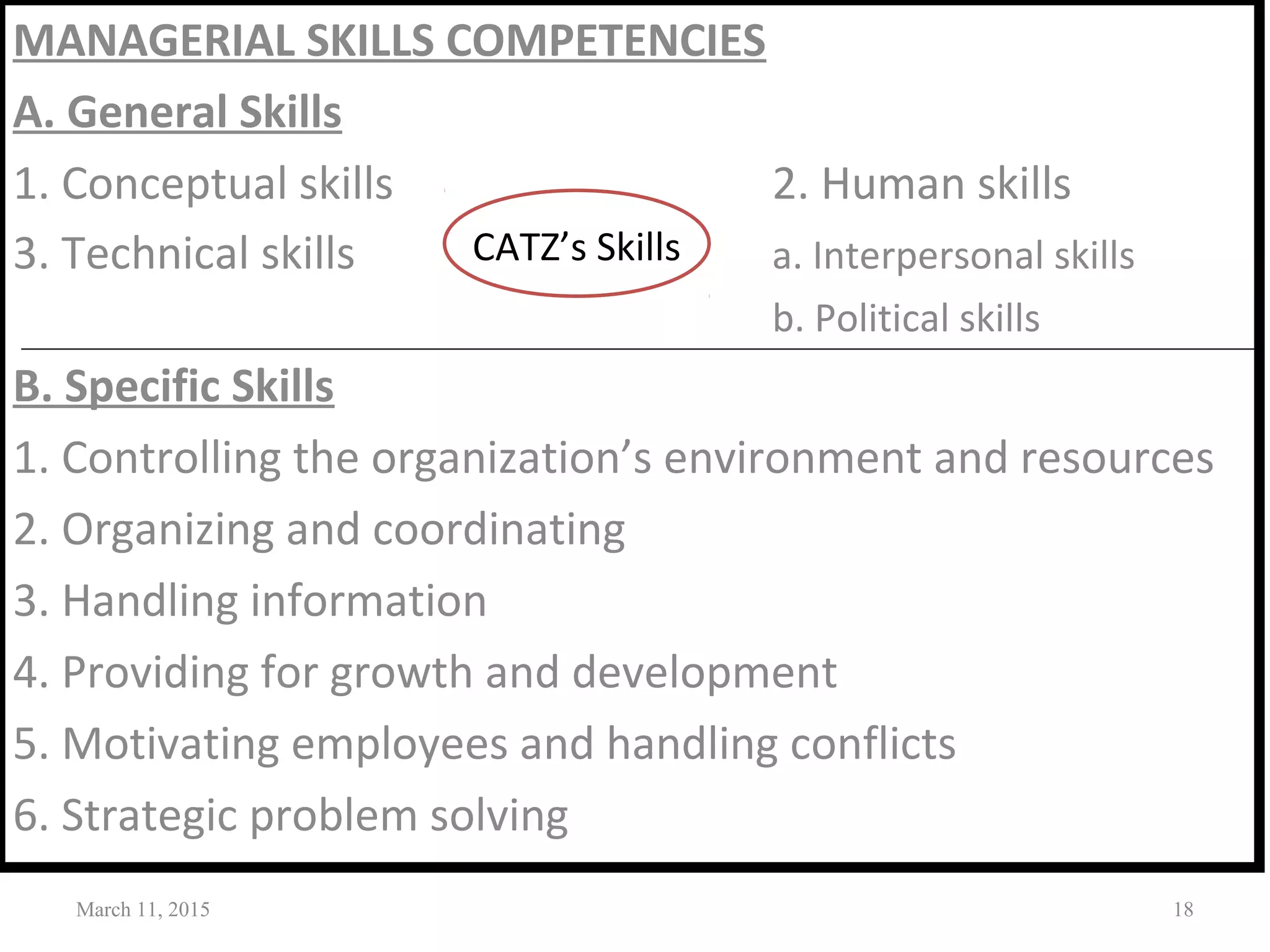
MANAGERIAL SKILLS COMPETENCIES
A. General Skills
1. Conceptual skills 2. Human skills
3. Technical skills a. Interpersonal skills
b. Political skills
B. Specific Skills
1. Controlling the organization’s environment and resources
2. Organizing and coordinating
3. Handling information
4. Providing for growth and development
5. Motivating employees and handling conflicts
6. Strategic problem solving
CATZ’s Skills
March 11, 2015 18
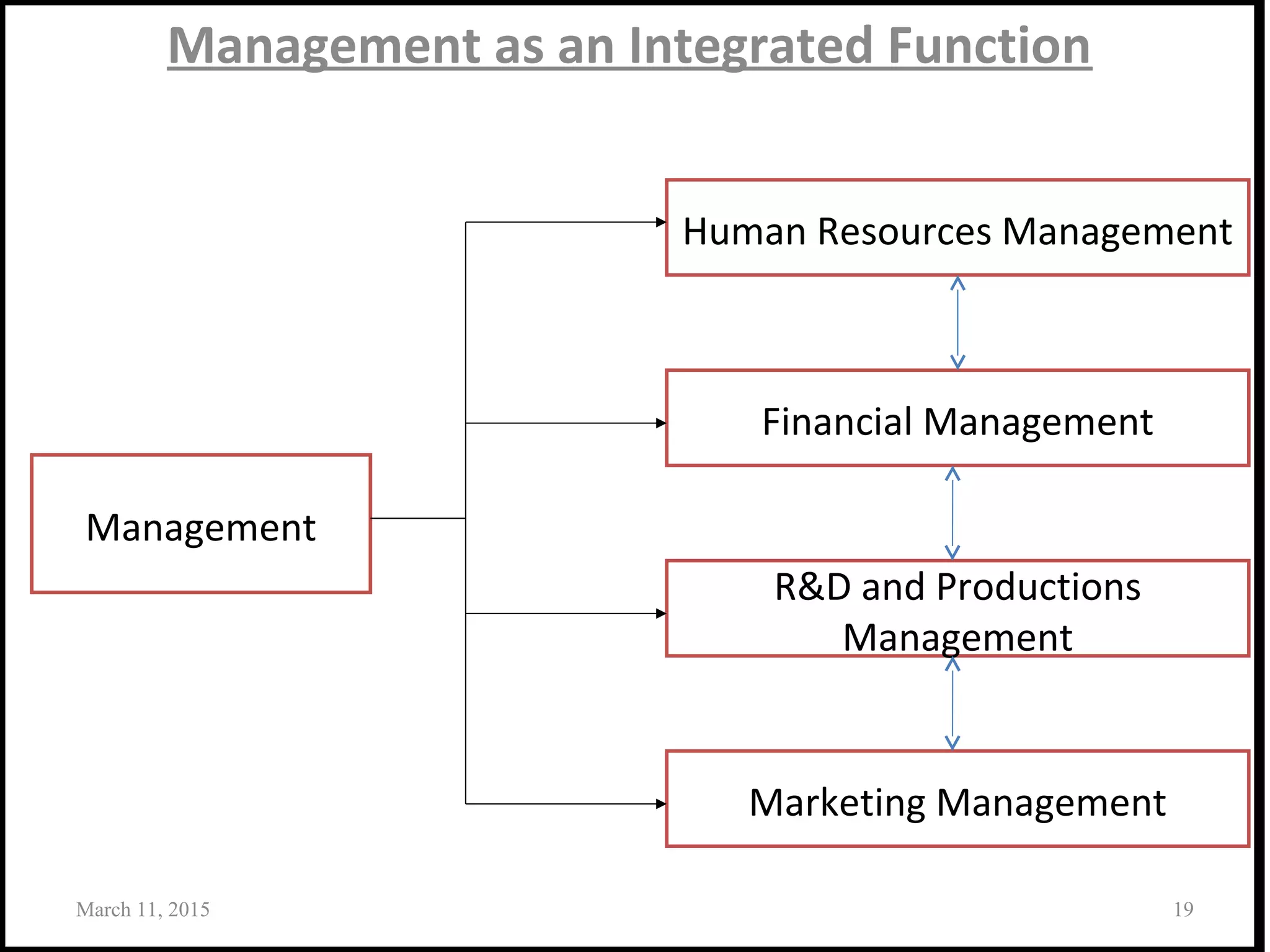
Management as an Integrated Function
March 11, 2015 19
Management
Human Resources Management
R&D and Productions
Management
Financial Management
Marketing Management
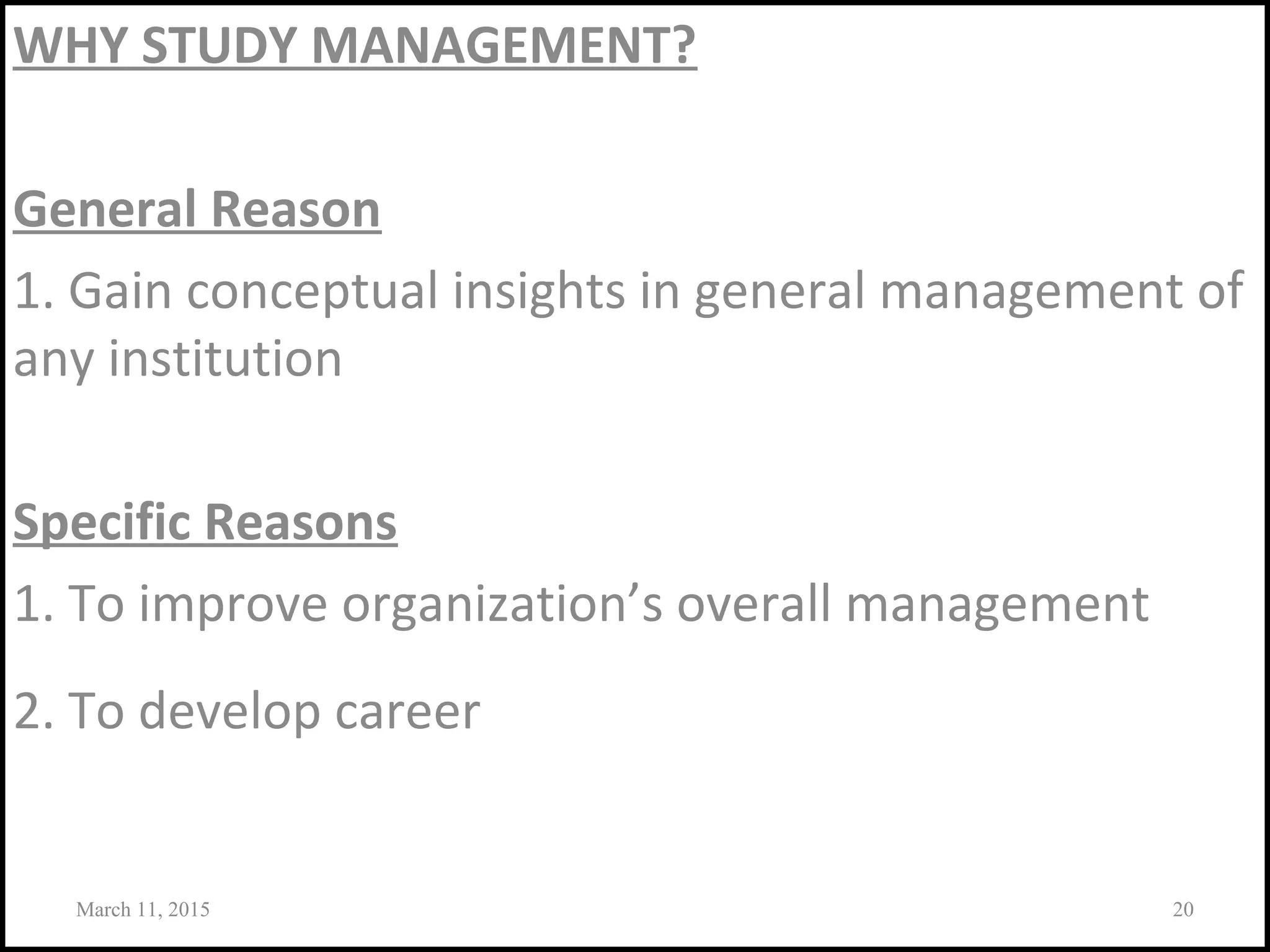
WHY STUDY MANAGEMENT?
General Reason
1. Gain conceptual insights in general management of
any institution
Specific Reasons
1. To improve organization’s overall management
2. To develop career
March 11, 2015 20
Universality of Management
Management is a universal discipline.
Application of management may be modified as per
the contexts and environments but the main essence
of management principles remains same worldwide.
For example, employee motivation is a universal
tool of productivity but the factors considered for
motivation may be different from country to country
and context to context.
March 11, 2015 21
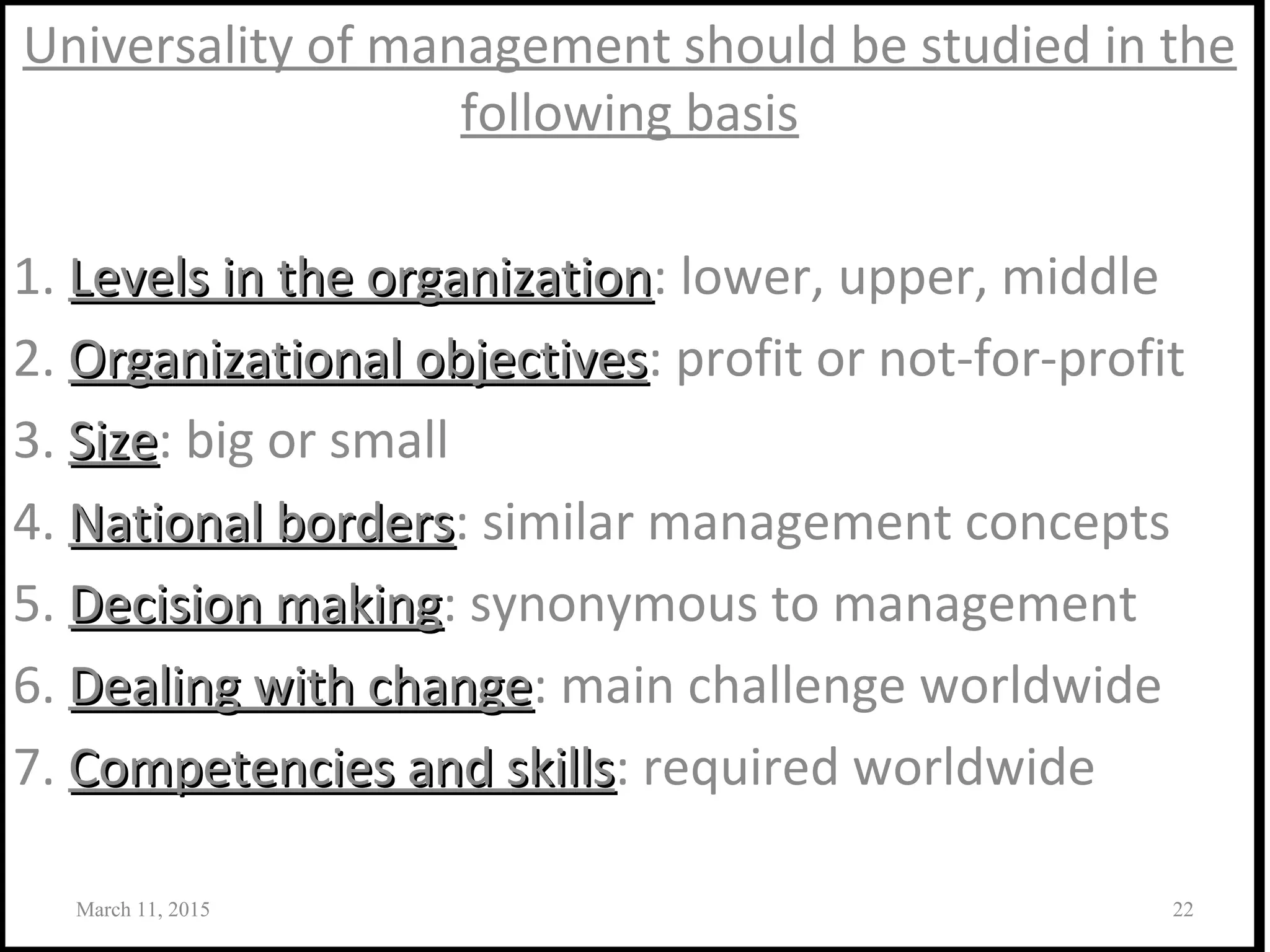
Universality of management should be studied in the
following basis
1. Levels in the organizationLevels in the organization: lower, upper, middle
2. Organizational objectivesOrganizational objectives: profit or not-for-profit
3. SizeSize: big or small
4. National bordersNational borders: similar management concepts
5. Decision makingDecision making: synonymous to management
6. Dealing with changeDealing with change: main challenge worldwide
7. Competencies and skillsCompetencies and skills: required worldwide
March 11, 2015 22
Evolution of Management as a DisciplineEvolution of Management as a Discipline
March 11, 2015 23
Such a study should be distinctively grouped
into two sections:
1.Historical background
2.Evolution of different approaches to the
evolution of management as a discipline
Historical BackgroundHistorical Background
Adam SmithAdam Smith published ‘the wealth of nations’ in 1776
where he argued the economic advantages that the
organizations and society would gain from
implementing the idea of division of labor or job
specialization (breakdown of jobs into narrow and
repetitive tasks)
For example, the way the different people work in a
tailoring shop, or the way different people work in a
building construction site.
March 11, 2015 24
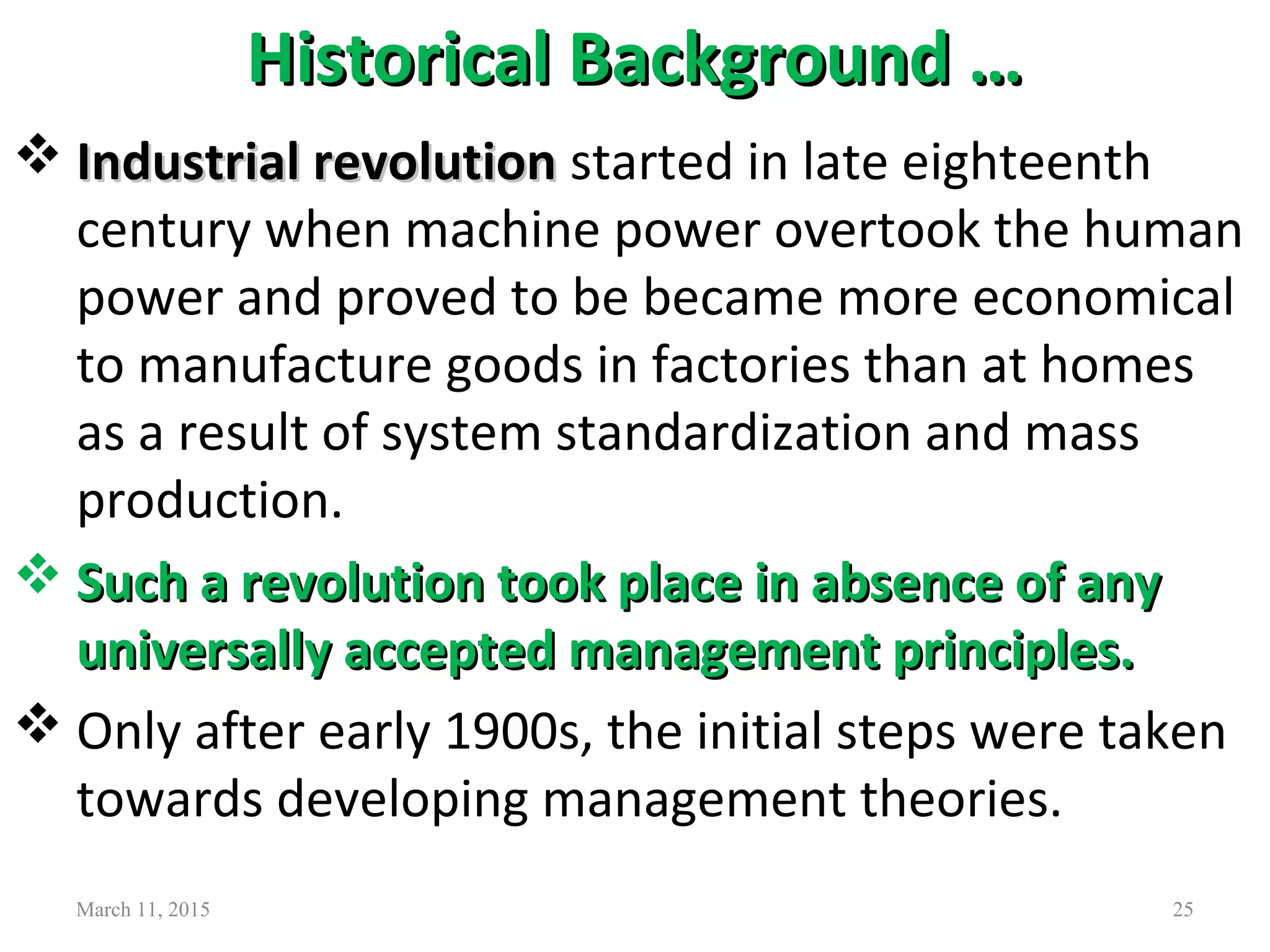
Historical Background …Historical Background …
 Industrial revolutionIndustrial revolution started in late eighteenth
century when machine power overtook the human
power and proved to be became more economical
to manufacture goods in factories than at homes
as a result of system standardization and mass
production.
 Such a revolution took place in absence of anySuch a revolution took place in absence of any
universally accepted management principles.universally accepted management principles.
 Only after early 1900s, the initial steps were taken
towards developing management theories.
March 11, 2015 25
2. Evolution of Management Approaches2. Evolution of Management Approaches
March 11, 2015 26
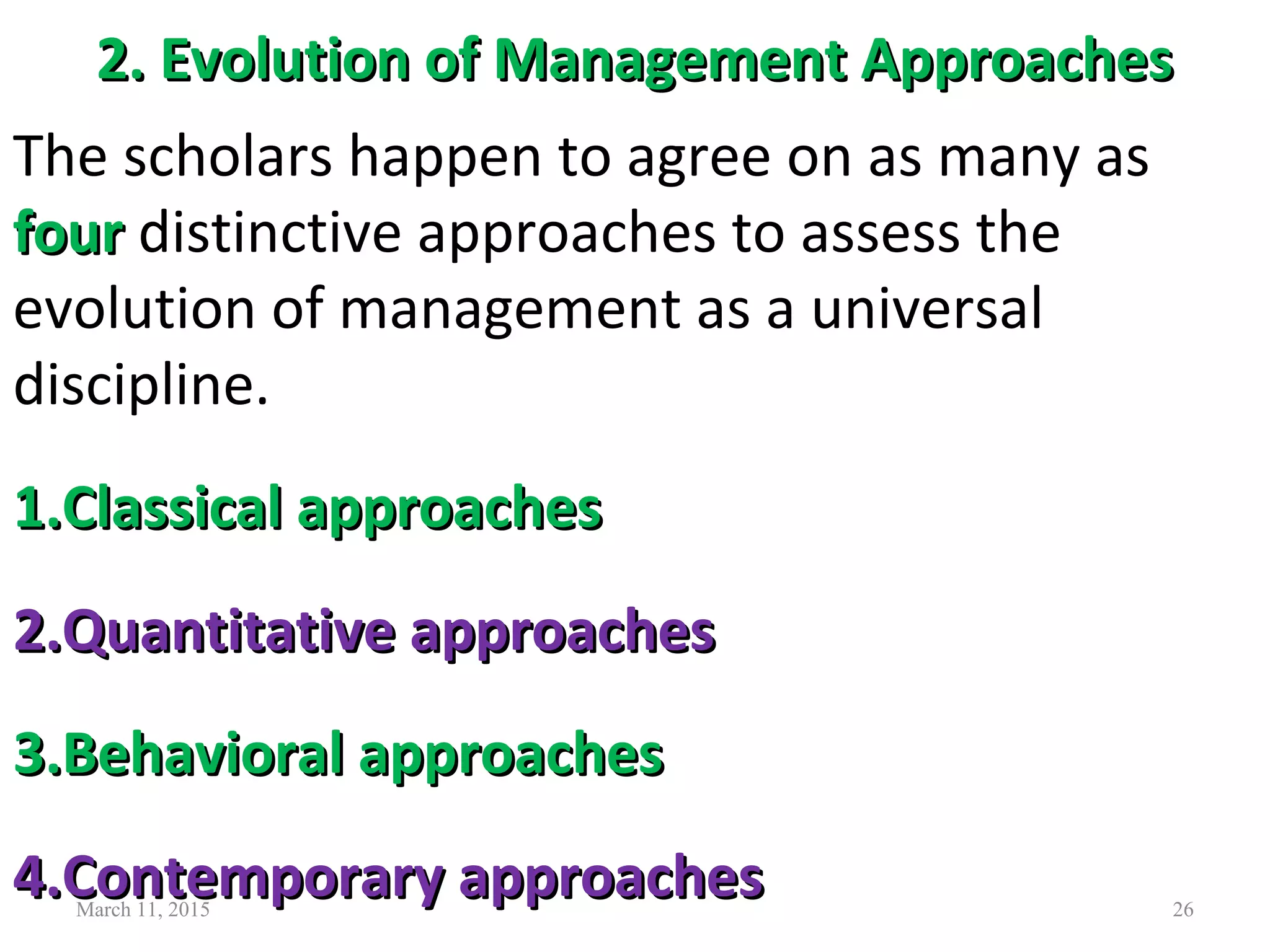
The scholars happen to agree on as many as
fourfour distinctive approaches to assess the
evolution of management as a universal
discipline.
1.1.Classical approachesClassical approaches
2.2.Quantitative approachesQuantitative approaches
3.3.Behavioral approachesBehavioral approaches
4.4.Contemporary approachesContemporary approaches
March 11, 2015 27
1. Mr Vivek, follow the same pattern and revise the
remaining slides accordingly and email me ASAP.
2. I am sorry to tell you that I am not convinced to
consider it to circulate among the graduates at this
level of purity. Please make it good enough, ok.
And I am sure you can do it…
3. Please make sure the content does not only look
impressive in presentation, but also has good
scope for the students to learn from it.
4.4. While talking about the approaches, discuss theWhile talking about the approaches, discuss the
contributor, key emphasis, merits and demeritscontributor, key emphasis, merits and demerits
of each approach and also talk with example theof each approach and also talk with example the
present day relevance of such approaches.present day relevance of such approaches.
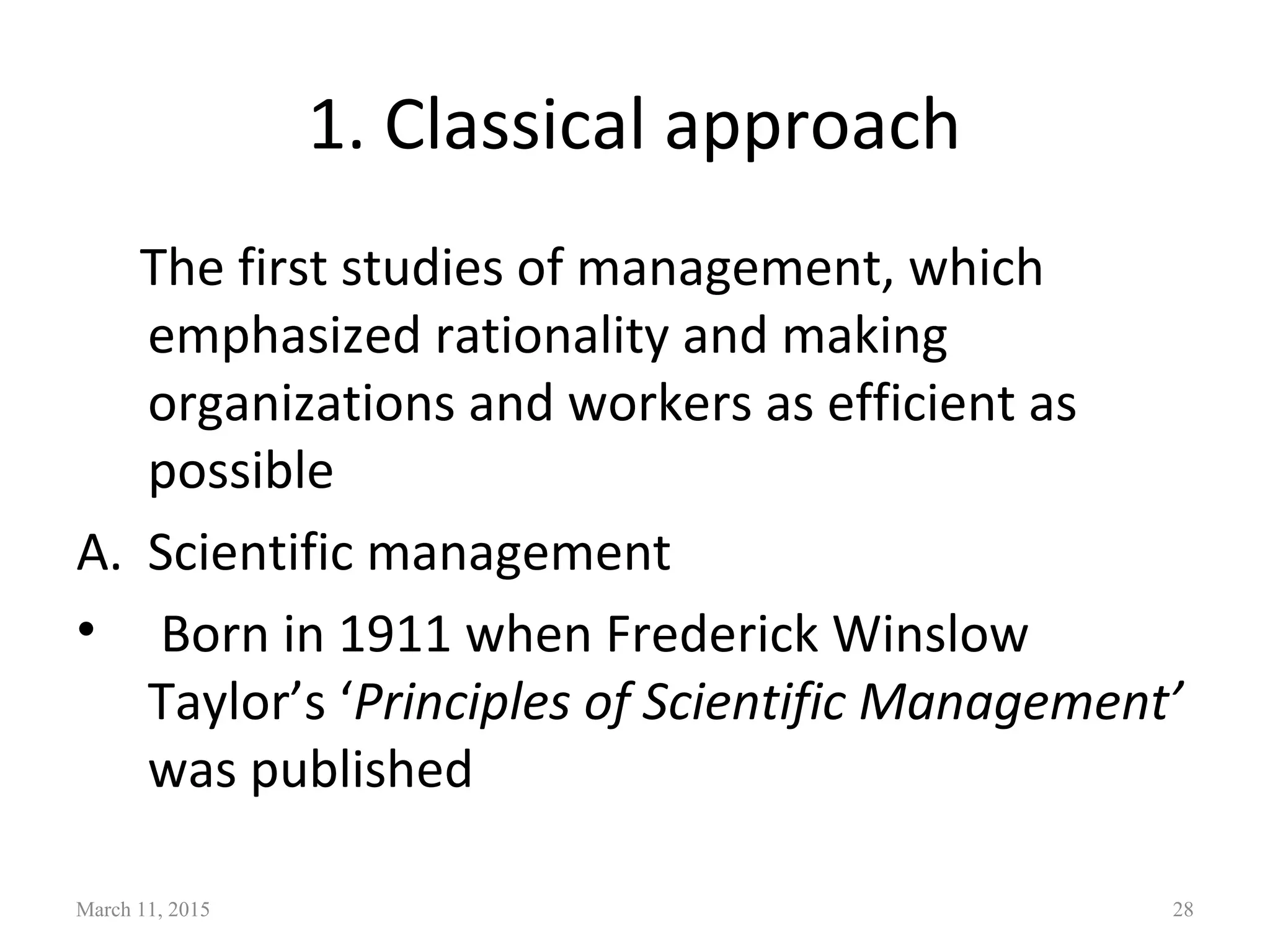
1. Classical approach
The first studies of management, which
emphasized rationality and making
organizations and workers as efficient as
possible
A. Scientific management
• Born in 1911 when Frederick Winslow
Taylor’s ‘Principles of Scientific Management’
was published
March 11, 2015 28
Contd…
• FW Taylor was the father of scientific
management
• Its contents were widely embraced by
managers around the world
• book described theory of scientific
management: use of scientific methods to
define “one best way for a job to be done”
March 11, 2015 29
B. General Administrative Theory (GAT)
• An approach to management that focuses on
describing what managers do and what
constitutes good management practice
• Two most prominent individuals behind GAT:
Henri Fayol and Max Weber
• Henri Fayol: first identified five managerial
functions: planning, organizing, commanding,
coordinating and controlling
March 11, 2015 30
Contd…
• Max Weber: A German sociologist, developed
a theory of authority structures and relations
based on an ideal type of organization he
called a bureaucracy
• Bureaucracy: a form of organization
characterized by division of labor, a clearly
defined hierarchy, detailed rules and
regulations and impersonal relationships, see
exhibit 2-4, page nu. 29, basic text book
March 11, 2015 31
2. Quantitative approach (QA)
• QA or management science is the use of
quantitative techniques to improve decision
making
• evolved from mathematical and statistical
solutions developed for military problems
during World War II
• After the war was over many of these
techniques used for military problems were
applied to business
March 11, 2015 32
Contd…
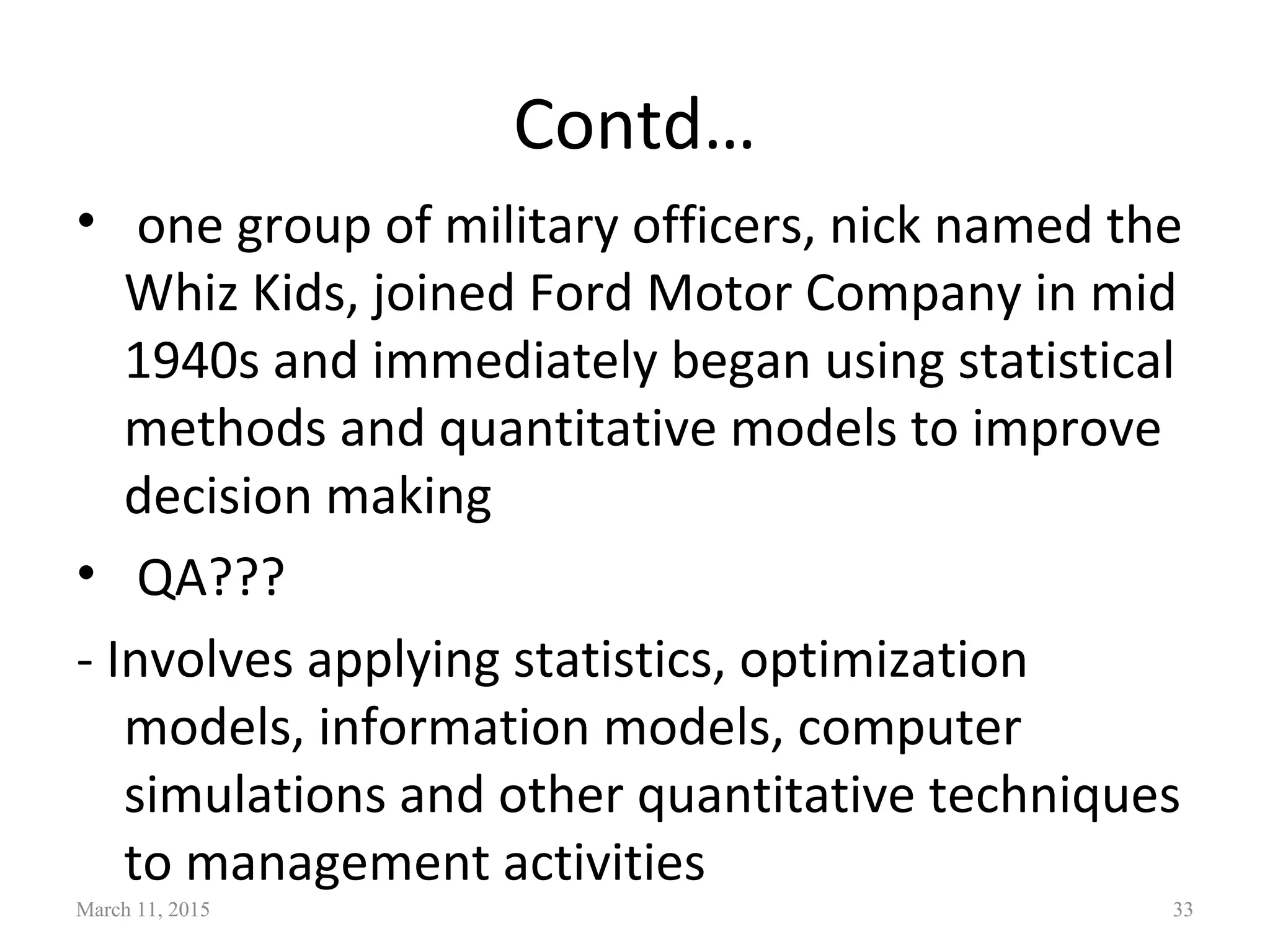
• one group of military officers, nick named the
Whiz Kids, joined Ford Motor Company in mid
1940s and immediately began using statistical
methods and quantitative models to improve
decision making
• QA???
- Involves applying statistics, optimization
models, information models, computer
simulations and other quantitative techniques
to management activities
March 11, 2015 33
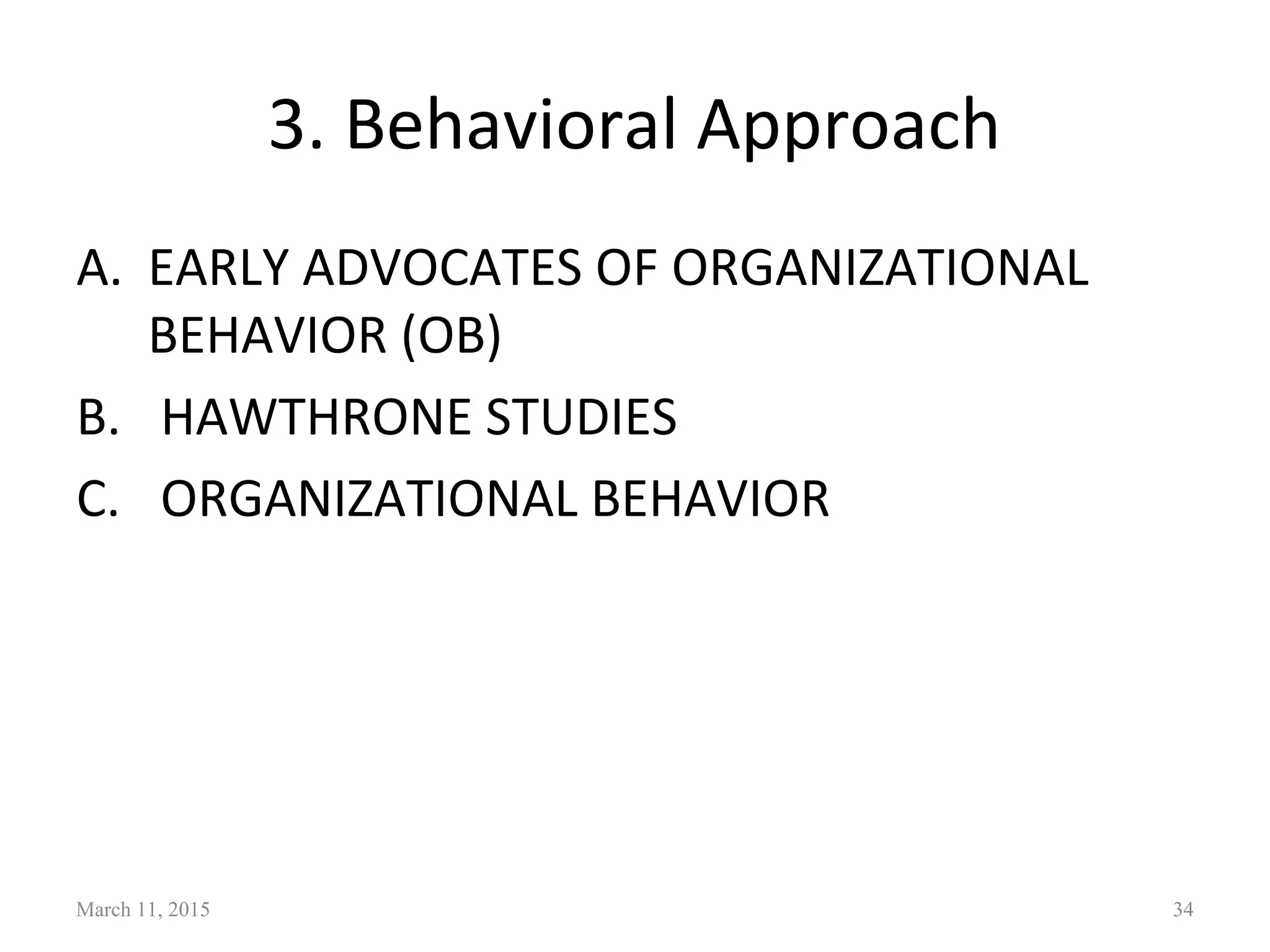
3. Behavioral Approach
A. EARLY ADVOCATES OF ORGANIZATIONAL
BEHAVIOR (OB)
B. HAWTHRONE STUDIES
C. ORGANIZATIONAL BEHAVIOR
March 11, 2015 34
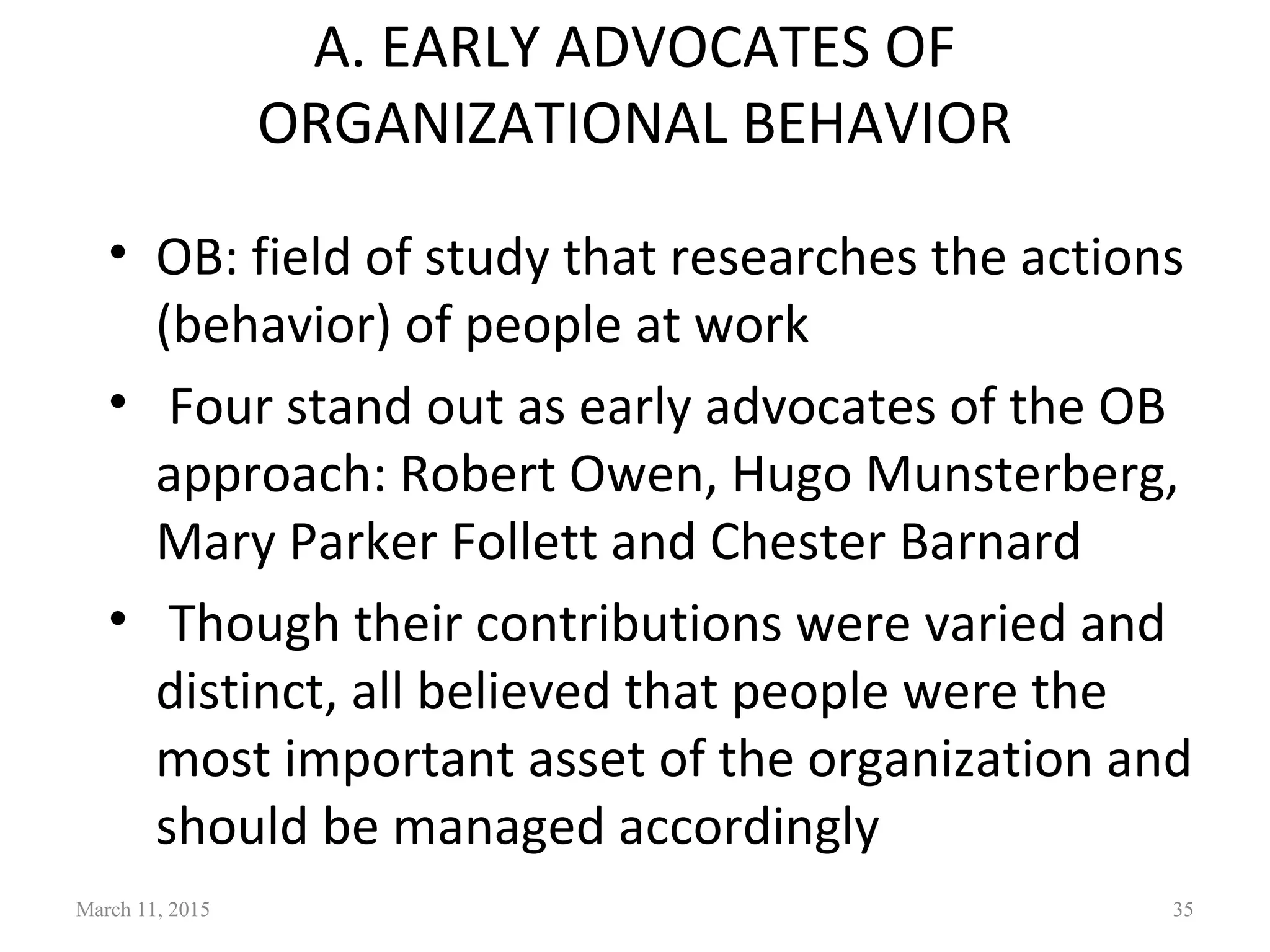
A. EARLY ADVOCATES OF
ORGANIZATIONAL BEHAVIOR
• OB: field of study that researches the actions
(behavior) of people at work
• Four stand out as early advocates of the OB
approach: Robert Owen, Hugo Munsterberg,
Mary Parker Follett and Chester Barnard
• Though their contributions were varied and
distinct, all believed that people were the
most important asset of the organization and
should be managed accordingly
March 11, 2015 35
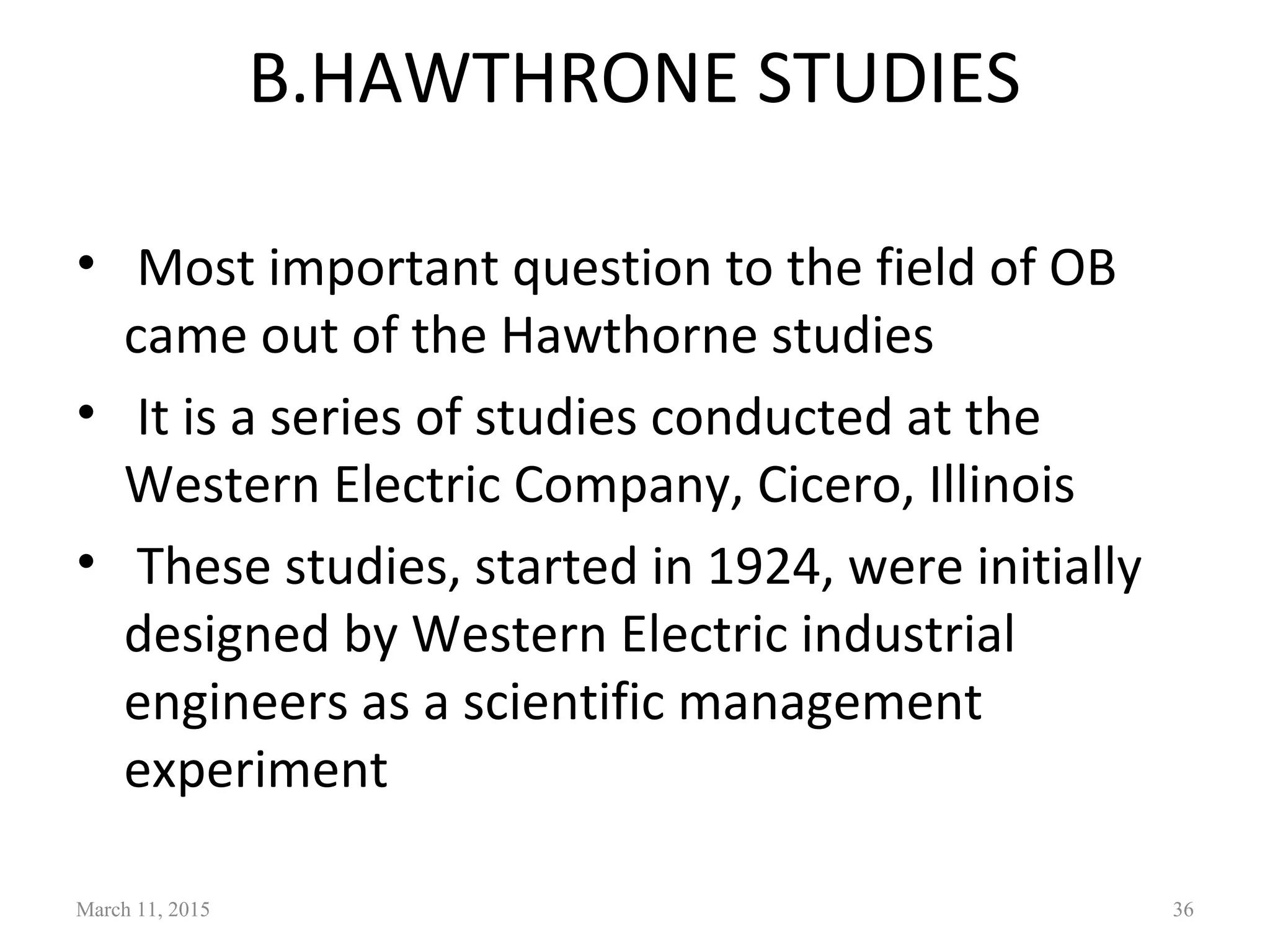
B.HAWTHRONE STUDIES
• Most important question to the field of OB
came out of the Hawthorne studies
• It is a series of studies conducted at the
Western Electric Company, Cicero, Illinois
• These studies, started in 1924, were initially
designed by Western Electric industrial
engineers as a scientific management
experiment
March 11, 2015 36
Contd…
• wanted to examine the effect of various
lighting levels on worker productivity
• experimental group (exposed to various
lighting intensities) and control group ( under
a constant intensity)
• individual output in the experimental group
would be directly related to the intensity of
light……….
• read about its final conclusion and Elton
Mayo’s workMarch 11, 2015 37
4. Contemporary approach
• Two contemporary management
perspectives- systems and contingency
Systems Theory
• A basic theory in physical science but never
been applied to organized human efforts
• A system is a set of interrelated and
interdependent parts arranged in a manner
that produces a unified whole
March 11, 2015 38
• Two basic types: Closed and open systems
• Closed: systems that are not influenced by
and do not interact with their environment
• Open: systems that interact with their
environment
• Today when we describe organizations as
systems, we mean open systems, see exhibit
2-7, page nu. 36, basic text book (organization
as an open system)
March 11, 2015 39
Contd…
Contingency approach: or situational approach
which says that organizations are different,
face different situations (contingencies), and
require different ways of managing
• a good way to describe contingency is “ if……
then………..”
• This approach is intuitively logical because
organizations and even units within the same
organization differ
March 11, 2015 40

Basic conceptual perspectives in management

  • 1.
    Lecture Notes on Basic Conceptsof Management by Chandra P. Rijal, PhD in Leadership Vivek Dhakal, MBA Nepal College of Management Nepal March 11, 2015 1
  • 2.
    Perspectives of Management Thissession will help you to -- understand the management terms like managers, employees, efficiency and effectiveness, and management, learn management process, managerial roles and essential skills, understand the various evolutionary concepts of management as a discipline, and learn essentials of high performing managers. March 11, 2015 2
  • 3.
    ORGANIZATION  The term‘organization’ may be referred to as a systematic arrangement of resources brought together to accomplish some specific purpose of an institution.  These resources are people dominant in an organizational process climate.  In addition to people arrangement, efficient and effective allocation of other resources is also equally important in management of an institution.March 11, 2015 3
  • 4.
    An institution isdistinct by its … * Vision * Mission * Objectives * Goals * Strategy, and * Tactics March 11, 2015 4 An institution may have its goal structure and people
  • 5.
    Operatives • People whowork directly on a job or task and have no responsibility for overseeing the work of others. • Known as employees. • Operatives in a university college? March 11, 2015 5
  • 6.
    Managers … Individuals inan organization, who direct the activities of others (operatives) Questions for discussion: 1. How are managers different from operatives at schools? 2. How operatives and managers contribute for the betterment of the institution as a social entity? March 11, 2015 6
  • 7.
    MANAGERS Vs. ENTREPRENEURS ¤Entrepreneurs are the people who pursue business opportunities, fulfilling needs and wants through innovation. ¤ Entrepreneurs are the innovative people who give birth to the new businesses regardless small or big in size. They are the creators. ¤ All entrepreneurs are managers but all managers may not be entrepreneurs. ¤ Can you identify five successful entrepreneurs of Nepal? March 11, 2015 7
  • 8.
    Manager Characteristics Administers Makes acopy or imitates Maintains Focuses on systems and structures Relies on controls Short-range view Asks how and when Eyes on the bottom line Accepts the status quo Classic good soldier Does things right March 11, 2015 8 Manager Vs. LeaderManager Vs. Leader Leader Characteristics Innovates Creates original or innovates Develops Focuses on people Inspires trust Long-range perspective Asks what and why Eyes on the horizon Challenges the status quo Own person Does the right things Warren G. Bennis, Managing the dream: leadership in 21st century, journal of Organizational Change Management, vol. 2, No. 1, 1989, p. 7
  • 9.
    Leadership Influencing people byproviding the purpose, direction, and motivation while operating to accomplish the mission and improving the organization. March 11, 2015 9
  • 10.
    ORGANIZATIONAL LEVELS &MANAGERS March 11, 2015 10 Top Managers Chair, President, MD, GM Middle Managers HODs, Sr. Managers First-Line Managers Supervisors Operatives Line staff What do these people do? How can you relate these levels in an institution?
  • 11.
    MANAGEMENT The process ofgetting things done - effectively and efficiently - through and with other people. Efficiency: doing something rightly. Effectiveness: doing something right. Management: getting done right thing in a right way. March 11, 2015 11 Example?
  • 12.
    Efficiency vs. Effectiveness MeansEnds Efficiency Effectiveness Goals Low High wastage attainment March 11, 2015 12 Resource Usage Goal Attainment
  • 13.
    Efficiency Vs. Effectiveness March11, 2015 13 1Optimalutilizationofresources 2Controlovercostofproduction 3Controloverdefectiveproduction 4Minimizedlevelofidletimeortimelags 5Continuoussystemstandardization 6Continuousprocessimprovement 7Ethicalandenvironmentfriendlyoperations Management of means of operation Attainment of ends or results of operation 1Lowercostofproduction 2Higherlevelofoperationalproductivity 3Satisfiedemployeesandstakeholders 4Increasedemployeeretention 5Reducedemployeeabsenteeism 6Improvedqualityofworklife 7Enhancedinstitutionalcitizenship Reduction of wastage Increment of outputs
  • 14.
    Features of anEffective Management System March 11, 2015 14 1. Goal attainment and maximization 2. Development of resourcefulness 4. Stakeholder satisfaction 3. Process improvement Bases of measuring management effectiveness
  • 15.
    MANAGEMENT PROCESS  Theprocesses aimed at the achievement of the organization’s stated objectives.  The French industrialist Henri Fayol wrote that all managers perform FIVE management activities; planning, organizing, commanding, coordinating, and controlling.  In the 1950s, two professors at UCLA recognized FIVE terms planning, organizing, staffing, directing and controlling as the framework of management.  Now condensed to FOUR; Planning, organizing, leading and controlling. March 11, 2015 15
  • 16.
    Management Process Activities March11, 2015 16 1. Planning1. Planning 1. Define goals 2. Establish strategy 3. Develop tactics/subplans 3. Leading3. Leading 1. Direct the people 2. Motivate the people 3. Resolve the conflicts 2. Organizing2. Organizing Determine: 1. What to be done 2. How to be done 3. Who is to do 4. Controlling4. Controlling Motivate activities to ensure that they are accomplished as planned. Achieving the organization’s stated purpose
  • 17.
    Mintzberg’s Managerial Roles Source:Robbins, S. P., Judge, T. A., & Sanghi, S. (2009). Organizational Behavior (13th ed.). PHI. Managerial Roles 1. Interpersonal Figurehead Leader Liaison 2. Informational Monitor Disseminator Spokesperson 3. Decisional Entrepreneur Disturbance handler Resource allocator Negotiator March 11, 2015 17
  • 18.
    MANAGERIAL SKILLS COMPETENCIES A.General Skills 1. Conceptual skills 2. Human skills 3. Technical skills a. Interpersonal skills b. Political skills B. Specific Skills 1. Controlling the organization’s environment and resources 2. Organizing and coordinating 3. Handling information 4. Providing for growth and development 5. Motivating employees and handling conflicts 6. Strategic problem solving CATZ’s Skills March 11, 2015 18
  • 19.
    Management as anIntegrated Function March 11, 2015 19 Management Human Resources Management R&D and Productions Management Financial Management Marketing Management
  • 20.
    WHY STUDY MANAGEMENT? GeneralReason 1. Gain conceptual insights in general management of any institution Specific Reasons 1. To improve organization’s overall management 2. To develop career March 11, 2015 20
  • 21.
    Universality of Management Managementis a universal discipline. Application of management may be modified as per the contexts and environments but the main essence of management principles remains same worldwide. For example, employee motivation is a universal tool of productivity but the factors considered for motivation may be different from country to country and context to context. March 11, 2015 21
  • 22.
    Universality of managementshould be studied in the following basis 1. Levels in the organizationLevels in the organization: lower, upper, middle 2. Organizational objectivesOrganizational objectives: profit or not-for-profit 3. SizeSize: big or small 4. National bordersNational borders: similar management concepts 5. Decision makingDecision making: synonymous to management 6. Dealing with changeDealing with change: main challenge worldwide 7. Competencies and skillsCompetencies and skills: required worldwide March 11, 2015 22
  • 23.
    Evolution of Managementas a DisciplineEvolution of Management as a Discipline March 11, 2015 23 Such a study should be distinctively grouped into two sections: 1.Historical background 2.Evolution of different approaches to the evolution of management as a discipline
  • 24.
    Historical BackgroundHistorical Background AdamSmithAdam Smith published ‘the wealth of nations’ in 1776 where he argued the economic advantages that the organizations and society would gain from implementing the idea of division of labor or job specialization (breakdown of jobs into narrow and repetitive tasks) For example, the way the different people work in a tailoring shop, or the way different people work in a building construction site. March 11, 2015 24
  • 25.
    Historical Background …HistoricalBackground …  Industrial revolutionIndustrial revolution started in late eighteenth century when machine power overtook the human power and proved to be became more economical to manufacture goods in factories than at homes as a result of system standardization and mass production.  Such a revolution took place in absence of anySuch a revolution took place in absence of any universally accepted management principles.universally accepted management principles.  Only after early 1900s, the initial steps were taken towards developing management theories. March 11, 2015 25
  • 26.
    2. Evolution ofManagement Approaches2. Evolution of Management Approaches March 11, 2015 26 The scholars happen to agree on as many as fourfour distinctive approaches to assess the evolution of management as a universal discipline. 1.1.Classical approachesClassical approaches 2.2.Quantitative approachesQuantitative approaches 3.3.Behavioral approachesBehavioral approaches 4.4.Contemporary approachesContemporary approaches
  • 27.
    March 11, 201527 1. Mr Vivek, follow the same pattern and revise the remaining slides accordingly and email me ASAP. 2. I am sorry to tell you that I am not convinced to consider it to circulate among the graduates at this level of purity. Please make it good enough, ok. And I am sure you can do it… 3. Please make sure the content does not only look impressive in presentation, but also has good scope for the students to learn from it. 4.4. While talking about the approaches, discuss theWhile talking about the approaches, discuss the contributor, key emphasis, merits and demeritscontributor, key emphasis, merits and demerits of each approach and also talk with example theof each approach and also talk with example the present day relevance of such approaches.present day relevance of such approaches.
  • 28.
    1. Classical approach Thefirst studies of management, which emphasized rationality and making organizations and workers as efficient as possible A. Scientific management • Born in 1911 when Frederick Winslow Taylor’s ‘Principles of Scientific Management’ was published March 11, 2015 28
  • 29.
    Contd… • FW Taylorwas the father of scientific management • Its contents were widely embraced by managers around the world • book described theory of scientific management: use of scientific methods to define “one best way for a job to be done” March 11, 2015 29
  • 30.
    B. General AdministrativeTheory (GAT) • An approach to management that focuses on describing what managers do and what constitutes good management practice • Two most prominent individuals behind GAT: Henri Fayol and Max Weber • Henri Fayol: first identified five managerial functions: planning, organizing, commanding, coordinating and controlling March 11, 2015 30
  • 31.
    Contd… • Max Weber:A German sociologist, developed a theory of authority structures and relations based on an ideal type of organization he called a bureaucracy • Bureaucracy: a form of organization characterized by division of labor, a clearly defined hierarchy, detailed rules and regulations and impersonal relationships, see exhibit 2-4, page nu. 29, basic text book March 11, 2015 31
  • 32.
    2. Quantitative approach(QA) • QA or management science is the use of quantitative techniques to improve decision making • evolved from mathematical and statistical solutions developed for military problems during World War II • After the war was over many of these techniques used for military problems were applied to business March 11, 2015 32
  • 33.
    Contd… • one groupof military officers, nick named the Whiz Kids, joined Ford Motor Company in mid 1940s and immediately began using statistical methods and quantitative models to improve decision making • QA??? - Involves applying statistics, optimization models, information models, computer simulations and other quantitative techniques to management activities March 11, 2015 33
  • 34.
    3. Behavioral Approach A.EARLY ADVOCATES OF ORGANIZATIONAL BEHAVIOR (OB) B. HAWTHRONE STUDIES C. ORGANIZATIONAL BEHAVIOR March 11, 2015 34
  • 35.
    A. EARLY ADVOCATESOF ORGANIZATIONAL BEHAVIOR • OB: field of study that researches the actions (behavior) of people at work • Four stand out as early advocates of the OB approach: Robert Owen, Hugo Munsterberg, Mary Parker Follett and Chester Barnard • Though their contributions were varied and distinct, all believed that people were the most important asset of the organization and should be managed accordingly March 11, 2015 35
  • 36.
    B.HAWTHRONE STUDIES • Mostimportant question to the field of OB came out of the Hawthorne studies • It is a series of studies conducted at the Western Electric Company, Cicero, Illinois • These studies, started in 1924, were initially designed by Western Electric industrial engineers as a scientific management experiment March 11, 2015 36
  • 37.
    Contd… • wanted toexamine the effect of various lighting levels on worker productivity • experimental group (exposed to various lighting intensities) and control group ( under a constant intensity) • individual output in the experimental group would be directly related to the intensity of light………. • read about its final conclusion and Elton Mayo’s workMarch 11, 2015 37
  • 38.
    4. Contemporary approach •Two contemporary management perspectives- systems and contingency Systems Theory • A basic theory in physical science but never been applied to organized human efforts • A system is a set of interrelated and interdependent parts arranged in a manner that produces a unified whole March 11, 2015 38
  • 39.
    • Two basictypes: Closed and open systems • Closed: systems that are not influenced by and do not interact with their environment • Open: systems that interact with their environment • Today when we describe organizations as systems, we mean open systems, see exhibit 2-7, page nu. 36, basic text book (organization as an open system) March 11, 2015 39
  • 40.
    Contd… Contingency approach: orsituational approach which says that organizations are different, face different situations (contingencies), and require different ways of managing • a good way to describe contingency is “ if…… then………..” • This approach is intuitively logical because organizations and even units within the same organization differ March 11, 2015 40