Departmentation
…learning never ends
the journey of excellence
always continues…
Objective :
to manage a large undertaking
to assign the work only to those who are best
suited
to facilitate the carrying out of the activities
efficiently for achieving overall results.
Meaning :
Process of dividing activities into units & subunits
Division of work into smaller units and their re-grouping
into bigger units as per the similarity of features.
Grouping common activities of a organization on the
basis of a function under a single person control.
Process of integrating similar activities of business into
units for facilitate smooth administration at all levels.
Definition:
Departmentation is the classification of activities and
organizations into units and sub-units on the basis of
operations and functions, so that each unit (called
Department) will work smoothly and separately for each
other .
◦ Each department is headed by a person called departmental
manager.
Example:
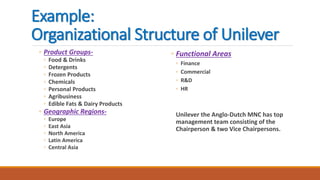
Organizational Structure of Unilever
◦ Product Groups-
◦ Food & Drinks
◦ Detergents
◦ Frozen Products
◦ Chemicals
◦ Personal Products
◦ Agribusiness
◦ Edible Fats & Dairy Products
◦ Geographic Regions-
◦ Europe
◦ East Asia
◦ North America
◦ Latin America
◦ Central Asia
◦ Functional Areas
◦ Finance
◦ Commercial
◦ R&D
◦ HR
Unilever the Anglo-Dutch MNC has top
management team consisting of the
Chairperson & two Vice Chairpersons.
Why Departmentation:
Effective control on expenditure
Budget preparation
Better coordination
Work analysis
Attaining specialization
Fixations of responsibilities
Freedom or autonomy
Other needs and importance:
Increases the operating efficiency of the employees
Makes the executive to be alert and efficient in his duties
Increases the prestige and skills of the departmental heads
Makes the departmental heads efficient
Easy to further expansion of the organization
Major problems:
De-emphasis of overall company’s objectives
Reduces coordination b/w functions
Responsibility for profits is at the top only
Slow adaptation to change in environment
Limits development of general managers
Overspecializes & narrow viewpoint of key personnel
There are certain danger points in the
process of departmentation,
the work of co-ordination becomes difficult;
the greater the number of departments and particularly levels, the more complicated becomes
the task of co -ordination. The managerial efficiency and the overall output would be lesser
because of poorer coordination
 the work of communication, control, supervision and planning appears more difficult and
enhances the cost of managing an enterprise
 there is remote possibility of direct contract between top management and operative
personnel because of the layering of executives
This causes a loss of morale on the part of subordinates. In short, levels are expensive in terms
of money and effort and undermine operating efficiency of the business.
Factors for departmentation:
Specification
Coordination
Control
Economy
Recognition of local conditions
Human considerations
Security attention
Factors description
for departmentation,
1.Specialization-
Departmentation should reflect the specialization in performing work
2.Coordination-
Best results achieved when activities are performed in coordination
3.Control-
Process of analyzing whether intended results are being achieved.
Factors description
for departmentation,
4.Economy-
Balance should be maintained b/w cost of creating a department &
its contributions
5.Local conditions-
More important for organizations operated in different geographical
areas
6.Human considerations-
Human factor plays an important role
Process of departmentation: (HOW)
Identification of work
Analysis of details of each work
Description of the function of the organization
Entrusting the function to a separate person who has
specialized in the respective field
Fixing the scope of authority and responsibility of the
departmental heads
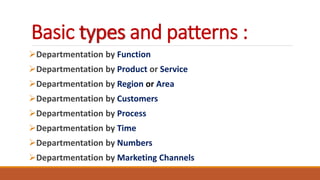
Basic types and patterns :
Departmentation by Function
Departmentation by Product or Service
Departmentation by Region or Area
Departmentation by Customers
Departmentation by Process
Departmentation by Time
Departmentation by Numbers
Departmentation by Marketing Channels
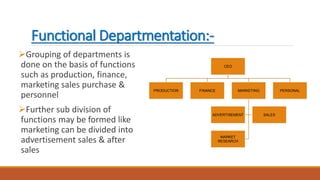
Functional Departmentation:-
Grouping of departments is
done on the basis of functions
such as production, finance,
marketing sales purchase &
personnel
Further sub division of
functions may be formed like
marketing can be divided into
advertisement sales & after
sales
CEO
PRODUCTION FINANCE MARKETING
ADVERTISEMENT SALES
MARKET
RESEARCH
PERSONAL
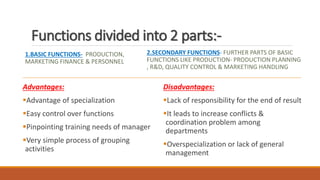
Functions divided into 2 parts:-
1.BASIC FUNCTIONS- PRODUCTION,
MARKETING FINANCE & PERSONNEL
Advantages:
Advantage of specialization
Easy control over functions
Pinpointing training needs of manager
Very simple process of grouping
activities
2.SECONDARY FUNCTIONS- FURTHER PARTS OF BASIC
FUNCTIONS LIKE PRODUCTION- PRODUCTION PLANNING
, R&D, QUALITY CONTROL & MARKETING HANDLING
Disadvantages:
Lack of responsibility for the end of result
It leads to increase conflicts &
coordination problem among
departments
Overspecialization or lack of general
management
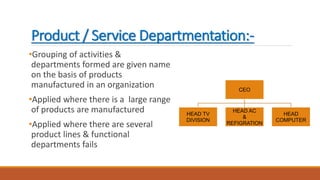
Product / Service Departmentation:-
•Grouping of activities &
departments formed are given name
on the basis of products
manufactured in an organization
•Applied where there is a large range
of products are manufactured
•Applied where there are several
product lines & functional
departments fails
CEO
HEAD TV
DIVISION
HEAD AC
&
REFIGRATION
HEAD
COMPUTER
Advantages:
 Ensures better
consumer services.
 Unprofitable products
may be easily
determined
 Assist in development of
all around managerial
talent
 Makes control effective
Disadvantages:
 Expensive as duplication
of service functions occurs
in various product
divisions
 Customers & dealers have
to deal with different
persons for complaints &
information of different
products
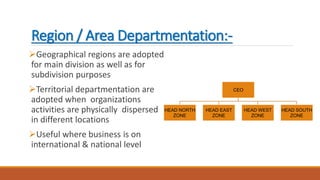
Region / Area Departmentation:-
Geographical regions are adopted
for main division as well as for
subdivision purposes
Territorial departmentation are
adopted when organizations
activities are physically dispersed
in different locations
Useful where business is on
international & national level
CEO
HEAD NORTH
ZONE
HEAD EAST
ZONE
HEAD WEST
ZONE
HEAD SOUTH
ZONE
Advantages:
 Cater to meet the needs
of local people more
satisfactorily
 It facilitates the effective
control
 Assists in development
of all- round managerial
skills
Disadvantages:
 Communication problem b/w
head office & regional office
due to lack of communication
at some places
 Coordination b/w various
divisions may become
difficult
 It leads to duplication of
activities which may cost
higher
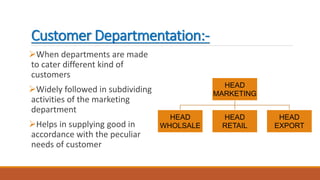
Customer Departmentation:-
When departments are made
to cater different kind of
customers
Widely followed in subdividing
activities of the marketing
department
Helps in supplying good in
accordance with the peculiar
needs of customer
HEAD
MARKETING
HEAD
WHOLSALE
HEAD
RETAIL
HEAD
EXPORT
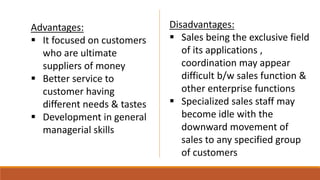
Advantages:
 It focused on customers
who are ultimate
suppliers of money
 Better service to
customer having
different needs & tastes
 Development in general
managerial skills
Disadvantages:
 Sales being the exclusive field
of its applications ,
coordination may appear
difficult b/w sales function &
other enterprise functions
 Specialized sales staff may
become idle with the
downward movement of
sales to any specified group
of customers
ANY QUERRIES…
An unexamined life is not worth living

Departmentation

  • 1.
    Departmentation …learning never ends thejourney of excellence always continues…
  • 2.
    Objective : to managea large undertaking to assign the work only to those who are best suited to facilitate the carrying out of the activities efficiently for achieving overall results.
  • 3.
    Meaning : Process ofdividing activities into units & subunits Division of work into smaller units and their re-grouping into bigger units as per the similarity of features. Grouping common activities of a organization on the basis of a function under a single person control. Process of integrating similar activities of business into units for facilitate smooth administration at all levels.
  • 4.
    Definition: Departmentation is theclassification of activities and organizations into units and sub-units on the basis of operations and functions, so that each unit (called Department) will work smoothly and separately for each other . ◦ Each department is headed by a person called departmental manager.
  • 5.
    Example: Organizational Structure ofUnilever ◦ Product Groups- ◦ Food & Drinks ◦ Detergents ◦ Frozen Products ◦ Chemicals ◦ Personal Products ◦ Agribusiness ◦ Edible Fats & Dairy Products ◦ Geographic Regions- ◦ Europe ◦ East Asia ◦ North America ◦ Latin America ◦ Central Asia ◦ Functional Areas ◦ Finance ◦ Commercial ◦ R&D ◦ HR Unilever the Anglo-Dutch MNC has top management team consisting of the Chairperson & two Vice Chairpersons.
  • 6.
    Why Departmentation: Effective controlon expenditure Budget preparation Better coordination Work analysis Attaining specialization Fixations of responsibilities Freedom or autonomy
  • 7.
    Other needs andimportance: Increases the operating efficiency of the employees Makes the executive to be alert and efficient in his duties Increases the prestige and skills of the departmental heads Makes the departmental heads efficient Easy to further expansion of the organization
  • 8.
    Major problems: De-emphasis ofoverall company’s objectives Reduces coordination b/w functions Responsibility for profits is at the top only Slow adaptation to change in environment Limits development of general managers Overspecializes & narrow viewpoint of key personnel
  • 9.
    There are certaindanger points in the process of departmentation, the work of co-ordination becomes difficult; the greater the number of departments and particularly levels, the more complicated becomes the task of co -ordination. The managerial efficiency and the overall output would be lesser because of poorer coordination  the work of communication, control, supervision and planning appears more difficult and enhances the cost of managing an enterprise  there is remote possibility of direct contract between top management and operative personnel because of the layering of executives This causes a loss of morale on the part of subordinates. In short, levels are expensive in terms of money and effort and undermine operating efficiency of the business.
  • 10.
    Factors for departmentation: Specification Coordination Control Economy Recognitionof local conditions Human considerations Security attention
  • 11.
    Factors description for departmentation, 1.Specialization- Departmentationshould reflect the specialization in performing work 2.Coordination- Best results achieved when activities are performed in coordination 3.Control- Process of analyzing whether intended results are being achieved.
  • 12.
    Factors description for departmentation, 4.Economy- Balanceshould be maintained b/w cost of creating a department & its contributions 5.Local conditions- More important for organizations operated in different geographical areas 6.Human considerations- Human factor plays an important role
  • 13.
    Process of departmentation:(HOW) Identification of work Analysis of details of each work Description of the function of the organization Entrusting the function to a separate person who has specialized in the respective field Fixing the scope of authority and responsibility of the departmental heads
  • 14.
    Basic types andpatterns : Departmentation by Function Departmentation by Product or Service Departmentation by Region or Area Departmentation by Customers Departmentation by Process Departmentation by Time Departmentation by Numbers Departmentation by Marketing Channels
  • 15.
    Functional Departmentation:- Grouping ofdepartments is done on the basis of functions such as production, finance, marketing sales purchase & personnel Further sub division of functions may be formed like marketing can be divided into advertisement sales & after sales CEO PRODUCTION FINANCE MARKETING ADVERTISEMENT SALES MARKET RESEARCH PERSONAL
  • 16.
    Functions divided into2 parts:- 1.BASIC FUNCTIONS- PRODUCTION, MARKETING FINANCE & PERSONNEL Advantages: Advantage of specialization Easy control over functions Pinpointing training needs of manager Very simple process of grouping activities 2.SECONDARY FUNCTIONS- FURTHER PARTS OF BASIC FUNCTIONS LIKE PRODUCTION- PRODUCTION PLANNING , R&D, QUALITY CONTROL & MARKETING HANDLING Disadvantages: Lack of responsibility for the end of result It leads to increase conflicts & coordination problem among departments Overspecialization or lack of general management
  • 17.
    Product / ServiceDepartmentation:- •Grouping of activities & departments formed are given name on the basis of products manufactured in an organization •Applied where there is a large range of products are manufactured •Applied where there are several product lines & functional departments fails CEO HEAD TV DIVISION HEAD AC & REFIGRATION HEAD COMPUTER
  • 18.
    Advantages:  Ensures better consumerservices.  Unprofitable products may be easily determined  Assist in development of all around managerial talent  Makes control effective Disadvantages:  Expensive as duplication of service functions occurs in various product divisions  Customers & dealers have to deal with different persons for complaints & information of different products
  • 19.
    Region / AreaDepartmentation:- Geographical regions are adopted for main division as well as for subdivision purposes Territorial departmentation are adopted when organizations activities are physically dispersed in different locations Useful where business is on international & national level CEO HEAD NORTH ZONE HEAD EAST ZONE HEAD WEST ZONE HEAD SOUTH ZONE
  • 20.
    Advantages:  Cater tomeet the needs of local people more satisfactorily  It facilitates the effective control  Assists in development of all- round managerial skills Disadvantages:  Communication problem b/w head office & regional office due to lack of communication at some places  Coordination b/w various divisions may become difficult  It leads to duplication of activities which may cost higher
  • 21.
    Customer Departmentation:- When departmentsare made to cater different kind of customers Widely followed in subdividing activities of the marketing department Helps in supplying good in accordance with the peculiar needs of customer HEAD MARKETING HEAD WHOLSALE HEAD RETAIL HEAD EXPORT
  • 22.
    Advantages:  It focusedon customers who are ultimate suppliers of money  Better service to customer having different needs & tastes  Development in general managerial skills Disadvantages:  Sales being the exclusive field of its applications , coordination may appear difficult b/w sales function & other enterprise functions  Specialized sales staff may become idle with the downward movement of sales to any specified group of customers
  • 23.
    ANY QUERRIES… An unexaminedlife is not worth living