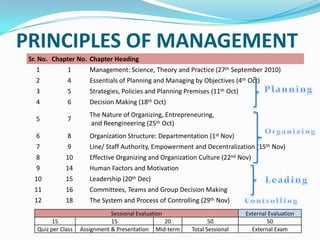
PRINCIPLES OF MANAGEMENTPlanningOrganizingLeadingControlling
Committees, Teams and Group Decision Makinghttp://www.slideshare.net/SubjectmaterialChapter 11
TABLE OF CONTENTSTHE NATURE OF COMMITTEES AND GROUPSREASON FOR MAKING COMMITTEES AND GROUPSDISADVANTAGES AND MISUSE OF COMMITTEESSUCCESSFUL OPERATION OF COMMITTEES AND GROUPSXADDITIONAL GROUP CONCEPTSTEAMSCONFLICTS IN COMMITTEES, GROUPS AND TEAMS
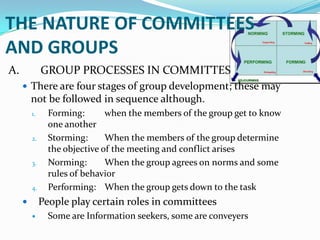
THE NATURE OF COMMITTEES AND GROUPSA.	GROUP PROCESSES IN COMMITTESThere are four stages of group development; these may not be followed in sequence although.Forming:	when the members of the group get to know one anotherStorming:	When the members of the group determine the objective of the meeting and conflict arisesNorming:	When the group agrees on norms and some rules of behaviorPerforming:	When the group gets down to the taskPeople play certain roles in committeesSome are Information seekers, some are conveyers
THE NATURE OF COMMITTEES AND GROUPSSome encourage others to contribute; Some followSome try to coordinate the group’s effort, or to achieve a compromise in case of conflicts; some are aggressiveThe seating arrangements also give clues to the social set up of the groupThe people who know each other, often sit next to each otherThe chairperson usually sits on a head chair; in modern setups the head chair is being removed, to promote equalityListen to verbal communication, as well as non verbal cues is also important while interacting in groups
THE NATURE OF COMMITTEES AND GROUPSFUNCTIONS AND FORMALITY OF COMMITTES AND GROUPSManagerial functions; some committees carry out the managerial functions such as planning, staffing, leading, controlling etc, while others do notDecision making roles;Some have the decision making authority; while other only deliberate on the problemsRecommendation functionSome have the authority to give recommendations to the managers; who may or may not accept themInformation functions: Some committees are designed to receive information only
THE NATURE OF COMMITTEES AND GROUPSLine or staff function:Plural executive: a line committee which also carries out managerial functions, such as the board of directorsStaff committee: a committee which has advisory relationship to the superiorsFormal or Informal; Formal: established as a part of the organization structure; with delegation of authority and dutiesInformal; established for group thinking or group decision on a particular problem; without delegation of authority. Permanent or temporary;The committees (formal or informal) may be permanent or temporary; depending upon the tasks or projects these are assigned for.
REASONS FOR USING COMMITTEES AND GROUPS:GROUP DELIBERATION AND JUDGEMENT:Most of the problems faced in enterprise either related to finance, engineering or sales required more knowledge, experience and judgment than an individual possesses. The committees are more widely used for the reason of getting the advantage of group deliberation and judgmentFEAR OF TOO MUCH AUTHORITY IN A SINGLE PERSONThe committees however are also formed to eliminate the probability of giving too much authority in a single person; such as president’s decisions may be challenged in a law making committee ie Congress/ Parliament
REASONS FOR USING COMMITTEES AND GROUPS:REPRESENTATION OF INTERESTED GROUPS:Such as selection of board of directorsCOORDINATION OF DEPARTMENTS, PLANS AND POLICIESTRANSMISSION AND SHARING OF INFORMATIONCONSOLIDATION OF AUTHORITYMOTIVATION THROUGH PARTICIPATION
DISADVANTAGES AND MISUSE OF COMMITTEES:They are costlyThey may result in compromises rather than an optimal decisionThey may lead to indecisionThey can split responsibilityThey can lead to a situation in which a few persons impose their will on the majority, not allowing the participation of other membersCommittees should never be used as a replacement of a manager, for research study, for unimportant decisions and for decisions beyond the participants’ authority
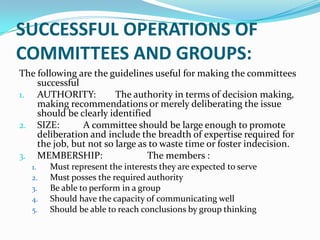
SUCCESSFUL OPERATIONS OF COMMITTEES AND GROUPS:The following are the guidelines useful for making the committees successfulAUTHORITY:	The authority in terms of decision making, making recommendations or merely deliberating the issue should be clearly identifiedSIZE:	A committee should be large enough to promote deliberation and include the breadth of expertise required for the job, but not so large as to waste time or foster indecision.MEMBERSHIP:		The members :Must represent the interests they are expected to serveMust posses the required authorityBe able to perform in a groupShould have the capacity of communicating wellShould be able to reach conclusions by group thinking
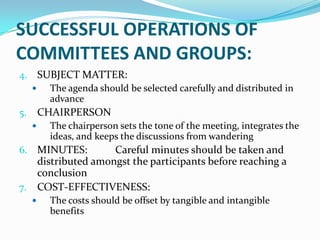
SUCCESSFUL OPERATIONS OF COMMITTEES AND GROUPS:SUBJECT MATTER:	The agenda should be selected carefully and distributed in advanceCHAIRPERSONThe chairperson sets the tone of the meeting, integrates the ideas, and keeps the discussions from wanderingMINUTES:	Careful minutes should be taken and distributed amongst the participants before reaching a conclusionCOST-EFFECTIVENESS:	The costs should be offset by tangible and intangible benefits
TEAMS“A small number of people with complementary skills who are committed to a common purpose, set of performance, goals and approach for which they hold themselves mutually accountable”Team buildingSelf-managing teamsVirtual teams
CONFLICTS IN COMMITTEES, GROUPS AND TEAMSConflict may arise between individuals, between groups and between the organization and its environmentThey may be dealt by communicating the norms in advanceThey may also be dealt by the leaders, with the styles varying in different situations

Management chap 11 committees

  • 1.
  • 2.
    Committees, Teams andGroup Decision Makinghttp://www.slideshare.net/SubjectmaterialChapter 11
  • 3.
    TABLE OF CONTENTSTHENATURE OF COMMITTEES AND GROUPSREASON FOR MAKING COMMITTEES AND GROUPSDISADVANTAGES AND MISUSE OF COMMITTEESSUCCESSFUL OPERATION OF COMMITTEES AND GROUPSXADDITIONAL GROUP CONCEPTSTEAMSCONFLICTS IN COMMITTEES, GROUPS AND TEAMS
  • 4.
    THE NATURE OFCOMMITTEES AND GROUPSA. GROUP PROCESSES IN COMMITTESThere are four stages of group development; these may not be followed in sequence although.Forming: when the members of the group get to know one anotherStorming: When the members of the group determine the objective of the meeting and conflict arisesNorming: When the group agrees on norms and some rules of behaviorPerforming: When the group gets down to the taskPeople play certain roles in committeesSome are Information seekers, some are conveyers
  • 5.
    THE NATURE OFCOMMITTEES AND GROUPSSome encourage others to contribute; Some followSome try to coordinate the group’s effort, or to achieve a compromise in case of conflicts; some are aggressiveThe seating arrangements also give clues to the social set up of the groupThe people who know each other, often sit next to each otherThe chairperson usually sits on a head chair; in modern setups the head chair is being removed, to promote equalityListen to verbal communication, as well as non verbal cues is also important while interacting in groups
  • 6.
    THE NATURE OFCOMMITTEES AND GROUPSFUNCTIONS AND FORMALITY OF COMMITTES AND GROUPSManagerial functions; some committees carry out the managerial functions such as planning, staffing, leading, controlling etc, while others do notDecision making roles;Some have the decision making authority; while other only deliberate on the problemsRecommendation functionSome have the authority to give recommendations to the managers; who may or may not accept themInformation functions: Some committees are designed to receive information only
  • 7.
    THE NATURE OFCOMMITTEES AND GROUPSLine or staff function:Plural executive: a line committee which also carries out managerial functions, such as the board of directorsStaff committee: a committee which has advisory relationship to the superiorsFormal or Informal; Formal: established as a part of the organization structure; with delegation of authority and dutiesInformal; established for group thinking or group decision on a particular problem; without delegation of authority. Permanent or temporary;The committees (formal or informal) may be permanent or temporary; depending upon the tasks or projects these are assigned for.
  • 8.
    REASONS FOR USINGCOMMITTEES AND GROUPS:GROUP DELIBERATION AND JUDGEMENT:Most of the problems faced in enterprise either related to finance, engineering or sales required more knowledge, experience and judgment than an individual possesses. The committees are more widely used for the reason of getting the advantage of group deliberation and judgmentFEAR OF TOO MUCH AUTHORITY IN A SINGLE PERSONThe committees however are also formed to eliminate the probability of giving too much authority in a single person; such as president’s decisions may be challenged in a law making committee ie Congress/ Parliament
  • 9.
    REASONS FOR USINGCOMMITTEES AND GROUPS:REPRESENTATION OF INTERESTED GROUPS:Such as selection of board of directorsCOORDINATION OF DEPARTMENTS, PLANS AND POLICIESTRANSMISSION AND SHARING OF INFORMATIONCONSOLIDATION OF AUTHORITYMOTIVATION THROUGH PARTICIPATION
  • 10.
    DISADVANTAGES AND MISUSEOF COMMITTEES:They are costlyThey may result in compromises rather than an optimal decisionThey may lead to indecisionThey can split responsibilityThey can lead to a situation in which a few persons impose their will on the majority, not allowing the participation of other membersCommittees should never be used as a replacement of a manager, for research study, for unimportant decisions and for decisions beyond the participants’ authority
  • 11.
    SUCCESSFUL OPERATIONS OFCOMMITTEES AND GROUPS:The following are the guidelines useful for making the committees successfulAUTHORITY: The authority in terms of decision making, making recommendations or merely deliberating the issue should be clearly identifiedSIZE: A committee should be large enough to promote deliberation and include the breadth of expertise required for the job, but not so large as to waste time or foster indecision.MEMBERSHIP: The members :Must represent the interests they are expected to serveMust posses the required authorityBe able to perform in a groupShould have the capacity of communicating wellShould be able to reach conclusions by group thinking
  • 12.
    SUCCESSFUL OPERATIONS OFCOMMITTEES AND GROUPS:SUBJECT MATTER: The agenda should be selected carefully and distributed in advanceCHAIRPERSONThe chairperson sets the tone of the meeting, integrates the ideas, and keeps the discussions from wanderingMINUTES: Careful minutes should be taken and distributed amongst the participants before reaching a conclusionCOST-EFFECTIVENESS: The costs should be offset by tangible and intangible benefits
  • 13.
    TEAMS“A small numberof people with complementary skills who are committed to a common purpose, set of performance, goals and approach for which they hold themselves mutually accountable”Team buildingSelf-managing teamsVirtual teams
  • 14.
    CONFLICTS IN COMMITTEES,GROUPS AND TEAMSConflict may arise between individuals, between groups and between the organization and its environmentThey may be dealt by communicating the norms in advanceThey may also be dealt by the leaders, with the styles varying in different situations