INTRODUCTION
Group - two or more people with common
interests, objectives, and continuing interaction
Team –Mature groups with a degree of member
interdependence and motivation to achieve a
common goal
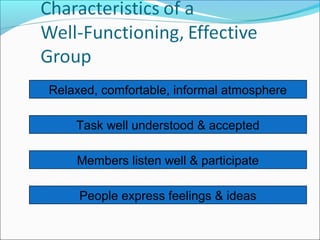
Relaxed, comfortable, informal atmosphere
Task well understood & accepted
People express feelings & ideas
Members listen well & participate
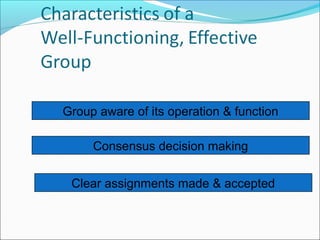
Consensus decision making
Clear assignments made & accepted
Group aware of its operation & function
TYPES OF GROUPS
Formal Groups –
Group formed by
management to accomplish
the goals
of the
organization
Informal Groups –
formed by individuals
and developed around
common interests and
friendships rather than
around a deliberate
design
Command Group
Group of subordinates who report to one particular
manager
Specified by the formal organization chart
Task group
Group of individuals who work as a unit to complete
a project or job task
Interest groups
Group that forms because of some special topic of
interest
When the interest declines or goal has been achieved
the group disbands.
Friendship groups
Informal group that is established in the workplace
Due to some common characteristic of its members
Include activities outside the workplace by its
members
STAGES OF GROUP
DEVELOPMENT
FORMING
First stage of group development
Includes confusions about the purpose, structure,
leadership of the group
This stage ends when members view themselves as a
part of the group
Group members get to know each other and reach
common goals.
STORMING
Group members disagree on direction and leadership.
Managers need to be sure the conflict stays focused.
May involve competition among members in between
the group matters
Involves redefinition of the group’s tasks and overall
goals
Critical stage for group survival and effectiveness
NORMING
Involves cooperation and collaboration
Group cohesion begins significant development
Involves open exchange of information, acceptance of
differences of opinion
Active attempts to achieve the common accepted
goals of the group
Strong degree of mutual attraction, commitment and
feelings of group identity
Leadership starts evolving
PERFORMING
The group begins to do its real work
Group structure is set,
Roles of each member are understood and accepted
Focuses its energies, efforts and commitments on
accomplishing the tasks
ADJOURNING
Involves the termination of group activities
Some groups are permanent and never reach adjourning
Once the goals or tasks are accomplished groups get
terminated
CHARACTERISTICS
Composition
relates to the extent to which group members are
alike
Group can be either homogeneous or heterogeneous
Roles
Each position in the group structure has an associated
role that consists of the behaviors expected of the
occupant of that position
Norms
Standards shared by members of a group
They may be written and sometimes communicated
verbally
In groups, norms relates to productivity
Leadership
Leader exerts influence over the other members of
the group
Viewed as a respected and high status member
Lead others in the group to accomplish the goals
Cohesiveness
Closeness or commonness of attitude,behavior and
performance
Force in between the group members
TEAMS
Mature group comprising people with
interdependence, motivation and a shared
commitment to accomplish goals
Good when performing complicated, complex,
interrelated and/or more voluminous work than one
person can handle
Good when knowledge, talent, skills, & abilities are
dispersed across organizational members
Empowerment and collaboration; not power and
competition
Quality Circles & Teams
Quality Team - a team that is part of an
organization’s structure & is empowered to act on
its decisions regarding product & quality service
Quality Circles (QC) - a small group of employees
who work voluntarily on company time, typically
one hour per week, to address work-related
problems
QC’s deal with substantive issues
Do not require final decision authority
QC’s need periodic reenergizing
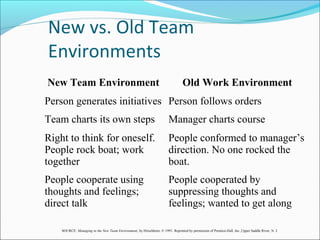
New vs. Old Team
Environments
New Team Environment Old Work Environment
Person generates initiatives Person follows orders
Team charts its own steps Manager charts course
Right to think for oneself.
People rock boat; work
together
People conformed to manager’s
direction. No one rocked the
boat.
People cooperate using
thoughts and feelings;
direct talk
People cooperated by
suppressing thoughts and
feelings; wanted to get along
SOURCE: Managing in the New Team Environment, by Hirschhorn, © 1991. Reprinted by permission of Prentice-Hall, Inc.,Upper Saddle River, N. J.
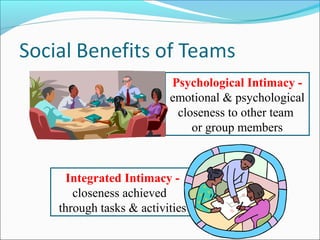
Psychological Intimacy -
emotional & psychological
closeness to other team
or group members
Integrated Intimacy -
closeness achieved
through tasks & activities
Self-Managed Teams
Self-Managed Teams - teams that make decisions
that were once reserved for managers
Multicultural groups represent
three or more ethnic backgrounds.
Diversity may increase uncertainty,
complexity, & inherent confusion in
group processes. Culturally
diverse groups may generate more
& better ideas & limit groupthink.
THANK YOU

Group and Team in an Organisation

  • 2.
    INTRODUCTION Group - twoor more people with common interests, objectives, and continuing interaction Team –Mature groups with a degree of member interdependence and motivation to achieve a common goal
  • 3.
    Relaxed, comfortable, informalatmosphere Task well understood & accepted People express feelings & ideas Members listen well & participate
  • 4.
    Consensus decision making Clearassignments made & accepted Group aware of its operation & function
  • 5.
    TYPES OF GROUPS FormalGroups – Group formed by management to accomplish the goals of the organization Informal Groups – formed by individuals and developed around common interests and friendships rather than around a deliberate design
  • 6.
    Command Group Group ofsubordinates who report to one particular manager Specified by the formal organization chart Task group Group of individuals who work as a unit to complete a project or job task
  • 7.
    Interest groups Group thatforms because of some special topic of interest When the interest declines or goal has been achieved the group disbands. Friendship groups Informal group that is established in the workplace Due to some common characteristic of its members Include activities outside the workplace by its members
  • 8.
    STAGES OF GROUP DEVELOPMENT FORMING Firststage of group development Includes confusions about the purpose, structure, leadership of the group This stage ends when members view themselves as a part of the group Group members get to know each other and reach common goals.
  • 9.
    STORMING Group members disagreeon direction and leadership. Managers need to be sure the conflict stays focused. May involve competition among members in between the group matters Involves redefinition of the group’s tasks and overall goals Critical stage for group survival and effectiveness
  • 10.
    NORMING Involves cooperation andcollaboration Group cohesion begins significant development Involves open exchange of information, acceptance of differences of opinion Active attempts to achieve the common accepted goals of the group Strong degree of mutual attraction, commitment and feelings of group identity Leadership starts evolving
  • 11.
    PERFORMING The group beginsto do its real work Group structure is set, Roles of each member are understood and accepted Focuses its energies, efforts and commitments on accomplishing the tasks ADJOURNING Involves the termination of group activities Some groups are permanent and never reach adjourning Once the goals or tasks are accomplished groups get terminated
  • 12.
    CHARACTERISTICS Composition relates to theextent to which group members are alike Group can be either homogeneous or heterogeneous Roles Each position in the group structure has an associated role that consists of the behaviors expected of the occupant of that position
  • 13.
    Norms Standards shared bymembers of a group They may be written and sometimes communicated verbally In groups, norms relates to productivity Leadership Leader exerts influence over the other members of the group Viewed as a respected and high status member Lead others in the group to accomplish the goals Cohesiveness Closeness or commonness of attitude,behavior and performance Force in between the group members
  • 14.
    TEAMS Mature group comprisingpeople with interdependence, motivation and a shared commitment to accomplish goals Good when performing complicated, complex, interrelated and/or more voluminous work than one person can handle Good when knowledge, talent, skills, & abilities are dispersed across organizational members Empowerment and collaboration; not power and competition
  • 15.
    Quality Circles &Teams Quality Team - a team that is part of an organization’s structure & is empowered to act on its decisions regarding product & quality service Quality Circles (QC) - a small group of employees who work voluntarily on company time, typically one hour per week, to address work-related problems QC’s deal with substantive issues Do not require final decision authority QC’s need periodic reenergizing
  • 16.
    New vs. OldTeam Environments New Team Environment Old Work Environment Person generates initiatives Person follows orders Team charts its own steps Manager charts course Right to think for oneself. People rock boat; work together People conformed to manager’s direction. No one rocked the boat. People cooperate using thoughts and feelings; direct talk People cooperated by suppressing thoughts and feelings; wanted to get along SOURCE: Managing in the New Team Environment, by Hirschhorn, © 1991. Reprinted by permission of Prentice-Hall, Inc.,Upper Saddle River, N. J.
  • 17.
    Psychological Intimacy - emotional& psychological closeness to other team or group members Integrated Intimacy - closeness achieved through tasks & activities
  • 18.
    Self-Managed Teams Self-Managed Teams- teams that make decisions that were once reserved for managers
  • 19.
    Multicultural groups represent threeor more ethnic backgrounds. Diversity may increase uncertainty, complexity, & inherent confusion in group processes. Culturally diverse groups may generate more & better ideas & limit groupthink.
  • 20.

Editor's Notes