MBO
 
Management by Objectives  (MBO) is a process of agreeing upon  objectives  within an organization so that  management  and  employees  agree to the objectives and understand what they are in the organization. The term "management by objectives" was first popularized by  Peter Drucker  in his 1954 book 'The Practice of Management. Objectives can be set in all domains of activities (production, services, sales, R&D, human resources, finance, information systems etc.). Some objectives are collective, for a whole department or the whole company, others can be individualized.
Appraise Performance Corporate Strategic goals Departmental goals Individual goals STEP 1: SET GOALS STEP 4:  APPRAISE OVERALL PERFORMANCE Action Plans Review Progress  &  Take Corrective Action STEP 2: DEVELOP PLANS STEP 3: REVIEW PROGRESS
Cascading of  organizational goals and objectives  Specific objectives for each   team member Participative decision making  Explicit time period  Performance evaluation &   feedback
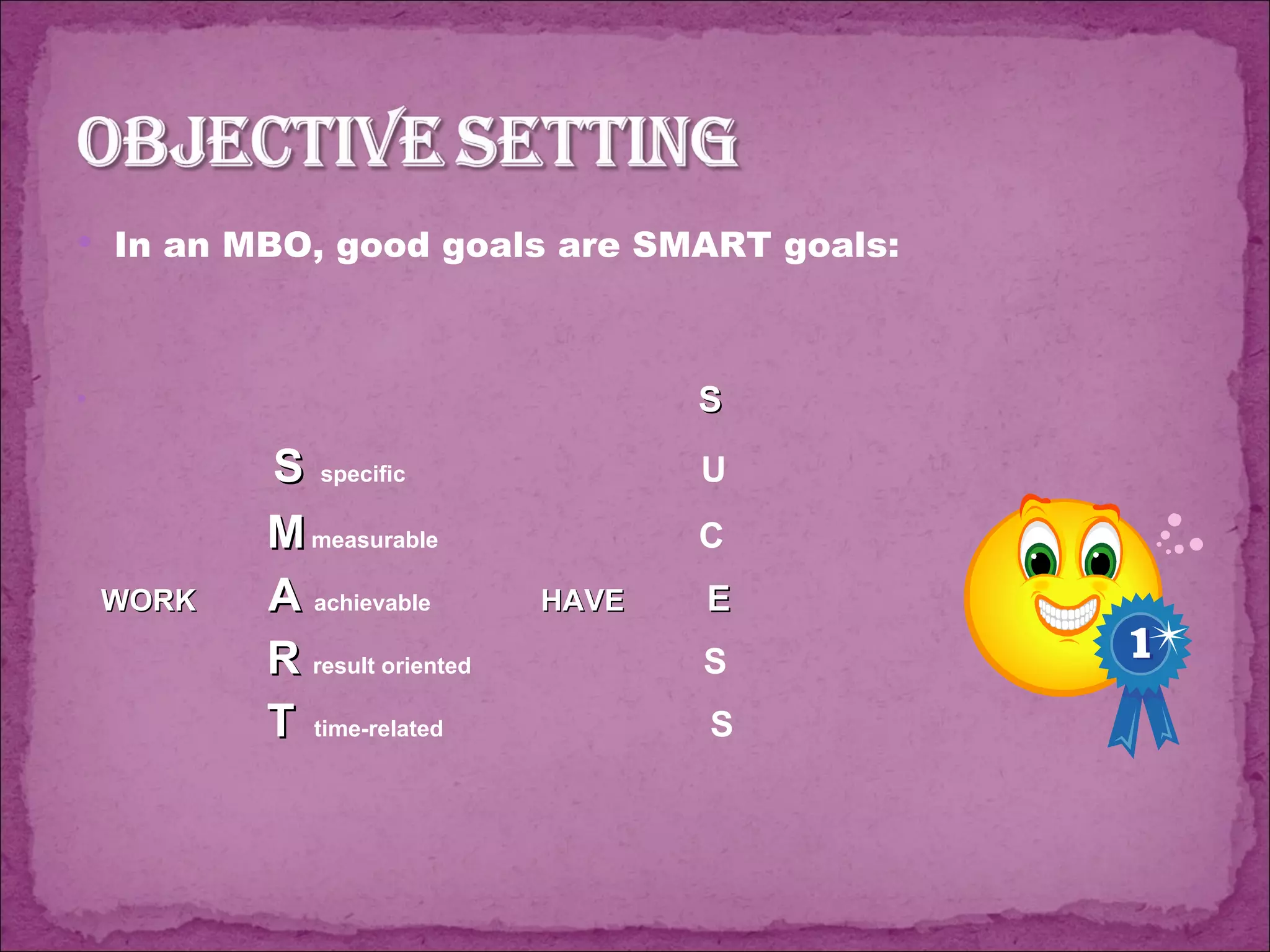
In an MBO, good goals are SMART goals: S S   specific   U M   measurable   C  WORK  A   achievable   HAVE   E  R   result oriented  S T   t ime-related  S
All individuals within an organization are assigned a special set of objectives that they try to reach during a normal operating period. These objectives are mutually set and agreed upon by individuals and their managers.  Performance reviews are conducted periodically to determine how close individuals are to attaining their objectives.  Rewards are given to individuals on the basis of how close they come to reaching their goals.
Improves employee motivation Improves communication in the organisation Flags up and highlights training needs required to achieve objectives Improves overall performance and efficiency Attainment of goals can lead to the satisfaction of Maslow’s higher order needs
May demotivate staff if targets are too high and unrealistic, also if imposed rather than agreed Requires the cooperation of all employees to succeed Can be bureaucratic and time consuming (meetings, feedback) Can encourage short-term rather a more focused long-term growth Objectives may go out of date and can restrict staff initiative and creativity Setting targets for certain specialised employees may be difficult
Lack of top management commitment and follow through on MBO. Employees’ negative beliefs about management’s sincerity in its efforts to include them in the decision-making process.
THANK YOU

Management by objectives

  • 1.
  • 2.
  • 3.
    Management by Objectives (MBO) is a process of agreeing upon objectives within an organization so that management and employees agree to the objectives and understand what they are in the organization. The term "management by objectives" was first popularized by Peter Drucker in his 1954 book 'The Practice of Management. Objectives can be set in all domains of activities (production, services, sales, R&D, human resources, finance, information systems etc.). Some objectives are collective, for a whole department or the whole company, others can be individualized.
  • 4.
    Appraise Performance CorporateStrategic goals Departmental goals Individual goals STEP 1: SET GOALS STEP 4: APPRAISE OVERALL PERFORMANCE Action Plans Review Progress & Take Corrective Action STEP 2: DEVELOP PLANS STEP 3: REVIEW PROGRESS
  • 5.
    Cascading of organizational goals and objectives Specific objectives for each team member Participative decision making Explicit time period Performance evaluation & feedback
  • 6.
    In an MBO,good goals are SMART goals: S S specific U M measurable C WORK A achievable HAVE E R result oriented S T t ime-related S
  • 7.
    All individuals withinan organization are assigned a special set of objectives that they try to reach during a normal operating period. These objectives are mutually set and agreed upon by individuals and their managers. Performance reviews are conducted periodically to determine how close individuals are to attaining their objectives. Rewards are given to individuals on the basis of how close they come to reaching their goals.
  • 8.
    Improves employee motivationImproves communication in the organisation Flags up and highlights training needs required to achieve objectives Improves overall performance and efficiency Attainment of goals can lead to the satisfaction of Maslow’s higher order needs
  • 9.
    May demotivate staffif targets are too high and unrealistic, also if imposed rather than agreed Requires the cooperation of all employees to succeed Can be bureaucratic and time consuming (meetings, feedback) Can encourage short-term rather a more focused long-term growth Objectives may go out of date and can restrict staff initiative and creativity Setting targets for certain specialised employees may be difficult
  • 10.
    Lack of topmanagement commitment and follow through on MBO. Employees’ negative beliefs about management’s sincerity in its efforts to include them in the decision-making process.
  • 11.

Editor's Notes

  • #5 Set goals – not day to day but rather goals that answer at least a portion of the “where are we going” question and then are linked with other goals Plans – Steps required Review – make sure plan is working; Is corrective action necessary either in the plan or the execution? CAUTION : Don’t get locked into PREDETERMINED behavior or sacrifice QUALITY to “MEET” goal