
Introduction to Logic Models
for Program, Project, and
Evaluation Design
Session Overview
O Introduction to logic modeling
O Purposes of logic modeling
O Different types of models
O Logic Model, Theory of Change,
Theory of Action
O Developing a logic model
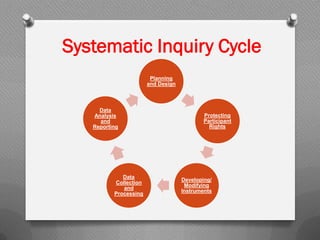
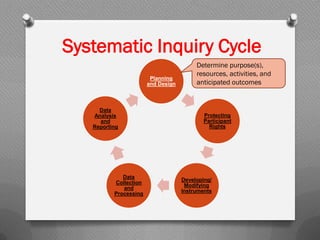
Systematic Inquiry Cycle
Planning
and Design
Protecting
Participant
Rights
Developing/
Modifying
Instruments
Data
Collection
and
Processing
Data
Analysis
and
Reporting
What is a Logic Model?
A program logic model is a picture of how your
program works – the theory and assumptions
underlying the program. ...This model provides
a road map of your program, highlighting how
it is expected to work, what activities need to
come before others, and how desired
outcomes are achieved (p. 35).
W.K. Kellogg Foundation Evaluation
Handbook (1998)
History of Logic Modeling
O 35+ year history
O Clear identification of goals (outcomes)
O First attempt to standardize a depiction of
program components so that activities align
with outcomes
O United Way provided the first widely-
accepted model
Key Features of Logic
Models
O Systematic
O Visual
O Sequential but not necessarily linear
O Typically have 5 components
O Shows “What” and “How”
O May show “Why”
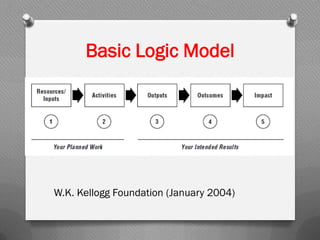
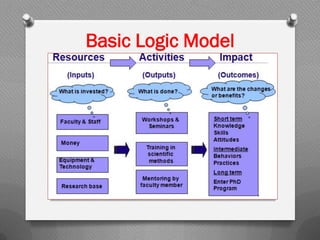
Basic Logic Model
W.K. Kellogg Foundation (January 2004)
Basic Logic Model
Components
PLANNED WORK
O Resources: human, financial, organizational,
community resources a program has
available to do the work (i.e., Inputs)
O Activities: processes, tools, events,
technology, and actions that are an
intentional part of program implementation.
Basic Logic Model
Components
INTENDED RESULTS
O Outputs: direct products of program activities
O Outcomes: specific changes in program
participants’ behavior, knowledge, skills, status
Short-term 1 to 3 years
Longer-term 4 to 6 years
O Impact: fundamental intended or unintended
change as a result of program (7 to 10 years)
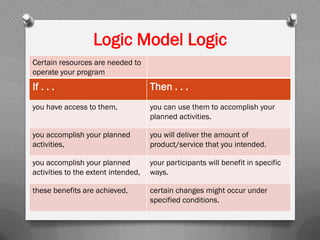
Logic Model Logic
Certain resources are needed to
operate your program
If . . . Then . . .
you have access to them, you can use them to accomplish your
planned activities.
you accomplish your planned
activities,
you will deliver the amount of
product/service that you intended.
you accomplish your planned
activities to the extent intended,
your participants will benefit in specific
ways.
these benefits are achieved, certain changes might occur under
specified conditions.
Why Use Logic Modeling?
1. Planning and Design
2. Implementation and
Management
3. Evaluation and Communication
Systematic Inquiry Cycle
Planning
and Design
Protecting
Participant
Rights
Developing/
Modifying
Instruments
Data
Collection
and
Processing
Data
Analysis
and
Reporting
Determine purpose(s),
resources, activities, and
anticipated outcomes
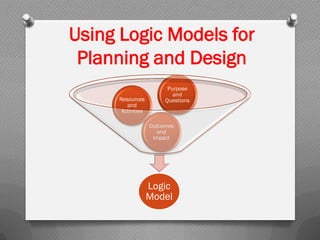
Using Logic Models for
Planning and Design
Logic
Model
Outcomes
and
Impact
Resources
and
Activities
Purpose
and
Questions
Planning and Design
O Provides a road map
O Describes sequence of events
O Connects the need for the program with
desired results
Most of the value in a logic model is in the
process of creating, validating, and modifying
the model …The clarity of thinking that occurs
from building the model is critical to the
overall success of the program (p. 43).
W.K. Kellogg Foundation (January 2004)
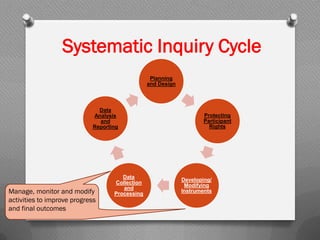
Systematic Inquiry Cycle
Planning
and Design
Protecting
Participant
Rights
Developing/
Modifying
Instruments
Data
Collection
and
Processing
Data
Analysis
and
Reporting
Manage, monitor and modify
activities to improve progress
and final outcomes
Implementation and
Management
O Helps visualize and understand how investments
contribute to achieving intended program goals
O Monitors incremental progress toward outcomes
O Facilitates program improvements
Program logic modeling is a learning and
management tool that can be used throughout a
program’s life . . . result(ing) in effective
programming and offering greater learning
opportunities (p. 1)
W.K. Kellogg Foundation (January 2004)
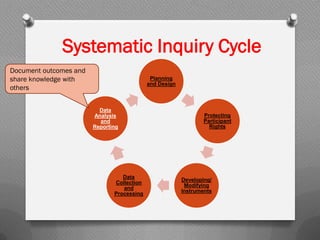
Systematic Inquiry Cycle
Planning
and Design
Protecting
Participant
Rights
Developing/
Modifying
Instruments
Data
Collection
and
Processing
Data
Analysis
and
Reporting
Document outcomes and
share knowledge with
others
Evaluation and
Communication
O Documentation of outcomes
O Shared knowledge about what works and why
O Improves likelihood of sustaining a program over
time through continuation of funding and/or
stakeholder buy-in.
A program is a theory and an evaluation is its test. .
. to organize the evaluation to provide a responsible
test, the evaluator needs to understand the
theoretical premises on which the program is
based (p. 55).
Carol Weiss (1998)
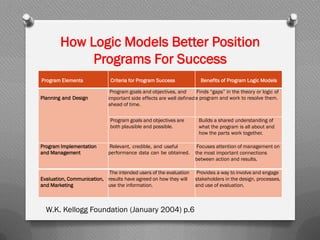
How Logic Models Better Position
Programs For Success
Program Elements Criteria for Program Success Benefits of Program Logic Models
Planning and Design
Program goals and objectives, and
important side effects are well defined
ahead of time.
Finds “gaps” in the theory or logic of
a program and work to resolve them.
Program goals and objectives are
both plausible and possible.
Builds a shared understanding of
what the program is all about and
how the parts work together.
Program Implementation
and Management
Relevant, credible, and useful
performance data can be obtained.
Focuses attention of management on
the most important connections
between action and results.
Evaluation, Communication,
and Marketing
The intended users of the evaluation
results have agreed on how they will
use the information.
Provides a way to involve and engage
stakeholders in the design, processes,
and use of evaluation.
W.K. Kellogg Foundation (January 2004) p.6
Sidebar 1
O There is no “Best” Logic Model - Choose the
model that fits your program best and provides
information you need in the format that is
most helpful.
O Practice using logic models - Experiment with
logic model design to determine what works
best for your program.
O Don’t worry if your model doesn’t look like
others but DO worry if you cannot explain your
model to others
More Key Features of Logic
Models
OFlexible
OShow areas of strength,
weakness, and gaps
ODynamic
OPromotes strategic
management
Forms of Logic Modeling
O Typically logic models use table and flow
chart formats with text and arrows or a
graphic representation of program ideas.
O A logic model does not have to be linear.
Concept maps or other visuals may
better describe complex program
concepts.
Three Approaches to Logic
Modeling
O Theory approach model (conceptual)
O Outcome approach model
O Activities approach model (applied)
O A program may use all three types of
logic models for different purposes.
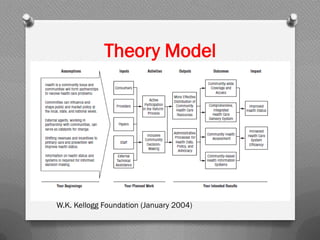
Theory Approach Models
O Emphasize the theory of change
influencing design and plan for the
program
O Explain how and why your program will
work
O May have additional parts (e.g., describe
problem or issue addressed by program,
connect strategies to activities)
Theory Model
W.K. Kellogg Foundation (January 2004)
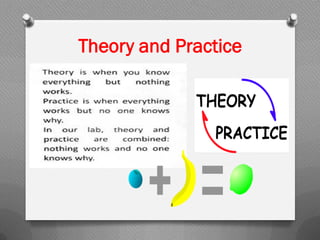
Theory and Practice
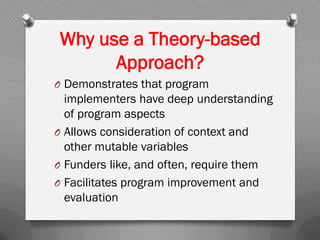
Why use a Theory-based
Approach?
O Demonstrates that program
implementers have deep understanding
of program aspects
O Allows consideration of context and
other mutable variables
O Funders like, and often, require them
O Facilitates program improvement and
evaluation
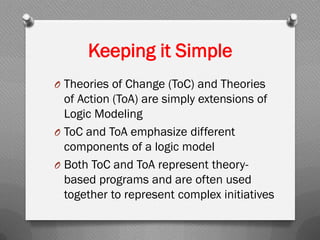
Keeping it Simple
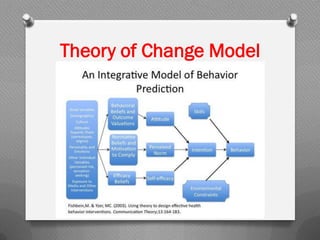
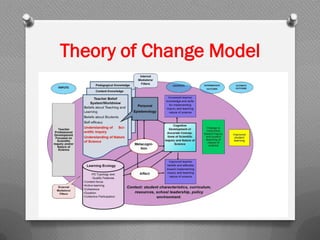
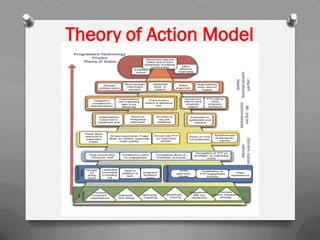
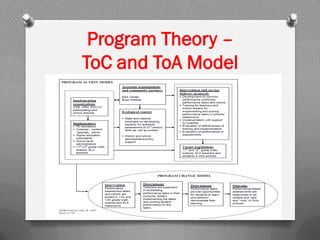
O Theories of Change (ToC) and Theories
of Action (ToA) are simply extensions of
Logic Modeling
O ToC and ToA emphasize different
components of a logic model
O Both ToC and ToA represent theory-
based programs and are often used
together to represent complex initiatives
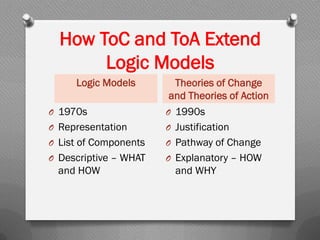
How ToC and ToA Extend
Logic Models
Logic Models Theories of Change
and Theories of Action
O 1970s
O Representation
O List of Components
O Descriptive – WHAT
and HOW
O 1990s
O Justification
O Pathway of Change
O Explanatory – HOW
and WHY
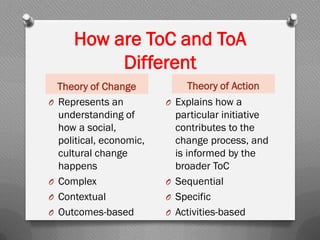
How are ToC and ToA
Different
Theory of Change Theory of Action
O Represents an
understanding of
how a social,
political, economic,
cultural change
happens
O Complex
O Contextual
O Outcomes-based
O Explains how a
particular initiative
contributes to the
change process, and
is informed by the
broader ToC
O Sequential
O Specific
O Activities-based
Theory of Change Model
Theory of Action Model
Program Theory –
ToC and ToA Model
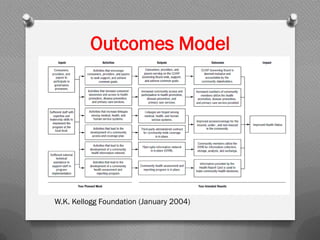
Outcomes Approach Models
O Focus on during early aspects of
program planning
O More clearly connect resources
and/or activities with desired results
O Subdivide outcomes and impact that
may result from a given set of
activities over time (i.e., short-term,
long-term, impact)
Outcomes Model
W.K. Kellogg Foundation (January 2004)
Why use an Outcomes-
based Approach?
O Demonstrates that program implementers
have understanding of anticipated results
O Explicitly considers time as a variable
O Stakeholders like them
O Facilitates program summative evaluation
O Can use when program theory is
underdeveloped – but not UNdeveloped
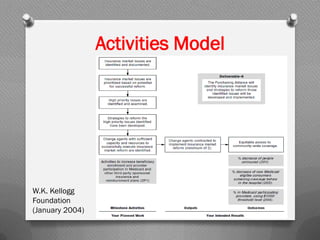
Activities Approach Models
O Focus on program implementation
process
O Clearly link activities to each other to
map implementation
O Provide more detail about steps and
sequence of program implementation
Activities Model
W.K. Kellogg
Foundation
(January 2004)
Why use an Activities-based
Approach?
O Demonstrates that program implementers
have understanding of relationships among
program activities
O Allows for studying interactions of activities
O Facilitates program monitoring, management
O Participants like them because they show
what you will actually do.
O Facilitates program formative or process
evaluation
Sidebar 2
O Logic Model, Theory of
Change, Theory of
Action are often used
interchangeably and are
not clearly defined in the
literature
O Funders’ often request
“logic model” when they
expect a representation
or model of theory
Basic Logic Model
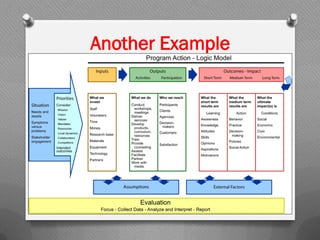
Another Example
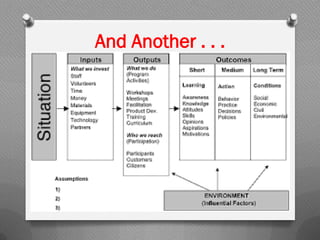
And Another . . .
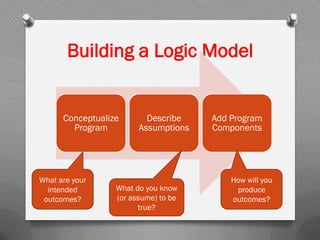
Building a Logic Model
Conceptualize
Program
Describe
Assumptions
Add Program
Components
What are your
intended
outcomes?
What do you know
(or assume) to be
true?
How will you
produce
outcomes?
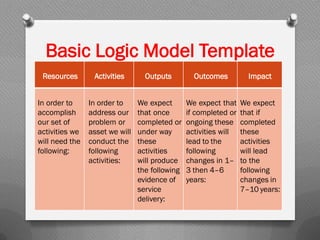
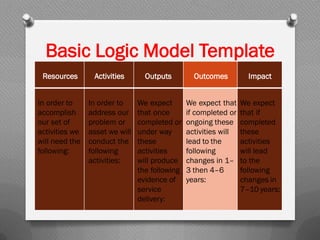
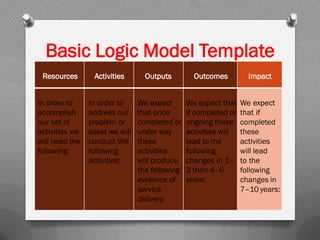
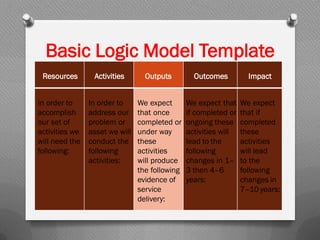
Basic Logic Model Template
Resources Activities Outputs Outcomes Impact
In order to
accomplish
our set of
activities we
will need the
following:
In order to
address our
problem or
asset we will
conduct the
following
activities:
We expect
that once
completed or
under way
these
activities
will produce
the following
evidence of
service
delivery:
We expect that
if completed or
ongoing these
activities will
lead to the
following
changes in 1–
3 then 4–6
years:
We expect
that if
completed
these
activities
will lead
to the
following
changes in
7–10 years:
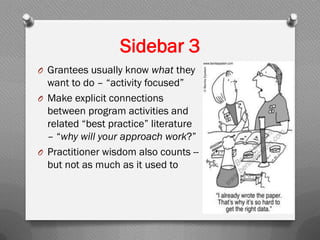
Sidebar 3
O Grantees usually know what they
want to do – “activity focused”
O Make explicit connections
between program activities and
related “best practice” literature
– “why will your approach work?”
O Practitioner wisdom also counts --
but not as much as it used to
Basic Logic Model Template
Resources Activities Outputs Outcomes Impact
In order to
accomplish
our set of
activities we
will need the
following:
In order to
address our
problem or
asset we will
conduct the
following
activities:
We expect
that once
completed or
under way
these
activities
will produce
the following
evidence of
service
delivery:
We expect that
if completed or
ongoing these
activities will
lead to the
following
changes in 1–
3 then 4–6
years:
We expect
that if
completed
these
activities
will lead
to the
following
changes in
7–10 years:
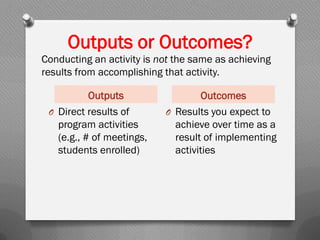
Outputs or Outcomes?
Outputs Outcomes
O Direct results of
program activities
(e.g., # of meetings,
students enrolled)
O Results you expect to
achieve over time as a
result of implementing
activities
Conducting an activity is not the same as achieving
results from accomplishing that activity.
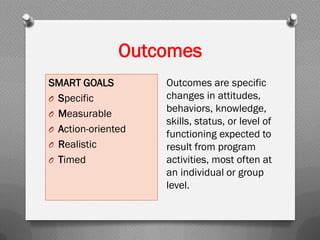
Outcomes
SMART GOALS
O Specific
O Measurable
O Action-oriented
O Realistic
O Timed
Outcomes are specific
changes in attitudes,
behaviors, knowledge,
skills, status, or level of
functioning expected to
result from program
activities, most often at
an individual or group
level.
Basic Logic Model Template
Resources Activities Outputs Outcomes Impact
In order to
accomplish
our set of
activities we
will need the
following:
In order to
address our
problem or
asset we will
conduct the
following
activities:
We expect
that once
completed or
under way
these
activities
will produce
the following
evidence of
service
delivery:
We expect that
if completed or
ongoing these
activities will
lead to the
following
changes in 1–
3 then 4–6
years:
We expect
that if
completed
these
activities
will lead
to the
following
changes in
7–10 years:
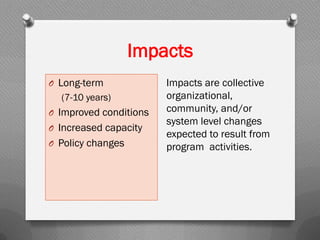
Impacts
O Long-term
(7-10 years)
O Improved conditions
O Increased capacity
O Policy changes
Impacts are collective
organizational,
community, and/or
system level changes
expected to result from
program activities.
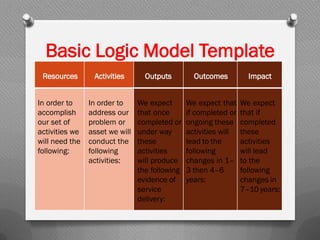
Basic Logic Model Template
Resources Activities Outputs Outcomes Impact
In order to
accomplish
our set of
activities we
will need the
following:
In order to
address our
problem or
asset we will
conduct the
following
activities:
We expect
that once
completed or
under way
these
activities
will produce
the following
evidence of
service
delivery:
We expect that
if completed or
ongoing these
activities will
lead to the
following
changes in 1–
3 then 4–6
years:
We expect
that if
completed
these
activities
will lead
to the
following
changes in
7–10 years:
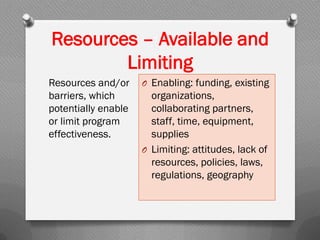
Resources – Available and
Limiting
Resources and/or
barriers, which
potentially enable
or limit program
effectiveness.
O Enabling: funding, existing
organizations,
collaborating partners,
staff, time, equipment,
supplies
O Limiting: attitudes, lack of
resources, policies, laws,
regulations, geography
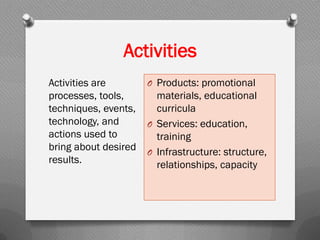
Activities
Activities are
processes, tools,
techniques, events,
technology, and
actions used to
bring about desired
results.
O Products: promotional
materials, educational
curricula
O Services: education,
training
O Infrastructure: structure,
relationships, capacity
Basic Logic Model Template
Resources Activities Outputs Outcomes Impact
In order to
accomplish
our set of
activities we
will need the
following:
In order to
address our
problem or
asset we will
conduct the
following
activities:
We expect
that once
completed or
under way
these
activities
will produce
the following
evidence of
service
delivery:
We expect that
if completed or
ongoing these
activities will
lead to the
following
changes in 1–
3 then 4–6
years:
We expect
that if
completed
these
activities
will lead
to the
following
changes in
7–10 years:
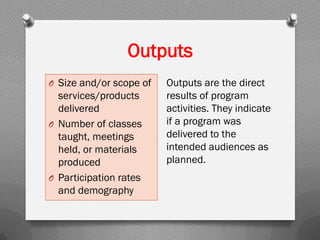
Outputs
O Size and/or scope of
services/products
delivered
O Number of classes
taught, meetings
held, or materials
produced
O Participation rates
and demography
Outputs are the direct
results of program
activities. They indicate
if a program was
delivered to the
intended audiences as
planned.
References
O W.K. Kellogg Foundation. (January 2004).
Using Logic Models to Bring Together
Planning, Evaluation, and Action: Logic Model
Development Guide. Battle Creek, Michigan.
O Chen, H. T. (1990). Theory driven evaluations.
Newbury Park, CA: Sage.
O Weiss, C. H. (1998). Evaluation: Methods for
studying programs and policies. (2nd Ed).
Upper Saddle River, NJ: Prentice Hall.
Resources
Resources for Logic Model Development
O The Evaluation Forum (1999). Outcomes for
success.
O Targeting Outcomes of Programs.
http://deal.unl.edu/TOP/synopsis.htm
O Innovation Network, Inc. electronic logic model
development tool http://www.inetwork.org
Resources
Related Planning and Evaluation Resources
O W.K. Kellogg Foundation, http://www.wkkf.org
O Taking Stock. http://www.horizon-research.org
O The Evaluation Forum (1994). A field guide to
outcome-based program evaluation.
O Rossi, P. H., Freeman, H. E., & Lipsey, M. W.
(1999). Evaluation: A systematic approach.
Thousand Oaks, CA: Sage.
O Patton, M. Q. (1997). Utilization-focused
evaluation: The new century text. Thousand Oaks,
CA: Sage.
Contact & Location Information
Discovery Center for Evaluation,
Research, and Professional Learning
210 E. Spring St.
408 McGuffey Hall
Phone: (513) 529-1686
Email: discoverycenter@MiamiOH.edu
Updates to
Discovery Center Website
coming soon.

Logic model pp presentation_final_for sharing

  • 1.
    Introduction to LogicModels for Program, Project, and Evaluation Design
  • 2.
    Session Overview O Introductionto logic modeling O Purposes of logic modeling O Different types of models O Logic Model, Theory of Change, Theory of Action O Developing a logic model
  • 3.
    Systematic Inquiry Cycle Planning andDesign Protecting Participant Rights Developing/ Modifying Instruments Data Collection and Processing Data Analysis and Reporting
  • 4.
    What is aLogic Model? A program logic model is a picture of how your program works – the theory and assumptions underlying the program. ...This model provides a road map of your program, highlighting how it is expected to work, what activities need to come before others, and how desired outcomes are achieved (p. 35). W.K. Kellogg Foundation Evaluation Handbook (1998)
  • 5.
    History of LogicModeling O 35+ year history O Clear identification of goals (outcomes) O First attempt to standardize a depiction of program components so that activities align with outcomes O United Way provided the first widely- accepted model
  • 6.
    Key Features ofLogic Models O Systematic O Visual O Sequential but not necessarily linear O Typically have 5 components O Shows “What” and “How” O May show “Why”
  • 7.
    Basic Logic Model W.K.Kellogg Foundation (January 2004)
  • 8.
    Basic Logic Model Components PLANNEDWORK O Resources: human, financial, organizational, community resources a program has available to do the work (i.e., Inputs) O Activities: processes, tools, events, technology, and actions that are an intentional part of program implementation.
  • 9.
    Basic Logic Model Components INTENDEDRESULTS O Outputs: direct products of program activities O Outcomes: specific changes in program participants’ behavior, knowledge, skills, status Short-term 1 to 3 years Longer-term 4 to 6 years O Impact: fundamental intended or unintended change as a result of program (7 to 10 years)
  • 10.
    Logic Model Logic Certainresources are needed to operate your program If . . . Then . . . you have access to them, you can use them to accomplish your planned activities. you accomplish your planned activities, you will deliver the amount of product/service that you intended. you accomplish your planned activities to the extent intended, your participants will benefit in specific ways. these benefits are achieved, certain changes might occur under specified conditions.
  • 11.
    Why Use LogicModeling? 1. Planning and Design 2. Implementation and Management 3. Evaluation and Communication
  • 12.
    Systematic Inquiry Cycle Planning andDesign Protecting Participant Rights Developing/ Modifying Instruments Data Collection and Processing Data Analysis and Reporting Determine purpose(s), resources, activities, and anticipated outcomes
  • 13.
    Using Logic Modelsfor Planning and Design Logic Model Outcomes and Impact Resources and Activities Purpose and Questions
  • 14.
    Planning and Design OProvides a road map O Describes sequence of events O Connects the need for the program with desired results Most of the value in a logic model is in the process of creating, validating, and modifying the model …The clarity of thinking that occurs from building the model is critical to the overall success of the program (p. 43). W.K. Kellogg Foundation (January 2004)
  • 15.
    Systematic Inquiry Cycle Planning andDesign Protecting Participant Rights Developing/ Modifying Instruments Data Collection and Processing Data Analysis and Reporting Manage, monitor and modify activities to improve progress and final outcomes
  • 16.
    Implementation and Management O Helpsvisualize and understand how investments contribute to achieving intended program goals O Monitors incremental progress toward outcomes O Facilitates program improvements Program logic modeling is a learning and management tool that can be used throughout a program’s life . . . result(ing) in effective programming and offering greater learning opportunities (p. 1) W.K. Kellogg Foundation (January 2004)
  • 17.
    Systematic Inquiry Cycle Planning andDesign Protecting Participant Rights Developing/ Modifying Instruments Data Collection and Processing Data Analysis and Reporting Document outcomes and share knowledge with others
  • 18.
    Evaluation and Communication O Documentationof outcomes O Shared knowledge about what works and why O Improves likelihood of sustaining a program over time through continuation of funding and/or stakeholder buy-in. A program is a theory and an evaluation is its test. . . to organize the evaluation to provide a responsible test, the evaluator needs to understand the theoretical premises on which the program is based (p. 55). Carol Weiss (1998)
  • 19.
    How Logic ModelsBetter Position Programs For Success Program Elements Criteria for Program Success Benefits of Program Logic Models Planning and Design Program goals and objectives, and important side effects are well defined ahead of time. Finds “gaps” in the theory or logic of a program and work to resolve them. Program goals and objectives are both plausible and possible. Builds a shared understanding of what the program is all about and how the parts work together. Program Implementation and Management Relevant, credible, and useful performance data can be obtained. Focuses attention of management on the most important connections between action and results. Evaluation, Communication, and Marketing The intended users of the evaluation results have agreed on how they will use the information. Provides a way to involve and engage stakeholders in the design, processes, and use of evaluation. W.K. Kellogg Foundation (January 2004) p.6
  • 20.
    Sidebar 1 O Thereis no “Best” Logic Model - Choose the model that fits your program best and provides information you need in the format that is most helpful. O Practice using logic models - Experiment with logic model design to determine what works best for your program. O Don’t worry if your model doesn’t look like others but DO worry if you cannot explain your model to others
  • 22.
    More Key Featuresof Logic Models OFlexible OShow areas of strength, weakness, and gaps ODynamic OPromotes strategic management
  • 23.
    Forms of LogicModeling O Typically logic models use table and flow chart formats with text and arrows or a graphic representation of program ideas. O A logic model does not have to be linear. Concept maps or other visuals may better describe complex program concepts.
  • 24.
    Three Approaches toLogic Modeling O Theory approach model (conceptual) O Outcome approach model O Activities approach model (applied) O A program may use all three types of logic models for different purposes.
  • 25.
    Theory Approach Models OEmphasize the theory of change influencing design and plan for the program O Explain how and why your program will work O May have additional parts (e.g., describe problem or issue addressed by program, connect strategies to activities)
  • 26.
    Theory Model W.K. KelloggFoundation (January 2004)
  • 27.
  • 28.
    Why use aTheory-based Approach? O Demonstrates that program implementers have deep understanding of program aspects O Allows consideration of context and other mutable variables O Funders like, and often, require them O Facilitates program improvement and evaluation
  • 29.
    Keeping it Simple OTheories of Change (ToC) and Theories of Action (ToA) are simply extensions of Logic Modeling O ToC and ToA emphasize different components of a logic model O Both ToC and ToA represent theory- based programs and are often used together to represent complex initiatives
  • 30.
    How ToC andToA Extend Logic Models Logic Models Theories of Change and Theories of Action O 1970s O Representation O List of Components O Descriptive – WHAT and HOW O 1990s O Justification O Pathway of Change O Explanatory – HOW and WHY
  • 31.
    How are ToCand ToA Different Theory of Change Theory of Action O Represents an understanding of how a social, political, economic, cultural change happens O Complex O Contextual O Outcomes-based O Explains how a particular initiative contributes to the change process, and is informed by the broader ToC O Sequential O Specific O Activities-based
  • 32.
  • 33.
  • 34.
  • 35.
  • 36.
    Outcomes Approach Models OFocus on during early aspects of program planning O More clearly connect resources and/or activities with desired results O Subdivide outcomes and impact that may result from a given set of activities over time (i.e., short-term, long-term, impact)
  • 37.
    Outcomes Model W.K. KelloggFoundation (January 2004)
  • 38.
    Why use anOutcomes- based Approach? O Demonstrates that program implementers have understanding of anticipated results O Explicitly considers time as a variable O Stakeholders like them O Facilitates program summative evaluation O Can use when program theory is underdeveloped – but not UNdeveloped
  • 39.
    Activities Approach Models OFocus on program implementation process O Clearly link activities to each other to map implementation O Provide more detail about steps and sequence of program implementation
  • 40.
  • 41.
    Why use anActivities-based Approach? O Demonstrates that program implementers have understanding of relationships among program activities O Allows for studying interactions of activities O Facilitates program monitoring, management O Participants like them because they show what you will actually do. O Facilitates program formative or process evaluation
  • 42.
    Sidebar 2 O LogicModel, Theory of Change, Theory of Action are often used interchangeably and are not clearly defined in the literature O Funders’ often request “logic model” when they expect a representation or model of theory
  • 43.
  • 44.
  • 45.
  • 46.
    Building a LogicModel Conceptualize Program Describe Assumptions Add Program Components What are your intended outcomes? What do you know (or assume) to be true? How will you produce outcomes?
  • 47.
    Basic Logic ModelTemplate Resources Activities Outputs Outcomes Impact In order to accomplish our set of activities we will need the following: In order to address our problem or asset we will conduct the following activities: We expect that once completed or under way these activities will produce the following evidence of service delivery: We expect that if completed or ongoing these activities will lead to the following changes in 1– 3 then 4–6 years: We expect that if completed these activities will lead to the following changes in 7–10 years:
  • 48.
    Sidebar 3 O Granteesusually know what they want to do – “activity focused” O Make explicit connections between program activities and related “best practice” literature – “why will your approach work?” O Practitioner wisdom also counts -- but not as much as it used to
  • 49.
    Basic Logic ModelTemplate Resources Activities Outputs Outcomes Impact In order to accomplish our set of activities we will need the following: In order to address our problem or asset we will conduct the following activities: We expect that once completed or under way these activities will produce the following evidence of service delivery: We expect that if completed or ongoing these activities will lead to the following changes in 1– 3 then 4–6 years: We expect that if completed these activities will lead to the following changes in 7–10 years:
  • 50.
    Outputs or Outcomes? OutputsOutcomes O Direct results of program activities (e.g., # of meetings, students enrolled) O Results you expect to achieve over time as a result of implementing activities Conducting an activity is not the same as achieving results from accomplishing that activity.
  • 51.
    Outcomes SMART GOALS O Specific OMeasurable O Action-oriented O Realistic O Timed Outcomes are specific changes in attitudes, behaviors, knowledge, skills, status, or level of functioning expected to result from program activities, most often at an individual or group level.
  • 52.
    Basic Logic ModelTemplate Resources Activities Outputs Outcomes Impact In order to accomplish our set of activities we will need the following: In order to address our problem or asset we will conduct the following activities: We expect that once completed or under way these activities will produce the following evidence of service delivery: We expect that if completed or ongoing these activities will lead to the following changes in 1– 3 then 4–6 years: We expect that if completed these activities will lead to the following changes in 7–10 years:
  • 53.
    Impacts O Long-term (7-10 years) OImproved conditions O Increased capacity O Policy changes Impacts are collective organizational, community, and/or system level changes expected to result from program activities.
  • 55.
    Basic Logic ModelTemplate Resources Activities Outputs Outcomes Impact In order to accomplish our set of activities we will need the following: In order to address our problem or asset we will conduct the following activities: We expect that once completed or under way these activities will produce the following evidence of service delivery: We expect that if completed or ongoing these activities will lead to the following changes in 1– 3 then 4–6 years: We expect that if completed these activities will lead to the following changes in 7–10 years:
  • 56.
    Resources – Availableand Limiting Resources and/or barriers, which potentially enable or limit program effectiveness. O Enabling: funding, existing organizations, collaborating partners, staff, time, equipment, supplies O Limiting: attitudes, lack of resources, policies, laws, regulations, geography
  • 57.
    Activities Activities are processes, tools, techniques,events, technology, and actions used to bring about desired results. O Products: promotional materials, educational curricula O Services: education, training O Infrastructure: structure, relationships, capacity
  • 58.
    Basic Logic ModelTemplate Resources Activities Outputs Outcomes Impact In order to accomplish our set of activities we will need the following: In order to address our problem or asset we will conduct the following activities: We expect that once completed or under way these activities will produce the following evidence of service delivery: We expect that if completed or ongoing these activities will lead to the following changes in 1– 3 then 4–6 years: We expect that if completed these activities will lead to the following changes in 7–10 years:
  • 59.
    Outputs O Size and/orscope of services/products delivered O Number of classes taught, meetings held, or materials produced O Participation rates and demography Outputs are the direct results of program activities. They indicate if a program was delivered to the intended audiences as planned.
  • 60.
    References O W.K. KelloggFoundation. (January 2004). Using Logic Models to Bring Together Planning, Evaluation, and Action: Logic Model Development Guide. Battle Creek, Michigan. O Chen, H. T. (1990). Theory driven evaluations. Newbury Park, CA: Sage. O Weiss, C. H. (1998). Evaluation: Methods for studying programs and policies. (2nd Ed). Upper Saddle River, NJ: Prentice Hall.
  • 61.
    Resources Resources for LogicModel Development O The Evaluation Forum (1999). Outcomes for success. O Targeting Outcomes of Programs. http://deal.unl.edu/TOP/synopsis.htm O Innovation Network, Inc. electronic logic model development tool http://www.inetwork.org
  • 62.
    Resources Related Planning andEvaluation Resources O W.K. Kellogg Foundation, http://www.wkkf.org O Taking Stock. http://www.horizon-research.org O The Evaluation Forum (1994). A field guide to outcome-based program evaluation. O Rossi, P. H., Freeman, H. E., & Lipsey, M. W. (1999). Evaluation: A systematic approach. Thousand Oaks, CA: Sage. O Patton, M. Q. (1997). Utilization-focused evaluation: The new century text. Thousand Oaks, CA: Sage.
  • 63.
    Contact & LocationInformation Discovery Center for Evaluation, Research, and Professional Learning 210 E. Spring St. 408 McGuffey Hall Phone: (513) 529-1686 Email: discoverycenter@MiamiOH.edu Updates to Discovery Center Website coming soon.