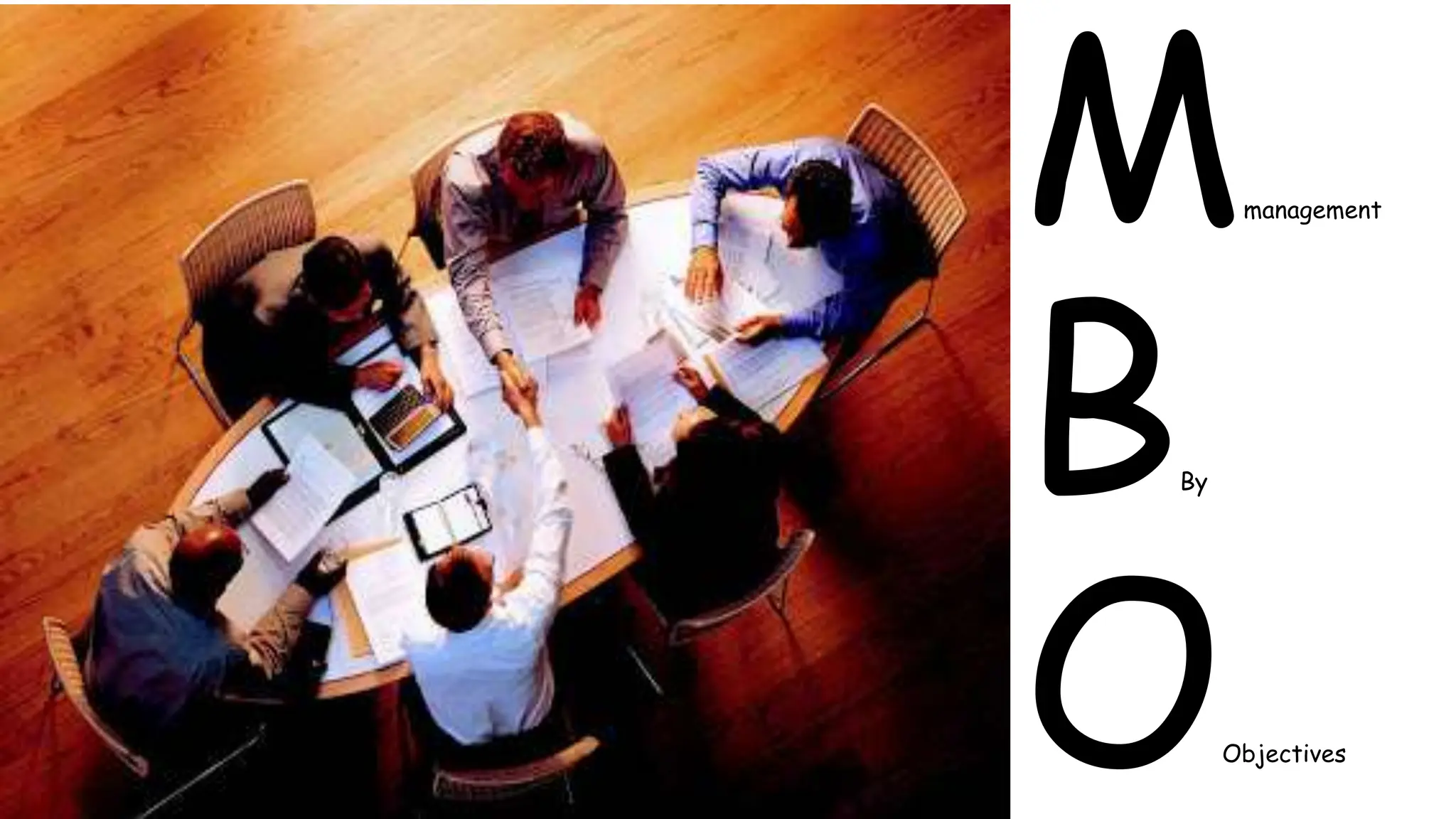
Mmanagement
BBy
OObjectives
MBO
• Management by Objectives (MBO) was first outlined by Peter Drucker in 1954 in his book
'The Practice of Management'.
• Management by objectives (MBO) is a systematic and organized approach that allows
management to focus on achievable goals and to attain the best possible results from
available resources.
• MBO includes ongoing tracking and feedback in the process to reach objectives.
• The complete MBO system is to get managers and empowered employees acting to
implement and achieve their plans, which automatically achieve those of the
organization.
What is MBO?
• Management By Objectives (MBO) can be defined as a process whereby the employees
and the superiors come together to identify common goals, the employees set their goals
to be achieved, the standards to be taken as the criteria for measurement of their
performance and contribution and deciding the course of action to be followed.
• The principle behind Management by Objectives (MBO) is to make sure that everybody
within the organization has a clear understanding of the aims, or objectives, of that
organization, as well as awareness of their own roles and responsibilities in achieving those
aims.
Core Concept of MBO
• According to Drucker managers should "avoid the activity
trap", getting so involved in their day to day activities that
they forget their main purpose or objective.
• Instead of just a few top-managers, all managers should:
• participate in the strategic planning process, in order to improve the
implementability of the plan, and
• implement a range of performance systems, designed to help the
organization stay on the right track.
Peter Drucker stated that:
• For the business to succeed, the managers and employees must work towards a
common goal
• Managers must identify and agree targets for achievement with subordinates
• Managers must negotiate the support needed to achieve the targets with
subordinates
• Evaluate the objectives over time
Management by Objectives:
Principles
• Cascading of organizational vision, goals and objectives
• Specific objectives for each member
• Participative decision making
• Explicit time period
• Performance evaluation and feedback
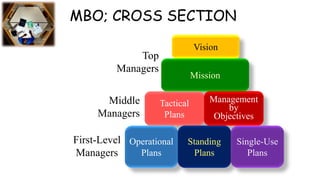
MBO; CROSS SECTION
Vision
Mission
Tactical
Plans
Management
by
Objectives
Operational
Plans
Standing
Plans
Single-Use
Plans
Top
Managers
Middle
Managers
First-Level
Managers
 Single-use Plans are developed to achieve objectives that are not likely to be repeated
in the future. Single-use plans include both programs and projects.
 Standing Plans are used to provide guidance for tasks performed repeatedly within the
organization. The primary standing plans are organizational policies, rules, and
procedures.
 Operational Plans are used to identifies specific results to be accomplished within a
given short term time period. Contain detailed information used in the lower levels in
an organization.
MBO Strategy: Three Basic
Parts
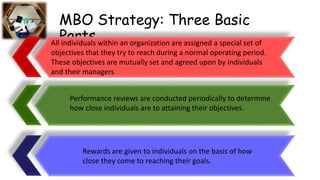
All individuals within an organization are assigned a special set of
objectives that they try to reach during a normal operating period.
These objectives are mutually set and agreed upon by individuals
and their managers
Rewards are given to individuals on the basis of how
close they come to reaching their goals.
Performance reviews are conducted periodically to determine
how close individuals are to attaining their objectives.
MBO Process
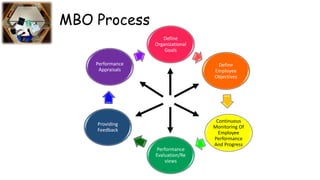
Define
Organizational
Goals
Define
Employee
Objectives
Continuous
Monitoring Of
Employee
Performance
And Progress
Performance
Evaluation/Re
views
Providing
Feedback
Performance
Appraisals
Features and Advantages of
MBO?
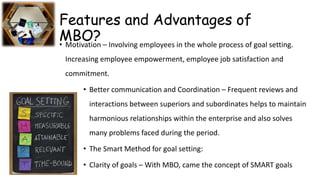
• Motivation – Involving employees in the whole process of goal setting.
Increasing employee empowerment, employee job satisfaction and
commitment.
• Better communication and Coordination – Frequent reviews and
interactions between superiors and subordinates helps to maintain
harmonious relationships within the enterprise and also solves
many problems faced during the period.
• The Smart Method for goal setting:
• Clarity of goals – With MBO, came the concept of SMART goals
The Smart Method for Goal
Setting:
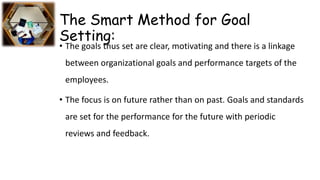
• The goals thus set are clear, motivating and there is a linkage
between organizational goals and performance targets of the
employees.
• The focus is on future rather than on past. Goals and standards
are set for the performance for the future with periodic
reviews and feedback.
Managerial focus
• MBO managers focus on the result, not the activity.
• They delegate tasks by "negotiating a contract of goals" with their
subordinates without dictating a detailed roadmap for implementation.
• Management by Objectives (MBO) is about setting yourself objectives and
then breaking these down into more specific goals or key results.
MBO in Action at Intel
"The one thing an MBO system should provide is focus", says
Andy Grove who ardently practiced MBO at Intel.
• A Manager's Guide at Intel provides the following directions.
• Start with a few well-chosen overriding objectives.
• Set subordinates objectives that fit in with overriding objectives.
• Allow subordinates to set their own key results to enable them to meet their objectives.
• In Management by Objectives systems at Intel, objectives are
• written down for each level of the organization, and individuals are given specific aims and
targets.
• The principle behind this is to ensure that people know what the organization is trying to achieve,
what their part of the organization must do to meet those aims, and how, as individuals, they are
expected to help
Balance Between Management and
Employee Empowerment
• The balance between management and employee empowerment has to
be struck, not by thinkers, but by practicing managers. Turning their aims
into successful actions, forces managers to master five basic operations:
• setting objectives
• organizing the group
• motivating and communicating
• measuring performance
• developing people
Individual Responsibility
• Management by Objectives (MBO) creates a link between top manager's strategic
thinking and the strategy's implementation lower down.
• Responsibility for objectives is passed from the organization to its individual members.
• It is especially important for knowledge-based organizations where all members have to
be able to control their own work by feeding back from their results to their objectives.
• Management by objectives is achieved through self-control, the tool of effectiveness.
management has to ask each employee three questions: What should we hold you
accountable for? What information do you need? What information do you owe the rest
of us?
MBO at Microsoft By Bill Gates
• Eliminate politics, by giving everybody the same message.
• Keep a flat organization in which all issues are discussed openly.
• Insist on clear and direct communication.
• Prevent competing missions or objectives
• Eliminate rivalry between different parts of the organization
• Empower teams to do their own things
MBO: Key Advantages and
Disadvantages
Advantages
• MBO programs continually emphasize what should be done in an organization to
achieve organizational goals.
• MBO process secures employee commitment to attaining organizational goals.
Disadvantages
• The development of objectives can be time consuming, leaving both managers and
employees less time in which to do their actual work.
Thank You…

Module 4.4 MBO.ppt management by objectives

  • 1.
  • 2.
    MBO • Management byObjectives (MBO) was first outlined by Peter Drucker in 1954 in his book 'The Practice of Management'. • Management by objectives (MBO) is a systematic and organized approach that allows management to focus on achievable goals and to attain the best possible results from available resources. • MBO includes ongoing tracking and feedback in the process to reach objectives. • The complete MBO system is to get managers and empowered employees acting to implement and achieve their plans, which automatically achieve those of the organization.
  • 3.
    What is MBO? •Management By Objectives (MBO) can be defined as a process whereby the employees and the superiors come together to identify common goals, the employees set their goals to be achieved, the standards to be taken as the criteria for measurement of their performance and contribution and deciding the course of action to be followed. • The principle behind Management by Objectives (MBO) is to make sure that everybody within the organization has a clear understanding of the aims, or objectives, of that organization, as well as awareness of their own roles and responsibilities in achieving those aims.
  • 4.
    Core Concept ofMBO • According to Drucker managers should "avoid the activity trap", getting so involved in their day to day activities that they forget their main purpose or objective. • Instead of just a few top-managers, all managers should: • participate in the strategic planning process, in order to improve the implementability of the plan, and • implement a range of performance systems, designed to help the organization stay on the right track.
  • 5.
    Peter Drucker statedthat: • For the business to succeed, the managers and employees must work towards a common goal • Managers must identify and agree targets for achievement with subordinates • Managers must negotiate the support needed to achieve the targets with subordinates • Evaluate the objectives over time
  • 6.
    Management by Objectives: Principles •Cascading of organizational vision, goals and objectives • Specific objectives for each member • Participative decision making • Explicit time period • Performance evaluation and feedback
  • 7.
  • 8.
     Single-use Plansare developed to achieve objectives that are not likely to be repeated in the future. Single-use plans include both programs and projects.  Standing Plans are used to provide guidance for tasks performed repeatedly within the organization. The primary standing plans are organizational policies, rules, and procedures.  Operational Plans are used to identifies specific results to be accomplished within a given short term time period. Contain detailed information used in the lower levels in an organization.
  • 9.
    MBO Strategy: ThreeBasic Parts All individuals within an organization are assigned a special set of objectives that they try to reach during a normal operating period. These objectives are mutually set and agreed upon by individuals and their managers Rewards are given to individuals on the basis of how close they come to reaching their goals. Performance reviews are conducted periodically to determine how close individuals are to attaining their objectives.
  • 10.
    MBO Process Define Organizational Goals Define Employee Objectives Continuous Monitoring Of Employee Performance AndProgress Performance Evaluation/Re views Providing Feedback Performance Appraisals
  • 11.
    Features and Advantagesof MBO? • Motivation – Involving employees in the whole process of goal setting. Increasing employee empowerment, employee job satisfaction and commitment. • Better communication and Coordination – Frequent reviews and interactions between superiors and subordinates helps to maintain harmonious relationships within the enterprise and also solves many problems faced during the period. • The Smart Method for goal setting: • Clarity of goals – With MBO, came the concept of SMART goals
  • 12.
    The Smart Methodfor Goal Setting: • The goals thus set are clear, motivating and there is a linkage between organizational goals and performance targets of the employees. • The focus is on future rather than on past. Goals and standards are set for the performance for the future with periodic reviews and feedback.
  • 13.
    Managerial focus • MBOmanagers focus on the result, not the activity. • They delegate tasks by "negotiating a contract of goals" with their subordinates without dictating a detailed roadmap for implementation. • Management by Objectives (MBO) is about setting yourself objectives and then breaking these down into more specific goals or key results.
  • 14.
    MBO in Actionat Intel "The one thing an MBO system should provide is focus", says Andy Grove who ardently practiced MBO at Intel. • A Manager's Guide at Intel provides the following directions. • Start with a few well-chosen overriding objectives. • Set subordinates objectives that fit in with overriding objectives. • Allow subordinates to set their own key results to enable them to meet their objectives. • In Management by Objectives systems at Intel, objectives are • written down for each level of the organization, and individuals are given specific aims and targets. • The principle behind this is to ensure that people know what the organization is trying to achieve, what their part of the organization must do to meet those aims, and how, as individuals, they are expected to help
  • 15.
    Balance Between Managementand Employee Empowerment • The balance between management and employee empowerment has to be struck, not by thinkers, but by practicing managers. Turning their aims into successful actions, forces managers to master five basic operations: • setting objectives • organizing the group • motivating and communicating • measuring performance • developing people
  • 16.
    Individual Responsibility • Managementby Objectives (MBO) creates a link between top manager's strategic thinking and the strategy's implementation lower down. • Responsibility for objectives is passed from the organization to its individual members. • It is especially important for knowledge-based organizations where all members have to be able to control their own work by feeding back from their results to their objectives. • Management by objectives is achieved through self-control, the tool of effectiveness. management has to ask each employee three questions: What should we hold you accountable for? What information do you need? What information do you owe the rest of us?
  • 17.
    MBO at MicrosoftBy Bill Gates • Eliminate politics, by giving everybody the same message. • Keep a flat organization in which all issues are discussed openly. • Insist on clear and direct communication. • Prevent competing missions or objectives • Eliminate rivalry between different parts of the organization • Empower teams to do their own things
  • 18.
    MBO: Key Advantagesand Disadvantages Advantages • MBO programs continually emphasize what should be done in an organization to achieve organizational goals. • MBO process secures employee commitment to attaining organizational goals. Disadvantages • The development of objectives can be time consuming, leaving both managers and employees less time in which to do their actual work.
  • 19.