STEP Program Logic Model
1. Increase capacity
of workforce
2. Enhance
performance
management
within Department
3. Reduce local &
state level health
care disparities
4. Increase the
number of positive
outcomes for
persons with
serious behavioral
health needs
5. Inform policy, and
practice
mechanisms
Population of Focus:
Adults & children diagnosed
with serious behavioral health
needs
Strengths:
- Dedication and drive of staff
to incorporate community
connection to state level policy
-Leadership support for
ensuring an effective and
efficient system of care
-Standardized approach to
quality care management and
performance
Opportunities:
- Enhance systematic
approach for program and
process improvement
- Enhance workforce
development & capacity
- Improve quality assurance
processes
- Improve client care
-Increase efficiency and
effectiveness of headquarters
workforce
Stakeholder List: These
individuals will become involved
throughout the evaluation process:
gathering input, collecting data, and
implementing change. Their
involvement is crucial.
Logic Model: Visual/blueprint of
how the intended effort will work –
describe how change will happen.
Evaluation Plan: This plan will
serve to render judgments as well as
improve the quality of decisions and
program improvement.
Data Analysis Findings: This
component will highlight areas of
effectiveness, efficiency, and equity
as well as areas in need of
improvement to inform decision-
making process.
Recommendation Plan: This plan
will provide key suggestions to
improve efforts and continuously
improve quality.
Technical Assistance and
Training: The evaluation process
will allow for performance
enhancement with personnel and
opportunities to provide technical
assistance and training to increase
clinical capacity.
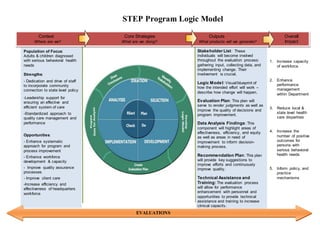
Context Core Strategies Outputs Overall
Where are we? What are we doing? What products will we generate? Impact
EVALUATIONS

Logic_Model

  • 1.
    STEP Program LogicModel 1. Increase capacity of workforce 2. Enhance performance management within Department 3. Reduce local & state level health care disparities 4. Increase the number of positive outcomes for persons with serious behavioral health needs 5. Inform policy, and practice mechanisms Population of Focus: Adults & children diagnosed with serious behavioral health needs Strengths: - Dedication and drive of staff to incorporate community connection to state level policy -Leadership support for ensuring an effective and efficient system of care -Standardized approach to quality care management and performance Opportunities: - Enhance systematic approach for program and process improvement - Enhance workforce development & capacity - Improve quality assurance processes - Improve client care -Increase efficiency and effectiveness of headquarters workforce Stakeholder List: These individuals will become involved throughout the evaluation process: gathering input, collecting data, and implementing change. Their involvement is crucial. Logic Model: Visual/blueprint of how the intended effort will work – describe how change will happen. Evaluation Plan: This plan will serve to render judgments as well as improve the quality of decisions and program improvement. Data Analysis Findings: This component will highlight areas of effectiveness, efficiency, and equity as well as areas in need of improvement to inform decision- making process. Recommendation Plan: This plan will provide key suggestions to improve efforts and continuously improve quality. Technical Assistance and Training: The evaluation process will allow for performance enhancement with personnel and opportunities to provide technical assistance and training to increase clinical capacity. Context Core Strategies Outputs Overall Where are we? What are we doing? What products will we generate? Impact EVALUATIONS