Management By
Objectives
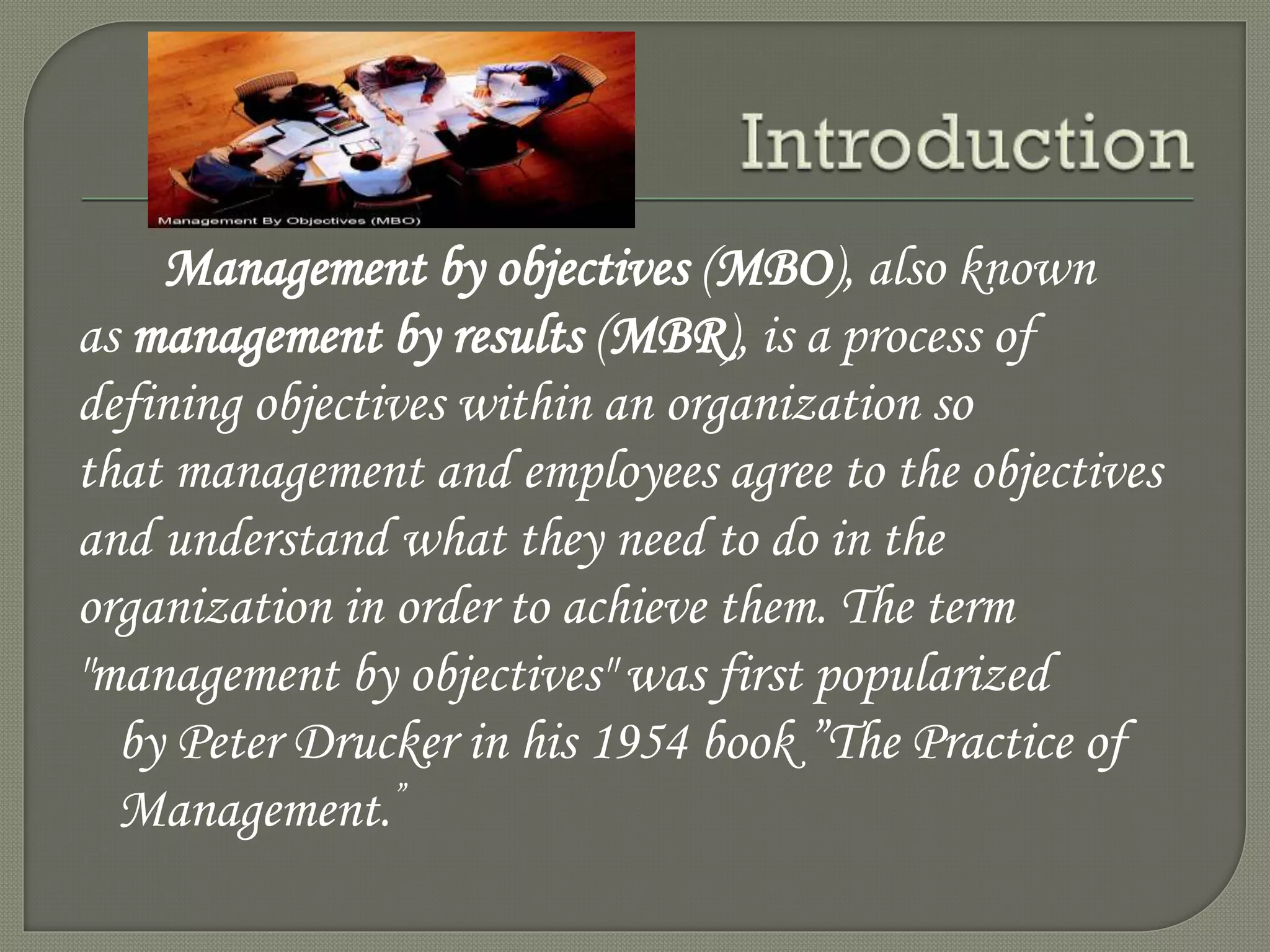
Management by objectives (MBO), also known
as management by results (MBR), is a process of
defining objectives within an organization so
that management and employees agree to the objectives
and understand what they need to do in the
organization in order to achieve them. The term
"management by objectives" was first popularized
by Peter Drucker in his 1954 book ”The Practice of
Management.”
The essence of MBO is participative goal setting,
choosing course of actions and decision making. An
important part of the MBO is the measurement and the
comparison of the employee’s actual performance with
the standards set. Ideally, when employees themselves
have been involved with the goal setting and choosing
the course of action to be followed by them, they are
more likely to fulfill their responsibilities.
MBO is both a physical and a technique of
management. It represents a rational and systematic
approach to management, wherein measurable goals
are set up in consultation with subordinate managers
and the contribution of each individual is judged in
terms of such goals.
According to George Odiorne
“MBO is a process whereby the superior and the
subordinates manages of an enterprise jointly identify
its common goals, define each individual’s major areas
of responsibility in terms of the result expected of him,
and us these measures as guides for operationg the
unit and assessing the contribution of each of its
members”.
According to John W. Humble
“MBO is a dynamic system which seeks to integrate
the company’s need to clarify and achieve its profit
and growth goals with the manager’s need to
contribute and develop himself. It is a demanding
and rewarding style of managing a business.”
“MBO is a comprehensive management approach
focusing on objectives or expected results for providing
a framework for organisational and managerial
decisions. The emphasis in MBO is that the Objective
should be the central focus in the management
process.”
Let people know what is expected of them:
This concept assumes “People perform better when
they know what is expected and can establish a
relationship between individual goals and
organisational goals.”
Allow employees to participate in setting goals:
This concept assumes “People want to participate in
the determination of goals.”
Tell people how they are doing:
This concept assumes that “people need to know how
are they performing”
Reward on the basis of accomplishment:
This concept assumes that “people need recognition,
opportunities for growth, and a sense of achievement
in their work.”
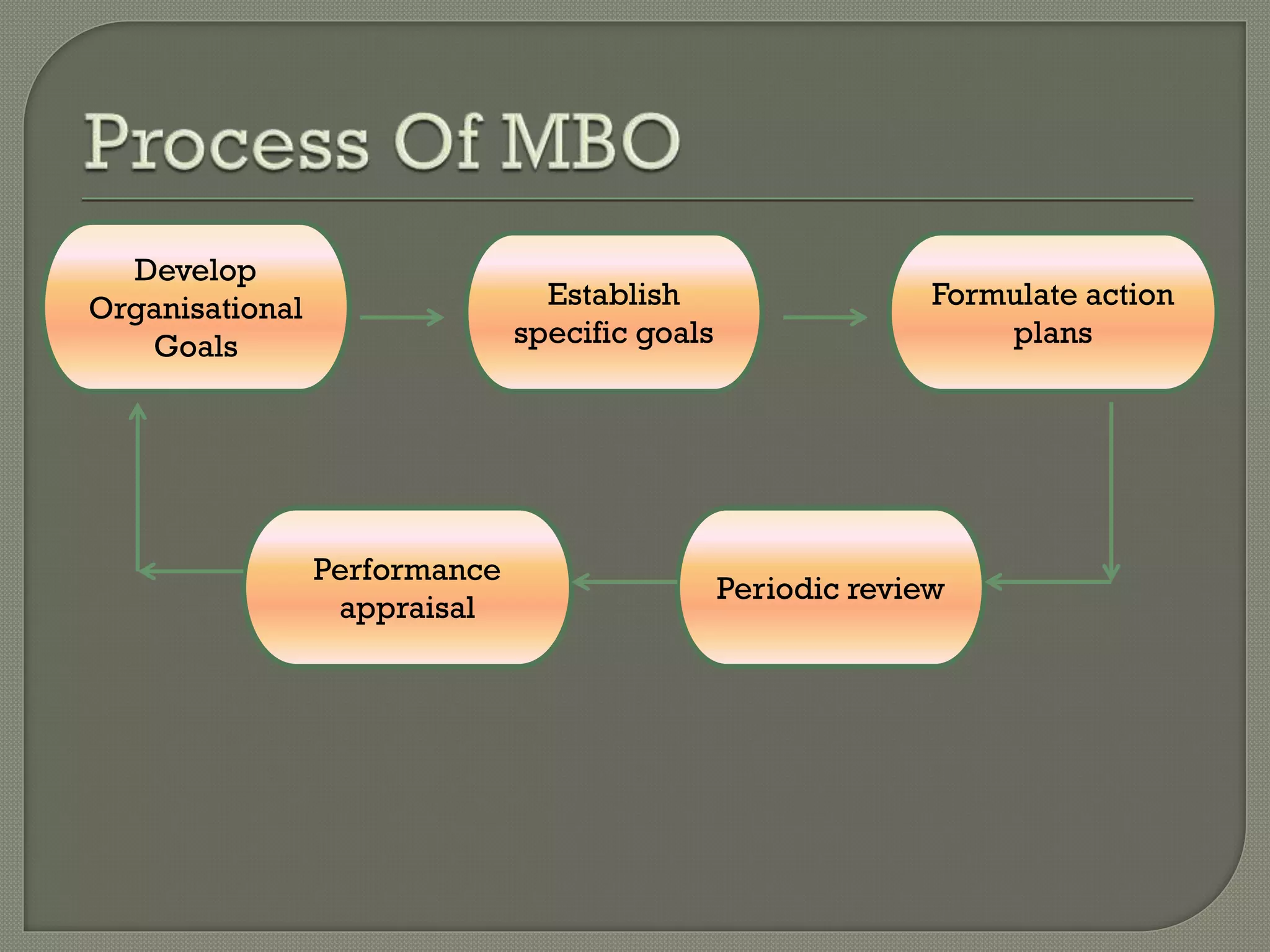
Develop
Organisational
Goals
Establish
specific goals
Formulate action
plans
Periodic review
Performance
appraisal
Develop organisational goals:
The first step concerns the preliminary activities
directed towards an understanding of the important
employee needs, jobs, technology and external
influences.
Every employee is required to describe his/her
particular job, it’s contents, duties, requirements and
responsibilities.
 Establish specific goals:
Under MBO, goal setting is a multistage process. First of
all the overall goals of the organisation are laid down in
all the key-result areas . These organisational goals are
laid down keeping in view the internal and external
environment of the organisation.
On the basis of organisational goals , the goals of
individual departments and sections are decided .
Managers in every department set its departmental goals.
Formulate Action Planning:
Goals reflect the ends of managerial performance .
Action plans provide means for their attainment.
Action planning involves determining what, who,
when, where, and how much is needed to achieve a
given objective. It is a practical way of establishing a
link between objectives and programmes of
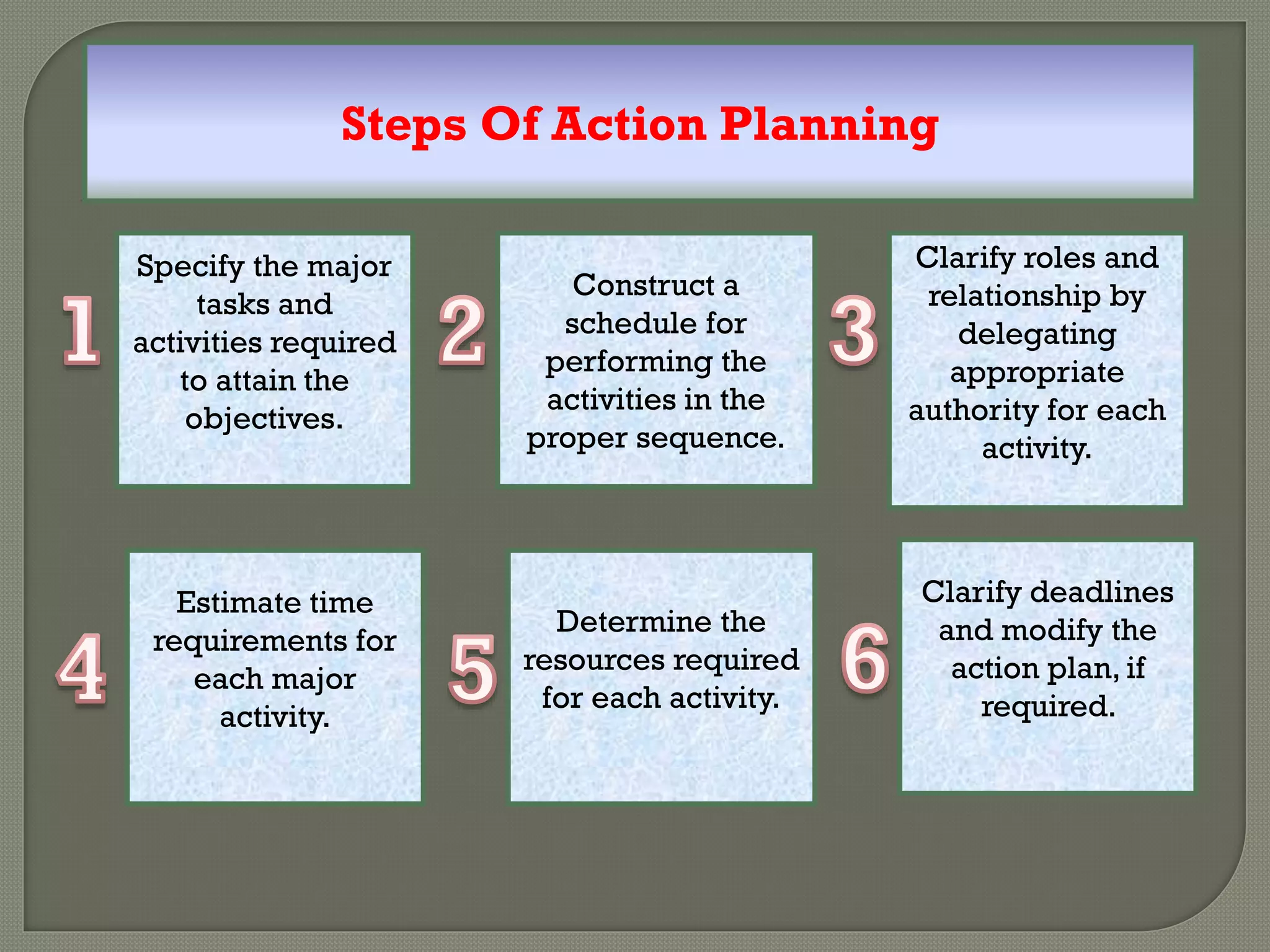
implementation. There are six steps in action
planning:
Steps Of Action Planning
Specify the major
tasks and
activities required
to attain the
objectives.
Construct a
schedule for
performing the
activities in the
proper sequence.
Clarify roles and
relationship by
delegating
appropriate
authority for each
activity.
Estimate time
requirements for
each major
activity.
Determine the
resources required
for each activity.
Clarify deadlines
and modify the
action plan, if
required.
 Periodic Review:
After regular time intervals the subordinate and
superior get together to review the progress towards
the attainment of goals. The focus of these meetings is
not only to see what progress has been made, but to
adjust the targets in case environmental charges
require.
Performance appraisal:
At the end of the goal setting period, superior and
subordinate formally meet to review the results.
Emphasis is placed on analysis, discussion and
feedback to the next MBO cycle. At the end of this
step the cycle is repeated for the next period. Rewards
are decided on the basis of final appraisal. The focus is
on improving performance and on improving
performance and on development of individuals rather
than penalising them.
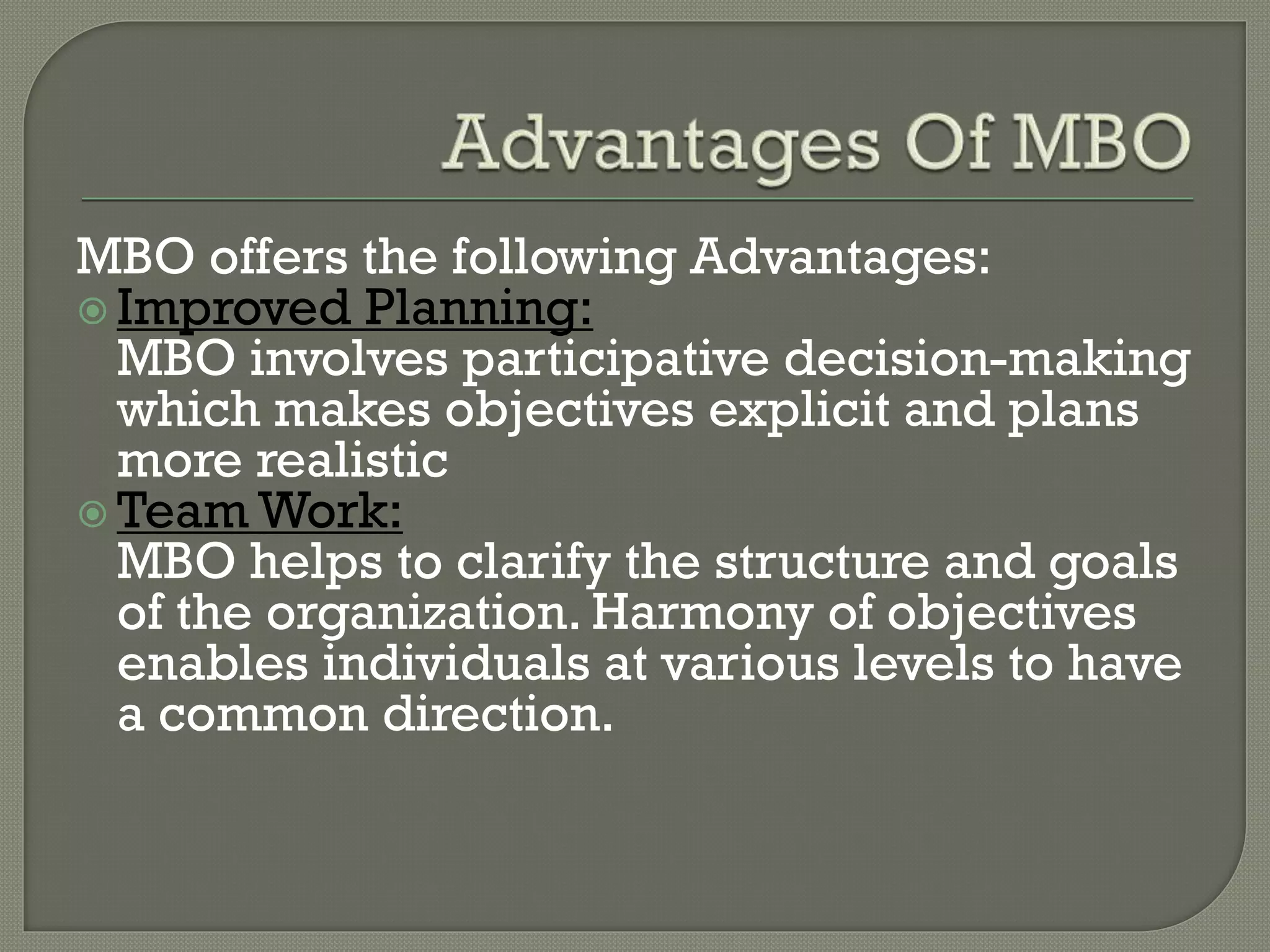
MBO offers the following Advantages:
 Improved Planning:
MBO involves participative decision-making
which makes objectives explicit and plans
more realistic
 Team Work:
MBO helps to clarify the structure and goals
of the organization. Harmony of objectives
enables individuals at various levels to have
a common direction.
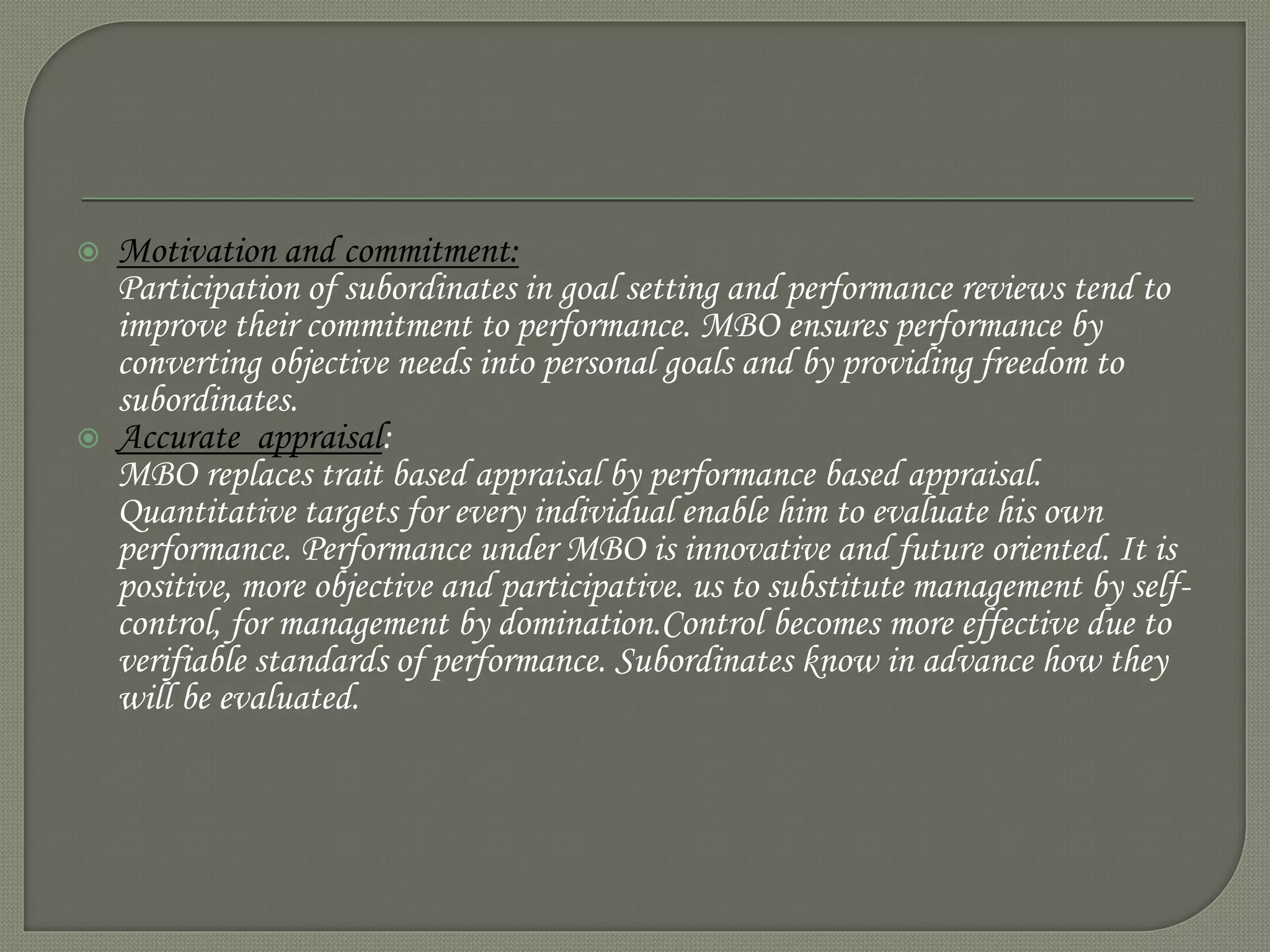
 Motivation and commitment:
Participation of subordinates in goal setting and performance reviews tend to
improve their commitment to performance. MBO ensures performance by
converting objective needs into personal goals and by providing freedom to
subordinates.
 Accurate appraisal:
MBO replaces trait based appraisal by performance based appraisal.
Quantitative targets for every individual enable him to evaluate his own
performance. Performance under MBO is innovative and future oriented. It is
positive, more objective and participative. us to substitute management by self-
control, for management by domination.Control becomes more effective due to
verifiable standards of performance. Subordinates know in advance how they
will be evaluated.
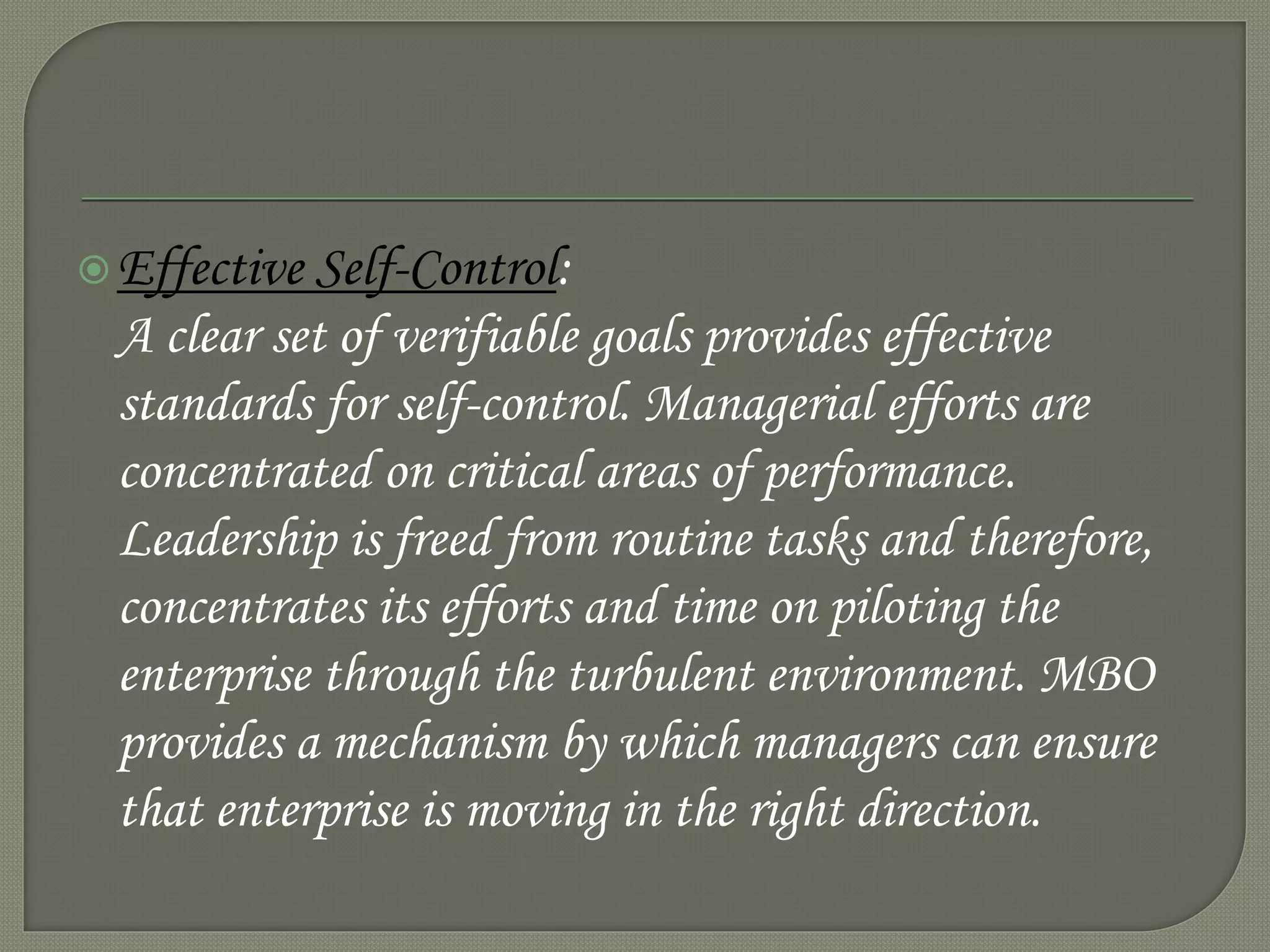
Effective Self-Control:
A clear set of verifiable goals provides effective
standards for self-control. Managerial efforts are
concentrated on critical areas of performance.
Leadership is freed from routine tasks and therefore,
concentrates its efforts and time on piloting the
enterprise through the turbulent environment. MBO
provides a mechanism by which managers can ensure
that enterprise is moving in the right direction.
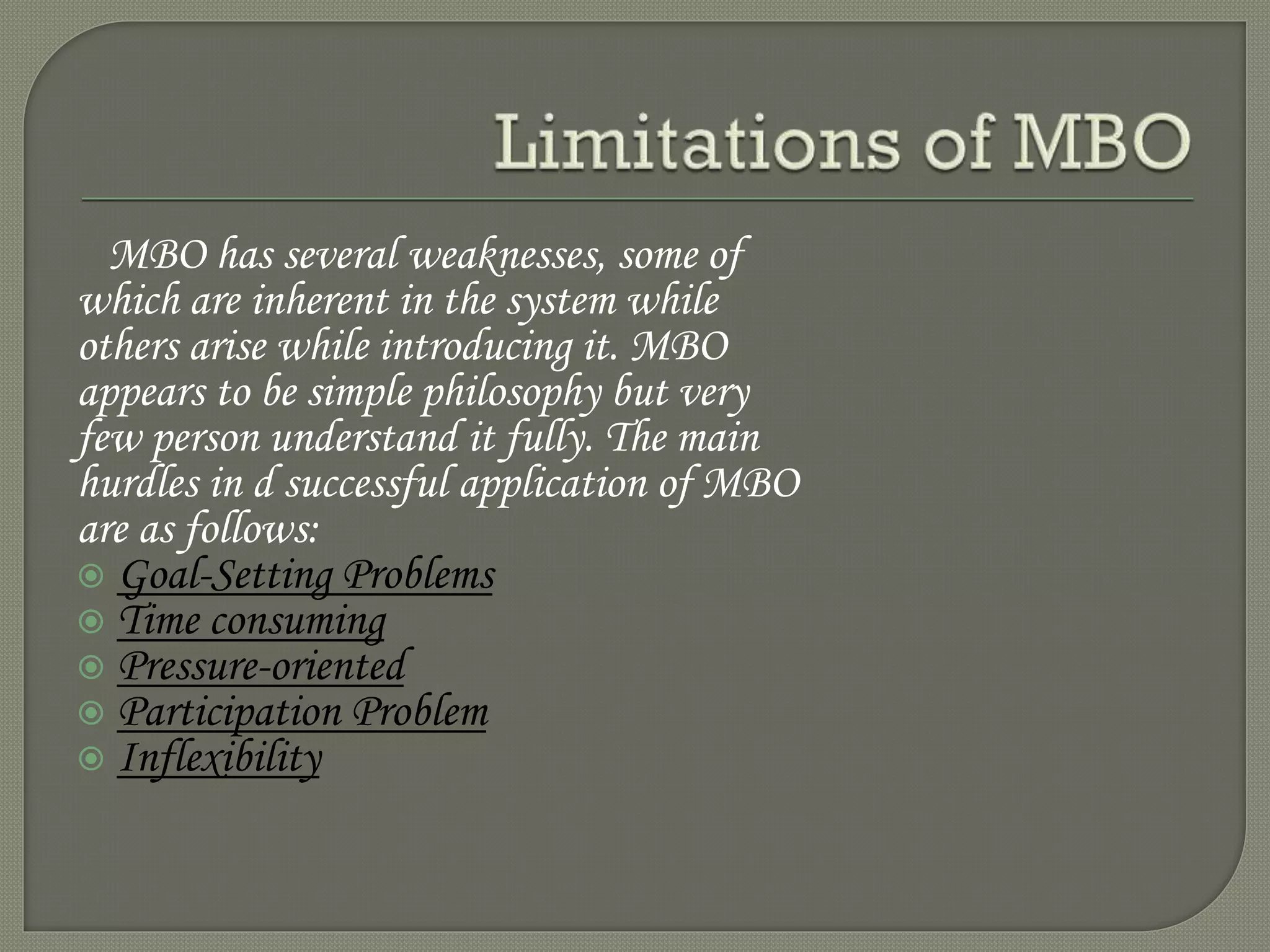
MBO has several weaknesses, some of
which are inherent in the system while
others arise while introducing it. MBO
appears to be simple philosophy but very
few person understand it fully. The main
hurdles in d successful application of MBO
are as follows:
 Goal-Setting Problems
 Time consuming
 Pressure-oriented
 Participation Problem
 Inflexibility
 MBO is used for different purposes. Some organisations
use MBO to clarify the employee’s job , others use it to
motivate employees while still other organisations apply
MBO as a performance control mechanism to check
performance. In this way MBO process is directly related
to all the major functions of management.
Thus, MBO is a result-oriented and rational philosophy.
It permits management by results in place of management
by crisis. Many organisations both in the private sector
and the public sector have benefited a lot through the
application of MBO.
MBO ???
Management by objective

Management by objective

  • 1.
  • 2.
    Management by objectives(MBO), also known as management by results (MBR), is a process of defining objectives within an organization so that management and employees agree to the objectives and understand what they need to do in the organization in order to achieve them. The term "management by objectives" was first popularized by Peter Drucker in his 1954 book ”The Practice of Management.”
  • 3.
    The essence ofMBO is participative goal setting, choosing course of actions and decision making. An important part of the MBO is the measurement and the comparison of the employee’s actual performance with the standards set. Ideally, when employees themselves have been involved with the goal setting and choosing the course of action to be followed by them, they are more likely to fulfill their responsibilities.
  • 4.
    MBO is botha physical and a technique of management. It represents a rational and systematic approach to management, wherein measurable goals are set up in consultation with subordinate managers and the contribution of each individual is judged in terms of such goals.
  • 5.
    According to GeorgeOdiorne “MBO is a process whereby the superior and the subordinates manages of an enterprise jointly identify its common goals, define each individual’s major areas of responsibility in terms of the result expected of him, and us these measures as guides for operationg the unit and assessing the contribution of each of its members”.
  • 6.
    According to JohnW. Humble “MBO is a dynamic system which seeks to integrate the company’s need to clarify and achieve its profit and growth goals with the manager’s need to contribute and develop himself. It is a demanding and rewarding style of managing a business.”
  • 7.
    “MBO is acomprehensive management approach focusing on objectives or expected results for providing a framework for organisational and managerial decisions. The emphasis in MBO is that the Objective should be the central focus in the management process.”
  • 8.
    Let people knowwhat is expected of them: This concept assumes “People perform better when they know what is expected and can establish a relationship between individual goals and organisational goals.” Allow employees to participate in setting goals: This concept assumes “People want to participate in the determination of goals.”
  • 9.
    Tell people howthey are doing: This concept assumes that “people need to know how are they performing” Reward on the basis of accomplishment: This concept assumes that “people need recognition, opportunities for growth, and a sense of achievement in their work.”
  • 10.
  • 11.
    Develop organisational goals: Thefirst step concerns the preliminary activities directed towards an understanding of the important employee needs, jobs, technology and external influences. Every employee is required to describe his/her particular job, it’s contents, duties, requirements and responsibilities.
  • 12.
     Establish specificgoals: Under MBO, goal setting is a multistage process. First of all the overall goals of the organisation are laid down in all the key-result areas . These organisational goals are laid down keeping in view the internal and external environment of the organisation. On the basis of organisational goals , the goals of individual departments and sections are decided . Managers in every department set its departmental goals.
  • 13.
    Formulate Action Planning: Goalsreflect the ends of managerial performance . Action plans provide means for their attainment. Action planning involves determining what, who, when, where, and how much is needed to achieve a given objective. It is a practical way of establishing a link between objectives and programmes of implementation. There are six steps in action planning:
  • 14.
    Steps Of ActionPlanning Specify the major tasks and activities required to attain the objectives. Construct a schedule for performing the activities in the proper sequence. Clarify roles and relationship by delegating appropriate authority for each activity. Estimate time requirements for each major activity. Determine the resources required for each activity. Clarify deadlines and modify the action plan, if required.
  • 15.
     Periodic Review: Afterregular time intervals the subordinate and superior get together to review the progress towards the attainment of goals. The focus of these meetings is not only to see what progress has been made, but to adjust the targets in case environmental charges require.
  • 16.
    Performance appraisal: At theend of the goal setting period, superior and subordinate formally meet to review the results. Emphasis is placed on analysis, discussion and feedback to the next MBO cycle. At the end of this step the cycle is repeated for the next period. Rewards are decided on the basis of final appraisal. The focus is on improving performance and on improving performance and on development of individuals rather than penalising them.
  • 17.
    MBO offers thefollowing Advantages:  Improved Planning: MBO involves participative decision-making which makes objectives explicit and plans more realistic  Team Work: MBO helps to clarify the structure and goals of the organization. Harmony of objectives enables individuals at various levels to have a common direction.
  • 18.
     Motivation andcommitment: Participation of subordinates in goal setting and performance reviews tend to improve their commitment to performance. MBO ensures performance by converting objective needs into personal goals and by providing freedom to subordinates.  Accurate appraisal: MBO replaces trait based appraisal by performance based appraisal. Quantitative targets for every individual enable him to evaluate his own performance. Performance under MBO is innovative and future oriented. It is positive, more objective and participative. us to substitute management by self- control, for management by domination.Control becomes more effective due to verifiable standards of performance. Subordinates know in advance how they will be evaluated.
  • 19.
    Effective Self-Control: A clearset of verifiable goals provides effective standards for self-control. Managerial efforts are concentrated on critical areas of performance. Leadership is freed from routine tasks and therefore, concentrates its efforts and time on piloting the enterprise through the turbulent environment. MBO provides a mechanism by which managers can ensure that enterprise is moving in the right direction.
  • 20.
    MBO has severalweaknesses, some of which are inherent in the system while others arise while introducing it. MBO appears to be simple philosophy but very few person understand it fully. The main hurdles in d successful application of MBO are as follows:  Goal-Setting Problems  Time consuming  Pressure-oriented  Participation Problem  Inflexibility
  • 21.
     MBO isused for different purposes. Some organisations use MBO to clarify the employee’s job , others use it to motivate employees while still other organisations apply MBO as a performance control mechanism to check performance. In this way MBO process is directly related to all the major functions of management. Thus, MBO is a result-oriented and rational philosophy. It permits management by results in place of management by crisis. Many organisations both in the private sector and the public sector have benefited a lot through the application of MBO.
  • 22.