MANAGEMENT BY
OBJECTIVES
(MBO)
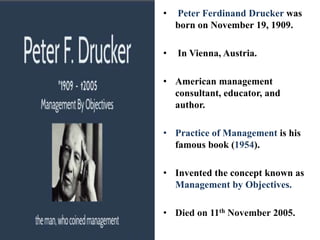
• Peter Ferdinand Drucker was
born on November 19, 1909.
• In Vienna, Austria.
• American management
consultant, educator, and
author.
• Practice of Management is his
famous book (1954).
• Invented the concept known as
Management by Objectives.
• Died on 11th November 2005.
Management By Objectives can be defined as,
 a process where the employees and the superiors
come together,
 to identify common goals,
 the employees set their goals to be achieved,
 employees agree to the objectives,
 understands what they are in the organization.
 The principle behind Management by Objectives
(MBO) is to make sure that everybody within
the organization has a clear understanding of the
aims, and objectives of that organization, as well
as awareness of their own roles and
responsibilities in achieving those aims.
Key Features
• Specific time period: Each goal has a specific time period
in which it is to be completed.
• Collaborative goal setting: The manager and subordinate
jointly sets goal and agree on how they will be measured.
• Periodic performance evaluation: Periodic performance
evaluation is done with the focus on result.
• Feedback: Feedback is provided to employees for self-
control purpose.
• Rewards: are linked to goal achievement.
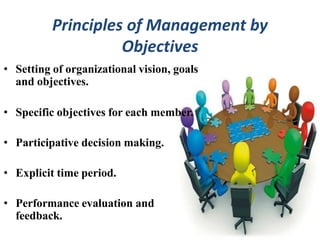
Principles of Management by
Objectives
• Setting of organizational vision, goals
and objectives.
• Specific objectives for each member.
• Participative decision making.
• Explicit time period.
• Performance evaluation and
feedback.
MBO Strategy: Three
Basic Parts
• All individuals within an organization are assigned
a special set of objectives that they try to reach
during a normal operating period. These objectives
are mutually set and agreed upon by individuals
and their managers.
• Performance reviews are conducted periodically
to determine how close individuals are to
attaining their objectives.
• Rewards are given to individuals on the basis of
how close they come to reaching their goals.
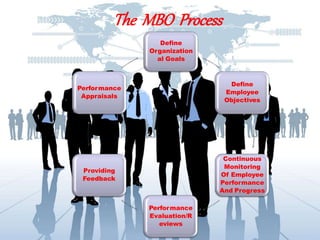
The MBO Process
Define
Organization
al Goals
Define
Employee
Objectives
Continuous
Monitoring
Of Employee
Performance
And Progress
Performance
Evaluation/R
eviews
Providing
Feedback
Performance
Appraisals
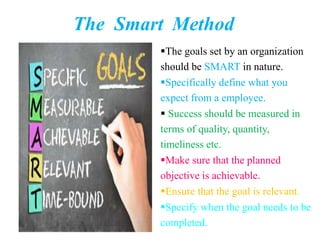
The Smart Method
The goals set by an organization
should be SMART in nature.
Specifically define what you
expect from a employee.
 Success should be measured in
terms of quality, quantity,
timeliness etc.
Make sure that the planned
objective is achievable.
Ensure that the goal is relevant.
Specify when the goal needs to be
completed.
Advantages…
• Since MBO is result oriented, it encourages managers to do
detailed planning.
• Both the managers and subordinates know what is
expected from them and hence there is no doubts.
• The responsibilities and authority of the personnel is
clearly established.
• It makes individuals more aware of the company goals.
Improves their morale and commitment.
Advantages…
• MBO highlights the area in which the employees need
further training.
• The system of periodic evaluation lets the subordinates
know how well the performs. It helps in their
improvement.
• Improves communication between management and
subordinates.
Disadvantages…
• MBO can only be successful if it has the complete support
from the top management.
• The subordinates may feel pressure to get along with the
management when setting goals and objectives.
• There is a lot of paperwork involved in MBO and it is time
consuming. Increases manager’s responsibility.
• The emphasis is more on short term goals. It is difficult to
do long term planning because all the variables affecting
the planning can’t be accurately forecasted.
Disadvantages…
• Most managers may not be skilled in interpersonal
interaction such as coaching and counseling.
• Integration of MBO system with other systems such as
forecasting and budgeting etc., is very poor. This affects the
overall functioning.
• Group goal is more difficult. As the goals of one dept.
depend on the goals of another dept., cohesion is more
difficult to obtain. Eg., the production dept. can’t produce
a set quota if it is not sufficiently supplied with raw
materials and personnel.
A7 mbo

A7 mbo

  • 1.
  • 2.
    • Peter FerdinandDrucker was born on November 19, 1909. • In Vienna, Austria. • American management consultant, educator, and author. • Practice of Management is his famous book (1954). • Invented the concept known as Management by Objectives. • Died on 11th November 2005.
  • 3.
    Management By Objectivescan be defined as,  a process where the employees and the superiors come together,  to identify common goals,  the employees set their goals to be achieved,  employees agree to the objectives,  understands what they are in the organization.  The principle behind Management by Objectives (MBO) is to make sure that everybody within the organization has a clear understanding of the aims, and objectives of that organization, as well as awareness of their own roles and responsibilities in achieving those aims.
  • 4.
    Key Features • Specifictime period: Each goal has a specific time period in which it is to be completed. • Collaborative goal setting: The manager and subordinate jointly sets goal and agree on how they will be measured. • Periodic performance evaluation: Periodic performance evaluation is done with the focus on result. • Feedback: Feedback is provided to employees for self- control purpose. • Rewards: are linked to goal achievement.
  • 5.
    Principles of Managementby Objectives • Setting of organizational vision, goals and objectives. • Specific objectives for each member. • Participative decision making. • Explicit time period. • Performance evaluation and feedback.
  • 6.
    MBO Strategy: Three BasicParts • All individuals within an organization are assigned a special set of objectives that they try to reach during a normal operating period. These objectives are mutually set and agreed upon by individuals and their managers. • Performance reviews are conducted periodically to determine how close individuals are to attaining their objectives. • Rewards are given to individuals on the basis of how close they come to reaching their goals.
  • 7.
    The MBO Process Define Organization alGoals Define Employee Objectives Continuous Monitoring Of Employee Performance And Progress Performance Evaluation/R eviews Providing Feedback Performance Appraisals
  • 8.
    The Smart Method Thegoals set by an organization should be SMART in nature. Specifically define what you expect from a employee.  Success should be measured in terms of quality, quantity, timeliness etc. Make sure that the planned objective is achievable. Ensure that the goal is relevant. Specify when the goal needs to be completed.
  • 9.
    Advantages… • Since MBOis result oriented, it encourages managers to do detailed planning. • Both the managers and subordinates know what is expected from them and hence there is no doubts. • The responsibilities and authority of the personnel is clearly established. • It makes individuals more aware of the company goals. Improves their morale and commitment.
  • 10.
    Advantages… • MBO highlightsthe area in which the employees need further training. • The system of periodic evaluation lets the subordinates know how well the performs. It helps in their improvement. • Improves communication between management and subordinates.
  • 11.
    Disadvantages… • MBO canonly be successful if it has the complete support from the top management. • The subordinates may feel pressure to get along with the management when setting goals and objectives. • There is a lot of paperwork involved in MBO and it is time consuming. Increases manager’s responsibility. • The emphasis is more on short term goals. It is difficult to do long term planning because all the variables affecting the planning can’t be accurately forecasted.
  • 12.
    Disadvantages… • Most managersmay not be skilled in interpersonal interaction such as coaching and counseling. • Integration of MBO system with other systems such as forecasting and budgeting etc., is very poor. This affects the overall functioning. • Group goal is more difficult. As the goals of one dept. depend on the goals of another dept., cohesion is more difficult to obtain. Eg., the production dept. can’t produce a set quota if it is not sufficiently supplied with raw materials and personnel.