By- sobic agarwal
INTRODUCTION
Management accounting or managerial accounting is the
process of identifying, analyzing, recording and presenting
financial information that is used for internally by the
management for planning, decision making and control.
In contrast to financial aacounting, managerial accounting is
concerned with providing helpful information and reports to
internal users such as managers and entrepreneurs etc. so
that they can control and plan the business activities.
Nature of management accounting guides to know main characteristics
of management accounting. Following are main points which shows
the nature of management accounting:
•No Fixed Norms Followed: In financial accounting, we follow different norms and
rules for creating ledgers and other account books. But there is no need to follow
fixed norms in management accounting. Management accounting tool may be
different from one organization to other organization.
•Increase in Efficiency: It is the nature of management accounting that it is used for
increasing in the efficiency of organization. It scans the points of inefficiency through
analysis of accounting information.
•Supplies Information not Decisions: Management accountant supplies
accounting facts and information and also provides interpretation, but decision
making is fully dependent on higher authorities. Management accounting is just
guide.
•Concerned with Forecasting :It is the temperament of management accounting
that it is fully concerned with forecasting. In management accounting, historical
accounting information is analyzed through common size financial statement,
ratio analysis, fund flow analysis and accounting data tendency for knowing the
probability of next fact.
The scope or field of management accounting is very wide and broad based and it
includes a variety of aspects of business operations. The main aim of management
accounting is to help management in its functions of planning, directing, controlling
and areas of specialization included within the admit of management accounting. The
scope of management accounting can be studied as follows:
•Financial Accounting
Financial accounting forms the basis for analysis and interpretation for furnishing
meaningful data to the management.
•Cost Accounting
Cost accounting is the process and techniques of ascertaining cost. Planning, decision
making and control are the basic managerial functions.
• Budgeting And Forecasting
Budgeting means expressing the plans, policies and goals of the firm for a
definite period in future. Forecasting on the other hand, is a prediction of
what will happen as a result of a given set of circumstances.
• Inventory Control
Inventory is necessary to control from the time it is acquire till its final disposal
as it involves large sum. For controlling inventory, management should
determine different level of stock. The inventory control technique will be
helpful for taking managerial decisions.
FUNCTIONS OF MANAGEMENT
ACCOUNTING
The functions of managerial accounting include:
Margin analysis. Determining the amount of profit or cash flow that a
business generates from a specific product, product line, customer,
store, or region.
Breakeven analysis. Calculating the mix of contribution margin and unit
volume at which a business exactly break even, which is useful for
determining price points for products and services.
Constraint analysis. Understanding where the principle bottlenecks are
in a company, and how they impact the ability of the business to earn
revenues and profits.
Target costing. Assisting in the design of new products by accumulating the 
costs of new designs, comparing them to target cost levels, and reporting this
information to management.
Though management accounting is helpful tool to the management
as it provides information for planning, controlling and decision
making, still its effectiveness is limited by a number of reasons.
Some of the limitations of management accounting are as follows:
• Based On Accounting Information
Management accounting is based on data and information provided
by financial accounting and cost accounting.
• Lack Of Knowledge
The use of management accounting requires the knowledge of
number of related subjects. Deficiency in knowledge in related subjects
like accounting principles, statistics, economics, principle of management
etc. will limit the use of management accounting.
• Management Accounting Is Only A Tool
The tools and techniques of management accounting provide only
information and not decisions. Decisions are to be taken by the
management and implementation of decisions are also done by
management.
• Evolutionary Stage
Management accounting is still in a development stage and has not
yet reached a final stage. The techniques and tools used by this
system give varying and differing results. It is still named as internal
accounting and/ or operational accounting.
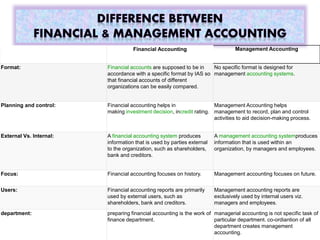
Financial Accounting Management Accounting
Format: Financial accounts are supposed to be in
accordance with a specific format by IAS so
that financial accounts of different
organizations can be easily compared.
No specific format is designed for
management accounting systems.
Planning and control: Financial accounting helps in
making investment decision, incredit rating.
Management Accounting helps
management to record, plan and control
activities to aid decision-making process.
External Vs. Internal: A financial accounting system produces
information that is used by parties external
to the organization, such as shareholders,
bank and creditors.
A management accounting systemproduces
information that is used within an
organization, by managers and employees.
Focus: Financial accounting focuses on history. Management accounting focuses on future.
Users: Financial accounting reports are primarily
used by external users, such as
shareholders, bank and creditors.
Management accounting reports are
exclusively used by internal users viz.
managers and employees.
department: preparing financial accounting is the work of
finance department.
managerial accounting is not specific task of
particular department. co-ordiantion of all
department creates management
accounting.
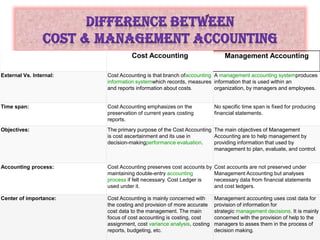
Cost Accounting Management Accounting
External Vs. Internal: Cost Accounting is that branch ofaccounting
information systemwhich records, measures
and reports information about costs.
A management accounting systemproduces
information that is used within an
organization, by managers and employees.
Time span: Cost Accounting emphasizes on the
preservation of current years costing
reports.
No specific time span is fixed for producing
financial statements.
Objectives: The primary purpose of the Cost Accounting
is cost ascertainment and its use in
decision-makingperformance evaluation.
The main objectives of Management
Accounting are to help management by
providing information that used by
management to plan, evaluate, and control.
Accounting process: Cost Accounting preserves cost accounts by
maintaining double-entry accounting
process if felt necessary. Cost Ledger is
used under it.
Cost accounts are not preserved under
Management Accounting but analyses
necessary data from financial statements
and cost ledgers.
Center of importance: Cost Accounting is mainly concerned with
the costing and provision of more accurate
cost data to the management. The main
focus of cost accounting is costing, cost
assignment, cost variance analysis, costing
reports, budgeting, etc.
Management accounting uses cost data for
provision of information for
strategic management decisions. It is mainly
concerned with the provision of help to the
managers to asses them in the process of
decision making.
MANAGEMENT ACCOUNTING USE
AS A TOOL FOR DECISION MAKING
Management accounting is fundamental in strategic
planning. When a business is looking to make a strategic
decision, for example, whether to develop a new product
line, acquire another business or expand into other
countries, the CIMA trained management accountant can
provide advice. They can use a number of tools to assist
decision-making. These include ratio analysis, budgets
and forecasts (such as cash flow and variances).
Management accounts .ppt (unit 1)

Management accounts .ppt (unit 1)

  • 1.
  • 2.
    INTRODUCTION Management accounting ormanagerial accounting is the process of identifying, analyzing, recording and presenting financial information that is used for internally by the management for planning, decision making and control. In contrast to financial aacounting, managerial accounting is concerned with providing helpful information and reports to internal users such as managers and entrepreneurs etc. so that they can control and plan the business activities.
  • 3.
    Nature of managementaccounting guides to know main characteristics of management accounting. Following are main points which shows the nature of management accounting: •No Fixed Norms Followed: In financial accounting, we follow different norms and rules for creating ledgers and other account books. But there is no need to follow fixed norms in management accounting. Management accounting tool may be different from one organization to other organization. •Increase in Efficiency: It is the nature of management accounting that it is used for increasing in the efficiency of organization. It scans the points of inefficiency through analysis of accounting information.
  • 4.
    •Supplies Information notDecisions: Management accountant supplies accounting facts and information and also provides interpretation, but decision making is fully dependent on higher authorities. Management accounting is just guide. •Concerned with Forecasting :It is the temperament of management accounting that it is fully concerned with forecasting. In management accounting, historical accounting information is analyzed through common size financial statement, ratio analysis, fund flow analysis and accounting data tendency for knowing the probability of next fact.
  • 5.
    The scope orfield of management accounting is very wide and broad based and it includes a variety of aspects of business operations. The main aim of management accounting is to help management in its functions of planning, directing, controlling and areas of specialization included within the admit of management accounting. The scope of management accounting can be studied as follows: •Financial Accounting Financial accounting forms the basis for analysis and interpretation for furnishing meaningful data to the management. •Cost Accounting Cost accounting is the process and techniques of ascertaining cost. Planning, decision making and control are the basic managerial functions.
  • 6.
    • Budgeting AndForecasting Budgeting means expressing the plans, policies and goals of the firm for a definite period in future. Forecasting on the other hand, is a prediction of what will happen as a result of a given set of circumstances. • Inventory Control Inventory is necessary to control from the time it is acquire till its final disposal as it involves large sum. For controlling inventory, management should determine different level of stock. The inventory control technique will be helpful for taking managerial decisions.
  • 7.
    FUNCTIONS OF MANAGEMENT ACCOUNTING Thefunctions of managerial accounting include: Margin analysis. Determining the amount of profit or cash flow that a business generates from a specific product, product line, customer, store, or region. Breakeven analysis. Calculating the mix of contribution margin and unit volume at which a business exactly break even, which is useful for determining price points for products and services. Constraint analysis. Understanding where the principle bottlenecks are in a company, and how they impact the ability of the business to earn revenues and profits. Target costing. Assisting in the design of new products by accumulating the costs of new designs, comparing them to target cost levels, and reporting this information to management.
  • 8.
    Though management accountingis helpful tool to the management as it provides information for planning, controlling and decision making, still its effectiveness is limited by a number of reasons. Some of the limitations of management accounting are as follows: • Based On Accounting Information Management accounting is based on data and information provided by financial accounting and cost accounting. • Lack Of Knowledge The use of management accounting requires the knowledge of number of related subjects. Deficiency in knowledge in related subjects like accounting principles, statistics, economics, principle of management etc. will limit the use of management accounting.
  • 9.
    • Management AccountingIs Only A Tool The tools and techniques of management accounting provide only information and not decisions. Decisions are to be taken by the management and implementation of decisions are also done by management. • Evolutionary Stage Management accounting is still in a development stage and has not yet reached a final stage. The techniques and tools used by this system give varying and differing results. It is still named as internal accounting and/ or operational accounting.
  • 10.
    Financial Accounting ManagementAccounting Format: Financial accounts are supposed to be in accordance with a specific format by IAS so that financial accounts of different organizations can be easily compared. No specific format is designed for management accounting systems. Planning and control: Financial accounting helps in making investment decision, incredit rating. Management Accounting helps management to record, plan and control activities to aid decision-making process. External Vs. Internal: A financial accounting system produces information that is used by parties external to the organization, such as shareholders, bank and creditors. A management accounting systemproduces information that is used within an organization, by managers and employees. Focus: Financial accounting focuses on history. Management accounting focuses on future. Users: Financial accounting reports are primarily used by external users, such as shareholders, bank and creditors. Management accounting reports are exclusively used by internal users viz. managers and employees. department: preparing financial accounting is the work of finance department. managerial accounting is not specific task of particular department. co-ordiantion of all department creates management accounting.
  • 11.
    Cost Accounting ManagementAccounting External Vs. Internal: Cost Accounting is that branch ofaccounting information systemwhich records, measures and reports information about costs. A management accounting systemproduces information that is used within an organization, by managers and employees. Time span: Cost Accounting emphasizes on the preservation of current years costing reports. No specific time span is fixed for producing financial statements. Objectives: The primary purpose of the Cost Accounting is cost ascertainment and its use in decision-makingperformance evaluation. The main objectives of Management Accounting are to help management by providing information that used by management to plan, evaluate, and control. Accounting process: Cost Accounting preserves cost accounts by maintaining double-entry accounting process if felt necessary. Cost Ledger is used under it. Cost accounts are not preserved under Management Accounting but analyses necessary data from financial statements and cost ledgers. Center of importance: Cost Accounting is mainly concerned with the costing and provision of more accurate cost data to the management. The main focus of cost accounting is costing, cost assignment, cost variance analysis, costing reports, budgeting, etc. Management accounting uses cost data for provision of information for strategic management decisions. It is mainly concerned with the provision of help to the managers to asses them in the process of decision making.
  • 12.
    MANAGEMENT ACCOUNTING USE ASA TOOL FOR DECISION MAKING Management accounting is fundamental in strategic planning. When a business is looking to make a strategic decision, for example, whether to develop a new product line, acquire another business or expand into other countries, the CIMA trained management accountant can provide advice. They can use a number of tools to assist decision-making. These include ratio analysis, budgets and forecasts (such as cash flow and variances).