MANAGEMENT
ACCOUNTING

   BY
   DHRUBA CHAKRABORTY
   MBA-HM 1ST SEM
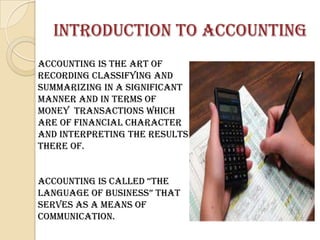
INTRODUCTION TO ACCOUNTING
ACCOUNTING is the art of
recording classifying and
summarizing in a significant
manner and in terms of
money transactions which
are of financial character
and interpreting the results
there of.


ACCountInG Is CAllED “tHE
lAnGuAGE oF BusInEss” tHAt
serves as a means of
communication.
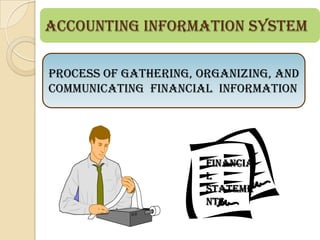
Accounting Information System

Process of gathering, organizing, and
Communicating financial information


                       Financia
                       l
                       Stateme
                       nts
History of accounting
management
Management accounting
developed to meet
mAnAGEmEnt’s nEEDs For
information as complexity
and uncertainty increased
with geographical expansion
and product diversification
Peter Drucker , In “tHE EmErGInG
tHEory oF mAnuFACturInG,” mADE
the comment:

“tHE most ExCItInG AnD InnovAtIvE work
in management today is found in
accounting theory, with new concepts,
new methodology --even what might be
called new economic philosophy --
rapidly taking shape. And while there
is enormous controversy over specifics,
the linaments of the new
manufacturing accounting are
BEComInG ClEArEr EvEry DAy.”
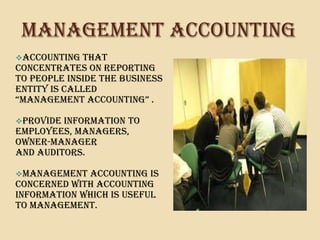
MANAGEMENT ACCOUNTING
Accounting   that
concentrates on reporting
to people inside the business
entity is called
“mAnAGEmEnt ACCountInG” .

provide information to
employees, managers,
owner-manager
and auditors.

Management  accounting is
concerned with accounting
information which is useful
to management.
REQUIREMENT OF
 MANAGEMENT ACCOUNTING
 Business owners use Management
Accounting to track, record and report
financial information for managerial
review.

Management  accounting does not
usually follow any national accounting
standards.

Business owners can design management
accounting systems according to their
company, business operations or
management and need for business
information.
FUNCTIONS OF MANAGEMENT
ACCOUNTING
Modification of data:-
Accounting data are not suitable for managerial
decision-making and control purposes . they may be used
for making future estimates and projections.
Management accounting modifies the available
accounting data by rearranging the same , by resorting
to a process of classification and combination.

Analysis and data interpretation:-
Accounting data is analyzed and interpreted for
effective planning and decision making . the data is
presented in a comparative form . analytical tools (trend
percentages , raTIO ANALYSIS) ARE USED AND LIKELY TRENDS
ARE PROJECTED.
                                                  ContD…….
FACILITATING MANAGEMENT CONTROL:-
STANDARDS OF PERFORMANCE AND MEASURE OF VARIATION ARE
THE ESSENTIAL ELEMENTS OF ANY CONTROL SYSTEM.ALL THESE ARE
MADE POSSIBLE THROUGH STANDARD COSTING AND BUDGETORY
CONTROL SYSTEMS, WHICH ARE AN INTEGRAL PART OF MANAGEMENT
ACCOUNTING.

USE OF QUALITATIVE INFORMATION:-
FINANCIAL DATA AND ITS ANALYSIS ARE NOT SUFFICIENT FOR
DECISION MAKING .MANAGEMENT NEED QUALITATATIVE
INFORMATION WHICH MAY BE OBTAINED FROM ENGINEERING
RECORDS , CASE STUDIES ETC.

SATISFYING ALL LEVEL OF MANAGEMENT:-
 VARIOUS LEVELS OF MANAGEMENT NEED DIFFERENT TYPES
OF INFORMATION.FOR TOP MANAGEMENT need CONCISE
INFORMATION , MEDIUM need TECHNICAL DATA REGULARLY
AND LOWER LEVEL ARE INTERESTED IN DETAILED FIGURES
RELATING TO THE PARTICULAR SPHERE OF ACTIVITY AT SHORT
INTERVALS.
ADVANTAGES OF MANAGEMENT
 ACCOUNTING
 Reduce   Expenses:
 Management accounting help companies lower
 their operational expenses. Business owners
 often use management accounting information
 to review the cost of economic resources and
 other business operations. This information
 allows owners to better understand how much
 money it costs to run the business.
 Improve   Cash Flow:
 Budgets is a major part of management
 accounting. Business owners often use budgets
 so they have a financial road map for future
 business expenditures. The main purpose of
 budgets is to save the company money through
 careful analysis of necessary and unnecessary
 cash expenditures.
Business Decisions:
 Management accounting often improves the
business decision-making process. Rather than
making business decisions based solely on
qualitative analysis, business owners or
managers can use management accounting
information as a decision-making tool. Management
accounting usually provides a quantitative
analysis for various decision opportunities.

Increase Financial Returns:
Business owners can also use management
ACCountInG to InCrEAsE tHEIr CompAny’s FInAnCIAl
returns. Management accountants can prepare
financial forecasts relating to consumer demand,
potential sales or the effects of consumer price
changes in the economic marketplace.
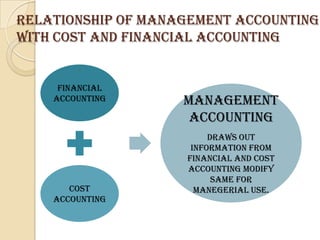
Relationship of management accounting
with cost and financial accounting


     FINANCIAL
    ACCOUNTING      MANAGEMENT
                     ACCOUNTING
                         DRAWS OUT
                     INFORMATION FROM
                    FINANCIAL AND COST
                    ACCOUNTING MODIFY
                          SAME FOR
       COST           MANEGERIAL USE.
    ACCOUNTING
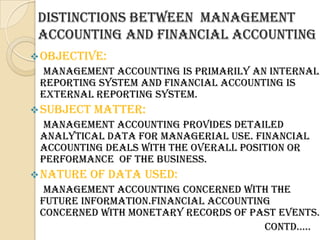
Distinctions between MANAGEMENT
 ACCOUNTING and FINANCIAL ACCOUNTING
 OBJECTIVE:
  MANAGEMENT ACCOUNTING IS PRIMARILY AN INTERNAL
 REPORTING SYSTEM AND FINANCIAL ACCOUNTING IS
 EXTERNAL REPORTING SYSTEM.
 SUBJECT   MATTER:
  MANAGEMENT ACCOUNTING PROVIDES DETAILED
 ANALYTICAL DATA FOR MANAGERIAL USE. FINANCIAL
 ACCOUNTING DEALS WITH THE OVERALL POSITION OR
 PERFORMANCE OF THE BUSINESS.
 NATURE   OF DATA USED:
  MANAGEMENT ACCOUNTING CONCERNED WITH THE
 FUTURE INFORMATION.FINANCIAL ACCOUNTING
 CONCERNED WITH MONETARY RECORDS OF PAST EVENTS.
                                       contd…..
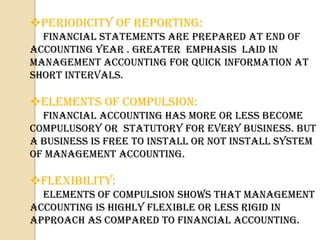
PERIODICITY OF REPORTING:
  FINANCIAL STATEMENTS ARE PREPARED AT END OF
ACCOUNTING YEAR . GREATER EMPHASIS LAID IN
MANAGEMENT ACCOUNTING FOR QUICK INFORMATION AT
SHORT INTERVALS.

ELEMENTS OF COMPULSION:
  FINANCIAL ACCOUNTING HAS MORE OR LESS BECOME
COMPULUSORY OR STATUTORY FOR EVERY BUSINESS. BUT
A BUSINESS IS FREE TO INSTALL OR NOT INSTALL SYSTEM
OF MANAGEMENT ACCOUNTING.

FLEXIBILITY:
  ELEMENTS OF COMPULSION SHOWS THAT MANAGEMENT
ACCOUNTING IS HIGHLY FLEXIBLE OR LESS RIGID IN
APPROACH AS COMPARED TO FINANCIAL ACCOUNTING.
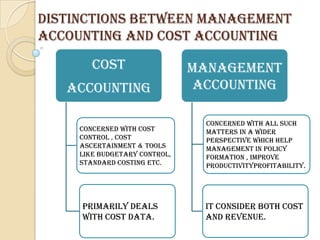
Distinctions between management
accounting and cost accounting

        cost                   management
   accounting                   accounting

                                 Concerned with all such
     Concerned with cost         matters in a wider
     control , cost              perspective which help
     ascertainment & tools       management in policy
     like budgetary control,     formation , improve
     standard costing etc.       productivityprofitability.


     Primarily deals             It consider both cost
     with cost data.             and revenue.
Limitations of accounting
management
Based on Accounting Information:
Mgt Accounting is based on data of Financial and Cost Accounting.
Historical data is used to make future decisions. The correctness and
effectiveness of managerial decisions will depend upon the quality of
data on which these decisions are based. If financial data is not reliable
then Mgt Accounting will not provide correct analysis.

Lack of Knowledge:
The application of Mgt Accounting will be useful to person connected
with Decision making process as they have proper understanding of Mgt
Accounting and related subjects such as Statistics, Economics, Principles
of Mgt, Engineering etc.

Intuitive decision :
In Mgt Accounting decision making based on facts and figures, there is a
tendency to make decisions intuitively. Mgt may avoid lengthy courses of
deciding things and may take an easy course of arriving at decision, using
intuitive. This makes management accounting system a waste.
                                                                contd….
Limitations of accounting
 management
Not an alternative to Administration:
The tools and techniques of Mgt Accounting provide only
information and not decision. Decisions and their implementations
are done, by Mgt. So it has supplementary service function and
has no final say in taking decisions and their implementations.

Top heavy structure:
Introduction of this system is costly affair and can be used by big
concerns only. Smaller concerns cant afford to use this system
because of heavy cost.

Psychological Resistance:
The Installation of Mgt Accounting involves basic changes in
organizational setup. New rule and regulations are to be framed
which affect a number of personnel and hence there is a
possibility of resistance
Role of management
  accounting
 Provide accounting information to the
  management to perform its function
  effectively.
 Modify available relevant information for
  effective planning and decision making.
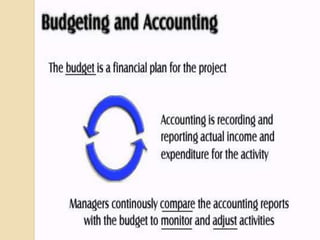
 Provide tools like budgetary control ,
  standard costing etc. which helps
  management.
 Effective coordination could be achieved
  through departmental budgets and reports
                                    contd……
 Communication
Contd…               is an important role of
    management which involves
    transmission of data, information,
    results etc. to both outsider and
    insider . decision of top management to
    be communicated to middle and lower
    level managements and the results and
    requirement should be reported to top
    level management.
   Results have to be reported to
    shareholders, creditors , investors who
    wIsH to know ABout CompAny’s FInAnCIAl
    position and progress.
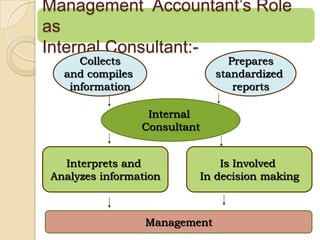
Management Accountant’s Role
as
Internal Consultant:-
     Collects                     Prepares
  and compiles                  standardized
   information                     reports

                  Internal
                 Consultant


  Interprets and                  Is Involved
Analyzes information          In decision making


                 Management
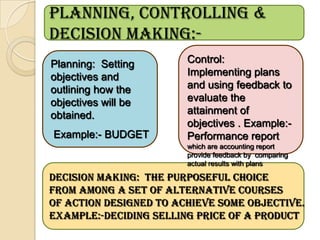
Planning, Controlling &
decision making:-
Planning: Setting       Control:
objectives and          Implementing plans
outlining how the       and using feedback to
objectives will be      evaluate the
obtained.               attainment of
                        objectives . Example:-
Example:- BUDGET        Performance report
                        which are accounting report
                        provide feedback by comparing
                        actual results with plans

Decision making: the purposeful choice
from among a set of alternative courses
of action designed to achieve some objective.
Example:-Deciding selling price of a product
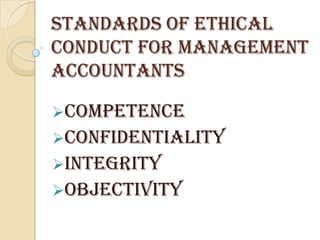
Standards of Ethical
Conduct for Management
Accountants

Competence
Confidentiality
Integrity
Objectivity
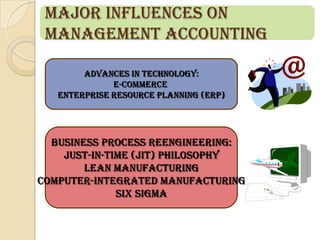
Major Influences on
 Management Accounting

        Advances in technology:
              E-commerce
   Enterprise resource planning (ERP)


  Business process reengineering:
    Just-in-time (JIT) philosophy
        Lean manufacturing
Computer-integrated manufacturing
              Six sigma
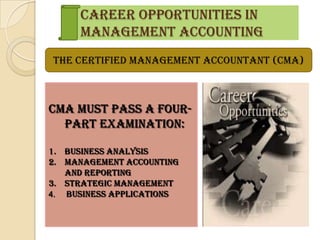
Career Opportunities in
     Management Accounting
The Certified Management Accountant (CMA)


CMA must pass a four-
  part examination:

1. Business Analysis
2. Management accounting
   and reporting
3. Strategic Management
4. Business Applications
Managent accounting by dhruba

Managent accounting by dhruba

  • 1.
    MANAGEMENT ACCOUNTING BY DHRUBA CHAKRABORTY MBA-HM 1ST SEM
  • 2.
    INTRODUCTION TO ACCOUNTING ACCOUNTINGis the art of recording classifying and summarizing in a significant manner and in terms of money transactions which are of financial character and interpreting the results there of. ACCountInG Is CAllED “tHE lAnGuAGE oF BusInEss” tHAt serves as a means of communication.
  • 3.
    Accounting Information System Processof gathering, organizing, and Communicating financial information Financia l Stateme nts
  • 4.
    History of accounting management Managementaccounting developed to meet mAnAGEmEnt’s nEEDs For information as complexity and uncertainty increased with geographical expansion and product diversification
  • 5.
    Peter Drucker ,In “tHE EmErGInG tHEory oF mAnuFACturInG,” mADE the comment: “tHE most ExCItInG AnD InnovAtIvE work in management today is found in accounting theory, with new concepts, new methodology --even what might be called new economic philosophy -- rapidly taking shape. And while there is enormous controversy over specifics, the linaments of the new manufacturing accounting are BEComInG ClEArEr EvEry DAy.”
  • 6.
    MANAGEMENT ACCOUNTING Accounting that concentrates on reporting to people inside the business entity is called “mAnAGEmEnt ACCountInG” . provide information to employees, managers, owner-manager and auditors. Management accounting is concerned with accounting information which is useful to management.
  • 7.
    REQUIREMENT OF MANAGEMENTACCOUNTING  Business owners use Management Accounting to track, record and report financial information for managerial review. Management accounting does not usually follow any national accounting standards. Business owners can design management accounting systems according to their company, business operations or management and need for business information.
  • 8.
    FUNCTIONS OF MANAGEMENT ACCOUNTING Modificationof data:- Accounting data are not suitable for managerial decision-making and control purposes . they may be used for making future estimates and projections. Management accounting modifies the available accounting data by rearranging the same , by resorting to a process of classification and combination. Analysis and data interpretation:- Accounting data is analyzed and interpreted for effective planning and decision making . the data is presented in a comparative form . analytical tools (trend percentages , raTIO ANALYSIS) ARE USED AND LIKELY TRENDS ARE PROJECTED. ContD…….
  • 9.
    FACILITATING MANAGEMENT CONTROL:- STANDARDSOF PERFORMANCE AND MEASURE OF VARIATION ARE THE ESSENTIAL ELEMENTS OF ANY CONTROL SYSTEM.ALL THESE ARE MADE POSSIBLE THROUGH STANDARD COSTING AND BUDGETORY CONTROL SYSTEMS, WHICH ARE AN INTEGRAL PART OF MANAGEMENT ACCOUNTING. USE OF QUALITATIVE INFORMATION:- FINANCIAL DATA AND ITS ANALYSIS ARE NOT SUFFICIENT FOR DECISION MAKING .MANAGEMENT NEED QUALITATATIVE INFORMATION WHICH MAY BE OBTAINED FROM ENGINEERING RECORDS , CASE STUDIES ETC. SATISFYING ALL LEVEL OF MANAGEMENT:- VARIOUS LEVELS OF MANAGEMENT NEED DIFFERENT TYPES OF INFORMATION.FOR TOP MANAGEMENT need CONCISE INFORMATION , MEDIUM need TECHNICAL DATA REGULARLY AND LOWER LEVEL ARE INTERESTED IN DETAILED FIGURES RELATING TO THE PARTICULAR SPHERE OF ACTIVITY AT SHORT INTERVALS.
  • 10.
    ADVANTAGES OF MANAGEMENT ACCOUNTING  Reduce Expenses: Management accounting help companies lower their operational expenses. Business owners often use management accounting information to review the cost of economic resources and other business operations. This information allows owners to better understand how much money it costs to run the business.  Improve Cash Flow: Budgets is a major part of management accounting. Business owners often use budgets so they have a financial road map for future business expenditures. The main purpose of budgets is to save the company money through careful analysis of necessary and unnecessary cash expenditures.
  • 11.
    Business Decisions: Managementaccounting often improves the business decision-making process. Rather than making business decisions based solely on qualitative analysis, business owners or managers can use management accounting information as a decision-making tool. Management accounting usually provides a quantitative analysis for various decision opportunities. Increase Financial Returns: Business owners can also use management ACCountInG to InCrEAsE tHEIr CompAny’s FInAnCIAl returns. Management accountants can prepare financial forecasts relating to consumer demand, potential sales or the effects of consumer price changes in the economic marketplace.
  • 12.
    Relationship of managementaccounting with cost and financial accounting FINANCIAL ACCOUNTING MANAGEMENT ACCOUNTING DRAWS OUT INFORMATION FROM FINANCIAL AND COST ACCOUNTING MODIFY SAME FOR COST MANEGERIAL USE. ACCOUNTING
  • 13.
    Distinctions between MANAGEMENT ACCOUNTING and FINANCIAL ACCOUNTING  OBJECTIVE: MANAGEMENT ACCOUNTING IS PRIMARILY AN INTERNAL REPORTING SYSTEM AND FINANCIAL ACCOUNTING IS EXTERNAL REPORTING SYSTEM.  SUBJECT MATTER: MANAGEMENT ACCOUNTING PROVIDES DETAILED ANALYTICAL DATA FOR MANAGERIAL USE. FINANCIAL ACCOUNTING DEALS WITH THE OVERALL POSITION OR PERFORMANCE OF THE BUSINESS.  NATURE OF DATA USED: MANAGEMENT ACCOUNTING CONCERNED WITH THE FUTURE INFORMATION.FINANCIAL ACCOUNTING CONCERNED WITH MONETARY RECORDS OF PAST EVENTS. contd…..
  • 14.
    PERIODICITY OF REPORTING: FINANCIAL STATEMENTS ARE PREPARED AT END OF ACCOUNTING YEAR . GREATER EMPHASIS LAID IN MANAGEMENT ACCOUNTING FOR QUICK INFORMATION AT SHORT INTERVALS. ELEMENTS OF COMPULSION: FINANCIAL ACCOUNTING HAS MORE OR LESS BECOME COMPULUSORY OR STATUTORY FOR EVERY BUSINESS. BUT A BUSINESS IS FREE TO INSTALL OR NOT INSTALL SYSTEM OF MANAGEMENT ACCOUNTING. FLEXIBILITY: ELEMENTS OF COMPULSION SHOWS THAT MANAGEMENT ACCOUNTING IS HIGHLY FLEXIBLE OR LESS RIGID IN APPROACH AS COMPARED TO FINANCIAL ACCOUNTING.
  • 15.
    Distinctions between management accountingand cost accounting cost management accounting accounting Concerned with all such Concerned with cost matters in a wider control , cost perspective which help ascertainment & tools management in policy like budgetary control, formation , improve standard costing etc. productivityprofitability. Primarily deals It consider both cost with cost data. and revenue.
  • 16.
    Limitations of accounting management Basedon Accounting Information: Mgt Accounting is based on data of Financial and Cost Accounting. Historical data is used to make future decisions. The correctness and effectiveness of managerial decisions will depend upon the quality of data on which these decisions are based. If financial data is not reliable then Mgt Accounting will not provide correct analysis. Lack of Knowledge: The application of Mgt Accounting will be useful to person connected with Decision making process as they have proper understanding of Mgt Accounting and related subjects such as Statistics, Economics, Principles of Mgt, Engineering etc. Intuitive decision : In Mgt Accounting decision making based on facts and figures, there is a tendency to make decisions intuitively. Mgt may avoid lengthy courses of deciding things and may take an easy course of arriving at decision, using intuitive. This makes management accounting system a waste. contd….
  • 17.
    Limitations of accounting management Not an alternative to Administration: The tools and techniques of Mgt Accounting provide only information and not decision. Decisions and their implementations are done, by Mgt. So it has supplementary service function and has no final say in taking decisions and their implementations. Top heavy structure: Introduction of this system is costly affair and can be used by big concerns only. Smaller concerns cant afford to use this system because of heavy cost. Psychological Resistance: The Installation of Mgt Accounting involves basic changes in organizational setup. New rule and regulations are to be framed which affect a number of personnel and hence there is a possibility of resistance
  • 18.
    Role of management accounting  Provide accounting information to the management to perform its function effectively.  Modify available relevant information for effective planning and decision making.  Provide tools like budgetary control , standard costing etc. which helps management.  Effective coordination could be achieved through departmental budgets and reports contd……
  • 19.
     Communication Contd… is an important role of management which involves transmission of data, information, results etc. to both outsider and insider . decision of top management to be communicated to middle and lower level managements and the results and requirement should be reported to top level management.  Results have to be reported to shareholders, creditors , investors who wIsH to know ABout CompAny’s FInAnCIAl position and progress.
  • 20.
    Management Accountant’s Role as InternalConsultant:- Collects Prepares and compiles standardized information reports Internal Consultant Interprets and Is Involved Analyzes information In decision making Management
  • 21.
    Planning, Controlling & decisionmaking:- Planning: Setting Control: objectives and Implementing plans outlining how the and using feedback to objectives will be evaluate the obtained. attainment of objectives . Example:- Example:- BUDGET Performance report which are accounting report provide feedback by comparing actual results with plans Decision making: the purposeful choice from among a set of alternative courses of action designed to achieve some objective. Example:-Deciding selling price of a product
  • 23.
    Standards of Ethical Conductfor Management Accountants Competence Confidentiality Integrity Objectivity
  • 24.
    Major Influences on Management Accounting Advances in technology: E-commerce Enterprise resource planning (ERP) Business process reengineering: Just-in-time (JIT) philosophy Lean manufacturing Computer-integrated manufacturing Six sigma
  • 25.
    Career Opportunities in Management Accounting The Certified Management Accountant (CMA) CMA must pass a four- part examination: 1. Business Analysis 2. Management accounting and reporting 3. Strategic Management 4. Business Applications