MANAGEMENT
ACCOUNTING
Dr.C.Sahila.,Ph.D
Assistant professor of Commerce
SRM IST
MEANING
The term management accounting refers to accounting for
the management. Management accounting provides necessary
information to assist the management in creation of policy and in
the day – to- day operations. It enables the management to
discharge all its functions i.e., planning, organization, staffing,
direction and control efficiently with the help of accounting
information.
DEFINITION
The Institute of Cost and Management Accountants London has
defined, “Management Accounting as the application of professional
knowledge and skill in the preparation of accounting information in
such a way as to assist management in the formulation of policies and
the planning control of the operation of the undertakings.”
According to R. N. Anthony, “Management Accounting is
concerned with accounting information that is useful to management.”
OBJECTIVES OF MANAGEMENT ACCOUNTING
 To assist the management in promoting efficiency. Efficiency includes best
possible services to customers, investors and employees.
 To prepare budgets covering all functions of a business (i.e, production, sales,
research and finance).
 To analyze monetary and non-monetary transactions.
 To compare the actual performance with plan for identifying deviations and their
causes.
CONT…
 To interpret financial statement to enable the management to formulate future
policies.
 To submit to the management at frequent intervals operating statements and short
term financial statements.
 To arrange for the systematic allocation of responsibilities.
 To provide a suitable organization for discharging the responsibilities.
SCOPE OF MANAGEMENT ACCOUNTING
 Financial Accounting:
Management accounting is mainly concerned with the rearrangement of the
information provided by financial accounting. Hence, management cannot obtain full
control and coordination of operations without a properly designed financial
accounting system.
 Cost Accounting:
Standard costing, marginal costing, opportunity cost analysis, differential
costing and other cost techniques play a useful role in operation and control of the
business undertaking.
 Budgetary Control:
This includes framing of budgets, comparison of actual performance
with the budgeted performance, computation of variances, finding of their causes,
etc.
 Inventory Control:
It includes control over inventory from the time it is acquired till its final
disposal.
 Reporting:
This includes preparation of monthly, quarterly, half-yearly income
statements and the related reports, cash flow and funds flow statements, scrap
reports, etc.
 Statistical Methods:
Graphs, charts, pictorial presentation, index numbers and other statistical
methods are used for presentation of information to various departments.
 Taxation:
This includes computation of income statement in accordance with the tax laws,
filing of returns and making tax payments.
 Methods and Procedures:
They deal with organizational methods for cost reduction, procedures for
improving the efficiency of accounting and office operations.
 Office Services:
This includes maintenance of proper data processing and other office
management services, reporting on best use of mechanical and electronic devices.
 Internal Audit:
Development of a suitable internal audit system for internal control.
FUNCTIONS OF MANAGEMENT ACCOUNTING
The main functions of management accounting are:
 Forecasting:
Making short- term and long-term forecasts and planning the future operations
of the business.
 Organizing:
Organizing the human and physical resources of the business. This is done by
assigning specific responsibilities to different people.
 Co-ordinating:
Providing different tools of co-ordination. Examples of such tools are
budgeting, financial reporting, financial analysis, interpretation etc.
 Controlling:
Controlling performance by using standard costing, variance analysis and
budgetary control.
 Analysis and Interpretation:
Analysis and Interpreting financial data in a simple and purposeful manner.
 Communicating:
Communicating the results of business activities through prompt and
accurate reporting system.
 Economic Appraisal:
Appraising of social and economic forces and government policies and
interpreting their effect on business.
ADVANTAGES OF MANAGEMENT ACCOUNTING
 Helps in decision making
 Helps in planning
 Helps in organizing
 Facilitates Communication
 Helps in Co-ordinating
 Evaluation and Control of performance
 Interpretation of financial information
 Economic Appraisal
LIMITATIONS OF MANAGEMENT ACCOUNTING
 Based on accounting information
Management accounting derives information from past financial and cost
accounting records. If the past records are not reliable, it will affect the
effectiveness of management accounting.
 Wide scope
It has a very wide scope incorporating many disciplines. This results in
inaccuracy and other practical difficulties.
 Costly
The installation of management accounting system requires a large
organization. Hence, it is very costly and only big concerns can afford to adopt it.
 Evolutionary stage
Management accounting is still in its initial stages. Tools end techniques are
not fully developed. This creates doubts about the utility of management accounting.
 Opposition to change
Introduction of management accounting system requires a number of
changes in the organization structure, rules and regulations. This rearrangement is
not generally liked by the people involved.
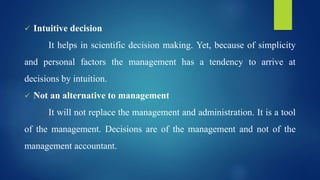
 Intuitive decision
It helps in scientific decision making. Yet, because of simplicity
and personal factors the management has a tendency to arrive at
decisions by intuition.
 Not an alternative to management
It will not replace the management and administration. It is a tool
of the management. Decisions are of the management and not of the
management accountant.
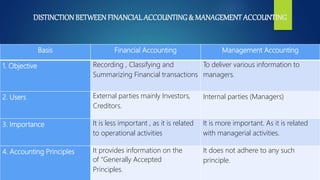
DISTINCTIONBETWEENFINANCIALACCOUNTING& MANAGEMENTACCOUNTING
Basis Financial Accounting Management Accounting
1. Objective Recording , Classifying and
Summarizing Financial transactions
To deliver various information to
managers.
2. Users External parties mainly Investors,
Creditors.
Internal parties (Managers)
3. Importance It is less important , as it is related
to operational activities
It is more important. As it is related
with managerial activities.
4. Accounting Principles It provides information on the
of “Generally Accepted
Principles.
It does not adhere to any such
principle.
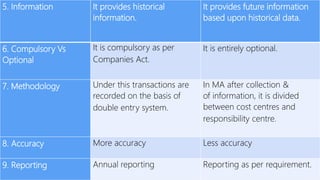
5. Information It provides historical
information.
It provides future information
based upon historical data.
6. Compulsory Vs
Optional
It is compulsory as per
Companies Act.
It is entirely optional.
7. Methodology Under this transactions are
recorded on the basis of
double entry system.
In MA after collection &
of information, it is divided
between cost centres and
responsibility centre.
8. Accuracy More accuracy Less accuracy
9. Reporting Annual reporting Reporting as per requirement.
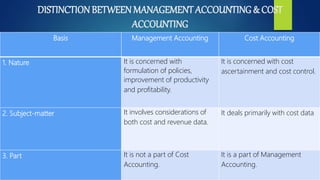
DISTINCTIONBETWEENMANAGEMENT ACCOUNTING & COST
ACCOUNTING
Basis Management Accounting Cost Accounting
1. Nature It is concerned with
formulation of policies,
improvement of productivity
and profitability.
It is concerned with cost
ascertainment and cost control.
2. Subject-matter It involves considerations of
both cost and revenue data.
It deals primarily with cost data
3. Part It is not a part of Cost
Accounting.
It is a part of Management
Accounting.
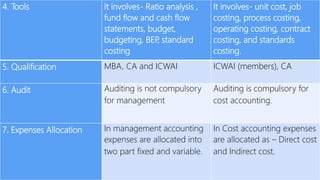
4. Tools It involves- Ratio analysis ,
fund flow and cash flow
statements, budget,
budgeting, BEP
, standard
costing
It involves- unit cost, job
costing, process costing,
operating costing, contract
costing, and standards
costing.
5. Qualification MBA, CA and ICWAI ICWAI (members), CA
6. Audit Auditing is not compulsory
for management
Auditing is compulsory for
cost accounting.
7. Expenses Allocation In management accounting
expenses are allocated into
two part fixed and variable.
In Cost accounting expenses
are allocated as – Direct cost
and Indirect cost.

Management accounting

  • 1.
  • 2.
    MEANING The term managementaccounting refers to accounting for the management. Management accounting provides necessary information to assist the management in creation of policy and in the day – to- day operations. It enables the management to discharge all its functions i.e., planning, organization, staffing, direction and control efficiently with the help of accounting information.
  • 3.
    DEFINITION The Institute ofCost and Management Accountants London has defined, “Management Accounting as the application of professional knowledge and skill in the preparation of accounting information in such a way as to assist management in the formulation of policies and the planning control of the operation of the undertakings.” According to R. N. Anthony, “Management Accounting is concerned with accounting information that is useful to management.”
  • 4.
    OBJECTIVES OF MANAGEMENTACCOUNTING  To assist the management in promoting efficiency. Efficiency includes best possible services to customers, investors and employees.  To prepare budgets covering all functions of a business (i.e, production, sales, research and finance).  To analyze monetary and non-monetary transactions.  To compare the actual performance with plan for identifying deviations and their causes.
  • 5.
    CONT…  To interpretfinancial statement to enable the management to formulate future policies.  To submit to the management at frequent intervals operating statements and short term financial statements.  To arrange for the systematic allocation of responsibilities.  To provide a suitable organization for discharging the responsibilities.
  • 6.
    SCOPE OF MANAGEMENTACCOUNTING  Financial Accounting: Management accounting is mainly concerned with the rearrangement of the information provided by financial accounting. Hence, management cannot obtain full control and coordination of operations without a properly designed financial accounting system.  Cost Accounting: Standard costing, marginal costing, opportunity cost analysis, differential costing and other cost techniques play a useful role in operation and control of the business undertaking.
  • 7.
     Budgetary Control: Thisincludes framing of budgets, comparison of actual performance with the budgeted performance, computation of variances, finding of their causes, etc.  Inventory Control: It includes control over inventory from the time it is acquired till its final disposal.  Reporting: This includes preparation of monthly, quarterly, half-yearly income statements and the related reports, cash flow and funds flow statements, scrap reports, etc.
  • 8.
     Statistical Methods: Graphs,charts, pictorial presentation, index numbers and other statistical methods are used for presentation of information to various departments.  Taxation: This includes computation of income statement in accordance with the tax laws, filing of returns and making tax payments.  Methods and Procedures: They deal with organizational methods for cost reduction, procedures for improving the efficiency of accounting and office operations.
  • 9.
     Office Services: Thisincludes maintenance of proper data processing and other office management services, reporting on best use of mechanical and electronic devices.  Internal Audit: Development of a suitable internal audit system for internal control.
  • 10.
    FUNCTIONS OF MANAGEMENTACCOUNTING The main functions of management accounting are:  Forecasting: Making short- term and long-term forecasts and planning the future operations of the business.  Organizing: Organizing the human and physical resources of the business. This is done by assigning specific responsibilities to different people.
  • 11.
     Co-ordinating: Providing differenttools of co-ordination. Examples of such tools are budgeting, financial reporting, financial analysis, interpretation etc.  Controlling: Controlling performance by using standard costing, variance analysis and budgetary control.  Analysis and Interpretation: Analysis and Interpreting financial data in a simple and purposeful manner.
  • 12.
     Communicating: Communicating theresults of business activities through prompt and accurate reporting system.  Economic Appraisal: Appraising of social and economic forces and government policies and interpreting their effect on business.
  • 13.
    ADVANTAGES OF MANAGEMENTACCOUNTING  Helps in decision making  Helps in planning  Helps in organizing  Facilitates Communication  Helps in Co-ordinating  Evaluation and Control of performance  Interpretation of financial information  Economic Appraisal
  • 14.
    LIMITATIONS OF MANAGEMENTACCOUNTING  Based on accounting information Management accounting derives information from past financial and cost accounting records. If the past records are not reliable, it will affect the effectiveness of management accounting.  Wide scope It has a very wide scope incorporating many disciplines. This results in inaccuracy and other practical difficulties.
  • 15.
     Costly The installationof management accounting system requires a large organization. Hence, it is very costly and only big concerns can afford to adopt it.  Evolutionary stage Management accounting is still in its initial stages. Tools end techniques are not fully developed. This creates doubts about the utility of management accounting.  Opposition to change Introduction of management accounting system requires a number of changes in the organization structure, rules and regulations. This rearrangement is not generally liked by the people involved.
  • 16.
     Intuitive decision Ithelps in scientific decision making. Yet, because of simplicity and personal factors the management has a tendency to arrive at decisions by intuition.  Not an alternative to management It will not replace the management and administration. It is a tool of the management. Decisions are of the management and not of the management accountant.
  • 17.
    DISTINCTIONBETWEENFINANCIALACCOUNTING& MANAGEMENTACCOUNTING Basis FinancialAccounting Management Accounting 1. Objective Recording , Classifying and Summarizing Financial transactions To deliver various information to managers. 2. Users External parties mainly Investors, Creditors. Internal parties (Managers) 3. Importance It is less important , as it is related to operational activities It is more important. As it is related with managerial activities. 4. Accounting Principles It provides information on the of “Generally Accepted Principles. It does not adhere to any such principle.
  • 18.
    5. Information Itprovides historical information. It provides future information based upon historical data. 6. Compulsory Vs Optional It is compulsory as per Companies Act. It is entirely optional. 7. Methodology Under this transactions are recorded on the basis of double entry system. In MA after collection & of information, it is divided between cost centres and responsibility centre. 8. Accuracy More accuracy Less accuracy 9. Reporting Annual reporting Reporting as per requirement.
  • 19.
    DISTINCTIONBETWEENMANAGEMENT ACCOUNTING &COST ACCOUNTING Basis Management Accounting Cost Accounting 1. Nature It is concerned with formulation of policies, improvement of productivity and profitability. It is concerned with cost ascertainment and cost control. 2. Subject-matter It involves considerations of both cost and revenue data. It deals primarily with cost data 3. Part It is not a part of Cost Accounting. It is a part of Management Accounting.
  • 20.
    4. Tools Itinvolves- Ratio analysis , fund flow and cash flow statements, budget, budgeting, BEP , standard costing It involves- unit cost, job costing, process costing, operating costing, contract costing, and standards costing. 5. Qualification MBA, CA and ICWAI ICWAI (members), CA 6. Audit Auditing is not compulsory for management Auditing is compulsory for cost accounting. 7. Expenses Allocation In management accounting expenses are allocated into two part fixed and variable. In Cost accounting expenses are allocated as – Direct cost and Indirect cost.