MANAGEMENT ACCOUNTING
SubmittedTo : Dr. SunilVerma Submitted By : DheerajTanwar
Professor of ManagementAccounting BBA (general) sec A
SGT University , Gurugram Roll No. 150602010
Introduction Of Management
Accounting
 Management accounting can be viewed as
Management-oriented Accounting. Basically it is
the study of managerial aspect of financial
accounting, "accounting in relation to
management function". It shows how the
accounting function can be re-oriented so as to
fit it within the framework of management
activity.The primary task of management
accounting is, therefore, to redesign the entire
accounting system so that it may serve the
operational needs of the firm.
Definition :
 Management accounting, also called
managerial accounting or cost accounting, is
the process of analysing business costs and
operations to prepare internal financial report,
records, and account to aid managers’ decision
making process in achieving business goals.
 In other words, it is the act of making sense of
financial and costing data and translating that
data into useful information for management
and officers within an organization.
Example On Management
Accounting :
 Anderson is the CEO of a small consulting firm. He wants to hire a
management accountant and a financial accountant. He has
come up with a list of job tasks and he needs to break them up
into those that should be performed by the managerial
accountant and those that should be performed by the financial
accountant.
Here is the list of tasks that Anderson has come up with:
 Preparing cash flow statements
 Income statement reporting
 Budgeting
 Calculating changes in stockholder equity
 Preparing taxes for the organization
 In this example, the only tasks that would be assigned to the
management accountant are budgeting and taxes.The financial
accountant would handle the other tasks
FUNCTIONS OF MANAGEMENT
ACCOUNTING
 (I) Provides data: Management accounting serves as a vital
source of data for management planning.The accounts and
documents are a repository of a vast quantity of data about
the past progress of the enterprise, which are a must for
making forecasts for the future.
 (ii) Modifies data:The accounting data required for
managerial decisions is properly compiled and classified.
For example, purchase figures for different months may be
classified to know total purchases made during each period
product-wise, supplier-wise and territory-wise.
 (iii)Analyses and interprets data:The accounting data is
analysed meaningfully for effective planning and decision-
making. For this purpose the data is presented in a
comparative form. Ratios are calculated and likely trends
are projected.
(iv) Serves as a means of communicating: Management
accounting provides a means of communicating
management plans upward, downward and outward
through the organization. Initially, it means identifying
the feasibility and consistency of the various segments
of the plan. At later stages it keeps all parties informed
about the plans that have been agreed upon and their
roles in these plans.
(v) Facilitates control: Management accounting helps in
translating given objectives and strategy into specified
goals for attainment by a specified time and secures
effective accomplishment of these goals in an efficient
manner. All this is made possible through budgetary
control and standard costing which is an integral part of
management accounting.
SCOPE OF MANAGEMENT
ACCOUNTING
 (I) Financial Accounting: Management accounting
is mainly concerned with the rearrangement of
the information provided by financial accounting.
Hence, management cannot obtain full control
and coordination of operations without a
properly designed financial accounting system.
 (ii) Cost Accounting: Standard costing, marginal
costing, opportunity cost analysis, differential
costing and other cost techniques play a useful
role in operation and control of the business
undertaking.
 (iii) Revaluation Accounting:This is concerned with
ensuring that capital is maintained intact in real terms
and profit is calculated with this fact in mind.
 (iv) Budgetary Control:This includes framing of
budgets, comparison of actual performance with the
budgeted performance, computation of variances,
finding of their causes, etc.
 (v) Inventory Control: It includes control over
inventory from the time it is acquired till its final
disposal.
 (vi) Statistical Methods: Graphs, charts, pictorial
presentation, index numbers and other statistical
methods make the information more impressive and
intelligible.
 (vii) Interim Reporting:This includes preparation of
monthly, quarterly, half-yearly income statements
and the related reports, cash flow and funds flow
statements, scrap reports, etc.
 (viii)Taxation:This includes computation of income
in accordance with the tax laws, filing of returns
and making tax payments.
 (ix) Office Services:This includes maintenance of
proper data processing and other office
management services, reporting on best use of
mechanical and electronic devices.
 (x) Internal Audit: Development of a suitable
internal audit system for internal control.
Characteristics Of
Management Accounting
 Helpful in Decision Making:-
It is an important feature of management
accounting. In fact, it helps the management of
organization by providing relevant and accurate
information from various sources (like financial
and cost accounting) in order to make sound
decisions to remove business problems.
 Provides Data, Not the Decision:-
It only provides required data and information to the
management, not the decision. It is up to the
management that how they utilize the available data and
information to resolving the business problems through
taking effective decisions.
 Related to Future:-
ManagementAccounting is an accounting system which is directly
related to future course of events. It means by preparing this account any
organization can forecast its future on the basis available information in
relating the past events (Historical data).
 Increase in Efficiency:-
It also plays an essential role in increasing efficiency of organization.
As we know that in this competitive business age it is difficult for every
organization to carry out its entity for ever. Hence to survive for long run it
is important for organization to increase its efficiency by finding the errors
and removing it through management accounting techniques (standard
costing, budgetary control, control accounting).
 Use of SpecialTechniques:-
ManagementAccounting uses special tools or techniques (like
standard costing, budgetary control, control accounting, marginal costing
etc.) for composing the accounting information and data more accurate
and relevant. So that management can easily make their decisions.The
type of technique to be applied will be determined according to the
situation and necessity.
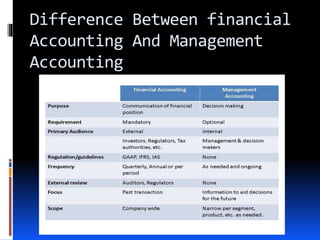
Difference Between financial
Accounting And Management
Accounting

Management accounting

  • 1.
    MANAGEMENT ACCOUNTING SubmittedTo :Dr. SunilVerma Submitted By : DheerajTanwar Professor of ManagementAccounting BBA (general) sec A SGT University , Gurugram Roll No. 150602010
  • 2.
    Introduction Of Management Accounting Management accounting can be viewed as Management-oriented Accounting. Basically it is the study of managerial aspect of financial accounting, "accounting in relation to management function". It shows how the accounting function can be re-oriented so as to fit it within the framework of management activity.The primary task of management accounting is, therefore, to redesign the entire accounting system so that it may serve the operational needs of the firm.
  • 3.
    Definition :  Managementaccounting, also called managerial accounting or cost accounting, is the process of analysing business costs and operations to prepare internal financial report, records, and account to aid managers’ decision making process in achieving business goals.  In other words, it is the act of making sense of financial and costing data and translating that data into useful information for management and officers within an organization.
  • 4.
    Example On Management Accounting:  Anderson is the CEO of a small consulting firm. He wants to hire a management accountant and a financial accountant. He has come up with a list of job tasks and he needs to break them up into those that should be performed by the managerial accountant and those that should be performed by the financial accountant. Here is the list of tasks that Anderson has come up with:  Preparing cash flow statements  Income statement reporting  Budgeting  Calculating changes in stockholder equity  Preparing taxes for the organization  In this example, the only tasks that would be assigned to the management accountant are budgeting and taxes.The financial accountant would handle the other tasks
  • 5.
    FUNCTIONS OF MANAGEMENT ACCOUNTING (I) Provides data: Management accounting serves as a vital source of data for management planning.The accounts and documents are a repository of a vast quantity of data about the past progress of the enterprise, which are a must for making forecasts for the future.  (ii) Modifies data:The accounting data required for managerial decisions is properly compiled and classified. For example, purchase figures for different months may be classified to know total purchases made during each period product-wise, supplier-wise and territory-wise.  (iii)Analyses and interprets data:The accounting data is analysed meaningfully for effective planning and decision- making. For this purpose the data is presented in a comparative form. Ratios are calculated and likely trends are projected.
  • 6.
    (iv) Serves asa means of communicating: Management accounting provides a means of communicating management plans upward, downward and outward through the organization. Initially, it means identifying the feasibility and consistency of the various segments of the plan. At later stages it keeps all parties informed about the plans that have been agreed upon and their roles in these plans. (v) Facilitates control: Management accounting helps in translating given objectives and strategy into specified goals for attainment by a specified time and secures effective accomplishment of these goals in an efficient manner. All this is made possible through budgetary control and standard costing which is an integral part of management accounting.
  • 7.
    SCOPE OF MANAGEMENT ACCOUNTING (I) Financial Accounting: Management accounting is mainly concerned with the rearrangement of the information provided by financial accounting. Hence, management cannot obtain full control and coordination of operations without a properly designed financial accounting system.  (ii) Cost Accounting: Standard costing, marginal costing, opportunity cost analysis, differential costing and other cost techniques play a useful role in operation and control of the business undertaking.
  • 8.
     (iii) RevaluationAccounting:This is concerned with ensuring that capital is maintained intact in real terms and profit is calculated with this fact in mind.  (iv) Budgetary Control:This includes framing of budgets, comparison of actual performance with the budgeted performance, computation of variances, finding of their causes, etc.  (v) Inventory Control: It includes control over inventory from the time it is acquired till its final disposal.  (vi) Statistical Methods: Graphs, charts, pictorial presentation, index numbers and other statistical methods make the information more impressive and intelligible.
  • 9.
     (vii) InterimReporting:This includes preparation of monthly, quarterly, half-yearly income statements and the related reports, cash flow and funds flow statements, scrap reports, etc.  (viii)Taxation:This includes computation of income in accordance with the tax laws, filing of returns and making tax payments.  (ix) Office Services:This includes maintenance of proper data processing and other office management services, reporting on best use of mechanical and electronic devices.  (x) Internal Audit: Development of a suitable internal audit system for internal control.
  • 10.
    Characteristics Of Management Accounting Helpful in Decision Making:- It is an important feature of management accounting. In fact, it helps the management of organization by providing relevant and accurate information from various sources (like financial and cost accounting) in order to make sound decisions to remove business problems.  Provides Data, Not the Decision:- It only provides required data and information to the management, not the decision. It is up to the management that how they utilize the available data and information to resolving the business problems through taking effective decisions.
  • 11.
     Related toFuture:- ManagementAccounting is an accounting system which is directly related to future course of events. It means by preparing this account any organization can forecast its future on the basis available information in relating the past events (Historical data).  Increase in Efficiency:- It also plays an essential role in increasing efficiency of organization. As we know that in this competitive business age it is difficult for every organization to carry out its entity for ever. Hence to survive for long run it is important for organization to increase its efficiency by finding the errors and removing it through management accounting techniques (standard costing, budgetary control, control accounting).  Use of SpecialTechniques:- ManagementAccounting uses special tools or techniques (like standard costing, budgetary control, control accounting, marginal costing etc.) for composing the accounting information and data more accurate and relevant. So that management can easily make their decisions.The type of technique to be applied will be determined according to the situation and necessity.
  • 12.
    Difference Between financial AccountingAnd Management Accounting