Page | 1
Assignment
Topic: Capital structure determinants
Muhammad Minhas Azeem
Msc Applied Chemistry
Department of Applied Chemistry and Bio-technology
GC University Faisalabad, Pakistan
Capital structure and its Determinants
Page | 2
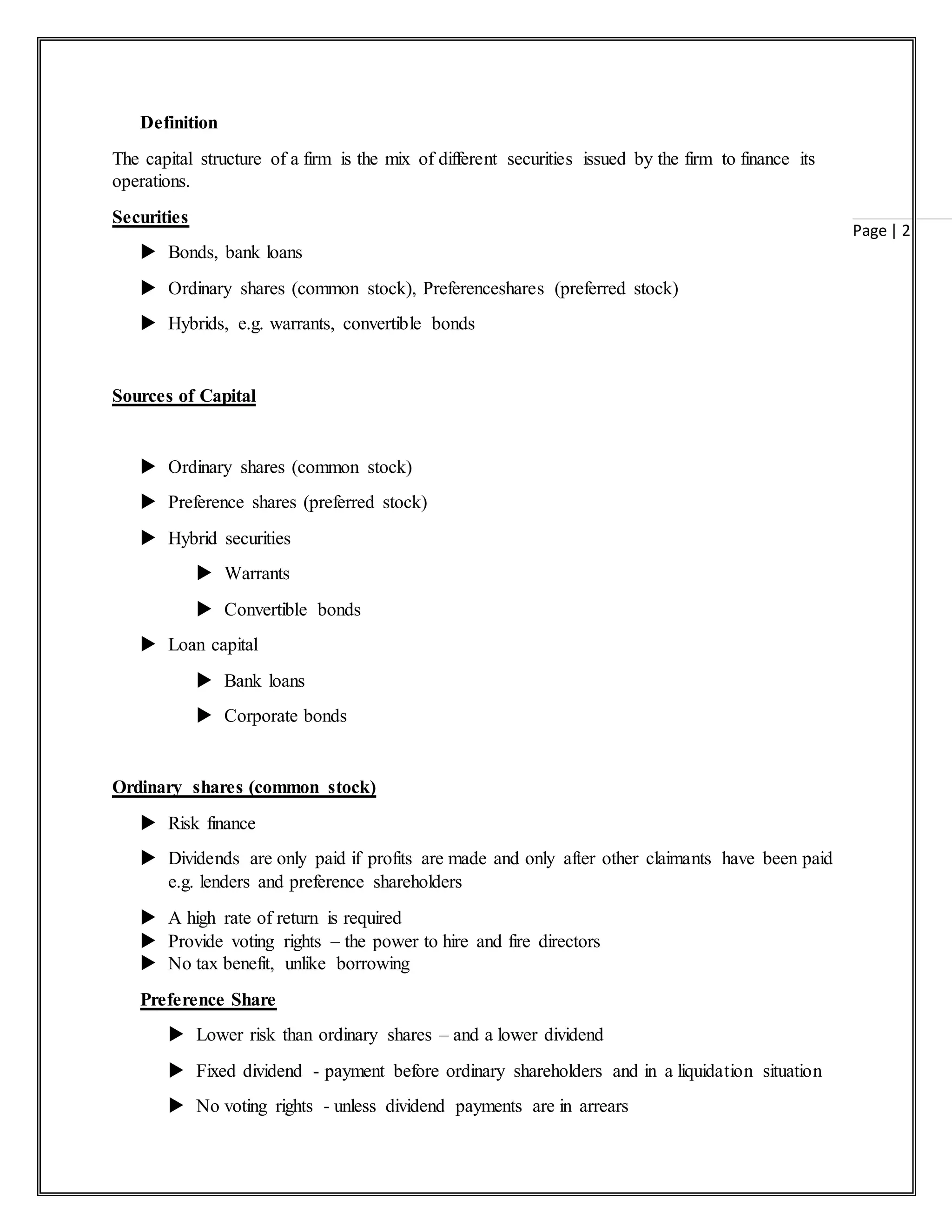
Definition
The capital structure of a firm is the mix of different securities issued by the firm to finance its
operations.
Securities
 Bonds, bank loans
 Ordinary shares (common stock), Preferenceshares (preferred stock)
 Hybrids, e.g. warrants, convertible bonds
Sources of Capital
 Ordinary shares (common stock)
 Preference shares (preferred stock)
 Hybrid securities
 Warrants
 Convertible bonds
 Loan capital
 Bank loans
 Corporate bonds
Ordinary shares (common stock)
 Risk finance
 Dividends are only paid if profits are made and only after other claimants have been paid
e.g. lenders and preference shareholders
 A high rate of return is required
 Provide voting rights – the power to hire and fire directors
 No tax benefit, unlike borrowing
Preference Share
 Lower risk than ordinary shares – and a lower dividend
 Fixed dividend - payment before ordinary shareholders and in a liquidation situation
 No voting rights - unless dividend payments are in arrears
Page | 3
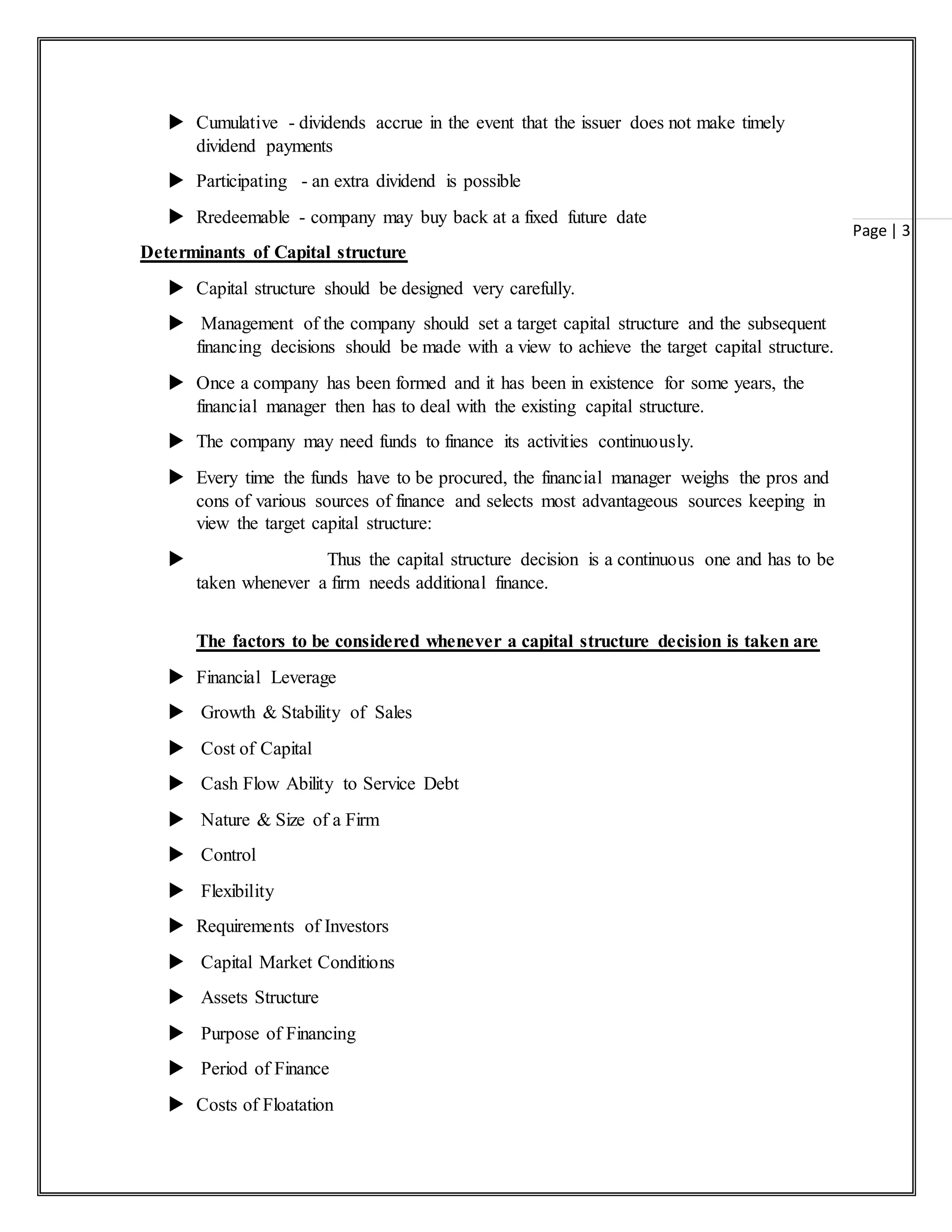
 Cumulative - dividends accrue in the event that the issuer does not make timely
dividend payments
 Participating - an extra dividend is possible
 Rredeemable - company may buy back at a fixed future date
Determinants of Capital structure
 Capital structure should be designed very carefully.
 Management of the company should set a target capital structure and the subsequent
financing decisions should be made with a view to achieve the target capital structure.
 Once a company has been formed and it has been in existence for some years, the
financial manager then has to deal with the existing capital structure.
 The company may need funds to finance its activities continuously.
 Every time the funds have to be procured, the financial manager weighs the pros and
cons of various sources of finance and selects most advantageous sources keeping in
view the target capital structure:
 Thus the capital structure decision is a continuous one and has to be
taken whenever a firm needs additional finance.
The factors to be considered whenever a capital structure decision is taken are
 Financial Leverage
 Growth & Stability of Sales
 Cost of Capital
 Cash Flow Ability to Service Debt
 Nature & Size of a Firm
 Control
 Flexibility
 Requirements of Investors
 Capital Market Conditions
 Assets Structure
 Purpose of Financing
 Period of Finance
 Costs of Floatation
Page | 4
 Personal Considerations
 Corporate Tax Rate
 Legal Requirements
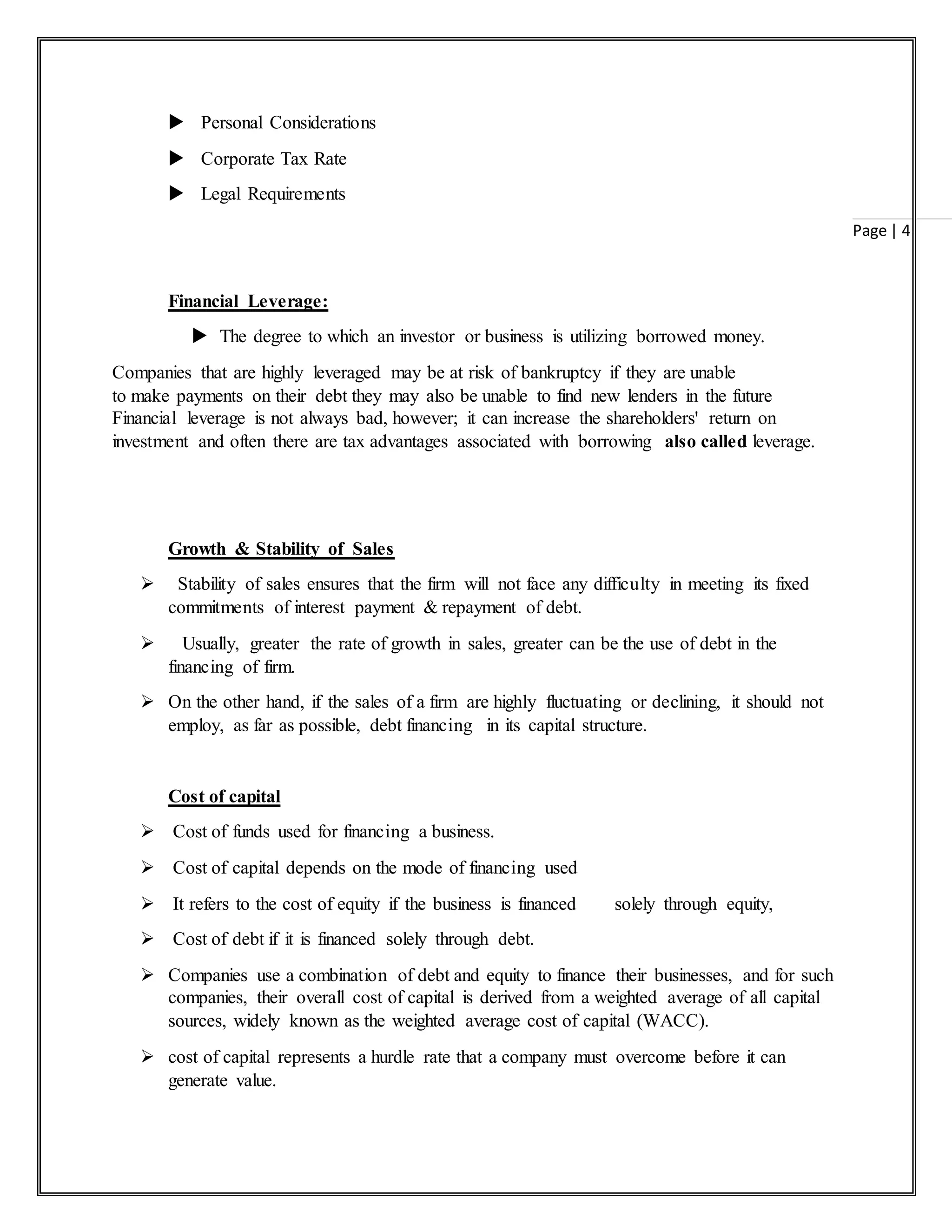
Financial Leverage:
 The degree to which an investor or business is utilizing borrowed money.
Companies that are highly leveraged may be at risk of bankruptcy if they are unable
to make payments on their debt they may also be unable to find new lenders in the future
Financial leverage is not always bad, however; it can increase the shareholders' return on
investment and often there are tax advantages associated with borrowing also called leverage.
Growth & Stability of Sales
 Stability of sales ensures that the firm will not face any difficulty in meeting its fixed
commitments of interest payment & repayment of debt.
 Usually, greater the rate of growth in sales, greater can be the use of debt in the
financing of firm.
 On the other hand, if the sales of a firm are highly fluctuating or declining, it should not
employ, as far as possible, debt financing in its capital structure.
Cost of capital
 Cost of funds used for financing a business.
 Cost of capital depends on the mode of financing used
 It refers to the cost of equity if the business is financed solely through equity,
 Cost of debt if it is financed solely through debt.
 Companies use a combination of debt and equity to finance their businesses, and for such
companies, their overall cost of capital is derived from a weighted average of all capital
sources, widely known as the weighted average cost of capital (WACC).
 cost of capital represents a hurdle rate that a company must overcome before it can
generate value.
Page | 5
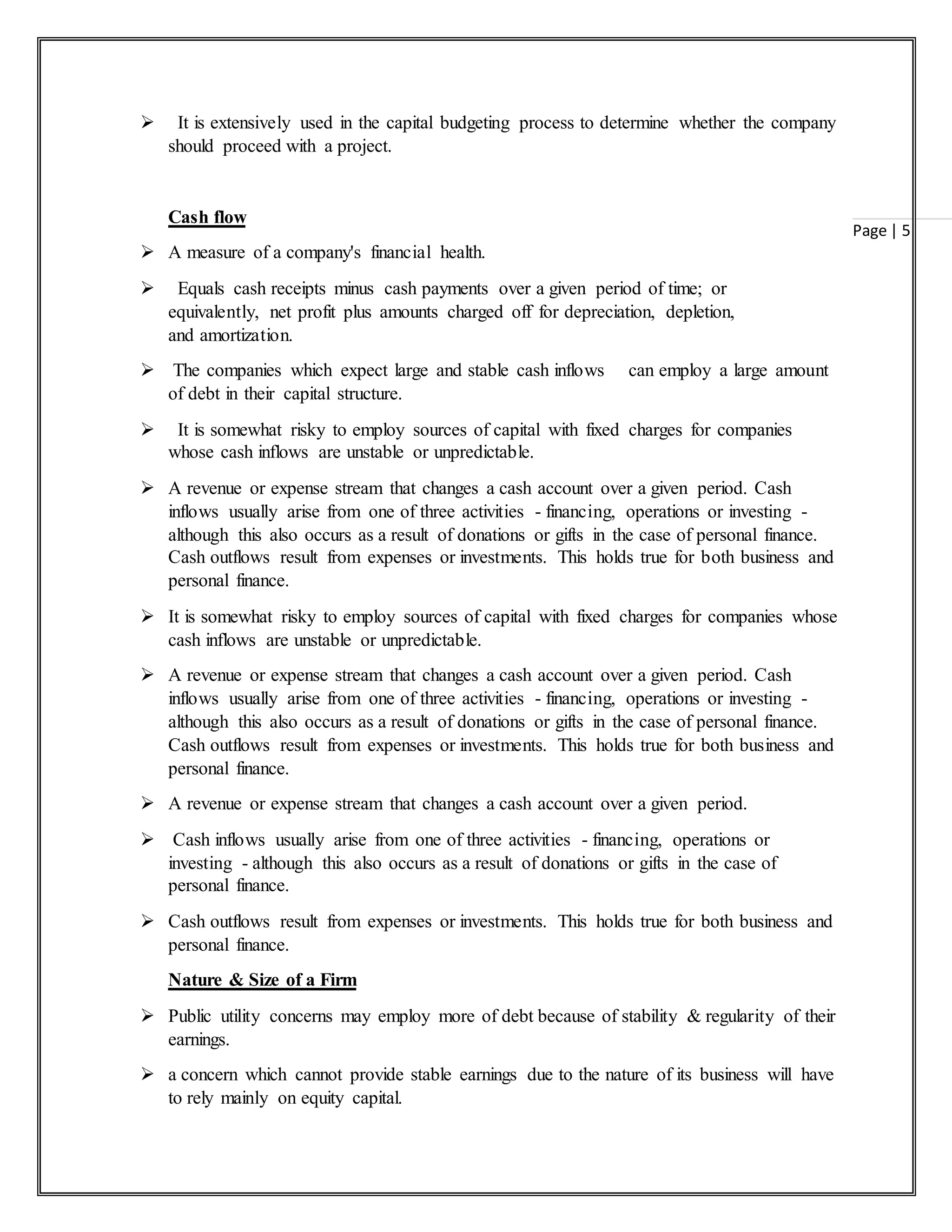
 It is extensively used in the capital budgeting process to determine whether the company
should proceed with a project.
Cash flow
 A measure of a company's financial health.
 Equals cash receipts minus cash payments over a given period of time; or
equivalently, net profit plus amounts charged off for depreciation, depletion,
and amortization.
 The companies which expect large and stable cash inflows can employ a large amount
of debt in their capital structure.
 It is somewhat risky to employ sources of capital with fixed charges for companies
whose cash inflows are unstable or unpredictable.
 A revenue or expense stream that changes a cash account over a given period. Cash
inflows usually arise from one of three activities - financing, operations or investing -
although this also occurs as a result of donations or gifts in the case of personal finance.
Cash outflows result from expenses or investments. This holds true for both business and
personal finance.
 It is somewhat risky to employ sources of capital with fixed charges for companies whose
cash inflows are unstable or unpredictable.
 A revenue or expense stream that changes a cash account over a given period. Cash
inflows usually arise from one of three activities - financing, operations or investing -
although this also occurs as a result of donations or gifts in the case of personal finance.
Cash outflows result from expenses or investments. This holds true for both business and
personal finance.
 A revenue or expense stream that changes a cash account over a given period.
 Cash inflows usually arise from one of three activities - financing, operations or
investing - although this also occurs as a result of donations or gifts in the case of
personal finance.
 Cash outflows result from expenses or investments. This holds true for both business and
personal finance.
Nature & Size of a Firm
 Public utility concerns may employ more of debt because of stability & regularity of their
earnings.
 a concern which cannot provide stable earnings due to the nature of its business will have
to rely mainly on equity capital.
Page | 6
 Small companies have to depend mainly upon owned capital as it is very difficult for
them to raise long-term loans on reasonable terms.
Control
 Whenever additional funds are required by a firm, the management of the firm wants to
raise the funds without any loss of control over the firm.
 The control of the existing shareholders is diluted. Hence, they might raise the additional
funds by way of fixed interest bearing debt & preference share capital.
 Preference shareholders & debentures holders do not have the voting right. Hence, from
the point of view of control, debt financing is recommended.
Flexibility
Capital structure should be as capable of being adjusted according to the needs of
the changing conditions.
It should be in such a manner that it can substitute one form of financing by
another. Redeemable preference shares & convertible debentures may be preferred on
account of flexibility.
Requirements of Investors
 It is necessary to meet the requirements of both institutional as well as private investors
when debt financing is used.
 Investors are generally classified under three kinds. i:e. Bold investors, Cautious
investors & Less cautious investors.
Capital Market condition
 Capital market conditions do not remain the same for ever. Sometimes there may be
depression while at other times there may be boom in the market.
 Securities is also influenced by the market conditions.
 Share market is depressed & there are pessimistic business conditions, the company
should not issue equity shares as investors would prefer safety. But in case there is boom
period, it would be advisable to issue equity shares.
Page | 7
Asset Structure
 The liquidity & the composition of assets should also be kept in mind while selecting the
capital structure.
 If fixed assets constitute a major portion of the total assets of the company, it may be
possible for the company to raise more of long term debts.
Purpose of Financing
 If funds are required for a productive purpose, debt financing is suitable & the company
should issue debentures as interest can be paid out of the profits generated from the
investment.
 If the funds are required for unproductive purpose or general development on permanent
basis, we should prefer equity capital.
Period of Finance
 Period for which the finances are required is also an important factor to be kept in mind
while selecting an appropriate capital mix.
 If the finances are required for a limited period of, seven years, debentures should be
preferred to shares.
 In case funds are needed on permanent basis, equity share capital is more appropriate.
Cost of Flotation
 Although not very significant, yet costs of floatation of various kinds of securities should
also be considered while raising funds.
 The cost of floating a debt is generally less than the cost of floating an equity & hence it
may persuade the management to raise debt financing.
 The costs of floating as a percentage of total funds decrease with the increase in size of
the issue.
Personal consideration
 The personal considerations & abilities of the management will have the final say on the
capital structure of a firm.
 Managements which are experienced & are very enterprising do not hesitate to use more
of debt in their financing as compared to the less experienced & conservative
management.
Page | 8
Corporate Tax Rate
 High rate of corporate taxes on profits compel the companies to prefer debt financing,
because interest is allowed to be deducted while computing taxable profits.
 On the other hand, dividend on shares is not an allowable expense for that purpose.
Legal requirements
 The government has also issued certain guidelines for the issue of shares & debentures.
 The legal restrictions are very significant as these lay down a framework within which
capital structure decision has to be made.
Capital structure theories
1- Net Income Approach (NI)
 Suggested by Durand
 It says a change in the capital structure will lead to a corresponding change in the overall
cost of capital as well as the total value of the firm
 If the ratio of debt to equity is increased, the weighted average cost of capital will
decline, while the value of the firm will increase and vice versa
Assumptions:
1. There are no taxes
2. That the cost of debt is less than the equity capitalization rate or cost of equity
3. That the use of debt does not change the risk-perception of investors.
2- Net operating Income (NOI) Approach
 Also suggested by durand
 This approach is diametrically opposite to the net income approach
 Any change in leverage or debt will not lead to any change in the total value of the firm
as the overall cost of capital is independent of the degree of leverage
 The significant feature is that the equity capitalization rate, increases with the increase in
the degree of leverage. The equity capitalization rate decreases with the decrease in the
degree of leverage.
Page | 9
3-Modigliani-Miller (MM) Approach
 Suggested by Modigliani Miller
 MM is similar to NOI approach
 It suggests that the cost of capital of the firm is an independent factor and has no concern
with the capital structure
 This theory implies that any change in capital structure of the concern does not affect the
cost of capital.
4-Traditional Approach
 This approach is a mid way between NI approach and NOI approach.

Capital structure and its Determinants

  • 1.
    Page | 1 Assignment Topic:Capital structure determinants Muhammad Minhas Azeem Msc Applied Chemistry Department of Applied Chemistry and Bio-technology GC University Faisalabad, Pakistan Capital structure and its Determinants
  • 2.
    Page | 2 Definition Thecapital structure of a firm is the mix of different securities issued by the firm to finance its operations. Securities  Bonds, bank loans  Ordinary shares (common stock), Preferenceshares (preferred stock)  Hybrids, e.g. warrants, convertible bonds Sources of Capital  Ordinary shares (common stock)  Preference shares (preferred stock)  Hybrid securities  Warrants  Convertible bonds  Loan capital  Bank loans  Corporate bonds Ordinary shares (common stock)  Risk finance  Dividends are only paid if profits are made and only after other claimants have been paid e.g. lenders and preference shareholders  A high rate of return is required  Provide voting rights – the power to hire and fire directors  No tax benefit, unlike borrowing Preference Share  Lower risk than ordinary shares – and a lower dividend  Fixed dividend - payment before ordinary shareholders and in a liquidation situation  No voting rights - unless dividend payments are in arrears
  • 3.
    Page | 3 Cumulative - dividends accrue in the event that the issuer does not make timely dividend payments  Participating - an extra dividend is possible  Rredeemable - company may buy back at a fixed future date Determinants of Capital structure  Capital structure should be designed very carefully.  Management of the company should set a target capital structure and the subsequent financing decisions should be made with a view to achieve the target capital structure.  Once a company has been formed and it has been in existence for some years, the financial manager then has to deal with the existing capital structure.  The company may need funds to finance its activities continuously.  Every time the funds have to be procured, the financial manager weighs the pros and cons of various sources of finance and selects most advantageous sources keeping in view the target capital structure:  Thus the capital structure decision is a continuous one and has to be taken whenever a firm needs additional finance. The factors to be considered whenever a capital structure decision is taken are  Financial Leverage  Growth & Stability of Sales  Cost of Capital  Cash Flow Ability to Service Debt  Nature & Size of a Firm  Control  Flexibility  Requirements of Investors  Capital Market Conditions  Assets Structure  Purpose of Financing  Period of Finance  Costs of Floatation
  • 4.
    Page | 4 Personal Considerations  Corporate Tax Rate  Legal Requirements Financial Leverage:  The degree to which an investor or business is utilizing borrowed money. Companies that are highly leveraged may be at risk of bankruptcy if they are unable to make payments on their debt they may also be unable to find new lenders in the future Financial leverage is not always bad, however; it can increase the shareholders' return on investment and often there are tax advantages associated with borrowing also called leverage. Growth & Stability of Sales  Stability of sales ensures that the firm will not face any difficulty in meeting its fixed commitments of interest payment & repayment of debt.  Usually, greater the rate of growth in sales, greater can be the use of debt in the financing of firm.  On the other hand, if the sales of a firm are highly fluctuating or declining, it should not employ, as far as possible, debt financing in its capital structure. Cost of capital  Cost of funds used for financing a business.  Cost of capital depends on the mode of financing used  It refers to the cost of equity if the business is financed solely through equity,  Cost of debt if it is financed solely through debt.  Companies use a combination of debt and equity to finance their businesses, and for such companies, their overall cost of capital is derived from a weighted average of all capital sources, widely known as the weighted average cost of capital (WACC).  cost of capital represents a hurdle rate that a company must overcome before it can generate value.
  • 5.
    Page | 5 It is extensively used in the capital budgeting process to determine whether the company should proceed with a project. Cash flow  A measure of a company's financial health.  Equals cash receipts minus cash payments over a given period of time; or equivalently, net profit plus amounts charged off for depreciation, depletion, and amortization.  The companies which expect large and stable cash inflows can employ a large amount of debt in their capital structure.  It is somewhat risky to employ sources of capital with fixed charges for companies whose cash inflows are unstable or unpredictable.  A revenue or expense stream that changes a cash account over a given period. Cash inflows usually arise from one of three activities - financing, operations or investing - although this also occurs as a result of donations or gifts in the case of personal finance. Cash outflows result from expenses or investments. This holds true for both business and personal finance.  It is somewhat risky to employ sources of capital with fixed charges for companies whose cash inflows are unstable or unpredictable.  A revenue or expense stream that changes a cash account over a given period. Cash inflows usually arise from one of three activities - financing, operations or investing - although this also occurs as a result of donations or gifts in the case of personal finance. Cash outflows result from expenses or investments. This holds true for both business and personal finance.  A revenue or expense stream that changes a cash account over a given period.  Cash inflows usually arise from one of three activities - financing, operations or investing - although this also occurs as a result of donations or gifts in the case of personal finance.  Cash outflows result from expenses or investments. This holds true for both business and personal finance. Nature & Size of a Firm  Public utility concerns may employ more of debt because of stability & regularity of their earnings.  a concern which cannot provide stable earnings due to the nature of its business will have to rely mainly on equity capital.
  • 6.
    Page | 6 Small companies have to depend mainly upon owned capital as it is very difficult for them to raise long-term loans on reasonable terms. Control  Whenever additional funds are required by a firm, the management of the firm wants to raise the funds without any loss of control over the firm.  The control of the existing shareholders is diluted. Hence, they might raise the additional funds by way of fixed interest bearing debt & preference share capital.  Preference shareholders & debentures holders do not have the voting right. Hence, from the point of view of control, debt financing is recommended. Flexibility Capital structure should be as capable of being adjusted according to the needs of the changing conditions. It should be in such a manner that it can substitute one form of financing by another. Redeemable preference shares & convertible debentures may be preferred on account of flexibility. Requirements of Investors  It is necessary to meet the requirements of both institutional as well as private investors when debt financing is used.  Investors are generally classified under three kinds. i:e. Bold investors, Cautious investors & Less cautious investors. Capital Market condition  Capital market conditions do not remain the same for ever. Sometimes there may be depression while at other times there may be boom in the market.  Securities is also influenced by the market conditions.  Share market is depressed & there are pessimistic business conditions, the company should not issue equity shares as investors would prefer safety. But in case there is boom period, it would be advisable to issue equity shares.
  • 7.
    Page | 7 AssetStructure  The liquidity & the composition of assets should also be kept in mind while selecting the capital structure.  If fixed assets constitute a major portion of the total assets of the company, it may be possible for the company to raise more of long term debts. Purpose of Financing  If funds are required for a productive purpose, debt financing is suitable & the company should issue debentures as interest can be paid out of the profits generated from the investment.  If the funds are required for unproductive purpose or general development on permanent basis, we should prefer equity capital. Period of Finance  Period for which the finances are required is also an important factor to be kept in mind while selecting an appropriate capital mix.  If the finances are required for a limited period of, seven years, debentures should be preferred to shares.  In case funds are needed on permanent basis, equity share capital is more appropriate. Cost of Flotation  Although not very significant, yet costs of floatation of various kinds of securities should also be considered while raising funds.  The cost of floating a debt is generally less than the cost of floating an equity & hence it may persuade the management to raise debt financing.  The costs of floating as a percentage of total funds decrease with the increase in size of the issue. Personal consideration  The personal considerations & abilities of the management will have the final say on the capital structure of a firm.  Managements which are experienced & are very enterprising do not hesitate to use more of debt in their financing as compared to the less experienced & conservative management.
  • 8.
    Page | 8 CorporateTax Rate  High rate of corporate taxes on profits compel the companies to prefer debt financing, because interest is allowed to be deducted while computing taxable profits.  On the other hand, dividend on shares is not an allowable expense for that purpose. Legal requirements  The government has also issued certain guidelines for the issue of shares & debentures.  The legal restrictions are very significant as these lay down a framework within which capital structure decision has to be made. Capital structure theories 1- Net Income Approach (NI)  Suggested by Durand  It says a change in the capital structure will lead to a corresponding change in the overall cost of capital as well as the total value of the firm  If the ratio of debt to equity is increased, the weighted average cost of capital will decline, while the value of the firm will increase and vice versa Assumptions: 1. There are no taxes 2. That the cost of debt is less than the equity capitalization rate or cost of equity 3. That the use of debt does not change the risk-perception of investors. 2- Net operating Income (NOI) Approach  Also suggested by durand  This approach is diametrically opposite to the net income approach  Any change in leverage or debt will not lead to any change in the total value of the firm as the overall cost of capital is independent of the degree of leverage  The significant feature is that the equity capitalization rate, increases with the increase in the degree of leverage. The equity capitalization rate decreases with the decrease in the degree of leverage.
  • 9.
    Page | 9 3-Modigliani-Miller(MM) Approach  Suggested by Modigliani Miller  MM is similar to NOI approach  It suggests that the cost of capital of the firm is an independent factor and has no concern with the capital structure  This theory implies that any change in capital structure of the concern does not affect the cost of capital. 4-Traditional Approach  This approach is a mid way between NI approach and NOI approach.