DETERMINANTS OF
CAPITAL STRUCTURE
1. Tax Benefit of Debt:
Interest on debt finance is tax deductible expense. To avail the tax
benefit, firm can use more debt, which helps in shareholder’s wealth
maximization.
When tax rate is high----- firm wants to avail tax benefit----- use
more debt--------because the usage if more debt in high tax rate
provides more tax benefit.
When tax rate is low-----------prefer equity
2. Flexibility:
Flexibility means firm’s ability to adjust its capital structure to the
needs of changing environment. Whenever needed the company
should be able to raise funds without undue delay and cost to finance
the profitable investment.
3. Control:
Whenever company issues new share, it introduce new shareholders
which shares the ownership and control with the existing
shareholders. If existing equity shareholders does not want to dilute
the control--------debt is more suitable for financing in such cases.
• if they don not mind sharing control---------------use equity
4. Seasonal Variation:
When the firm is seasonal in nature--------- prefer less debt.
For example: Business such as production and sale of umbrellas, fans, air
coolers use less debt capital in their capital structure. Use of more debt may
make the firm unable to pay interest obligation in lean period, which would
lead to financial distress.
When firm is non seasonal in nature------------------------ prefer more debt
For example: Business such as production and sale of consumer non durable
products( food items etc.),which have an inelastic demand are not likely to
be wider fluctuations in sales can use more debt in their capital structure,
since they are able to earn regular profit.
5. Degree of competition:
When there is less competition--------------------------use less equity or more
debt in their capital structure, since they can sell more products at higher
prices.
Example : public utility corporations like gas, electricity etc.
When there is more competition---------------------- use more equity or less
debt because firm may not be able to sell more units and cannot earn more
profits.
Example: Garment industry , home appliances industry etc.
6. Industry life cycle:
The industry life cycle consists of introduction stage, growth stage, maturity
stage and declining stage.
In introduction stage--------------use less debt or more equity , since the profit
earning capacity is less due to less sales.
In growth stage------have more profits---------use more debt or less equity swill
helps to maximize the shareholders wealth.
7. Agency Cost:
In practice, there may exists conflicts of interest among shareholders, debt
holders and management. These conflict give rise to agency problems, which
involve agency cost.
Shareholders and managers conflict: Managers may transfer shareholders
wealth to their advantage by increasing their compensation and perquisites.
Shareholders and debt holders conflict: it arises because of possibility of
shareholders transferring the wealth of debt holders to their own favor.
“So, the financial strategy of the firm seek to minimize agency cost.
Management should use the debt to that extent that it maximizes the
shareholders wealth.”
8. Size of the firm:
Small firms have to depend on owners fund for financing activities as compared to
large firms. On the other hand, large firms are forced to make use of different
sources of funds, because no single source is sufficient to their needs.
9. Period of Finance:
When the firm needs finance for unlimited period------- equity share capital is the
best source.
When the firm needs finance for limited period---------------redeemable
debentures or preference share is the best source.
10. Purpose of Finance:
When the finance is needed for productive purpose ( like for purchase of
machinery)---------------- debt is suitable.
When the finance is need for unproductive purpose ( like for social responsibility
of general development)------------equity share capital is the best source.
11. Credit Rating Charactertics: (capacity of the firm meet financial obligations)
Firm enjoying high credit rating may get funds easily from the capital market as
compared to firms having low credit rating. Because investor and creditor prefer
to invest and grant loans to high credit rating firms, since the risk is less.
12. Timing of Public Issue:
Public offering should be made at a time when state of the economy as well
as capital market is ideal to provide the funds. Example: during 2003 to 2004
period, many firms like Vijaya bank, Union bank, NTPC come up with IPO due
to ideal capital market and economy.
13. Requirement of Investors:
Some investors are ready to take risk (Bold Investor), who prefer capital gain
and control-------------- equity shares are preferred by them.
Investors who are interested in safety of their investment and stable returns
(Conservative Investors), prefer to investment in debentures.
Investors who are less cautious who prefer stable returns and share in profit,
preference share more suitable to them.
14. Legal Requirements:
There are some guidelines on shares and debentures issued by the
government that are very important for the construction of capital structure.
For Example: Stock Exchange Board of India grant consent for capital issue
when—debt equity ratio does not exceed 2:1, ratio of preference capital to
equity capital does not exceed 1:3, promoters hold atleast 25 percent of
equity capital.
15. Cash Flow Position:
Enough Cash Flow--------------------------use more debt or less equity.
Shortage of cash flow---------------------use more equity or less debt.
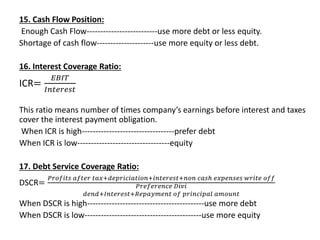
16. Interest Coverage Ratio:
ICR=
𝐸𝐵𝐼𝑇
𝐼𝑛𝑡𝑒𝑟𝑒𝑠𝑡
This ratio means number of times company’s earnings before interest and taxes
cover the interest payment obligation.
When ICR is high----------------------------------prefer debt
When ICR is low----------------------------------equity
17. Debt Service Coverage Ratio:
DSCR=
𝑃𝑟𝑜𝑓𝑖𝑡𝑠 𝑎𝑓𝑡𝑒𝑟 𝑡𝑎𝑥+𝑑𝑒𝑝𝑟𝑖𝑐𝑖𝑎𝑡𝑖𝑜𝑛+𝑖𝑛𝑡𝑒𝑟𝑒𝑠𝑡+𝑛𝑜𝑛 𝑐𝑎𝑠ℎ 𝑒𝑥𝑝𝑒𝑛𝑠𝑒𝑠 𝑤𝑟𝑖𝑡𝑒 𝑜𝑓𝑓
𝑃𝑟𝑒𝑓𝑒𝑟𝑒𝑛𝑐𝑒 𝐷𝑖𝑣𝑖
𝑑𝑒𝑛𝑑+𝐼𝑛𝑡𝑒𝑟𝑒𝑠𝑡+𝑅𝑒𝑝𝑎𝑦𝑚𝑒𝑛𝑡 𝑜𝑓 𝑝𝑟𝑖𝑛𝑐𝑖𝑝𝑎𝑙 𝑎𝑚𝑜𝑢𝑛𝑡
When DSCR is high-------------------------------------------use more debt
When DSCR is low-------------------------------------------use more equity
18. Return of investment:
If rate of investment > rate of interest---------------prefer debt
If rate of investment < rate of interest---------------prefer equity
19. Flotation Cost:
Generally flotation cost of debenture is less than the cost of equity.
This may influence financial manager to use the cheapest finance .i.e. debt.
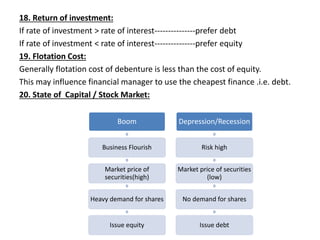
20. State of Capital / Stock Market:
Boom
Business Flourish
Market price of
securities(high)
Heavy demand for shares
Issue equity
Depression/Recession
Risk high
Market price of securities
(low)
No demand for shares
Issue debt
21. Risk Consideration:
Financial Risk: when company is unable to meet its fixed financial charges. i.e.
interest payment to debenture holders
Operating Risk: arise when company is unable to meet its operating cost
Risk Low--------------------------- issue Debt
Risk High---------------------------issue equity
22. Capital Structure of other companies:
Company in one industry produce almost similar products and use similar
sources of funding and debt/equity mix. So when making decision on the
capital structure, it’s useful to take a look at debt/equity prevalent in selected
industry.

Factors affecting capital structure

  • 1.
  • 2.
    1. Tax Benefitof Debt: Interest on debt finance is tax deductible expense. To avail the tax benefit, firm can use more debt, which helps in shareholder’s wealth maximization. When tax rate is high----- firm wants to avail tax benefit----- use more debt--------because the usage if more debt in high tax rate provides more tax benefit. When tax rate is low-----------prefer equity 2. Flexibility: Flexibility means firm’s ability to adjust its capital structure to the needs of changing environment. Whenever needed the company should be able to raise funds without undue delay and cost to finance the profitable investment. 3. Control: Whenever company issues new share, it introduce new shareholders which shares the ownership and control with the existing shareholders. If existing equity shareholders does not want to dilute the control--------debt is more suitable for financing in such cases. • if they don not mind sharing control---------------use equity
  • 3.
    4. Seasonal Variation: Whenthe firm is seasonal in nature--------- prefer less debt. For example: Business such as production and sale of umbrellas, fans, air coolers use less debt capital in their capital structure. Use of more debt may make the firm unable to pay interest obligation in lean period, which would lead to financial distress. When firm is non seasonal in nature------------------------ prefer more debt For example: Business such as production and sale of consumer non durable products( food items etc.),which have an inelastic demand are not likely to be wider fluctuations in sales can use more debt in their capital structure, since they are able to earn regular profit. 5. Degree of competition: When there is less competition--------------------------use less equity or more debt in their capital structure, since they can sell more products at higher prices. Example : public utility corporations like gas, electricity etc. When there is more competition---------------------- use more equity or less debt because firm may not be able to sell more units and cannot earn more profits. Example: Garment industry , home appliances industry etc.
  • 4.
    6. Industry lifecycle: The industry life cycle consists of introduction stage, growth stage, maturity stage and declining stage. In introduction stage--------------use less debt or more equity , since the profit earning capacity is less due to less sales. In growth stage------have more profits---------use more debt or less equity swill helps to maximize the shareholders wealth. 7. Agency Cost: In practice, there may exists conflicts of interest among shareholders, debt holders and management. These conflict give rise to agency problems, which involve agency cost. Shareholders and managers conflict: Managers may transfer shareholders wealth to their advantage by increasing their compensation and perquisites. Shareholders and debt holders conflict: it arises because of possibility of shareholders transferring the wealth of debt holders to their own favor. “So, the financial strategy of the firm seek to minimize agency cost. Management should use the debt to that extent that it maximizes the shareholders wealth.”
  • 5.
    8. Size ofthe firm: Small firms have to depend on owners fund for financing activities as compared to large firms. On the other hand, large firms are forced to make use of different sources of funds, because no single source is sufficient to their needs. 9. Period of Finance: When the firm needs finance for unlimited period------- equity share capital is the best source. When the firm needs finance for limited period---------------redeemable debentures or preference share is the best source. 10. Purpose of Finance: When the finance is needed for productive purpose ( like for purchase of machinery)---------------- debt is suitable. When the finance is need for unproductive purpose ( like for social responsibility of general development)------------equity share capital is the best source. 11. Credit Rating Charactertics: (capacity of the firm meet financial obligations) Firm enjoying high credit rating may get funds easily from the capital market as compared to firms having low credit rating. Because investor and creditor prefer to invest and grant loans to high credit rating firms, since the risk is less.
  • 6.
    12. Timing ofPublic Issue: Public offering should be made at a time when state of the economy as well as capital market is ideal to provide the funds. Example: during 2003 to 2004 period, many firms like Vijaya bank, Union bank, NTPC come up with IPO due to ideal capital market and economy. 13. Requirement of Investors: Some investors are ready to take risk (Bold Investor), who prefer capital gain and control-------------- equity shares are preferred by them. Investors who are interested in safety of their investment and stable returns (Conservative Investors), prefer to investment in debentures. Investors who are less cautious who prefer stable returns and share in profit, preference share more suitable to them. 14. Legal Requirements: There are some guidelines on shares and debentures issued by the government that are very important for the construction of capital structure. For Example: Stock Exchange Board of India grant consent for capital issue when—debt equity ratio does not exceed 2:1, ratio of preference capital to equity capital does not exceed 1:3, promoters hold atleast 25 percent of equity capital.
  • 7.
    15. Cash FlowPosition: Enough Cash Flow--------------------------use more debt or less equity. Shortage of cash flow---------------------use more equity or less debt. 16. Interest Coverage Ratio: ICR= 𝐸𝐵𝐼𝑇 𝐼𝑛𝑡𝑒𝑟𝑒𝑠𝑡 This ratio means number of times company’s earnings before interest and taxes cover the interest payment obligation. When ICR is high----------------------------------prefer debt When ICR is low----------------------------------equity 17. Debt Service Coverage Ratio: DSCR= 𝑃𝑟𝑜𝑓𝑖𝑡𝑠 𝑎𝑓𝑡𝑒𝑟 𝑡𝑎𝑥+𝑑𝑒𝑝𝑟𝑖𝑐𝑖𝑎𝑡𝑖𝑜𝑛+𝑖𝑛𝑡𝑒𝑟𝑒𝑠𝑡+𝑛𝑜𝑛 𝑐𝑎𝑠ℎ 𝑒𝑥𝑝𝑒𝑛𝑠𝑒𝑠 𝑤𝑟𝑖𝑡𝑒 𝑜𝑓𝑓 𝑃𝑟𝑒𝑓𝑒𝑟𝑒𝑛𝑐𝑒 𝐷𝑖𝑣𝑖 𝑑𝑒𝑛𝑑+𝐼𝑛𝑡𝑒𝑟𝑒𝑠𝑡+𝑅𝑒𝑝𝑎𝑦𝑚𝑒𝑛𝑡 𝑜𝑓 𝑝𝑟𝑖𝑛𝑐𝑖𝑝𝑎𝑙 𝑎𝑚𝑜𝑢𝑛𝑡 When DSCR is high-------------------------------------------use more debt When DSCR is low-------------------------------------------use more equity
  • 8.
    18. Return ofinvestment: If rate of investment > rate of interest---------------prefer debt If rate of investment < rate of interest---------------prefer equity 19. Flotation Cost: Generally flotation cost of debenture is less than the cost of equity. This may influence financial manager to use the cheapest finance .i.e. debt. 20. State of Capital / Stock Market: Boom Business Flourish Market price of securities(high) Heavy demand for shares Issue equity Depression/Recession Risk high Market price of securities (low) No demand for shares Issue debt
  • 9.
    21. Risk Consideration: FinancialRisk: when company is unable to meet its fixed financial charges. i.e. interest payment to debenture holders Operating Risk: arise when company is unable to meet its operating cost Risk Low--------------------------- issue Debt Risk High---------------------------issue equity 22. Capital Structure of other companies: Company in one industry produce almost similar products and use similar sources of funding and debt/equity mix. So when making decision on the capital structure, it’s useful to take a look at debt/equity prevalent in selected industry.