MALLORY-WEISS SYNDROMEMALLORY-WEISS SYNDROME
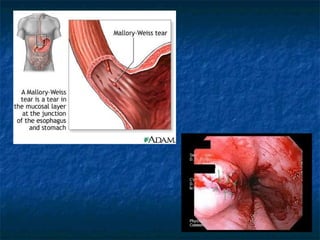
 Vigorous vomiting-vert split in the gastricVigorous vomiting-vert split in the gastric
mucosa (below sc jn at the cardia)- 90%mucosa (below sc jn at the cardia)- 90%
 Tear in the oesophagus-10%Tear in the oesophagus-10%
 Presents with hematemesisPresents with hematemesis
 endoscopic injection therapy requird 4 severeendoscopic injection therapy requird 4 severe
casescases
CORROSIVE INJURYCORROSIVE INJURY
 Corrosive-sod hydroxide,sulphuric acidCorrosive-sod hydroxide,sulphuric acid
 Accidental ingestion-damageAccidental ingestion-damage
2nouth,pharynx,larynx,oeso,stomach2nouth,pharynx,larynx,oeso,stomach
 Alkalies causeliquifaction,saponification ofAlkalies causeliquifaction,saponification of
fat,dehydration and thrombosis of bv- fibrousfat,dehydration and thrombosis of bv- fibrous
scarringscarring
 Acids-coagulative necrosis with eschar formationAcids-coagulative necrosis with eschar formation
-causes intense pylorospasm with pooling-causes intense pylorospasm with pooling
in the antrum(more gastric damage)in the antrum(more gastric damage)
Investigaion- endoscopy
-deep ulcers n black eschars-greatest
risk of perforation
Managemnt-minor injury- pt safely fed
sev injury-feeding jejunostomy
Complication-stricture formation-50%
(oeso resection)
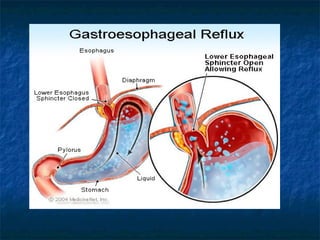
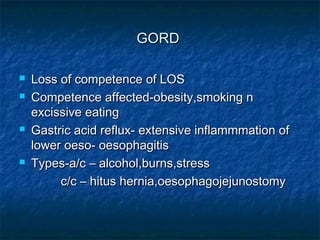
GORDGORD
 Loss of competence of LOSLoss of competence of LOS
 Competence affected-obesity,smoking nCompetence affected-obesity,smoking n
excissive eatingexcissive eating
 Gastric acid reflux- extensive inflammmation ofGastric acid reflux- extensive inflammmation of
lower oeso- oesophagitislower oeso- oesophagitis
 Types-a/c – alcohol,burns,stressTypes-a/c – alcohol,burns,stress
c/c – hitus hernia,oesophagojejunostomyc/c – hitus hernia,oesophagojejunostomy
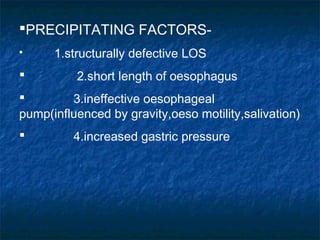
PRECIPITATING FACTORS-
 1.structurally defective LOS
 2.short length of oesophagus
 3.ineffective oesophageal
pump(influenced by gravity,oeso motility,salivation)
 4.increased gastric pressure
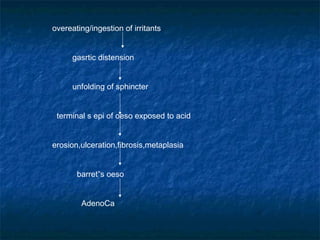
overeating/ingestion of irritants
gasrtic distension
unfolding of sphincter
terminal s epi of oeso exposed to acid
erosion,ulceration,fibrosis,metaplasia
barret”s oeso
AdenoCa
AetiopathogenesisAetiopathogenesis
 Acid reflux to LOS – diffuse inflmn withAcid reflux to LOS – diffuse inflmn with
multiple ulcersmultiple ulcers
 Symptoms worse when patient lies downSymptoms worse when patient lies down
 Vicious cycleVicious cycle
 vagal hypersensitivity – oesophagitis –vagal hypersensitivity – oesophagitis –
long muscle spasm – displacement oflong muscle spasm – displacement of
oesophagus – increased regurgitationoesophagus – increased regurgitation
CLINICAL FEATURESCLINICAL FEATURES
 Retrosternal painRetrosternal pain
 Epigastric painEpigastric pain
 RegurgitationRegurgitation
 Occult blood in stoolsOccult blood in stools
 Anaemia & weaknessAnaemia & weakness
 Dysphagia(sricture)Dysphagia(sricture)
 Atypical symp – Angina like chest pain , pulm orAtypical symp – Angina like chest pain , pulm or
laryngeal symplaryngeal symp
DIAGNOSISDIAGNOSIS
 Assume rather than prevent – Rx isAssume rather than prevent – Rx is
empericalemperical
 Investigations – when patient does notInvestigations – when patient does not
respond to ppirespond to ppi
 24 hr ph recording – gold std24 hr ph recording – gold std
 TLOSR – manometric findingTLOSR – manometric finding
 Ba swallow( in trendelenburg position)Ba swallow( in trendelenburg position)
 OesophagoscopyOesophagoscopy
MEDICAL MANAGEMENTMEDICAL MANAGEMENT
 Alcohol minimisedAlcohol minimised
 Loose weightLoose weight
 Coffee & tea minimisedCoffee & tea minimised
 Oeso mucosal protecters(Antacids,H2 blockers)Oeso mucosal protecters(Antacids,H2 blockers)
 Head up tiltHead up tilt
 Oily& spicy food avoidedOily& spicy food avoided
 Large meal avoided at nightLarge meal avoided at night
 PPI most effective drug Rx (8 wks)PPI most effective drug Rx (8 wks)
SURGERYSURGERY
 Endoscopic treatmentsEndoscopic treatments
 Surgical treatments –Surgical treatments –
uncomplicated gord –pt”s choiceuncomplicated gord –pt”s choice
Symptomatic on PPI(volume reflux ,Symptomatic on PPI(volume reflux ,
hermit lifestyle , poor compliance)hermit lifestyle , poor compliance)
Laproscopic fundoplicationLaproscopic fundoplication
COMPLICATIONSCOMPLICATIONS
 Barret”s oesophagusBarret”s oesophagus
 StrictureStricture
 Oesophageal shorteningOesophageal shortening
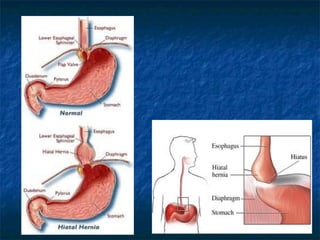
HIATUS HERNIAHIATUS HERNIA
 Abnormal protrusion of abdominal viscusAbnormal protrusion of abdominal viscus
through oesophageal hiatus into chest.through oesophageal hiatus into chest.
 TYPESTYPES
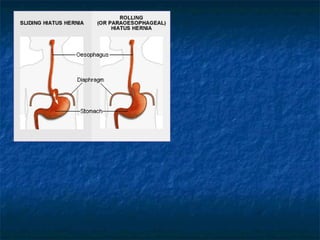
 1.Sliding hernia(oesophageo gastric1.Sliding hernia(oesophageo gastric
hernia) – 80%hernia) – 80%
 2.Rolling or paraoesophageal hernia2.Rolling or paraoesophageal hernia
 3.Mixed hernia3.Mixed hernia
 4.Massive herniation4.Massive herniation
Common symptomsCommon symptoms
 1.Symptoms due to reflux(reflux &heart1.Symptoms due to reflux(reflux &heart
burn)burn)
 2.Symptoms due to2.Symptoms due to
complications(dysphagia,complications(dysphagia,
odynophagia,hematemesis, melaena)odynophagia,hematemesis, melaena)
 3.Nonoesophageal synp(asthma & chest3.Nonoesophageal synp(asthma & chest
pain )pain )
SLIDING HERNIASLIDING HERNIA
 Anatomical factors which prevent slidingAnatomical factors which prevent sliding
herniahernia
 1.Presence of 2 cm of intraabd1.Presence of 2 cm of intraabd
oesophagusoesophagus
 2.The angle of His2.The angle of His
 3.Mucosal folds at oesophageocardial jn3.Mucosal folds at oesophageocardial jn
 4.+ intraabd pressure4.+ intraabd pressure
 5.LOS5.LOS
CausesCauses
 1.The position of fatty tissue in the hiatus1.The position of fatty tissue in the hiatus
 2.Advancing age – mus degeneration2.Advancing age – mus degeneration
 3.Lower abd trs , preg – raised intraabd3.Lower abd trs , preg – raised intraabd
pressurepressure
 4.Saint”s triad- Gallstone , diverticulosis,4.Saint”s triad- Gallstone , diverticulosis,
hiatus herniahiatus hernia
CF
like reflux oesophagitis
commom in women,obese
INVESTIATIONS
Oesophagoscopy- reflux of the gastric acd –
most valuable sign.
Ba meal- gord in trendelemburg
TREATMENT
 1.Conservative treatment
Principles:
1.Lifestyle changes
-decrease in wt
-Diet cntrol
-decreasd alcohol n tobecco consumption
2.Oesophageal mucosa protection
-Antacids
-H2 blockers
-PPI
SurgerySurgery
 IndicationsIndications
-Intractable pain-Intractable pain
-Complication –hge or stricture-Complication –hge or stricture
Types of surgeryTypes of surgery
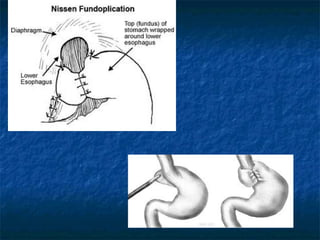
1.Nissen”s total fundoplication1.Nissen”s total fundoplication
2.Partial fundplication(Tupet)2.Partial fundplication(Tupet)
3.Belsey mark IV operation3.Belsey mark IV operation
4.Hill”s repair4.Hill”s repair
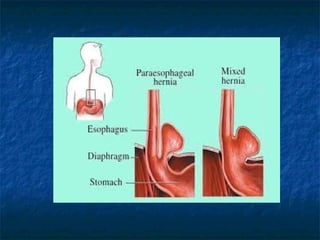
ROLLING HERNIAROLLING HERNIA
 Cardio –oeso jn is normal.Cardio –oeso jn is normal.
 Greater curvature of stomach ascends intoGreater curvature of stomach ascends into
a preformed sac in mediastinum.a preformed sac in mediastinum.
 Compression of heart & lung.Compression of heart & lung.
Clinical FeaturesClinical Features
 No retrosternal burning painNo retrosternal burning pain
 Discomfort after a small mealDiscomfort after a small meal
 Feeling of fullness after meal or dysphagiaFeeling of fullness after meal or dysphagia
 PalpitationsPalpitations
 RTI or hiccough (phrenic nerve irritation)RTI or hiccough (phrenic nerve irritation)
InvestigationInvestigation
Ba mealBa meal
RxRx
 Reduction of sac &repair of hiatusReduction of sac &repair of hiatus
MIXED HERNIAMIXED HERNIA
Both rolling & sliding hernia +Both rolling & sliding hernia +
Symptoms & Rx - mixedSymptoms & Rx - mixed
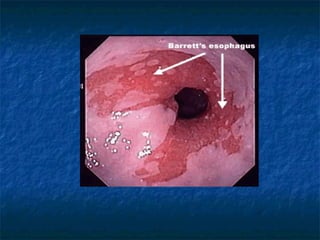
BARRET”S OESOPHAGUSBARRET”S OESOPHAGUS
 When columnar mucosa extends at least 3When columnar mucosa extends at least 3
cm into oesophaguscm into oesophagus
 Intestinal metaplasiaIntestinal metaplasia
PathogenesisPathogenesis
 Rptd reflux –Shifting of oesogastric jnRptd reflux –Shifting of oesogastric jn
upwards – Further increase in reflux –upwards – Further increase in reflux –
Intestinal metaplasia of middle & lowerIntestinal metaplasia of middle & lower
oesooeso
PATHOLOGICAL TYPESPATHOLOGICAL TYPES
 1.Gastric type – Chief & parietal cells1.Gastric type – Chief & parietal cells
 2.Intestinal type – Goblet cells2.Intestinal type – Goblet cells
 3. junctional type – Mucous glands3. junctional type – Mucous glands
CLINICAL TYPESCLINICAL TYPES
-Long segment : Metaplastic changes more-Long segment : Metaplastic changes more
than 3cmthan 3cm
-Short segment:Changes less than 3 cm-Short segment:Changes less than 3 cm
Incidence of malignancyIncidence of malignancy
 Lower &Midle oeso more prone to developLower &Midle oeso more prone to develop
CACA
 CA will be invasive & more proximalCA will be invasive & more proximal
TYPES OF DYSPLASIATYPES OF DYSPLASIA
-Low grade : negligible risk for ca-Low grade : negligible risk for ca
-High grade :very high risk for ca-High grade :very high risk for ca
RxRx
 Laser photodynamic therapyLaser photodynamic therapy
 Argon beam plasma coaulationArgon beam plasma coaulation
 Lap antireflux surgeryLap antireflux surgery
 High dose PPIHigh dose PPI
 Oesophagectomy(High grade dysplasia)Oesophagectomy(High grade dysplasia)
ComplicationsComplications
 1. Oesophageal ulcers1. Oesophageal ulcers
 2.Oesophageal strictures2.Oesophageal strictures
 3.Dysplasia & adenoca3.Dysplasia & adenoca

Mallory weiss syndrome

  • 1.
    MALLORY-WEISS SYNDROMEMALLORY-WEISS SYNDROME Vigorous vomiting-vert split in the gastricVigorous vomiting-vert split in the gastric mucosa (below sc jn at the cardia)- 90%mucosa (below sc jn at the cardia)- 90%  Tear in the oesophagus-10%Tear in the oesophagus-10%  Presents with hematemesisPresents with hematemesis  endoscopic injection therapy requird 4 severeendoscopic injection therapy requird 4 severe casescases
  • 3.
    CORROSIVE INJURYCORROSIVE INJURY Corrosive-sod hydroxide,sulphuric acidCorrosive-sod hydroxide,sulphuric acid  Accidental ingestion-damageAccidental ingestion-damage 2nouth,pharynx,larynx,oeso,stomach2nouth,pharynx,larynx,oeso,stomach  Alkalies causeliquifaction,saponification ofAlkalies causeliquifaction,saponification of fat,dehydration and thrombosis of bv- fibrousfat,dehydration and thrombosis of bv- fibrous scarringscarring  Acids-coagulative necrosis with eschar formationAcids-coagulative necrosis with eschar formation -causes intense pylorospasm with pooling-causes intense pylorospasm with pooling in the antrum(more gastric damage)in the antrum(more gastric damage)
  • 4.
    Investigaion- endoscopy -deep ulcersn black eschars-greatest risk of perforation Managemnt-minor injury- pt safely fed sev injury-feeding jejunostomy Complication-stricture formation-50% (oeso resection)
  • 6.
    GORDGORD  Loss ofcompetence of LOSLoss of competence of LOS  Competence affected-obesity,smoking nCompetence affected-obesity,smoking n excissive eatingexcissive eating  Gastric acid reflux- extensive inflammmation ofGastric acid reflux- extensive inflammmation of lower oeso- oesophagitislower oeso- oesophagitis  Types-a/c – alcohol,burns,stressTypes-a/c – alcohol,burns,stress c/c – hitus hernia,oesophagojejunostomyc/c – hitus hernia,oesophagojejunostomy
  • 7.
    PRECIPITATING FACTORS-  1.structurallydefective LOS  2.short length of oesophagus  3.ineffective oesophageal pump(influenced by gravity,oeso motility,salivation)  4.increased gastric pressure
  • 8.
    overeating/ingestion of irritants gasrticdistension unfolding of sphincter terminal s epi of oeso exposed to acid erosion,ulceration,fibrosis,metaplasia barret”s oeso AdenoCa
  • 9.
    AetiopathogenesisAetiopathogenesis  Acid refluxto LOS – diffuse inflmn withAcid reflux to LOS – diffuse inflmn with multiple ulcersmultiple ulcers  Symptoms worse when patient lies downSymptoms worse when patient lies down  Vicious cycleVicious cycle  vagal hypersensitivity – oesophagitis –vagal hypersensitivity – oesophagitis – long muscle spasm – displacement oflong muscle spasm – displacement of oesophagus – increased regurgitationoesophagus – increased regurgitation
  • 10.
    CLINICAL FEATURESCLINICAL FEATURES Retrosternal painRetrosternal pain  Epigastric painEpigastric pain  RegurgitationRegurgitation  Occult blood in stoolsOccult blood in stools  Anaemia & weaknessAnaemia & weakness  Dysphagia(sricture)Dysphagia(sricture)  Atypical symp – Angina like chest pain , pulm orAtypical symp – Angina like chest pain , pulm or laryngeal symplaryngeal symp
  • 11.
    DIAGNOSISDIAGNOSIS  Assume ratherthan prevent – Rx isAssume rather than prevent – Rx is empericalemperical  Investigations – when patient does notInvestigations – when patient does not respond to ppirespond to ppi  24 hr ph recording – gold std24 hr ph recording – gold std  TLOSR – manometric findingTLOSR – manometric finding  Ba swallow( in trendelenburg position)Ba swallow( in trendelenburg position)  OesophagoscopyOesophagoscopy
  • 12.
    MEDICAL MANAGEMENTMEDICAL MANAGEMENT Alcohol minimisedAlcohol minimised  Loose weightLoose weight  Coffee & tea minimisedCoffee & tea minimised  Oeso mucosal protecters(Antacids,H2 blockers)Oeso mucosal protecters(Antacids,H2 blockers)  Head up tiltHead up tilt  Oily& spicy food avoidedOily& spicy food avoided  Large meal avoided at nightLarge meal avoided at night  PPI most effective drug Rx (8 wks)PPI most effective drug Rx (8 wks)
  • 13.
    SURGERYSURGERY  Endoscopic treatmentsEndoscopictreatments  Surgical treatments –Surgical treatments – uncomplicated gord –pt”s choiceuncomplicated gord –pt”s choice Symptomatic on PPI(volume reflux ,Symptomatic on PPI(volume reflux , hermit lifestyle , poor compliance)hermit lifestyle , poor compliance) Laproscopic fundoplicationLaproscopic fundoplication
  • 14.
    COMPLICATIONSCOMPLICATIONS  Barret”s oesophagusBarret”soesophagus  StrictureStricture  Oesophageal shorteningOesophageal shortening
  • 15.
    HIATUS HERNIAHIATUS HERNIA Abnormal protrusion of abdominal viscusAbnormal protrusion of abdominal viscus through oesophageal hiatus into chest.through oesophageal hiatus into chest.  TYPESTYPES  1.Sliding hernia(oesophageo gastric1.Sliding hernia(oesophageo gastric hernia) – 80%hernia) – 80%  2.Rolling or paraoesophageal hernia2.Rolling or paraoesophageal hernia  3.Mixed hernia3.Mixed hernia  4.Massive herniation4.Massive herniation
  • 16.
    Common symptomsCommon symptoms 1.Symptoms due to reflux(reflux &heart1.Symptoms due to reflux(reflux &heart burn)burn)  2.Symptoms due to2.Symptoms due to complications(dysphagia,complications(dysphagia, odynophagia,hematemesis, melaena)odynophagia,hematemesis, melaena)  3.Nonoesophageal synp(asthma & chest3.Nonoesophageal synp(asthma & chest pain )pain )
  • 18.
    SLIDING HERNIASLIDING HERNIA Anatomical factors which prevent slidingAnatomical factors which prevent sliding herniahernia  1.Presence of 2 cm of intraabd1.Presence of 2 cm of intraabd oesophagusoesophagus  2.The angle of His2.The angle of His  3.Mucosal folds at oesophageocardial jn3.Mucosal folds at oesophageocardial jn  4.+ intraabd pressure4.+ intraabd pressure  5.LOS5.LOS
  • 20.
    CausesCauses  1.The positionof fatty tissue in the hiatus1.The position of fatty tissue in the hiatus  2.Advancing age – mus degeneration2.Advancing age – mus degeneration  3.Lower abd trs , preg – raised intraabd3.Lower abd trs , preg – raised intraabd pressurepressure  4.Saint”s triad- Gallstone , diverticulosis,4.Saint”s triad- Gallstone , diverticulosis, hiatus herniahiatus hernia
  • 21.
    CF like reflux oesophagitis commomin women,obese INVESTIATIONS Oesophagoscopy- reflux of the gastric acd – most valuable sign. Ba meal- gord in trendelemburg
  • 22.
    TREATMENT  1.Conservative treatment Principles: 1.Lifestylechanges -decrease in wt -Diet cntrol -decreasd alcohol n tobecco consumption 2.Oesophageal mucosa protection -Antacids -H2 blockers -PPI
  • 23.
    SurgerySurgery  IndicationsIndications -Intractable pain-Intractablepain -Complication –hge or stricture-Complication –hge or stricture Types of surgeryTypes of surgery 1.Nissen”s total fundoplication1.Nissen”s total fundoplication 2.Partial fundplication(Tupet)2.Partial fundplication(Tupet) 3.Belsey mark IV operation3.Belsey mark IV operation 4.Hill”s repair4.Hill”s repair
  • 25.
    ROLLING HERNIAROLLING HERNIA Cardio –oeso jn is normal.Cardio –oeso jn is normal.  Greater curvature of stomach ascends intoGreater curvature of stomach ascends into a preformed sac in mediastinum.a preformed sac in mediastinum.  Compression of heart & lung.Compression of heart & lung.
  • 26.
    Clinical FeaturesClinical Features No retrosternal burning painNo retrosternal burning pain  Discomfort after a small mealDiscomfort after a small meal  Feeling of fullness after meal or dysphagiaFeeling of fullness after meal or dysphagia  PalpitationsPalpitations  RTI or hiccough (phrenic nerve irritation)RTI or hiccough (phrenic nerve irritation)
  • 27.
    InvestigationInvestigation Ba mealBa meal RxRx Reduction of sac &repair of hiatusReduction of sac &repair of hiatus MIXED HERNIAMIXED HERNIA Both rolling & sliding hernia +Both rolling & sliding hernia + Symptoms & Rx - mixedSymptoms & Rx - mixed
  • 29.
    BARRET”S OESOPHAGUSBARRET”S OESOPHAGUS When columnar mucosa extends at least 3When columnar mucosa extends at least 3 cm into oesophaguscm into oesophagus  Intestinal metaplasiaIntestinal metaplasia PathogenesisPathogenesis  Rptd reflux –Shifting of oesogastric jnRptd reflux –Shifting of oesogastric jn upwards – Further increase in reflux –upwards – Further increase in reflux – Intestinal metaplasia of middle & lowerIntestinal metaplasia of middle & lower oesooeso
  • 31.
    PATHOLOGICAL TYPESPATHOLOGICAL TYPES 1.Gastric type – Chief & parietal cells1.Gastric type – Chief & parietal cells  2.Intestinal type – Goblet cells2.Intestinal type – Goblet cells  3. junctional type – Mucous glands3. junctional type – Mucous glands CLINICAL TYPESCLINICAL TYPES -Long segment : Metaplastic changes more-Long segment : Metaplastic changes more than 3cmthan 3cm -Short segment:Changes less than 3 cm-Short segment:Changes less than 3 cm
  • 32.
    Incidence of malignancyIncidenceof malignancy  Lower &Midle oeso more prone to developLower &Midle oeso more prone to develop CACA  CA will be invasive & more proximalCA will be invasive & more proximal TYPES OF DYSPLASIATYPES OF DYSPLASIA -Low grade : negligible risk for ca-Low grade : negligible risk for ca -High grade :very high risk for ca-High grade :very high risk for ca
  • 33.
    RxRx  Laser photodynamictherapyLaser photodynamic therapy  Argon beam plasma coaulationArgon beam plasma coaulation  Lap antireflux surgeryLap antireflux surgery  High dose PPIHigh dose PPI  Oesophagectomy(High grade dysplasia)Oesophagectomy(High grade dysplasia) ComplicationsComplications  1. Oesophageal ulcers1. Oesophageal ulcers  2.Oesophageal strictures2.Oesophageal strictures  3.Dysplasia & adenoca3.Dysplasia & adenoca