




Tips on using my ppt.
1. You can freely download, edit, modify and put your
name etc.
2. Don’t be concerned about number of slides. Half the
slides are blanks except for the title.
3. First show the blank slides (eg. Aetiology ) > Ask
students what they already know about ethology of
today's topic. > Then show next slide which enumerates
aetiologies.
4. At the end rerun the show – show blank> ask questions >
show next slide.
5. This will be an ACTIVE LEARNING SESSION x
three revisions.
6. Good for self study also.
7. See notes for bibliography.
Learning Objectives
Learning Objectives:GORD/GERD
1. Introduction & History
2. Relevant Anatomy, Physiology
3. Aetiology
4. Pathophysiology
5. Pathology
6. Classification
7. Clinical Features
8. Investigations
9. Management
10. Prevention
11. Guidelines
12. Take home messages
Introduction & History.
•
Introduction
• Gastroesophageal reflux disease (GERD), is
defined as a condition in which the stomach
contents reflux into the esophagus or
beyond (oral cavity, larynx, or the lungs),
causing troublesome symptoms and
complications.
• Reflux esophagitis is defined as
inflammation of the esophageal mucosa
secondary to gastroesophageal reflux
disease.
Aetiology
• Idiopathic
• Congenital/ Genetic
• Nutritional Deficiency/excess
• Traumatic
• Infections /Infestation
• Autoimmune
• Neoplastic (Benign/Malignant)
• Degenerative / lifestyle
• Iatrogenic
• Psychosomatic
• Poisoning/ Toxins/ Drug induced
Aetiology
• Idiopathic
• Congenital/ Genetic
• Nutritional Deficiency/excess
• Traumatic
• Infections /Infestation
• Autoimmune
• Neoplastic (Benign/Malignant)
• Degenerative / lifestyle
• Iatrogenic
• Psychosomatic
• Poisoning/ Toxins/ Drug induced
Etiology
• Reflux of gastric contents into the
esophagus due to weak lower esophageal
sphincter (LES) function,
• Impaired esophageal clearance
– Esophageal dysmotility
– Presence of hiatal hernia,
– Impairment in the tone of the lower esophageal
sphincter (LES),
– Transient LES relaxation,
– Poor gastric emptying
Etiology
• Obesity
• Smoking
• Alcohol,
• Caffeine
• Lack of physical activity
• Anxiety/depression
• Stress
• Eating habits (large meals,
eating before bed)
• Diabetes
• Age 50 years or older
• Connective tissue
disorders Scleroderma
• High dietary fat
• Drugs
• Microbiome alteration
• Pregnancy
• Tobacco chewing
• Nonalcoholic fatty liver
disease.
• Zollinger-Ellison
syndrome causing
increased acid secretion
Etiology:Drugs induced
• Angiotensin-
converting enzyme
inhibitors
• Anticholinergics
• Calcium channel
blockers
• Narcotics
• Nitrates
• Progesterone
• Sedatives or
tranquilizers (eg,
benzodiazepines)
• Statins
• Theophylline
• Tricyclic
antidepressants (eg,
amitriptyline)
•
Etiology
• Protective role of H.Pylori remains
controversial.
Pathophysiology
Pathophysiology
Mechanism of LES
–Intrinsic distal esophageal muscles –
tonically contracted.
–Angle of His
–Muscular Sling fibers of the gastric cardia.
–Diaphragmatic crura.
–Transmitted pressure of the abdominal
cavity.
–Phreno-esophageal membrane
Pathophysiology
• Reflux occurs in healthy individuals also
cleared by-
1. Clearance by esophageal peristaltic movement
2. Neutralization of the small acidic residue by weakly
alkaline swallowed saliva.
Pathophysiology
• Pepsin” in the reflux contents
• Strong acid (pH < 2), however, can cause
mucosal damage independent of the
presence of pepsin.
• The presence of bile in reflux
Pathophysiology
• Transient relaxation of the lower esophageal sphincter or a
low resting lower esophageal sphincter pressure
• Presence of a hiatus hernia
• Increased intra-abdominal fat, as is the case in obesity, and
increased intra-abdominal pressure, such as in pregnancy
and patients with ascites
• Impairment of the normal defense mechanisms, including
esophageal peristalsis (dysregulation of esophageal
peristalsis)
• Impairment of saliva production due to several causes,
including chronic inflammation of the salivary glands
• Impairment of esophageal mural defense mechanisms.
Clinical Features
•
Clinical Features
• Demography
• Symptoms
• Signs
• Prognosis
• Complications
Demography
Demography
• 10-20% of healthy adult Americans experienced
symptomatic GERD at least once a month. Severe disease
in6%.
• 5%in Asians.
• White individuals have higher prevalence of severe grades
of esophagitis
• Reflux esophagitis is equally prevalent among men and
women.However, the predominance of esophagitis and
Barrett esophagitis in men compared to women is 3:1 and
10:1, respectively.
• Incidence of gerd increased in the autumn and winter
• Incidence of reflux esophagitis has doubled over a period
of 10 years.
• Gastroesophageal reflux exists universally in preterm
infants.
Symptoms
• .
Symptoms
Esophageal and Extraesophageal
• Esophageal
– Heartburn
– Acid dyspepsia
– Regurgitation
– Chest pain.
• Exraesophageal symptoms-
Symptoms
• Exraesophageal symptoms-
– Chronic Cough
– Dental erosions,,
– Asthma
– Throat pain
– Aspiration pneumonia,
– Globus sensation
– Hoarseness due to pharyngitis, laryngitis, or
sinus problems.
Symptoms
• However, some patients with severe
esophagitis or Barrett esophagus may be
symptom-free and have no heartburn
Complications
Complications
• Upper gastrointestinal bleeding,
• Anemia,
• Stricture,
• Barrett esophagus
• Dysplasia
• Malignancy
Alarming Signs & Symptoms
• Dysphagia
• Early satiety
• GI bleeding
• Odynophagia
• Vomiting
• Weight loss
• Iron deficiency anemia
Investigations
• Laboratory Studies
– Routine
– Special
• Imaging Studies
• Tissue diagnosis
– Cytology
• FNAC
– Histology
– Germ line Testing and Molecular Analysis
• Diagnostic Laparotomy.
Diagnostic Studies
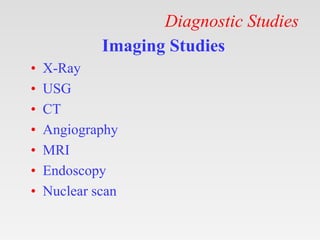
Imaging Studies
• X-Ray
• USG
• CT
• Angiography
• MRI
• Endoscopy
• Nuclear scan
Diagnostic Studies
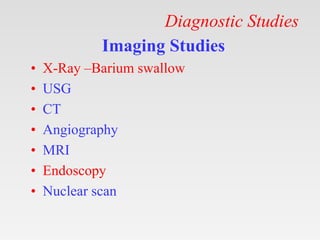
Imaging Studies
• X-Ray –Barium swallow
• USG
• CT
• Angiography
• MRI
• Endoscopy
• Nuclear scan
Diagnostic Studies
• Esophagogastroduodenoscopy (EGD) (or,
upper gastrointestinal [GI] endoscopy) with
biopsy,
• 24-hour ambulatory pH study,
• Manometry,
• Barium contrast study,
• Gastric emptying study.
Diagnostic Studies
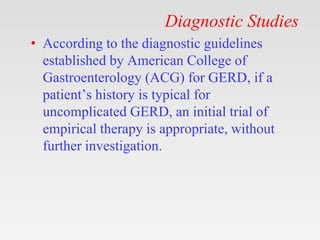
• According to the diagnostic guidelines
established by American College of
Gastroenterology (ACG) for GERD, if a
patient’s history is typical for
uncomplicated GERD, an initial trial of
empirical therapy is appropriate, without
further investigation.
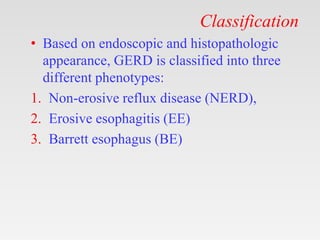
Classification
• Based on endoscopic and histopathologic
appearance, GERD is classified into three
different phenotypes:
1. Non-erosive reflux disease (NERD),
2. Erosive esophagitis (EE)
3. Barrett esophagus (BE)
Grades of Esophagitis
•
Grades of Esophagitis
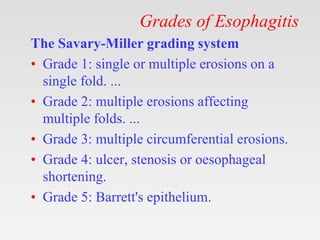
The Savary-Miller grading system
• Grade 1: single or multiple erosions on a
single fold. ...
• Grade 2: multiple erosions affecting
multiple folds. ...
• Grade 3: multiple circumferential erosions.
• Grade 4: ulcer, stenosis or oesophageal
shortening.
• Grade 5: Barrett's epithelium.
Diagnostic Studies
• The endoscopic findings in
gastroesophageal reflux disease (GERD)
range from normal esophageal mucosa to
erosions and ulcerations
Pathology
Microscopy
• Squamous (basal) cell hyperplasia,
elongation of vascular papillae, presence of
intraepithelial inflammatory cells, dilated
intercellular spaces (intercellular edema),
ballooning degeneration of squamous cells
(due to accumulation of intracellular plasma
proteins), vascular lakes (dilated small
blood vessels in superficial lamina
propria/vascular papillae), acanthosis,
mucosal erosions and ulcerations
Barrett's epithelium.
• Replacement of squamous
epithelium with gastric columnar
epithelium
Differential Diagnosis
• Coronary artery disease
• Infectious esophagitis
• Eosinophilic esophagitis
• Peptic ulcer disease
• Biliary colic
• Esophageal motor disorders
• Esophageal stricture
• Esophageal cancer
• Dyspepsia
• Dysphagia
• Rumination syndrome
• Radiation and chemotherapy-induced esophagitis
Complications
Complications
• Barrett esophagus,
• Dysplasia,
• Malignancy
Management
•
Management
• The treatment is based on-
1 Lifestyle modification
2 Control of gastric acid secretion through
• A. Medical therapy with-
– Antacids
– PPIs
B.Surgical treatment with corrective antireflux
surgery
Lifestyle Modifications
•
Lifestyle Modifications
• Losing weight (if overweight)
• Avoiding alcohol, chocolate, citrus juice,
and tomato-based products peppermint,
coffee, and possibly the onion
• Avoiding large meals
• Waiting 3 hours after a meal before lying
down
• Elevating the head of the bed by 8 inches
Operative Therapy
Minimally invasive Therapy
Laparoscopic fundoplication
• Complete mobilization of the fundus of the
stomach with division of the short gastric
vessels
• Reduction of the hiatal hernia
• Narrowing of the esophageal hiatus
• Creation of a 360° fundoplication over a
large intraesophageal dilator (Nissen
fundoplication)
Operative Therapy
• Indications for fundoplication include the
following:
– Patients with symptoms that are not completely
controlled by PPI therapy
– Barrett esophagus
– extraesophageal manifestations Young patients
– Poor patient compliance with regard to
medications
– Postmenopausal women with osteoporosis
– Patients with cardiac conduction defects
– Cost of medical therapy
Myths
• Heartburn chest pain should not be first
managed as GERD. First angina must be
excluded.
Futuristic
• Endoscopic antireflex surgery.
Controversies
• Surgery or PPIs
Take home messages
• Gastroesophageal reflux disease (GERD) is
a common clinical problem, affecting
millions of people worldwide.
• Patients are recognized by both classic and
atypical symptoms.
• Acid suppressive therapy provides
symptomatic relief and prevents
complications in many individuals with
GERD.
• Fundoplication is surgical treatment.
MCQs
• A diagnosis of gastroesophageal reflux
disease implies that a patient has which
of the following functional abnormalities?
A.Compression of the esophagus from a
double aortic arch
B.Cricopharyngeal incoordination
C.Denervation of esophageal muscle
D.Lower esophageal sphincter incompetence
MCQs
• A diagnosis of gastroesophageal reflux
disease implies that a patient has which
of the following functional abnormalities?
A.Compression of the esophagus from a
double aortic arch
B.Cricopharyngeal incoordination
C.Denervation of esophageal muscle
D.Lower esophageal sphincter incompetence
MCQs
• A patient who has symptoms of
gastroesophageal reflux disease (GERD) is
prescribed a trial of proton pump inhibitors.
One month later the symptoms have not
improved despite treatment, and findings on
endoscopy are unremarkable. Which of the
following is the most appropriate next step in
management?
• A.Barium swallow x-ray study
• B.Esophageal manometry
• C.Repeat endoscopy in one month
• D.24-hour pH testing
MCQs
• A patient who has symptoms of
gastroesophageal reflux disease (GERD) is
prescribed a trial of proton pump inhibitors.
One month later the symptoms have not
improved despite treatment, and findings on
endoscopy are unremarkable. Which of the
following is the most appropriate next step in
management?
• A.Barium swallow x-ray study
• B.Esophageal manometry
• C.Repeat endoscopy in one month
• D.24-hour pH testing
MCQs
• Which of these is considered an "alarm symptom"
suggestive of complicated GERD?
A. Excessive belching/flatulence
B. Epigastric pain
C. Nausea
D. Odynophagia
MCQs
• Which of these is considered an "alarm symptom"
suggestive of complicated GERD?
A. Excessive belching/flatulence
B. Epigastric pain
C. Nausea
D. Odynophagia
MCQs
• which is most accurate regarding the workup for
GERD?
A. Barium radiography is routinely recommended in
the diagnosis of GERD
B. A presumptive diagnosis of GERD can be made
and empirical proton pump inhibitor (PPI)
therapy initiated in the setting of typical
symptoms of heartburn and regurgitation without
additional studies
C. Upper endoscopy is required for diagnosis of
GERD in all patients
D. Specific diagnosis of GERD can only be made
with biopsies obtained from the distal esophagus
MCQs
• which is most accurate regarding the workup for
GERD?
A. Barium radiography is routinely recommended in
the diagnosis of GERD
B. A presumptive diagnosis of GERD can be made
and empirical proton pump inhibitor (PPI)
therapy initiated in the setting of typical
symptoms of heartburn and regurgitation without
additional studies
C. Upper endoscopy is required for diagnosis of
GERD in all patients
D. Specific diagnosis of GERD can only be made
with biopsies obtained from the distal esophagus
MCQs
• Which of these is most commonly
recognized as an "alarm symptom" that
suggests potentially serious complications
associated with GERD?
A. Dysphagia
B. Constipation
C. Epigastric pain
D. Foul-smelling gas
MCQs
• Which of these is most commonly
recognized as an "alarm symptom" that
suggests potentially serious complications
associated with GERD?
A. Dysphagia
B. Constipation
C. Epigastric pain
D. Foul-smelling gas
MCQs
• Which of these is best established as a risk
factor for GERD?
A. Epilepsy
B. Diabetes
C. Male sex
D. Use of beta-blockers
MCQs
• Which of these is best established as a risk
factor for GERD?
A. Epilepsy
B. Diabetes
C. Male sex
D. Use of beta-blockers
MCQs
• Which of these medications is most likely to
increase acid reflux and worsen GERD
symptoms?
A. Metformin
B. Levothyroxine
C. Amitriptyline
D. Warfarin
MCQs
• Which of these medications is most likely to
increase acid reflux and worsen GERD
symptoms?
A. Metformin
B. Levothyroxine
C. Amitriptyline
D. Warfarin
MCQs
• In addition to upper gastrointestinal (GI)
endoscopy, which of these is most routinely
a part of the workup for GERD?
A. Nuclear medicine gastric emptying study
B. CT
C. Manometry
D. Ultrasonography
MCQs
• In addition to upper gastrointestinal (GI)
endoscopy, which of these is most routinely
a part of the workup for GERD?
A. Nuclear medicine gastric emptying study
B. CT
C. Manometry
D. Ultrasonography
MCQs
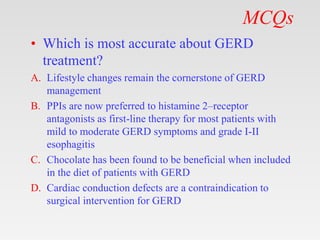
• Which is most accurate about GERD
treatment?
A. Lifestyle changes remain the cornerstone of GERD
management
B. PPIs are now preferred to histamine 2–receptor
antagonists as first-line therapy for most patients with
mild to moderate GERD symptoms and grade I-II
esophagitis
C. Chocolate has been found to be beneficial when included
in the diet of patients with GERD
D. Cardiac conduction defects are a contraindication to
surgical intervention for GERD
MCQs
• Which is most accurate about GERD
treatment?
A. Lifestyle changes remain the cornerstone of GERD
management
B. PPIs are now preferred to histamine 2–receptor
antagonists as first-line therapy for most patients with
mild to moderate GERD symptoms and grade I-II
esophagitis
C. Chocolate has been found to be beneficial when included
in the diet of patients with GERD
D. Cardiac conduction defects are a contraindication to
surgical intervention for GERD
Get this ppt in mobile
1. Download Microsoft
PowerPoint from play
store.
2. Open Google assistant
3. Open Google lens.
4. Scan qr code from
next slide.
Get this ppt in mobile
Get my ppt collection
• https://t.me/surgerypresentation
• https://www.slideshare.net/drpradeeppande/e
dit_my_uploads
• https://www.dropbox.com/sh/x600md3cvj85
woy/AACVMHuQtvHvl_K8ehc3ltkEa?dl=0
• https://www.facebook.com/doctorpradeeppan
de/?ref=pages_you_manage
• https://t.me/+eqNYT21gmWZjMjI9

GERD Reflux Oesophagitis.pptx

  • 1.
    Tips on usingmy ppt. 1. You can freely download, edit, modify and put your name etc. 2. Don’t be concerned about number of slides. Half the slides are blanks except for the title. 3. First show the blank slides (eg. Aetiology ) > Ask students what they already know about ethology of today's topic. > Then show next slide which enumerates aetiologies. 4. At the end rerun the show – show blank> ask questions > show next slide. 5. This will be an ACTIVE LEARNING SESSION x three revisions. 6. Good for self study also. 7. See notes for bibliography.
  • 2.
  • 3.
    Learning Objectives:GORD/GERD 1. Introduction& History 2. Relevant Anatomy, Physiology 3. Aetiology 4. Pathophysiology 5. Pathology 6. Classification 7. Clinical Features 8. Investigations 9. Management 10. Prevention 11. Guidelines 12. Take home messages
  • 4.
  • 5.
    Introduction • Gastroesophageal refluxdisease (GERD), is defined as a condition in which the stomach contents reflux into the esophagus or beyond (oral cavity, larynx, or the lungs), causing troublesome symptoms and complications. • Reflux esophagitis is defined as inflammation of the esophageal mucosa secondary to gastroesophageal reflux disease.
  • 6.
    Aetiology • Idiopathic • Congenital/Genetic • Nutritional Deficiency/excess • Traumatic • Infections /Infestation • Autoimmune • Neoplastic (Benign/Malignant) • Degenerative / lifestyle • Iatrogenic • Psychosomatic • Poisoning/ Toxins/ Drug induced
  • 7.
    Aetiology • Idiopathic • Congenital/Genetic • Nutritional Deficiency/excess • Traumatic • Infections /Infestation • Autoimmune • Neoplastic (Benign/Malignant) • Degenerative / lifestyle • Iatrogenic • Psychosomatic • Poisoning/ Toxins/ Drug induced
  • 8.
    Etiology • Reflux ofgastric contents into the esophagus due to weak lower esophageal sphincter (LES) function, • Impaired esophageal clearance – Esophageal dysmotility – Presence of hiatal hernia, – Impairment in the tone of the lower esophageal sphincter (LES), – Transient LES relaxation, – Poor gastric emptying
  • 9.
    Etiology • Obesity • Smoking •Alcohol, • Caffeine • Lack of physical activity • Anxiety/depression • Stress • Eating habits (large meals, eating before bed) • Diabetes • Age 50 years or older • Connective tissue disorders Scleroderma • High dietary fat • Drugs • Microbiome alteration • Pregnancy • Tobacco chewing • Nonalcoholic fatty liver disease. • Zollinger-Ellison syndrome causing increased acid secretion
  • 10.
    Etiology:Drugs induced • Angiotensin- convertingenzyme inhibitors • Anticholinergics • Calcium channel blockers • Narcotics • Nitrates • Progesterone • Sedatives or tranquilizers (eg, benzodiazepines) • Statins • Theophylline • Tricyclic antidepressants (eg, amitriptyline) •
  • 11.
    Etiology • Protective roleof H.Pylori remains controversial.
  • 12.
  • 13.
    Pathophysiology Mechanism of LES –Intrinsicdistal esophageal muscles – tonically contracted. –Angle of His –Muscular Sling fibers of the gastric cardia. –Diaphragmatic crura. –Transmitted pressure of the abdominal cavity. –Phreno-esophageal membrane
  • 14.
    Pathophysiology • Reflux occursin healthy individuals also cleared by- 1. Clearance by esophageal peristaltic movement 2. Neutralization of the small acidic residue by weakly alkaline swallowed saliva.
  • 15.
    Pathophysiology • Pepsin” inthe reflux contents • Strong acid (pH < 2), however, can cause mucosal damage independent of the presence of pepsin. • The presence of bile in reflux
  • 16.
    Pathophysiology • Transient relaxationof the lower esophageal sphincter or a low resting lower esophageal sphincter pressure • Presence of a hiatus hernia • Increased intra-abdominal fat, as is the case in obesity, and increased intra-abdominal pressure, such as in pregnancy and patients with ascites • Impairment of the normal defense mechanisms, including esophageal peristalsis (dysregulation of esophageal peristalsis) • Impairment of saliva production due to several causes, including chronic inflammation of the salivary glands • Impairment of esophageal mural defense mechanisms.
  • 17.
  • 18.
    Clinical Features • Demography •Symptoms • Signs • Prognosis • Complications
  • 19.
  • 20.
    Demography • 10-20% ofhealthy adult Americans experienced symptomatic GERD at least once a month. Severe disease in6%. • 5%in Asians. • White individuals have higher prevalence of severe grades of esophagitis • Reflux esophagitis is equally prevalent among men and women.However, the predominance of esophagitis and Barrett esophagitis in men compared to women is 3:1 and 10:1, respectively. • Incidence of gerd increased in the autumn and winter • Incidence of reflux esophagitis has doubled over a period of 10 years. • Gastroesophageal reflux exists universally in preterm infants.
  • 21.
  • 22.
    Symptoms Esophageal and Extraesophageal •Esophageal – Heartburn – Acid dyspepsia – Regurgitation – Chest pain. • Exraesophageal symptoms-
  • 23.
    Symptoms • Exraesophageal symptoms- –Chronic Cough – Dental erosions,, – Asthma – Throat pain – Aspiration pneumonia, – Globus sensation – Hoarseness due to pharyngitis, laryngitis, or sinus problems.
  • 24.
    Symptoms • However, somepatients with severe esophagitis or Barrett esophagus may be symptom-free and have no heartburn
  • 25.
  • 26.
    Complications • Upper gastrointestinalbleeding, • Anemia, • Stricture, • Barrett esophagus • Dysplasia • Malignancy
  • 27.
    Alarming Signs &Symptoms • Dysphagia • Early satiety • GI bleeding • Odynophagia • Vomiting • Weight loss • Iron deficiency anemia
  • 28.
    Investigations • Laboratory Studies –Routine – Special • Imaging Studies • Tissue diagnosis – Cytology • FNAC – Histology – Germ line Testing and Molecular Analysis • Diagnostic Laparotomy.
  • 29.
    Diagnostic Studies Imaging Studies •X-Ray • USG • CT • Angiography • MRI • Endoscopy • Nuclear scan
  • 30.
    Diagnostic Studies Imaging Studies •X-Ray –Barium swallow • USG • CT • Angiography • MRI • Endoscopy • Nuclear scan
  • 31.
    Diagnostic Studies • Esophagogastroduodenoscopy(EGD) (or, upper gastrointestinal [GI] endoscopy) with biopsy, • 24-hour ambulatory pH study, • Manometry, • Barium contrast study, • Gastric emptying study.
  • 32.
    Diagnostic Studies • Accordingto the diagnostic guidelines established by American College of Gastroenterology (ACG) for GERD, if a patient’s history is typical for uncomplicated GERD, an initial trial of empirical therapy is appropriate, without further investigation.
  • 33.
    Classification • Based onendoscopic and histopathologic appearance, GERD is classified into three different phenotypes: 1. Non-erosive reflux disease (NERD), 2. Erosive esophagitis (EE) 3. Barrett esophagus (BE)
  • 34.
  • 35.
    Grades of Esophagitis TheSavary-Miller grading system • Grade 1: single or multiple erosions on a single fold. ... • Grade 2: multiple erosions affecting multiple folds. ... • Grade 3: multiple circumferential erosions. • Grade 4: ulcer, stenosis or oesophageal shortening. • Grade 5: Barrett's epithelium.
  • 36.
    Diagnostic Studies • Theendoscopic findings in gastroesophageal reflux disease (GERD) range from normal esophageal mucosa to erosions and ulcerations
  • 37.
    Pathology Microscopy • Squamous (basal)cell hyperplasia, elongation of vascular papillae, presence of intraepithelial inflammatory cells, dilated intercellular spaces (intercellular edema), ballooning degeneration of squamous cells (due to accumulation of intracellular plasma proteins), vascular lakes (dilated small blood vessels in superficial lamina propria/vascular papillae), acanthosis, mucosal erosions and ulcerations
  • 38.
    Barrett's epithelium. • Replacementof squamous epithelium with gastric columnar epithelium
  • 39.
  • 40.
    Differential Diagnosis • Coronaryartery disease • Infectious esophagitis • Eosinophilic esophagitis • Peptic ulcer disease • Biliary colic • Esophageal motor disorders • Esophageal stricture • Esophageal cancer • Dyspepsia • Dysphagia • Rumination syndrome • Radiation and chemotherapy-induced esophagitis
  • 41.
  • 42.
  • 43.
  • 44.
    Management • The treatmentis based on- 1 Lifestyle modification 2 Control of gastric acid secretion through • A. Medical therapy with- – Antacids – PPIs B.Surgical treatment with corrective antireflux surgery
  • 45.
  • 46.
    Lifestyle Modifications • Losingweight (if overweight) • Avoiding alcohol, chocolate, citrus juice, and tomato-based products peppermint, coffee, and possibly the onion • Avoiding large meals • Waiting 3 hours after a meal before lying down • Elevating the head of the bed by 8 inches
  • 47.
  • 48.
    Minimally invasive Therapy Laparoscopicfundoplication • Complete mobilization of the fundus of the stomach with division of the short gastric vessels • Reduction of the hiatal hernia • Narrowing of the esophageal hiatus • Creation of a 360° fundoplication over a large intraesophageal dilator (Nissen fundoplication)
  • 49.
    Operative Therapy • Indicationsfor fundoplication include the following: – Patients with symptoms that are not completely controlled by PPI therapy – Barrett esophagus – extraesophageal manifestations Young patients – Poor patient compliance with regard to medications – Postmenopausal women with osteoporosis – Patients with cardiac conduction defects – Cost of medical therapy
  • 50.
    Myths • Heartburn chestpain should not be first managed as GERD. First angina must be excluded.
  • 51.
  • 52.
  • 53.
    Take home messages •Gastroesophageal reflux disease (GERD) is a common clinical problem, affecting millions of people worldwide. • Patients are recognized by both classic and atypical symptoms. • Acid suppressive therapy provides symptomatic relief and prevents complications in many individuals with GERD. • Fundoplication is surgical treatment.
  • 54.
    MCQs • A diagnosisof gastroesophageal reflux disease implies that a patient has which of the following functional abnormalities? A.Compression of the esophagus from a double aortic arch B.Cricopharyngeal incoordination C.Denervation of esophageal muscle D.Lower esophageal sphincter incompetence
  • 55.
    MCQs • A diagnosisof gastroesophageal reflux disease implies that a patient has which of the following functional abnormalities? A.Compression of the esophagus from a double aortic arch B.Cricopharyngeal incoordination C.Denervation of esophageal muscle D.Lower esophageal sphincter incompetence
  • 56.
    MCQs • A patientwho has symptoms of gastroesophageal reflux disease (GERD) is prescribed a trial of proton pump inhibitors. One month later the symptoms have not improved despite treatment, and findings on endoscopy are unremarkable. Which of the following is the most appropriate next step in management? • A.Barium swallow x-ray study • B.Esophageal manometry • C.Repeat endoscopy in one month • D.24-hour pH testing
  • 57.
    MCQs • A patientwho has symptoms of gastroesophageal reflux disease (GERD) is prescribed a trial of proton pump inhibitors. One month later the symptoms have not improved despite treatment, and findings on endoscopy are unremarkable. Which of the following is the most appropriate next step in management? • A.Barium swallow x-ray study • B.Esophageal manometry • C.Repeat endoscopy in one month • D.24-hour pH testing
  • 58.
    MCQs • Which ofthese is considered an "alarm symptom" suggestive of complicated GERD? A. Excessive belching/flatulence B. Epigastric pain C. Nausea D. Odynophagia
  • 59.
    MCQs • Which ofthese is considered an "alarm symptom" suggestive of complicated GERD? A. Excessive belching/flatulence B. Epigastric pain C. Nausea D. Odynophagia
  • 60.
    MCQs • which ismost accurate regarding the workup for GERD? A. Barium radiography is routinely recommended in the diagnosis of GERD B. A presumptive diagnosis of GERD can be made and empirical proton pump inhibitor (PPI) therapy initiated in the setting of typical symptoms of heartburn and regurgitation without additional studies C. Upper endoscopy is required for diagnosis of GERD in all patients D. Specific diagnosis of GERD can only be made with biopsies obtained from the distal esophagus
  • 61.
    MCQs • which ismost accurate regarding the workup for GERD? A. Barium radiography is routinely recommended in the diagnosis of GERD B. A presumptive diagnosis of GERD can be made and empirical proton pump inhibitor (PPI) therapy initiated in the setting of typical symptoms of heartburn and regurgitation without additional studies C. Upper endoscopy is required for diagnosis of GERD in all patients D. Specific diagnosis of GERD can only be made with biopsies obtained from the distal esophagus
  • 62.
    MCQs • Which ofthese is most commonly recognized as an "alarm symptom" that suggests potentially serious complications associated with GERD? A. Dysphagia B. Constipation C. Epigastric pain D. Foul-smelling gas
  • 63.
    MCQs • Which ofthese is most commonly recognized as an "alarm symptom" that suggests potentially serious complications associated with GERD? A. Dysphagia B. Constipation C. Epigastric pain D. Foul-smelling gas
  • 64.
    MCQs • Which ofthese is best established as a risk factor for GERD? A. Epilepsy B. Diabetes C. Male sex D. Use of beta-blockers
  • 65.
    MCQs • Which ofthese is best established as a risk factor for GERD? A. Epilepsy B. Diabetes C. Male sex D. Use of beta-blockers
  • 66.
    MCQs • Which ofthese medications is most likely to increase acid reflux and worsen GERD symptoms? A. Metformin B. Levothyroxine C. Amitriptyline D. Warfarin
  • 67.
    MCQs • Which ofthese medications is most likely to increase acid reflux and worsen GERD symptoms? A. Metformin B. Levothyroxine C. Amitriptyline D. Warfarin
  • 68.
    MCQs • In additionto upper gastrointestinal (GI) endoscopy, which of these is most routinely a part of the workup for GERD? A. Nuclear medicine gastric emptying study B. CT C. Manometry D. Ultrasonography
  • 69.
    MCQs • In additionto upper gastrointestinal (GI) endoscopy, which of these is most routinely a part of the workup for GERD? A. Nuclear medicine gastric emptying study B. CT C. Manometry D. Ultrasonography
  • 70.
    MCQs • Which ismost accurate about GERD treatment? A. Lifestyle changes remain the cornerstone of GERD management B. PPIs are now preferred to histamine 2–receptor antagonists as first-line therapy for most patients with mild to moderate GERD symptoms and grade I-II esophagitis C. Chocolate has been found to be beneficial when included in the diet of patients with GERD D. Cardiac conduction defects are a contraindication to surgical intervention for GERD
  • 71.
    MCQs • Which ismost accurate about GERD treatment? A. Lifestyle changes remain the cornerstone of GERD management B. PPIs are now preferred to histamine 2–receptor antagonists as first-line therapy for most patients with mild to moderate GERD symptoms and grade I-II esophagitis C. Chocolate has been found to be beneficial when included in the diet of patients with GERD D. Cardiac conduction defects are a contraindication to surgical intervention for GERD
  • 72.
    Get this pptin mobile 1. Download Microsoft PowerPoint from play store. 2. Open Google assistant 3. Open Google lens. 4. Scan qr code from next slide.
  • 73.
    Get this pptin mobile
  • 74.
    Get my pptcollection • https://t.me/surgerypresentation • https://www.slideshare.net/drpradeeppande/e dit_my_uploads • https://www.dropbox.com/sh/x600md3cvj85 woy/AACVMHuQtvHvl_K8ehc3ltkEa?dl=0 • https://www.facebook.com/doctorpradeeppan de/?ref=pages_you_manage • https://t.me/+eqNYT21gmWZjMjI9