MALIGNANT THYROID
Dr. Amna Akram
CMH, Multan
Thyroid cancer is a cancer
originating from follicular and
parafollicular cells. These cells
give rise to well-differentiated
and anaplastic cancers.
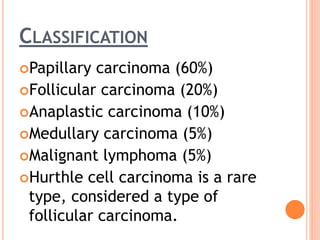
CLASSIFICATION
Papillary carcinoma (60%)
Follicular carcinoma (20%)
Anaplastic carcinoma (10%)
Medullary carcinoma (5%)
Malignant lymphoma (5%)
Hurthle cell carcinoma is a rare
type, considered a type of
follicular carcinoma.
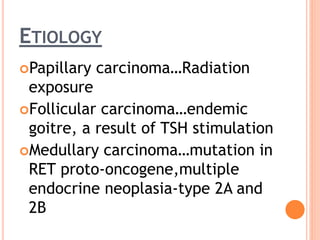
ETIOLOGY
Papillary carcinoma…Radiation
exposure
Follicular carcinoma…endemic
goitre, a result of TSH stimulation
Medullary carcinoma…mutation in
RET proto-oncogene,multiple
endocrine neoplasia-type 2A and
2B
Lymphoma…autoimmune
thyroiditis
RISK FACTORS
Hx neck irradiation in childhood
Endemic goitre
Hashimoto’s thyroiditis
Hx of thyroid adenoma
Familial thyroid CA
Cowden’s syndrome
Exposure to nuclear Fallout
(Chernobyl)
PRESENTATION
History: Thyroid carcinoma most
commonly manifests as painless,
palpable, solitary thyroid nodules.
These are mostly discovered on
routine palpation.
 Age of the patient is important at
time of presentation because
solitary nodules are most likely to be
malignant in pt.s older than 60yrs
and in younger than 30yrs.
Hoarsness suggests recurrent
laryngeal nerve and vocal fold
paralysis.
Dysphagia may be a sign
of impingement of the digestive
tract
 Heat intolerance and
palpitations suggest
autonomously functioning
nodules.
PHYSICAL EXAMINATION
Malignant nodules are usually
hard, fixed and non-tender
Firm cervical masses are highly
suggestive of regional lymph node
metastases.
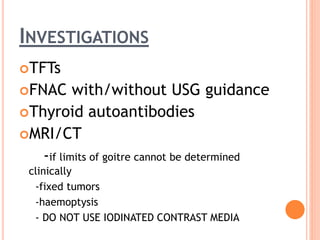
INVESTIGATIONS
TFTs
FNAC with/without USG guidance
Thyroid autoantibodies
MRI/CT
-if limits of goitre cannot be determined
clinically
-fixed tumors
-haemoptysis
- DO NOT USE IODINATED CONTRAST MEDIA
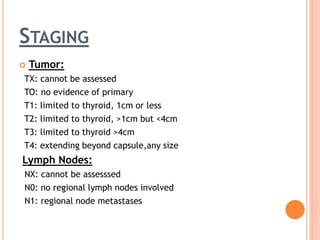
STAGING
 Tumor:
TX: cannot be assessed
TO: no evidence of primary
T1: limited to thyroid, 1cm or less
T2: limited to thyroid, >1cm but <4cm
T3: limited to thyroid >4cm
T4: extending beyond capsule,any size
Lymph Nodes:
NX: cannot be assesssed
N0: no regional lymph nodes involved
N1: regional node metastases
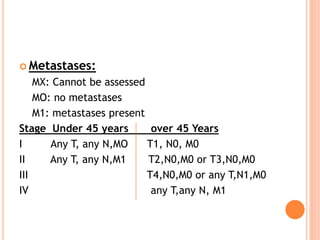
 Metastases:
MX: Cannot be assessed
MO: no metastases
M1: metastases present
Stage Under 45 years over 45 Years
I Any T, any N,MO T1, N0, M0
II Any T, any N,M1 T2,N0,M0 or T3,N0,M0
III T4,N0,M0 or any T,N1,M0
IV any T,any N, M1
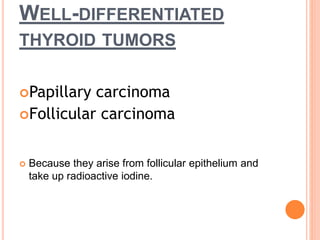
WELL-DIFFERENTIATED
THYROID TUMORS
Papillary carcinoma
Follicular carcinoma
 Because they arise from follicular epithelium and
take up radioactive iodine.
PAPILLARY CARCINOMA
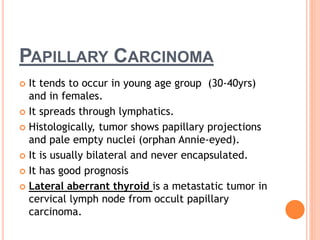
 It tends to occur in young age group (30-40yrs)
and in females.
 It spreads through lymphatics.
 Histologically, tumor shows papillary projections
and pale empty nuclei (orphan Annie-eyed).
 It is usually bilateral and never encapsulated.
 It has good prognosis
 Lateral aberrant thyroid is a metastatic tumor in
cervical lymph node from occult papillary
carcinoma.
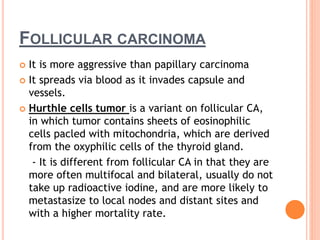
FOLLICULAR CARCINOMA
 It is more aggressive than papillary carcinoma
 It spreads via blood as it invades capsule and
vessels.
 Hurthle cells tumor is a variant on follicular CA,
in which tumor contains sheets of eosinophilic
cells pacled with mitochondria, which are derived
from the oxyphilic cells of the thyroid gland.
- It is different from follicular CA in that they are
more often multifocal and bilateral, usually do not
take up radioactive iodine, and are more likely to
metastasize to local nodes and distant sites and
with a higher mortality rate.
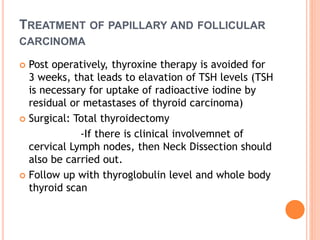
TREATMENT OF PAPILLARY AND FOLLICULAR
CARCINOMA
 Post operatively, thyroxine therapy is avoided for
3 weeks, that leads to elavation of TSH levels (TSH
is necessary for uptake of radioactive iodine by
residual or metastases of thyroid carcinoma)
 Surgical: Total thyroidectomy
-If there is clinical involvemnet of
cervical Lymph nodes, then Neck Dissection should
also be carried out.
 Follow up with thyroglobulin level and whole body
thyroid scan
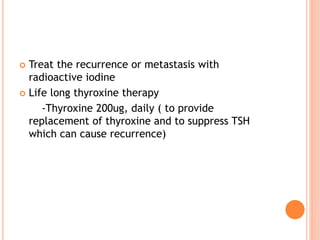
 Treat the recurrence or metastasis with
radioactive iodine
 Life long thyroxine therapy
-Thyroxine 200ug, daily ( to provide
replacement of thyroxine and to suppress TSH
which can cause recurrence)
PRE-REQUISITES FOR FULL BODY THYROID
SCAN
 It is necessary to ablate all normal thyroid tissue,
or else it will uptake all the radioactive material
and residual or metastases will be difficult to
detect
 TSH levels should be adequate
 Thyroxine therapy should be stopped for 6 weeks
 T3 should be given to the patient during this time
period, to decrease the period of hypothyroidism
and should be discontinued for 2 weeks before
scan to let TSH levels raise.
MEDULLARY CARCINOMA
 Arise from parafollicular cells derived from neural
crest cells.
 Calcitonin and carcinoembryonic antigen is
produced by these tumors and can be used as
tumor markers
 Familial cases occur in children and young adults
while sporadic cases occur at any age
 It is associated with pheochromocytoma and
hyperparathyroidism in MEN-2A mutation.
TREATMENT
 Total thyroidectomy along with bilateral central
lymph nodes dissection
 If large tumor or positive central lymph
nodes….modified radical neck dissection
 Rule out pheochromocytoma by measuring urinary
catecholamine before doing thyroidectomy. If
pheochromocytoma present, it should be operated on
first
 If Hypercalcemia present… only obvious enlarged
parathyroid glands should be removed
 If normocalcemia…when a normal parathyroid cannot
be maintained on a vascular pedicle, it should be
removed and then auto transplanted to the forearm.
 If RET mutation carriers…Prophylactic
thyroidectomy is indicated
- before age of 6 years in MEN2A patients
- before age of 1 years in MEN2B patients
 If calcitonin raised and suggests carcinoma…
prophylactic central neck dissection is done.
ANAPLASTIC CARCINOMA
 More aggressive
 Treatment :
 All forms of treatment have dissappointing
outcome
 If tumor confined to thyroid ( very rare) , Then
total thyroidectomy should be carried out
 External beam radiotherapy has some role
 If tracheal obstruction present…isthmusectomy is
also done
LYMPHOMA OF THYROID
 Follows autoimmune thyroiditis (Hashimoto’s
thyroiditis)
 Treatment:
 Stage I and II … Radiotherapy
 Stage III and IV…chemotherapy
POST OPERATIVE COMPLICATIONS
 Hemorrhage
 Reespiratory obstruction
 Tracheomalacia
 Recurrent laryngeal nerve palsy
 Thyroid insufficiency
 Thyrotoxic crisis
 Hypocalcemia (parathyroid insufficiency)
 Wound infection
 Hypertrophic scar or keloid
 Stitch granuloma
Thank you

Malignant thyroid

  • 1.
    MALIGNANT THYROID Dr. AmnaAkram CMH, Multan
  • 2.
    Thyroid cancer isa cancer originating from follicular and parafollicular cells. These cells give rise to well-differentiated and anaplastic cancers.
  • 3.
    CLASSIFICATION Papillary carcinoma (60%) Follicularcarcinoma (20%) Anaplastic carcinoma (10%) Medullary carcinoma (5%) Malignant lymphoma (5%) Hurthle cell carcinoma is a rare type, considered a type of follicular carcinoma.
  • 4.
    ETIOLOGY Papillary carcinoma…Radiation exposure Follicular carcinoma…endemic goitre,a result of TSH stimulation Medullary carcinoma…mutation in RET proto-oncogene,multiple endocrine neoplasia-type 2A and 2B
  • 5.
  • 6.
    RISK FACTORS Hx neckirradiation in childhood Endemic goitre Hashimoto’s thyroiditis Hx of thyroid adenoma Familial thyroid CA Cowden’s syndrome Exposure to nuclear Fallout (Chernobyl)
  • 7.
    PRESENTATION History: Thyroid carcinomamost commonly manifests as painless, palpable, solitary thyroid nodules. These are mostly discovered on routine palpation.  Age of the patient is important at time of presentation because solitary nodules are most likely to be malignant in pt.s older than 60yrs and in younger than 30yrs.
  • 8.
    Hoarsness suggests recurrent laryngealnerve and vocal fold paralysis. Dysphagia may be a sign of impingement of the digestive tract  Heat intolerance and palpitations suggest autonomously functioning nodules.
  • 9.
    PHYSICAL EXAMINATION Malignant nodulesare usually hard, fixed and non-tender Firm cervical masses are highly suggestive of regional lymph node metastases.
  • 10.
    INVESTIGATIONS TFTs FNAC with/without USGguidance Thyroid autoantibodies MRI/CT -if limits of goitre cannot be determined clinically -fixed tumors -haemoptysis - DO NOT USE IODINATED CONTRAST MEDIA
  • 11.
    STAGING  Tumor: TX: cannotbe assessed TO: no evidence of primary T1: limited to thyroid, 1cm or less T2: limited to thyroid, >1cm but <4cm T3: limited to thyroid >4cm T4: extending beyond capsule,any size Lymph Nodes: NX: cannot be assesssed N0: no regional lymph nodes involved N1: regional node metastases
  • 12.
     Metastases: MX: Cannotbe assessed MO: no metastases M1: metastases present Stage Under 45 years over 45 Years I Any T, any N,MO T1, N0, M0 II Any T, any N,M1 T2,N0,M0 or T3,N0,M0 III T4,N0,M0 or any T,N1,M0 IV any T,any N, M1
  • 13.
    WELL-DIFFERENTIATED THYROID TUMORS Papillary carcinoma Follicularcarcinoma  Because they arise from follicular epithelium and take up radioactive iodine.
  • 14.
    PAPILLARY CARCINOMA  Ittends to occur in young age group (30-40yrs) and in females.  It spreads through lymphatics.  Histologically, tumor shows papillary projections and pale empty nuclei (orphan Annie-eyed).  It is usually bilateral and never encapsulated.  It has good prognosis  Lateral aberrant thyroid is a metastatic tumor in cervical lymph node from occult papillary carcinoma.
  • 15.
    FOLLICULAR CARCINOMA  Itis more aggressive than papillary carcinoma  It spreads via blood as it invades capsule and vessels.  Hurthle cells tumor is a variant on follicular CA, in which tumor contains sheets of eosinophilic cells pacled with mitochondria, which are derived from the oxyphilic cells of the thyroid gland. - It is different from follicular CA in that they are more often multifocal and bilateral, usually do not take up radioactive iodine, and are more likely to metastasize to local nodes and distant sites and with a higher mortality rate.
  • 16.
    TREATMENT OF PAPILLARYAND FOLLICULAR CARCINOMA  Post operatively, thyroxine therapy is avoided for 3 weeks, that leads to elavation of TSH levels (TSH is necessary for uptake of radioactive iodine by residual or metastases of thyroid carcinoma)  Surgical: Total thyroidectomy -If there is clinical involvemnet of cervical Lymph nodes, then Neck Dissection should also be carried out.  Follow up with thyroglobulin level and whole body thyroid scan
  • 17.
     Treat therecurrence or metastasis with radioactive iodine  Life long thyroxine therapy -Thyroxine 200ug, daily ( to provide replacement of thyroxine and to suppress TSH which can cause recurrence)
  • 18.
    PRE-REQUISITES FOR FULLBODY THYROID SCAN  It is necessary to ablate all normal thyroid tissue, or else it will uptake all the radioactive material and residual or metastases will be difficult to detect  TSH levels should be adequate  Thyroxine therapy should be stopped for 6 weeks  T3 should be given to the patient during this time period, to decrease the period of hypothyroidism and should be discontinued for 2 weeks before scan to let TSH levels raise.
  • 19.
    MEDULLARY CARCINOMA  Arisefrom parafollicular cells derived from neural crest cells.  Calcitonin and carcinoembryonic antigen is produced by these tumors and can be used as tumor markers  Familial cases occur in children and young adults while sporadic cases occur at any age  It is associated with pheochromocytoma and hyperparathyroidism in MEN-2A mutation.
  • 20.
    TREATMENT  Total thyroidectomyalong with bilateral central lymph nodes dissection  If large tumor or positive central lymph nodes….modified radical neck dissection  Rule out pheochromocytoma by measuring urinary catecholamine before doing thyroidectomy. If pheochromocytoma present, it should be operated on first  If Hypercalcemia present… only obvious enlarged parathyroid glands should be removed  If normocalcemia…when a normal parathyroid cannot be maintained on a vascular pedicle, it should be removed and then auto transplanted to the forearm.
  • 21.
     If RETmutation carriers…Prophylactic thyroidectomy is indicated - before age of 6 years in MEN2A patients - before age of 1 years in MEN2B patients  If calcitonin raised and suggests carcinoma… prophylactic central neck dissection is done.
  • 22.
    ANAPLASTIC CARCINOMA  Moreaggressive  Treatment :  All forms of treatment have dissappointing outcome  If tumor confined to thyroid ( very rare) , Then total thyroidectomy should be carried out  External beam radiotherapy has some role  If tracheal obstruction present…isthmusectomy is also done
  • 23.
    LYMPHOMA OF THYROID Follows autoimmune thyroiditis (Hashimoto’s thyroiditis)  Treatment:  Stage I and II … Radiotherapy  Stage III and IV…chemotherapy
  • 24.
    POST OPERATIVE COMPLICATIONS Hemorrhage  Reespiratory obstruction  Tracheomalacia  Recurrent laryngeal nerve palsy  Thyroid insufficiency  Thyrotoxic crisis  Hypocalcemia (parathyroid insufficiency)  Wound infection  Hypertrophic scar or keloid  Stitch granuloma
  • 25.