MANAGEMENT OF THYROID
MALIGNANCIES
DR. SIDDHARTH M. VYAS (MDS , FAOMSI)
FELLOW, HEAD & NECK SURGICAL ONCOLOGY,
KAILASH CANCER HOSPITAL & RESEARCH CENTRE
GORAJ, GUJARAT
CONTENTS
 Basic goals of the treatment of thyroid malignancies
 Terminologies
 Diagnostic thyroid surgery
 Surgery for DTC
 Management of Papillary Microcarcinoma
 Radioactive remnant ablation & therapy for DTC
 EBRT for DTC
 Post treatment F/U for patients of DTC
 Recurrent/Persistent DTC
 Medullary thyroid carcinoma
 Anaplastic thyroid carcinoma
BASIC GOALS OF THE TREATMENT FOR DTC
 Remove the primary tumour and involved lymph nodes
 Minimise treatment related morbidity
 Allow accurate staging of the disease
 Facilitate post-operative treatment with radioactive iodine in
appropriate patients
 Enable long-term surveillance for disease recurrence &
minimise the risk of disease recurrence and distant metastases
TERMINOLOGY – THYROID SURGERY
 Hemithyroidectomy: Complete removal of one thyroid lobe
including the isthmus
 Near-total lobectomy: a total lobectomy leaving behind only the
small amount of thyroid tissue (significantly less than 1 g) to
protect the recurrent laryngeal nerves
 Near-total thyroidectomy: complete removal of one thyroid lobe
(lobectomy) and near-total of contralateral side or a bilateral near-
total procedure
 Total thyroidectomy: the removal of both thyroid lobes, isthmus
and pyramidal lobe
DIAGNOSTIC THYROID SURGERY
 For Thy3 fine-needle aspiration cytology (FNAC) cases –
hemithyroidectomy
 For patients with Thy4 FNAC, from a small, well defined target
lesion suspicious of PTC (or MTC) – diagnostic
hemithyroidectomy
 Positive intra-operative frozen section facilitates single stage
therapeutic surgery
 Frozen section is not appropriate for follicular lesions
 A total thyroidectomy may be appropriate for patients with
similar cytology and associated symptomatic thyroid disorder
(e.g. multinodular goitre/Graves’ disease)
 Seningen, J.L., Nassar, A. & Henry, M.R. (2012) Correlation of thyroid nodule fine-needle aspiration cytology with
corresponding histology at Mayo Clinic, 2001-2007: an institutional experience of 1,945 cases. Diagnostic
Cytopathology, 40(Suppl. 1), E27–32
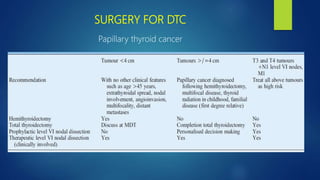
SURGERY FOR DTC
Papillary thyroid cancer
 Male gender ; previously considered as an additional risk factor
for reduced disease-specific survival
 Two recent studies have failed to confirm that it is an
independent risk factor for survival
 Also, there is uncertainty as to whether a sole finding of
microscopic extra-thyroidal extension (pT3) is an adverse risk
factor
 Nilubol, N., Zhang, L. & Kebebew, E. (2013) Multivariate analysis of the relationship between male sex, disease-specific
survival, and features of tumor aggressiveness in thyroid cancer of follicular cell origin. Thyroid, 23, 695–702
 Oyer, S.L., Smith, V.A. & Lentsch, E.J. (2013) Sex is not an independent risk factor for survival in differentiated thyroid
cancer. Laryngoscope, 123, 2913–2919
 Prophylactic lateral neck lymph node dissection (III-IV):
• Not recommended in patients with no evidence of central
compartment lymph node metastases
• Advantage of prophylactic lateral ND in patients with central
compartment LN involvement is also unclear
• Further study reports that patients who had previously
undergone total thyroidectomy and PCCND, had a 6% lateral
neck node recurrence rate at 5 years follow-up
 Barczynski, M., Konturek, A., Stopa, M. et al. (2014) Nodal recurrence in the lateral neck after total thyroidectomy
with prophylactic central neck dissection for papillary thyroid cancer. Langenbeck’s Archives of Surgery, 399,
237–244
 Obvious lateral neck disease – central compartment involvement
is > 80%
 Pre-operative confirmation of lateral neck node involvement –
Levels iia, III, IV and Vb dissected
 Levels I, iib and va left out unless obvious involvement noted
 Farrag, T., Lin, F., Brownlee, N. et al. (2009) Is routine dissection of level II-B and V-A necessary in patients with
papillary thyroid cancer undergoing lateral neck dissection for FNA-confirmed metastases in other levels. World
Journal of Surgery, 33, 1680–1683
 Surgery for follicular thyroid carcinoma [excluding oncocytic
(Hurthle cell) follicular carcinoma]:
 Lymph node metastasis from follicular thyroid cancer is found in
1–8% of patients
 If there is preoperative or intraoperative suspicion of nodal
disease, FNAC or frozen section advised prior to therapeutic neck
dissection
 Alfalah, H., Cranshaw, I., Jany, T. et al. (2008) Risk factors for lateral cervical lymph node involvement in follicular
thyroid carcinoma. World Journal of Surgery, 32, 2623–2626
 Surgery for oncocytic (Hurthle cell) follicular carcinoma:
• Total thyroidectomy for lesions > 1 cm
• Patients with oncocytic (H€urthle cell) microcarcinoma (tumour
size ≤1 cm) are reported to have an increased risk of distant
metastases and reduced disease specific survival compared with
patients with microPTC
 The role of prophylactic node dissection is unclear
 Kuo, E.J., Roman, S.A. & Sosa, J.A. (2013) Patients with follicular and Hurthle cell microcarcinomas have
compromised survival: a population level study of 22,738 patients. Surgery, 154, 1246–1254
 Locally advanced DTC:
• Preserving the nerve at the expense of risking residual
macroscopic disease, does not carry adverse prognostic
implications
 Lang, B.H., Lo, C.Y., Wong, K.P. et al. (2013) Should an involved but functioning recurrent laryngeal nerve be
shaved or resected in a locally advanced papillary thyroid carcinoma? Annals of Surgical Oncology, 20, 2951–
2957
POST-OPERATIVE RISK STRATIFICATION
 Low-risk patients:
• No local or distant metastases
• All macroscopic tumours resected, i.e. R0 or R1 resection
• No tumour invasion of locoregional tissues or structures
• The tumour does not have aggressive histology
(tall cell or columnar cell PTC, diffuse sclerosing PTC, poorly
differentiated elements) or angioinvasion
 Intermediate-risk patients:
• Microscopic invasion of tumour into the peri-thyroidal soft tissues
(T3) at initial surgery
• Cervical lymph node metastases (N1a or N1b)
• Tumour with aggressive histology
(tall cell or columnar cell PTC, diffuse sclerosing PTC, poorly
differentiated elements) or angioinvasion
 High-risk patients:
• Extrathyroidal invasion
• Incomplete macroscopic tumour resection (R2)
• Distant metastases (M1)
MANAGEMENT OF PAPILLARY MICROCARCINOMA
 ‘Microcarcinoma’ is defined as a carcinoma of size of 10 mm and
below
 Microcarcinomas constitute approximately 30% of all differentiated
thyroid cancers
 Management is one of the most controversial areas
 These are nearly always papillary thyroid carcinoma (microPTC) type
 Incidental micro PTC are found in 2.2–49.9% (mostly 5–12%) of
otherwise benign thyroid disease specimens
 Given that long-term survival is nearly 100%, the objective of any
treatment is to reduce the risk of loco-regional recurrence (2.5%)
and distant metastases (0.4%)
 Dunki-Jacobs, E., Grannan, K., McDonough, S. et al. (2012) Clinically unsuspected papillary microcarcinomas of the
thyroid: a common finding with favorable biology? American Journal of Surgery, 203, 140–144
 Risk factors for future recurrence and/or lymph node metastases
in patients with thyroid microPTC (British Thyroid Association
guidelines, 2014)
 Clinical and/or radiological features:
- Non-incidental
- Larger size (6-10mm)
 Histological features
- Multifocal and/or bilateral
- Extra-thyroidal extension
- Poorly differentiated component
- Desmoplastic fibrosis and/or infiltrative growth pattern
 SURGERY
 Thyroid lobectomy is recommended for patients with a unifocal
microPTC and no other risk factors
 Total thyroidectomy is recommended for patients with microPTC
which are familial non-medullary thyroid cancer
 Total thyroidectomy is recommended for patients with multifocal
microPTC involving both lobes of the thyroid
 For all other patients – No definite guidelines (Personalised
decision making)
 PCCND should be considered in patients with tumours that are
multifocal and with extra-thyroidal spread
RADIOIODINE REMNANT ABLATION AND
THERAPY FOR DTC
 Following a total or near total thyroidectomy, some 131 I uptake is
usually demonstrable in the thyroid bed
 131 I-induced destruction of this residual thyroid tissue is known as
‘radioiodine remnant ablation’ (RRA)
 This term should not be used to describe treatment for known
residual local or metastatic disease
 ‘Radioiodine therapy’ refers to administration of 131I with the
intention to treat residual, recurrent or metastatic disease
 Advantages of RRA:
• Increased overall and disease free survival
• Eradication of all residual thyroid cells postoperatively with
subsequent reduced risk of local and distant tumour recurrence
• Reassurance to patients provided by the knowledge that serum
Tg is undetectable and neck US or diagnostic iodine scan imaging
is negative, implying that all thyroid tissue has been destroyed
• Increased sensitivity of Tg monitoring facilitating early detection of
recurrent or metastatic disease
• Increased sensitivity of subsequent iodine scanning if required
 Hackshaw, A., Harmer, C., Mallick, U. et al. (2007) 131I activity for remnant ablation in patients with differentiated
thyroid cancer: a systematic review. Journal of Clinical Endocrinology and Metabolism, 92, 28–38
 Disadvantages of RRA:
• Need to avoid pregnancy (6 months) or fathering a child (4
months)
• Slightly increased risk of miscarriage in the first year after RRA
• Hospital stay in isolation
• Need to maintain a safe distance from others for a short period
after treatment
• Radiation cystitis, nausea, gastritis
• Exposure to potential side-effects of recombinant human TSH
(rhTSH) (rare)
• Sialadenitis, Xerostomia, Dysgeusia
• Pulmonary fibrosis (rare)
• Second malignancy (risk may be higher than previously thought
 Iyer, N.G., Morris, L.G., Tuttle, R.M. et al. (2011) Rising incidence of second cancers in patients with low-risk (T1N0)
thyroid cancer who receive radioactive iodine therapy. Cancer, 117, 4439–4446
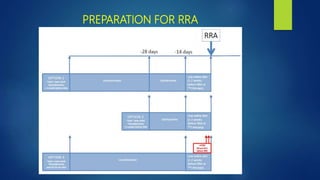
PREPARATION FOR RRA
Indications for I 131therapy
 Definite I131 ablation:
- Tumour >4 cm
- Any tumour size with gross extrathyroidal extension
- Distant metastases present
 Uncertain indications (Should be considered on individual case
merit (MDT)
- Tumour greater than 1 cm
- Extrathyroidal extension
- Unfavourable cell type (tall cell, columnar or diffuse sclerosing
papillary cancer, poorly differentiated elements)
- Widely invasive histology
- Multiple lymph node involvement, large size of involved lymph
nodes, high ratio of positive-to-negative nodes, extracapsular
nodal involvement
 No I131 ablation (all criteria must be met):
- Tumour <1 cm unifocal or multifocal
- Histology classical papillary or follicular variant of papillary
carcinoma, or follicular carcinoma
- Minimally invasive without angioinvasion
- No invasion of thyroid capsule (extrathyroidal extension)
 PREPARATION FOR RRA OR 131 I THERAPY
A) Avoidance of exogenous Iodine
 Diet rich in Iodine, iodinated IV contrast and Amiodarone may
compromise the efficacy of 131I, hence avoided
 low iodine diet for 1– 2 weeks prior to RRA or 131I therapy is
advised
 Gap of 8 weeks is desirable between administration of iodinated IV
contrast and RRA/131 I
 RRA/131 I should be deferred if patient is currently taking
Amiadarone or has used it in past 12 months
B) Recombinant human TSH (rhTSH) and RRA or therapy
 Randomised trials have shown that RRA is equally successful after
rhTSH, as after THW for selected patients with DTC
 rhTSH is recommended method of preparation for RRA in patients
who are: pT1 to T3, pN0 or NX or N1, and M0 and R0
 Schlumberger, M., Catargi, B., Borget, I. et al. (2012) Strategies of radioiodine ablation in patients with low-risk
thyroid cancer. New England Journal of Medicine, 366, 1663–1673
 Preferability of THW versus rhTSH for RRA of high risk patients or
patients with recurrent/metastatic disease, is uncertain
 rhTSH is safer alternative when THW is contraindicated
C) Also, breastfeeding must be discontinued at least 8 weeks before
RRA or 131I therapy to avoid breast irradiation
 Should not be resumed until after a subsequent pregnancy
 Robbins, R.J., Driedger, A. & Magner, J. (2006) Recombinant human thyrotropin-assisted radioiodine therapy for
patients with metastatic thyroid cancer who could not elevate endogenous thyrotropin or be withdrawn from
thyroxine. Thyroid, 16, 1121– 1130
 Pre-treatment sperm banking should be considered in male
patients likely to have more than two high activity 131I therapies
 Excretion of 131I is mainly via the renal system
 Adequate renal function must be ensured prior to administration
Activity of 131I
 Two large multicentre RCTs have shown that 1.1 GBq of 131 I was as
effective as 3.7 GBq in ablating the thyroid remnant in the low and
intermediate risk group
 Adverse events were fewer in the 1.1 GBq group
 One of the trials included patients with pT3 tumours, and patients
with N1 disease, who were ablated successfully with 1.1 GBq
 Mallick, U., Harmer, C., Yap, B. et al. (2012) Ablation with lowdose radioiodine and thyrotropin alfa in thyroid
cancer. New England Journal of Medicine, 366, 1674–1685
 Meta-analysis by Cheng found no difference in efficacy between 1.1
and 3.7 GBq
 Patients with pT1-2, N0 with R0 resection should receive 1.1 GBq
 Patients with pT3 and/or N1 disease, the final choice of 131 I
activity should be decided by the MDT
 131 I activities of 3.7–5.5 GBq are recommended for residual local
disease following RRA or distant metastases
 Cheng, W., Ma, C., Fu, H. et al. (2013) Low- or high-dose radioiodine remnant ablation for differentiated thyroid
carcinoma: a meta-analysis. Journal of Clinical Endocrinology and Metabolism, 98, 1353–1360
 Pulmonary metastasis – Micronodular responds more favourably
 Bone metastasis – Surgical intervention if amenable/ High dose
EBRT followed by 131 I
- Sole 131 I therapy rearely achieves complete response
 Refractory disease – Supportive care
 Assessment of RRA success:
- A post-ablation scan is performed when residual activity levels
permit satisfactory imaging (usually 2– 10 days)
- sTg evaluation (THW or rhTSH)
- US examination
(9-12 months post RRA)
 DYNAMIC RISK STRATIFICATION
 Excellent response (All the following):
- Suppressed and stimulated Tg< 1 ng/ml
- Neck US without evidence of disease
- Cross-sectional and/or nuclear medicine imaging negative (if
performed)
 Low risk:
- Maintain TSH 0.3–2.0 mIU/l
 Indeterminate response (Any of the following):
- Suppressed Tg < 1 ng/ml and stimulated Tg ≥ 1 and <10 ng/ml
- Neck US with non-specific changes or stable sub centimetre
lymph nodes
- Cross-sectional and/or nuclear medicine imaging with non-
specific changes , although not completely normal
 Intermediate risk:
- Suppress TSH 0.1–0.5 mIU/l for 5–10 years then reassess
 Incomplete response (Any of the following):
- Suppressed Tg ≥1 ng/ml or stimulated Tg ≥10 ng/ml
- Rising Tg values Persistent or
- Newly identified disease on cross-sectional and/or nuclear
medicine imaging
 High risk
- Suppress TSH < 0.1 mIU/l indefinitely
EBRT for DTC
 Several studies have shown a statistically significant benefit for
EBRT in terms of local disease control
 The indications for primary management with EBRT are rare and
fall into the palliative setting
 Indications for adjuvant EBRT:
- gross macroscopic residual disease, or
- residual or recurrent tumour that fails to concentrate radioiodine
and surgery is impractical
 Sia, M.A., Tsang, R.W., Panzarella, T. et al. (2010) Differentiated thyroid cancer with extrathyroidal extension:
Prognosis and the role of external beam radiotherapy. Journal of Thyroid Research, 183461. doi:
10.4061/2010/183461
 60 Gy in 30 fractions
 Usually given post RRA to obviate the concern of stunning effect
on thyroid cells
 No definite sequencing exists
 If residual disease poses a threat to the critical structure such as
airway, EBRT may be given first (lessens the risk associated with
RRA induced tumoral edema)
 PALLIATION
 For bone/brain metastases, spinal cord compression, bleeding &
painful masses that are no longer iodine avid
 A short course (20 Gy in five fractions over one week) is
recommended for palliation can be repeated if needed
 Patients with good performance status and limited metastatic
disease - higher palliative doses (>40 Gy)
 Rapidly progressive neck masses 30 Gy in 10 fractions over 2 weeks
POST-TREATMENT FOLLOW-UP OF PATIENTS
WITH DTC
 Management of acute post-thyroidectomy hypocalcaemia
 Post thyroidectomy >30% will need calcium supplementation
 By 3 months, <10% will require the same
 Decline in the first 24 hours is predictive of need of Calcium
supplementation
 Hannan, F.M. & Thakker, R.V. (2013) Investigating Hypocalcaemia. BMJ, 9, 346, f2213
 Serum calcium remains between 1.9 and 2.1 mM (asymptomatic)
increase calcium supplements
 Mildly hypocalcaemic beyond 72 hours post op despite calcium
supplements, alfacalcidol or calcitriol 025 mcg/day is started with
close monitoring
 severe symptomatic hypocalcaemia (<1.9mM) – 10 to 20ml of 10%
calcium gluconate in 50-100 ml of 5% Dextrose IV over the period
of 10 minutes
 Infusion follows
- 100 ml of 10% Ca gluconate in 1 litre of NS or 5% Dextrose at the
rate of 50-100ml/hr
- Calcium chloride can be alternative
- Irritant to veins, central line should be used
 Severe hypocalcemia in asymptomatic or minimally symptomatic
patients – oral supplements with alfacalcidiol or calcitriol is
preferred over IV Calcium gluconate
 Suppression of serum thyroid stimulating hormone (TSH)
 A meta-analysis supported the efficacy of TSH suppression in
preventing major adverse clinical events
 The need for long-term TSH suppression should be based on
Dynamic Risk Stratification determined 9–12 months following total
thyroidectomy and RRA
 Cooper, D.S., Doherty, G.M., Haugen, B.R. et al. (2009) Revised American Thyroid Association management
guidelines for patients with thyroid nodules and differentiated thyroid cancer. Thyroid, 19, 1167–1214
 Incomplete response to treatment for thyroid cancer the serum
TSH should be suppressed below 0.1 mIU/l indefinitely in the
absence of specific contra-indications
 Indeterminate response - between 01 and 05 mU/l for 5–10 years
(After that re-evaluated)
 Excellent response - low-normal range between 0.3–2 mU/l
 who have not undergone Dynamic Risk Stratification - below 0.1
mU/l for 5–10 years followed by reevaluation
 Measurement of Serum Tg
 In the post-thyroidectomy setting, a detectable serum Tg is highly
suggestive of thyroid remnant, residual or recurrent tumour
 Serum Tg rising with time while on suppressive thyroxine therapy
highly suggestive of tumour recurrence or progression
 Endogenous Tg antibodies (TgAb) may interfere with the
measurement of serum Tg
 TgAb concentrations decline with successful removal of Tg
antigenic stimulus (following thyroidectomy and RRA) over a
median time of 3 years
 De novo appearance or a rising in TgAb concentration - significant
risk factor for recurrent disease
 TSH-stimulated serum Tg (sTg) measurement
- The diagnostic sensitivity of serum Tg measurements is enhanced
by an elevated TSH concentration
- Tumour recurrence or progression can be diagnosed earlier by
detecting a raised sTg (When TSH > 30mIU/L)
- sTg<0.5 ng/ml after rhTSH has been shown to identify patients free
of disease with a 98– 995% probability
- A sTg > 2 ng/ml following rhTSH stimulation, is highly sensitive in
identifying patients with persistent disease (though the specificity is
low)
 Castagna, M.G., Brilli, L., Pilli, T. et al. (2008) Limited value of repeat recombinant thyrotropin (rhTSH)-
stimulated thyroglobulin testing in differentiated thyroid carcinoma patients with previous negative
rhTSHstimulated thyroglobulin and undetectable basal serum thyroglobulin levels. Journal of Clinical
Endocrinology and Metabolism, 93, 76–81
- An unstimulated serum Tg <0.1 ng/ml measured by a sensitive
assay in the absence of TgAbs has a very high negative
predictive
(Patients subjected to total thyroidectomy and RRA)
 Recommendations for the use of rhTSH-stimulated Tg:
- Hypopituitarism
- severe ischaemic heart disease
- previous history of psychiatric disturbance precipitated by
hypothyroidism
- Advanced age/frailty
Recurrent/persistent DTC
 Recurrence in the thyroid bed or cervical lymph nodes:
 Surgery with curative intent is the treatment of choice for
recurrent disease confined to the neck
 Low volume recurrent or persistent disease in the neck, which is
not progressive, may be treated either by surgery or managed
with active surveillance
 Residual macroscopic disease in the neck following surgery for
recurrent disease may be treated with 131 I
 Patients with progressive disease in the neck not amenable to
surgery and unresponsive to 131I should be considered for EBRT
 Patients with distant metastases having recurrent disease in the
neck or mediastinum are considered for reoperative surgery if
locoregional control loss compromises aerodigestive tract
 Metastatic disease involving lung and other soft tissue areas
• 131I therapy
 Bone metastasis
• 131 I therapy plus EBRT
• Pamidronate improves pain control
• Zoledronic acid and Denosumab, is associated with reduced
skeletal-related events (pathological fracture, spinal cord
compression)
 Wexler, J.A. (2011) Approach to the thyroid cancer patient with bone metastases. Journal of Clinical Endocrinology
and Metabolism, 96, 2296–2307
 Cerebral metastasis
• Patients with oligometastases and good performance status -
considered for surgical resection or radiosurgery followed by 131 I
• Unresectable cerebral metastases – EBRT
• Cerebral radiotherapy - used carefully in patients with poor
performance status
 MANAGEMENT OF PATIENTS WITH AN ELEVATED SERUM
THYROGLOBULIN
 Occasionally the serum thyroglobulin (Tg) may be falsely increased
by Tg antibodies, which may not always be measurable
 A single elevated serum Tg should be confirmed by repeating
 An elevated serum Tg should lead to a detailed neck US
 US negative, Tg positive- challenging scenario
 As first line, any of the following imaging modalities may be used:
chest CT without contrast, rhTSH-stimulated FDGPET- CT, neck MRI,
bone scan
 THW or rhTSH administration have been shown to increase the
sensitivity of FDG-PET-CT scan
 If diagnostic imaging fails to identify the source of raised Tg,
empirical 131I treatment may be given – Advantage uncertain (3.7 –
5.5 GBq)
 Van Tol, K.M., Jager, P.L., Piers, D.A. et al. (2002) Better yield of (18)fluorodeoxyglucose- positron emission
tomography in patients with metastatic differentiated thyroid carcinoma during thyrotropin stimulation. Thyroid, 12,
381–387
 Palliative treatment
 EBRT, Chemotherapy/targeted therapy
 Sorafenib and Lenvatinib exhibits most clinical benefits
 Early data have shown good response rates in BRAF V600E mutated
papillary carcinoma with vemurafanib
 Dadu, R., Devine, C., Hernandez, M., et al. (2014) Role of salvage targeted therapy in differentiated thyroid cancer
patients who failed first-line sorafenib. Journal of Clinical Endocrinology and Metabolism, 99, 2086–2094
MEDULLARY THYROID CANCER
 TREATMENT
 Established MTC - a minimum of total thyroidectomy and central
compartment node dissection
 Incidental, sporadic (RET negative), unifocal micro MTC <5 mm,
completion thyroidectomy is not essential
 However, approximately 20% of patients may have node
metastases
 Kazaure, H.S., Roman, S.A. & Sosa, J.A. (2012) Medullary thyroid microcarcinoma: a population-level analysis of 310
patients. Cancer, 118, 620–627
 Post-operative basal calcitonin should determine the need for
further surgery (completion thyroidectomy/ central neck
dissection)
 Clinical or radiologically involved lymph nodes in the lateral
compartment - Total thyroidectomy + central ND + selective
lateral neck dissection of levels IIa–Vb
 Ipsilateral prophylactic lateral neck dissection recommended in
the presence of central compartment node metastases
(risk of lateral node involvement is at least 70%)
 Pre-op imaging of central compartment has low sensitivity to
detect nodal metastasis
 Hence either central & lateral compartment dissection at initial
surgery or frozen section or two staged surgery
 Prophylactic bilateral lateral compartment ND – role unclear
 Approx 35% patients with central LN metastasis have contralateral
lateral nodal metastasis
 Machens, A., Hauptmann, S. & Dralle, H. (2008) Prediction of lateral lymph node metastases in medullary thyroid
cancer. British Journal of Surgery, 95, 586–591
 B/L lateral ND in patients with basal calcitonin of ≤1000 ng/l
achieves biochemical cure in more than 50% of patients
 Likelihood of biochemical cure goes down in patients with >10
nodal metastases or > 2 LN compartments involved
 In summary, B/L prophylactic lateral ND will likely reduce calcitonin
levels and the need for reoperation, but its impact on survival is not
certain
 Machens, A. & Dralle, H. (2010) Biomarker-based risk stratification for previously untreated medullary thyroid cancer.
Journal of Clinical Endocrinology and Metabolism, 95, 2655–2663
 Prophylactic surgery:
 Young patients with RET gene mutations/carriers having MEN2/3 –
prophylactic surgery advised
 Initially C cell hyperplasia, gradually converts to MTC
(Basal calcitonin levels suggest the risk)
 MEN 3 – Surgery preferable within first 6 months of life
 MEN 2A with 634 codon mutation- within first 5 years of life
 LN metastasis – very low risk in mild/moderately elevated calcitonin
levels
 (proposed cut-offs in different series: 20 ng/l, <31 ng/l, 60 ng/l, 90
ng/l)
 Rohmer, V., Vidal-Trecan, G., Bourdelot, A. et al. (2011) Prognostic factors of disease-free survival after thyroidectomy
in 170 young patients with a RET germline mutation: a multicentre study of the Groupe Francais d’Etude des
Tumeurs Endocrines. Journal of Clinical Endocrinology and Metabolism, 96, E509–E518
 ADJUVANT THERAPY:
 Radioactive Iodine – No role
 EBRT – Not shown to improve survival
 Can be used to prevent local recurrence after optimal surgery
(In situation of microscopic residual disease in the
of large disease volume)
 Follow up: Lifelong
 Calcitonin post surgery – after 15 days
 Response to primary surgery assessed clinically and by the
measurement of serum calcitonin and CEA usually 6 months after
surgery
 Calcitonin and CEA doubling times correlate with tumour
progression and are useful prognostic indicators for MTC
recurrence and survival
 Recurrence presenting as advanced disease – Surgery (Even in
cases of distant metastasis)
 Palliative EBRT for painful bone metastasis/ unresectable masses
 Chemotherapy – rarely used
 Doxorubicin provides short term and partial relief in <30% of
cases
ANAPLASTIC THYROID CANCER
 By virtue of rarity – lack of clinical trials producing high quality
evidence
 Guidelines make recommendations of weak strength
 Management – Multimodality (Surgery + Radiotherapy +
Chemotherapy)
 Median survival is in the range of 3– 7 months and 1-year survival
10–20%
 Kebebew, E. (2012) Anaplastic thyroid carcinoma; rare, fatal and neglected. Surgery, 152, 1088–1089
 EBRT – No consensus on the dosage and fractionations
 >40 Gy have produced better results
 Hypofractionated regimen for palliative management
 The addition of concurrent chemotherapy may improve the 1-year
survival rate
 Wang, Y., Tsang, R., Asa, S. et al. (2006) Clinical outcome of anaplastic thyroid carcinoma treated with radiotherapy
of once- and twice-daily fractionation regimens. Cancer, 107, 1786– 1792
 Concurrent chemotherapy regimens that have been used include:
- Cisplatin weekly
- Doxorubicin weekly or 3 weekly
- Paclitaxel/carboplatin weekly
- Docetaxel/doxorubicin 3–4 weekly and
- Paclitaxel weekly
THANK YOU

Management of thyroid malignancies

  • 1.
    MANAGEMENT OF THYROID MALIGNANCIES DR.SIDDHARTH M. VYAS (MDS , FAOMSI) FELLOW, HEAD & NECK SURGICAL ONCOLOGY, KAILASH CANCER HOSPITAL & RESEARCH CENTRE GORAJ, GUJARAT
  • 2.
    CONTENTS  Basic goalsof the treatment of thyroid malignancies  Terminologies  Diagnostic thyroid surgery  Surgery for DTC  Management of Papillary Microcarcinoma  Radioactive remnant ablation & therapy for DTC  EBRT for DTC  Post treatment F/U for patients of DTC  Recurrent/Persistent DTC  Medullary thyroid carcinoma  Anaplastic thyroid carcinoma
  • 3.
    BASIC GOALS OFTHE TREATMENT FOR DTC  Remove the primary tumour and involved lymph nodes  Minimise treatment related morbidity  Allow accurate staging of the disease  Facilitate post-operative treatment with radioactive iodine in appropriate patients  Enable long-term surveillance for disease recurrence & minimise the risk of disease recurrence and distant metastases
  • 4.
    TERMINOLOGY – THYROIDSURGERY  Hemithyroidectomy: Complete removal of one thyroid lobe including the isthmus  Near-total lobectomy: a total lobectomy leaving behind only the small amount of thyroid tissue (significantly less than 1 g) to protect the recurrent laryngeal nerves  Near-total thyroidectomy: complete removal of one thyroid lobe (lobectomy) and near-total of contralateral side or a bilateral near- total procedure  Total thyroidectomy: the removal of both thyroid lobes, isthmus and pyramidal lobe
  • 5.
    DIAGNOSTIC THYROID SURGERY For Thy3 fine-needle aspiration cytology (FNAC) cases – hemithyroidectomy  For patients with Thy4 FNAC, from a small, well defined target lesion suspicious of PTC (or MTC) – diagnostic hemithyroidectomy  Positive intra-operative frozen section facilitates single stage therapeutic surgery
  • 6.
     Frozen sectionis not appropriate for follicular lesions  A total thyroidectomy may be appropriate for patients with similar cytology and associated symptomatic thyroid disorder (e.g. multinodular goitre/Graves’ disease)  Seningen, J.L., Nassar, A. & Henry, M.R. (2012) Correlation of thyroid nodule fine-needle aspiration cytology with corresponding histology at Mayo Clinic, 2001-2007: an institutional experience of 1,945 cases. Diagnostic Cytopathology, 40(Suppl. 1), E27–32
  • 7.
  • 8.
     Male gender; previously considered as an additional risk factor for reduced disease-specific survival  Two recent studies have failed to confirm that it is an independent risk factor for survival  Also, there is uncertainty as to whether a sole finding of microscopic extra-thyroidal extension (pT3) is an adverse risk factor  Nilubol, N., Zhang, L. & Kebebew, E. (2013) Multivariate analysis of the relationship between male sex, disease-specific survival, and features of tumor aggressiveness in thyroid cancer of follicular cell origin. Thyroid, 23, 695–702  Oyer, S.L., Smith, V.A. & Lentsch, E.J. (2013) Sex is not an independent risk factor for survival in differentiated thyroid cancer. Laryngoscope, 123, 2913–2919
  • 9.
     Prophylactic lateralneck lymph node dissection (III-IV): • Not recommended in patients with no evidence of central compartment lymph node metastases • Advantage of prophylactic lateral ND in patients with central compartment LN involvement is also unclear • Further study reports that patients who had previously undergone total thyroidectomy and PCCND, had a 6% lateral neck node recurrence rate at 5 years follow-up  Barczynski, M., Konturek, A., Stopa, M. et al. (2014) Nodal recurrence in the lateral neck after total thyroidectomy with prophylactic central neck dissection for papillary thyroid cancer. Langenbeck’s Archives of Surgery, 399, 237–244
  • 10.
     Obvious lateralneck disease – central compartment involvement is > 80%  Pre-operative confirmation of lateral neck node involvement – Levels iia, III, IV and Vb dissected  Levels I, iib and va left out unless obvious involvement noted  Farrag, T., Lin, F., Brownlee, N. et al. (2009) Is routine dissection of level II-B and V-A necessary in patients with papillary thyroid cancer undergoing lateral neck dissection for FNA-confirmed metastases in other levels. World Journal of Surgery, 33, 1680–1683
  • 11.
     Surgery forfollicular thyroid carcinoma [excluding oncocytic (Hurthle cell) follicular carcinoma]:
  • 12.
     Lymph nodemetastasis from follicular thyroid cancer is found in 1–8% of patients  If there is preoperative or intraoperative suspicion of nodal disease, FNAC or frozen section advised prior to therapeutic neck dissection  Alfalah, H., Cranshaw, I., Jany, T. et al. (2008) Risk factors for lateral cervical lymph node involvement in follicular thyroid carcinoma. World Journal of Surgery, 32, 2623–2626
  • 13.
     Surgery foroncocytic (Hurthle cell) follicular carcinoma: • Total thyroidectomy for lesions > 1 cm • Patients with oncocytic (H€urthle cell) microcarcinoma (tumour size ≤1 cm) are reported to have an increased risk of distant metastases and reduced disease specific survival compared with patients with microPTC  The role of prophylactic node dissection is unclear  Kuo, E.J., Roman, S.A. & Sosa, J.A. (2013) Patients with follicular and Hurthle cell microcarcinomas have compromised survival: a population level study of 22,738 patients. Surgery, 154, 1246–1254
  • 14.
     Locally advancedDTC: • Preserving the nerve at the expense of risking residual macroscopic disease, does not carry adverse prognostic implications  Lang, B.H., Lo, C.Y., Wong, K.P. et al. (2013) Should an involved but functioning recurrent laryngeal nerve be shaved or resected in a locally advanced papillary thyroid carcinoma? Annals of Surgical Oncology, 20, 2951– 2957
  • 15.
    POST-OPERATIVE RISK STRATIFICATION Low-risk patients: • No local or distant metastases • All macroscopic tumours resected, i.e. R0 or R1 resection • No tumour invasion of locoregional tissues or structures • The tumour does not have aggressive histology (tall cell or columnar cell PTC, diffuse sclerosing PTC, poorly differentiated elements) or angioinvasion
  • 16.
     Intermediate-risk patients: •Microscopic invasion of tumour into the peri-thyroidal soft tissues (T3) at initial surgery • Cervical lymph node metastases (N1a or N1b) • Tumour with aggressive histology (tall cell or columnar cell PTC, diffuse sclerosing PTC, poorly differentiated elements) or angioinvasion
  • 17.
     High-risk patients: •Extrathyroidal invasion • Incomplete macroscopic tumour resection (R2) • Distant metastases (M1)
  • 18.
    MANAGEMENT OF PAPILLARYMICROCARCINOMA  ‘Microcarcinoma’ is defined as a carcinoma of size of 10 mm and below  Microcarcinomas constitute approximately 30% of all differentiated thyroid cancers  Management is one of the most controversial areas  These are nearly always papillary thyroid carcinoma (microPTC) type
  • 19.
     Incidental microPTC are found in 2.2–49.9% (mostly 5–12%) of otherwise benign thyroid disease specimens  Given that long-term survival is nearly 100%, the objective of any treatment is to reduce the risk of loco-regional recurrence (2.5%) and distant metastases (0.4%)  Dunki-Jacobs, E., Grannan, K., McDonough, S. et al. (2012) Clinically unsuspected papillary microcarcinomas of the thyroid: a common finding with favorable biology? American Journal of Surgery, 203, 140–144
  • 20.
     Risk factorsfor future recurrence and/or lymph node metastases in patients with thyroid microPTC (British Thyroid Association guidelines, 2014)  Clinical and/or radiological features: - Non-incidental - Larger size (6-10mm)  Histological features - Multifocal and/or bilateral
  • 21.
    - Extra-thyroidal extension -Poorly differentiated component - Desmoplastic fibrosis and/or infiltrative growth pattern  SURGERY  Thyroid lobectomy is recommended for patients with a unifocal microPTC and no other risk factors  Total thyroidectomy is recommended for patients with microPTC which are familial non-medullary thyroid cancer
  • 22.
     Total thyroidectomyis recommended for patients with multifocal microPTC involving both lobes of the thyroid  For all other patients – No definite guidelines (Personalised decision making)  PCCND should be considered in patients with tumours that are multifocal and with extra-thyroidal spread
  • 23.
    RADIOIODINE REMNANT ABLATIONAND THERAPY FOR DTC  Following a total or near total thyroidectomy, some 131 I uptake is usually demonstrable in the thyroid bed  131 I-induced destruction of this residual thyroid tissue is known as ‘radioiodine remnant ablation’ (RRA)  This term should not be used to describe treatment for known residual local or metastatic disease  ‘Radioiodine therapy’ refers to administration of 131I with the intention to treat residual, recurrent or metastatic disease
  • 24.
     Advantages ofRRA: • Increased overall and disease free survival • Eradication of all residual thyroid cells postoperatively with subsequent reduced risk of local and distant tumour recurrence • Reassurance to patients provided by the knowledge that serum Tg is undetectable and neck US or diagnostic iodine scan imaging is negative, implying that all thyroid tissue has been destroyed
  • 25.
    • Increased sensitivityof Tg monitoring facilitating early detection of recurrent or metastatic disease • Increased sensitivity of subsequent iodine scanning if required  Hackshaw, A., Harmer, C., Mallick, U. et al. (2007) 131I activity for remnant ablation in patients with differentiated thyroid cancer: a systematic review. Journal of Clinical Endocrinology and Metabolism, 92, 28–38
  • 26.
     Disadvantages ofRRA: • Need to avoid pregnancy (6 months) or fathering a child (4 months) • Slightly increased risk of miscarriage in the first year after RRA • Hospital stay in isolation • Need to maintain a safe distance from others for a short period after treatment • Radiation cystitis, nausea, gastritis
  • 27.
    • Exposure topotential side-effects of recombinant human TSH (rhTSH) (rare) • Sialadenitis, Xerostomia, Dysgeusia • Pulmonary fibrosis (rare) • Second malignancy (risk may be higher than previously thought  Iyer, N.G., Morris, L.G., Tuttle, R.M. et al. (2011) Rising incidence of second cancers in patients with low-risk (T1N0) thyroid cancer who receive radioactive iodine therapy. Cancer, 117, 4439–4446
  • 28.
  • 29.
    Indications for I131therapy  Definite I131 ablation: - Tumour >4 cm - Any tumour size with gross extrathyroidal extension - Distant metastases present  Uncertain indications (Should be considered on individual case merit (MDT) - Tumour greater than 1 cm - Extrathyroidal extension
  • 30.
    - Unfavourable celltype (tall cell, columnar or diffuse sclerosing papillary cancer, poorly differentiated elements) - Widely invasive histology - Multiple lymph node involvement, large size of involved lymph nodes, high ratio of positive-to-negative nodes, extracapsular nodal involvement
  • 31.
     No I131ablation (all criteria must be met): - Tumour <1 cm unifocal or multifocal - Histology classical papillary or follicular variant of papillary carcinoma, or follicular carcinoma - Minimally invasive without angioinvasion - No invasion of thyroid capsule (extrathyroidal extension)
  • 32.
     PREPARATION FORRRA OR 131 I THERAPY A) Avoidance of exogenous Iodine  Diet rich in Iodine, iodinated IV contrast and Amiodarone may compromise the efficacy of 131I, hence avoided  low iodine diet for 1– 2 weeks prior to RRA or 131I therapy is advised  Gap of 8 weeks is desirable between administration of iodinated IV contrast and RRA/131 I
  • 33.
     RRA/131 Ishould be deferred if patient is currently taking Amiadarone or has used it in past 12 months B) Recombinant human TSH (rhTSH) and RRA or therapy  Randomised trials have shown that RRA is equally successful after rhTSH, as after THW for selected patients with DTC  rhTSH is recommended method of preparation for RRA in patients who are: pT1 to T3, pN0 or NX or N1, and M0 and R0  Schlumberger, M., Catargi, B., Borget, I. et al. (2012) Strategies of radioiodine ablation in patients with low-risk thyroid cancer. New England Journal of Medicine, 366, 1663–1673
  • 34.
     Preferability ofTHW versus rhTSH for RRA of high risk patients or patients with recurrent/metastatic disease, is uncertain  rhTSH is safer alternative when THW is contraindicated C) Also, breastfeeding must be discontinued at least 8 weeks before RRA or 131I therapy to avoid breast irradiation  Should not be resumed until after a subsequent pregnancy  Robbins, R.J., Driedger, A. & Magner, J. (2006) Recombinant human thyrotropin-assisted radioiodine therapy for patients with metastatic thyroid cancer who could not elevate endogenous thyrotropin or be withdrawn from thyroxine. Thyroid, 16, 1121– 1130
  • 35.
     Pre-treatment spermbanking should be considered in male patients likely to have more than two high activity 131I therapies  Excretion of 131I is mainly via the renal system  Adequate renal function must be ensured prior to administration
  • 36.
    Activity of 131I Two large multicentre RCTs have shown that 1.1 GBq of 131 I was as effective as 3.7 GBq in ablating the thyroid remnant in the low and intermediate risk group  Adverse events were fewer in the 1.1 GBq group  One of the trials included patients with pT3 tumours, and patients with N1 disease, who were ablated successfully with 1.1 GBq  Mallick, U., Harmer, C., Yap, B. et al. (2012) Ablation with lowdose radioiodine and thyrotropin alfa in thyroid cancer. New England Journal of Medicine, 366, 1674–1685
  • 37.
     Meta-analysis byCheng found no difference in efficacy between 1.1 and 3.7 GBq  Patients with pT1-2, N0 with R0 resection should receive 1.1 GBq  Patients with pT3 and/or N1 disease, the final choice of 131 I activity should be decided by the MDT  131 I activities of 3.7–5.5 GBq are recommended for residual local disease following RRA or distant metastases  Cheng, W., Ma, C., Fu, H. et al. (2013) Low- or high-dose radioiodine remnant ablation for differentiated thyroid carcinoma: a meta-analysis. Journal of Clinical Endocrinology and Metabolism, 98, 1353–1360
  • 38.
     Pulmonary metastasis– Micronodular responds more favourably  Bone metastasis – Surgical intervention if amenable/ High dose EBRT followed by 131 I - Sole 131 I therapy rearely achieves complete response  Refractory disease – Supportive care
  • 39.
     Assessment ofRRA success: - A post-ablation scan is performed when residual activity levels permit satisfactory imaging (usually 2– 10 days) - sTg evaluation (THW or rhTSH) - US examination (9-12 months post RRA)
  • 40.
     DYNAMIC RISKSTRATIFICATION  Excellent response (All the following): - Suppressed and stimulated Tg< 1 ng/ml - Neck US without evidence of disease - Cross-sectional and/or nuclear medicine imaging negative (if performed)  Low risk: - Maintain TSH 0.3–2.0 mIU/l
  • 41.
     Indeterminate response(Any of the following): - Suppressed Tg < 1 ng/ml and stimulated Tg ≥ 1 and <10 ng/ml - Neck US with non-specific changes or stable sub centimetre lymph nodes - Cross-sectional and/or nuclear medicine imaging with non- specific changes , although not completely normal  Intermediate risk: - Suppress TSH 0.1–0.5 mIU/l for 5–10 years then reassess
  • 42.
     Incomplete response(Any of the following): - Suppressed Tg ≥1 ng/ml or stimulated Tg ≥10 ng/ml - Rising Tg values Persistent or - Newly identified disease on cross-sectional and/or nuclear medicine imaging  High risk - Suppress TSH < 0.1 mIU/l indefinitely
  • 43.
    EBRT for DTC Several studies have shown a statistically significant benefit for EBRT in terms of local disease control  The indications for primary management with EBRT are rare and fall into the palliative setting  Indications for adjuvant EBRT: - gross macroscopic residual disease, or - residual or recurrent tumour that fails to concentrate radioiodine and surgery is impractical  Sia, M.A., Tsang, R.W., Panzarella, T. et al. (2010) Differentiated thyroid cancer with extrathyroidal extension: Prognosis and the role of external beam radiotherapy. Journal of Thyroid Research, 183461. doi: 10.4061/2010/183461
  • 44.
     60 Gyin 30 fractions  Usually given post RRA to obviate the concern of stunning effect on thyroid cells  No definite sequencing exists  If residual disease poses a threat to the critical structure such as airway, EBRT may be given first (lessens the risk associated with RRA induced tumoral edema)
  • 45.
     PALLIATION  Forbone/brain metastases, spinal cord compression, bleeding & painful masses that are no longer iodine avid  A short course (20 Gy in five fractions over one week) is recommended for palliation can be repeated if needed  Patients with good performance status and limited metastatic disease - higher palliative doses (>40 Gy)  Rapidly progressive neck masses 30 Gy in 10 fractions over 2 weeks
  • 46.
    POST-TREATMENT FOLLOW-UP OFPATIENTS WITH DTC  Management of acute post-thyroidectomy hypocalcaemia  Post thyroidectomy >30% will need calcium supplementation  By 3 months, <10% will require the same  Decline in the first 24 hours is predictive of need of Calcium supplementation  Hannan, F.M. & Thakker, R.V. (2013) Investigating Hypocalcaemia. BMJ, 9, 346, f2213
  • 47.
     Serum calciumremains between 1.9 and 2.1 mM (asymptomatic) increase calcium supplements  Mildly hypocalcaemic beyond 72 hours post op despite calcium supplements, alfacalcidol or calcitriol 025 mcg/day is started with close monitoring  severe symptomatic hypocalcaemia (<1.9mM) – 10 to 20ml of 10% calcium gluconate in 50-100 ml of 5% Dextrose IV over the period of 10 minutes
  • 48.
     Infusion follows -100 ml of 10% Ca gluconate in 1 litre of NS or 5% Dextrose at the rate of 50-100ml/hr - Calcium chloride can be alternative - Irritant to veins, central line should be used  Severe hypocalcemia in asymptomatic or minimally symptomatic patients – oral supplements with alfacalcidiol or calcitriol is preferred over IV Calcium gluconate
  • 49.
     Suppression ofserum thyroid stimulating hormone (TSH)  A meta-analysis supported the efficacy of TSH suppression in preventing major adverse clinical events  The need for long-term TSH suppression should be based on Dynamic Risk Stratification determined 9–12 months following total thyroidectomy and RRA  Cooper, D.S., Doherty, G.M., Haugen, B.R. et al. (2009) Revised American Thyroid Association management guidelines for patients with thyroid nodules and differentiated thyroid cancer. Thyroid, 19, 1167–1214
  • 50.
     Incomplete responseto treatment for thyroid cancer the serum TSH should be suppressed below 0.1 mIU/l indefinitely in the absence of specific contra-indications  Indeterminate response - between 01 and 05 mU/l for 5–10 years (After that re-evaluated)  Excellent response - low-normal range between 0.3–2 mU/l  who have not undergone Dynamic Risk Stratification - below 0.1 mU/l for 5–10 years followed by reevaluation
  • 51.
     Measurement ofSerum Tg  In the post-thyroidectomy setting, a detectable serum Tg is highly suggestive of thyroid remnant, residual or recurrent tumour  Serum Tg rising with time while on suppressive thyroxine therapy highly suggestive of tumour recurrence or progression  Endogenous Tg antibodies (TgAb) may interfere with the measurement of serum Tg
  • 52.
     TgAb concentrationsdecline with successful removal of Tg antigenic stimulus (following thyroidectomy and RRA) over a median time of 3 years  De novo appearance or a rising in TgAb concentration - significant risk factor for recurrent disease  TSH-stimulated serum Tg (sTg) measurement - The diagnostic sensitivity of serum Tg measurements is enhanced by an elevated TSH concentration
  • 53.
    - Tumour recurrenceor progression can be diagnosed earlier by detecting a raised sTg (When TSH > 30mIU/L) - sTg<0.5 ng/ml after rhTSH has been shown to identify patients free of disease with a 98– 995% probability - A sTg > 2 ng/ml following rhTSH stimulation, is highly sensitive in identifying patients with persistent disease (though the specificity is low)  Castagna, M.G., Brilli, L., Pilli, T. et al. (2008) Limited value of repeat recombinant thyrotropin (rhTSH)- stimulated thyroglobulin testing in differentiated thyroid carcinoma patients with previous negative rhTSHstimulated thyroglobulin and undetectable basal serum thyroglobulin levels. Journal of Clinical Endocrinology and Metabolism, 93, 76–81
  • 54.
    - An unstimulatedserum Tg <0.1 ng/ml measured by a sensitive assay in the absence of TgAbs has a very high negative predictive (Patients subjected to total thyroidectomy and RRA)  Recommendations for the use of rhTSH-stimulated Tg: - Hypopituitarism - severe ischaemic heart disease - previous history of psychiatric disturbance precipitated by hypothyroidism - Advanced age/frailty
  • 55.
    Recurrent/persistent DTC  Recurrencein the thyroid bed or cervical lymph nodes:  Surgery with curative intent is the treatment of choice for recurrent disease confined to the neck  Low volume recurrent or persistent disease in the neck, which is not progressive, may be treated either by surgery or managed with active surveillance  Residual macroscopic disease in the neck following surgery for recurrent disease may be treated with 131 I
  • 56.
     Patients withprogressive disease in the neck not amenable to surgery and unresponsive to 131I should be considered for EBRT  Patients with distant metastases having recurrent disease in the neck or mediastinum are considered for reoperative surgery if locoregional control loss compromises aerodigestive tract
  • 57.
     Metastatic diseaseinvolving lung and other soft tissue areas • 131I therapy  Bone metastasis • 131 I therapy plus EBRT • Pamidronate improves pain control • Zoledronic acid and Denosumab, is associated with reduced skeletal-related events (pathological fracture, spinal cord compression)  Wexler, J.A. (2011) Approach to the thyroid cancer patient with bone metastases. Journal of Clinical Endocrinology and Metabolism, 96, 2296–2307
  • 58.
     Cerebral metastasis •Patients with oligometastases and good performance status - considered for surgical resection or radiosurgery followed by 131 I • Unresectable cerebral metastases – EBRT • Cerebral radiotherapy - used carefully in patients with poor performance status
  • 59.
     MANAGEMENT OFPATIENTS WITH AN ELEVATED SERUM THYROGLOBULIN  Occasionally the serum thyroglobulin (Tg) may be falsely increased by Tg antibodies, which may not always be measurable  A single elevated serum Tg should be confirmed by repeating  An elevated serum Tg should lead to a detailed neck US  US negative, Tg positive- challenging scenario
  • 60.
     As firstline, any of the following imaging modalities may be used: chest CT without contrast, rhTSH-stimulated FDGPET- CT, neck MRI, bone scan  THW or rhTSH administration have been shown to increase the sensitivity of FDG-PET-CT scan  If diagnostic imaging fails to identify the source of raised Tg, empirical 131I treatment may be given – Advantage uncertain (3.7 – 5.5 GBq)  Van Tol, K.M., Jager, P.L., Piers, D.A. et al. (2002) Better yield of (18)fluorodeoxyglucose- positron emission tomography in patients with metastatic differentiated thyroid carcinoma during thyrotropin stimulation. Thyroid, 12, 381–387
  • 61.
     Palliative treatment EBRT, Chemotherapy/targeted therapy  Sorafenib and Lenvatinib exhibits most clinical benefits  Early data have shown good response rates in BRAF V600E mutated papillary carcinoma with vemurafanib  Dadu, R., Devine, C., Hernandez, M., et al. (2014) Role of salvage targeted therapy in differentiated thyroid cancer patients who failed first-line sorafenib. Journal of Clinical Endocrinology and Metabolism, 99, 2086–2094
  • 62.
    MEDULLARY THYROID CANCER TREATMENT  Established MTC - a minimum of total thyroidectomy and central compartment node dissection  Incidental, sporadic (RET negative), unifocal micro MTC <5 mm, completion thyroidectomy is not essential  However, approximately 20% of patients may have node metastases  Kazaure, H.S., Roman, S.A. & Sosa, J.A. (2012) Medullary thyroid microcarcinoma: a population-level analysis of 310 patients. Cancer, 118, 620–627
  • 63.
     Post-operative basalcalcitonin should determine the need for further surgery (completion thyroidectomy/ central neck dissection)  Clinical or radiologically involved lymph nodes in the lateral compartment - Total thyroidectomy + central ND + selective lateral neck dissection of levels IIa–Vb  Ipsilateral prophylactic lateral neck dissection recommended in the presence of central compartment node metastases (risk of lateral node involvement is at least 70%)
  • 64.
     Pre-op imagingof central compartment has low sensitivity to detect nodal metastasis  Hence either central & lateral compartment dissection at initial surgery or frozen section or two staged surgery  Prophylactic bilateral lateral compartment ND – role unclear  Approx 35% patients with central LN metastasis have contralateral lateral nodal metastasis  Machens, A., Hauptmann, S. & Dralle, H. (2008) Prediction of lateral lymph node metastases in medullary thyroid cancer. British Journal of Surgery, 95, 586–591
  • 65.
     B/L lateralND in patients with basal calcitonin of ≤1000 ng/l achieves biochemical cure in more than 50% of patients  Likelihood of biochemical cure goes down in patients with >10 nodal metastases or > 2 LN compartments involved  In summary, B/L prophylactic lateral ND will likely reduce calcitonin levels and the need for reoperation, but its impact on survival is not certain  Machens, A. & Dralle, H. (2010) Biomarker-based risk stratification for previously untreated medullary thyroid cancer. Journal of Clinical Endocrinology and Metabolism, 95, 2655–2663
  • 66.
     Prophylactic surgery: Young patients with RET gene mutations/carriers having MEN2/3 – prophylactic surgery advised  Initially C cell hyperplasia, gradually converts to MTC (Basal calcitonin levels suggest the risk)  MEN 3 – Surgery preferable within first 6 months of life  MEN 2A with 634 codon mutation- within first 5 years of life
  • 67.
     LN metastasis– very low risk in mild/moderately elevated calcitonin levels  (proposed cut-offs in different series: 20 ng/l, <31 ng/l, 60 ng/l, 90 ng/l)  Rohmer, V., Vidal-Trecan, G., Bourdelot, A. et al. (2011) Prognostic factors of disease-free survival after thyroidectomy in 170 young patients with a RET germline mutation: a multicentre study of the Groupe Francais d’Etude des Tumeurs Endocrines. Journal of Clinical Endocrinology and Metabolism, 96, E509–E518
  • 68.
     ADJUVANT THERAPY: Radioactive Iodine – No role  EBRT – Not shown to improve survival  Can be used to prevent local recurrence after optimal surgery (In situation of microscopic residual disease in the of large disease volume)
  • 69.
     Follow up:Lifelong  Calcitonin post surgery – after 15 days  Response to primary surgery assessed clinically and by the measurement of serum calcitonin and CEA usually 6 months after surgery  Calcitonin and CEA doubling times correlate with tumour progression and are useful prognostic indicators for MTC recurrence and survival
  • 70.
     Recurrence presentingas advanced disease – Surgery (Even in cases of distant metastasis)  Palliative EBRT for painful bone metastasis/ unresectable masses  Chemotherapy – rarely used  Doxorubicin provides short term and partial relief in <30% of cases
  • 71.
    ANAPLASTIC THYROID CANCER By virtue of rarity – lack of clinical trials producing high quality evidence  Guidelines make recommendations of weak strength  Management – Multimodality (Surgery + Radiotherapy + Chemotherapy)  Median survival is in the range of 3– 7 months and 1-year survival 10–20%  Kebebew, E. (2012) Anaplastic thyroid carcinoma; rare, fatal and neglected. Surgery, 152, 1088–1089
  • 72.
     EBRT –No consensus on the dosage and fractionations  >40 Gy have produced better results  Hypofractionated regimen for palliative management  The addition of concurrent chemotherapy may improve the 1-year survival rate  Wang, Y., Tsang, R., Asa, S. et al. (2006) Clinical outcome of anaplastic thyroid carcinoma treated with radiotherapy of once- and twice-daily fractionation regimens. Cancer, 107, 1786– 1792
  • 73.
     Concurrent chemotherapyregimens that have been used include: - Cisplatin weekly - Doxorubicin weekly or 3 weekly - Paclitaxel/carboplatin weekly - Docetaxel/doxorubicin 3–4 weekly and - Paclitaxel weekly
  • 74.