

Making the business case for your intranet Sam MarshallDirector	sam@clearboxconsulting.co.uk01244 676097www.clearboxconsulting.co.uk
Agenda9.30 – 10.00	Introductions			The challenge of Business Cases10.00 – 11.00	Creating an Effective Business Case11.00  - 11.15	Coffee11.15 – 12.00	Establishing ROI12.00 – 12.15	Discussion & Wrap-Up
IntroductionIt’s good to learn from your mistakes, but its much cheaper to learn from someone else’s
Sam MarshallClearBox Consulting Intranet & portal strategy
Getting sponsorship and support for your intranet
 An independent view on your Steering Group
 Intranets for effective communication
 Achieving Global-Local balance
 Introducing Web 2.0
 Effective team collaborationDirector of ClearBox ConsultingFormer Global Portal Implementation Manager – UnileverComms, KM & IT backgroundWork with BT, PwC, BUPA, Müller, ExxonMobil etc.
You and your intranetWho you areWhat you doStatus of your intranetWhy you’re at the workshopwww.clearboxconsulting.co.uk© ClearBox Consulting 2007
20 – 100 cm
Health WarningThere’s no ‘standard’ business caseDepends on each organisation’sCulturePracticeScaleLeadershipStructure
Why have a business case?
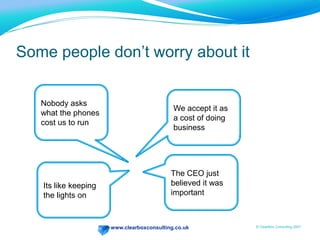
Nobody asks what the phones cost us to runWe accept it as a cost of doing businessThe CEO just believed it was importantIts like keeping the lights onSome people don’t worry about it
ROI - It’s hard and you’re not aloneFewer than two-thirds of companies attempt to measure the business value of IT and, of those that do, only half measure their return after IT investments are made. The most popular metrics are among the most ineffectiveAsked if their company found it difficult to calculate ROI, 62% of IT executives answered “yes”. This figure rises to 75% in organizations with revenues of $500m or more.47% of this group claimed that their metrics did not accurately capture the value of IT investments“time to payback” was used by 60% of those who engaged in measurement - but by 73% of those who claimed that their value metrics were failing.					Source: CIO Insight
“If you can’t measure it, you can’t manage it”		-Anon“Everything that can be counted does not necessarily count; everything that counts cannot necessarily be counted.”		-Albert Einstein
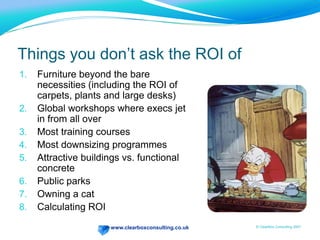
Things you don’t ask the ROI ofFurniture beyond the bare necessities (including the ROI of carpets, plants and large desks) Global workshops where execs jet in from all overMost training courses Most downsizing programmesAttractive buildings vs. functional concretePublic parks Owning a cat Calculating ROI
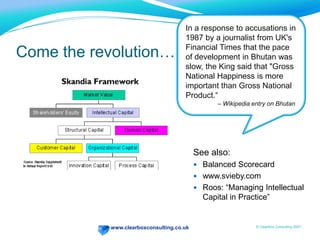
Come the revolution…In a response to accusations in 1987 by a journalist from UK's Financial Times that the pace of development in Bhutan was slow, the King said that "Gross National Happiness is more important than Gross National Product.“ 	– Wikipedia entry on BhutanSee also:Balanced Scorecardwww.svieby.comRoos: “Managing Intellectual Capital in Practice”
With the person next to you…How was the case made for your current intranet?What way of making the case worked?What would you do differently?
Coffee Break
Determining Benefits and ROI
Hard and Soft (intangible) BenefitsDirect & Indirect benefits
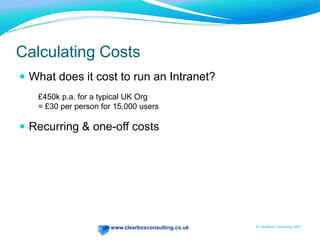
Calculating CostsWhat does it cost to run an Intranet?Recurring & one-off costs£450k p.a. for a typical UK Org= £30 per person for 15,000 users
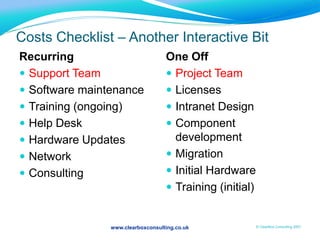
Costs Checklist – Another Interactive BitRecurringSupport TeamSoftware maintenanceTraining (ongoing)Help DeskHardware UpdatesNetworkConsultingOne OffProject TeamLicensesIntranet DesignComponent developmentMigrationInitial HardwareTraining (initial)
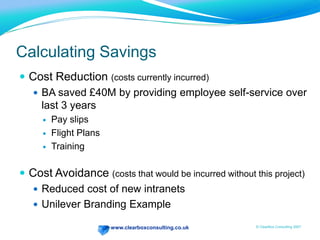
Calculating SavingsCost Reduction (costs currently incurred)BA saved £40M by providing employee self-service over last 3 yearsPay slipsFlight PlansTrainingCost Avoidance (costs that would be incurred without this project)Reduced cost of new intranetsUnilever Branding Example
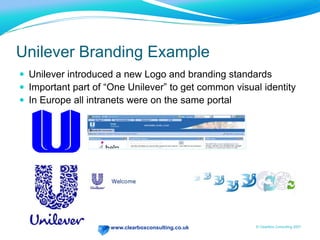
Unilever Branding ExampleUnilever introduced a new Logo and branding standardsImportant part of “One Unilever” to get common visual identityIn Europe all intranets were on the same portal
BenefitNet Benefit = (direct benefits + quantified soft benefits) - 			  (one-off costs + recurring costs)
Cost AvoidanceWithout PortalWith Portal£5,000 design25 days agree, implement & testAssume £300/day costs	300 x 25 	+5000= £12,500Completed: day of launch4000 intranetsAssume 1000 would have re-brandedAssume £1,500 per designAssume 5 days agree,  implement & testAssume £300\day costs(1500 + 300 x 5) x 1000= £3MCompleted: 1 year after?
Where to look for savingsIn BusinessWhole FTEs removedWork with 3rd partiesReduced travelTransaction costsExpenses, travel, facilities, payroll, recruitment, phonebook etc.Procurement costs Print and distribution costsOffice vs. home workingIn IT IntegrationHosting (int. & ext.)Publishing costsCost of new developmentsCost of test & deployTraining costsWhole FTEs removedDesignersCost of E-mail and dataIT support and helpdesksTech self-helpPassword re-setUsability
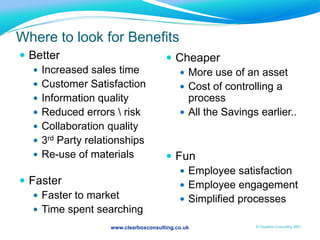
Where to look for BenefitsBetterIncreased sales timeCustomer SatisfactionInformation qualityReduced errors \ riskCollaboration quality3rd Party relationshipsRe-use of materialsFasterFaster to marketTime spent searchingCheaperMore use of an assetCost of controlling a processAll the Savings earlier..FunEmployee satisfactionEmployee engagementSimplified processes
Calculating BenefitsCross-charging approachAggregate individual benefitsCost of existing systemsTry to do on a like-for-like basisBut be grateful for anything!
Quantifying IntangiblesTime SavingsEthnographyTime SurveyExternal Sources e.g. time seeking dataIdeally do something you can repeat post-implementation
Ethnography (professional stalking)ApproachProsPick a representative range of subjects (7-15)AgeSeniorityAttitude to ITShadow doing relevant tasksRecord activityAsk clarification questions only when task completeUse video \ photo to get context After use quotes \ video \ photo to bring to lifeInsightfulDetailed dataHard to challengeReplicableConsSmall sample size
Time-consuming
Risk of Taylorism if done inexpertly
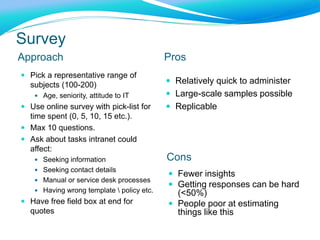
Needs specialist skillsSurveyApproachProsPick a representative range of subjects (100-200)Age, seniority, attitude to ITUse online survey with pick-list for time spent (0, 5, 10, 15 etc.). Max 10 questions.Ask about tasks intranet could affect:Seeking informationSeeking contact detailsManual or service desk processesHaving wrong template \ policy etc.Have free field box at end for quotesRelatively quick to administerLarge-scale samples possibleReplicableConsFewer insights
Getting responses can be hard (<50%)
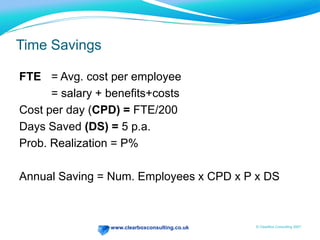
People poor at estimating things like thisFTE 	= Avg. cost per employee 		= salary + benefits+costsCost per day (CPD) = FTE/200Days Saved (DS) = 5 p.a. Prob. Realization = P%Annual Saving = Num. Employees x CPD x P x DSTime Savings
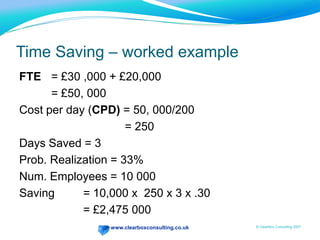
Time Saving – worked exampleFTE 	= £30 ,000 + £20,000		= £50, 000Cost per day (CPD) = 50, 000/200				   = 250Days Saved = 3Prob. Realization = 33%Num. Employees = 10 000Saving 	= 10,000 x  250 x 3 x .30			= £2,475 000
ROI Calculations
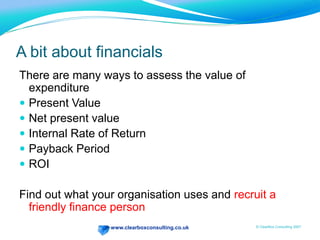
A bit about financialsThere are many ways to assess the value of expenditurePresent Value Net present valueInternal Rate of ReturnPayback PeriodROIFind out what your organisation uses and recruit a friendly finance person
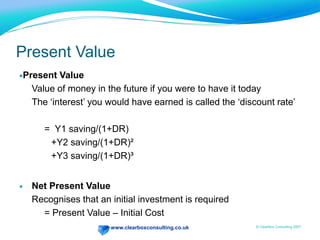
Present Value Present ValueValue of money in the future if you were to have it todayThe ‘interest’ you would have earned is called the ‘discount rate’=  Y1 saving/(1+DR) 	+Y2 saving/(1+DR)² 	+Y3 saving/(1+DR)³Net Present ValueRecognises that an initial investment is required= Present Value – Initial Cost
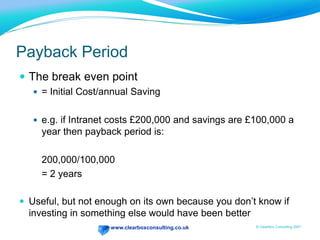
Payback PeriodThe break even point= Initial Cost/annual Savinge.g. if Intranet costs £200,000 and savings are £100,000 a year then payback period is:	200,000/100,000	= 2 yearsUseful, but not enough on its own because you don’t know if investing in something else would have been better
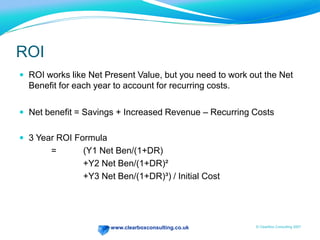
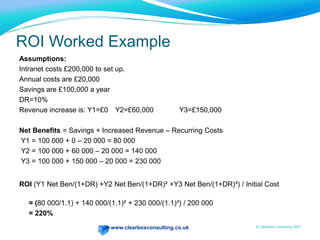
ROIROI works like Net Present Value, but you need to work out the Net Benefit for each year to account for recurring costs.Net benefit = Savings + Increased Revenue – Recurring Costs3 Year ROI Formula  	=  	(Y1 Net Ben/(1+DR) 		+Y2 Net Ben/(1+DR)² 		+Y3 Net Ben/(1+DR)³) / Initial Cost
ROI Worked ExampleAssumptions:Intranet costs £200,000 to set up. Annual costs are £20,000Savings are £100,000 a yearDR=10%Revenue increase is: Y1=£0	Y2=£60,000	Y3=£150,000Net Benefits = Savings + Increased Revenue – Recurring Costs Y1 = 100 000 + 0 – 20 000 = 80 000 Y2 = 100 000 + 60 000 – 20 000 = 140 000 Y3 = 100 000 + 150 000 – 20 000 = 230 000ROI (Y1 Net Ben/(1+DR) +Y2 Net Ben/(1+DR)² +Y3 Net Ben/(1+DR)³) / Initial Cost= (80 000/1.1) + 140 000/(1.1)² + 230 000/(1.1)³) / 200 000	= 220%
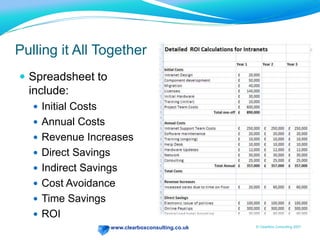
Pulling it All TogetherSpreadsheet to include:Initial CostsAnnual CostsRevenue IncreasesDirect SavingsIndirect SavingsCost AvoidanceTime SavingsROI
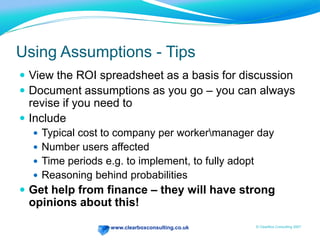
Using Assumptions - TipsView the ROI spreadsheet as a basis for discussionDocument assumptions as you go – you can always revise if you need toIncludeTypical cost to company per worker\manager dayNumber users affectedTime periods e.g. to implement, to fully adoptReasoning behind probabilitiesGet help from finance – they will have strong opinions about this!
Creating an Effective Business Case
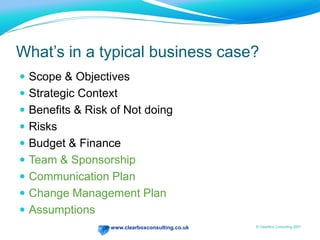
What’s in a typical business case?Scope & ObjectivesStrategic ContextBenefits & Risk of Not doingRisksBudget & FinanceTeam & SponsorshipCommunication PlanChange Management PlanAssumptions
Planning the business caseAudience – who is it for?Behaviours – what do you want them to do?Content – what do you need to cover?Delivery – what channels will you use?Evaluation – how will you know it has worked?
Interactive BitInterview each other to work out the ABCDE for your own organisations’ business case
Scope & ObjectivesWhat flavour intranet do you have \ want?What value does your intranet bring?How does this link to current priorities? Communication & Culture
 Process Support (e.g. dashboards)
 Collaboration (unstructured)
 Services (e.g. expenses, travel)
 LearningLinking to StrategyStuck in Economy class?Often there are high-visibility initiatives that are leadership-driven not spreadsheet-drivenMay be part of explicit or only de-facto strategyLook for the hot buttons and hop-onDemonstrate to the sponsor that their project needs the intranet to deliverFind case-studiesTry to do a pilot before asking for budget
Linking to Strategy - ExamplesRestructuring \ Offshoring \ OutsourcingProcess cost reductionProcess improvement (e.g. faster to market)Improved Execution (e.g. sales closure)Risk avoidance (e.g. post calamity)Downsizing (via productivity)Learning and knowledge-sensitive objectivesCulture (esp. “One” initiatives)EngagementAny of the above but with function \ geography \ BU focus
Value to the EmployeeJob satisfaction \ removing onerous tasksEnhanced productivityEnhanced performance (e.g. better decisions)EngagementBeware the things that only the users loveWeatherFor sale & wantedLunch Menu
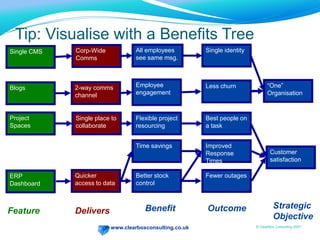
Tip: Visualise with a Benefits TreeAll employees see same msg.Single identityCorp-Wide CommsSingle CMSEmployee engagement“One” OrganisationLess churn2-way comms channelBlogsProject SpacesSingle place to collaborateFlexible project resourcingBest people on a taskTime savingsImproved Response TimesCustomer satisfactionQuicker access to dataBetter stock controlFewer outagesERP DashboardStrategic ObjectiveBenefitOutcomeDeliversFeature
BenefitsWhat to measureWhole system – no decent model for this yetSpecific projects – e-procurement, employee self-service, etc.Hard vs. SoftBalance depends on your organisation’s culture and climate
Risks and IssuesRisks impacting completionRisks if it does succeedRisks of not doingStakeholders & politics
Structuring the CaseHeadline ROIReminding people of the “invest” bitThe 3 Phase curveCost per user or Decreased cost of ownershipTip: if cost base static, focus on projected usageSell the Soft BenefitsBenefits TreePersonasStorytellingCase Studies from other orgs
Influencing and building supportWhich method for which audience?Detailed ROI‘Anecdotal ROI’ and Soft BenefitsAlign to something where Soft accepted or Soft-Hard establishedOil Company: risk-reductionRetailer: increase time on shop floor > increased salesUse KPIs strategically, not just operationallyTie to benefits treee.g. % Marketing people using learning system
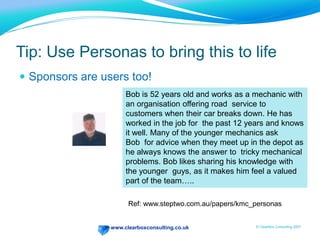
Tip: Use Personas to bring this to lifeSponsors are users too!Bob is 52 years old and works as a mechanic with an organisation offering road  service to customers when their car breaks down. He has worked in the job for  the past 12 years and knows it well. Many of the younger mechanics ask Bob  for advice when they meet up in the depot as he always knows the answer to  tricky mechanical problems. Bob likes sharing his knowledge with the younger  guys, as it makes him feel a valued part of the team…..Ref: www.steptwo.com.au/papers/kmc_personas
Tips: When to ask for budgetIts tempting to put all the big costs in year one, but phasing can helpSplit the 12 months over two financial years – you only need to secure half the budget to get goingGetting the 2nd half usually easier as you can pitch the risk as being lowerKeep the annual costs down and do as much as you can as projectsGet the foundation in place then go for multiple budget holders e.g. HR, Marketing, CommsUse secondments or other temporary resourcing to demonstrate control over ongoing headcount
Using an External ViewProsExternal view often given more intrinsic kudos (regrettably)Comparative view – hard to see other intranetsFocus – investigating the value of an Intranet takes time that many people just don’t haveSpecialism – someone who’s done it beforePolitically neutral – can sometimes ask the questions you can’tConsCostWon’t understand culture or politics
Business Case - ReviewScope & ObjectivesStrategic ContextBenefits & Risk of Not doingRisksBudget & FinanceTeam & SponsorshipCommunication PlanChange Management PlanAssumptions

Making the business case for your intranet

  • 1.
    Making the businesscase for your intranet Sam MarshallDirector sam@clearboxconsulting.co.uk01244 676097www.clearboxconsulting.co.uk
  • 2.
    Agenda9.30 – 10.00 Introductions Thechallenge of Business Cases10.00 – 11.00 Creating an Effective Business Case11.00 - 11.15 Coffee11.15 – 12.00 Establishing ROI12.00 – 12.15 Discussion & Wrap-Up
  • 3.
    IntroductionIt’s good tolearn from your mistakes, but its much cheaper to learn from someone else’s
  • 4.
    Sam MarshallClearBox ConsultingIntranet & portal strategy
  • 5.
    Getting sponsorship andsupport for your intranet
  • 6.
    An independentview on your Steering Group
  • 7.
    Intranets foreffective communication
  • 8.
  • 9.
  • 10.
    Effective teamcollaborationDirector of ClearBox ConsultingFormer Global Portal Implementation Manager – UnileverComms, KM & IT backgroundWork with BT, PwC, BUPA, Müller, ExxonMobil etc.
  • 11.
    You and yourintranetWho you areWhat you doStatus of your intranetWhy you’re at the workshopwww.clearboxconsulting.co.uk© ClearBox Consulting 2007
  • 12.
  • 13.
    Health WarningThere’s no‘standard’ business caseDepends on each organisation’sCulturePracticeScaleLeadershipStructure
  • 14.
    Why have abusiness case?
  • 15.
    Nobody asks whatthe phones cost us to runWe accept it as a cost of doing businessThe CEO just believed it was importantIts like keeping the lights onSome people don’t worry about it
  • 16.
    ROI - It’shard and you’re not aloneFewer than two-thirds of companies attempt to measure the business value of IT and, of those that do, only half measure their return after IT investments are made. The most popular metrics are among the most ineffectiveAsked if their company found it difficult to calculate ROI, 62% of IT executives answered “yes”. This figure rises to 75% in organizations with revenues of $500m or more.47% of this group claimed that their metrics did not accurately capture the value of IT investments“time to payback” was used by 60% of those who engaged in measurement - but by 73% of those who claimed that their value metrics were failing. Source: CIO Insight
  • 17.
    “If you can’tmeasure it, you can’t manage it” -Anon“Everything that can be counted does not necessarily count; everything that counts cannot necessarily be counted.” -Albert Einstein
  • 18.
    Things you don’task the ROI ofFurniture beyond the bare necessities (including the ROI of carpets, plants and large desks) Global workshops where execs jet in from all overMost training courses Most downsizing programmesAttractive buildings vs. functional concretePublic parks Owning a cat Calculating ROI
  • 19.
    Come the revolution…Ina response to accusations in 1987 by a journalist from UK's Financial Times that the pace of development in Bhutan was slow, the King said that "Gross National Happiness is more important than Gross National Product.“ – Wikipedia entry on BhutanSee also:Balanced Scorecardwww.svieby.comRoos: “Managing Intellectual Capital in Practice”
  • 20.
    With the personnext to you…How was the case made for your current intranet?What way of making the case worked?What would you do differently?
  • 21.
  • 22.
  • 23.
    Hard and Soft(intangible) BenefitsDirect & Indirect benefits
  • 24.
    Calculating CostsWhat doesit cost to run an Intranet?Recurring & one-off costs£450k p.a. for a typical UK Org= £30 per person for 15,000 users
  • 25.
    Costs Checklist –Another Interactive BitRecurringSupport TeamSoftware maintenanceTraining (ongoing)Help DeskHardware UpdatesNetworkConsultingOne OffProject TeamLicensesIntranet DesignComponent developmentMigrationInitial HardwareTraining (initial)
  • 26.
    Calculating SavingsCost Reduction(costs currently incurred)BA saved £40M by providing employee self-service over last 3 yearsPay slipsFlight PlansTrainingCost Avoidance (costs that would be incurred without this project)Reduced cost of new intranetsUnilever Branding Example
  • 27.
    Unilever Branding ExampleUnileverintroduced a new Logo and branding standardsImportant part of “One Unilever” to get common visual identityIn Europe all intranets were on the same portal
  • 28.
    BenefitNet Benefit =(direct benefits + quantified soft benefits) - (one-off costs + recurring costs)
  • 29.
    Cost AvoidanceWithout PortalWithPortal£5,000 design25 days agree, implement & testAssume £300/day costs 300 x 25 +5000= £12,500Completed: day of launch4000 intranetsAssume 1000 would have re-brandedAssume £1,500 per designAssume 5 days agree, implement & testAssume £300\day costs(1500 + 300 x 5) x 1000= £3MCompleted: 1 year after?
  • 30.
    Where to lookfor savingsIn BusinessWhole FTEs removedWork with 3rd partiesReduced travelTransaction costsExpenses, travel, facilities, payroll, recruitment, phonebook etc.Procurement costs Print and distribution costsOffice vs. home workingIn IT IntegrationHosting (int. & ext.)Publishing costsCost of new developmentsCost of test & deployTraining costsWhole FTEs removedDesignersCost of E-mail and dataIT support and helpdesksTech self-helpPassword re-setUsability
  • 31.
    Where to lookfor BenefitsBetterIncreased sales timeCustomer SatisfactionInformation qualityReduced errors \ riskCollaboration quality3rd Party relationshipsRe-use of materialsFasterFaster to marketTime spent searchingCheaperMore use of an assetCost of controlling a processAll the Savings earlier..FunEmployee satisfactionEmployee engagementSimplified processes
  • 32.
    Calculating BenefitsCross-charging approachAggregateindividual benefitsCost of existing systemsTry to do on a like-for-like basisBut be grateful for anything!
  • 33.
    Quantifying IntangiblesTime SavingsEthnographyTimeSurveyExternal Sources e.g. time seeking dataIdeally do something you can repeat post-implementation
  • 34.
    Ethnography (professional stalking)ApproachProsPicka representative range of subjects (7-15)AgeSeniorityAttitude to ITShadow doing relevant tasksRecord activityAsk clarification questions only when task completeUse video \ photo to get context After use quotes \ video \ photo to bring to lifeInsightfulDetailed dataHard to challengeReplicableConsSmall sample size
  • 35.
  • 36.
    Risk of Taylorismif done inexpertly
  • 37.
    Needs specialist skillsSurveyApproachProsPicka representative range of subjects (100-200)Age, seniority, attitude to ITUse online survey with pick-list for time spent (0, 5, 10, 15 etc.). Max 10 questions.Ask about tasks intranet could affect:Seeking informationSeeking contact detailsManual or service desk processesHaving wrong template \ policy etc.Have free field box at end for quotesRelatively quick to administerLarge-scale samples possibleReplicableConsFewer insights
  • 38.
    Getting responses canbe hard (<50%)
  • 39.
    People poor atestimating things like thisFTE = Avg. cost per employee = salary + benefits+costsCost per day (CPD) = FTE/200Days Saved (DS) = 5 p.a. Prob. Realization = P%Annual Saving = Num. Employees x CPD x P x DSTime Savings
  • 40.
    Time Saving –worked exampleFTE = £30 ,000 + £20,000 = £50, 000Cost per day (CPD) = 50, 000/200 = 250Days Saved = 3Prob. Realization = 33%Num. Employees = 10 000Saving = 10,000 x 250 x 3 x .30 = £2,475 000
  • 41.
  • 42.
    A bit aboutfinancialsThere are many ways to assess the value of expenditurePresent Value Net present valueInternal Rate of ReturnPayback PeriodROIFind out what your organisation uses and recruit a friendly finance person
  • 43.
    Present Value PresentValueValue of money in the future if you were to have it todayThe ‘interest’ you would have earned is called the ‘discount rate’= Y1 saving/(1+DR) +Y2 saving/(1+DR)² +Y3 saving/(1+DR)³Net Present ValueRecognises that an initial investment is required= Present Value – Initial Cost
  • 44.
    Payback PeriodThe breakeven point= Initial Cost/annual Savinge.g. if Intranet costs £200,000 and savings are £100,000 a year then payback period is: 200,000/100,000 = 2 yearsUseful, but not enough on its own because you don’t know if investing in something else would have been better
  • 45.
    ROIROI works likeNet Present Value, but you need to work out the Net Benefit for each year to account for recurring costs.Net benefit = Savings + Increased Revenue – Recurring Costs3 Year ROI Formula = (Y1 Net Ben/(1+DR) +Y2 Net Ben/(1+DR)² +Y3 Net Ben/(1+DR)³) / Initial Cost
  • 46.
    ROI Worked ExampleAssumptions:Intranetcosts £200,000 to set up. Annual costs are £20,000Savings are £100,000 a yearDR=10%Revenue increase is: Y1=£0 Y2=£60,000 Y3=£150,000Net Benefits = Savings + Increased Revenue – Recurring Costs Y1 = 100 000 + 0 – 20 000 = 80 000 Y2 = 100 000 + 60 000 – 20 000 = 140 000 Y3 = 100 000 + 150 000 – 20 000 = 230 000ROI (Y1 Net Ben/(1+DR) +Y2 Net Ben/(1+DR)² +Y3 Net Ben/(1+DR)³) / Initial Cost= (80 000/1.1) + 140 000/(1.1)² + 230 000/(1.1)³) / 200 000 = 220%
  • 47.
    Pulling it AllTogetherSpreadsheet to include:Initial CostsAnnual CostsRevenue IncreasesDirect SavingsIndirect SavingsCost AvoidanceTime SavingsROI
  • 48.
    Using Assumptions -TipsView the ROI spreadsheet as a basis for discussionDocument assumptions as you go – you can always revise if you need toIncludeTypical cost to company per worker\manager dayNumber users affectedTime periods e.g. to implement, to fully adoptReasoning behind probabilitiesGet help from finance – they will have strong opinions about this!
  • 49.
  • 50.
    What’s in atypical business case?Scope & ObjectivesStrategic ContextBenefits & Risk of Not doingRisksBudget & FinanceTeam & SponsorshipCommunication PlanChange Management PlanAssumptions
  • 51.
    Planning the businesscaseAudience – who is it for?Behaviours – what do you want them to do?Content – what do you need to cover?Delivery – what channels will you use?Evaluation – how will you know it has worked?
  • 52.
    Interactive BitInterview eachother to work out the ABCDE for your own organisations’ business case
  • 53.
    Scope & ObjectivesWhatflavour intranet do you have \ want?What value does your intranet bring?How does this link to current priorities? Communication & Culture
  • 54.
    Process Support(e.g. dashboards)
  • 55.
  • 56.
    Services (e.g.expenses, travel)
  • 57.
    LearningLinking toStrategyStuck in Economy class?Often there are high-visibility initiatives that are leadership-driven not spreadsheet-drivenMay be part of explicit or only de-facto strategyLook for the hot buttons and hop-onDemonstrate to the sponsor that their project needs the intranet to deliverFind case-studiesTry to do a pilot before asking for budget
  • 58.
    Linking to Strategy- ExamplesRestructuring \ Offshoring \ OutsourcingProcess cost reductionProcess improvement (e.g. faster to market)Improved Execution (e.g. sales closure)Risk avoidance (e.g. post calamity)Downsizing (via productivity)Learning and knowledge-sensitive objectivesCulture (esp. “One” initiatives)EngagementAny of the above but with function \ geography \ BU focus
  • 59.
    Value to theEmployeeJob satisfaction \ removing onerous tasksEnhanced productivityEnhanced performance (e.g. better decisions)EngagementBeware the things that only the users loveWeatherFor sale & wantedLunch Menu
  • 60.
    Tip: Visualise witha Benefits TreeAll employees see same msg.Single identityCorp-Wide CommsSingle CMSEmployee engagement“One” OrganisationLess churn2-way comms channelBlogsProject SpacesSingle place to collaborateFlexible project resourcingBest people on a taskTime savingsImproved Response TimesCustomer satisfactionQuicker access to dataBetter stock controlFewer outagesERP DashboardStrategic ObjectiveBenefitOutcomeDeliversFeature
  • 61.
    BenefitsWhat to measureWholesystem – no decent model for this yetSpecific projects – e-procurement, employee self-service, etc.Hard vs. SoftBalance depends on your organisation’s culture and climate
  • 62.
    Risks and IssuesRisksimpacting completionRisks if it does succeedRisks of not doingStakeholders & politics
  • 63.
    Structuring the CaseHeadlineROIReminding people of the “invest” bitThe 3 Phase curveCost per user or Decreased cost of ownershipTip: if cost base static, focus on projected usageSell the Soft BenefitsBenefits TreePersonasStorytellingCase Studies from other orgs
  • 64.
    Influencing and buildingsupportWhich method for which audience?Detailed ROI‘Anecdotal ROI’ and Soft BenefitsAlign to something where Soft accepted or Soft-Hard establishedOil Company: risk-reductionRetailer: increase time on shop floor > increased salesUse KPIs strategically, not just operationallyTie to benefits treee.g. % Marketing people using learning system
  • 65.
    Tip: Use Personasto bring this to lifeSponsors are users too!Bob is 52 years old and works as a mechanic with an organisation offering road  service to customers when their car breaks down. He has worked in the job for  the past 12 years and knows it well. Many of the younger mechanics ask Bob  for advice when they meet up in the depot as he always knows the answer to  tricky mechanical problems. Bob likes sharing his knowledge with the younger  guys, as it makes him feel a valued part of the team…..Ref: www.steptwo.com.au/papers/kmc_personas
  • 66.
    Tips: When toask for budgetIts tempting to put all the big costs in year one, but phasing can helpSplit the 12 months over two financial years – you only need to secure half the budget to get goingGetting the 2nd half usually easier as you can pitch the risk as being lowerKeep the annual costs down and do as much as you can as projectsGet the foundation in place then go for multiple budget holders e.g. HR, Marketing, CommsUse secondments or other temporary resourcing to demonstrate control over ongoing headcount
  • 67.
    Using an ExternalViewProsExternal view often given more intrinsic kudos (regrettably)Comparative view – hard to see other intranetsFocus – investigating the value of an Intranet takes time that many people just don’t haveSpecialism – someone who’s done it beforePolitically neutral – can sometimes ask the questions you can’tConsCostWon’t understand culture or politics
  • 68.
    Business Case -ReviewScope & ObjectivesStrategic ContextBenefits & Risk of Not doingRisksBudget & FinanceTeam & SponsorshipCommunication PlanChange Management PlanAssumptions

Editor's Notes

  • #6 Line from “what’s a business case?” to “Totally Sorted” – pick someone u not spoken to yet and go thru these topics.
  • #7 What’s this the answer to?How long is a piece of string can be reasonably answered if you have enough context, but the answer must be appropriate to your certainty (accuracy vs precision).
  • #11 “Never go to a party thrown by someone who asks the ROI querstion”
  • #13 Downsizingprogrammes - they show apparent savings, but they imply one investment strategy over another, and nobody works out which ultimately yields more
  • #18 Ask: what do these terms mean?Hard = quantifiablesoft (aka intangible) = qualitative things like motivation, employee satisfactionDirect = more revenue or directly reduced costsIndirect = has a knock-on effect on revenue or costs e.g. increases consumer awareness, reduces time to market
  • #25 3rd parties – often costs are more visible because there’s a formal transaction pointPrint &amp; distrib – e.g. in-house magazine, but also people print email attachments of e.g. policies every time they’re updated, but if they’re easy to read online they won’t.Procurement – e.g. centralized buying – BBC TaxisReduced travel – if collaborationtools in intranet
  • #26 Example: Unilever SMS portlet; WebEx console
  • #29 Example of Scientists in Australia
  • #34 Present Value – what’s better £100 now or £150 in a year’s time? What about £110? Discount rate is the return we think we could generate if we had the £100 now. So if its &gt;10%, you’re better off with £100 now.
  • #35 Present Value – what’s better £100 now or £150 in a year’s time? What about £110? Discount rate is the return we think we could generate if we had the £100 now. So if its &gt;10%, you’re better off with £100 now.
  • #36 Present Value – what’s better £100 now or £150 in a year’s time? What about £110? Discount rate is the return we think we could generate if we had the £100 now. So if its &gt;10%, you’re better off with £100 now.
  • #37 ROI- usually over 3 years.Remember Net Benefit – about having £100 now or £110 in a year? Well ROI uses the same idea, but first we need to work out if we really will have £110 or not. This is what the Net Benefit is, once we’ve accounted for annual costs
  • #42 Scope &amp; Objectives – what will you do, and what’s the reason for doing it?Strategic Context – how is this aligned with where the business wants to be?Benefits &amp; Risk of Not doing – quantitative and qualitative benefits, or cost of not doing e.g. fail to comply with legislation like SOXRisks – what would affect success? Might there be adverse outcomes if it succeeds e.g. loss of Intellectual PropertyBudget &amp; FinanceTeam &amp; SponsorshipCommunication PlanChange Management Plan
  • #52 Bernardo’s drawing – starts at N, you invest in change so goes up to N+1, then you get savings and gradually goes down to N-1
  • #57 Scope &amp; Objectives – what will you do, and what’s the reason for doing it?Strategic Context – how is this aligned with where the business wants to be?Benefits &amp; Risk of Not doing – quantitative and qualitative benefits, or cost of not doing e.g. fail to comply with legislation like SOXRisks – what would affect success? Might there be adverse outcomes if it succeeds e.g. loss of Intellectual PropertyBudget &amp; FinanceTeam &amp; SponsorshipCommunication PlanChange Management Plan