Digital Transformation Strategy
James Woolwine
2
Business transformation of the future
True business transformation in the digital age centers around
unified product-service experiences that stay ahead of customer
expectation by continuously improving process, people, and
technology by:
• Using research and discoveries to establish pain-points and opportunities
• Making assessments on business processes and functions, technology, and
people organization
• Creating strategic roadmaps, propositions and process digitization and
automation
• Making recommendations for process, technology and people improvements
• Establish governance models to sustain the solutions, creating measurable
business benefits.
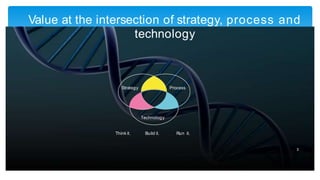
Think it. Build it. Run it.
Strategy
3
Process
Technology
Value at the intersection of strategy, process and
technology
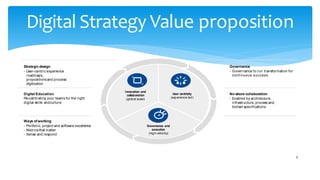
Digital Strategy Value proposition
Governance
- Governance to run transformation for
continuous success
No-shore collaboration
- Enabled by architecture,
infrastructure,process and
toolset specifications
Innovation and
collaboration
(global scale)
User centricity
(experience-led)
Governance and
execution
(high-velocity)
Strategicdesign
- User-centric experience
roadmaps,
propositionsand process
digitization
Digital Education
Re-calibrating your teams for the right
digital skills andculture
Ways of working
- Portfolio, project and software excellence
- Metricsthat matter
- Sense and respond
4
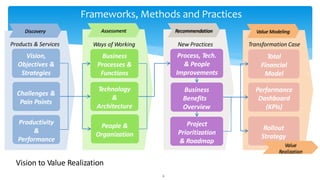
Vision to Value Realization
6
Discovery Assessment Recommendation Value Modeling
Products & Services
Vision,
Objectives &
Strategies
Challenges &
Pain Points
Productivity
&
Performance
Ways of Working
Business
Processes &
Functions
Technology
&
Architecture
People &
Organization
New Practices
Process, Tech.
& People
Improvements
Project
Prioritization
& Roadmap
Business
Benefits
Overview
Transformation Case
Total
Financial
Model
Performance
Dashboard
(KPIs)
Rollout
Strategy
Value
Realization
Frameworks, Methods and Practices
Digital Tools
7
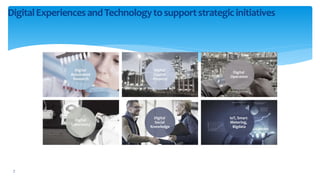
DigitalExperiencesandTechnologytosupportstrategicinitiatives
Digital
Automated
Research
Digital
Capital
Projects
Digital
Operation
Digital
Laboratory
IoT, Smart
Metering,
Bigdata
Digital
Social
Knowledge
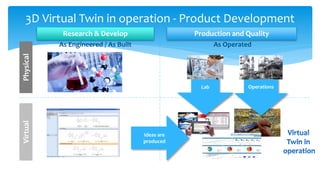
3D Virtual Twin in operation - Product Development
As Engineered / As Built As Operated
PhysicalVirtual
Research & Develop
Lab
Production and Quality
Operations
Ideas are
produced
Digital Collaboration Platforms
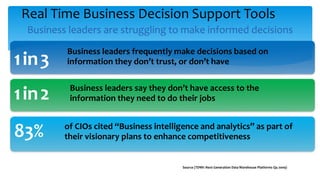
Business leaders are struggling to make informed decisions
Business leaders frequently make decisions based on
information they don’t trust, or don’t have1in3
83% of CIOs cited “Business intelligence and analytics” as part of
their visionary plans to enhance competitiveness
Business leaders say they don’t have access to the
information they need to do their jobs1in2
Source (TDWI: Next Generation Data Warehouse Platforms Q4 2009)
Real Time Business Decision Support Tools
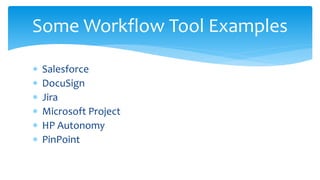
 Salesforce
 DocuSign
 Jira
 Microsoft Project
 HP Autonomy
 PinPoint
Some Workflow Tool Examples
The Internet of Things (IoT) is the network of physical objects or "things“ embedded with
electronics, software, sensors, and network connectivity, which enables these objects to
collect and exchange data. The Internet of Things allows objects to be sensed and
controlled remotely across existing network infrastructure, creating opportunities for
more direct integration between the physical world and computer-based systems, and
resulting in improved efficiency, accuracy and economic benefit; when IoT is augmented
with sensors and actuators, the technology becomes an instance of the more general
class of cyber-physical systems, which also encompasses technologies such as smart grids,
smart homes, intelligent transportation, and smart cities. Each thing is uniquely
identifiable through its embedded computing system but is able to interoperate within
the existing Internet infrastructure. Experts estimate that the IoT will consist of almost 50
billion objects by 2020. (Wikipedia)
Internet of Things (IoT)
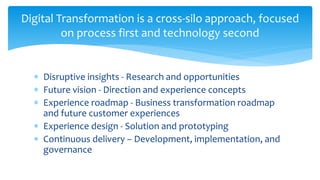
 Disruptive insights - Research and opportunities
 Future vision - Direction and experience concepts
 Experience roadmap - Business transformation roadmap
and future customer experiences
 Experience design - Solution and prototyping
 Continuous delivery – Development, implementation, and
governance
Digital Transformation is a cross-silo approach, focused
on process first and technology second

Digital Transformation Strategy

  • 1.
  • 2.
    2 Business transformation ofthe future True business transformation in the digital age centers around unified product-service experiences that stay ahead of customer expectation by continuously improving process, people, and technology by: • Using research and discoveries to establish pain-points and opportunities • Making assessments on business processes and functions, technology, and people organization • Creating strategic roadmaps, propositions and process digitization and automation • Making recommendations for process, technology and people improvements • Establish governance models to sustain the solutions, creating measurable business benefits.
  • 3.
    Think it. Buildit. Run it. Strategy 3 Process Technology Value at the intersection of strategy, process and technology
  • 4.
    Digital Strategy Valueproposition Governance - Governance to run transformation for continuous success No-shore collaboration - Enabled by architecture, infrastructure,process and toolset specifications Innovation and collaboration (global scale) User centricity (experience-led) Governance and execution (high-velocity) Strategicdesign - User-centric experience roadmaps, propositionsand process digitization Digital Education Re-calibrating your teams for the right digital skills andculture Ways of working - Portfolio, project and software excellence - Metricsthat matter - Sense and respond 4
  • 5.
    Vision to ValueRealization 6 Discovery Assessment Recommendation Value Modeling Products & Services Vision, Objectives & Strategies Challenges & Pain Points Productivity & Performance Ways of Working Business Processes & Functions Technology & Architecture People & Organization New Practices Process, Tech. & People Improvements Project Prioritization & Roadmap Business Benefits Overview Transformation Case Total Financial Model Performance Dashboard (KPIs) Rollout Strategy Value Realization Frameworks, Methods and Practices
  • 6.
  • 7.
  • 8.
    3D Virtual Twinin operation - Product Development As Engineered / As Built As Operated PhysicalVirtual Research & Develop Lab Production and Quality Operations Ideas are produced
  • 9.
  • 10.
    Business leaders arestruggling to make informed decisions Business leaders frequently make decisions based on information they don’t trust, or don’t have1in3 83% of CIOs cited “Business intelligence and analytics” as part of their visionary plans to enhance competitiveness Business leaders say they don’t have access to the information they need to do their jobs1in2 Source (TDWI: Next Generation Data Warehouse Platforms Q4 2009) Real Time Business Decision Support Tools
  • 11.
     Salesforce  DocuSign Jira  Microsoft Project  HP Autonomy  PinPoint Some Workflow Tool Examples
  • 12.
    The Internet ofThings (IoT) is the network of physical objects or "things“ embedded with electronics, software, sensors, and network connectivity, which enables these objects to collect and exchange data. The Internet of Things allows objects to be sensed and controlled remotely across existing network infrastructure, creating opportunities for more direct integration between the physical world and computer-based systems, and resulting in improved efficiency, accuracy and economic benefit; when IoT is augmented with sensors and actuators, the technology becomes an instance of the more general class of cyber-physical systems, which also encompasses technologies such as smart grids, smart homes, intelligent transportation, and smart cities. Each thing is uniquely identifiable through its embedded computing system but is able to interoperate within the existing Internet infrastructure. Experts estimate that the IoT will consist of almost 50 billion objects by 2020. (Wikipedia) Internet of Things (IoT)
  • 13.
     Disruptive insights- Research and opportunities  Future vision - Direction and experience concepts  Experience roadmap - Business transformation roadmap and future customer experiences  Experience design - Solution and prototyping  Continuous delivery – Development, implementation, and governance Digital Transformation is a cross-silo approach, focused on process first and technology second