Ask, Share, Learn – Within the Largest Community of Corporate Finance Professionals
How to Build a Great Cloud/SaaS Business
Case Analysis for Technology Investment
Drew Wright, co-founder, Technology Finance Partners
Mike Murphy, CBO, goTransverse
2
Benefits of Business Case
Analysis for Tech Investments
Budgets Are Meant To Be Broken
3
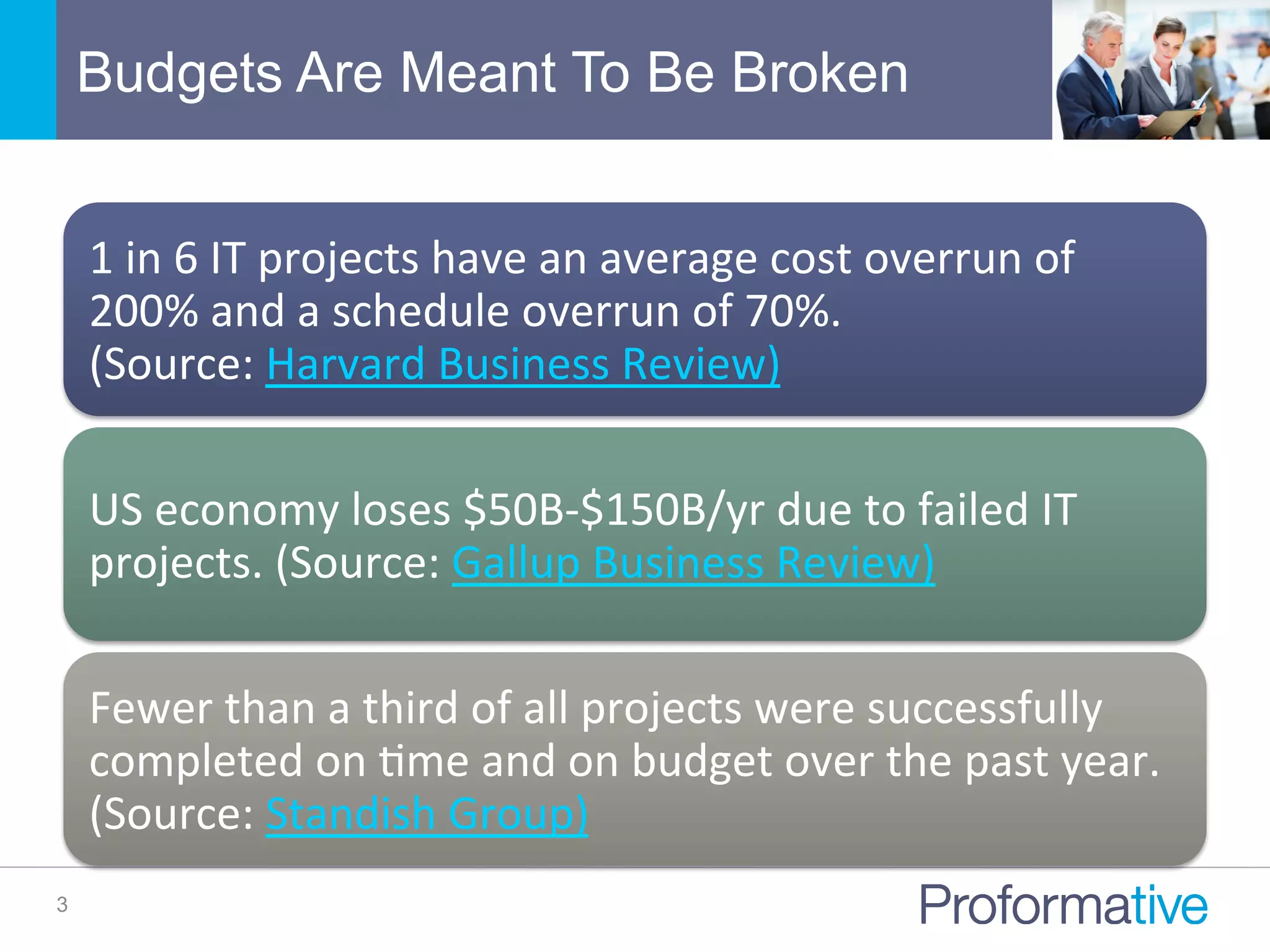
1	
  in	
  6	
  IT	
  projects	
  have	
  an	
  average	
  cost	
  overrun	
  of	
  
200%	
  and	
  a	
  schedule	
  overrun	
  of	
  70%.	
  	
  
(Source:	
  Harvard	
  Business	
  Review)	
  
US	
  economy	
  loses	
  $50B-­‐$150B/yr	
  due	
  to	
  failed	
  IT	
  
projects.	
  (Source:	
  Gallup	
  Business	
  Review)	
  
Fewer	
  than	
  a	
  third	
  of	
  all	
  projects	
  were	
  successfully	
  
completed	
  on	
  Nme	
  and	
  on	
  budget	
  over	
  the	
  past	
  year.	
  
(Source:	
  Standish	
  Group)	
  
Why Produce a BCA?
4
• Helps	
  prioriNze	
  projects	
  in	
  resource-­‐
constrained	
  orgs	
  
• Ensures	
  resources	
  expended	
  are	
  
commensurate	
  with	
  opportunity	
  
• Must	
  be	
  accurate,	
  transparent	
  &	
  
conservaNve	
  
Business	
  Case	
  Analysis	
  (BCA)	
  
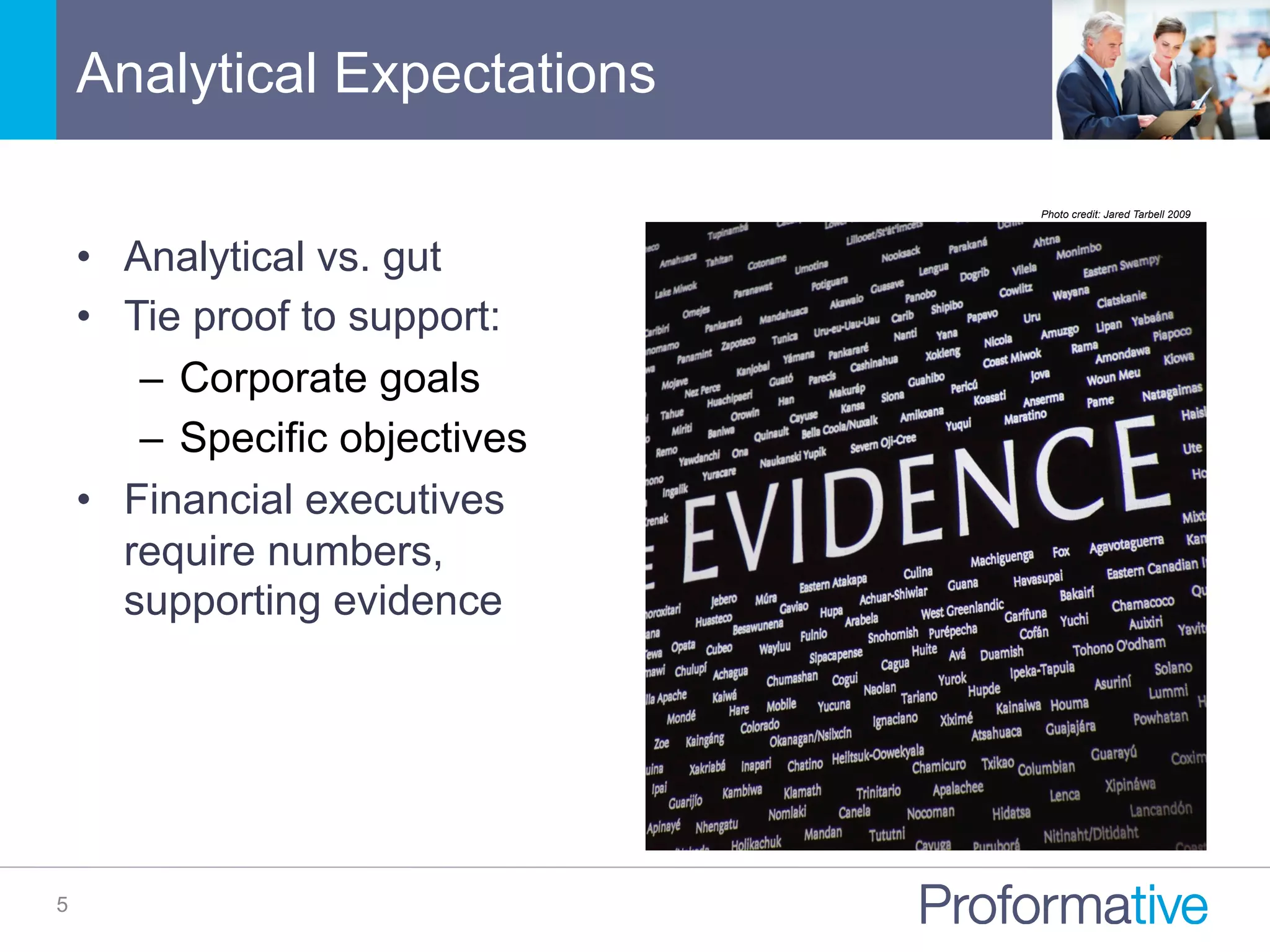
Analytical Expectations
5
•  Analytical vs. gut
•  Tie proof to support:
–  Corporate goals
–  Specific objectives
•  Financial executives
require numbers,
supporting evidence
Photo credit: Jared Tarbell 2009
Minimize Bias Risk
6
Key financial metrics from a business case
analysis allow dispassionate, rational, comparison
of investment opportunities.
Polling Question
8
Quantify Financial Benefits
Comprehensive BCA Inclusions
9
•  Increased	
  labor	
  producNvity	
  
•  Reduce	
  costs	
  
•  Increased	
  revenue	
  (and	
  associated	
  margin)	
  
Forecast	
  benefits	
  
•  Upfront	
  costs	
  
•  Recurring	
  costs	
  
Project	
  costs	
  
•  Ramp	
  up	
  
•  [Benefits	
  –	
  Costs	
  =	
  Annual	
  Net	
  Benefits]	
  	
  
Map	
  benefit	
  and	
  cost	
  projecNons	
  
Calculate	
  key	
  financial	
  metrics	
  
Meaningful Financial Metrics
10
Return	
  on	
  Investment	
  (ROI)	
  	
  
• [Total	
  Net	
  Benefits	
  –	
  Total	
  Costs]	
  /	
  [Total	
  
Costs]	
  
• Does	
  not	
  take	
  into	
  account	
  Nme	
  value	
  of	
  
money	
  
Net	
  Present	
  Value	
  (NPV)	
  
• Uses	
  cost	
  of	
  capital	
  to	
  discount	
  to	
  “current”	
  
dollars	
  
• NPV	
  <	
  0	
  	
  is	
  by	
  definiNon	
  a	
  poor	
  investment	
  
Payback	
  Period	
  
• Net	
  benefit	
  crosses	
  from	
  negaNve	
  to	
  posiNve	
  
• CriNcal	
  if	
  expediNous	
  return	
  of	
  capital	
  is	
  
needed!	
  
Internal	
  Rate	
  of	
  Return	
  (IRR)	
  
• Discount	
  rate	
  where	
  NPV	
  =	
  0	
  
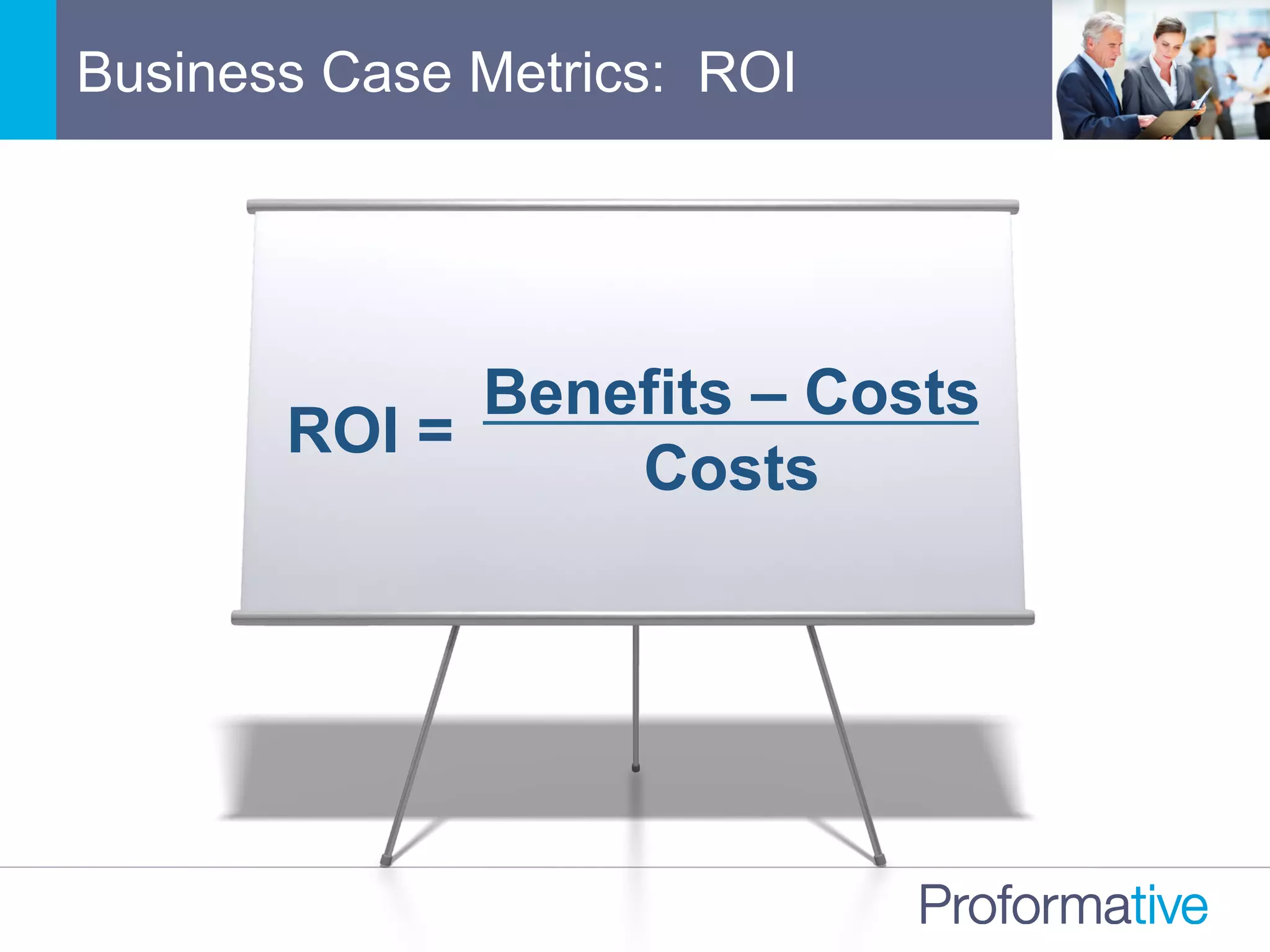
Business Case Metrics: ROI
Benefits – Costs
Costs
ROI =
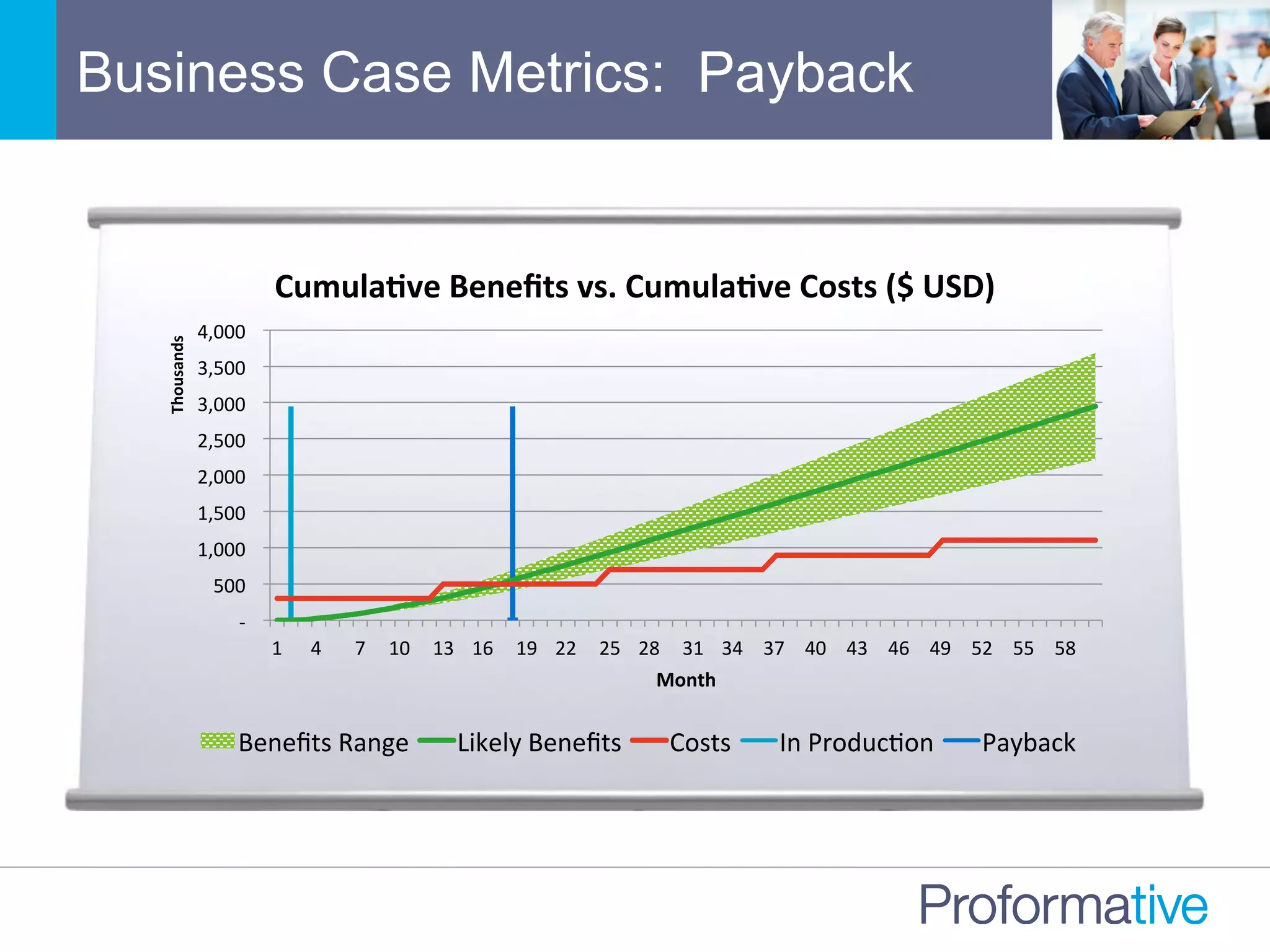
Business Case Metrics: Payback
	
  -­‐	


  500	


  1,000	


  1,500	


  2,000	


  2,500	


  3,000	


  3,500	


  4,000	
  	
  
1	
   4	
  	
   7	
   10	
  	
   13	
   16	
  	
   19	
   22	
  	
   25	
   28	
  	
   31	
   34	
  	
   37	
  	
   40	
  	
   43	
  	
   46	
  	
   49	
  	
   52	
  	
   55	
  	
   58	
  	
  
Thousands	
  
Month	
  
Cumula/ve	
  Benefits	
  vs.	
  Cumula/ve	
  Costs	
  ($	
  USD)	
  
Benefits	
  Range	
   Likely	
  Benefits	
   Costs	
   In	
  ProducNon	
   Payback	
  
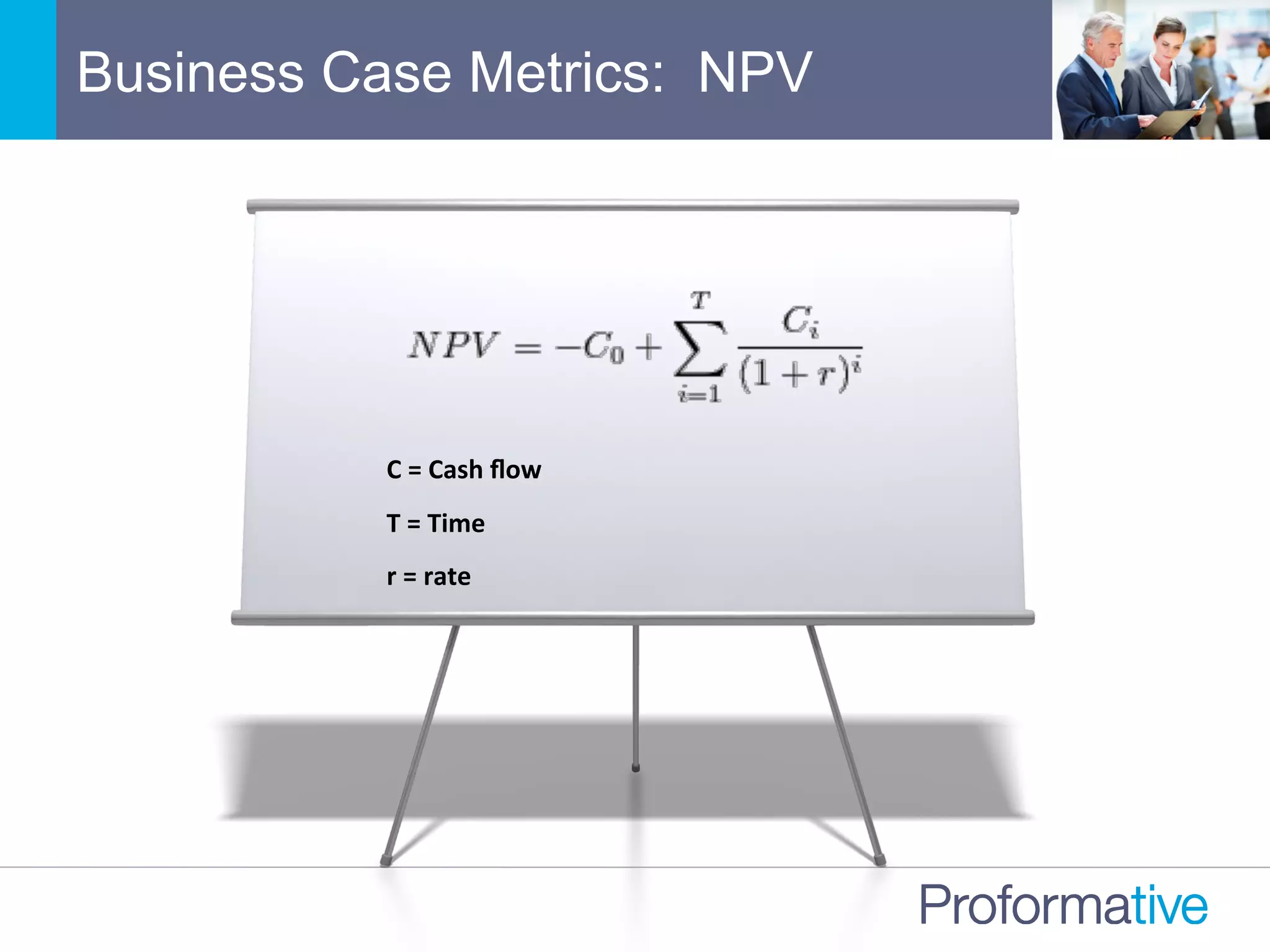
Business Case Metrics: NPV
C	
  =	
  Cash	
  flow	
  
T	
  =	
  Time	
  
r	
  =	
  rate	


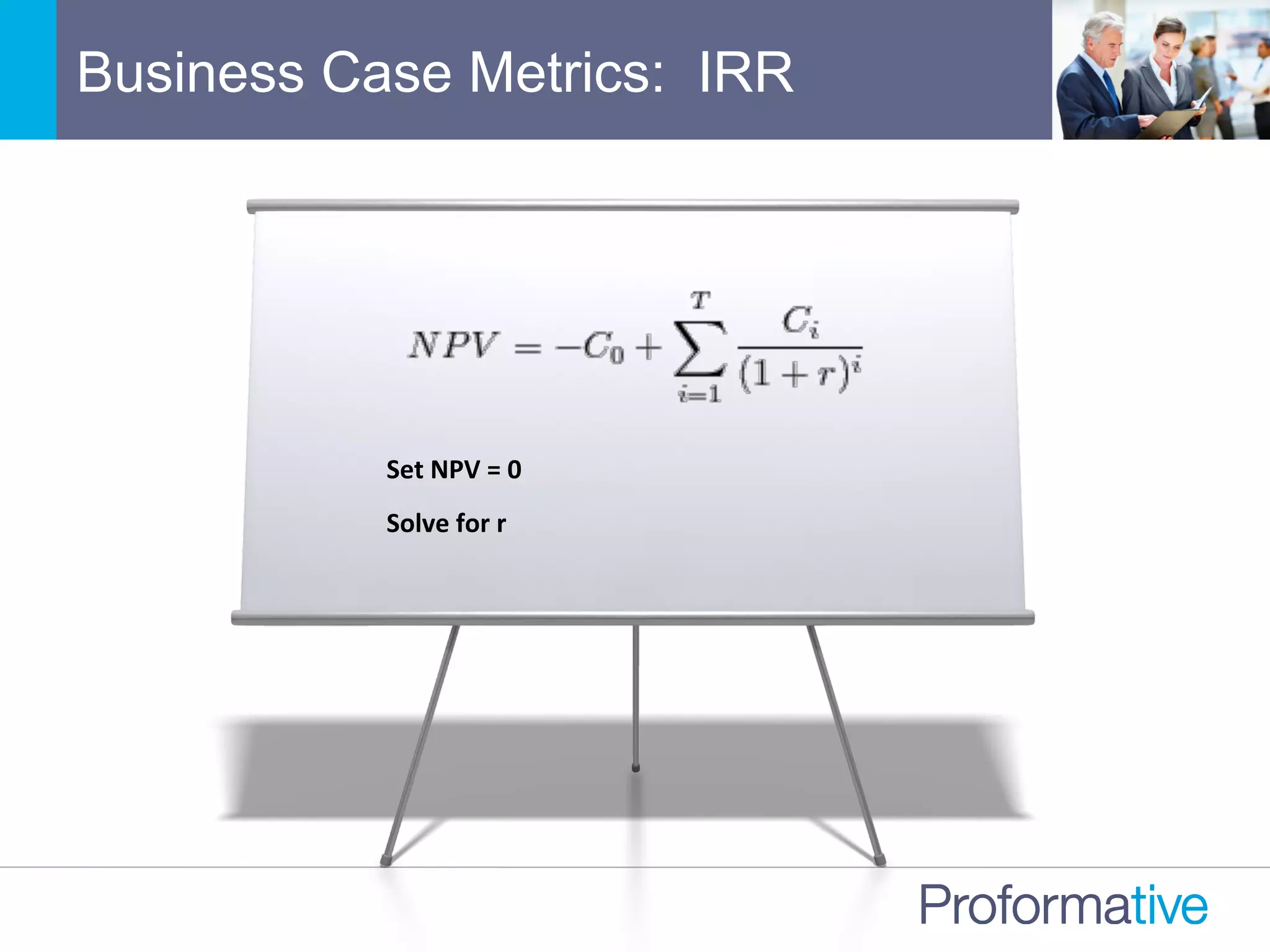
Business Case Metrics: IRR
Set	
  NPV	
  =	
  0	
  
Solve	
  for	
  r	


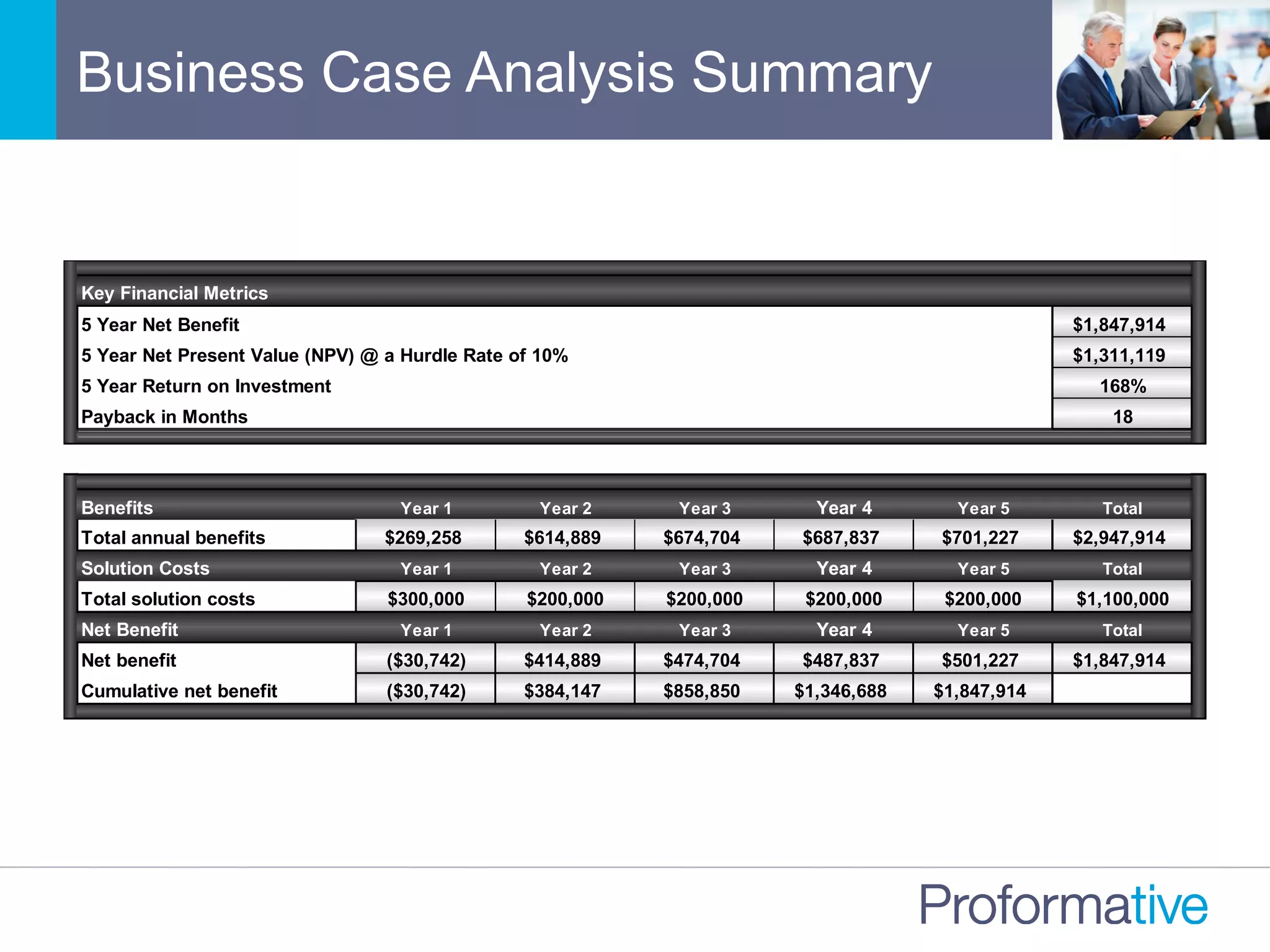
Key Financial Metrics
5 Year Net Benefit $1,847,914
5 Year Net Present Value (NPV) @ a Hurdle Rate of 10% $1,311,119
5 Year Return on Investment 168%
Payback in Months 18
Benefits Year 1 Year 2 Year 3 Year 4 Year 5 Total
Total annual benefits $269,258 $614,889 $674,704 $687,837 $701,227 $2,947,914
Solution Costs Year 1 Year 2 Year 3 Year 4 Year 5 Total
Total solution costs $300,000 $200,000 $200,000 $200,000 $200,000 $1,100,000
Net Benefit Year 1 Year 2 Year 3 Year 4 Year 5 Total
Net benefit ($30,742) $414,889 $474,704 $487,837 $501,227 $1,847,914
Cumulative net benefit ($30,742) $384,147 $858,850 $1,346,688 $1,847,914
Business Case Analysis Summary
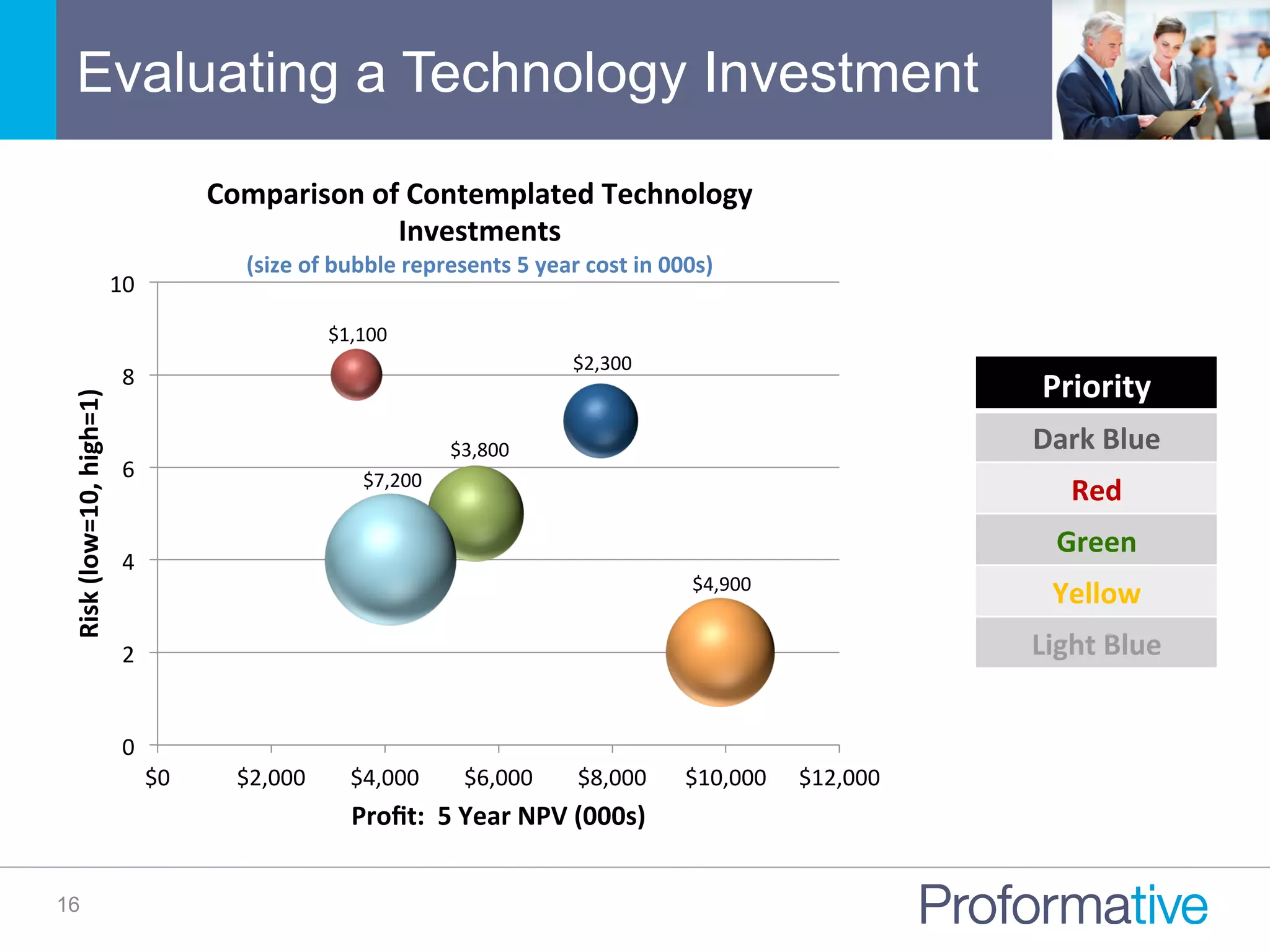
Evaluating a Technology Investment
16
$4,900	
  
$1,100	
  
$3,800	
  
$2,300	
  
$7,200	
  
0	
  
2	
  
4	
  
6	
  
8	
  
10	
  
$0	
   $2,000	
   $4,000	
   $6,000	
   $8,000	
   $10,000	
   $12,000	
  
Risk	
  (low=10,	
  high=1)	
  
Profit:	
  	
  5	
  Year	
  NPV	
  (000s)	
  
Comparison	
  of	
  Contemplated	
  Technology	
  
Investments	
  
(size	
  of	
  bubble	
  represents	
  5	
  year	
  cost	
  in	
  000s)	
  
Priority	
  
Dark	
  Blue	
  
Red	
  
Green	
  
Yellow	
  
Light	
  Blue	
  
Polling Question
18
Transparency & Accuracy
Detail Assumptions and Projections
19
•  Make assumptions and calculations TRANSPARENT
•  Best Practice Example: include complete detail of
assumptions and projections
Ex	
  Benefit	
  #1:	
  Labor	
  Savings	
  
Daily	
  savings	
  per	
  employee	
   $26.25	
   Calculated	
  as	
  15%	
  of	
  emp’s	
  day	
  X	
  rate	
  $175/day	
  
Annual	
  savings	
  per	
  employee	
   $5,119	
   Assumes	
  195	
  days	
  worked/year	
  
Total	
  pre-­‐tax	
  savings	
   $255,938	
   Assumes	
  50	
  affected	
  employees	
  
Total	
  aqer-­‐tax	
  savings	
   $166,359	
   Assumes	
  35%	
  blended	
  tax	
  rate	
  
Use Scenarios
20
•  Create scenarios to evaluate ranges in projections
•  Example: Benefit projections
Total	
  
Total	
  Benefits	
   $204,500	
  
Total	
  Costs	
   $195,250	
  
Net	
  Benefits	
   $9,250	
  
Total	
  
Total	
  Benefits	
   $214,500	
  
Total	
  Costs	
   $195,250	
  
Net	
  Benefits	
   $19,250	
  
Total	
  
Total	
  Benefits	
   $224,500	
  
Total	
  Costs	
   $195,250	
  
Net	
  Benefits	
   $29,250	
  
Low
Medium
High
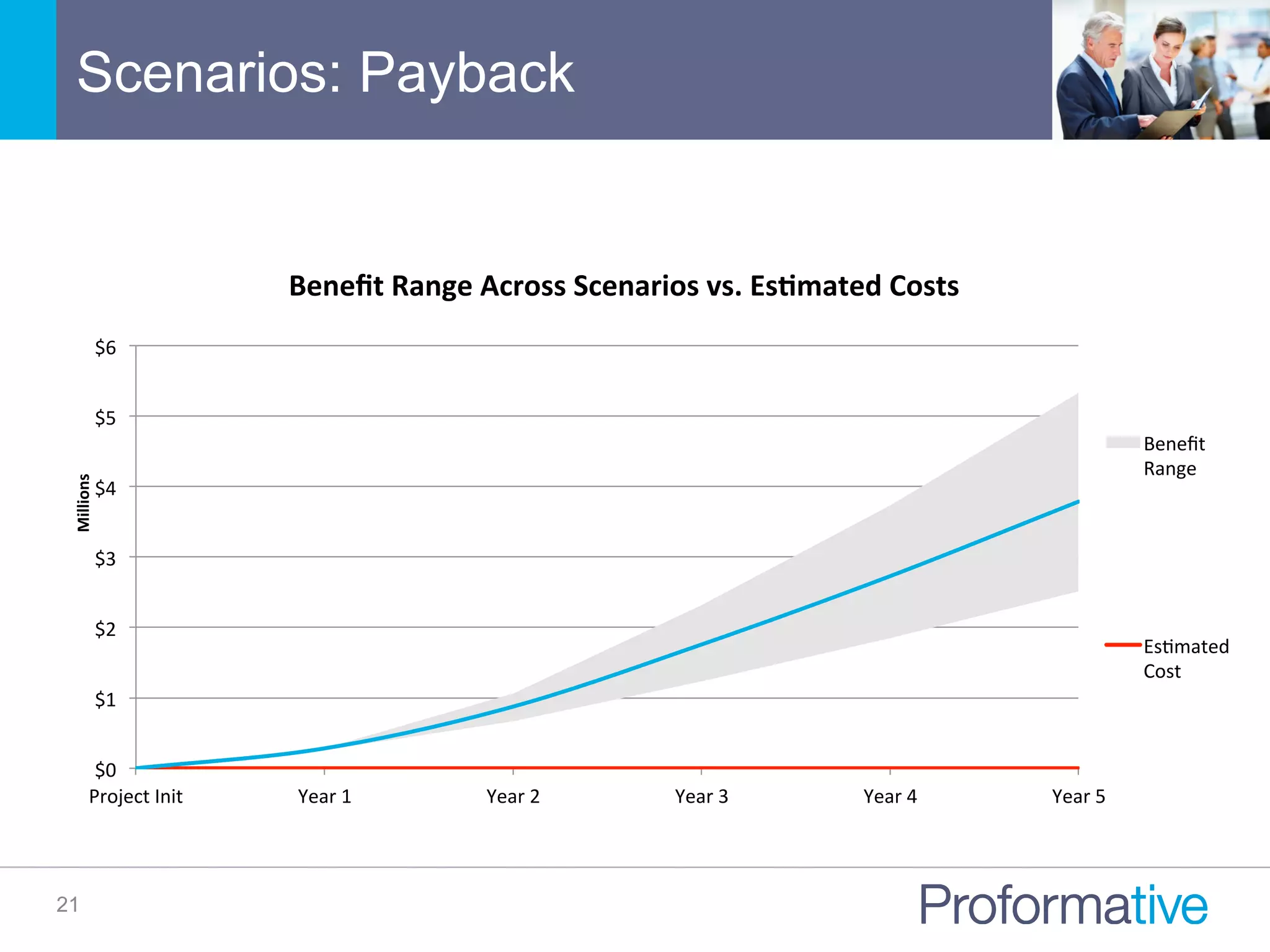
Scenarios: Payback
21
$0	
  
$1	
  
$2	
  
$3	
  
$4	
  
$5	
  
$6	
  
Project	
  Init	
   Year	
  1	
   Year	
  2	
   Year	
  3	
   Year	
  4	
   Year	
  5	
  
Millions	
  
Benefit	
  Range	
  Across	
  Scenarios	
  vs.	
  Es/mated	
  Costs	
  
Benefit	
  
Range	
  
EsNmated	
  
Cost	
  
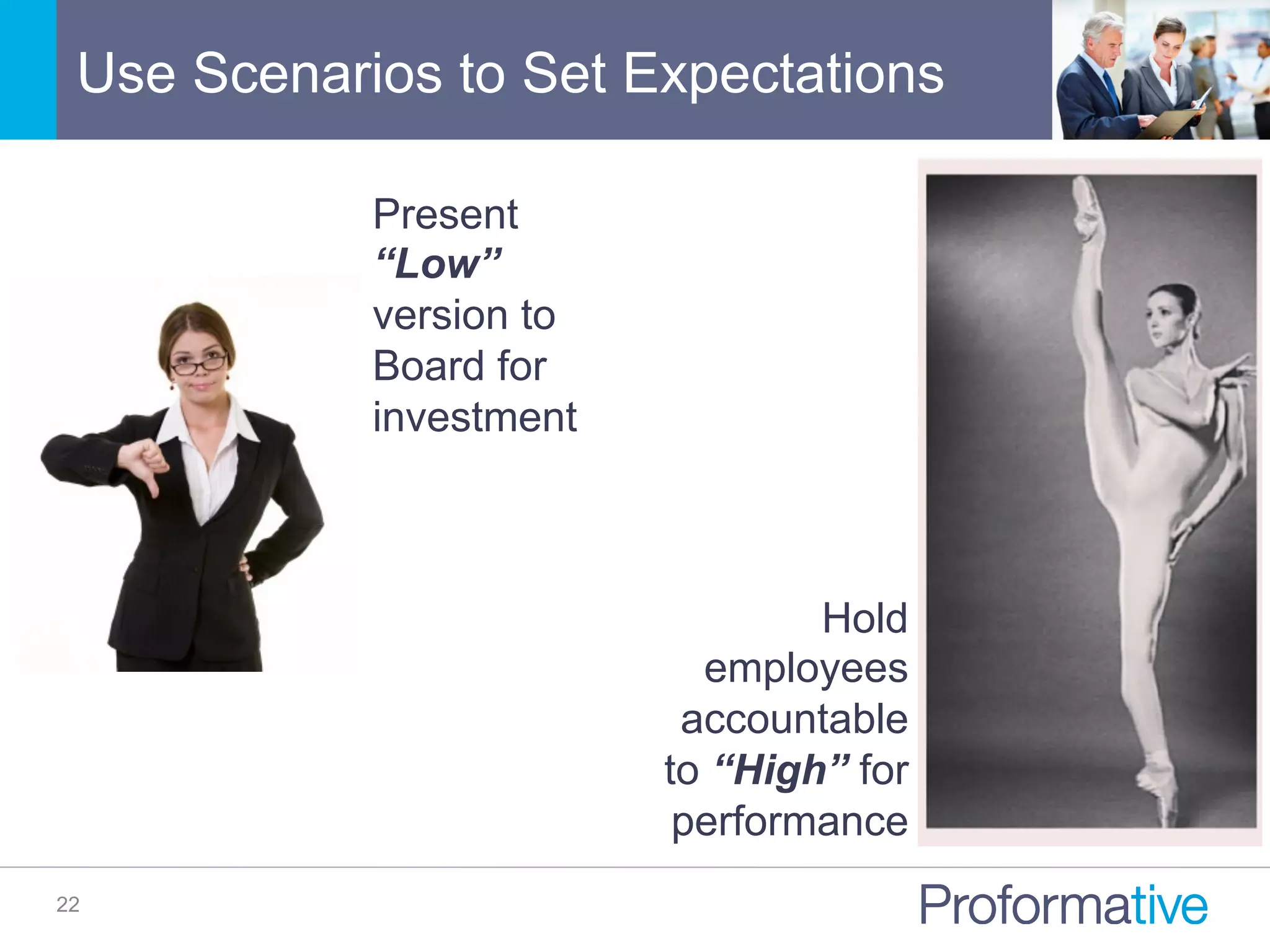
Use Scenarios to Set Expectations
22
Present
“Low”
version to
Board for
investment
Hold
employees
accountable
to “High” for
performance
23
Key Components of Cloud
Economics
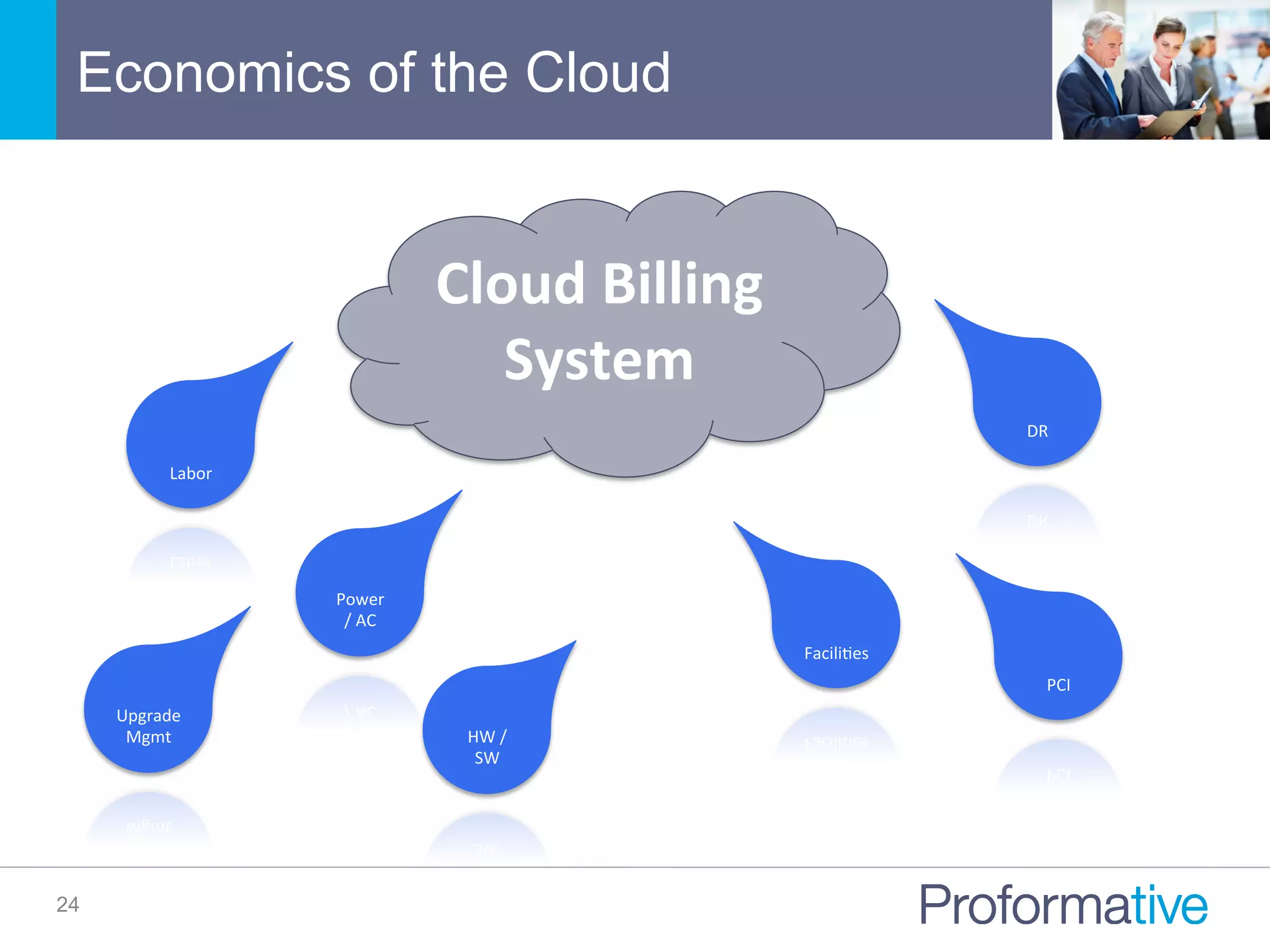
Economics of the Cloud
24
Cloud	
  Billing	
  
System	
  
Labor	
  
Power	
  
/	
  AC	
  
Upgrade	
  
Mgmt	
   HW	
  /	
  
SW	
  
FaciliNes	
  
DR	
  
PCI	
  
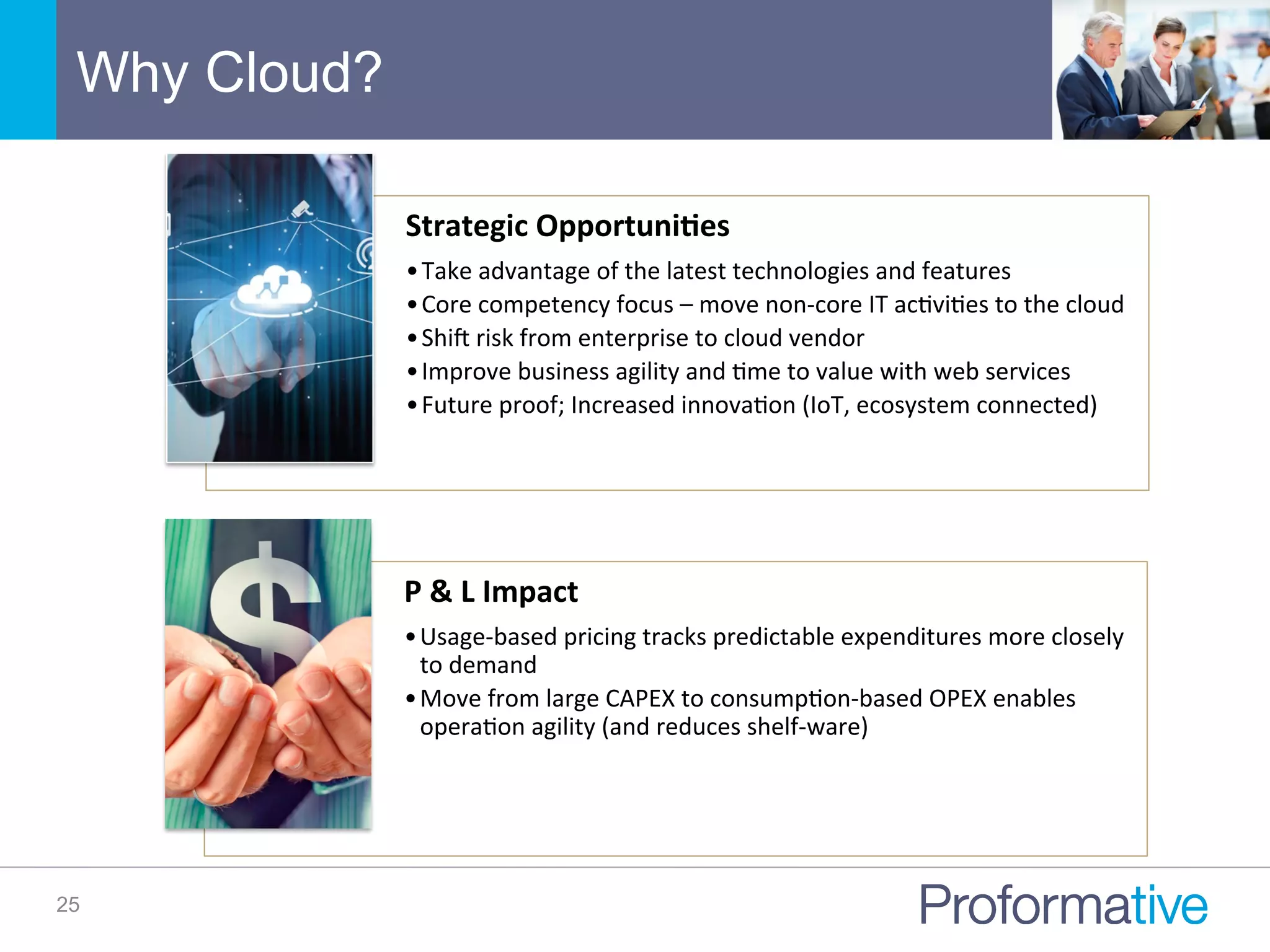
Why Cloud?
25
P	
  &	
  L	
  Impact	
  
• Usage-­‐based	
  pricing	
  tracks	
  predictable	
  expenditures	
  more	
  closely	
  
to	
  demand	
  
• Move	
  from	
  large	
  CAPEX	
  to	
  consumpNon-­‐based	
  OPEX	
  enables	
  
operaNon	
  agility	
  (and	
  reduces	
  shelf-­‐ware)	
  
Strategic	
  Opportuni/es	
  
• Take	
  advantage	
  of	
  the	
  latest	
  technologies	
  and	
  features	
  
• Core	
  competency	
  focus	
  –	
  move	
  non-­‐core	
  IT	
  acNviNes	
  to	
  the	
  cloud	
  
• Shiq	
  risk	
  from	
  enterprise	
  to	
  cloud	
  vendor	
  
• Improve	
  business	
  agility	
  and	
  Nme	
  to	
  value	
  with	
  web	
  services	
  
• Future	
  proof;	
  Increased	
  innovaNon	
  (IoT,	
  ecosystem	
  connected)	
  
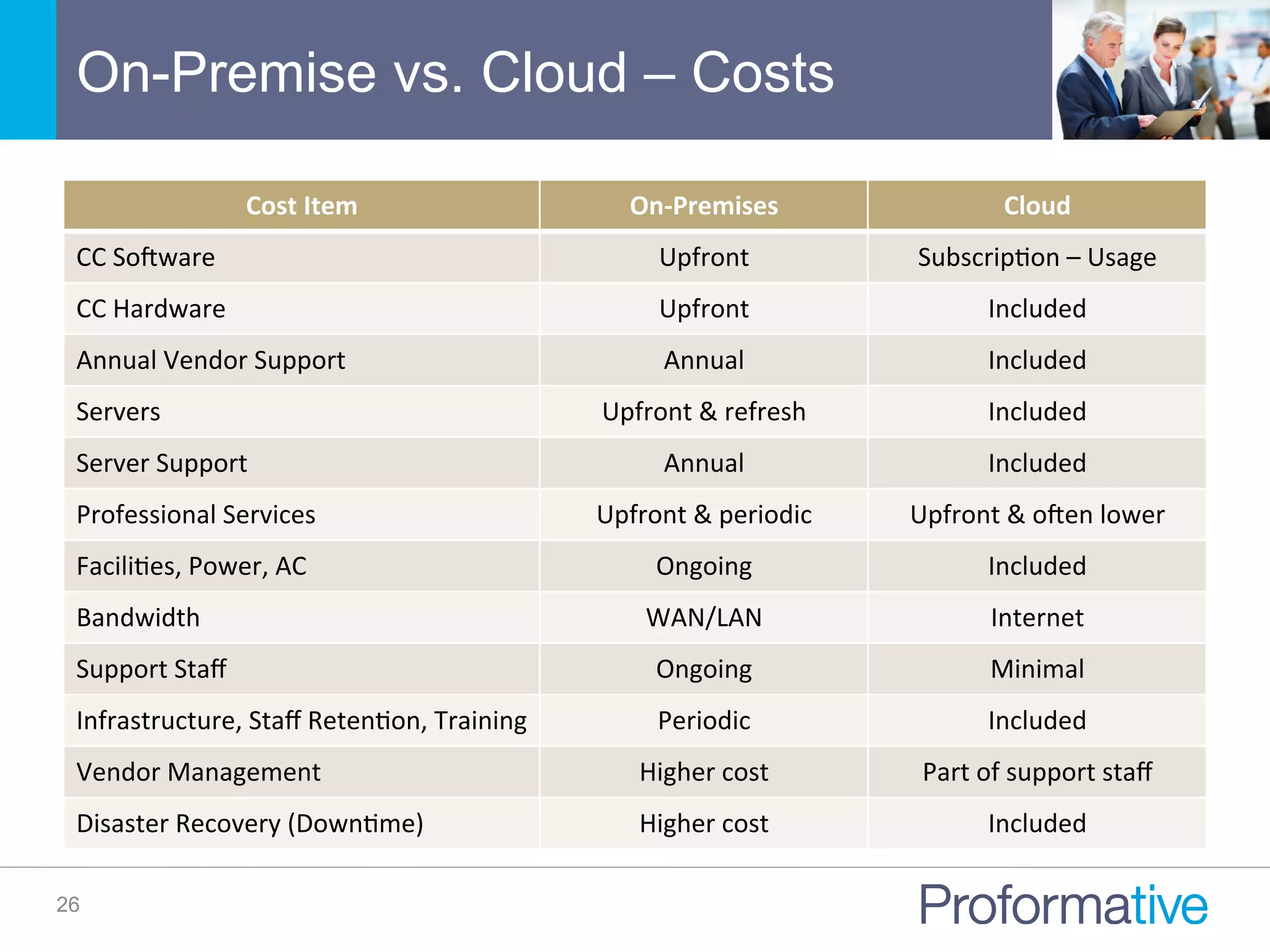
On-Premise vs. Cloud – Costs
26
Cost	
  Item	
   On-­‐Premises	
   Cloud	
  
CC	
  Soqware	
   Upfront	
   SubscripNon	
  –	
  Usage	
  
CC	
  Hardware	
   Upfront	
   Included	
  
Annual	
  Vendor	
  Support	
   Annual	
   Included	
  
Servers	
   Upfront	
  &	
  refresh	
   Included	
  
Server	
  Support	
   Annual	
   Included	
  
Professional	
  Services	
   Upfront	
  &	
  periodic	
   Upfront	
  &	
  oqen	
  lower	
  
FaciliNes,	
  Power,	
  AC	
   Ongoing	
   Included	
  
Bandwidth	
   WAN/LAN	
   Internet	
  
Support	
  Staff	
   Ongoing	
   Minimal	
  
Infrastructure,	
  Staff	
  RetenNon,	
  Training	
   Periodic	
   Included	
  
Vendor	
  Management	
   Higher	
  cost	
   Part	
  of	
  support	
  staff	
  
Disaster	
  Recovery	
  (DownNme)	
   Higher	
  cost	
   Included	
  
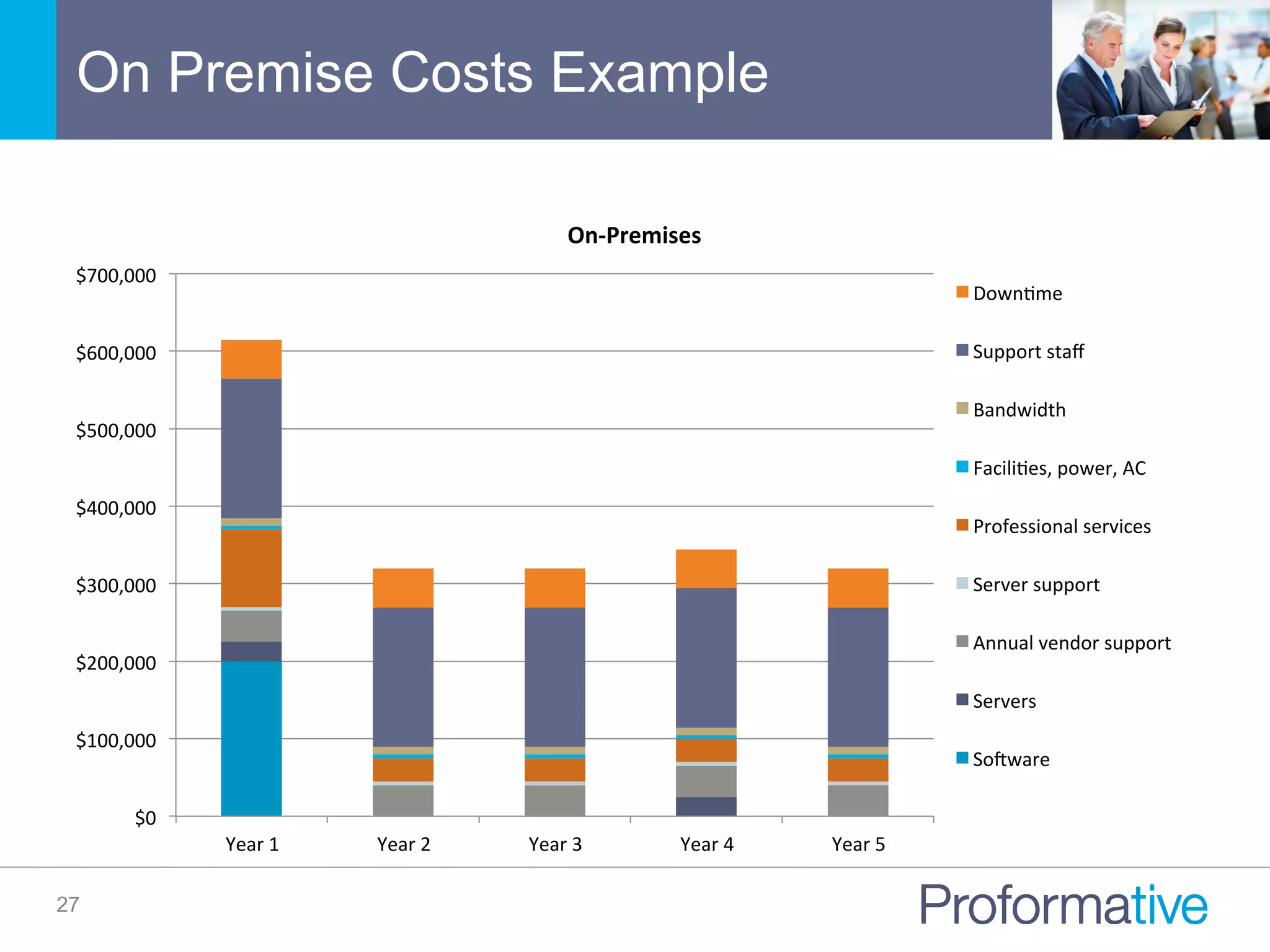
On Premise Costs Example
27
$0	
  
$100,000	
  
$200,000	
  
$300,000	
  
$400,000	
  
$500,000	
  
$600,000	
  
$700,000	
  
Year	
  1	
   Year	
  2	
   Year	
  3	
   Year	
  4	
   Year	
  5	
  
On-­‐Premises	
  
DownNme	
  
Support	
  staff	
  
Bandwidth	
  
FaciliNes,	
  power,	
  AC	
  
Professional	
  services	
  
Server	
  support	
  
Annual	
  vendor	
  support	
  
Servers	
  
Soqware	
  
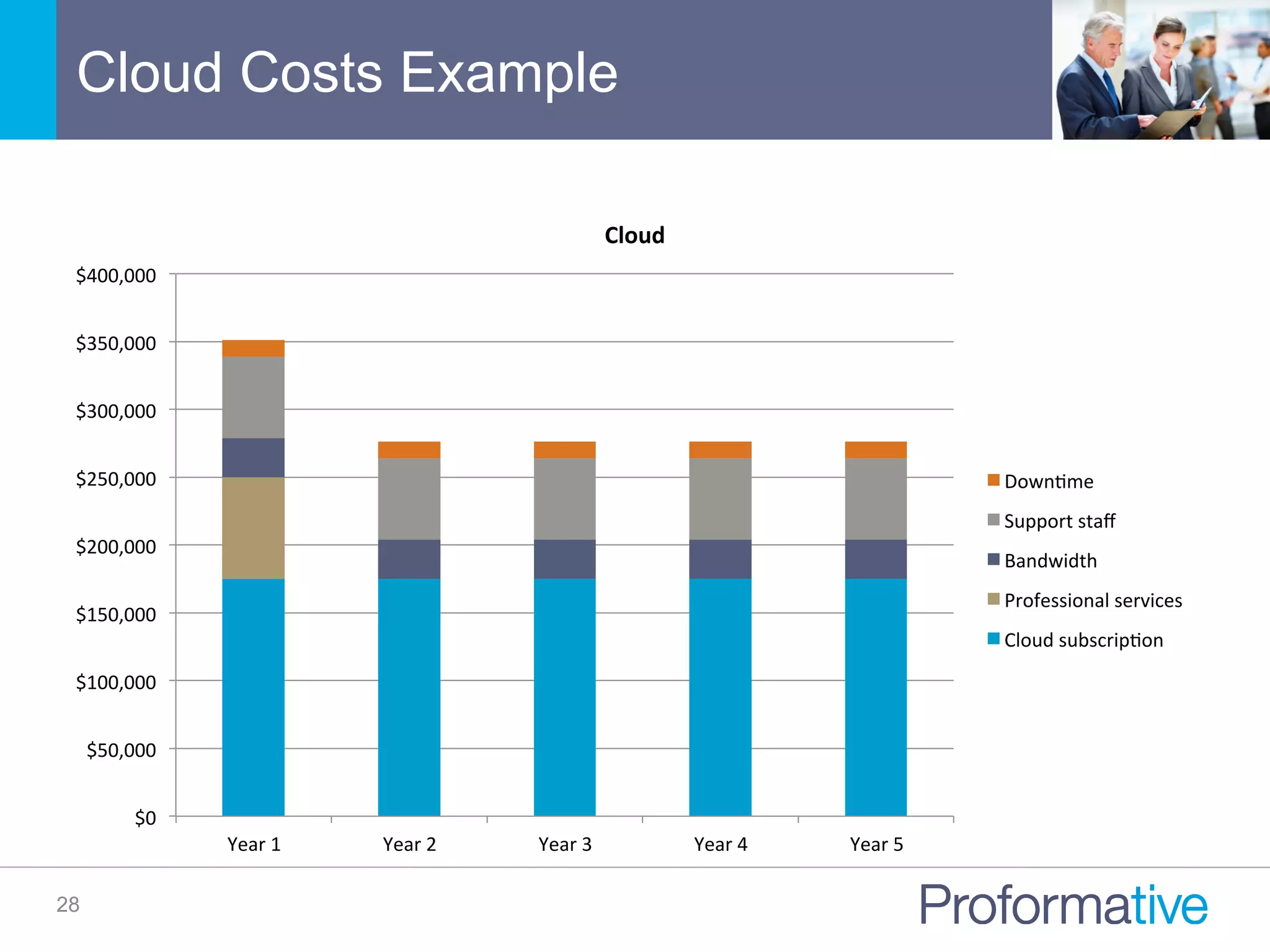
Cloud Costs Example
28
$0	
  
$50,000	
  
$100,000	
  
$150,000	
  
$200,000	
  
$250,000	
  
$300,000	
  
$350,000	
  
$400,000	
  
Year	
  1	
   Year	
  2	
   Year	
  3	
   Year	
  4	
   Year	
  5	
  
Cloud	
  
DownNme	
  
Support	
  staff	
  
Bandwidth	
  
Professional	
  services	
  
Cloud	
  subscripNon	
  
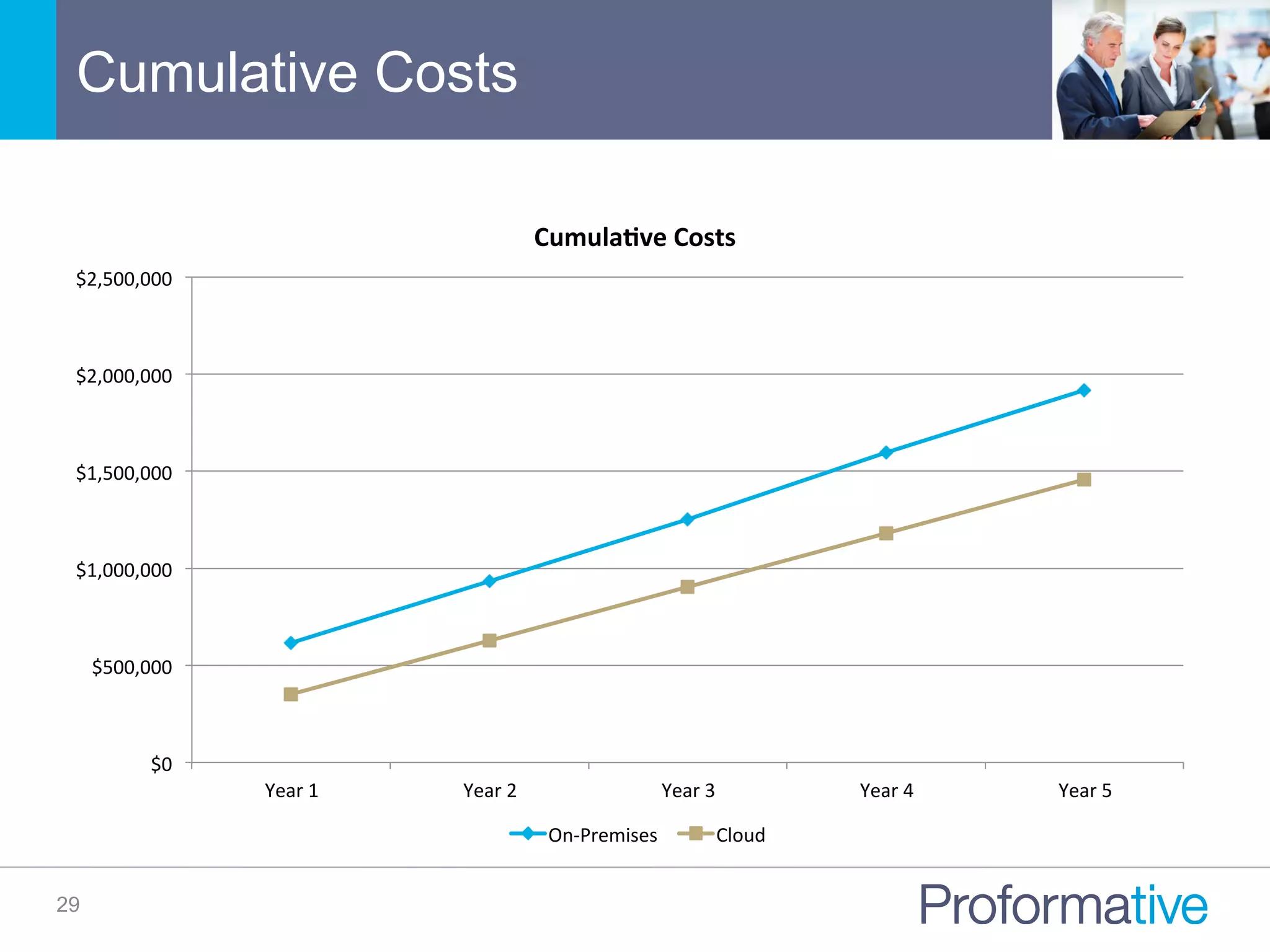
Cumulative Costs
29
$0	
  
$500,000	
  
$1,000,000	
  
$1,500,000	
  
$2,000,000	
  
$2,500,000	
  
Year	
  1	
   Year	
  2	
   Year	
  3	
   Year	
  4	
   Year	
  5	
  
Cumula/ve	
  Costs	
  
On-­‐Premises	
   Cloud	
  
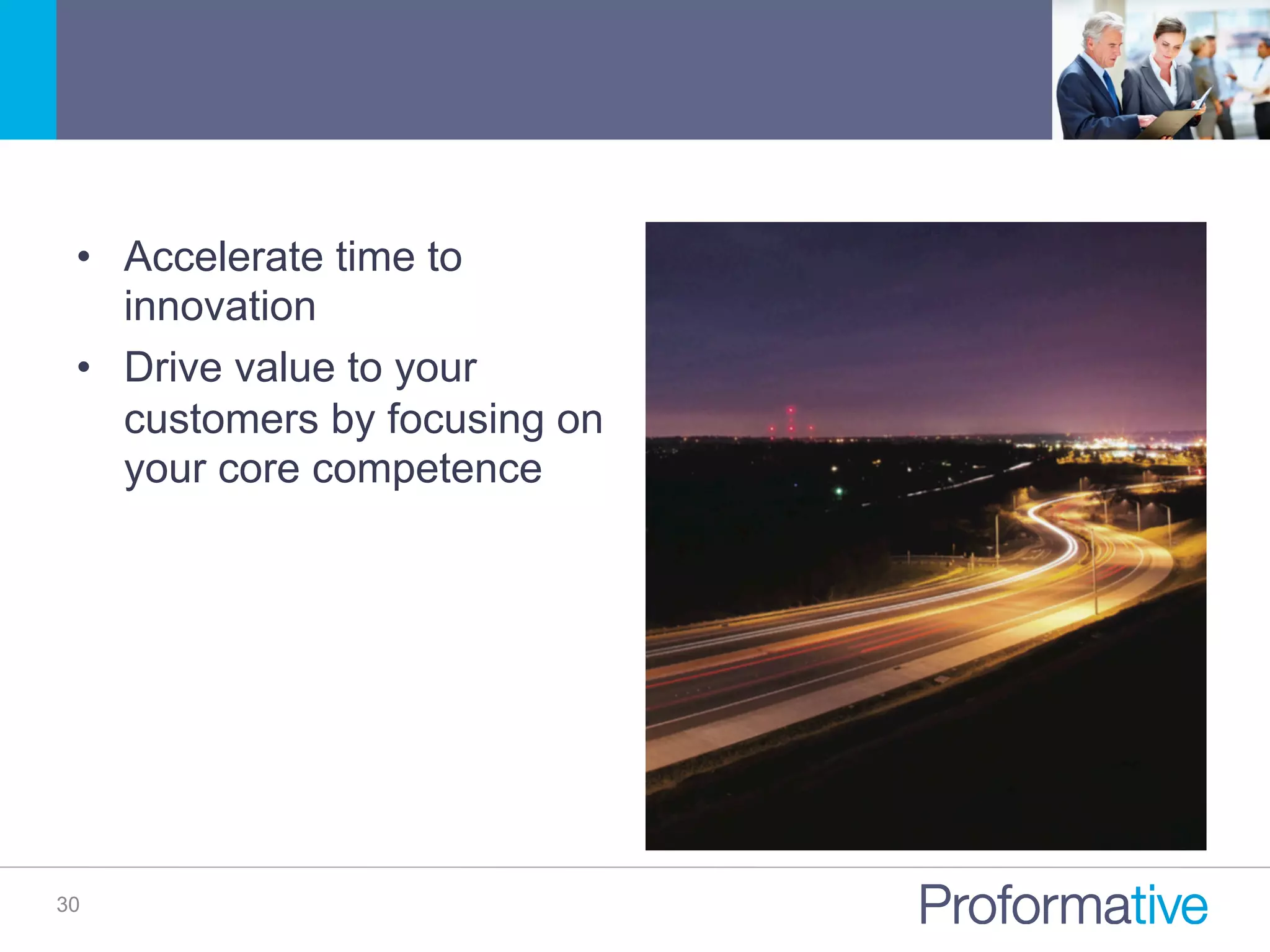
30
•  Accelerate time to
innovation
•  Drive value to your
customers by focusing on
your core competence
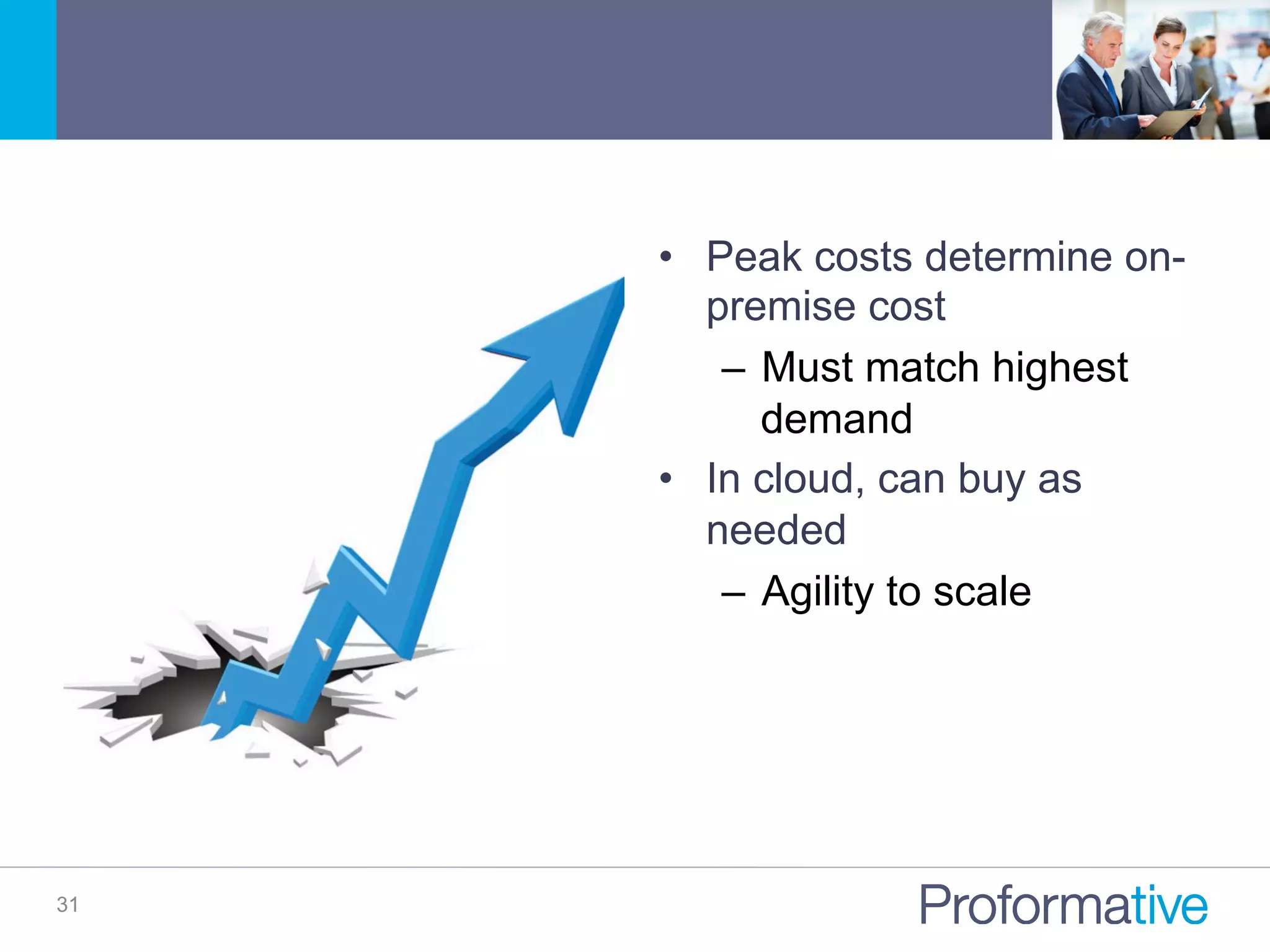
31
•  Peak costs determine on-
premise cost
–  Must match highest
demand
•  In cloud, can buy as
needed
–  Agility to scale
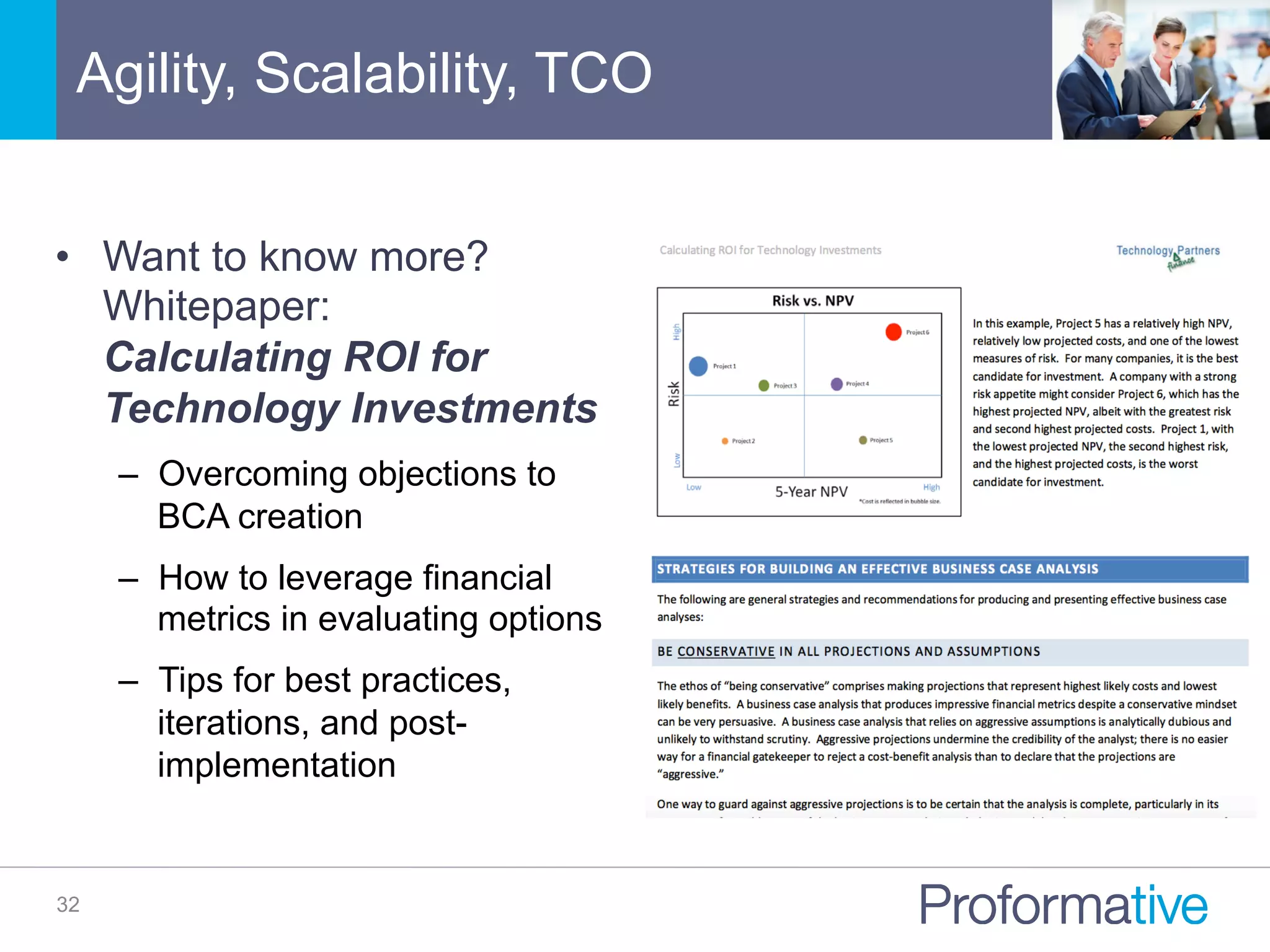
Agility, Scalability, TCO
32
•  Want to know more?
Whitepaper:
Calculating ROI for
Technology Investments
–  Overcoming objections to
BCA creation
–  How to leverage financial
metrics in evaluating options
–  Tips for best practices,
iterations, and post-
implementation
Thank You

How to Build a Great Cloud/SaaS Business Case Analysis for Technology Investment

  • 1.
    Ask, Share, Learn– Within the Largest Community of Corporate Finance Professionals How to Build a Great Cloud/SaaS Business Case Analysis for Technology Investment Drew Wright, co-founder, Technology Finance Partners Mike Murphy, CBO, goTransverse
  • 2.
    2 Benefits of BusinessCase Analysis for Tech Investments
  • 3.
    Budgets Are MeantTo Be Broken 3 1  in  6  IT  projects  have  an  average  cost  overrun  of   200%  and  a  schedule  overrun  of  70%.     (Source:  Harvard  Business  Review)   US  economy  loses  $50B-­‐$150B/yr  due  to  failed  IT   projects.  (Source:  Gallup  Business  Review)   Fewer  than  a  third  of  all  projects  were  successfully   completed  on  Nme  and  on  budget  over  the  past  year.   (Source:  Standish  Group)  
  • 4.
    Why Produce aBCA? 4 • Helps  prioriNze  projects  in  resource-­‐ constrained  orgs   • Ensures  resources  expended  are   commensurate  with  opportunity   • Must  be  accurate,  transparent  &   conservaNve   Business  Case  Analysis  (BCA)  
  • 5.
    Analytical Expectations 5 •  Analyticalvs. gut •  Tie proof to support: –  Corporate goals –  Specific objectives •  Financial executives require numbers, supporting evidence Photo credit: Jared Tarbell 2009
  • 6.
    Minimize Bias Risk 6 Keyfinancial metrics from a business case analysis allow dispassionate, rational, comparison of investment opportunities.
  • 7.
  • 8.
  • 9.
    Comprehensive BCA Inclusions 9 • Increased  labor  producNvity   •  Reduce  costs   •  Increased  revenue  (and  associated  margin)   Forecast  benefits   •  Upfront  costs   •  Recurring  costs   Project  costs   •  Ramp  up   •  [Benefits  –  Costs  =  Annual  Net  Benefits]     Map  benefit  and  cost  projecNons   Calculate  key  financial  metrics  
  • 10.
    Meaningful Financial Metrics 10 Return  on  Investment  (ROI)     • [Total  Net  Benefits  –  Total  Costs]  /  [Total   Costs]   • Does  not  take  into  account  Nme  value  of   money   Net  Present  Value  (NPV)   • Uses  cost  of  capital  to  discount  to  “current”   dollars   • NPV  <  0    is  by  definiNon  a  poor  investment   Payback  Period   • Net  benefit  crosses  from  negaNve  to  posiNve   • CriNcal  if  expediNous  return  of  capital  is   needed!   Internal  Rate  of  Return  (IRR)   • Discount  rate  where  NPV  =  0  
  • 11.
    Business Case Metrics:ROI Benefits – Costs Costs ROI =
  • 12.
    Business Case Metrics:Payback  -­‐      500      1,000      1,500      2,000      2,500      3,000      3,500      4,000     1   4     7   10     13   16     19   22     25   28     31   34     37     40     43     46     49     52     55     58     Thousands   Month   Cumula/ve  Benefits  vs.  Cumula/ve  Costs  ($  USD)   Benefits  Range   Likely  Benefits   Costs   In  ProducNon   Payback  
  • 13.
    Business Case Metrics:NPV C  =  Cash  flow   T  =  Time   r  =  rate    
  • 14.
    Business Case Metrics:IRR Set  NPV  =  0   Solve  for  r    
  • 15.
    Key Financial Metrics 5Year Net Benefit $1,847,914 5 Year Net Present Value (NPV) @ a Hurdle Rate of 10% $1,311,119 5 Year Return on Investment 168% Payback in Months 18 Benefits Year 1 Year 2 Year 3 Year 4 Year 5 Total Total annual benefits $269,258 $614,889 $674,704 $687,837 $701,227 $2,947,914 Solution Costs Year 1 Year 2 Year 3 Year 4 Year 5 Total Total solution costs $300,000 $200,000 $200,000 $200,000 $200,000 $1,100,000 Net Benefit Year 1 Year 2 Year 3 Year 4 Year 5 Total Net benefit ($30,742) $414,889 $474,704 $487,837 $501,227 $1,847,914 Cumulative net benefit ($30,742) $384,147 $858,850 $1,346,688 $1,847,914 Business Case Analysis Summary
  • 16.
    Evaluating a TechnologyInvestment 16 $4,900   $1,100   $3,800   $2,300   $7,200   0   2   4   6   8   10   $0   $2,000   $4,000   $6,000   $8,000   $10,000   $12,000   Risk  (low=10,  high=1)   Profit:    5  Year  NPV  (000s)   Comparison  of  Contemplated  Technology   Investments   (size  of  bubble  represents  5  year  cost  in  000s)   Priority   Dark  Blue   Red   Green   Yellow   Light  Blue  
  • 17.
  • 18.
  • 19.
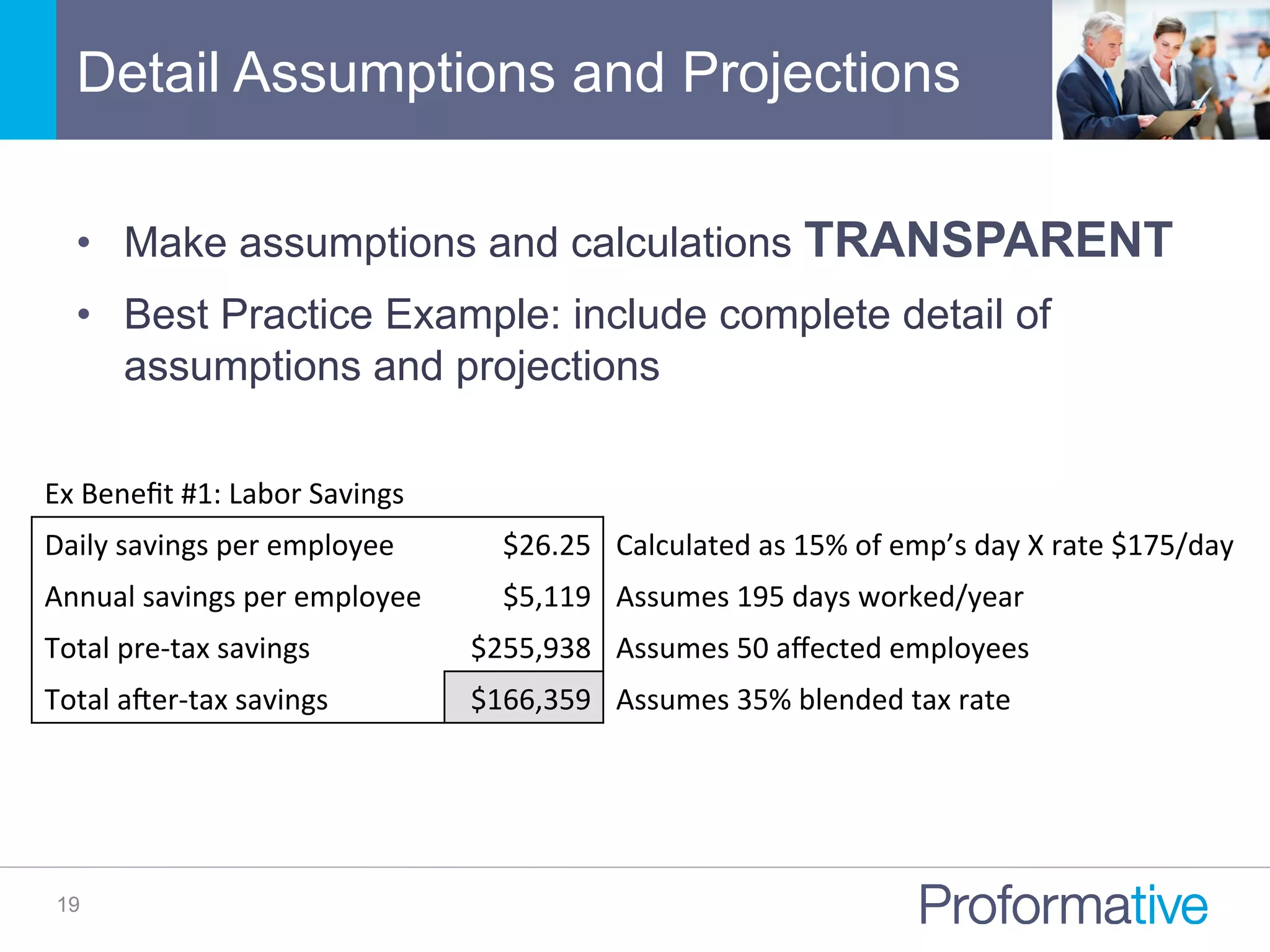
    Detail Assumptions andProjections 19 •  Make assumptions and calculations TRANSPARENT •  Best Practice Example: include complete detail of assumptions and projections Ex  Benefit  #1:  Labor  Savings   Daily  savings  per  employee   $26.25   Calculated  as  15%  of  emp’s  day  X  rate  $175/day   Annual  savings  per  employee   $5,119   Assumes  195  days  worked/year   Total  pre-­‐tax  savings   $255,938   Assumes  50  affected  employees   Total  aqer-­‐tax  savings   $166,359   Assumes  35%  blended  tax  rate  
  • 20.
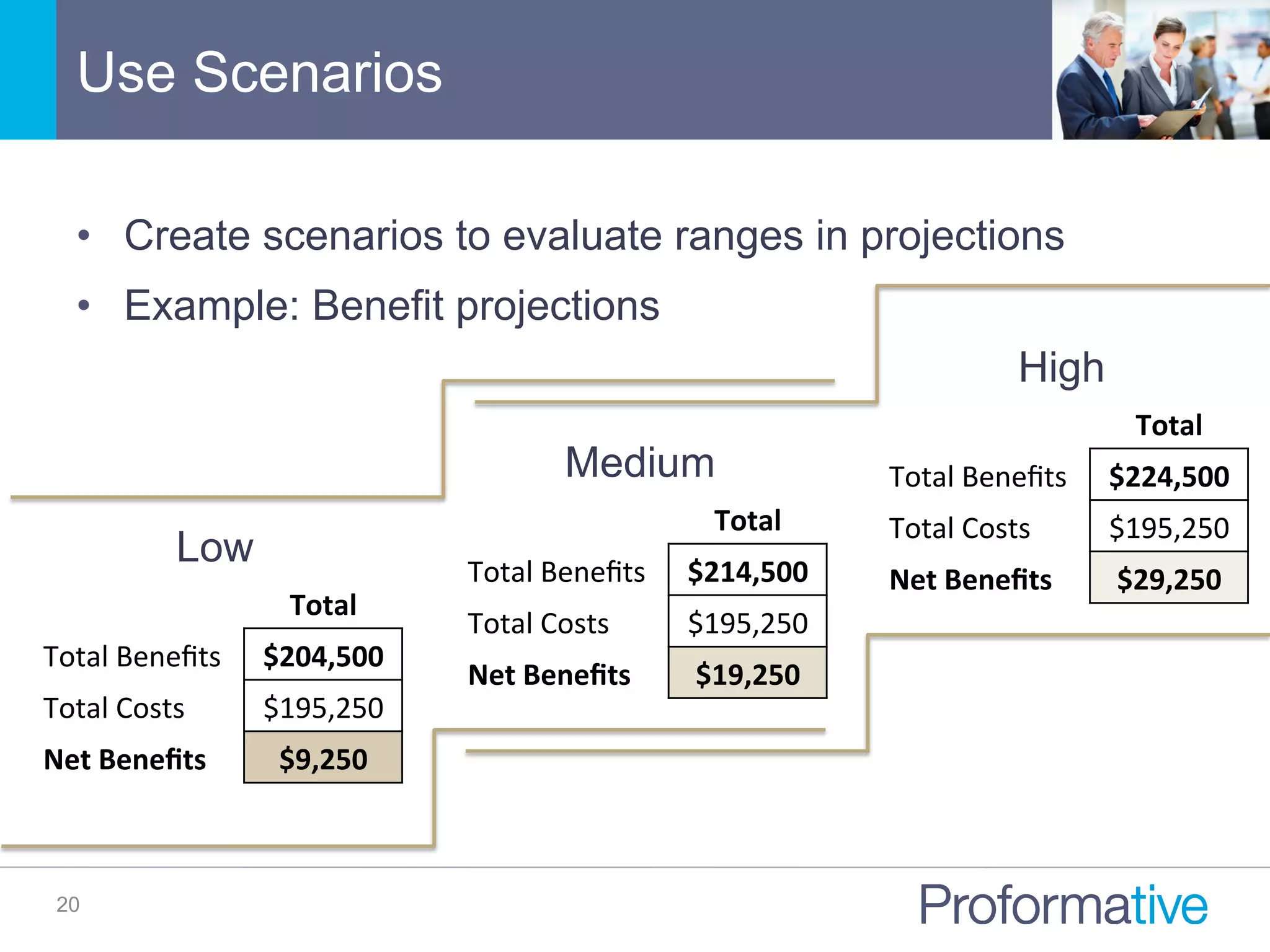
    Use Scenarios 20 •  Createscenarios to evaluate ranges in projections •  Example: Benefit projections Total   Total  Benefits   $204,500   Total  Costs   $195,250   Net  Benefits   $9,250   Total   Total  Benefits   $214,500   Total  Costs   $195,250   Net  Benefits   $19,250   Total   Total  Benefits   $224,500   Total  Costs   $195,250   Net  Benefits   $29,250   Low Medium High
  • 21.
    Scenarios: Payback 21 $0   $1   $2   $3   $4   $5   $6   Project  Init   Year  1   Year  2   Year  3   Year  4   Year  5   Millions   Benefit  Range  Across  Scenarios  vs.  Es/mated  Costs   Benefit   Range   EsNmated   Cost  
  • 22.
    Use Scenarios toSet Expectations 22 Present “Low” version to Board for investment Hold employees accountable to “High” for performance
  • 23.
    23 Key Components ofCloud Economics
  • 24.
    Economics of theCloud 24 Cloud  Billing   System   Labor   Power   /  AC   Upgrade   Mgmt   HW  /   SW   FaciliNes   DR   PCI  
  • 25.
    Why Cloud? 25 P  &  L  Impact   • Usage-­‐based  pricing  tracks  predictable  expenditures  more  closely   to  demand   • Move  from  large  CAPEX  to  consumpNon-­‐based  OPEX  enables   operaNon  agility  (and  reduces  shelf-­‐ware)   Strategic  Opportuni/es   • Take  advantage  of  the  latest  technologies  and  features   • Core  competency  focus  –  move  non-­‐core  IT  acNviNes  to  the  cloud   • Shiq  risk  from  enterprise  to  cloud  vendor   • Improve  business  agility  and  Nme  to  value  with  web  services   • Future  proof;  Increased  innovaNon  (IoT,  ecosystem  connected)  
  • 26.
    On-Premise vs. Cloud– Costs 26 Cost  Item   On-­‐Premises   Cloud   CC  Soqware   Upfront   SubscripNon  –  Usage   CC  Hardware   Upfront   Included   Annual  Vendor  Support   Annual   Included   Servers   Upfront  &  refresh   Included   Server  Support   Annual   Included   Professional  Services   Upfront  &  periodic   Upfront  &  oqen  lower   FaciliNes,  Power,  AC   Ongoing   Included   Bandwidth   WAN/LAN   Internet   Support  Staff   Ongoing   Minimal   Infrastructure,  Staff  RetenNon,  Training   Periodic   Included   Vendor  Management   Higher  cost   Part  of  support  staff   Disaster  Recovery  (DownNme)   Higher  cost   Included  
  • 27.
    On Premise CostsExample 27 $0   $100,000   $200,000   $300,000   $400,000   $500,000   $600,000   $700,000   Year  1   Year  2   Year  3   Year  4   Year  5   On-­‐Premises   DownNme   Support  staff   Bandwidth   FaciliNes,  power,  AC   Professional  services   Server  support   Annual  vendor  support   Servers   Soqware  
  • 28.
    Cloud Costs Example 28 $0   $50,000   $100,000   $150,000   $200,000   $250,000   $300,000   $350,000   $400,000   Year  1   Year  2   Year  3   Year  4   Year  5   Cloud   DownNme   Support  staff   Bandwidth   Professional  services   Cloud  subscripNon  
  • 29.
    Cumulative Costs 29 $0   $500,000   $1,000,000   $1,500,000   $2,000,000   $2,500,000   Year  1   Year  2   Year  3   Year  4   Year  5   Cumula/ve  Costs   On-­‐Premises   Cloud  
  • 30.
    30 •  Accelerate timeto innovation •  Drive value to your customers by focusing on your core competence
  • 31.
    31 •  Peak costsdetermine on- premise cost –  Must match highest demand •  In cloud, can buy as needed –  Agility to scale
  • 32.
    Agility, Scalability, TCO 32 • Want to know more? Whitepaper: Calculating ROI for Technology Investments –  Overcoming objections to BCA creation –  How to leverage financial metrics in evaluating options –  Tips for best practices, iterations, and post- implementation
  • 33.