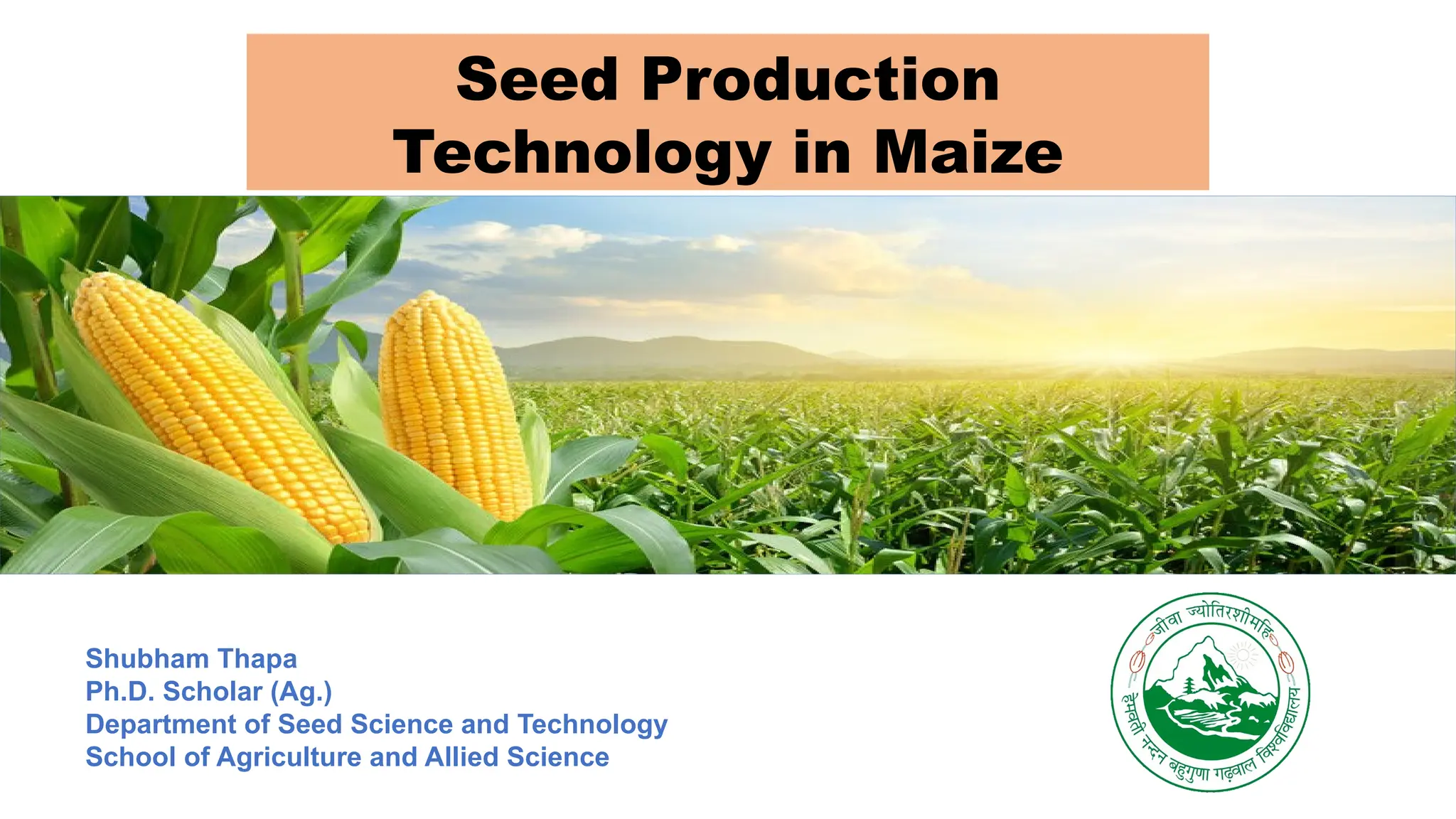
Seed Production
Technology in Maize
Shubham Thapa
Ph.D. Scholar (Ag.)
Department of Seed Science and Technology
School of Agriculture and Allied Science
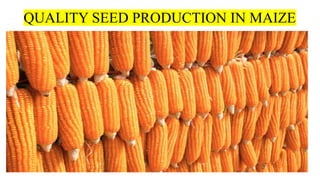
QUALITY SEED PRODUCTION IN MAIZE
INTRODUCTION
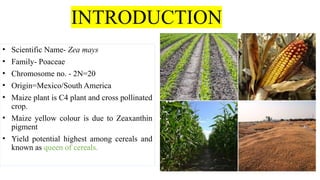
• Scientific Name- Zea mays
• Family- Poaceae
• Chromosome no. - 2N=20
• Origin=Mexico/South America
• Maize plant is C4 plant and cross pollinated
crop.
• Maize yellow colour is due to Zeaxanthin
pigment
• Yield potential highest among cereals and
known as queen of cereals.
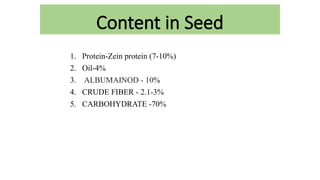
Content in Seed
1. Protein-Zein protein (7-10%)
2. Oil-4%
3. ALBUMAINOD - 10%
4. CRUDE FIBER - 2.1-3%
5. CARBOHYDRATE -70%
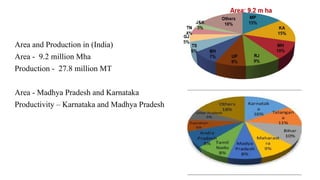
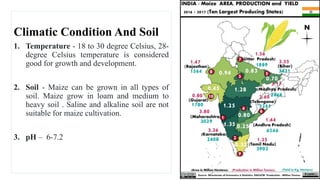
Area and Production in (India)
Area - 9.2 million Mha
Production - 27.8 million MT
Area - Madhya Pradesh and Karnataka
Productivity – Karnataka and Madhya Pradesh
Climatic Condition And Soil
1. Temperature - 18 to 30 degree Celsius, 28-
degree Celsius temperature is considered
good for growth and development.
2. Soil - Maize can be grown in all types of
soil. Maize grow in loam and medium to
heavy soil . Saline and alkaline soil are not
suitable for maize cultivation.
3. pH – 6-7.2
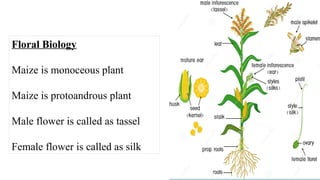
Floral Biology
Maize is monoceous plant
Maize is protoandrous plant
Male flower is called as tassel
Female flower is called as silk
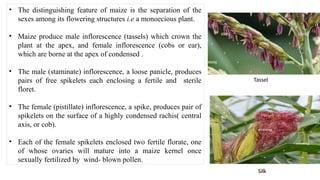
• The distinguishing feature of maize is the separation of the
sexes among its flowering structures i.e a monoecious plant.
• Maize produce male inflorescence (tassels) which crown the
plant at the apex, and female inflorescence (cobs or ear),
which are borne at the apex of condensed .
• The male (staminate) inflorescence, a loose panicle, produces
pairs of free spikelets each enclosing a fertile and sterile
floret.
• The female (pistillate) inflorescence, a spike, produces pair of
spikelets on the surface of a highly condensed rachis( central
axis, or cob).
• Each of the female spikelets enclosed two fertile florate, one
of whose ovaries will mature into a maize kernel once
sexually fertilized by wind- blown pollen.
Tassel
Silk
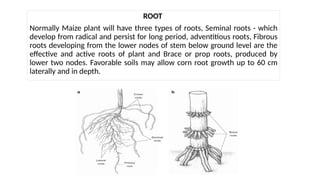
ROOT
Normally Maize plant will have three types of roots, Seminal roots - which
develop from radical and persist for long period, adventitious roots, Fibrous
roots developing from the lower nodes of stem below ground level are the
effective and active roots of plant and Brace or prop roots, produced by
lower two nodes. Favorable soils may allow corn root growth up to 60 cm
laterally and in depth.
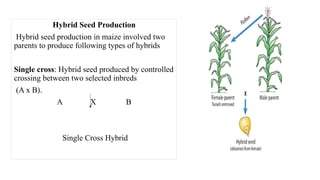
Hybrid Seed Production
Hybrid seed production in maize involved two
parents to produce following types of hybrids
Single cross: Hybrid seed produced by controlled
crossing between two selected inbreds
(A x B).
A X B
Single Cross Hybrid
Double cross: Hybrid seed produced by crossing
between two Certified single crosses
[(A x B) x (C x D)].
A X B C X D
Single Cross Hybrid X Single Cross Hybrid
Double Cross Hybrid
Three way cross: Hybrid seed produced by crossing between an inbred used as male and
a Certified single cross hybrid [(A x B) x C] as female parent.
A X B
Single Cross Hybrid X C
Three-way cross Hybrid
Classification of maize
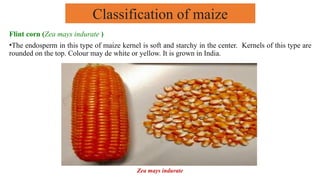
Flint corn (Zea mays indurate )
•The endosperm in this type of maize kernel is soft and starchy in the center. Kernels of this type are
rounded on the top. Colour may de white or yellow. It is grown in India.
Zea mays indurate
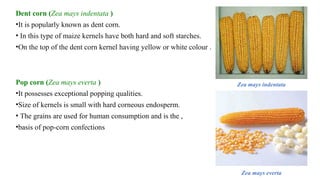
Dent corn (Zea mays indentata )
•It is popularly known as dent corn.
• In this type of maize kernels have both hard and soft starches.
•On the top of the dent corn kernel having yellow or white colour .
Pop corn (Zea mays everta )
•It possesses exceptional popping qualities.
•Size of kernels is small with hard corneous endosperm.
• The grains are used for human consumption and is the ,
•basis of pop-corn confections
Zea mays indentata
Zea mays everta
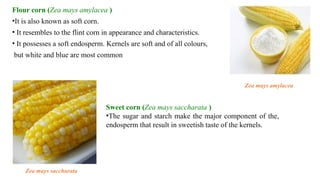
Flour corn (Zea mays amylacea )
•It is also known as soft corn.
• It resembles to the flint corn in appearance and characteristics.
• It possesses a soft endosperm. Kernels are soft and of all colours,
but white and blue are most common
Sweet corn (Zea mays saccharata )
•The sugar and starch make the major component of the,
endosperm that result in sweetish taste of the kernels.
Zea mays amylacea
Zea mays saccharata
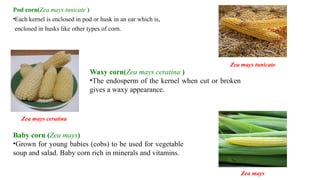
Pod corn(Zea mays tunicate )
•Each kernel is enclosed in pod or husk in an ear which is,
enclosed in husks like other types of corn.
Waxy corn(Zea mays ceratina )
•The endosperm of the kernel when cut or broken
gives a waxy appearance.
Baby corn (Zea mays)
•Grown for young babies (cobs) to be used for vegetable
soup and salad. Baby corn rich in minerals and vitamins.
Zea mays tunicate
Zea mays ceratina
Zea mays
Varieties of Maize
• 1st
hybrid of maize = Ganga-1 (1961 by All India Coordinated research project )
• High Quality protein varieties – Shaktiman-1 , HQPM-1 .
• Synthetic varieties = Amber
• Composites varieties = Prabhat , Navjot , Kiran , CO-1 .
• Lysin (4%) rich varieties = Shakti , Ratna
Land requirement
• Land should be free from volunteer plants. The previous crop should not be the same
variety or other varieties of the same crop. The soil should be well-aerated and suitable for
maize growing
• It can be the same variety if it is certified as per the procedures of certification agency.
Isolation Requirement
• Maize is normally cross-pollinated by wind . Isolation of seed fields from other maize
fields is , therefore, necessary to prevent foreign pollen contamination .
• The field must be isolated at least 400 metres for foundation seed class ,and 200 metres for
certified seed class.
Cultural practices
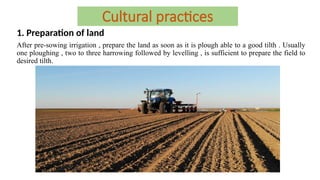
1. Preparation of land
After pre-sowing irrigation , prepare the land as soon as it is plough able to a good tilth . Usually
one ploughing , two to three harrowing followed by levelling , is sufficient to prepare the field to
desired tilth.
2. Time of sowing – Best time for sowing maize is two weeks prior to the onset of the
monsoon. Maize is usually sown from second week of July to mid-July.
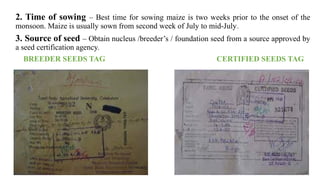
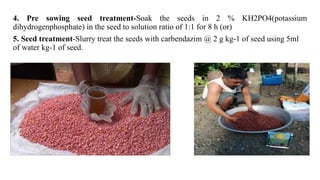
3. Source of seed – Obtain nucleus /breeder’s / foundation seed from a source approved by
a seed certification agency.
BREEDER SEEDS TAG CERTIFIED SEEDS TAG
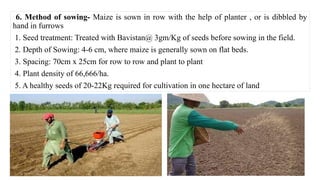
4. Pre sowing seed treatment-Soak the seeds in 2 % KH2PO4(potassium
dihydrogenphosphate) in the seed to solution ratio of 1:1 for 8 h (or)
5. Seed treatment-Slurry treat the seeds with carbendazim @ 2 g kg-1 of seed using 5ml
of water kg-1 of seed.
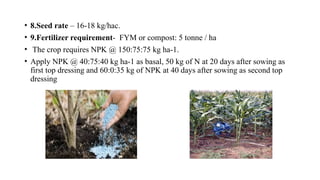
6. Method of sowing- Maize is sown in row with the help of planter , or is dibbled by
hand in furrows
1. Seed treatment: Treated with Bavistan@ 3gm/Kg of seeds before sowing in the field.
2. Depth of Sowing: 4-6 cm, where maize is generally sown on flat beds.
3. Spacing: 70cm x 25cm for row to row and plant to plant
4. Plant density of 66,666/ha.
5. A healthy seeds of 20-22Kg required for cultivation in one hectare of land
• 8.Seed rate – 16-18 kg/hac.
• 9.Fertilizer requirement- FYM or compost: 5 tonne / ha
• The crop requires NPK @ 150:75:75 kg ha-1.
• Apply NPK @ 40:75:40 kg ha-1 as basal, 50 kg of N at 20 days after sowing as
first top dressing and 60:0:35 kg of NPK at 40 days after sowing as second top
dressing
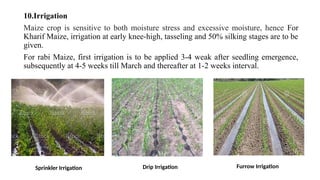
10.Irrigation
Maize crop is sensitive to both moisture stress and excessive moisture, hence For
Kharif Maize, irrigation at early knee-high, tasseling and 50% silking stages are to be
given.
For rabi Maize, first irrigation is to be applied 3-4 weak after seedling emergence,
subsequently at 4-5 weeks till March and thereafter at 1-2 weeks interval.
Sprinkler Irrigation Drip Irrigation Furrow Irrigation
11. INTERCULTURE OPERATION - Thinning should be done after 10 days of
germination keeping one plant per hill. At knee high stage (about 35 days after germination)
the crop plants should be earthed-up followed by light hand weeding. The second earthing up
should be done at 60 days after germination of the crop; it may slightly vary in respective to
locality.
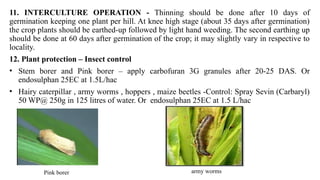
12. Plant protection – Insect control
• Stem borer and Pink borer – apply carbofuran 3G granules after 20-25 DAS. Or
endosulphan 25EC at 1.5L/hac
• Hairy caterpillar , army worms , hoppers , maize beetles -Control: Spray Sevin (Carbaryl)
50 WP@ 250g in 125 litres of water. Or endosulphan 25EC at 1.5 L/hac
Pink borer army worms
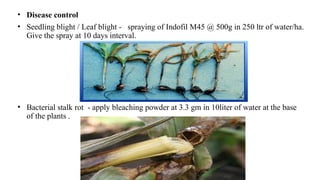
• Disease control
• Seedling blight / Leaf blight - spraying of Indofil M45 @ 500g in 250 ltr of water/ha.
Give the spray at 10 days interval.
• Bacterial stalk rot - apply bleaching powder at 3.3 gm in 10liter of water at the base
of the plants .
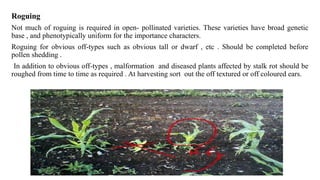
Roguing
Not much of roguing is required in open- pollinated varieties. These varieties have broad genetic
base , and phenotypically uniform for the importance characters.
Roguing for obvious off-types such as obvious tall or dwarf , etc . Should be completed before
pollen shedding .
In addition to obvious off-types , malformation and diseased plants affected by stalk rot should be
roughed from time to time as required . At harvesting sort out the off textured or off coloured ears.
Harvesting of maize
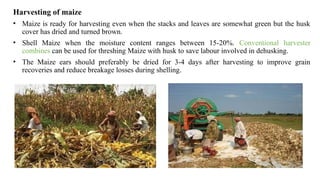
• Maize is ready for harvesting even when the stacks and leaves are somewhat green but the husk
cover has dried and turned brown.
• Shell Maize when the moisture content ranges between 15-20%. Conventional harvester
combines can be used for threshing Maize with husk to save labour involved in dehusking.
• The Maize ears should preferably be dried for 3-4 days after harvesting to improve grain
recoveries and reduce breakage losses during shelling.
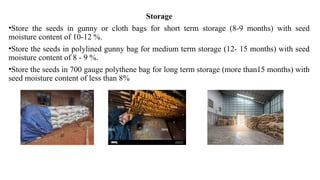
Storage
•Store the seeds in gunny or cloth bags for short term storage (8-9 months) with seed
moisture content of 10-12 %.
•Store the seeds in polylined gunny bag for medium term storage (12- 15 months) with seed
moisture content of 8 - 9 %.
•Store the seeds in 700 gauge polythene bag for long term storage (more than15 months) with
seed moisture content of less than 8%
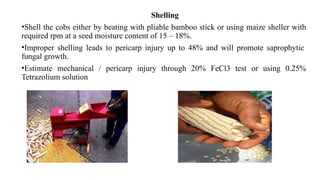
Shelling
•Shell the cobs either by beating with pliable bamboo stick or using maize sheller with
required rpm at a seed moisture content of 15 – 18%.
•Improper shelling leads to pericarp injury up to 48% and will promote saprophytic
fungal growth.
•Estimate mechanical / pericarp injury through 20% FeCl3 test or using 0.25%
Tetrazolium solution
Size grading
•Grade the seeds using 18/64” round perforated metal sieve
Processing
•After shelling the seeds are processed at processing plants.
Seed Yield
• Average seed yield varies from 25-30 qtl/hac.
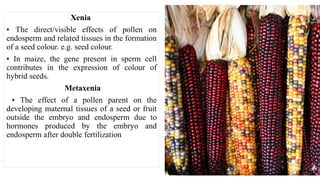
Xenia
• The direct/visible effects of pollen on
endosperm and related tissues in the formation
of a seed colour. e.g. seed colour.
• In maize, the gene present in sperm cell
contributes in the expression of colour of
hybrid seeds.
Metaxenia
• The effect of a pollen parent on the
developing maternal tissues of a seed or fruit
outside the embryo and endosperm due to
hormones produced by the embryo and
endosperm after double fertilization
THANK YOU

Seed Production Technology in Maize.pptx

  • 1.
    Seed Production Technology inMaize Shubham Thapa Ph.D. Scholar (Ag.) Department of Seed Science and Technology School of Agriculture and Allied Science
  • 2.
  • 3.
    INTRODUCTION • Scientific Name-Zea mays • Family- Poaceae • Chromosome no. - 2N=20 • Origin=Mexico/South America • Maize plant is C4 plant and cross pollinated crop. • Maize yellow colour is due to Zeaxanthin pigment • Yield potential highest among cereals and known as queen of cereals.
  • 4.
    Content in Seed 1.Protein-Zein protein (7-10%) 2. Oil-4% 3. ALBUMAINOD - 10% 4. CRUDE FIBER - 2.1-3% 5. CARBOHYDRATE -70%
  • 5.
    Area and Productionin (India) Area - 9.2 million Mha Production - 27.8 million MT Area - Madhya Pradesh and Karnataka Productivity – Karnataka and Madhya Pradesh
  • 6.
    Climatic Condition AndSoil 1. Temperature - 18 to 30 degree Celsius, 28- degree Celsius temperature is considered good for growth and development. 2. Soil - Maize can be grown in all types of soil. Maize grow in loam and medium to heavy soil . Saline and alkaline soil are not suitable for maize cultivation. 3. pH – 6-7.2
  • 7.
    Floral Biology Maize ismonoceous plant Maize is protoandrous plant Male flower is called as tassel Female flower is called as silk
  • 8.
    • The distinguishingfeature of maize is the separation of the sexes among its flowering structures i.e a monoecious plant. • Maize produce male inflorescence (tassels) which crown the plant at the apex, and female inflorescence (cobs or ear), which are borne at the apex of condensed . • The male (staminate) inflorescence, a loose panicle, produces pairs of free spikelets each enclosing a fertile and sterile floret. • The female (pistillate) inflorescence, a spike, produces pair of spikelets on the surface of a highly condensed rachis( central axis, or cob). • Each of the female spikelets enclosed two fertile florate, one of whose ovaries will mature into a maize kernel once sexually fertilized by wind- blown pollen. Tassel Silk
  • 9.
    ROOT Normally Maize plantwill have three types of roots, Seminal roots - which develop from radical and persist for long period, adventitious roots, Fibrous roots developing from the lower nodes of stem below ground level are the effective and active roots of plant and Brace or prop roots, produced by lower two nodes. Favorable soils may allow corn root growth up to 60 cm laterally and in depth.
  • 10.
    Hybrid Seed Production Hybridseed production in maize involved two parents to produce following types of hybrids Single cross: Hybrid seed produced by controlled crossing between two selected inbreds (A x B). A X B Single Cross Hybrid
  • 11.
    Double cross: Hybridseed produced by crossing between two Certified single crosses [(A x B) x (C x D)]. A X B C X D Single Cross Hybrid X Single Cross Hybrid Double Cross Hybrid
  • 12.
    Three way cross:Hybrid seed produced by crossing between an inbred used as male and a Certified single cross hybrid [(A x B) x C] as female parent. A X B Single Cross Hybrid X C Three-way cross Hybrid
  • 13.
    Classification of maize Flintcorn (Zea mays indurate ) •The endosperm in this type of maize kernel is soft and starchy in the center. Kernels of this type are rounded on the top. Colour may de white or yellow. It is grown in India. Zea mays indurate
  • 14.
    Dent corn (Zeamays indentata ) •It is popularly known as dent corn. • In this type of maize kernels have both hard and soft starches. •On the top of the dent corn kernel having yellow or white colour . Pop corn (Zea mays everta ) •It possesses exceptional popping qualities. •Size of kernels is small with hard corneous endosperm. • The grains are used for human consumption and is the , •basis of pop-corn confections Zea mays indentata Zea mays everta
  • 15.
    Flour corn (Zeamays amylacea ) •It is also known as soft corn. • It resembles to the flint corn in appearance and characteristics. • It possesses a soft endosperm. Kernels are soft and of all colours, but white and blue are most common Sweet corn (Zea mays saccharata ) •The sugar and starch make the major component of the, endosperm that result in sweetish taste of the kernels. Zea mays amylacea Zea mays saccharata
  • 16.
    Pod corn(Zea maystunicate ) •Each kernel is enclosed in pod or husk in an ear which is, enclosed in husks like other types of corn. Waxy corn(Zea mays ceratina ) •The endosperm of the kernel when cut or broken gives a waxy appearance. Baby corn (Zea mays) •Grown for young babies (cobs) to be used for vegetable soup and salad. Baby corn rich in minerals and vitamins. Zea mays tunicate Zea mays ceratina Zea mays
  • 17.
    Varieties of Maize •1st hybrid of maize = Ganga-1 (1961 by All India Coordinated research project ) • High Quality protein varieties – Shaktiman-1 , HQPM-1 . • Synthetic varieties = Amber • Composites varieties = Prabhat , Navjot , Kiran , CO-1 . • Lysin (4%) rich varieties = Shakti , Ratna
  • 18.
    Land requirement • Landshould be free from volunteer plants. The previous crop should not be the same variety or other varieties of the same crop. The soil should be well-aerated and suitable for maize growing • It can be the same variety if it is certified as per the procedures of certification agency. Isolation Requirement • Maize is normally cross-pollinated by wind . Isolation of seed fields from other maize fields is , therefore, necessary to prevent foreign pollen contamination . • The field must be isolated at least 400 metres for foundation seed class ,and 200 metres for certified seed class.
  • 19.
    Cultural practices 1. Preparationof land After pre-sowing irrigation , prepare the land as soon as it is plough able to a good tilth . Usually one ploughing , two to three harrowing followed by levelling , is sufficient to prepare the field to desired tilth.
  • 20.
    2. Time ofsowing – Best time for sowing maize is two weeks prior to the onset of the monsoon. Maize is usually sown from second week of July to mid-July. 3. Source of seed – Obtain nucleus /breeder’s / foundation seed from a source approved by a seed certification agency. BREEDER SEEDS TAG CERTIFIED SEEDS TAG
  • 21.
    4. Pre sowingseed treatment-Soak the seeds in 2 % KH2PO4(potassium dihydrogenphosphate) in the seed to solution ratio of 1:1 for 8 h (or) 5. Seed treatment-Slurry treat the seeds with carbendazim @ 2 g kg-1 of seed using 5ml of water kg-1 of seed.
  • 22.
    6. Method ofsowing- Maize is sown in row with the help of planter , or is dibbled by hand in furrows 1. Seed treatment: Treated with Bavistan@ 3gm/Kg of seeds before sowing in the field. 2. Depth of Sowing: 4-6 cm, where maize is generally sown on flat beds. 3. Spacing: 70cm x 25cm for row to row and plant to plant 4. Plant density of 66,666/ha. 5. A healthy seeds of 20-22Kg required for cultivation in one hectare of land
  • 23.
    • 8.Seed rate– 16-18 kg/hac. • 9.Fertilizer requirement- FYM or compost: 5 tonne / ha • The crop requires NPK @ 150:75:75 kg ha-1. • Apply NPK @ 40:75:40 kg ha-1 as basal, 50 kg of N at 20 days after sowing as first top dressing and 60:0:35 kg of NPK at 40 days after sowing as second top dressing
  • 24.
    10.Irrigation Maize crop issensitive to both moisture stress and excessive moisture, hence For Kharif Maize, irrigation at early knee-high, tasseling and 50% silking stages are to be given. For rabi Maize, first irrigation is to be applied 3-4 weak after seedling emergence, subsequently at 4-5 weeks till March and thereafter at 1-2 weeks interval. Sprinkler Irrigation Drip Irrigation Furrow Irrigation
  • 25.
    11. INTERCULTURE OPERATION- Thinning should be done after 10 days of germination keeping one plant per hill. At knee high stage (about 35 days after germination) the crop plants should be earthed-up followed by light hand weeding. The second earthing up should be done at 60 days after germination of the crop; it may slightly vary in respective to locality. 12. Plant protection – Insect control • Stem borer and Pink borer – apply carbofuran 3G granules after 20-25 DAS. Or endosulphan 25EC at 1.5L/hac • Hairy caterpillar , army worms , hoppers , maize beetles -Control: Spray Sevin (Carbaryl) 50 WP@ 250g in 125 litres of water. Or endosulphan 25EC at 1.5 L/hac Pink borer army worms
  • 26.
    • Disease control •Seedling blight / Leaf blight - spraying of Indofil M45 @ 500g in 250 ltr of water/ha. Give the spray at 10 days interval. • Bacterial stalk rot - apply bleaching powder at 3.3 gm in 10liter of water at the base of the plants .
  • 27.
    Roguing Not much ofroguing is required in open- pollinated varieties. These varieties have broad genetic base , and phenotypically uniform for the importance characters. Roguing for obvious off-types such as obvious tall or dwarf , etc . Should be completed before pollen shedding . In addition to obvious off-types , malformation and diseased plants affected by stalk rot should be roughed from time to time as required . At harvesting sort out the off textured or off coloured ears.
  • 28.
    Harvesting of maize •Maize is ready for harvesting even when the stacks and leaves are somewhat green but the husk cover has dried and turned brown. • Shell Maize when the moisture content ranges between 15-20%. Conventional harvester combines can be used for threshing Maize with husk to save labour involved in dehusking. • The Maize ears should preferably be dried for 3-4 days after harvesting to improve grain recoveries and reduce breakage losses during shelling.
  • 29.
    Storage •Store the seedsin gunny or cloth bags for short term storage (8-9 months) with seed moisture content of 10-12 %. •Store the seeds in polylined gunny bag for medium term storage (12- 15 months) with seed moisture content of 8 - 9 %. •Store the seeds in 700 gauge polythene bag for long term storage (more than15 months) with seed moisture content of less than 8%
  • 30.
    Shelling •Shell the cobseither by beating with pliable bamboo stick or using maize sheller with required rpm at a seed moisture content of 15 – 18%. •Improper shelling leads to pericarp injury up to 48% and will promote saprophytic fungal growth. •Estimate mechanical / pericarp injury through 20% FeCl3 test or using 0.25% Tetrazolium solution
  • 31.
    Size grading •Grade theseeds using 18/64” round perforated metal sieve Processing •After shelling the seeds are processed at processing plants. Seed Yield • Average seed yield varies from 25-30 qtl/hac.
  • 32.
    Xenia • The direct/visibleeffects of pollen on endosperm and related tissues in the formation of a seed colour. e.g. seed colour. • In maize, the gene present in sperm cell contributes in the expression of colour of hybrid seeds. Metaxenia • The effect of a pollen parent on the developing maternal tissues of a seed or fruit outside the embryo and endosperm due to hormones produced by the embryo and endosperm after double fertilization
  • 34.